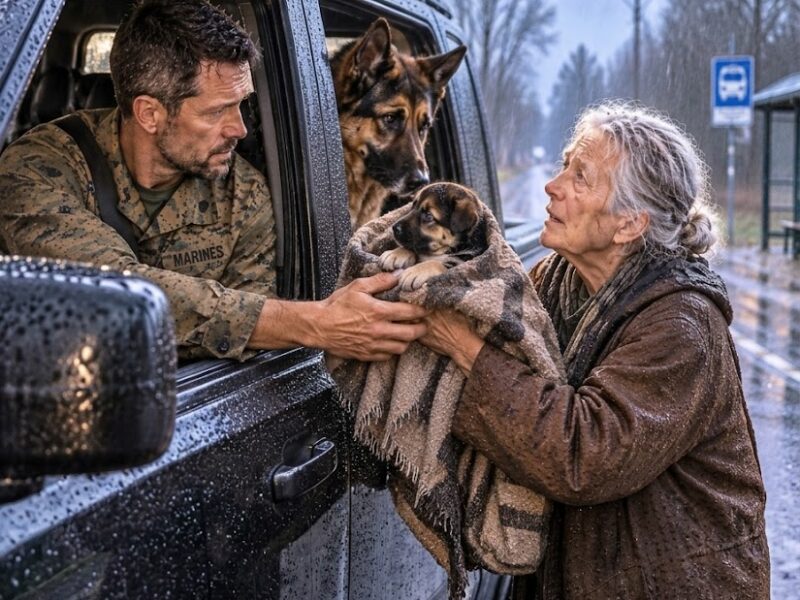
An elderly woman begged a Marine to save her puppy in the pouring rain. His K9 knew something was wrong before he did.
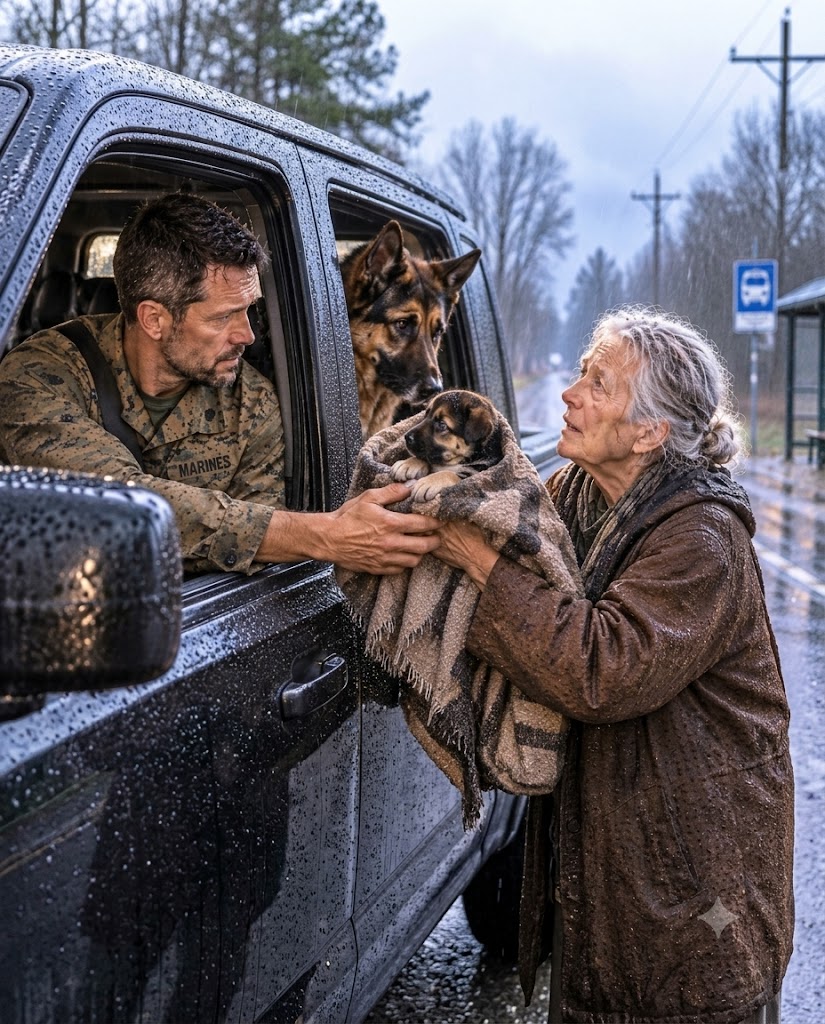
Gunnery Sergeant Declan Roark was driving home through freezing rain on the back roads outside Jacksonville, North Carolina, when his German Shepherd suddenly barked at an abandoned bus shelter.
The rain had turned the roadside ditches black with water and flattened the last brown grass beneath a cold Atlantic wind.
Declan drove with both hands steady on the wheel, shoulders squared from habit even after a long day of training.
At forty-three, he stood six foot two, lean and hard through the shoulders, with short chestnut brown hair graying at both temples and gray-blue eyes that had learned to look at everything and trust almost nothing.
Beneath the shelter sat an elderly woman soaked to the bone, clutching a dying German Shepherd puppy beneath her coat.
She didn’t ask him to save her.
“Don’t worry about me, Marine,” she said, her voice steady despite the cold. “Just get him somewhere warm.”
Declan crouched several feet away, one hand resting naturally on his bent knee, while the other remained open at his side.
“Ma’am, do you need an ambulance?”
“No.”
“What do you need?”
The woman looked down at the puppy, and something changed in her face—not helplessness, but fear carefully contained.
“Both of you,” Declan said. “I can manage.”
“I’m sure you can.”
“But he can’t.”
Ten minutes later, Elspeth Vardon sat in the heated passenger seat with the puppy against her chest while Moro watched from behind the barrier.
The old working dog did not whine or paw at the glass.
He simply watched.
The nearest overnight veterinary clinic was still open, and Doctor Hannah Sloan took the puppy immediately.
Elspeth called him Tuck.
He was dehydrated, underweight, and dangerously chilled, but after fluids and controlled warming, Sloan told them he had a strong chance of recovering.
Only then did Declan notice Elspeth’s hands.
When Sloan checked Tuck’s gums, Elspeth had already been watching their color.
When the puppy’s breathing changed, she noticed before the monitor did.
“You’ve done this before,” Declan said.
“For a long time. Nothing more.”
Doctor Sloan returned carrying a handheld scanner to check for a microchip.
The device beeped, and Sloan entered the number into the clinic computer.
Her expression changed.
“What?” Elspeth asked.
Sloan read the screen again.
“According to this record, this puppy was transferred and received into approved care nine days ago.”
Silence settled over the room.
Nine days ago, according to a computer, this animal had been safe.
Tonight, he had nearly frozen to death.
“Who’s listed on the transfer?” Declan asked.
Sloan turned the monitor enough for Elspeth to see.
The color seemed to leave the old woman’s face.
“Wesley Croll.”
Declan caught the change instantly.
“You know him?”
“I know the name.”
That name followed Declan all the way home.
If Tuck had been safely transferred nine days ago, who had left him behind to die?
By morning, the rain had thinned to a gray mist over Jacksonville, leaving the churchyard wet and shining beneath a low November sky.
Declan returned to Harbor House shortly after eight, telling himself he was there because Doctor Sloan had promised an update on Tuck.
He knew that was only partly true.
He found Elspeth in the kitchen drying breakfast dishes, because accepting shelter without giving something back was apparently not something she could do.
Tuck was asleep in a padded carrier nearby, warmer now, his breathing steadier.
Moro settled beside the carrier and remained there without touching it.
When Tuck woke and pushed his nose toward the mesh, Moro lowered his head.
The puppy stared at him, then awkwardly folded his front legs and lay down in almost the same position.
“He’s copying him,” Declan said.
“Young dogs usually find something worth copying before people realize they’re watching,” Elspeth replied, and there was history in the way she said it.
Declan poured coffee while she finished the last plate, and only when she sat down did he mention the transfer record.
“You said you knew the name.”
Elspeth rested both hands around her cup.
“My husband and I ran a place called Red Fern Working Dogs.”
That was how Declan first learned about Harlan Vardon—a tall, rangy man with a sun-brown face, iron gray hair, and large hands that rested naturally on the shoulders of two German Shepherds.
Elspeth described him as patient with animals, impatient with excuses, and incapable of passing a broken fence without repairing it.
Together they had spent decades raising and training German Shepherds for assistance programs and selected working placements.
Harlan died four years earlier after a brief illness, and Elspeth kept Red Fern going alone until rising costs, shrinking contracts, and her own age finally forced her to close it several months ago.
“That’s where Tuck came from?” Declan asked.
Elspeth nodded.
“He was the smallest of Sabine’s last litter.”
Sabine was an eight-year-old female with a dark sable coat, a strong deep chest, and silver beginning around her muzzle.
When Red Fern closed, a licensed intermediary named Wesley Croll handled the final transfers.
Three days ago, Elspeth had returned to Red Fern with permission to collect the last boxes from a storage room.
Most of the kennels were already empty.
Then she heard scratching from an auxiliary enclosure behind the main building.
Tuck was inside.
“He couldn’t stand properly,” she said. “His water bowl was dry.”
She had called the number Croll’s company provided.
No one answered.
She called again.
She waited.
When Tuck stopped trying to lift his head, waiting ceased to feel like the responsible choice.
“So you took him?” Declan said.
“I took a dying puppy to find help.”
There was no apology in her voice, and Declan did not ask for one.
His phone rang before he could respond.
Doctor Sloan wanted Tuck brought back for another examination, so they drove to the clinic together.
Tuck had gained enough strength to protest softly when Sloan examined him, which she considered encouraging.
Then Elspeth’s phone rang.
She stared at the number before answering.
“This is Elspeth Vardon.”
Declan could not hear every word from the other end, but he heard the man’s voice—low, measured, controlled.
Elspeth’s shoulders tightened, then she put the call on speaker.
Wesley Croll introduced himself without being asked.
What came through the phone was a man accustomed to making demands sound administrative.
“Mrs. Vardon, I’ve been informed that an animal covered under the Red Fern transfer agreement is currently in your possession. His name is Tuck. Whatever you’ve chosen to call him, he was included in the transfer inventory.”
“He was alone in a dry pen and barely conscious.”
“I’m not calling to debate kennel conditions. I’m asking you to return property that was legally transferred.”
Declan felt an old instinct tighten through him, the one that wanted to move toward pressure rather than wait for it.
He kept both hands resting on his knees.
This was Elspeth’s conversation.
“Show me where that puppy was transferred,” she said. “Show me who received him nine days ago.”
Silence.
“Mrs. Vardon.”
“And explain why I found him at Red Fern three days ago.”
Croll’s voice cooled.
“You signed away responsibility for those animals. You don’t get to reclaim authority because you’re unhappy with how the transition was handled.”
Elspeth looked at Tuck on the examination table.
“No,” she said quietly. “But I get to refuse to hand a sick animal back until you prove you’re entitled to him.”
She ended the call.
For several seconds, nobody spoke.
Declan looked at her differently then.
The woman beneath the bus shelter had not been waiting for someone stronger to fight for her.
She had been carrying a fight alone.
Doctor Sloan broke the silence.
“There’s something else.”
She had been reviewing the information Elspeth provided about Tuck’s litter, comparing the puppies’ registered history with the chip information Elspeth still had from Red Fern.
“Do you have Sabine’s chip number?”
Elspeth recited it from memory.
Sloan entered it.
Sabine’s record showed a completed transfer to a working dog placement organization several weeks earlier.
“I know that organization,” Elspeth said.
“Then that’s good,” Declan said.
“No.” She shook her head. “Harlan and I worked with them for eighteen years. They don’t take breeding females over seven.”
Sloan checked the number again.
Same result.
For the first time that morning, Elspeth looked frightened—not for herself.
She reached for her phone and found the organization’s contact number.
Tuck had been listed as safe when he was not.
Now Sabine’s record said she had gone somewhere Elspeth knew would never have accepted her.
And suddenly one abandoned puppy no longer looked like an accident.
It looked like the first mistake they had found.
The call Elspeth made from Doctor Sloan’s clinic confirmed what she already feared.
The organization listed as Sabine’s destination had never received her.
They had not even been contacted about her.
By noon, Elspeth returned to Harbor House carrying an old canvas ledger bag she had kept packed with the few things from Red Fern she could not bring herself to throw away.
From it she removed Harlan’s ledger.
Every dog had a page—name, date of birth, microchip number, vaccination history, temperament notes, medical concerns, and intended placement.
Harlan had written most entries in heavy block letters.
Elspeth had added notes in smaller handwriting after his death.
Declan did not treat the ledger like proof of a crime.
He treated it like what it was: an original record that could be compared against other records.
They worked at a table in Harbor House, Declan organizing copies while Elspeth read numbers aloud.
By mid-afternoon, eleven names did not match the destinations on Croll’s final transfer documents.
Eleven.
Declan stared at the list.
“We stop guessing now.”
He called Deputy Miles Keegan, a forty-eight-year-old sheriff’s deputy he knew through community canine demonstrations and veterans events.
Miles was five foot eleven and broad through the chest, with close-cropped sandy gray hair, a weathered square face, and a trimmed mustache.
A former canine handler, he had lost his retired dog to cancer three years earlier—an experience that had made him unusually patient about animal cases, but equally resistant to emotional conclusions unsupported by evidence.
Miles arrived an hour later, read the documents, and tapped one finger against the table.
“Eleven bad records aren’t automatically eleven missing dogs.”
Elspeth nodded.
“Then help me find out what they are.”
That answer seemed to satisfy him.
Miles explained that Declan and Elspeth should continue verifying destinations while he forwarded the documented discrepancies through the proper channel to county animal control.
Declan made no mention of being a gunnery sergeant beyond what Miles already knew.
This was not Marine Corps business, and he intended to keep it that way.
The first calls brought relief.
Five dogs had reached the facilities intended for them—Croll’s paperwork simply reflected outdated dates or incomplete transfer details.
Two more had been legally transferred onward to private homes after their original placements changed.
Seven accounted for.
Four remained.
Sabine was one of them.
That evening, Elspeth stepped outside Harbor House with Declan while Moro rose from beside Tuck’s carrier.
The German Shepherd planted his front paws, pushed upward, and paused before his hindquarters fully followed.
It lasted perhaps two seconds.
Elspeth saw it.
So did Declan.
“Cold floor,” he said.
“Maybe.”
He looked at her.
She did not challenge him.
Somehow that bothered him more.
The following afternoon, Croll called and asked Elspeth to meet him.
Miles advised her that she was under no obligation, but Elspeth agreed on the condition that it happened in public.
They chose a coffee shop near a busy shopping center.
Declan accompanied her but sat slightly back from the table, Moro settled quietly beside his chair.
Wesley Croll arrived precisely on time.
At fifty-three, he was just under six feet, trim rather than athletic, with neatly combed dark blond hair thinning at the temples and narrow blue eyes.
His charcoal overcoat was immaculate, his shoes polished despite the wet pavement.
He carried himself like a man who had spent years negotiating contracts and had learned that a controlled voice could intimidate more effectively than shouting.
There was nothing visibly cruel about him.
That made Declan dislike him more slowly and trust him less quickly.
Croll placed a folder on the table.
“Mrs. Vardon, this is the agreement you signed.”
“I remember signing it.”
“Then you understand that the remaining Red Fern inventory passed out of your control.”
“Inventory?”
Croll exhaled.
“Dogs, if you prefer.”
“I do.”
His eyes moved briefly toward Declan and then Moro.
“This doesn’t involve the Marine Corps.”
Declan kept one hand resting loosely on Moro’s leash and the other flat on his thigh.
“I agree.”
Croll seemed almost disappointed.
He turned back to Elspeth.
“Return the puppy and stop contacting my clients. Otherwise, I’ll have to document that you’re interfering with contracted placements and retaining an animal that no longer belongs to you.”
Elspeth did not raise her voice.
“Where is Sabine?”
Croll’s expression remained composed.
“We’re discussing the puppy.”
“No. I’m discussing Sabine.”
“I don’t personally track every placement. You signed the transfer sheet. My office processed it.”
“Then where is she?”
The crease between Croll’s brows deepened.
He closed the folder.
“If you continue this, Mrs. Vardon, you may create problems for yourself that you don’t need.”
Declan felt Moro shift against his boot.
His instinct was immediate—step in, reduce the pressure, make Croll understand exactly who was sitting across from him.
He did none of those things.
Elspeth leaned forward.
“I’m seventy-six, Mr. Croll. I’ve had problems before.”
Croll held her gaze, then stood.
For the first time, Declan saw irritation break through the man’s polished exterior.
But Croll still had not answered the question.
Two days later, Miles called with another development.
A microchip registry update tied one of the four missing dogs to a private kennel forty-seven minutes west of Jacksonville.
The kennel was not listed anywhere in the Red Fern transfer documents.
Animal Control now had enough discrepancies to make formal inquiries and verify whether the dogs were being held there.
Declan was at home when the call came.
Elspeth had stopped by to collect an unused travel crate he kept in the storage shed for Tuck.
As they crossed the yard, she noticed the locked cottage beyond the back fence.
“Its small porch is weathered, but structurally sound,” she said. “Shame to leave a good building empty.”
Declan shifted the crate between both hands.
“Never had a use for it.”
Elspeth looked at the cottage once more but said nothing.
Moro had followed them outside.
When Declan set the crate down, the old canine lowered himself near the porch steps rather than remaining standing.
Again, Declan noticed.
Again, he said nothing.
His phone rang.
Miles.
Declan answered.
The deputy did not waste words.
“They checked the kennel.”
Declan straightened.
“And?”
“Four dogs matching the missing chip numbers are there.”
Elspeth stopped moving.
Declan looked at her before asking the only question that mattered.
“Sabine?”
A pause.
Then Miles said, “She’s alive.”
Elspeth closed her eyes.
For weeks, she had been trying to discover whether she had failed the dogs Harlan had trusted her to protect.
Now she finally had an answer.
Sabine was alive.
But Miles had not said she was safe.
A hard northwest wind cleared the last rain from coastal North Carolina, leaving the morning bright, cold, and sharp enough to make every breath visible beyond Jacksonville.
Animal Control inspected the private kennel the following morning with support from the county sheriff’s office.
Declan and Elspeth had no authority to enter during the inspection, and Miles made that boundary clear before they arrived.
They waited beyond the property line beside Declan’s pickup, Moro sitting near his left leg, while Elspeth stood with both hands clasped in front of her coat.
The kennel looked ordinary from the road.
That disturbed Declan more than he expected.
There were no collapsing sheds or dramatic signs of cruelty—only two long metal buildings, gravel runs, and fencing stretched across several acres.
Places did not have to look evil to hide neglect.
Marion Holt, the county animal control supervisor leading the inspection, was a fifty-six-year-old woman of medium height with a sturdy build, short steel gray hair, and dark eyes that seemed to miss very little.
Twenty-three years of animal control work had made her suspicious of both sentimental accusations and convenient paperwork, which was why Miles trusted her judgment.
Nearly two hours passed before Marion walked back toward them.
“We found the four chip numbers.”
Elspeth’s breath caught.
“Sabine?”
“She’s inside.”
“Can I see her?”
“Not yet.”
Marion explained what investigators had found.
Croll had accepted more animals than he could place after several anticipated contracts fell through.
Rather than return them or pay for proper boarding, dogs had been shifted between cheaper facilities.
Records were incomplete.
Veterinary visits had been delayed.
Feeding standards had slipped.
The four Red Fern German Shepherds were underweight, and two showed untreated skin and ear problems.
None appeared to be in immediate danger of dying, but none had received the standard of care represented in their transfer paperwork.
Declan felt anger arrive quietly—not the hot anger he could dismiss, the colder kind.
These dogs had not vanished because of some elaborate criminal operation.
They had become inconvenient.
A vehicle door slammed behind them.
Croll had arrived.
His polished appearance from the coffee shop was less perfect now.
Wind pulled at his coat, and exhaustion darkened the skin beneath his eyes.
He walked toward Marion with a folder tucked beneath one arm.
“This facility isn’t mine.”
“No one said it was,” Marion replied.
“I contracted temporary boarding.”
“And those contracts are being reviewed.”
Croll glanced toward Elspeth.
“This is exactly what I warned you about.”
Elspeth did not answer.
Croll’s control slipped slightly.
“You think I wanted this? Three placements collapsed in six weeks. Boarding costs doubled. I had twenty-seven animals and nowhere to put them.”
“Then you called me,” Elspeth said.
“You had already closed Red Fern.”
“I still would have answered.”
Croll shook his head.
“And done what? Paid for twenty-seven dogs with money you didn’t have?”
The words struck where he intended them to.
Declan saw it in Elspeth’s face.
Still, she did not retreat.
“You could have told the truth.”
Croll looked away first.
A kennel door opened.
Two animal control officers began bringing the Red Fern dogs outside one at a time for identification and veterinary transport.
Elspeth recognized each before the scanner confirmed the chip.
She whispered their names under her breath.
The fourth dog did not appear immediately.
Moro rose.
Declan felt the leash shift through his hand.
He kept it loose, his other hand resting naturally beside his thigh.
Moro did not bark.
He stared toward the building.
Then Sabine emerged.
Time had altered her more than Elspeth expected.
Her once full sable coat had thinned along the flanks.
Her ribs showed beneath it, and silver covered much of the muzzle that had only begun to gray when Elspeth last saw her.
She moved carefully, head low, uncertain of the open space after weeks of confinement.
Elspeth stopped breathing.
“Sabine!”
The dog halted, one ear turned.
Elspeth took a single step forward, but Marion gently lifted a hand, asking her to wait while the handler maintained control.
“Sabine!”
This time the dog’s head came up.
Her brown eyes searched the people beyond the gate.
Then she saw Elspeth.
Sabine pulled forward—not violently, not with the frantic strength of a frightened animal, but with recognition.
Marion nodded to the handler.
Elspeth crossed the few remaining feet and dropped to her knees on the cold gravel.
Sabine pressed her head beneath the woman’s chin as though four missing weeks had collapsed into nothing.
Elspeth’s hands found the old familiar places behind the dog’s ears and along her cheeks.
For the first time since Declan had found her beneath the bus shelter, her composure broke.
She did not sob.
She simply held Sabine’s face and whispered, “I’m sorry it took me so long.”
Declan looked away for a moment.
Beside him, Moro stood perfectly still.
There was something almost ceremonial in the old working dog’s silence, as if he understood that this reunion belonged to someone else.
Croll stood several yards away.
“I never ordered anyone to neglect them,” he said.
Elspeth remained beside Sabine.
“No. You just stopped asking what happened after you sent them away.”
“I was trying to keep a business alive.”
Elspeth looked up.
“They were alive, too.”
Croll had no answer.
By evening, the accounting was complete.
All eleven discrepancies from Harlan’s ledger had been resolved.
Seven dogs were already confirmed safe, and the remaining four were now in veterinary care.
Tuck would remain temporarily with Elspeth while ownership and welfare documentation were reviewed.
Sabine needed treatment for malnutrition, an ear infection, and general deconditioning before anyone could discuss permanent placement.
But she was alive.
For Elspeth, that changed everything.
Two days later, she began packing for Ohio.
Declan found himself surprised by how final the sight of her suitcase felt.
She had accomplished what she stayed to accomplish.
There was no missing dog left for her to chase, no unanswered name in Harlan’s ledger.
Then an envelope arrived at Harbor House by certified delivery.
Elspeth opened it at the kitchen table.
Declan watched her read the first page twice.
“What is it?”
She passed it across.
The notice came from an attorney representing Wesley Croll’s business interests.
It asserted that the original Red Fern transfer agreement remained valid and that neither the investigation nor temporary veterinary custody automatically extinguished Croll’s claimed contractual interest in two animals—Tuck and Sabine.
Declan set the page down.
Elspeth looked toward Tuck sleeping beside Moro.
Croll had finally told them where Sabine was.
Now he intended to argue that she still belonged to him.
December arrived over Jacksonville beneath a clear blue sky, the morning frost whitening the grass while bare branches moved gently in the cold wind.
Declan received Moro’s retirement notice three days after Croll’s legal claim arrived.
He read it twice at his kitchen table while Moro slept near the back door.
The decision was not unexpected.
Veterinary evaluations had documented the stiffness Declan had spent months pretending was temporary.
Moro could still work, but working and deserving to work were no longer the same thing.
His official retirement date had been set, and Declan’s application to adopt him afterward was already moving through the proper process.
He should have felt relieved.
Instead, he felt afraid.
For years, Moro had known what every morning meant—harness, vehicle, command, task, reward.
Declan understood that language because it was his language, too.
What he did not understand was what came after.
Elspeth found him later sitting on the back porch, one hand resting against Moro’s shoulder while the other held the retirement paperwork.
“What am I supposed to do with him when there’s nothing to do?” he asked.
Elspeth studied the old canine.
“Who said there’ll be nothing to do?”
“He’s retiring.”
“From one job.”
Declan looked at her.
She crouched beside Moro and scratched gently beneath his collar.
“Don’t teach him to stop, Declan. Teach him that his job is changed.”
The words stayed with him.
Two days later, Elspeth attended the final review of Croll’s ownership claim.
It took place not in a courtroom but in a county administrative office, where the transfer documents, welfare findings, and ownership records could be examined together.
Elspeth brought Harlan’s ledger.
Marion Holt submitted the kennel inspection findings.
Doctor Sloan’s records documented Tuck’s condition when he was found, and Sabine’s rehabilitation records established the condition in which she had been recovered.
Croll’s own paperwork supplied the final weakness.
Destinations recorded as completed did not match where several dogs had actually gone.
Croll sat across the table, still composed, though the certainty he had carried into the coffee shop was gone.
His attorney spoke more than he did.
Declan sat behind Elspeth and remained silent.
The dispute ultimately came down to something simpler than Croll wanted it to be.
He could point to a transfer agreement, but the investigation showed that the responsibilities attached to that transfer had not been carried out as represented.
Faced with the inspection findings, veterinary documentation, contradictory placement records, and the prospect of further proceedings over the remaining contractual claims, Croll agreed to relinquish any asserted interest in Tuck and Sabine.
The papers were placed in front of Elspeth.
She signed.
Croll stood to leave.
For a moment, he looked at her as if expecting triumph.
Elspeth gave him none.
“You could have called me,” she said.
Croll’s jaw tightened.
“I know.”
It was the closest thing to an admission she would receive.
Then he left.
Elspeth remained seated for several seconds with one hand over Harlan’s ledger.
Four years after burying her husband, months after closing Red Fern, and weeks after believing she had failed the last dogs entrusted to them, she finally had nothing left to chase.
She was free to go to Ohio.
Declan understood that before he asked her to come to his house the following morning.
He led her behind the main house to the cottage she had noticed earlier.
This time the door was unlocked.
Inside were two small rooms, worn pine floors, a utility sink, and windows facing the fenced yard.
Dust covered the shelves, but the roof was sound.
Declan walked through slowly.
“One or two dogs,” he said. “That’s all.”
Elspeth looked at him.
“One or two what?”
“Older working dogs. Maybe dogs coming out of service that need time before permanent placement. Or one recovering before going somewhere else.”
She said nothing.
Declan continued.
“I know how to work with them. I know routines, obedience, handling. But I don’t know what you know.”
“And what do I know?”
“How to make them understand they’re still worth something when nobody needs them to perform anymore.”
That silenced her.
Declan did not ask her to stay because his house was empty.
He did not mention loneliness.
He knew she had a sister waiting in Ohio and a life she could choose without owing him anything.
“I’m going to fix this place either way,” he said. “I’m asking whether you’d like to help me build it right.”
Elspeth walked to the window.
For years, Red Fern had told her who she was.
When it closed, she had mistaken the ending of the work for the ending of her usefulness.
Ohio would have been safe.
Her sister would have welcomed her.
But safety and purpose were not always the same thing.
“When do we start?”
Declan smiled.
It was small, but real.
Six weeks later, Sabine walked through the cottage door.
She had regained weight, her coat was fuller, and although age still slowed her steps, there was strength behind them again.
Tuck nearly tangled himself around Elspeth’s boots trying to reach his mother.
Sabine lowered her head, sniffed him carefully, then touched her nose to his forehead.
Across the yard, Moro watched from the porch.
His retirement had become official.
Declan’s adoption had been approved, and for the first time in their years together, there was no working assignment waiting for them the next morning.
Yet Moro still rose when Declan rose.
He still checked the yard.
He still watched Tuck.
Spring came slowly to coastal North Carolina.
Declan repaired the fence and replaced the cottage steps, while Elspeth established simple routines for the dogs.
They never called the place a rescue center.
It was too small for that.
It was simply somewhere a working dog could arrive without being asked what it could still produce.
One afternoon, Elspeth stood in the yard with Tuck.
“Stay.”
The puppy lasted three seconds before his attention wandered toward a leaf tumbling across the grass.
“Tuck.”
He looked back.
“Stay.”
His front paws shifted.
Then he noticed Moro lying on the porch.
The old German Shepherd was perfectly still, head raised, watching.
Tuck stared at him.
Slowly, awkwardly, the puppy lowered his chest to the ground.
Then he stayed.
Elspeth smiled.
Declan stopped working on the fence and watched from several yards away.
Sabine rested in the winter sun beside the cottage.
Moro remained on the porch, silver muzzle lifted, no vest on his back, and no mission waiting beyond the gate.
Or perhaps there was.
Tuck kept watching him, and Moro kept teaching.
Declan had once believed duty was something assigned to you.
Elspeth had believed usefulness was something you could lose.
Between an old dog resting on a porch and a puppy learning how to stay, both of them finally understood something simpler.
A mission could end.
A life did not become less valuable because it had.
Sometimes miracles do not arrive with thunder, bright lights, or signs from heaven.
Sometimes they arrive quietly in a cold rain beneath an abandoned bus shelter, through an old dog who still has something to teach, or through a stranger who chooses to turn around instead of driving past.
Declan thought duty was what gave a life meaning.
Elspeth believed the closing of Red Fern meant the most useful years of her life were behind her.
And Moro was approaching the day when the world would no longer ask him to serve.
But a new purpose can be placed where we only see an ending.
Maybe that is true in our own lives, too.
A job can end.
Children grow up.
People we love leave us.
Doors close that we thought would stay open forever.
Yet sometimes what feels like the end of our purpose is only the quiet preparation for a different one.
If this story touched your heart, share it with someone who may need that reminder today.
Tell us in the comments what new purpose has been placed in your life.
May God bless you and your family, protect your home, strengthen you through every difficult season, and guide you toward the purpose still waiting for you.
And when one chapter of your life ends, may you have the faith to believe that another is already beginning.









