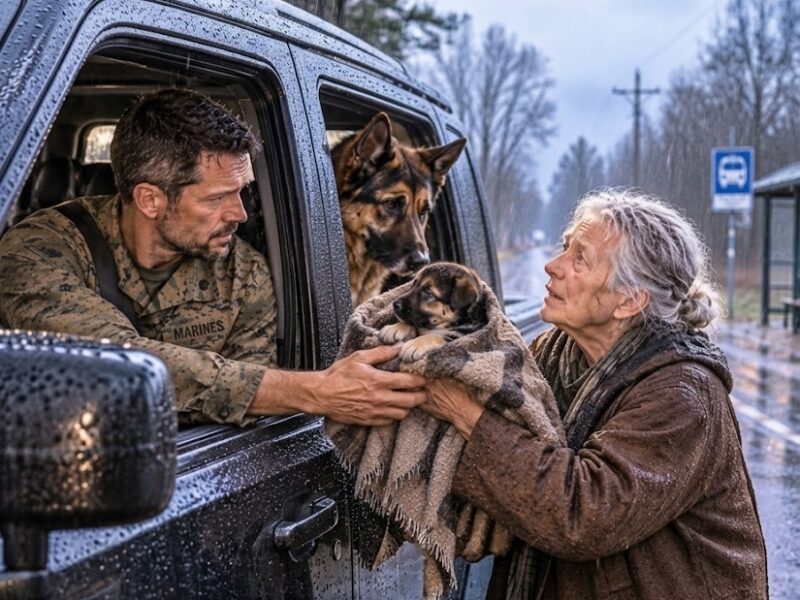
An Elderly Woman Begged a Marine to Rescue Her Puppy in the Rain—But His K9 Refused to Leave Her Side
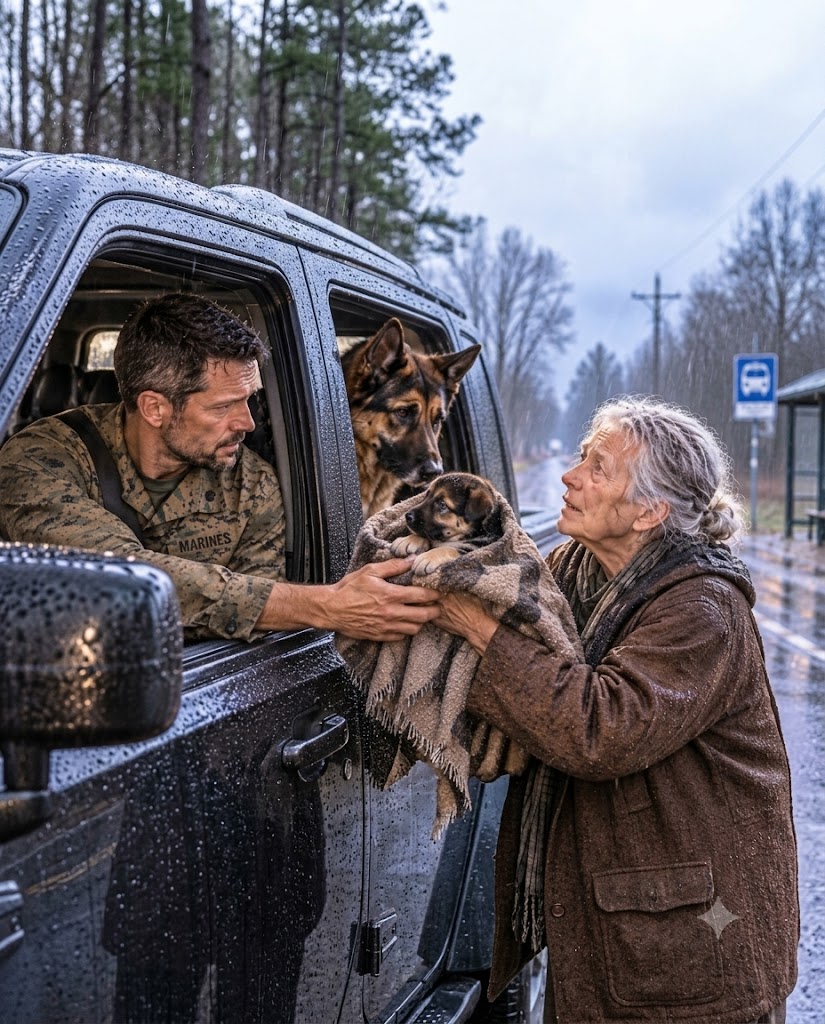
The freezing rain fell in sheets across the back roads outside Jacksonville, North Carolina, turning every ditch into a black river and every field into a memory of summer.
Gunnery Sergeant Declan Ror drove with both hands steady on the wheel, his shoulders squared from habit even after fourteen hours of training exercises at Camp Lejeune.
At forty-three, he was lean and hard through the shoulders, with short chestnut-brown hair graying at both temples and gray-blue eyes that had seen too much and said too little.
A narrow scar beneath his chin caught the dashboard light whenever he checked the mirror, a reminder of a helicopter extraction gone sideways in Kandahar.
Two years earlier, his closest friend had died in a training accident, and since then Declan had become a man who trusted schedules because schedules did not disappear without warning.
—
Work, drive home, feed the dog, sleep, repeat.
His small house reflected the same discipline—clean counters, made bed, almost nothing on the walls.
Behind it stood an old caretaker’s cottage he had kept locked for years because an empty building required nothing from him.
Morrow occupied the secured rear section of the pickup cabin, and the seven-year-old German Shepherd was large without being bulky, black across the saddle with deep tan legs and chest.
His amber-brown eyes missed nothing, and a small notch along his left ear marked a long-ago encounter with a suspect who had chosen poorly.
Years as a working canine had taught Morrow to conserve movement, watch before reacting, and distinguish danger from ordinary noise.
Lately, though, Declan had noticed that Morrow took an extra second to rise after lying down on cold mornings.
—
Declan noticed many things he preferred not to name.
They were several miles outside town when Morrow suddenly lifted his head, and Declan glanced in the mirror to see the dog’s ears had gone forward.
His stare remained fixed through the rain-streaked passenger window as they passed an abandoned bus shelter beside the road.
“What?”
Morrow gave one short, low bark.
Declan drove another hundred yards before breaking, and for several seconds he sat listening to rain strike the roof.
Going home would have been easier.
He turned the truck around.
—
The shelter leaned slightly toward a drainage ditch, its faded wooden bench protected by only half a roof.
Beneath it sat an elderly woman holding something inside her coat.
Elizabeth Varden was seventy-six, barely five-foot-three, slender without appearing fragile, with pale weathered skin and light blue eyes.
Silver-white hair twisted into a low bun that rain had partly undone, and her brown wool coat was soaked along one shoulder.
Her hands were narrow and deeply lined with the rough knuckles of someone who had worked with them all her life.
She watched Declan approach without fear, but with the guarded dignity of someone already preparing to refuse pity.
—
Then the bundle against her chest moved.
A German Shepherd puppy, perhaps eight weeks old, pushed a tiny black-and-tan muzzle from beneath the coat.
One ear had begun to stand while the other folded sideways, and its ribs were too easy to see.
Declan crouched several feet away, one hand resting naturally on his bent knee while the other remained open at his side.
“Ma’am, do you need an ambulance?”
“No.”
Her answer came immediately.
“What do you need?”
Elizabeth looked down at the puppy, and something changed in her face then—not helplessness, but fear carefully contained.
“Don’t worry about me, Marine.”
She opened her coat slightly around the shivering animal.
“Just get him somewhere warm.”
—
Declan looked at her wet clothes, then back at the puppy.
“Both of you. I can manage.”
“I’m sure you can.”
That made her look directly at him.
“But he can’t.”
Ten minutes later, Elizabeth sat in the heated passenger seat with the puppy against her chest while Morrow watched from behind.
The old K-9 did not whine or paw at the barrier.
He simply watched.
—
The nearest overnight veterinary clinic was still open.
Doctor Hannah Sloan, a compact woman in her early fifties with cropped auburn hair and rectangular glasses, took the puppy immediately.
Elizabeth called him Tuck.
He was dehydrated, underweight, and dangerously chilled.
But after fluids, controlled warming, and an examination, Sloan told them he had a strong chance of recovering.
Only then did Declan notice Elizabeth’s hands.
When Sloan checked Tuck’s gums, Elizabeth had already been watching their color.
When the puppy’s breathing changed, she noticed before the monitor did.
“You’ve done this before,” Declan said.
“For a long time.”
“Nothing more.”
—
Elizabeth finally explained that she was traveling to Ohio to live near her younger sister.
She had sold her old car weeks earlier and had been staying temporarily outside Jacksonville while finishing some business.
That afternoon, she had missed the last bus while trying to find help for Tuck.
Her phone had died.
The shelter had simply been the nearest roof.
Declan felt something inside him ease.
She had somewhere to go.
She was not waiting for him to rearrange her life.
—
Dr. Sloan returned carrying a handheld scanner.
“Let’s see if our little man has a chip.”
The device beeped.
Sloan entered the number into the clinic computer.
Her expression changed.
Elizabeth saw it.
“What?”
Sloan read the screen again.
“According to this record, this puppy was transferred and received into approved care nine days ago.”
Silence settled over the room.
Declan looked at Tuck beneath the warming blanket.
Nine days ago, according to a computer, this animal had been safe.
Tonight, he had nearly frozen to death.
—
“Who’s listed on the transfer?”
Declan asked.
Sloan hesitated, then turned the monitor enough for Elizabeth to see.
The color seemed to leave the old woman’s face.
Wesley Croll.
Declan caught the change instantly.
Elizabeth’s fingers closed around the edge of the examination table.
“You know him?”
“I know the name.”
It was not the same answer.
—
Declan arranged a temporary room for her at Harbor House, a church guest house he knew through volunteer work.
When it was time to leave, Morrow paused near Tuck’s carrier, sniffed once beneath its edge, then followed Declan while looking back twice.
Outside, rain still covered Jacksonville in darkness.
Declan should have driven home and forgotten the whole thing.
Instead, one question followed him all the way to his truck.
If Tuck had been safely transferred nine days ago, who had left him behind to die?
—
By morning, the rain had thinned to a gray mist over Jacksonville, leaving the churchyard wet and shining beneath a low November sky.
Declan returned to Harbor House shortly after eight.
He told himself he was there because Dr. Sloan had promised an update on Tuck, but he knew that was only partly true.
The name on the transfer record had followed him home the night before.
So had Elizabeth’s face when she saw it.
He had spent enough years reading people under pressure to recognize the difference between surprise and recognition.
Elizabeth had recognized Wesley Croll.
—
He found her in the Harbor House kitchen drying breakfast dishes.
No one had asked her to work.
That much Declan understood immediately.
Accepting shelter was one thing.
Accepting it without giving something back was apparently another.
Tuck was asleep in a padded carrier nearby, warmer now, his breathing steadier.
Morrow settled beside the carrier and remained there without touching it.
When Tuck woke and pushed his nose toward the mesh, Morrow lowered his head.
The puppy stared at him, then awkwardly folded his front legs and lay down in almost the same position.
—
Declan noticed.
Elizabeth did too.
“He’s copying him,” Declan said.
“Young dogs usually find something worth copying before people realize they’re watching.”
There was history in the way she said it.
Declan did not ask about Croll immediately.
He poured coffee while Elizabeth finished the last plate.
Only when she sat down did he mention the transfer record.
“You said you knew the name.”
Elizabeth rested both hands around her cup.
“My husband and I ran a place called Red Fern Working Dogs.”
—
That was how Declan first learned about Harlon Varden.
In the photograph Elizabeth eventually showed him on her phone, Harlon had been a tall, rangy man with a sun-browned face and iron-gray hair.
A square jaw softened by a crooked smile, and large hands resting naturally on the shoulders of two German Shepherds.
Elizabeth described him as patient with animals, impatient with excuses, and incapable of passing a broken fence without repairing it.
Together they had spent decades raising and training German Shepherds for assistance programs and selected working placements.
Harlon died four years earlier after a brief illness.
Elizabeth kept Red Fern going alone until rising costs, shrinking contracts, and her own age finally forced her to close it several months ago.
—
“That’s where Tuck came from?”
Declan asked.
Elizabeth nodded.
“He was the smallest of Sabine’s last litter.”
Sabine was an eight-year-old female German Shepherd with a dark sable coat and a strong, deep chest.
Intelligent brown eyes and silver beginning around her muzzle.
She had produced several dogs with the stable temperament Red Fern valued, but Elizabeth spoke of her less like breeding stock than an old colleague.
Sabine could settle frightened puppies simply by lying near them, she said, and had once spent an entire night beside a young dog recovering from surgery.
When Red Fern closed, Elizabeth had neither the resources nor legal arrangements to place every remaining dog herself.
A licensed intermediary named Wesley Croll handled the final transfers.
—
Three days ago, Elizabeth had returned to Red Fern with permission to collect the last boxes from a storage room.
Most of the kennels were already empty.
Then she heard scratching from an auxiliary enclosure behind the main building.
Tuck was inside.
He couldn’t stand properly, she said.
His water bowl was dry.
She had called the number Croll’s company provided.
No one answered.
She called again.
She waited.
When Tuck stopped trying to lift his head, waiting ceased to feel like the responsible choice.
—
“So you took him,” Declan said.
“I took a dying puppy to find help.”
There was no apology in her voice.
Declan did not ask for one.
His phone rang before he could respond.
Dr. Sloan wanted Tuck brought back for another examination, so they drove to the clinic together.
Tuck had gained enough strength to protest softly when Sloan examined him, which she considered encouraging.
Then Elizabeth’s phone rang.
She stared at the number before answering.
“This is Varden.”
—
Declan could not hear every word from the other end, but he heard the man’s voice—low, measured, controlled.
Elizabeth’s shoulders tightened.
Then she put the call on speaker.
Wesley Croll introduced himself without being asked.
He was fifty-three, though Declan knew nothing yet of his appearance.
What came through the phone was a man accustomed to making demands sound administrative.
His voice remained polished even when his meaning did not.
“Mrs. Varden, I’ve been informed that an animal covered under the Red Fern transfer agreement is currently in your possession.”
—
“His name is Tuck.”
“Whatever you’ve chosen to call him, he was included in the transfer inventory.”
“He was alone in a dry pen and barely conscious.”
A pause.
“I’m not calling to debate kennel conditions. I’m asking you to return property that was legally transferred.”
Declan felt an old instinct tighten through him.
The one that wanted to move toward pressure rather than wait for it.
He kept both hands resting on his knees.
This was her conversation.
—
“Show me where that puppy was transferred,” she said.
“Show me who received him nine days ago.”
Silence.
“Mrs. Varden.”
“And explain why I found him at Red Fern three days ago.”
Croll’s voice cooled.
“You signed away responsibility for those animals. You don’t get to reclaim authority because you’re unhappy with how the transition was handled.”
Elizabeth looked at Tuck on the examination table.
“No,” she said quietly.
“But I get to refuse to hand a sick animal back until you prove you’re entitled to him.”
She ended the call.
—
For several seconds, nobody spoke.
Declan looked at her differently.
The woman beneath the bus shelter had not been waiting for someone stronger to fight for her.
She had been carrying a fight alone.
Dr. Sloan broke the silence.
“There’s something else.”
She had been reviewing the information provided about Tuck’s litter.
The clinic database allowed her to compare the puppy’s registered history with the chip information still had from Red Fern.
“Do you have Sabine’s chip number?”
Elizabeth recited it from memory.
Sloan entered it.
The result appeared.
—
Sabine’s record showed a completed transfer to a working dog placement organization several weeks earlier.
Elizabeth leaned toward the screen.
“I know that organization.”
“Then that’s good,” Declan said.
“No.”
She shook her head.
“Harlon and I worked with them for eighteen years. They don’t take breeding females over seven.”
Sloan checked the number again.
Same result.
For the first time that morning, Elizabeth looked frightened.
Not for herself.
—
She reached for her phone and found the organization’s contact number.
Declan watched her thumb hover over the call button.
Tuck had been listed as safe when he was not.
Now Sabine’s record said she had gone somewhere Elizabeth knew would never have accepted her.
And suddenly, one abandoned puppy no longer looked like an accident.
It looked like the first mistake they had found.
—
The cold settled harder over Jacksonville the next morning, leaving the wet road silver beneath a pale sky and a thin crust of frost along every shaded fence line.
The call made from Dr. Sloan’s clinic confirmed what she already feared.
The organization listed as Sabine’s destination had never received her.
They had not even been contacted about her.
By noon, Elizabeth returned to Harbor House carrying an old canvas ledger bag she had kept packed with the few things from Red Fern she could not bring herself to throw away.
From it, she removed Harlon’s ledger.
Its corners were rounded with age, the cover stained from years of kennel dust and wet hands.
—
Every dog had a page—name, date of birth, microchip number, vaccination history, temperament notes, medical concerns, and intended placement.
Harlon had written most entries in heavy block letters.
Elizabeth had added notes in smaller handwriting after his death.
Declan did not treat the ledger like proof of a crime.
He treated it like what it was—an original record that could be compared against other records.
They worked at a table in Harbor House, Declan organizing copies while Elizabeth read numbers aloud.
By midafternoon, eleven names did not match the destinations on Croll’s final transfer documents.
Eleven.
Declan stared at the list.
“We stopped guessing now.”
—
He called Deputy Miles Keegan, a forty-eight-year-old sheriff’s deputy he knew through community K-9 demonstrations and veterans events.
Miles was five-eleven and broad through the chest with close-cropped sandy-gray hair and a weathered square face.
Pale hazel eyes and a trimmed mustache.
A former canine handler, he had lost his retired dog to cancer three years earlier, an experience that had made him unusually patient about animal cases but equally resistant to emotional conclusions unsupported by evidence.
Miles arrived an hour later, read the documents, and tapped one finger against the table.
“Eleven bad records aren’t automatically eleven missing dogs.”
Elizabeth nodded.
“Then help me find out what they are.”
That answer seemed to satisfy him.
—
Miles explained that Declan and Elizabeth should continue verifying destinations while he forwarded the documented discrepancies through the proper channel to county animal control.
Declan made no mention of being a gunnery sergeant beyond what Miles already knew.
This was not Marine Corps business, and he intended to keep it that way.
The first calls brought relief.
Five dogs had reached the facilities intended for them.
Croll’s paperwork simply reflected outdated dates or incomplete transfer details.
Two more had been legally transferred onward to private homes after their original placements changed.
Seven accounted for, four remained.
Sabine was one of them.
—
That evening, Elizabeth stepped outside Harbor House with Declan while Morrow rose from beside Tuck’s carrier.
The German Shepherd planted his front paws, pushed upward, and paused before his hindquarters fully followed.
It lasted perhaps two seconds.
Elizabeth saw it.
So did Declan.
“Cold floor,” he said.
“Maybe.”
He looked at her.
She did not challenge him.
Somehow that bothered him more.
—
The following afternoon, Croll called and asked Elizabeth to meet him.
Miles advised her that she was under no obligation, but Elizabeth agreed on the condition that it happened in public.
They chose a coffee shop near a busy shopping center.
Declan accompanied her but sat slightly back from the table.
Morrow settled quietly beside his chair.
Wesley Croll arrived precisely on time.
At fifty-three, he was just under six feet, trim rather than athletic, with neatly combed dark-blonde hair thinning at the temples.
A clean-shaven, angular face, narrow blue eyes, and a small crease between his brows that deepened whenever someone contradicted him.
—
His charcoal overcoat was immaculate, his shoes polished despite the wet pavement.
He carried himself like a man who had spent years negotiating contracts and had learned that a controlled voice could intimidate more effectively than shouting.
There was nothing visibly cruel about him.
That made Declan dislike him more slowly and trust him less quickly.
Croll placed a folder on the table.
“Mrs. Varden, this is the agreement you signed.”
“I remember signing it.”
“Then you understand that the remaining Red Fern inventory passed out of your control.”
“Inventory?”
Croll exhaled.
“Dogs, if you prefer.”
“I do.”
—
His eyes moved briefly toward Declan and then Morrow.
“This doesn’t involve the Marine Corps.”
Declan kept one hand resting loosely on Morrow’s leash and the other flat on his thigh.
“I agree.”
Croll seemed almost disappointed.
He turned back to Elizabeth.
“Return the puppy and stop contacting my clients. Otherwise, I’ll have to document that you’re interfering with contracted placements and retaining an animal that no longer belongs to you.”
Elizabeth did not raise her voice.
“Where is Sabine?”
Croll’s expression remained composed.
“We’re discussing the puppy.”
“No, I am discussing Sabine.”
—
“I don’t personally track every placement. You signed the transfer sheet. My office processed it.”
“Then where is she?”
The crease between Croll’s brows deepened.
He closed the folder.
“If you continue this, Mrs. Varden, you may create problems for yourself that you don’t need.”
Declan felt Morrow shift against his boot.
His instinct was immediate—step in, reduce the pressure, make Croll understand exactly who was sitting across from him.
He did none of those things.
Elizabeth leaned forward.
“I’m seventy-six, Mr. Croll. I’ve had problems before.”
Croll held her gaze, then stood.
—
For the first time, Declan saw irritation break through the man’s polished exterior, but Croll still had not answered the question.
Two days later, Miles called with another development.
A microchip registry update tied one of the four missing dogs to a private kennel forty-seven minutes west of Jacksonville.
The kennel was not listed anywhere in the Red Fern transfer documents.
Animal control now had enough discrepancies to make formal inquiries and verify whether the dogs were being held there.
Declan was at home when the call came.
Elizabeth had stopped by to collect an unused travel crate he kept in the storage shed for Tuck.
As they crossed the yard, she noticed the locked cottage beyond the back fence.
—
Its small porch weathered but structurally sound.
“Shame to leave a good building empty.”
Declan shifted the crate between both hands.
“Never had a use for it.”
Elizabeth looked at the cottage once more but said nothing.
Morrow had followed them outside.
When Declan set the crate down, the old K-9 lowered himself near the porch steps rather than remaining standing.
Again, Declan noticed.
Again, he said nothing.
His phone rang.
Miles.
Declan answered.
The deputy did not waste words.
“They checked the kennel.”
Declan straightened.
—
“Four dogs matching the missing chip numbers are there.”
Elizabeth stopped moving.
Declan looked at her before asking the only question that mattered.
“Sabine.”
A pause.
Then Miles said, “She’s alive.”
Elizabeth closed her eyes.
For weeks, she had been trying to discover whether she had failed the dogs Harlon had trusted her to protect.
Now she finally had an answer.
Sabine was alive, but Miles had not said she was safe.
—
A hard northwest wind cleared the last rain from coastal North Carolina, leaving the morning bright, cold, and sharp enough to make every breath visible beyond Jacksonville.
Animal control inspected the private kennel the following morning with support from the county sheriff’s office.
Declan and Elizabeth had no authority to enter during the inspection, and Miles made that boundary clear before they arrived.
They waited beyond the property line beside Declan’s pickup, Morrow sitting near his left leg while Elizabeth stood with both hands clasped in front of her coat.
The kennel looked ordinary from the road.
That disturbed Declan more than he expected.
—
There were no collapsing sheds or dramatic signs of cruelty.
Only two long metal buildings, gravel runs, and fencing stretched across several acres.
Places did not have to look evil to hide neglect.
Marian Hall, the county animal control supervisor leading the inspection, was a fifty-six-year-old woman of medium height with a sturdy build.
Short steel-gray hair, brown skin weathered from years outdoors, and dark eyes that seemed to miss very little.
She spoke plainly and moved without hurry.
Twenty-three years of animal control work had made her suspicious of both sentimental accusations and convenient paperwork, which was why Miles trusted her judgment.
Nearly two hours passed before Marian walked back toward them.
—
“We found the four chip numbers.”
Elizabeth’s breath caught.
“Sabine—she’s inside. Can I see her?”
“Not yet.”
Marian explained what investigators had found.
Croll had accepted more animals than he could place after several anticipated contracts fell through.
Rather than return them or pay for proper boarding, dogs had been shifted between cheaper facilities.
Records were incomplete.
Veterinary visits had been delayed.
Feeding standards had slipped.
The four Red Fern German Shepherds were underweight and two showed untreated skin and ear problems.
—
None appeared to be in immediate danger of dying, but none had received the standard of care represented in their transfer paperwork.
Declan felt anger arrive quietly.
Not the hot anger he could dismiss—the colder kind.
These dogs had not vanished because of some elaborate criminal operation.
They had become inconvenient.
A vehicle door slammed behind them.
Croll had arrived.
His polished appearance from the coffee shop was less perfect now.
Wind pulled at his coat and exhaustion darkened the skin beneath his eyes.
He walked toward Marian with a folder tucked beneath one arm.
“This facility isn’t mine.”
—
“No one said it was,” Marian replied.
“I contracted temporary boarding and those contracts are being reviewed.”
Croll glanced toward Elizabeth.
“This is exactly what I warned you about.”
Elizabeth did not answer.
Croll’s control slipped slightly.
“You think I wanted this? Three placements collapsed in six weeks. Boarding costs doubled. I had twenty-seven animals and nowhere to put them.”
“Then you call me,” Elizabeth said.
“You had already closed Red Fern.”
“I still would have answered.”
Croll shook his head.
“And done what? Paid for twenty-seven dogs with money you didn’t have.”
—
The words struck where he intended them to.
Declan saw it in Elizabeth’s face.
Still, she did not retreat.
“You could have told the truth.”
Croll looked away first.
A kennel door opened.
Two animal control officers began bringing the Red Fern dogs outside one at a time for identification and veterinary transport.
Elizabeth recognized each before the scanner confirmed the chip.
She whispered their names under her breath.
The fourth dog did not appear immediately.
Morrow rose.
Declan felt the leash shift through his hand.
He kept it loose, his other hand resting naturally beside his thigh.
Morrow did not bark.
He stared toward the building.
—
Then Sabine emerged.
Time had altered her more than Elizabeth expected.
Her once-full sable coat had thinned along the flanks.
Her ribs showed beneath it, and silver covered much of the muzzle that had only begun to gray when Elizabeth last saw her.
She moved carefully, head low, uncertain of the open space after weeks of confinement.
Elizabeth stopped breathing.
“Sabine.”
The dog halted.
One ear turned.
Elizabeth took a single step forward, but Marian gently lifted a hand, asking her to wait while the handler maintained control.
“Sabine.”
—
This time, the dog’s head came up.
Her brown eyes searched the people beyond the gate.
Then she saw Elizabeth.
Sabine pulled forward—not violently, not with the frantic strength of a frightened animal.
With recognition.
Marian nodded to the handler.
Elizabeth crossed the few remaining feet and dropped to her knees on the cold gravel.
Sabine pressed her head beneath the woman’s chin as though four missing weeks had collapsed into nothing.
Elizabeth’s hands found the old familiar places behind the dog’s ears and along her cheeks.
For the first time since Declan had found her beneath the bus shelter, her composure broke.
—
She did not sob.
She simply held Sabine’s face and whispered, “I’m sorry it took me so long.”
Declan looked away for a moment.
Beside him, Morrow stood perfectly still.
There was something almost ceremonial in the old working dog’s silence, as if he understood that this reunion belonged to someone else.
Croll stood several yards away.
“I never ordered anyone to neglect them.”
Elizabeth remained beside Sabine.
“No, you just stopped asking what happened after you sent them away.”
“I was trying to keep a business alive.”
Elizabeth looked up.
“They were alive, too.”
Croll had no answer.
—
By evening, the accounting was complete.
All eleven discrepancies from Harlon’s ledger had been resolved.
Seven dogs were already confirmed safe and the remaining four were now in veterinary care.
Tuck would remain temporarily with Elizabeth while ownership and welfare documentation were reviewed.
Sabine needed treatment for malnutrition and ear infection and general deconditioning before anyone could discuss permanent placement.
But she was alive.
For Elizabeth, that changed everything.
Two days later, she began packing for Ohio.
Declan found himself surprised by how final the sight of her suitcase felt.
She had accomplished what she stayed to accomplish.
There was no missing dog left for her to chase.
No unanswered name in Harlon’s ledger.
—
Then an envelope arrived at Harbor House by certified delivery.
Elizabeth opened it at the kitchen table.
Declan watched her read the first page twice.
“What is it?”
She passed it across.
The notice came from an attorney representing Wesley Croll’s business interests.
It asserted that the original Red Fern transfer agreement remained valid and that neither the investigation nor temporary veterinary custody automatically extinguished Croll’s claimed contractual interest in two animals—Tuck and Sabine.
Declan set the page down.
Elizabeth looked toward Tuck sleeping beside Morrow.
Croll had finally told them where Sabine was.
Now he intended to argue that she still belonged to him.
—
December arrived over Jacksonville beneath a clear blue sky, the morning frost whitening the grass while bare branches moved gently in the cold wind.
Declan received Morrow’s retirement notice three days after Croll’s legal claim arrived.
He read it twice at his kitchen table while Morrow slept near the back door.
The decision was not unexpected.
Veterinary evaluations had documented the stiffness Declan had spent months pretending was temporary.
Morrow could still work, but working and deserving to work were no longer the same thing.
His official retirement date had been set, and Declan’s application to adopt him afterward was already moving through the proper process.
He should have felt relieved.
Instead, he felt afraid.
—
For years, Morrow had known what every morning meant.
Harness, vehicle, command, task, reward.
Declan understood that language because it was his language, too.
What he did not understand was what came after.
Elizabeth found him later sitting on the back porch, one hand resting against Morrow’s shoulder while the other held the retirement paperwork.
“What am I supposed to do with him when there’s nothing to do?”
He asked.
Elizabeth studied the old K-9.
“Who said there will be nothing to do?”
“He’s retiring from one job.”
Declan looked at her.
She crouched beside Morrow and scratched gently beneath his collar.
—
“Don’t teach him to stop, Declan. Teach him that his job is changed.”
The words stayed with him.
Two days later, Elizabeth attended the final review of Croll’s ownership claim.
It took place not in a courtroom, but in a county administrative office where the transfer documents, welfare findings, and ownership records could be examined together.
Elizabeth brought Harlon’s ledger.
Marian Hall submitted the kennel inspection findings.
Dr. Sloan’s records documented Tuck’s condition when he was found, and Sabine’s rehabilitation records established the condition in which she had been recovered.
Croll’s own paperwork supplied the final weakness.
Destinations recorded as completed did not match where several dogs had actually gone.
—
Croll sat across the table, still composed, though the certainty he had carried into the coffee shop was gone.
His attorney spoke more than he did.
Declan sat behind and remained silent.
The dispute ultimately came down to something simpler than Croll wanted it to be.
He could point to a transfer agreement, but the investigation showed that the responsibilities attached to that transfer had not been carried out as represented.
Faced with the inspection findings, veterinary documentation, contradictory placement records, and the prospect of further proceedings over the remaining contractual claims, Croll agreed to relinquish any asserted interest in Tuck and Sabine.
The papers were placed in front of Elizabeth.
She signed.
—
Croll stood to leave.
For a moment, he looked at her as if expecting triumph.
Elizabeth gave him none.
“You could have called me,” she said.
Croll’s jaw tightened.
“I know.”
It was the closest thing to an admission she would receive.
Then he left.
Elizabeth remained seated for several seconds with one hand over Harlon’s ledger.
Four years after burying her husband, months after closing Red Fern, and weeks after believing she had failed the last dogs entrusted to them, she finally had nothing left to chase.
She was free to go to Ohio.
Declan understood that before he asked her to come to his house the following morning.
—
He led her behind the main house to the cottage she had noticed earlier.
This time the door was unlocked.
Inside were two small rooms, worn pine floors, a utility sink, and windows facing the fenced yard.
Dust covered the shelves, but the roof was sound.
Declan walked through slowly.
“One or two dogs,” he said.
“That’s all.”
Elizabeth looked at him.
“One or two what?”
“Older working dogs. Maybe dogs coming out of service that need time before permanent placement. Or one recovering before going somewhere else.”
She said nothing.
Declan continued.
—
“I know how to work with them. I know routines, obedience, handling. But I don’t know what you know.”
“And what do I know?”
“How to make them understand they’re still worth something when nobody needs them to perform anymore.”
That silenced her.
Declan did not ask her to stay because his house was empty.
He did not mention loneliness.
He knew she had a sister waiting in Ohio and a life she could choose without owing him anything.
“I’m going to fix this place either way,” he said.
“I’m asking whether you’d like to help me build it. Right?”
Elizabeth walked to the window.
For years, Red Fern had told her who she was.
—
When it closed, she had mistaken the ending of the work for the ending of her usefulness.
Ohio would have been safe.
Her sister would have welcomed her.
But safety and purpose were not always the same thing.
“When do we start?”
Declan smiled.
It was small but real.
Six weeks later, Sabine walked through the cottage door.
She had regained weight.
Her coat was fuller.
And although age still slowed her steps, there was strength behind them again.
Tuck nearly tangled himself around Declan’s boots trying to reach his mother.
Sabine lowered her head, sniffed him carefully, then touched her nose to his forehead.
—
Across the yard, Morrow watched from the porch.
His retirement had become official.
Declan’s adoption had been approved, and for the first time in their years together, there was no working assignment waiting for them the next morning.
Yet Morrow still rose when Declan rose.
He still checked the yard.
He still watched Tuck.
Spring came slowly to coastal North Carolina.
Declan repaired the fence and replaced the cottage steps while Elizabeth established simple routines for the dogs.
They never called the place a rescue center.
It was too small for that.
It was simply somewhere a working dog could arrive without being asked what it could still produce.
—
One afternoon, Elizabeth stood in the yard with Tuck.
“Stay.”
The puppy lasted three seconds before his attention wandered toward a leaf tumbling across the grass.
“Tuck.”
He looked back.
“Stay.”
His front paws shifted.
Then he noticed Morrow lying on the porch.
The old German Shepherd was perfectly still, head raised, watching.
Tuck stared at him, then slowly, awkwardly, the puppy lowered his chest to the ground.
Then he stayed.
Elizabeth smiled.
Declan stopped working on the fence and watched from several yards away.
Sabine rested in the winter sun beside the cottage.
Morrow remained on the porch, silver muzzle lifted, no vest on his back and no mission waiting beyond the gate.
Or perhaps there was.
—
Tuck kept watching him, and Morrow kept teaching.
Declan had once believed duty was something assigned to you.
Elizabeth had believed usefulness was something you could lose.
Between an old dog resting on a porch and a puppy learning how to stay, both of them finally understood something simpler.
A mission could end.
A life did not become less valuable because it had.
Sometimes miracles do not arrive with thunder, bright lights, or signs from heaven.
Sometimes they arrive quietly in a cold rain beneath an abandoned bus shelter, through an old dog who still has something to teach, or through a stranger who chooses to turn around instead of driving past.
—
Declan thought duty was what gave a life meaning.
Elizabeth believed the closing of Red Fern meant the most useful years of her life were behind her.
And Morrow was approaching the day when the world would no longer ask him to serve.
But purpose can be placed where we only see an ending.
Maybe that is true in our own lives, too.
A job can end.
Children grow up.
People we love leave us.
Doors close that we thought would stay open forever.
Yet sometimes what feels like the end of our purpose is only preparation for a different one.
—
If this story touched your heart, share it with someone who may need that reminder today.
Tell us in the comments what new purpose has been placed in your life, and subscribe for more stories of faith, loyalty, kindness, and second chances.
May God bless you and your family, protect your home, strengthen you through every difficult season, and guide you toward the purpose He still has waiting for you.
And when one chapter of your life ends, may He give you the faith to believe that another is already beginning.
—









