An Elderly Widow Fed 30 Stranded Bikers—The Next Morning, 800 Riders Surrounded Her Broken House
Part 1
Rain didn’t just fall. It battered the rotting siding of Maeve’s farmhouse like fistfuls of gravel.
Thirty men in wet leather stood on her sagging porch carrying the kind of reputation that usually locks doors.
She opened hers anyway.
Sometimes salvation smells like exhaust fumes and cheap whiskey.
Maeve Sullivan sat in the dark. The power had blown three hours ago, right around the time the wind started tearing shingles off her roof.
She didn’t flinch at the crashes anymore. At seventy-four, she had buried a husband, outlived her pension, and watched her childhood home slowly decay around her.
A missing shingle was just another item on a list she would never get around to fixing.
She pulled a moth-eaten wool blanket tighter around her shoulders. The house was freezing.
Outside, the Black Hills of South Dakota were drowning in a freak late October torrential storm.
The rain turned the dirt road leading to her property into a river of slick, impassable mud.
Then, she heard it. It wasn’t thunder. It was a low, guttural mechanical roar.
A swarm of heavy V-twin engines cutting through the howling wind.
Maeve stood up, her arthritic knees popping in the quiet kitchen. She shuffled to the window and pushed aside the faded floral curtain.
Headlights cut through the darkness, dozens of them. They were pulling into her front yard, the heavy motorcycles sinking into the mud.
Men were dismounting, pulling kickstands down, cursing loudly as the freezing rain lashed at them.
Through the downpour, lightning flashed, illuminating the scene in stark, flashing bursts.
She saw wet denim, heavy boots, leather vests, and on the back of those vests, a winged death’s head. Red and white.
Hells Angels.
Henry, her late husband, used to talk about the bikers that rolled through the state every year. He talked about them like they were an invading army.
Maeve watched as the men huddled near her porch. There were about thirty of them, stranded, freezing.
A heavy fist pounded on her front door. It rattled the loose hinges.
Maeve didn’t hesitate. She didn’t have anything worth stealing, and she was too tired to be afraid.
She walked into the hallway, unhooked the chain, and pulled the door open.
A giant of a man stood on the threshold. Water poured off the brim of his helmet.
His beard was soaked, matted against his chest, hiding a thick scar that ran along his jawline. His leather vest was plastered to a thick flannel shirt.
Behind him, twenty-nine other men stood shivering, looking like drowned rats in outlaw gear.
The giant looked down at her. He didn’t push his way in. He stood exactly on the edge of the doormat.
“Ma’am,” he said. His voice was gravel, ruined by years of cheap cigarettes and screaming over open exhaust pipes.
“I’m Dutch. The bridge on County Road 9 is washed out. We got nowhere to go, and I got guys out here pushing hypothermia. We just need a roof until morning. The barn, the porch, anything.”
Maeve looked at Dutch. She looked past him at the men huddled together. Some of them were young, practically kids, their teeth chattering.
“The barn collapsed two winters ago,” Maeve said, her voice dry and steady. “And the porch is going to drop you into the mud if too many of you stand on it.”
She stepped back and pulled the door open wider.
“Take your boots off before you step on the hardwood,” she ordered. “It’s warped enough as it is.”
Dutch stared at her for a split second, surprised. Then he nodded. He turned to the men.
“Boots off! Leave the wet gear on the porch!” he barked.
They filed in, thirty enormous, tattooed, road-hardened men stripping off soaked leather and muddy boots, walking in their socks onto Maeve’s faded Persian rug.
The house instantly smelled of wet wool, gasoline, stale sweat, and damp earth.
They crowded into the living room, sitting on the floor, leaning against the peeling wallpaper, trying to retain whatever body heat they had left.
Maeve walked back into the kitchen. She lit a kerosene lantern and set it on the counter.
She had a gas stove. It still worked without power. She opened her pantry. It was a depressing sight.
Maeve lived on a fixed income that barely covered the property taxes.
Her shelves held a scattered collection of canned goods, a ten-pound bag of flour, some cornmeal, and a giant bag of dried pinto beans she had been chipping away at for months.
She had a chest freezer on the back porch that was rapidly thawing. Inside were a few packages of cheap ground beef, a frozen turkey from last Thanksgiving she hadn’t bothered to cook for just herself, and some frozen vegetables.
She didn’t calculate the cost. She didn’t think about what she would eat next week.
She just grabbed a massive aluminum stockpot from the bottom cabinet, the one she used to use for canning tomatoes, and hauled it onto the stove.
In the living room, Dutch was assigning sleeping spots, making sure the youngest and coldest guys were closest to the brick fireplace.
He turned when he smelled bacon grease. He walked to the edge of the kitchen.
Maeve was standing at the stove throwing chopped onions into the sizzling fat.
“You don’t need to do that, Mom,” Dutch said, leaning against the door frame.
“Thirty men freezing to death in my living room is bad for my property value,” Maeve replied without looking up. “Go sit down. You’re dripping on the linoleum.”
Dutch let out a short, quiet laugh. He walked back to the men.
Maeve went to work. It was muscle memory from her years working the grill at a diner in Rapid City.
She browned three pounds of ground beef, threw in the onions, dumped in six cans of crushed tomatoes, a jar of chili powder, and three cans of kidney beans.
While the chili simmered, she mixed a massive bowl of cornbread batter. She poured it into two cast iron skillets and shoved them into the gas oven.
An hour later, the smell of chili and baking bread had completely overpowered the smell of wet biker.
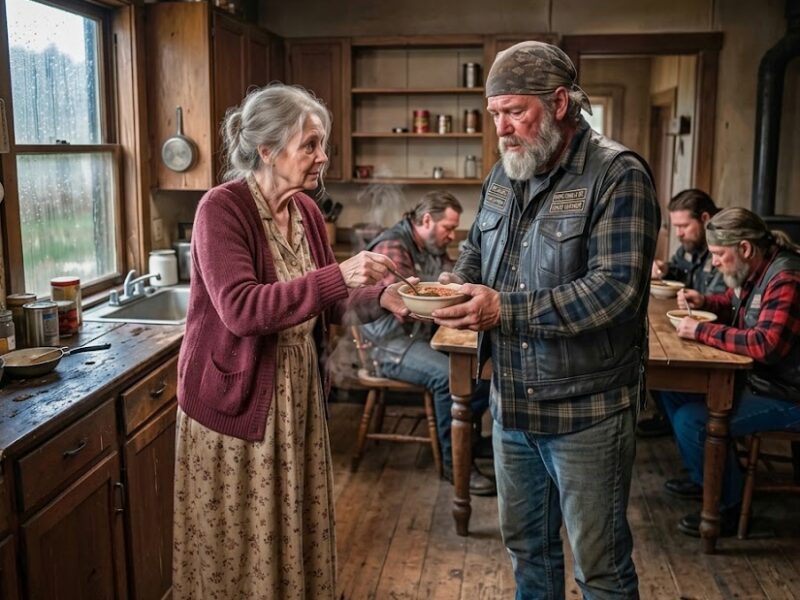
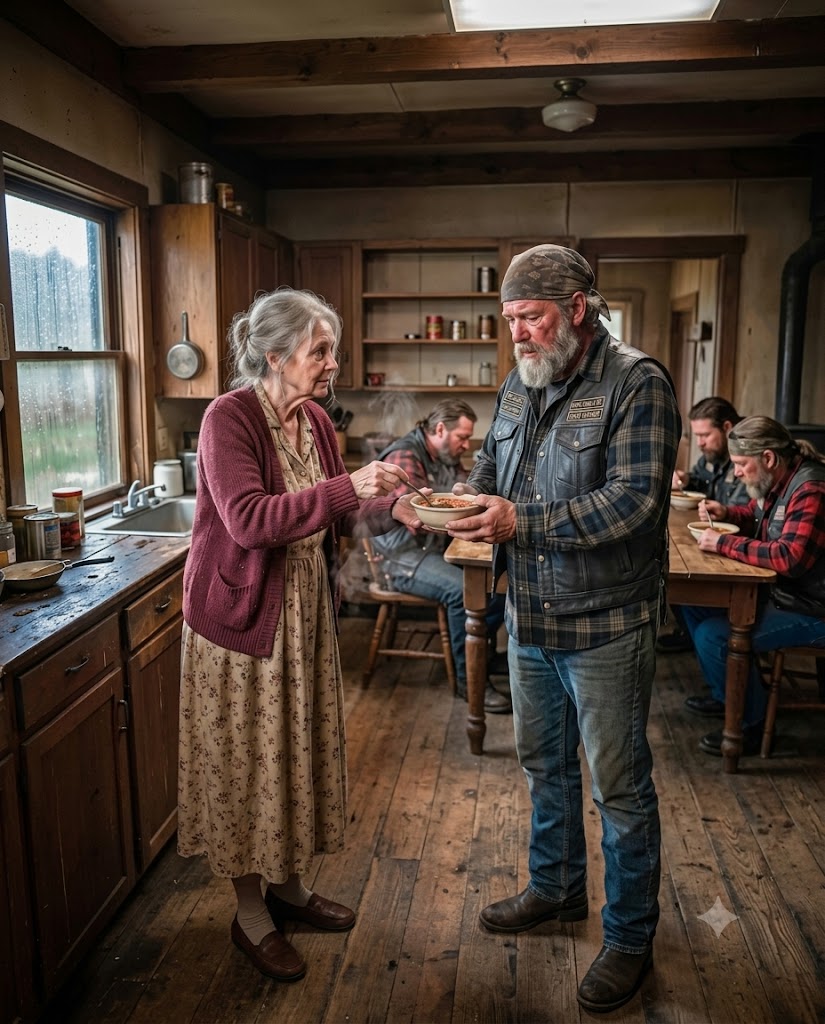
Maeve walked into the living room holding a stack of mismatched bowls, Tupperware containers, and coffee mugs.
“I don’t have thirty bowls,” she said. “You’ll have to improvise.”
The men fell silent. They looked at the food. They looked at her.
Dutch stood up. He took a chipped ceramic mug from her hands.
“Line up,” he commanded the room.
They lined up. No pushing. No loud talking. These men who regularly cleared out bars and terrified local law enforcement waited patiently as a seventy-four-year-old woman ladled thick, boiling chili into plastic containers and handed out chunks of hot cornbread.
They ate in silence, the only sound the scraping of spoons.
Maeve sat in her worn armchair in the corner holding a small bowl of her own. She watched them.
She saw the heavy silver rings on their fingers, the faded ink on their necks, the dirt beneath their fingernails. She also saw the way they held the bowls with both hands, absorbing the heat.
A younger biker, maybe twenty-five, with a spiderweb tattooed on his elbow, scraped the bottom of his Tupperware.
He looked up at Maeve.
“Best thing I ever ate, Mom,” he mumbled.
“It’s just chili,” Maeve said.
But her chest felt tight. A rusty valve finally turning after years of disuse. The house hadn’t felt this full, this alive, in over a decade.
By midnight, the men were asleep, sprawled across the floorboards. Dutch sat near the doorway, keeping watch.
Maeve threw her wool blanket over him before she went to her bedroom. He didn’t say anything, just pulled it up to his chin.
The rain stopped just before dawn. The morning light crept through the cracked windows, gray and unforgiving. It stripped away the shadows that usually hid the house’s misery, exposing everything in brutal clarity.
Dutch woke up early. He folded the wool blanket and left it on the armchair. He stood up, his joints aching from the hard floor, and walked through the silent house.
The other men were starting to stir, groaning as they sat up.
Dutch walked into the kitchen to find a glass of water. That was when he really saw it.
Last night in the dark, lit only by kerosene, the house had just felt old. In the daylight, it was a disaster.
He noticed the bucket sitting in the center of the kitchen floor, filled to the brim with rainwater that had leaked through the ceiling. The drywall above was black with mold and bowing under the weight of trapped water.
The linoleum was peeling up at the corners, revealing rotten subflooring.
He walked back into the hallway. He saw the exposed wiring hanging near the front door. He looked out the window at the front porch. The support beams were severely rotted, barely holding the overhang.
The roof was missing large patches of shingles. The exposed wood underneath spongy and dark.
Thorien “Grip” Manley, the club’s sergeant-at-arms, walked up behind Dutch. He ran a hand over his shaved head, looking at the ceiling.
“Place is a stiff breeze away from a total collapse,” Grip muttered quietly.
Dutch didn’t answer. He walked back into the kitchen. He opened the pantry door.
It was completely empty.
Last night in the dark, he hadn’t noticed. But now, staring at the bare shelves, the reality hit him. She hadn’t just cooked them a meal. She had cooked them everything she had.
Every can, every bag of flour. She had emptied her reserves to feed thirty strangers who knocked on her door in the middle of the night.
Dutch closed the pantry door softly. He gripped the handle for a long moment.
He had spent his whole life taking from the world, demanding space, taking respect by force. He understood transactions. He understood debts.
He turned around. Maeve was standing in the doorway wearing a faded pink bathrobe, her gray hair pinned up loosely. She looked exhausted, her face pale in the morning light.
“Coffee pot’s broke,” she said, her voice raspy. “I can boil some water for instant, if you don’t mind it tasting like copper.”
“We’re all right, Maeve,” Dutch said.
He pulled his wallet from his heavy denim jeans. He opened it. He had a fifty-dollar bill and a twenty. He pulled them out and set them on the kitchen counter.
He turned to Grip.
“Empty it.”
Grip didn’t ask questions. He pulled out his wallet, dumped forty bucks on the counter.
Dutch walked into the living room.
“Everybody, wallets out. Now,” Dutch barked.
The men didn’t hesitate. They dug into their pockets. Crumpled fives, tens, a few twenties, sweaty dollar bills. They piled it on the coffee table.
It was the end of a long run. Most of them were broke, surviving on gas money and whatever they had left for food.
Dutch gathered the pile of cash. He walked back to the kitchen and placed it next to his seventy dollars. It was maybe three hundred dollars total, a pathetic pile of wrinkled paper.
“It’s for the groceries, Mom,” Dutch said, refusing to meet her eyes.
He felt a rare, uncomfortable burn of shame in his chest. Three hundred bucks wouldn’t fix that roof. It wouldn’t fix the rot. It barely covered the food she had sacrificed.
Maeve looked at the money. She didn’t reach for it.
“I didn’t run a restaurant last night, Dutch,” she said quietly. “Keep your money. You boys need gas.”
“We’re leaving it,” Dutch said, his tone leaving no room for argument. “Bridge should be passable by now. The mud’s drying. We need to clear out of your hair.”
Maeve just nodded. She followed them to the front door.
The men filtered out, pulling on their damp boots, shrugging into heavy cold leather. They didn’t say much. A few of them touched the brim of their helmets as they passed her.
The young kid with the spiderweb tattoo gave her a small tight nod.
They fired up the bikes. The noise shattered the quiet morning. A deafening roar that shook the loose glass in the window panes.
Dutch sat on his massive Harley revving the engine. He looked back at the porch.
Maeve stood there. Her pink bathrobe flapping slightly in the cold wind. Looking small against the decaying frame of the house.
Dutch dropped his bike into gear. They rode out. Thirty deep. Tearing through the mud. Leaving deep ruts in the yard.
In two minutes, the sound of the engines faded into the distance.
Maeve stood on the porch until it was completely quiet again. The silence felt heavier now. It pressed down on her.
She walked inside, closed the door, and locked it. She walked into the kitchen, looked at the pile of crumpled money. And then looked at the bucket of dirty rainwater on the floor.
She picked up a mop. Life went on. She figured she would never see those men again.
Twenty miles down the highway, Dutch pulled his bike into a run-down Sinclair gas station. The pack rumbled in behind him, lining up at the pumps.
Dutch didn’t go for the gas nozzle. He walked straight to the edge of the parking lot, pulling his cell phone from his inner pocket. He dialed a number he knew by heart.
It rang twice.
“Yeah,” a voice answered on the other end. It was the chapter vice president back at the clubhouse in Rapid City.
“It’s Dutch,” he said, staring out at the pine trees lining the highway.
“Call the Seattle charter. Call Denver. Call the Nomads out in Wyoming.”
“What’s wrong? You guys run into trouble?”
“No,” Dutch said, his voice flat, dead serious. “Get hold of anyone who does roofing, carpentry, electrical, or plumbing. Tell them to load up the flatbeds. Bring tools. Bring lumber. Bring everything in the club’s emergency fund.”
There was a pause on the line.
“Dutch, what the hell are we doing?”
Dutch lit a cigarette, shielding the flame from the wind. He took a long drag.
“We got a house to build,” he said.
Maeve didn’t sleep well that night. The wind had died down, but the silence in the house was too heavy.
A stark contrast to the thirty souls who had occupied it twenty-four hours earlier.
She woke up at dawn on Friday. Her joints ached. The bucket in the kitchen was overflowing again, a puddle of brown water creeping towards the baseboards.
She put the kettle on the stove.
That was when the glass in the kitchen window began to vibrate. It started as a low hum, something felt in the floorboards rather than heard.
Maeve paused, a cold sense of dread pooling in her stomach. Earthquakes were rare here, but the vibration grew, shifting from a hum to a bone-rattling roar.
She walked out to the front porch, pulling her wool cardigan tight against the morning chill.
Over the crest of County Road 9, a massive dust cloud rose into the pale autumn sky.
Then, they breached the hill.
It wasn’t thirty headlights this time. It was an ocean of them. A mechanical cavalry stretching as far as she could see down the two-lane blacktop.
Hundreds of motorcycles rode in a tight, staggered formation.
Behind the leading wave of bikes rumbled heavy machinery. Four flatbed trucks loaded with lumber, a cement mixer, two roofing trucks carrying pallets of asphalt shingles, and a refrigerated box truck.
Maeve gripped the rotting wooden railing of her porch. She couldn’t breathe. The sheer volume of noise was deafening, a physical pressure against her chest.
Leading the pack was the giant, Dutch. He pulled his Harley into her yard, kicking the stand down in the dirt.
Behind him, the swarm descended. Over eight hundred men wearing the winged death’s head flooded her property. They parked in the yard, along the ditches, down the driveway.
The men were a patchwork of chapters from across the country. Seattle, Denver, Omaha, Cheyenne.
They were hardened men, ex-cons, tradesmen, veterans, enforcers.
They climbed off their bikes, unstrapping tool belts, carrying heavy canvas bags, pulling crowbars, hammers, and drills from their saddlebags.
Dutch walked up the gravel path. He didn’t look tired anymore. He looked like a general surveying a battlefield.
Maeve stood frozen on the porch.
“What is this?” she whispered, though the roar of the engines drowned it out.
Dutch stopped at the bottom of the steps. He looked up at her, chewing on a matchstick.
“Morning, Maeve. Hope we didn’t wake you.”
Before she could process the question, a man with a thick neck and a heavily tattooed scalp stepped up beside Dutch. He carried a clipboard.
“Dutch,” the man barked, his voice pure gravel. “Roofers are ready. Plumbers are tracing the main line now. We got the generator hooked up out back.”
Dutch nodded. “Strip the roof first. Rip it down to the plywood. If the decking is rotten, replace it. I want it watertight by nightfall.”
“What are you doing?” Maeve finally managed to shout over the din.
Dutch looked at her, his expression entirely serious.
“You fed my guys, Maeve. You gave us everything in your house. Outlaws don’t like being in debt.”
He pointed a massive, leather-clad finger at the sagging roofline above her.
“And this house is an insult to gravity. We’re fixing it.”
Maeve opened her mouth to protest, to tell them they couldn’t just tear her house apart, but it was too late. The invasion had begun.
It was a display of chaotic, terrifying efficiency. These were men who operated outside the law, men who understood logistics, supply chains, and getting things done without asking for permits.
They descended on the farmhouse like a swarm of angry, highly skilled locusts.
Twenty men were on her roof within minutes, tearing away the rotting shingles with heavy flat bars. The sound of tearing nails and falling debris echoed like gunfire.
Down below, a crew of younger prospects in unpatched vests ran wheelbarrows back and forth, catching the garbage and hauling it to a massive rented dumpster that had just been backed into the driveway.
Inside the house, Thorien “Grip” Manley took charge.
Grip walked into the kitchen, took one look at the waterlogged ceiling, and swung a sledgehammer straight up.
The drywall exploded in a cloud of black mold and wet plaster. Maeve flinched, stepping back into the hallway.
“Sorry, ma’am,” Grip said, wiping dust off his forehead. “Rot’s got to go.”
They didn’t just patch the problems, they eradicated them.
Plumbers crawled into the cramped, spider-infested crawl space beneath the house, ripping out seventy-year-old galvanized pipes that were rusted tight, replacing them with thick, brand new PVC and copper.
Electricians snaked new Romex wire through the walls, pulling out the dangerous, frayed knob-and-tube wiring that was a spark away from burning the place down.
Maeve stood in the corner of her living room, entirely useless in her own home. She watched heavily bearded men, men who looked like they belonged in a maximum-security yard, measuring baseboards with laser-like precision.
They spoke in short, clipped sentences, no arguments, just orders and execution.
By noon, the house was unrecognizable. The old, warped linoleum in the kitchen was gone, ripped up to reveal the subfloor. Three men were laying down thick, durable hardwood. Their pneumatic nail guns hissing and popping in a rhythmic beat.
Maeve found Dutch out in the yard. He was standing by the refrigerated box truck.
“Dutch,” she said, raising her voice over a circular saw. “This is too much. The materials alone, I can’t pay for this.”
Dutch looked down at her. He pulled a fresh pack of cigarettes from his vest, offering her one. She shook her head. He lit one for himself.
“You’re not paying for a damn thing,” Dutch said, exhaling a plume of gray smoke. “Club fund covered the lumber. The boys passed the hat for the rest. We got guys here who frame houses for a living. Guys who lay pipe. They ain’t charging labor.”
He gestured toward the massive crowd of bikers sitting on the grass eating sandwiches wrapped in foil.
“A lot of these guys don’t have mothers. Some of them haven’t been inside a real home in twenty years. You opened your door to thirty strangers in a storm. You gave us your last can of beans. Don’t insult them by trying to pay for this.”
Maeve looked at the men. She saw the rough edges, the scars, the prison tattoos, but she also saw the way they worked. There was a desperate kind of care in their movements.
They weren’t just building a roof. They were building a fortress for someone who had shown them a flicker of grace.
She turned back to Dutch. Her eyes burned, but she refused to cry in front of him.
“I don’t have a coffee pot,” she said fiercely, “and I can’t feed eight hundred men.”
Dutch smiled. It was a tight, rare expression that actually reached his eyes.
“We brought our own catering, Maeve. You just sit on the porch and tell us if we missed a spot.”
The work didn’t stop when the sun went down. Industrial floodlights were erected in the yard, casting harsh white beams against the farmhouse. The roar of the gasoline generator replaced the rumble of the motorcycles.
The men worked in shifts. When one crew got tired, they tapped out, retreating to their bikes to sleep on the ground wrapped in bedrolls. Another crew immediately stepped in.
Maeve didn’t sleep. She sat in a heavy lawn chair Dutch had procured from somewhere, wrapped in her wool blankets, watching the impossible happen.
By Saturday morning, the roof was completely finished. A heavy architectural grade shingle that could withstand a hurricane.
The sagging front porch had been jacked up. The rotten support beams chainsawed out and replaced with thick pressure-treated six-by-sixes.
Inside, the transformation was staggering. Maeve walked through her front door on Saturday afternoon. The smell of wet dog and decay was gone. In its place was the sharp, clean scent of fresh pine, new paint, and floor wax.
Grip was in the kitchen wiping grease off his hands with a rag. He nodded to her.
“Turn the faucet, ma’am.”
Maeve walked to the sink. She reached out with trembling fingers and turned the hot water knob. Instead of the usual pathetic rusty trickle, a powerful clear stream of scalding water blasted into the stainless steel basin.
“Water pressure,” Grip said with a grin. “Replaced the water heater, too. You got fifty gallons of boiling water whenever you want it.”
She looked around. The black mold was gone. The walls were clad in fresh white drywall, expertly taped and mudded.
The floors were solid. Not a single squeak or dip when she walked.
Then she opened the pantry. She gasped. It wasn’t just restocked, it was fortified.
The shelves were lined with absolute precision. Rows of canned vegetables, heavy bags of flour, sugar, and rice. Dozens of boxes of pasta. A massive rack of spices. Heavy glass jars of local honey.
Down on the floor were three fifty-pound bags of premium dog food, even though she didn’t own a dog.
“Dutch said you might want to get a dog,” Grip muttered, seeing her confusion. “Good for security.”
He walked past her, heading for the door. “We’re almost done here.”
By Sunday morning, the chaos began to pack up. The flatbeds were empty, pulling out of the driveway to head back to wherever they came from. The dumpster was full to the brim with the rotting evidence of Maeve’s past.
The men were strapping their bedrolls back onto their motorcycles, slipping into their heavy leather cuts.
Maeve stood on her new, sturdy porch. The wood felt solid under her boots.
Dutch walked up the gravel path one last time. He didn’t look like a general anymore. He just looked like a tired man with a long ride ahead of him.
“We’re rolling out,” Dutch said.
He reached into his vest pocket and pulled out a small, heavy piece of metal. He pressed it into Maeve’s palm. It was a challenge coin, heavy brass with the winged death head stamped on one side and the words “Black Hills Charter” on the other.
“You ever need anything,” Dutch said, his voice dropping to a low rumble. “A leak, a flat tire, some local kid gives you a hard time, you show that to any guy wearing our patch, they’ll know who you are.”
Maeve looked down at the brass coin. It was cold and heavy in her hand. She looked up at the giant in front of her.
She didn’t offer a hug. She knew better than to treat a man like Dutch like a schoolboy.
Instead, she reached out and gripped his heavy leather forearm. Her grip was surprisingly strong.
“Keep your head down on the highway, Dutch,” she said, looking him dead in the eye.
Dutch nodded slowly. “You keep warm, Maeve.”
He turned and walked back to his bike. He swung his heavy leg over the saddle and kicked the engine over. The roar was immediate.
Down the road, eight hundred engines fired up in unison, a mechanical symphony that shook the pine needles from the trees.
Dutch dropped his bike into gear. He didn’t look back. He rode out, leading the massive column of leather and chrome down County Road 9.
Maeve stood on the porch, watching them go. She watched until the last tail light disappeared over the hill and the heavy rumble faded into nothing but the sound of the South Dakota wind.
She turned around and walked inside. The front door closed behind her with a heavy, solid thud. No rattling hinges, no drafts.
She walked into her kitchen, turned on the brand new stove, and put the kettle on.
For the first time in ten years, she wasn’t cold.
Part 2
The kettle whistled. A sharp, clean sound that cut through the silence of the house.
Maeve stood at the counter, staring at the brass challenge coin Dutch had pressed into her palm. She turned it over in her fingers, feeling the weight of it.
It was heavier than it looked. Solid brass. The winged death’s head on one side, the words “Black Hills Charter” on the other. A tiny serial number stamped along the edge.
She set it on the windowsill above the sink. It caught the morning light, glinting against the fresh white drywall.
She made her tea. For the first time in years, the water tasted clean. No rust. No copper. No reminder of the seventy-year-old pipes that had been poisoning her slowly.
She sat down at the kitchen table. The wood was new. A solid oak table that hadn’t been there on Friday morning. One of the men had built it in the driveway, sanded it smooth, and stained it a warm honey color.
She ran her hand over the surface. It was perfect.
The house was quiet. Too quiet. The silence pressed against her ears, a stark contrast to the roaring engines and the shouting men and the pounding hammers of the past three days.
She should have been relieved. She should have been grateful.
Instead, she felt a strange, hollow ache in her chest. The same ache she had felt after Henry died. The ache of a house that was too big for one person.
She shook it off. She had work to do.
The first thing she did was walk through every room. She opened every cabinet, every drawer, every closet. She ran her fingers along the baseboards, checking for gaps. She turned on every faucet, flushed every toilet, flipped every light switch.
Everything worked. Everything was perfect.
The bedroom had a new mattress. A queen-sized bed with a brass frame that gleamed in the afternoon light. The sheets were crisp and white, the comforter a soft gray wool.
She hadn’t slept in a proper bed in years. Her old mattress had been a hand-me-down from a neighbor who had died in 2009. It sagged in the middle and smelled faintly of mothballs.
She sat down on the edge of the new bed. It didn’t creak. It didn’t sag. It held her weight like it was made for her.
She lay back. The ceiling was fresh and white. No water stains. No cracks. No mold.
She closed her eyes.
And for the first time in a decade, she slept through the night.
The phone rang at seven the next morning. Maeve was already awake, sitting at the kitchen table with a cup of coffee. Real coffee. One of the men had left a bag of freshly ground beans on the counter.
She picked up the receiver. It was a landline. A relic from a different era. She had kept it because it was cheaper than a cell phone.
“Sullivan residence,” she said.
“Maeve? It’s Betty. Betty from the church.”
Betty was the president of the Ladies’ Auxiliary at the First Baptist Church of Custer. She was seventy-eight, drove a powder-blue Cadillac, and had a voice that could cut glass.
“Morning, Betty,” Maeve said.
“I heard the most extraordinary thing,” Betty said. Her voice was tight, almost breathless. “I heard that a gang of bikers descended on your property over the weekend. A gang of criminals. Maeve, are you all right? Did they hurt you? Did they steal anything?”
Maeve took a sip of her coffee. She looked out the window at her new roof. The shingles were a deep charcoal gray. They looked like they could withstand a nuclear blast.
“They didn’t steal anything, Betty,” Maeve said.
“Then what did they do? I heard there were hundreds of them. Hundreds. The whole town is talking about it. Someone said they saw a convoy of trucks heading out toward your place on Friday morning. Someone else said they heard gunshots.”
“There weren’t any gunshots,” Maeve said. “They fixed my roof.”
There was a long pause on the line.
“I beg your pardon?”
“They fixed my roof. And my porch. And my plumbing. And my wiring. They restocked my pantry. They built me a new table. They replaced my mattress.”
Another pause. Longer this time.
“Maeve,” Betty said, her voice dropping to a whisper. “Are you telling me that a gang of outlaw bikers remodeled your house?”
“I’m telling you that thirty men showed up on my porch in a storm, and I fed them chili. And then eight hundred of them came back and fixed everything that was broken.”
Betty was silent for a long moment. Maeve could hear her breathing on the other end of the line.
“Well,” Betty finally said. “I suppose I owe you an apology. I may have called the sheriff.”
Maeve laughed. It was a dry, raspy sound. A sound she hadn’t made in years.
“You did what you thought was right, Betty. I’m not upset.”
“The sheriff is probably on his way out there right now. I told him there was a home invasion.”
“He’ll find a new roof and a fresh pot of coffee,” Maeve said. “I’ll put on a pot for him.”
She hung up the phone and walked to the stove. She filled the kettle and set it on the burner. The new burner. It lit with a soft click, a clean blue flame.
She was measuring coffee grounds into the French press when she heard the sound of a vehicle pulling into the driveway.
She looked out the window. A Custer County sheriff’s cruiser was parked in the yard. A tall man in a tan uniform was stepping out, adjusting his belt.
Maeve opened the front door before he could knock.
“Morning, Sheriff,” she said.
The sheriff was a man named Dale Hendricks. He was fifty-two years old, had a thick mustache, and had known Maeve since he was a kid. His father had been a regular at the diner where she worked.
“Morning, Maeve,” he said. He looked around the yard. His eyes landed on the new porch, the new roof, the fresh gravel in the driveway.
“I got a call from Betty at the church,” he said. “She said there was a home invasion out here. A gang of bikers.”
Maeve leaned against the door frame.
“There was no home invasion, Dale. There was a storm. Thirty men got stranded. I fed them. They left.”
“And then eight hundred of them came back and fixed your house?”
Maeve nodded.
Dale took off his hat. He scratched the back of his head.
“Maeve, I’ve known you for thirty years. I know you’re not a liar. But you have to understand how this sounds.”
“I understand,” Maeve said. “You want to come in and see for yourself?”
Dale followed her inside. He walked through the kitchen, the living room, the hallway. He opened the pantry. He looked at the new wiring. He ran his hand along the new drywall.
He stopped in the living room. He stared at the challenge coin on the windowsill.
“May I?” he asked.
Maeve nodded.
Dale picked up the coin. He turned it over in his hands. His face was unreadable.
“You know what this is?” Maeve asked.
Dale nodded slowly. “I know what it is.”
He set the coin back on the windowsill. He looked at Maeve.
“I’m going to go back to my car and call this in as a false alarm,” he said. “I’m going to tell dispatch that there’s no evidence of any criminal activity out here. And then I’m going to go home and have a beer.”
“That sounds like a good plan,” Maeve said.
Dale walked to the door. He stopped on the threshold. He turned back.
“Maeve,” he said. “If you ever need anything. Anything at all. You call me. Not the department. Me. Personal line.”
Maeve nodded. “I appreciate that, Dale.”
He put his hat back on. “You take care of yourself.”
He walked back to his cruiser and drove away.
Maeve stood on the porch for a long time after he left. The sun was rising higher. The air was crisp and clean. The smell of fresh pine and new shingles filled her lungs.
She walked back inside and poured herself a cup of coffee.
The phone rang again at noon. This time, it was the bank.
“Mrs. Sullivan? This is Carol at First Dakota National Bank. We’ve received a rather unusual deposit into your account this morning.”
Maeve frowned. “What kind of deposit?”
“A wire transfer. Twenty-five thousand dollars. From an account in Rapid City. The memo line says ‘For groceries.'”
Maeve sat down at the kitchen table. Her hands were trembling.
“I see,” she said.
“Mrs. Sullivan, we just need to verify that you were expecting this transfer. It’s a substantial amount.”
“I wasn’t expecting it,” Maeve said. “But I know who sent it.”
“Is it a legitimate transfer? We need to make sure there’s no fraud involved.”
“It’s legitimate,” Maeve said. “You can process it.”
“Very well. Is there anything else we can help you with?”
Maeve looked at the challenge coin on the windowsill. She looked at the new table. The new floors. The new roof.
“No,” she said. “That’s all. Thank you.”
She hung up the phone. She sat in the silence for a long moment.
Twenty-five thousand dollars. It was more money than she had seen in her entire life. More than her pension was worth. More than the house was worth, probably.
She thought about Dutch. She thought about the men on the porch. She thought about the young kid with the spiderweb tattoo who had told her it was the best thing he had ever eaten.
She thought about the way Dutch had stood on the edge of the doormat, respecting her threshold. The way he had called her “Mom.” The way he had refused to meet her eyes when he put the cash on the counter.
She walked to the windowsill and picked up the challenge coin. She held it in her palm. It was warm from the sunlight.
She made a decision.
She walked to the phone and dialed a number. It rang three times.
“Black Hills Charter,” a voice answered. Gruff. Impatient.
“This is Maeve Sullivan,” she said. “I need to speak to Dutch.”
There was a pause.
“Who?”
“Maeve Sullivan. He gave me a coin. He said if I ever needed anything, I should call.”
Another pause. Then, a different voice. Deeper. Familiar.
“Maeve?”
“Dutch,” she said. “I got your money.”
“We know.”
“It’s too much.”
“It’s not enough,” Dutch said. “Not for what you did.”
“I didn’t do anything.”
“You fed us. You gave us your last can of beans. You let thirty strangers sleep on your floor. You didn’t ask for anything in return. That’s not nothing, Maeve. That’s everything.”
Maeve was silent. Her throat was tight.
“I don’t know how to accept this,” she said.
“You don’t have to accept it. You just have to use it. Fix the barn. Buy a dog. Get your hip replaced. Whatever you need.”
“My hip is fine.”
“Then buy a boat. I don’t care. It’s yours.”
Maeve laughed. The same dry, raspy laugh.
“Dutch,” she said. “I don’t know how to thank you.”
“You don’t thank me. You just keep the door open. For whoever needs it.”
Maeve nodded. She knew he couldn’t see her, but she nodded anyway.
“I can do that,” she said.
“Good. I gotta go. We’re in Sturgis. Somebody’s bike broke down.”
“Be careful.”
“I always am.”
He hung up. Maeve stood in the kitchen, holding the phone to her ear. The dial tone hummed.
She set the phone down. She walked to the window and looked out at the Black Hills. The sun was high in the sky. The storm was a memory.
She picked up the challenge coin and put it in her pocket.
Then she walked out to the porch, sat down in her new rocking chair, and watched the world go by.
Part 3
The story didn’t end there.
Word travels fast in small towns. Faster than a wildfire in a drought year. By the end of the week, everyone in Custer County knew what had happened at the Sullivan place.
Some people didn’t believe it. They said it was a tall tale. A prank. A delusion from an old woman who had finally lost her grip on reality.
But then they drove past the farmhouse on County Road 9. They saw the new roof. The new porch. The fresh gravel in the driveway.
They saw Maeve sitting on the porch in her rocking chair, a cup of coffee in her hand, a brass coin on the windowsill behind her.
And they started to wonder.
The first person to show up was a young woman named Sarah. She was twenty-six, a single mother with a four-year-old son. She worked two jobs in Rapid City and drove a beat-up Honda that was held together with duct tape and prayer.
She knocked on Maeve’s door on a Tuesday afternoon.
“Mrs. Sullivan?” she said. Her voice was nervous. Her hands were shaking.
“That’s me,” Maeve said.
“I heard what happened. The bikers. The house. I know it sounds crazy, but I need help. My landlord is evicting me. He says he’s going to tear down the house. I don’t have anywhere to go.”
Maeve looked at the young woman. She saw the dark circles under her eyes. The worn-out shoes. The desperate hope in her face.
She stepped back and opened the door wider.
“Take your boots off before you step on the hardwood,” she said. “It’s new.”
Sarah walked inside. She looked around the kitchen. The new table. The new floors. The pantry full of food.
Maeve poured her a cup of coffee.
“Sit down,” she said. “Tell me everything.”
Sarah told her. The deadbeat ex-husband. The low-paying jobs. The landlord who had raised the rent three times in two years. The son who was starting kindergarten in the fall.
Maeve listened. She didn’t interrupt. She didn’t offer advice. She just listened.
When Sarah was finished, Maeve stood up. She walked to the windowsill and picked up the challenge coin.
“Do you know what this is?” she asked.
Sarah shook her head.
“It’s a key,” Maeve said. “It opens doors you didn’t even know were closed.”
She pressed the coin into Sarah’s hand.
“Take this,” she said. “Go to the address on the back. It’s a clubhouse in Rapid City. Show it to whoever’s there. Tell them Maeve sent you.”
Sarah stared at the coin. “What will they do?”
“I don’t know,” Maeve said. “But I know they’ll help.”
Sarah left an hour later. She was crying. She hugged Maeve at the door.
“Thank you,” she whispered. “Thank you.”
Maeve watched her drive away. She watched until the beat-up Honda disappeared over the hill.
She walked back inside. She poured herself another cup of coffee. She sat at the kitchen table and looked around the room.
The house was full. Not of people. Not of things. But of something else. Something she couldn’t name.
She thought about Henry. She thought about the diner. She thought about all the strangers who had passed through her life, leaving footprints on her heart.
She thought about the thirty men on her porch. The eight hundred on her lawn. The young kid with the spiderweb tattoo.
She thought about Dutch.
She picked up the phone and dialed a number.
“Black Hills Charter.”
“Dutch,” she said. “It’s Maeve.”
“Maeve. You all right?”
“I’m fine. I gave away your coin.”
There was a pause.
“You did what?”
“I gave it to a young woman. Sarah. She’s about to be homeless. Her son is four. She needs help.”
Another pause. Longer this time.
“You gave away the coin,” Dutch repeated.
“I did.”
“Do you know what that coin means?”
“I know it means help. And she needs help more than I do.”
Dutch was silent. Maeve could hear him breathing on the other end of the line.
“You’re something else, Maeve,” he finally said.
“I’m just an old woman with a house.”
“No,” Dutch said. “You’re not. You’re the woman who fed thirty strangers in a storm. You’re the woman who refused to take our money. You’re the woman who gave away the only thing we gave you in return.”
“I didn’t need it anymore,” Maeve said. “I have everything I need.”
Dutch laughed. It was a low, rumbling sound.
“I’ll call the clubhouse. Tell them to expect her.”
“Thank you.”
“Don’t thank me. You’re the one who taught us how to give.”
Maeve hung up the phone. She walked to the window and looked out at the Black Hills.
The sun was setting. The sky was a deep orange, streaked with purple and gold. The trees were swaying in the evening breeze.
She picked up her cup of coffee and walked out to the porch.
She sat in her rocking chair and watched the sun go down.
For the first time in years, she felt like she was exactly where she was supposed to be.
Part 4
Months passed.
The seasons changed. October turned to November. November turned to December. The Black Hills were blanketed in snow.
Maeve stayed warm. The new furnace hummed in the basement. The new windows kept out the drafts. The new roof held against the weight of the snow.
She bought a dog. A German Shepherd mix from the animal shelter in Rapid City. She named him Henry, after her late husband.
Henry slept at the foot of her bed. He followed her around the house. He barked at the mailman. He was a good dog.
The town slowly accepted her. The whispers stopped. The stares faded. People started stopping by to say hello. They brought pies and casseroles and jars of jam.
Betty from the church came by every Sunday. She never mentioned the bikers. She never asked about the coin. She just sat at the kitchen table and drank coffee and talked about the weather.
Dale Hendricks came by once a week. He checked the locks. He cleared the snow from the driveway. He never asked for anything in return.
Maeve didn’t need anything in return. She had everything she needed.
But she never stopped thinking about Dutch. She never stopped thinking about the men who had rebuilt her life.
She thought about them every time she turned on the faucet. Every time she flipped a light switch. Every time she ran her hand along the new table.
She thought about them when she looked at the challenge coin. She had gotten it back from Sarah, who had returned it with a handwritten note that said “Thank you for saving my life.”
Maeve kept the note. She kept the coin. She put them both on the windowsill, next to a photograph of Henry.
One cold morning in January, she heard the sound of engines.
She was sitting at the kitchen table, drinking coffee, reading the newspaper. Henry was asleep at her feet.
The sound started as a low rumble. Then it grew. A familiar roar. A swarm of V-twin engines.
Maeve stood up. She walked to the window.
A single motorcycle was pulling into her driveway. A massive Harley. A giant man in a leather vest.
Dutch.
She opened the front door before he could knock.
He stood on the edge of the doormat. He looked the same. Same beard. Same scar. Same leather vest.
“Morning, Maeve,” he said.
“Dutch,” she said. “You’re a long way from Sturgis.”
“I was in the neighborhood.”
She stepped back and opened the door wider.
“Take your boots off before you step on the hardwood,” she said. “It’s still new.”
Dutch smiled. He kicked off his boots and walked inside.
He looked around the kitchen. The new table. The new floors. The pantry full of food.
“You’ve been busy,” he said.
“I’ve been living,” Maeve said. “There’s a difference.”
Dutch sat down at the table. Maeve poured him a cup of coffee.
They sat in silence for a long moment. The only sound was the wind outside and the crackling of the fire in the wood stove.
“You know,” Dutch finally said, “I’ve been thinking about what you said. About the coin.”
“What about it?”
“You said you didn’t need it anymore. That you had everything you needed.”
Maeve nodded.
“I’ve been thinking about that,” Dutch said. “And I realized something. You didn’t give it away because you didn’t need it. You gave it away because you understood something we didn’t.”
“What’s that?”
“You understood that the coin isn’t about having help. It’s about being help. It’s not a gift. It’s a responsibility. You gave it to Sarah because you knew she would pass it on. And she did. And now someone else has it. And they’ll pass it on. And so on. And so on.”
Maeve looked at him. Her eyes were bright.
“You’re smarter than you look, Dutch.”
“I’ve had a lot of time to think.”
They sat in silence again. Henry woke up and walked over to Dutch, sniffing his boots. Dutch reached down and scratched his ears.
“What’s his name?” Dutch asked.
“Henry,” Maeve said. “After my husband.”
Dutch nodded. He didn’t say anything.
He stayed for an hour. They talked about the weather. About the club. About the young kid with the spiderweb tattoo, who had gotten married and was expecting a baby.
When he left, he stood on the porch for a long moment. He looked at the new roof. The new porch. The fresh gravel in the driveway.
“You did good, Maeve,” he said.
“I had help,” she said.
Dutch nodded. He walked to his bike. He swung his leg over the saddle.
“Keep your head down on the highway,” Maeve said.
“You keep warm,” Dutch said.
He kicked the engine over. The roar filled the yard. He dropped the bike into gear and rode away.
Maeve stood on the porch, watching him go. She watched until the last tail light disappeared over the hill.
Then she walked back inside. She closed the door. She sat down at the kitchen table.
She picked up the challenge coin and held it in her palm. It was warm from the sunlight.
She thought about the storm. She thought about the chili. She thought about the thirty men on her porch and the eight hundred on her lawn.
She thought about Dutch. She thought about Sarah. She thought about all the strangers who had passed through her life, leaving footprints on her heart.
She set the coin back on the windowsill. She looked out at the Black Hills.
The sun was rising. The sky was a pale blue, streaked with pink and gold.
She poured herself another cup of coffee.
For the first time in years, she felt like she was exactly where she was supposed to be.
Part 5
The story spread.
It spread like a wildfire. It spread like a rumor in a small town. It spread like a prayer.
A reporter from the Rapid City Journal heard about it. She drove out to the farmhouse on County Road 9. She knocked on the door.
Maeve answered. She was wearing a faded pink bathrobe. Her gray hair was pinned up loosely. Henry was barking at her heels.
“Mrs. Sullivan? I’m Jennifer from the Journal. I’d like to write a story about you.”
Maeve looked at her. She looked at the notebook. She looked at the camera.
“I don’t want a story,” she said.
“Please. It’s important. People need to hear this.”
Maeve thought about it. She thought about the storm. She thought about the chili. She thought about the coin.
“All right,” she said. “But you have to get one thing straight.”
“What’s that?”
“It wasn’t about the bikers. It wasn’t about the house. It was about the door.”
Jennifer frowned. “The door?”
“The door to my house. I opened it. That’s all. I opened the door. And everything else followed.”
Jennifer wrote the story. It ran on the front page of the Sunday edition. The headline read: “The Woman Who Opened Her Door.”
The story spread. It went viral. It was shared on Facebook and Twitter and Reddit. People from all over the country read about the elderly widow who had fed thirty Hells Angels and received a new house in return.
Maeve didn’t care about the attention. She didn’t care about the headlines. She didn’t care about the strangers who sent her letters and cards and gifts.
She cared about the door. She kept it open.
She kept it open for Sarah, who came by every week with her son. She kept it open for Betty, who still came by on Sundays. She kept it open for Dale, who checked the locks and cleared the snow.
She kept it open for Dutch, who stopped by every few months. Who sat at her kitchen table and drank coffee and talked about the weather. Who scratched Henry’s ears and told her about the club.
She kept it open for anyone who needed it.
One day, a young man showed up at her door. He was maybe twenty. He had a backpack and a black eye and the desperate look of someone who had run out of options.
He knocked on the door. Maeve answered.
“Ma’am,” he said. “I’m sorry to bother you. I heard about you. I heard you help people.”
Maeve looked at him. She saw the fear in his eyes. She saw the hunger. She saw the hope.
She stepped back and opened the door wider.
“Take your boots off before you step on the hardwood,” she said. “It’s new.”
The young man walked inside. He looked around the kitchen. The new table. The new floors. The pantry full of food.
Maeve poured him a cup of coffee. She set it on the table.
“Sit down,” she said. “Tell me everything.”
He told her. The abusive father. The mother who had died. The streets that had swallowed him up. The mistakes he had made.
Maeve listened. She didn’t interrupt. She didn’t judge. She just listened.
When he was finished, she stood up. She walked to the windowsill and picked up the challenge coin.
“Do you know what this is?” she asked.
He shook his head.
“It’s a key,” she said. “It opens doors you didn’t even know were closed.”
She pressed the coin into his hand.
“Take this,” she said. “Go to the address on the back. It’s a clubhouse in Rapid City. Show it to whoever’s there. Tell them Maeve sent you.”
The young man stared at the coin. “What will they do?”
“I don’t know,” Maeve said. “But I know they’ll help.”
He left an hour later. He was crying. He hugged Maeve at the door.
“Thank you,” he whispered. “Thank you.”
Maeve watched him walk down the gravel path. She watched him disappear over the hill.
She walked back inside. She poured herself another cup of coffee. She sat at the kitchen table and looked around the room.
The house was full. Not of people. Not of things. But of something else. Something she couldn’t name.
She thought about the storm. She thought about the chili. She thought about the thirty men on her porch and the eight hundred on her lawn.
She thought about Dutch. She thought about Sarah. She thought about the young man with the black eye.
She thought about all the strangers who had passed through her life, leaving footprints on her heart.
She picked up the phone and dialed a number.
“Black Hills Charter.”
“Dutch,” she said. “It’s Maeve.”
“Maeve. You all right?”
“I’m fine. I gave away your coin again.”
There was a pause.
“You did what?”
“I gave it to a young man. He’s about twenty. He’s homeless. He’s scared. He needs help.”
Another pause. Longer this time.
“You gave away the coin,” Dutch repeated.
“I did.”
“Do you know what that coin means?”
“I know it means help. And he needs help more than I do.”
Dutch was silent. Maeve could hear him breathing on the other end of the line.
“You’re something else, Maeve,” he finally said.
“I’m just an old woman with a house.”
“No,” Dutch said. “You’re not. You’re the woman who fed thirty strangers in a storm. You’re the woman who refused to take our money. You’re the woman who gave away the only thing we gave you in return. Twice.”
“I didn’t need it anymore,” Maeve said. “I have everything I need.”
Dutch laughed. It was a low, rumbling sound.
“I’ll call the clubhouse. Tell them to expect him.”
“Thank you.”
“Don’t thank me. You’re the one who taught us how to give.”
Maeve hung up the phone. She walked to the window and looked out at the Black Hills.
The sun was setting. The sky was a deep orange, streaked with purple and gold. The trees were swaying in the evening breeze.
She picked up her cup of coffee and walked out to the porch.
She sat in her rocking chair and watched the sun go down.
For the first time in years, she felt like she was exactly where she was supposed to be.
Part 6
The years passed.
Maeve grew older. Her hair turned white. Her knees ached. Her hands trembled. But her eyes were still bright. Her mind was still sharp. Her door was still open.
The house remained solid. The roof held. The plumbing worked. The wiring hummed.
The challenge coin came back to her three more times. Each time, she gave it away. Each time, it found its way back.
It became a legend. A myth. A story that people told in bars and diners and church basements.
They said there was an old woman in the Black Hills who could fix anything. They said she had a coin that could open any door. They said she had fed thirty Hells Angels and they had rebuilt her house.
They said she was a saint. They said she was a witch. They said she was crazy.
Maeve didn’t care what they said. She just kept the door open.
One cold morning in February, she woke up and knew it was time.
She didn’t feel sick. She didn’t feel afraid. She just felt tired. A deep, bone-tired exhaustion that she knew she couldn’t sleep off.
She got out of bed. She put on her pink bathrobe. She walked into the kitchen and put the kettle on.
She made a cup of tea. She sat at the kitchen table. She looked around the room.
The new table. The new floors. The pantry full of food. The challenge coin on the windowsill.
Henry walked over and rested his head on her knee. She scratched his ears.
“Good boy,” she said. “Good boy.”
She picked up the phone and dialed a number.
“Black Hills Charter.”
“Dutch,” she said. “It’s Maeve.”
“Maeve. You all right?”
“I’m fine. I just wanted to hear your voice.”
There was a pause.
“You sure you’re all right?”
“I’m sure. I just wanted to say thank you.”
“For what?”
“For the roof. For the porch. For the pantry. For everything.”
“Maeve, you don’t have to thank me. We’ve been through this.”
“I know. But I wanted to say it anyway.”
Another pause. Longer this time.
“You’re scaring me, Maeve.”
“Don’t be scared. I’m not scared.”
“Do you want me to come out there?”
“No. I want you to stay where you are. I want you to keep doing what you’re doing.”
“What’s that?”
“Keeping the door open.”
Dutch was silent. Maeve could hear him breathing on the other end of the line.
“I will,” he said. “I promise.”
“Good,” Maeve said. “That’s all I wanted to hear.”
She hung up the phone. She finished her tea. She walked out to the porch.
She sat in her rocking chair. Henry lay at her feet. The sun was rising over the Black Hills.
She looked out at the land she had lived on for seventy-four years. The land where she had buried a husband. The land where she had outlived a pension. The land where she had watched her childhood home slowly decay around her.
She looked at the new roof. The new porch. The fresh gravel in the driveway.
She thought about the storm. She thought about the chili. She thought about the thirty men on her porch and the eight hundred on her lawn.
She thought about Dutch. She thought about Sarah. She thought about all the strangers who had passed through her life, leaving footprints on her heart.
She closed her eyes.
The sun rose higher. The morning was quiet. The wind was still.
Henry lifted his head. He looked at Maeve. He whined softly.
She didn’t move.
He whined again. Louder this time.
She still didn’t move.
He stood up. He walked over to her. He nuzzled her hand.
It was cold.
Henry threw his head back and howled.
The sound echoed across the Black Hills. It bounced off the trees. It carried on the wind.
Twenty miles away, Dutch was sitting on his bike at a gas station in Sturgis. He was drinking a cup of coffee. He was thinking about Maeve.
He heard the howl. He didn’t know why, but he heard it.
He set down his coffee. He pulled out his phone. He dialed a number.
“Black Hills Charter.”
“It’s Dutch. I need you to send someone out to County Road 9. The Sullivan place. Check on Maeve.”
“Is everything all right?”
“I don’t know. Just do it.”
He hung up. He stared out at the highway. His hands were shaking.
An hour later, his phone rang.
“Dutch.”
“It’s Grip. We’re at the Sullivan place.”
“And?”
There was a long pause.
“She’s gone, Dutch. She’s sitting on the porch. She looks peaceful. Like she just fell asleep.”
Dutch closed his eyes. He felt something break inside him. Something he hadn’t felt in years.
“The dog?” he asked.
“He’s here. He’s sitting next to her. He won’t leave her side.”
Dutch nodded. He didn’t say anything.
“We’re going to take care of her,” Grip said. “We’re going to give her a proper send-off.”
“Good,” Dutch said. “I’ll be there in two hours.”
He hung up the phone. He started his bike. He rode out of Sturgis, heading west.
The funeral was held three days later.
It was a small affair. Just the men from the Black Hills Charter. A few of the locals. Betty from the church. Dale Hendricks.
They buried her next to Henry. They put a simple headstone on her grave. It read: “Maeve Sullivan. 1949-2023. She kept the door open.”
Dutch stood at the grave after everyone else had left. He looked down at the headstone. He thought about the storm. He thought about the chili. He thought about the coin.
He reached into his pocket and pulled out the challenge coin. It had come back to him, as it always did. A young man had returned it to the clubhouse the day after Maeve died. He said she had given it to him. He said she had told him to pass it on.
Dutch held the coin in his palm. It was cold and heavy.
He thought about Maeve. He thought about her pink bathrobe. Her dry laugh. Her fierce, stubborn kindness.
He thought about the way she had stood on the porch, watching them ride away. The way she had said “Keep your head down on the highway.”
He thought about the way she had opened her door. The way she had opened her heart.
He put the coin back in his pocket. He turned and walked back to his bike.
He rode out of the cemetery. He rode out of town. He rode out into the Black Hills.
He didn’t look back.
Part 7
The story didn’t end when Maeve died.
It didn’t end when they buried her next to Henry. It didn’t end when they put the headstone on her grave.
It didn’t end because stories like Maeve’s never end.
They live on in the people who hear them. They live on in the people who tell them. They live on in the people who open their doors.
The house on County Road 9 stayed empty for a year. The club kept it up. They mowed the lawn. They shoveled the snow. They fixed the roof when a shingle blew off in a storm.
Henry the dog went to live with Grip. He slept at the foot of Grip’s bed. He followed Grip around the clubhouse. He barked at the mailman. He was a good dog.
Dutch visited the house every few months. He sat on the porch in Maeve’s rocking chair. He looked out at the Black Hills. He thought about the storm. He thought about the chili. He thought about the coin.
He thought about Maeve.
One day, a young woman showed up at the clubhouse in Rapid City. She was maybe thirty. She had a little girl with her. She was holding a challenge coin.
“I was told to come here,” she said. “A woman named Maeve sent me.”
The man at the door looked at the coin. He looked at the woman. He looked at the little girl.
“Come in,” he said. “We’ve been expecting you.”
The woman walked inside. She looked around the clubhouse. The leather couches. The pool table. The bar.
“I need help,” she said. “My husband left. I lost my job. I don’t have anywhere to go.”
The man nodded. “What’s your name?”
“Sarah. Sarah Miller.”
The man smiled. “Maeve told us about you. You’re the one she gave the coin to. The first one.”
Sarah nodded. Her eyes were wet.
“She saved my life,” she said. “I don’t know how to repay her.”
The man reached into his pocket and pulled out a challenge coin. It was the same coin. The one Maeve had given away so many times.
“You don’t repay her,” he said. “You pass it on.”
He pressed the coin into Sarah’s hand.
“Take this,” he said. “Go to the address on the back. It’s a farmhouse on County Road 9. Show it to whoever’s there. Tell them Maeve sent you.”
Sarah stared at the coin. “What will they do?”
“I don’t know,” the man said. “But I know they’ll help.”
Sarah left an hour later. She was crying. She hugged the man at the door.
“Thank you,” she whispered. “Thank you.”
She drove out to County Road 9. She parked in the driveway. She walked up the gravel path.
The farmhouse was waiting. The new roof. The new porch. The fresh gravel.
She knocked on the door.
A young man answered. He was maybe twenty-five. He had a spiderweb tattoo on his elbow. He was holding a baby in his arms.
“Can I help you?” he asked.
Sarah held out the challenge coin.
“Maeve sent me,” she said.
The young man looked at the coin. He looked at Sarah. He looked at the little girl standing next to her.
He stepped back and opened the door wider.
“Take your boots off before you step on the hardwood,” he said. “It’s new.”
Sarah walked inside. She looked around the kitchen. The new table. The new floors. The pantry full of food.
The young man poured her a cup of coffee. He set it on the table.
“Sit down,” he said. “Tell me everything.”
Sarah told him. The deadbeat husband. The lost job. The little girl who needed a home.
The young man listened. He didn’t interrupt. He didn’t judge. He just listened.
When she was finished, he stood up. He walked to the windowsill and picked up a photograph. It was a picture of an old woman in a pink bathrobe. She was sitting on a porch, holding a cup of coffee. She was smiling.
“This was Maeve,” he said. “She opened her door to thirty strangers in a storm. She fed them chili. She gave them her last can of beans. And they rebuilt her house.”
He set the photograph back on the windowsill.
“She taught us something,” he said. “She taught us that the most important thing you can do is open the door. You never know who’s going to walk through it. You never know who’s going to need help. You never know who’s going to change your life.”
He looked at Sarah. He looked at her little girl.
“You can stay here,” he said. “As long as you need.”
Sarah stared at him. “I can’t pay you.”
“You don’t have to pay me. You just have to pass it on.”
Sarah nodded. She was crying. She hugged the young man.
“Thank you,” she whispered. “Thank you.”
The young man smiled. “Don’t thank me. Thank Maeve.”
Sarah stayed at the farmhouse for six months. She got a job at the diner in Custer. She saved up enough money for a small apartment. She enrolled her daughter in kindergarten.
When she left, she stood on the porch for a long moment. She looked at the new roof. The new porch. The fresh gravel in the driveway.
She reached into her pocket and pulled out the challenge coin. She held it in her palm.
She thought about Maeve. She thought about the storm. She thought about the chili.
She thought about all the strangers who had passed through her life, leaving footprints on her heart.
She put the coin back in her pocket.
She walked to her car. She drove away.
She didn’t look back.
Part 8
The farmhouse on County Road 9 became a legend.
It became a sanctuary. A waystation. A beacon of hope.
People came from all over the country. They came with challenge coins. They came with stories. They came with nothing but the clothes on their backs.
They were always welcomed. They were always fed. They were always given a place to sleep.
The young man with the spiderweb tattoo became the caretaker. He lived in the farmhouse with his wife and his baby. He kept the door open.
He kept it open for the veterans who came back from war with scars you couldn’t see. He kept it open for the single mothers who had nowhere else to go. He kept it open for the teenagers who had run away from home.
He kept it open for anyone who needed it.
The club supported him. They paid the property taxes. They fixed the roof when it needed fixing. They stocked the pantry when it ran low.
They did it because of Maeve. They did it because she had opened her door. They did it because she had taught them how to give.
One day, a young man showed up at the farmhouse. He was maybe eighteen. He had a backpack and a black eye and the desperate look of someone who had run out of options.
He knocked on the door. The young man with the spiderweb tattoo answered.
“Can I help you?” he asked.
The young man held out a challenge coin.
“Maeve sent me,” he said.
The young man with the spiderweb tattoo looked at the coin. He looked at the young man. He looked at the black eye. He looked at the backpack.
He stepped back and opened the door wider.
“Take your boots off before you step on the hardwood,” he said. “It’s new.”
The young man walked inside. He looked around the kitchen. The new table. The new floors. The pantry full of food.
The young man with the spiderweb tattoo poured him a cup of coffee. He set it on the table.
“Sit down,” he said. “Tell me everything.”
The young man told him. The abusive father. The mother who had died. The streets that had swallowed him up. The mistakes he had made.
The young man with the spiderweb tattoo listened. He didn’t interrupt. He didn’t judge. He just listened.
When the young man was finished, the young man with the spiderweb tattoo stood up. He walked to the windowsill and picked up the photograph of Maeve.
“This was Maeve,” he said. “She opened her door to thirty strangers in a storm. She fed them chili. She gave them her last can of beans. And they rebuilt her house.”
He set the photograph back on the windowsill.
“She taught us something,” he said. “She taught us that the most important thing you can do is open the door. You never know who’s going to walk through it. You never know who’s going to need help. You never know who’s going to change your life.”
He looked at the young man.
“You can stay here,” he said. “As long as you need.”
The young man stared at him. “I can’t pay you.”
“You don’t have to pay me. You just have to pass it on.”
The young man nodded. He was crying. He hugged the young man with the spiderweb tattoo.
“Thank you,” he whispered. “Thank you.”
The young man with the spiderweb tattoo smiled. “Don’t thank me. Thank Maeve.”
The young man stayed at the farmhouse for a year. He got a job at the hardware store in Custer. He saved up enough money for a small apartment. He enrolled in community college.
When he left, he stood on the porch for a long moment. He looked at the new roof. The new porch. The fresh gravel in the driveway.
He reached into his pocket and pulled out the challenge coin. He held it in his palm.
He thought about Maeve. He thought about the storm. He thought about the chili.
He thought about all the strangers who had passed through his life, leaving footprints on his heart.
He put the coin back in his pocket.
He walked to his car. He drove away.
He didn’t look back.
Part 9
The years passed.
The farmhouse on County Road 9 remained standing. It remained solid. It remained open.
The legend grew. It spread across the country. It spread across the world.
People told the story in bars and diners and church basements. They told it in living rooms and classrooms and boardrooms. They told it in whispers and shouts and prayers.
They told the story of the elderly widow who had fed thirty Hells Angels in a storm. They told the story of the eight hundred bikers who had rebuilt her house. They told the story of the challenge coin that had been passed from hand to hand, from heart to heart, for generations.
They told the story of Maeve Sullivan. The woman who kept the door open.
Dutch grew old. His beard turned gray. His scar faded. His voice grew quieter. But his eyes were still sharp. His mind was still clear. His heart was still open.
He retired from the club. He moved to a small cabin in the Black Hills. He got a dog. A German Shepherd mix from the animal shelter in Rapid City. He named him Henry.
He visited the farmhouse every week. He sat on the porch in Maeve’s rocking chair. He looked out at the Black Hills. He thought about the storm. He thought about the chili. He thought about the coin.
He thought about Maeve.
One day, a young woman showed up at his cabin. She was maybe twenty-five. She had a little boy with her. She was holding a challenge coin.
“I was told to come here,” she said. “A woman named Maeve sent me.”
Dutch looked at the coin. He looked at the young woman. He looked at the little boy.
“Come in,” he said. “I’ve been expecting you.”
The young woman walked inside. She looked around the cabin. The leather couch. The wood stove. The photograph of Maeve on the mantel.
“I need help,” she said. “My husband left. I lost my job. I don’t have anywhere to go.”
Dutch nodded. “What’s your name?”
“Sarah. Sarah Miller.”
Dutch smiled. “Maeve told me about you. You’re the one she gave the coin to. The first one.”
Sarah nodded. Her eyes were wet.
“She saved my life,” she said. “I don’t know how to repay her.”
Dutch reached into his pocket and pulled out a challenge coin. It was the same coin. The one Maeve had given away so many times.
“You don’t repay her,” he said. “You pass it on.”
He pressed the coin into Sarah’s hand.
“Take this,” he said. “Go to the address on the back. It’s a farmhouse on County Road 9. Show it to whoever’s there. Tell them Maeve sent you.”
Sarah stared at the coin. “What will they do?”
“I don’t know,” Dutch said. “But I know they’ll help.”
Sarah left an hour later. She was crying. She hugged Dutch at the door.
“Thank you,” she whispered. “Thank you.”
Dutch watched her drive away. He watched until her car disappeared over the hill.
He walked back inside. He sat down in his chair by the wood stove. Henry lay at his feet.
He picked up the photograph of Maeve. He looked at her smiling face. Her pink bathrobe. Her cup of coffee.
He thought about the storm. He thought about the chili. He thought about the thirty men on her porch and the eight hundred on her lawn.
He thought about the way she had stood on the porch, watching them ride away. The way she had said “Keep your head down on the highway.”
He thought about the way she had opened her door. The way she had opened her heart.
He set the photograph back on the mantel.
He closed his eyes.
The fire crackled in the wood stove. The wind whispered through the trees. The sun set over the Black Hills.
For the first time in years, Dutch felt like he was exactly where he was supposed to be.
Part 10
The story didn’t end when Dutch died.
It didn’t end when they buried him next to Maeve. It didn’t end when they put the headstone on his grave.
It didn’t end because stories like Dutch’s never end.
They live on in the people who hear them. They live on in the people who tell them. They live on in the people who open their doors.
The farmhouse on County Road 9 remained standing. It remained solid. It remained open.
The young man with the spiderweb tattoo grew old. His baby grew up. His wife grew gray. But the door was still open.
People came from all over the country. They came with challenge coins. They came with stories. They came with nothing but the clothes on their backs.
They were always welcomed. They were always fed. They were always given a place to sleep.
One day, a young woman showed up at the farmhouse. She was maybe twenty. She had a backpack and a black eye and the desperate look of someone who had run out of options.
She knocked on the door. An old man answered. He had a spiderweb tattoo on his elbow.
“Can I help you?” he asked.
The young woman held out a challenge coin.
“Maeve sent me,” she said.
The old man looked at the coin. He looked at the young woman. He looked at the black eye. He looked at the backpack.
He stepped back and opened the door wider.
“Take your boots off before you step on the hardwood,” he said. “It’s new.”
The young woman walked inside. She looked around the kitchen. The new table. The new floors. The pantry full of food.
The old man poured her a cup of coffee. He set it on the table.
“Sit down,” he said. “Tell me everything.”
The young woman told him. The abusive father. The mother who had died. The streets that had swallowed her up. The mistakes she had made.
The old man listened. He didn’t interrupt. He didn’t judge. He just listened.
When the young woman was finished, the old man stood up. He walked to the windowsill and picked up a photograph. It was a picture of an old woman in a pink bathrobe. She was sitting on a porch, holding a cup of coffee. She was smiling.
“This was Maeve,” he said. “She opened her door to thirty strangers in a storm. She fed them chili. She gave them her last can of beans. And they rebuilt her house.”
He set the photograph back on the windowsill.
“She taught us something,” he said. “She taught us that the most important thing you can do is open the door. You never know who’s going to walk through it. You never know who’s going to need help. You never know who’s going to change your life.”
He looked at the young woman.
“You can stay here,” he said. “As long as you need.”
The young woman stared at him. “I can’t pay you.”
“You don’t have to pay me. You just have to pass it on.”
The young woman nodded. She was crying. She hugged the old man.
“Thank you,” she whispered. “Thank you.”
The old man smiled. “Don’t thank me. Thank Maeve.”
The young woman stayed at the farmhouse for a year. She got a job at the diner in Custer. She saved up enough money for a small apartment. She enrolled in community college.
When she left, she stood on the porch for a long moment. She looked at the new roof. The new porch. The fresh gravel in the driveway.
She reached into her pocket and pulled out the challenge coin. She held it in her palm.
She thought about Maeve. She thought about the storm. She thought about the chili.
She thought about all the strangers who had passed through her life, leaving footprints on her heart.
She put the coin back in her pocket.
She walked to her car. She drove away.
She didn’t look back.
Part 11
The farmhouse on County Road 9 is still standing.
The roof is new. The porch is sturdy. The gravel in the driveway is fresh.
The door is open.
People come from all over the country. They come with challenge coins. They come with stories. They come with nothing but the clothes on their backs.
They are always welcomed. They are always fed. They are always given a place to sleep.
The legend lives on. The story is told. The door is kept open.
And somewhere, in the Black Hills of South Dakota, a woman in a pink bathrobe is sitting on a porch, holding a cup of coffee, watching the sun rise.
She is smiling.
She is exactly where she is supposed to be.
She is Maeve Sullivan.
And she kept the door open.









