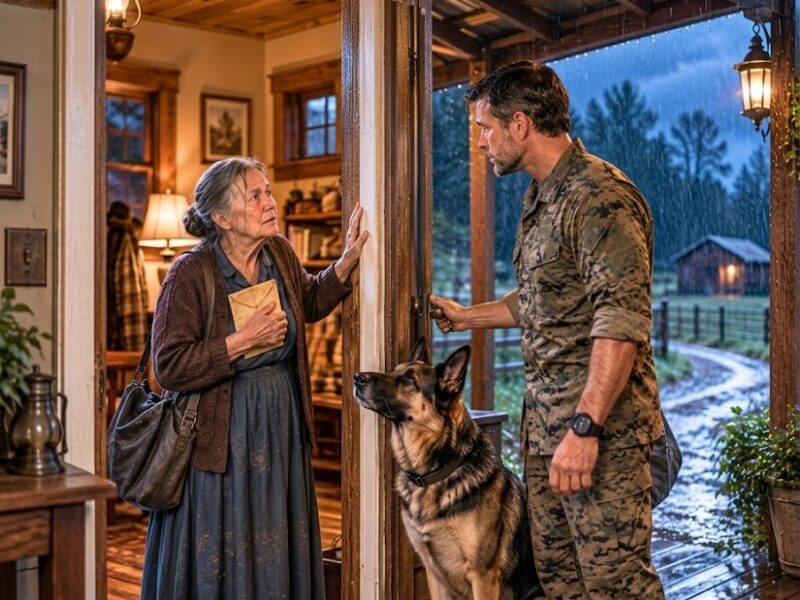
An Elderly Stranger Knocked on a Marine and His K9’s Door—What She Carried Turned Them Into a Family
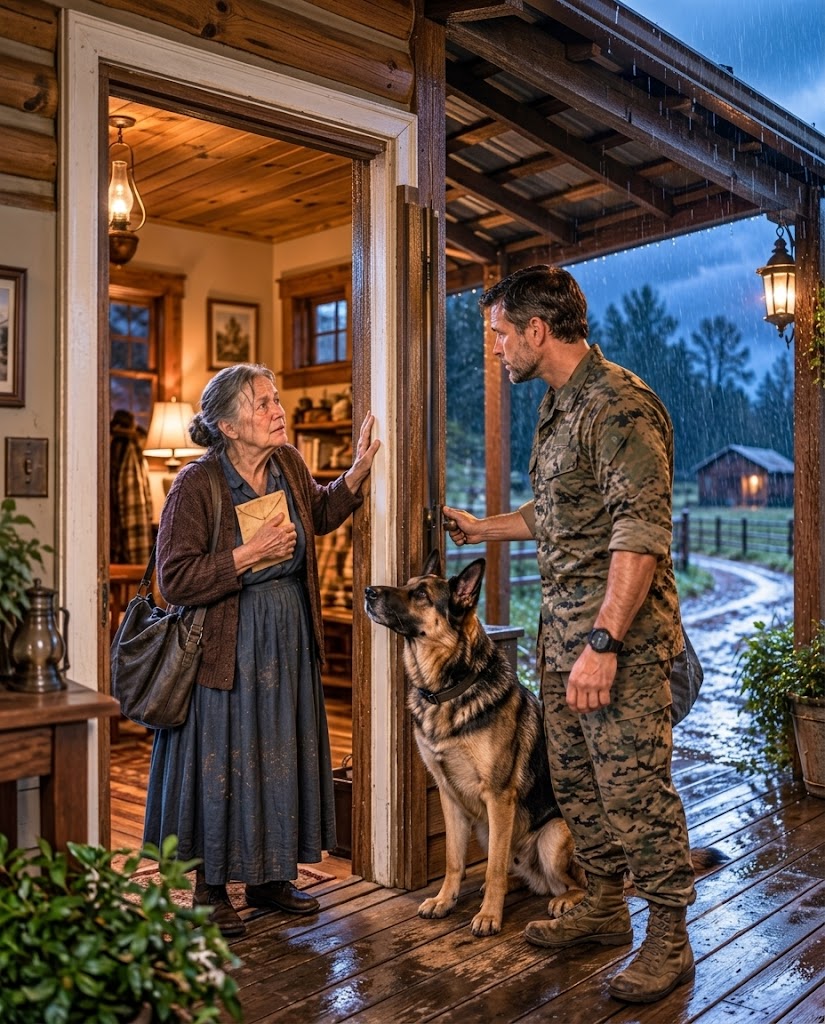
Three knocks echoed through a retired Marine’s farmhouse on a cold, rain-soaked night.
Outside stood an elderly woman, drenched and exhausted, carrying a letter tied to a family secret buried for 43 years.
Inside, a Marine struggling to find purpose after 22 years of service hesitated at the door while his retired German Shepherd stared into the darkness.
Neither of them knew that opening that door would uncover a father’s final regret, the truth behind why a 17-year-old boy walked away, and a choice that had waited 43 years to be made.
Sometimes one opened door can change more than one life.
Late November rain swept across the wooded hills west of Rowan Oak, Virginia, turning the narrow country roads black beneath bare branches and wrapping the isolated farmhouses in a cold, gray darkness.
Gunnery Sergeant Alden Strickland had spent 22 years learning that every hour should have a purpose.
At 44, nearly five months removed from the Marine Corps, he still woke at 4:50 each morning without an alarm.
He was six-foot-two, broad through the shoulders without being bulky, with short, dark brown hair beginning to gray at the temples, a square, weathered face, hazel eyes, and a neatly trimmed beard that had grown slightly fuller since retirement.
A thin, pale scar crossed the edge of his left jaw, noticeable only when light struck it from the side.
Alden was reserved rather than unfriendly, the kind of man who listened before speaking, and had spent so many years solving problems for other people that he had never considered what he might do when nobody brought him one.
His farmhouse sat beyond a narrow gravel road bordered by oak and pine, old but solid, with a stone chimney, a detached workshop, and more empty rooms than one man needed.
He had bought it because silence had sounded attractive while he was still surrounded by schedules, radios, engines, and voices calling his rank.
Now the silence occasionally felt like something watching him.
Beside the kitchen table lay Vesper, his eight-year-old retired German Shepherd, a powerful black and tan dog with intelligent amber-brown eyes, a small notch in his right ear, silver beginning around his muzzle, and hind legs that stiffened slightly on cold mornings.
Vesper had spent years working beside Alden and had adapted to retirement no better than his handler.
Whenever Alden picked up his truck keys, the dog rose immediately and waited beside the door, ears forward, ready for an instruction that rarely came.
That evening, Alden had done it accidentally while clearing the counter.
Vesper stood.
Alden looked at him, then slowly put the keys back down.
“Not going anywhere, partner.”
Vesper remained there another second before returning to his bed.
The small exchange bothered Alden more than he wanted to admit.
Two old habits living in one house, both still waiting to be useful.
Across Rowan Oak earlier that afternoon, 79-year-old Lenora Pritchard had been sorting through the possessions of a lifetime.
She was barely five-foot-four, slender without appearing frail, with pale blue-gray eyes, fine lines around a composed face, and silver hair gathered into a low bun.
Age had slowed her steps but not dulled her mind.
She lived independently, disliked being fussed over, and possessed the quiet stubbornness of someone who had survived enough years to know the difference between danger and inconvenience, though she did not always judge that difference perfectly.
She was preparing to move into a smaller apartment when she opened a battered cardboard box of family records that had followed her through several homes.
Inside an old account book, she found a yellowed envelope bearing her name in handwriting she recognized before consciously remembering it.
Hollis Pritchard.
Her older brother had been dead for more than four decades.
Lenora sat down before opening it.
The letter was brief, uneven, and painfully direct.
Hollis wrote that he had made a terrible mistake with his 17-year-old son, Gideon.
He did not explain the mistake.
One sentence stopped Lenora cold.
*I left something for Gideon where Dad used to hide the winter money.*
She read it again, then closed her eyes.
She knew the place—beneath the eastern window of the old Pritchard farmhouse.
Their father had once loosened a section of baseboard and hidden emergency cash inside the wall before winter.
Lenora had not entered that house in 43 years.
By mid-afternoon, she had hired a local driver, a quiet middle-aged man named Ray Dobbins, thick-set beneath a canvas jacket with graying hair and an easy, cautious manner.
He took her as far as the weather allowed.
Less than a mile from the farmhouse, a large oak had fallen across the secondary road, its branches tangled from ditch to ditch.
Water was already collecting behind them.
Ray wanted to turn around and offered to take Lenora home, but her phone map showed the house roughly three-quarters of a mile away.
She insisted she could manage the remaining distance and told him not to risk getting trapped if the creek rose.
It seemed reasonable while she could still see the road.
Twenty minutes later, darkness had swallowed the landmarks.
Lenora mistakenly followed an abandoned farm lane, discovered her error, and backtracked through mud while rain soaked through her coat.
Her phone died after repeated GPS checks.
For the first time that evening, she wondered whether determination had crossed quietly into foolishness.
But turning back no longer promised safety either.
At approximately 9:30, Vesper lifted his head from the kitchen floor.
Alden noticed immediately.
The dog’s ears angled toward the front of the house.
Then came three deliberate knocks.
Alden crossed the hallway and opened the door to find a soaked elderly woman beneath the porch light, one hand gripping a worn canvas bag, the other braced against the door frame.
She looked exhausted but entirely alert.
“Is this still the Pritchard house?”
“No, ma’am. I bought it nearly five months ago.”
Something moved behind her eyes—not surprise exactly, but the confirmation of something she had feared.
“Then I’m 43 years late.”
Alden brought her inside without another question.
He found towels, put water on for coffee, and watched Vesper study the stranger before settling several feet from her chair.
Lenora explained who she was and placed Hollis’s letter on the table.
Alden read it once, then again more slowly.
He could feel the old instinct returning—a problem, incomplete information, something that needed doing.
Yet Lenora was not asking him to solve her life.
She asked only whether the eastern room still existed.
“It does.”
She turned toward the dark hallway.
“Tomorrow morning,” Alden said. “We’ll look.”
Lenora nodded, but her gaze remained fixed on the room beyond the shadows.
“If Hollis was telling the truth,” she whispered, “something meant for Gideon has been inside that wall for 43 years.”
Behind them, the rain continued against the windows, and neither of them yet knew why Hollis had been so afraid he would never get the chance to give it to his son.
Morning came, cold and colorless over the hills west of Rowan Oak.
The rain had weakened to a thin drizzle, leaving the fields soaked and the bare trees shining beyond the farmhouse windows.
Alden found Lenora already sitting at the kitchen table when he came downstairs.
Hollis’s letter lay beside her cup, folded along the same old creases it had carried for more than four decades.
She had barely touched her coffee.
Her eyes kept drifting toward the hallway, and Alden understood without asking that she had probably been awake for hours.
Vesper followed him into the kitchen, stretched slowly against the stiffness in his hind legs, then settled near Lenora’s chair.
Alden poured himself coffee and gave the old woman time.
He had spent enough years around frightened young Marines, grieving families, and men waiting for news they could not control to know that silence was sometimes more useful than reassurance.
“You still remember exactly where it was?”
Lenora looked toward the eastern room.
“I remember where my father thought we didn’t know it was.”
That brought the faintest smile to Alden’s face.
The room at the end of the hall had become little more than storage since he bought the farmhouse.
Two unopened boxes sat against one wall, and an old bookcase leaned slightly toward the window.
Lenora entered slowly.
For several seconds, she said nothing.
Her attention moved from the stone chimney to the deep eastern window, then down toward the baseboard beneath it.
The paint was newer, the floor had been replaced, but the distance between the chimney and window had not changed.
She stepped closer and pointed.
“There.”
Alden crouched.
One short length of baseboard had nail spacing slightly different from the rest.
He went to the workshop and returned with a small pry bar, a hammer, and a thin block of wood.
Lenora watched as he protected the trim before applying pressure, working patiently rather than ripping into a wall that had stood longer than either of them had been alive.
The first nail eased free, then the second.
The board gave a dry groan and moved outward.
Dust drifted from the darkness behind it.
Alden reached inside.
His fingers touched paper.
Lenora stopped breathing for a moment.
He withdrew a small bundle wrapped in brittle waxed paper and placed it carefully on the floor.
Neither of them spoke as he unfolded the covering.
Inside were four faded photographs, an old storage receipt, and a small brass key hanging from a metal tag.
B17.
Lenora picked up one of the photographs with both hands.
Time had yellowed its edges, but the two figures remained clear.
Hollis stood beside an old pickup, tall and raw-boned, with dark hair pushed back from a long, angular face and the heavy hands of a man accustomed to mills, engines, and hard physical work.
Even in the photograph, there was something guarded around his eyes.
Beside him stood Gideon at 17, lean and long-legged, brown hair falling untidily over his forehead, his father’s narrow jaw softened by the gentler eyes he had inherited from his mother.
He was not smiling for the camera.
He looked as though he had been interrupted on his way somewhere else.
“He wasn’t trouble,” Lenora said quietly. “People called him difficult because that was easier than asking why he was angry.”
Alden remained beside the open wall.
Lenora told him Gideon’s mother had died several years before the photograph was taken.
Hollis had loved his wife deeply, but grief had not made him softer.
It had closed him down.
He worked longer shifts, came home exhausted, and began drinking at night.
He still paid every bill.
Food remained on the table.
Gideon had clothes, a roof, and a father who never missed work, but the house gradually became a place where two people could live ten feet apart and still be unable to reach each other.
Lenora tried to fill the space between them.
She brought meals when Hollis worked late, drove Gideon when he needed somewhere to go, and listened when the boy needed to speak.
The final argument began after she suggested Gideon stay with her for a while.
She had meant it as breathing room.
Hollis heard something else.
“You think I can’t raise my own son?”
“I think both of you are hurting each other.”
“He’s my boy.”
“Then stop making him feel like he has to survive you.”
Even after all those years, Lenora’s face tightened at the memory.
That was when he told me to get out.
She had left furious, expecting Hollis to cool down by morning.
She expected a telephone call.
When none came, pride kept her from making the first one.
Eleven days later, Hollis died in an accident at the mill.
Lenora returned to the farmhouse and found Gideon gone.
His backpack was missing.
So were some clothes and a few personal things.
There was no broken window, no sign of violence, nothing suggesting someone had taken him.
Police believed the 17-year-old had left voluntarily.
Lenora refused to accept that as the end of it.
For months, she called relatives, questioned his friends, checked places he had mentioned, and followed rumors that led nowhere.
Then one of Gideon’s friends received a postcard.
There was no return address.
Gideon wrote only enough to say that he was alive, safe, and did not want anyone trying to find him.
Lenora lowered the photograph.
“So I stopped looking.”
Alden glanced at her.
“Because he asked you to?”
“Yes.” Her voice nearly broke, but she held it steady. “Not because I stopped wanting him home.”
For more than four decades, she had believed Gideon left because the grief and anger inside the farmhouse had finally become unbearable, then chose to remain gone after learning his father was dead.
Hollis’s letter had shattered that explanation.
A father whose son simply ran away might carry regret, but Hollis had written that he had made a terrible mistake.
He had hidden something specifically for Gideon.
Whatever happened after Lenora walked out that night, Hollis had taken it to his grave.
Alden picked up the storage receipt.
The faded print showed a facility in Lexington, Virginia, and the same designation stamped onto the key.
Unit B17.
More importantly, the rental date preceded Gideon’s disappearance.
Lenora remembered Hollis renting storage after his wife died because he could not bring himself to throw away her belongings and needed room for tools from the mill.
B17 had already existed.
Whatever Hollis later placed there, he had not created the unit in a panic during the eleven days before his death.
Alden searched the business name on his phone.
Nothing current appeared.
The old address now belonged to another commercial property.
He made several calls and eventually confirmed through an archived business listing that a storage company had once operated there, but it had been gone for decades.
No one he reached could tell him what happened to its contents.
Lenora stared at the brass key resting in his palm.
“Then we’re probably too late.”
Alden looked at the faded B17 stamped into the metal.
“Probably isn’t definitely.”
He walked toward the kitchen and reached for his truck keys.
Before Alden could say a word, Vesper rose from beside the doorway.
The German Shepherd moved toward him with a little stiffness in his hindquarters, then stopped beside the front door, ears forward, waiting.
Yesterday, that sight had reminded Alden of everything the two of them no longer had.
This morning, for the first time in nearly five months, they actually had somewhere to go.
Alden clipped the lead to Vesper’s collar.
“All right, partner.”
Lenora buttoned her coat and closed her fingers around the little brass key.
Behind them, the eastern wall stood open and empty.
Ahead of them was a storage unit that had disappeared decades ago, and somewhere beyond it, perhaps the answer to what Hollis Pritchard had done during the eleven days before he died.
By late morning, the clouds over Lexington had lifted into a pale winter sky.
Water still ran along the curbs, and the wet brick storefronts reflected a weak strip of sunlight as Alden followed the last surviving trail of unit B17.
There was no storage locker waiting for them.
The facility had closed decades earlier, and after several calls, a visit to an old records office, and help from a retired clerk who knew where archived business files had been transferred, Alden found what remained of the answer.
Unclaimed contents from the old facility had been sold in bulk lots when it closed.
Unit numbers appeared beside purchaser names, and B17 led not to a family member or another storage company, but to a secondhand shop that had once operated near the edge of Lexington.
That business was gone, too.
Its former owner, however, was still alive.
His name was Walter Keen, 76.
A broad-bodied man diminished slightly by age, with thinning white hair, heavy gray eyebrows, and a round, weathered face marked by years of squinting through dust.
His hands were thick and scarred from decades of moving furniture and repairing things other people had discarded.
Walter spoke slowly, not because his mind was failing, but because he disliked claiming certainty where he had none.
He remembered buying several storage lots when the facility closed.
Most of the furniture had sold.
Tools disappeared piece by piece.
Boxes were opened, divided, and forgotten.
But when Alden showed him Hollis’s photograph and said the name Pritchard, Walter leaned back in his chair.
“Steel toolbox,” he said after a long silence. “Heavy son of a gun.”
Lenora leaned forward.
“You remember it?”
“I remember nobody wanted it.”
That was all.
No miracle of memory, no carefully preserved family relic.
Walter explained that when his shop eventually closed, he hauled whatever remained unsold to an old barn behind his house rather than pay someone to dispose of it.
Some of it had been sitting there ever since.
The barn smelled of dry hay, rust, and old wood.
Vesper remained close to Alden while Walter led them between leaning shelves and stacks of forgotten household goods.
They searched by hand.
Alden shifted boxes while Lenora checked faded labels, and Walter tried to remember where heavier items had been placed.
Nearly forty minutes passed before Alden moved two cracked plastic bins and saw the corner of dark steel beneath a collapsed cardboard carton.
White paint showed through the rust.
H. Pritchard.
Lenora stopped several feet away.
Alden pulled the toolbox free.
The brass B17 key did not fit its lock.
Walter disappeared into the house and returned with a ring of old shop keys, eventually finding one that opened it.
Inside lay a folded denim jacket, several photographs tied with string, a small notebook, and a cassette sealed inside a plastic bag.
Lenora recognized the jacket first.
Gideon’s.
Her hand rested against the faded denim but did not lift it.
Walter found an old cassette player in the house.
It took cleaning the battery contacts and two attempts before the machine worked.
Then the reels began to turn.
Static filled the barn.
A man’s breathing followed.
Hollis’s voice came through thin and damaged by time.
He did not begin with an excuse.
He began with Gideon’s name.
Hollis said that after Lenora left the farmhouse that night, he kept drinking.
Gideon came downstairs angry and demanded to know why he had driven away the one person still trying to help them.
Hollis told him to stay out of it.
Gideon refused.
The boy accused his father of turning grief into punishment for everyone around him.
Hollis shouted back.
One sentence became another until neither was listening.
Then Hollis said the words that changed everything.
If Gideon walked through that door, he should never come back.
The barn became completely still.
Hollis’s recorded voice cracked as he described watching his 17-year-old son take his jacket and backpack and leave.
Pride kept him from following.
Alcohol let him pretend he meant what he had said.
Morning took both away.
Hollis woke before sunrise, found Gideon’s room empty, and understood what he had done.
For the next several days, he searched.
He checked the bus station, drove to friends’ houses, returned to places Gideon sometimes went to be alone.
He asked questions that humiliated him because humiliation no longer mattered.
He searched again the next morning and the morning after that.
Each night he returned to an empty farmhouse.
The cassette had pauses where Hollis seemed unable to continue.
He explained that he had placed some of Gideon’s things in B17 because he could not bear looking at them and could not bear throwing them away.
He recorded the tape in case his son came back after Hollis was gone.
Then he hid the storage receipt and key behind the eastern baseboard where his father had once kept winter money.
Lenora would know the place if she ever returned.
Then came the part Lenora had never known.
Hollis had written her a letter.
He meant to send it.
Each day he told himself he would do it after he found Gideon.
He wanted to bring his son home first, then face his sister and admit exactly what he had done.
Shame became delay.
Delay became another day.
There was no other day after the eleventh.
The mill accident took him before he could send the letter.
On the cassette, Hollis fell silent for so long that Alden thought the tape had ended.
Then his voice returned.
“If Gideon ever hears this, tell him something for me.”
Static whispered between the words.
“You weren’t unwanted. Your father was just too broken to say he was wrong.”
Lenora lowered her head.
She did not sob.
That somehow made the grief harder to watch.
For decades, she had carried guilt for leaving the farmhouse that night, believing Gideon had simply reached his limit and disappeared.
Now she understood that he had walked away because his own father had told him not to return.
Alden stared at the cassette player.
His first instinct arrived with the force of muscle memory.
Find Gideon.
There was a name, an approximate age.
A trail could be built.
“We can look for him.”
Lenora raised her eyes.
“I mean it. There are ways to know.”
Alden stopped.
“He deserves to hear this.”
“Yes. Then we find him.”
Lenora stood slowly, one hand resting on Gideon’s denim jacket.
“No, Alden. We find a way to give him a choice.”
The distinction frustrated him more than he expected.
“He may never know unless somebody does something.”
“And doing something doesn’t give us the right to decide what happens afterward.”
Alden said nothing.
Lenora looked at the cassette that had waited decades for a 17-year-old boy who was now an older man with a life none of them knew.
“I want him to know his father regretted those words. I want him to know the truth.”
She drew a slow breath.
“But I didn’t come here to drag a 60-year-old man back into a life he escaped.”
Alden looked down at Vesper resting quietly beside his boot.
For 22 years, a problem had meant action.
Identify it, reach it, fix what could be fixed.
But Gideon Pritchard was not a mission.
And for the first time since Lenora knocked on his door, Alden understood that helping someone might require him to stop before the part he knew best.
December settled quietly over the hills west of Rowan Oak, bringing hard white mornings, bare fields, and thin ice along the farmhouse gutters.
The mystery had given them an answer.
What came next required something Alden had always found harder than action.
Patience.
They did not drive to Tennessee.
Alden did not turn Gideon into a target to be located, contacted, and brought home.
Instead, he and Lenora spent several evenings checking ordinary public records, old directories, and publicly available listings until one name appeared often enough to matter.
Gideon Pritchard, approximately the right age, living in Knoxville.
There was no certainty at first, only a reasonable possibility.
Alden could have pushed further.
Once he started following a trail, every instinct in him wanted confirmation before stopping.
But Gideon had once asked not to be found.
Being able to cross a boundary did not make crossing it right.
When they had a likely mailing address, Alden closed the laptop.
“That’s as far as we go.”
Lenora understood what that decision cost him.
She wrote the letter by hand at Alden’s kitchen table.
Three pages became four because she kept crossing out sentences that sounded too much like explanations.
At one point she wrote, *I only wanted what was best for you.*
Stared at it, then drew a line through the words.
“Why take that out?” Alden asked.
“Because good intentions don’t erase what happened.”
She started again.
Lenora told Gideon what she had learned about the night he left.
She admitted she had walked away after arguing with Hollis and had spent decades believing she understood what happened afterward.
She told him about B17, the toolbox, and the cassette.
She apologized for not knowing the truth sooner, but attached no request to the apology.
She did not ask Gideon to forgive Hollis.
She did not ask him to forgive her.
She did not ask him to come back to Virginia.
*You do not owe me a reply. You do not owe your father forgiveness because he regretted what he did. I only believe you deserve to know that his last words to you were not the whole truth. The recording is here if you ever want it.*
At the bottom, she wrote her apartment address and, with Alden’s permission, the farmhouse address beneath it.
The next morning, she mailed the envelope herself.
Then they waited.
One week passed, then three, then more than a month.
At first, Alden caught himself treating the silence like an unfinished task.
Once he almost asked Lenora whether she wanted him to check if the letter had been delivered.
He stopped before the words came out.
Gideon had been given the truth and a choice.
Alden was beginning to understand that respecting that choice meant accepting the silence that came with it.
Lenora returned to her apartment in Rowan Oak and continued living independently exactly as she had before appearing at the farmhouse in the rain.
But on some Saturdays, she rode a bus toward the countryside and Alden picked her up from a stop several miles away.
By the third Saturday, Vesper understood the routine.
Shortly before the usual pickup time, the German Shepherd began settling near the front door.
When Lenora arrived, his tail moved in a slow sweep against the floor before he followed her toward the kitchen or the neglected garden beds behind the house.
Lenora cleared dead stems from two narrow beds she hoped to plant when spring came.
Alden repaired the loose leg on a chair from her apartment, replaced the cracked cord on an old tabletop radio, and tightened the handle on a kitchen drawer she had mentioned only once.
One Saturday, she brought the repaired radio back and let an old country station play quietly in the kitchen.
The farmhouse no longer seemed quite so determined to remain silent.
Their Saturdays developed without either of them naming what they were becoming.
One afternoon, Lenora found Alden standing in the detached workshop.
Tools hung in perfect rows above a workbench he had barely used since moving in.
“You know what your problem is?” she asked.
Alden glanced at her.
“I’m sure you’re about to tell me.”
“You think usefulness has to come with orders.”
He almost laughed, then realized she was serious.
For 22 years, someone had always needed him somewhere.
There had been times to report, equipment to inspect, people to prepare, and problems that became his because duty said they were his.
Retirement had removed the structure without removing the man trained to live inside it.
“I don’t know what replaces it,” he admitted.
“Maybe nothing should.”
Alden looked at her.
“Maybe you don’t replace 22 years. Maybe you build the life you never had time to live while you were busy serving everybody else’s.”
A few days later, an elderly neighbor named Harold Mercer arrived with a damaged walker.
Harold was 81, thin and slightly stooped, with wispy white hair, a narrow, weathered face, and the stubborn embarrassment of a man who hated asking anyone for help.
One front wheel kept locking sideways.
Alden repaired it in twenty minutes.
“What do I owe you?”
“Nothing.”
“I didn’t ask for charity.”
“Good. I’m not offering any.”
Alden nodded toward the coffee pot.
“You can make coffee.”
Harold smiled.
The following week, he returned with a lawn mower belonging to his widowed sister.
Then someone else heard Alden could repair a sagging door.
Another neighbor needed a loose porch step reinforced before winter ice made it dangerous.
Without planning it, Alden began opening the workshop most mornings.
There was no sign outside, no organization, and no donation jar.
He charged for parts when necessary and often nothing for labor.
The jobs were small—walkers, chairs, mower blades, doors, loose steps.
But Alden began noticing what those small repairs meant to people who wanted to remain independent in their own homes.
Vesper found his place, too.
Most mornings he lay across the workshop doorway where winter sunlight reached the concrete, lifting his head when someone approached and lowering it once he decided everything was fine.
One morning, Alden picked up his truck keys.
Vesper opened one eye.
He did not move.
Alden stopped.
For years, the sound of keys had meant work, a vehicle, a destination, an order waiting somewhere beyond the door.
Now, Vesper simply lowered his head again.
Alden smiled.
“Yeah, partner. I think we’re figuring it out.”
Nearly six weeks after Lenora mailed the letter, Alden drove to collect her for another Saturday.
She was waiting at the bus stop with one hand inside her coat pocket and an expression he could not read.
She said nothing until they reached the farmhouse.
Then she placed a postcard on the kitchen table.
The postmark was Tennessee.
Alden did not touch it.
Lenora turned it over.
There were only nine words beneath her name.
*I received your letter. I need some time. Gideon.*
Lenora read it once, then again.
There was no forgiveness in those words, no promise, no invitation, nothing saying Gideon would ever come to Virginia or listen to his father’s voice.
But Lenora pressed the postcard gently against the table as tears gathered in her eyes.
After 43 years, she finally knew Gideon Pritchard was alive, and this time the next choice belonged entirely to him.
Late winter rain moved softly across the farmhouse windows, lighter than the storm that had brought Lenora there months earlier.
Inside, supper dishes covered the kitchen table while Vesper slept beneath it, his silvering muzzle resting across Alden’s boot.
Nearly six weeks had passed since the postcard from Tennessee.
A few days after it arrived, Gideon had sent one brief request, asking Lenora to mail him a copy of Hollis’s cassette.
She did exactly that without adding another letter or asking what he intended to do with it.
Afterward, silence returned.
There had been no promise of a visit, no telephone call, nothing to suggest Gideon was ready for anything more.
Lenora had learned not to interpret that silence as rejection, and Alden had learned not to search for answers that belonged to someone else.
They were finishing coffee when Vesper’s head suddenly lifted.
His ears turned toward the hallway.
A second later, three measured knocks sounded from the front door.
Alden and Lenora looked at each other.
Vesper rose.
Alden crossed the hallway and opened the door.
The man beneath the porch light appeared to be around sixty, a little over six feet tall and leaner than Hollis had been, with brown hair now mostly gray, cut short around a long, narrow face.
Deep lines bracketed his mouth, and a close-trimmed gray beard sharpened a jaw Alden recognized from the photograph in the toolbox.
He wore a dark rain jacket and held no luggage, only his car keys.
His posture was cautious rather than weak, the posture of someone who had driven a long distance while still arguing with himself about whether to complete the final few steps.
Lenora appeared behind Alden.
The man’s eyes found her.
Age had changed almost everything else, but not those eyes.
“Gideon.”
He swallowed.
“I almost didn’t come.”
Lenora did not move toward him.
“You didn’t owe me coming.”
Something in Gideon’s face shifted.
Perhaps he had prepared himself for tears, apologies, or arms reaching toward him before he was ready.
Instead, Lenora stepped aside and left the doorway open.
Gideon looked into the house where he had once been told never to return.
Then he crossed the threshold.
There was no embrace.
Alden introduced himself only briefly.
Vesper approached, sniffed Gideon’s lowered hand, and stepped back without ceremony.
Alden understood that the room no longer belonged to him.
He took his coat from the hook.
“I’ll be in the workshop.”
He touched Vesper’s shoulder.
“Come on, partner.”
The German Shepherd followed him into the rain.
Inside, Lenora and Gideon sat across from one another at the same kitchen table where she had written the letter.
At first, they spoke about small things because 43 years could not be crossed in a single sentence.
Gideon told her he had taken a bus out of Virginia the night he left.
He moved from place to place, working wherever someone would hire a 17-year-old who asked few questions.
Eventually, Tennessee became home.
He married.
He built a life.
He had two children, both grown now.
“The postcard?” Lenora asked.
“It was mine.”
Gideon remembered sending it to an old friend because he knew people were searching.
At 17, anger had felt like the only thing he still controlled.
His father had told him not to return, so he decided nobody from that life would get to tell him where to go next.
“I wanted everyone to stop looking, so I did.”
“I know.”
Years later, Gideon sometimes wondered about Lenora.
He thought about writing when he married.
Again when his first child was born, and again after becoming older than Hollis had ever lived to be.
But every year of silence made the next year harder to break.
“After a while,” he said, “you don’t know whether you’re protecting yourself or just protecting the decision you made when you were 17.”
Lenora lowered her eyes.
“You listen to the cassette?”
Gideon was quiet for a moment.
“Three times.”
She looked up.
“The first time I was angry. The second time I kept stopping it.”
He rubbed a thumb slowly across his knuckles.
“The third time I just listened.”
Hearing Hollis’s voice had not repaired anything.
The words his father shouted that night still belonged to Hollis.
Regret did not erase them, and Gideon had spent too many years living with their consequences to pretend a recording could make them disappear.
“But I spent most of my life believing he meant them,” Gideon said. “Every word.”
Lenora waited.
“Now I know he meant them for one terrible minute.”
That was different from forgiveness.
It was also different from 43 years of believing he had been unwanted.
When Alden returned later, Gideon was standing near the front door.
Lenora remained several feet away.
Neither looked transformed.
Some wounds were too old for that kind of ending.
Gideon reached for the door, then stopped.
“Lenora?”
“Yes.”
“Would you like to meet my kids sometime?”
Her hand rose briefly to her mouth.
“Yes,” she said. “Whenever you’re ready.”
Gideon nodded.
That was all.
It was enough.
In the months that followed, reconciliation came unevenly.
Gideon returned to Virginia occasionally.
Some visits lasted a weekend, others only an afternoon.
There were conversations that ended in laughter and others that ended with both him and Lenora staring at their coffee because neither knew what to say next.
But silence no longer automatically meant disappearance.
Sometimes Gideon worked beside Alden in the workshop, sanding a chair or holding a door steady while Alden reset a hinge.
The workshop changed too, though never into anything grand.
People continued arriving with walkers, lawn equipment, broken chairs, and small problems that mattered because independence was often held together by small things.
One spring morning, Corporal Mason Hale, a 26-year-old Marine recently separated from service, arrived after Harold sent him over.
Mason was tall and wiry with close-cropped sandy hair, a clean-shaven, angular face, and restless green eyes that kept scanning the workshop as though he expected someone to tell him where to stand.
He had spent his entire adult life inside a structure he suddenly no longer possessed.
“Mr. Mercer said you might need help a couple days a week.”
“I might.”
Mason looked toward the tools.
“What would I be doing today?”
“Fixing Mrs. Bell’s porch railing.”
The young Marine nodded as though relieved to have somewhere to begin.
Vesper walked over, sniffed Mason’s hand, then lowered himself beside his boot.
Alden looked at the old canine and understood.
Neither of them had stopped serving.
They had simply stopped needing orders to do it.
Months later, on a quiet Saturday afternoon, Lenora stood at the farmhouse entrance, preparing to return to her apartment.
Through the open workshop door, Gideon was finishing the repair on an old wooden chair.
Vesper slept nearby in a patch of warmth, no longer waiting for keys, commands, or the sound of a vehicle starting.
Lenora rested her hand against the door frame.
“You ever regret opening that door?”
Alden looked past her.
The farmhouse that had once been almost painfully silent now carried the distant scrape of sandpaper from the workshop, a radio playing softly in the kitchen, and Gideon’s occasional voice complaining about Alden’s choice of tools.
Alden smiled.
“Ma’am, I think that door opened both ways.”
Lenora had once arrived there believing she was 43 years too late.
Gideon had once crossed that same threshold because an angry father told him never to return.
Decades later, nobody ordered him back through it.
Nobody begged him.
Nobody promised that crossing it would erase what happened.
He chose.
That was what made the difference.
Lenora found a road back toward a family.
Gideon found a truth about his father that did not require him to forget the pain.
Alden and Vesper found purpose after the last official mission ended.
There had been no miracle, only a door and people finally willing to let one another choose whether to walk through it.
Sometimes God’s miracles do not arrive with thunder, signs, or answers we immediately understand.
Sometimes they come as three quiet knocks on a door we almost choose not to open.
Lenora could not recover the 43 years she lost with Gideon.
Gideon could not erase the words that wounded him as a boy.
And Alden could not return to the life of purpose he once knew.
But God does not always heal us by giving back what was lost.
Sometimes He places someone in our path who helps us discover what can still be built.
Maybe there is a door in your own life that has remained closed because of pride, pain, fear, or too many years of silence.
You may not be able to change yesterday.
But while God gives us another day, there is still time to choose kindness, to speak the truth, to forgive when we are ready, or simply to leave the door open for someone who may one day return.
If this story touched your heart, share it with someone who may need that reminder today.
Tell us in the comments where you’re watching from and what this story meant to you, and subscribe to the channel for more stories about faith, loyalty, compassion, and second chances.
May God bless you and your family, protect those you love, bring peace to the wounds you carry, and guide you toward every door He still intends for you to open.
Amen.









