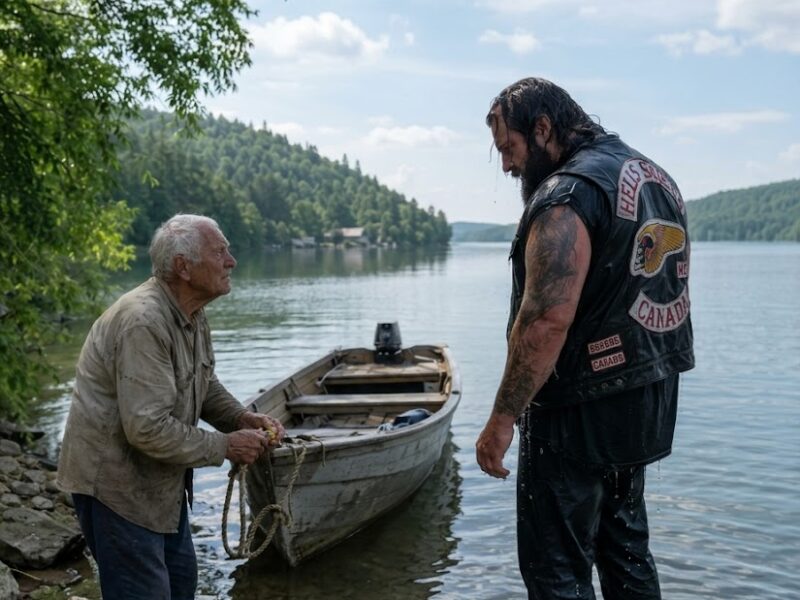
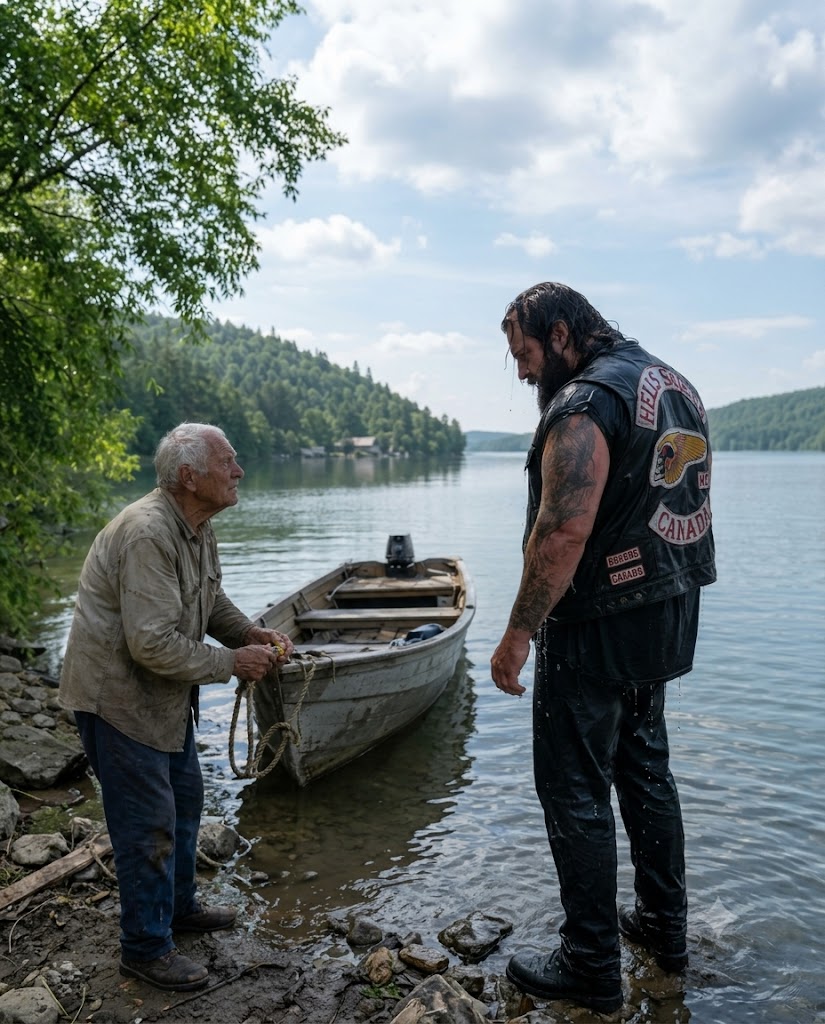
An elderly ferryman carried a stranded biker across a flooded river on his back. At dawn, 670 Hells Angels arrived.
The Cumberland River had a particular way of rising without announcement.
It didn’t roar or crash the way rivers did in movies. It simply climbed patient and indifferent, swallowing the lower banks inch by inch until the cattails disappeared and the old dock pilings stood like forgotten tombstones in a brown churning expanse that bore no resemblance to the river people thought they knew.
Walter Callaway had watched it rise this way sixty-one times. He knew its moods the way a man knows the moods of someone he has lived beside for decades, not with affection exactly, but with the deep bone-level familiarity that leaves no room for surprise.
He was standing on the loading dock of the Harlow’s Crossing Ferry Terminal when the rain came back on the second morning. Not the heavy rain of the night before, which had hammered the corrugated roof of his toolshed like gravel thrown from a passing truck, but a thin, gray, persistent rain that turned the wooden planks dark and made the whole world smell like wet iron and old leaves.
Walter pulled his canvas work jacket tighter and looked out at the water. The far bank was nearly invisible through the mist. He could see the outline of the tree line, bare oaks and sycamores standing knee-deep in overflow, but nothing beyond that.
Harlow’s Crossing was an island this morning, same as it had been on and off for the past three days. The ferry itself was a flat-bottomed aluminum pontoon barge, thirty-eight feet long with a small pilot house bolted to the starboard side and a chain-link safety railing along both gunnels.
Walter had bought it second-hand from a salvage company in Clarksville eleven years ago after the county decommissioned its old cable ferry. He had spent the better part of two summers repainting it, rerouting the hydraulic steering, and replacing the two outboard motors with a single low-profile inboard diesel that he trusted with his life, which he did regularly.
The river crossing at Harlow’s was just under three hundred yards wide under normal conditions. During a flood event with the water six feet above normal pool, the actual distance a ferry crossing covered, accounting for upstream correction and current compensation, was closer to seven hundred yards.
Walter knew this mathematically and instinctively. The river didn’t scare him anymore, but it still required his full attention every time. He’d put up a handwritten sign on the approach road three days ago. *Ferry suspended, high water event, reopen when safe.*
He’d posted the same notice on the hardware store bulletin board in town, called the county road department, and left a message on the church voicemail that people sometimes checked for community news. He’d done everything right, which meant that when he heard the motorcycle coming down the gravel access road at half past seven in the morning, he wasn’t prepared for it.
The bike came in slow, the engine dropping to a low, unhurried idle that he could feel more than hear beneath the sound of rain on the dock roof. It was a big machine, a touring motorcycle, the kind built for distance with hard saddlebags and a windshield and a headlight that cut through the mist like a single pale eye.
The rider pulled up alongside Walter’s old Ford pickup and killed the engine. He sat there for a moment without moving. Then he swung his leg over and stood up, and Walter saw that he was a large man, not tall but broad, with a solidity to him that reminded Walter of fence posts set in concrete, wearing a rain-soaked leather jacket with a vest over it.
The vest was black with patches, and even from across the dock Walter could read the largest one. *Hells Angels* in block letters arcing over a grinning death’s head. Walter had seen the patch before over the years. He didn’t have particular feelings about it one way or the other.
He’d grown up in a county where people formed strong opinions about strangers based on what they wore or what they drove, and he’d spent seventy-four years quietly concluding that those opinions were more about the people holding them than the strangers they described.
The man walked to the edge of the dock and looked at the river. He took off his helmet, revealing a face that was older than Walter expected, with deep-set brown eyes and a jaw shadowed with several days of dark gray stubble, and held it under his arm. He didn’t say anything for a long moment.
“Sign said the ferry was closed,” the man finally said. His voice was flat and even, a Midwestern voice stripped of regional color by years of distance.
“It is,” Walter said.
“How bad is it?”
Walter looked out at the water. “Six feet above normal pool. Currents running maybe eight, nine miles an hour at mid-channel. Lot of debris.”
The man nodded slowly. He was looking at the far bank the same way Walter looked at it sometimes, not searching for something specific, just taking stock.
“I need to get across,” he said. “My daughter’s in Cookeville. She had a baby two days ago, premature, twenty-six weeks.” He stopped. “I’ve been riding from Kansas City since yesterday morning.”
Walter looked at him. The man wasn’t asking for pity. He was just stating facts, the way people in difficult situations sometimes strip their words down to essentials, because essentials were all they had energy for.
“Where’s the next bridge?” the man asked.
“Smithfield Crossing, twenty-two miles north, but the county road on the north approach washed out last night. You’d have to go all the way to Ashland to get around it. That’s sixty, maybe seventy miles out of your way, plus backtracking.”
The man absorbed this. He looked at his motorcycle, then at the ferry, then at the river again. His jaw tightened briefly and then relaxed.
“All right,” he said. He reached into his jacket and produced a wallet that was thick and dark from years of use. “What do you charge?”
“Twenty dollars for a motorcycle,” Walter said, “but the ferry’s closed.”
“I can pay more.”
“It’s not about money.”
Walter paused. He looked at the river again. He’d been running this ferry for eleven years and he’d never made a crossing he wasn’t comfortable with. That was his rule, his only rule, the one that had kept him alive and kept his passengers alive and kept his operating license intact through three different county administrations.
But he also understood the arithmetic of a twenty-six-week premature baby and a father who had ridden through the night from Kansas City. He was quiet for a long time. The rain moved through in a curtain and then thinned again.
“Wait here,” he said.
He went into the pilot house and pulled up the National Weather Service gauge report on his phone. The Cumberland at Harlow’s was at 18.4 feet. Flood stage was 12 feet. Action stage, the point at which Walter’s personal operating rules required suspension, was 16 feet.
He was 2 feet and 4 inches above his own limit. But the gauge had peaked at 19.1 the previous evening, which meant the river was dropping, slowly but dropping. He checked the radar on a second application. The main rain band had moved through. Scattered showers for the next several hours, then clearing.
He walked back to the dock.
“I’ll take you across,” he said. “I’m not supposed to by my own rules. River’s above my operating threshold, but it’s falling and the debris load is lighter than it was at peak.” He looked at the man steadily. “You understand the risk you’re taking?”
The man looked back at him with the same steadiness. “I understand.”
“Load the bike yourself. I’ll walk you through how to tie it down. And if I tell you to do something on the water, you do it without asking why.”
“Yes, sir,” the man said. He said it naturally, without irony, the way someone says it when they mean it.
It took them twelve minutes to load the motorcycle onto the barge deck, run the wheel chocks, and run three separate tie-down straps from the frame to the deck cleats. Walter checked each strap twice.
He started the diesel and let it warm for four minutes. He checked the bilge pump, the running lights, both fire extinguishers, and the life ring. He did all of this methodically and without hurrying, because hurrying was how people died on the water.
“What’s your name?” he asked as they cast off the bowline.
“Earl,” the man said. “Earl Bowman.”
“Walter Callaway.”
He put the ferry in gear. “Stay behind me in the pilot house unless I tell you otherwise. Keep your hands off the rails when we’re fighting the current. If we take a big piece of debris and the boat lurches, the rail is the first thing that’ll throw you over the side.”
Earl nodded and stepped back without a word.
—
The crossing took thirty-one minutes. Under normal conditions, it took eight. Walter spent the entire time reading the water the way he had learned to read it over six decades of living beside it, watching the surface patterns that indicated subsurface currents, noting the movement of debris to calculate flow velocity, correcting constantly for the push of the water against the hull.
He took the ferry two hundred yards upstream before beginning his crosscurrent transit, which gave him the angle he needed to reach the far landing rather than being swept a quarter mile downriver. A half-submerged propane tank came out of the mist on their port side, and he steered around it without comment.
Earl stood behind him the whole time, silent, watching the river with those dark eyes. He didn’t ask questions. He didn’t make conversation. He just watched, and occasionally Walter could hear him breathing with a kind of controlled steadiness, the way someone breathes when they are managing something.
They touched the far landing with a bump that Walter minimized by cutting the engine at precisely the right moment and letting the hull drift the last twenty feet. He dropped the bow ramp himself and helped Earl release the tie-downs.
The motorcycle rolled off the barge and onto the gravel ramp of the far landing without incident. Earl stood there for a moment, helmet in his hands. He opened his wallet again.
“What do I owe you?”
“Nothing,” Walter said.
The words seemed to land strangely. Earl looked at him.
“Ferry’s closed,” Walter said simply. “I’m not running a commercial crossing. You needed to get to your daughter. I had a boat that could do it.” He shrugged, a small motion of his shoulders. “That’s all it is.”
Earl studied him for a long moment. “That’s not nothing,” he said.
“It’s not a transaction, either.” Walter looked past him at the river, then back. “How far to Cookeville from here?”
“Forty minutes.”
“Ride safe. Roads are going to be wet, and there’ll be standing water in the low spots.”
Earl put his helmet on. He started the motorcycle and sat there for a moment with the engine running, looking at Walter with an expression that was difficult to read. Something between gratitude and a kind of weight, like a man who has just received something he doesn’t know how to carry.
He gave a single nod, then he pulled out of the gravel ramp and onto the county road and was gone, the sound of the engine fading quickly into the rain and the gray morning.
Walter turned the ferry around and made the return crossing alone. It was harder going back. With no counterweight on the deck, he had to fight the current the whole way. By the time he tied up at his own dock, his hands were shaking slightly from grip fatigue, and his right knee, the one he’d had replaced six years ago, ached with the deep, dull persistence that always followed a long time on his feet in the cold.
He went inside his house, which sat fifty yards back from the dock at the end of a gravel path, and made a pot of coffee, and sat at his kitchen table. The table was old, an oak table he’d had for forty years, the surface worn smooth in the spots where plates and elbows and coffee mugs had lived.
His wife, Carol, had bought it at an estate sale the year they moved into this house back when they were young and poor and not yet sure that anything would work out. Carol had been gone for seven years. The table remained.
He drank his coffee and watched the rain come and go through the kitchen window and after a while he stopped thinking about the crossing and started thinking about the week’s accounts, the fuel bill, the maintenance schedule for the diesel, the county permit renewal that was due next month. Ordinary things.
The ferry was a small operation. It had always been small. It had never made him rich and it had occasionally made him nothing at all during high water events. But it was his in the fullest sense of that word, built with his own labor, run with his own judgment, answerable to no one but the river and the people who needed to cross it.
He didn’t think of himself as having done anything particular that morning. A man needed to get somewhere. He had a way to get him there. The calculation had seemed simple enough.
He had no idea, sitting there at his oak table with his second cup of coffee going cold, that it wasn’t simple at all. That somewhere forty miles east of Harlow’s Crossing, the large man with the death’s head patches and the dark steady eyes was pulling into a hospital parking garage in Cookeville, Tennessee and that within the next hour he would be standing at a glass window in a neonatal intensive care unit looking at a child who weighed less than two pounds connected to machines that breathed for her, alive.
And that while he stood there he would be making a phone call and then another. And then another.
—
The afternoon passed quietly. The rain thinned by two o’clock and stopped entirely by four. Walter spent an hour checking the dock lines and walking the length of the barge to inspect the hull for debris impact damage. A log or a piece of fencing moving at current speed could dent aluminum, and he found nothing concerning.
He ate an early dinner alone, a bowl of soup heated on the stove, and watched the local weather report on the small television he kept on the kitchen counter. The river would drop another foot by morning. He’d be back in operation by the day after tomorrow if conditions held.
He went to bed at nine. He woke at eleven to a sound he couldn’t immediately identify.
It was not a threatening sound. It was low and layered and rhythmic, the kind of sound that takes a moment to resolve into its component parts. He lay in the dark for several seconds blinking. Then he understood.
Motorcycles. Not one or two. Many.
The sound was growing, not diminishing, which meant they were coming toward him, not passing. He got up, put on his work pants and his heavy shirt and his boots, and went to the front window.
The sight that met him was one he would spend years trying to describe accurately and never quite manage. The county road that fronted his property, a two-lane blacktop that saw perhaps forty vehicles on a busy day, was filled bank to bank with motorcycles.
They were moving in pairs, their headlights throwing long columns of white light through the darkness, and they were pulling off onto his gravel access road, his parking area, the flat field beside the dock in an orderly and purposeful way. No one was speeding. No one was revving unnecessarily. They rode the way professional drivers ride, economically, with awareness, occupying their space and no more.
But there were so many of them, so many. Walter stood at his window for perhaps thirty seconds. Then he put on his jacket and went outside.
The night air was cool and still and smelled of rain and engine heat and the specific mineral scent of the river after a flood. His gravel drive, his parking area, the field, all of it was filling with parked motorcycles, row after careful row, and their riders were dismounting and removing helmets and standing in groups of two and three, talking quietly.
They were men and women of various ages, most of them wearing black leather vests with the same patch he’d seen that morning, though the details varied. Different chapter names arcing below the main insignia, different positions and insignia indicating different roles. Some were older than Walter himself. Some were young enough to be his grandchildren.
All of them, without exception, stopped whatever they were doing when they saw him come out of his house. The nearest group fell silent. Then the next. It spread outward like a ripple in still water until the whole assembly was looking at him and the only sounds were the ticking of cooling engines and the distant murmur of the river.
Walter stood on his porch and looked back at them. His heart was beating harder than usual. He would admit that later, but he was also underneath the surprise simply and profoundly curious.
A path opened through the crowd. Earl Bowman walked through it and stopped at the bottom of Walter’s porch steps. He was not wearing his riding gear anymore. He was wearing a clean shirt under his vest and someone had done something about his hair and the four days of road grime had been washed from his face.
He looked like what he was, a middle-aged man who had been through something enormous and was still moving through it. His eyes were different from the morning, too. Still the same steady brown, but changed in some way that Walter couldn’t precisely name, as though something behind them had shifted, rearranged itself into a new configuration.
“Mr. Calloway,” he said.
“Mr. Bowman,” Walter replied. He looked at the assembled crowd. “You brought some friends.”
Something passed briefly across Earl’s face. Almost a smile, but weighted with too much feeling to be exactly that. “Six hundred and seventy-one of them,” he said, “including me.”
Walter looked at the field. He believed it.
“My daughter’s name is Melissa,” Earl said. “She’s thirty-two years old and her husband’s overseas deployed and she had nobody. Her baby, my granddaughter, she’s twenty-six weeks and four days old and she weighs one pound eleven ounces and she’s breathing on her own now. They took her off the ventilator an hour ago.”
He stopped. His voice was level and precise, but the precision was the effort of a man keeping something contained. “If I hadn’t made it this morning, I would have missed that. I would have been on the wrong side of a river in a rainstorm while my daughter needed me.”
“She might have been fine regardless,” Walter said.
“That’s not the point,” Earl said quietly. “The point is you didn’t have to do it. The sign said closed. You were within every right to send me away and you didn’t.”
He paused. “I called some people on my way to the hospital. They called some people. We are not—” He seemed to search for language. “People have a lot of ideas about who we are. Most of those ideas are wrong. What we are mostly is people who show up when someone needs something.”
He looked at Walter steadily. “So, we’re here to show up.”
Walter was quiet for a moment. He looked at the field of motorcycles and the people standing between them, all of them watching him in the cool night air. He was aware of a sensation he hadn’t felt in a long time, not since Carol was alive, not since his children were small and the world seemed large and populated with people who might show up at unexpected moments.
It was the sensation of being inside something larger than himself, not overwhelmed by it, but held by it, the way a river holds a boat, not gently exactly, but completely.
“What did you have in mind?” he asked.
—
They worked through the night and into the next day and the day after that. Walter would have trouble afterward creating a precise inventory of what was done. There was too much of it, accomplished too quickly by too many people moving with a kind of coordinated purpose that he had rarely witnessed outside of footage of professional emergency response teams.
But he would remember pieces of it with the sharp-edged clarity that certain memories carry, regardless of how many other memories crowd around them.
He would remember the generator truck, an enormous diesel generator on a flatbed trailer that arrived at five in the morning, driven by a man named Doug, who said almost nothing, but who connected the generator to Walter’s dock equipment with a speed and competence that suggested he’d done it many times before. The dock electrical system, which Walter had been limping along for two years on a combination of workarounds and prayers, was completely rewired by nine.
The new wiring was cleaner and more professionally done than anything Walter could have afforded through a licensed electrician.
He would remember the group of eight people, four men and four women, ranging in age from perhaps twenty-five to perhaps sixty, who showed up with a flatbed truck loaded with lumber and spent the first day replacing the dock’s four most deteriorated sections.
They worked with hand tools and power tools with the easy confidence of people who had built things before, and they consulted Walter at each step about what he wanted rather than assuming they knew better. By evening, the dock was solid in a way it hadn’t been in years.
He would remember the woman named Sandra, compact, precise, with reading glasses perpetually perched on top of her head, who identified herself as a retired marine mechanic and spent an entire day going over the ferry’s diesel engine with a thoroughness that Walter found both impressive and slightly embarrassing because she found two issues he hadn’t known were there.
A hairline crack in the exhaust manifold and a worn impeller in the raw water pump. Both were repaired by the following morning using parts that arrived in a box delivered by one of a rotating series of riders who seemed to be running a continuous shuttle from somewhere further up the county.
He would remember the food. People brought food, not random food, but the kind of food people bring when they have been told there will be a lot of people to feed and have thought carefully about it. There were folding tables in his field with enough food to supply a church potluck for a week. He was gently but firmly prevented from cooking anything himself for the duration. He found this faintly amusing and more than a little touching.
He would remember the conversations. Not one long conversation, but dozens of brief ones. A few minutes here, ten minutes there, with people who introduced themselves with first names only, and who turned out to have lives he would not have predicted from their appearance.
A retired school principal from Colorado, a combat surgeon who was now running a free clinic in rural Oklahoma, a retired detective from Cleveland who had spent the last decade coaching youth wrestling. A woman who had survived breast cancer and had been riding in charity events for three years in honor of a friend who hadn’t. An engineer from Detroit who spent his weekends building free wheelchair ramps for elderly residents who couldn’t afford them.
Each conversation was its own small revelation, the kind that Walter received with the quiet surprise of a man who had lived long enough to know that people contained more than they showed, but who was still occasionally caught off guard by the depth of what they contained.
On the second evening, he sat with Earl on the dock, their feet hanging over the water. The river was still running fast, but had dropped another eighteen inches. The debris load was lighter. Tomorrow or the day after, Walter would reopen the ferry. Everything that needed attention had been attended to.
The dock was in better shape than it had been in a decade. The ferry was running with a smoothness that he hadn’t heard from the engine in years. His woodshed had been reroofed, a project he’d been putting off for two years, by a group of four people who had apparently noticed it was leaking and simply done it without asking, which he only discovered when someone handed him a cup of coffee and mentioned it casually.
“How’s your granddaughter?” Walter asked.
“Better,” Earl said. There was something that moved through the word. A depth of feeling that the word itself could barely contain. “They think she’s going to be okay.”
“She’s a fighter. Named her Ellie.” He was quiet for a moment. “Melissa’s husband is trying to get emergency leave. Her friends have been going in shifts to sit with her. She’s going to be surrounded.”
“Good,” Walter said.
They sat with that for a while. The river moved past them in the darkness, carrying its freight of sediment and leaves and all the indifferent business of water finding its level.
“You know what gets me?” Earl said eventually. “You didn’t ask who I was. You didn’t ask about the patches. You just—” He gestured vaguely at the river. “You looked at the water and made a decision.”
“I looked at you,” Walter said. “Not the patches.”
“Most people don’t. Most people are distracted by things that are easy to see.”
Walter turned his coffee cup in his hands. “Your daughter needed you. That was the only thing I could actually see.”
Earl was quiet for a while. Then he said, “Can I ask you something?”
“Go ahead.”
“Why’d you come out here? To the dock, I mean. Eleven years ago. What made a man decide to run a river ferry at sixty-something?”
Walter thought about this. It was not a question he was asked often, though he had asked it of himself many times.
“My wife grew up across the river,” he said. “Her family’s farm is over there. Was over there. She used to take the old cable ferry to get to school every morning. She talked about it her whole life. The way the river looked in the morning light. The ferryman who always knew her name.”
He paused. “When she got sick toward the end, she used to talk about it a lot. The river, the crossing, the way it felt to be between two shores.” He looked out at the water. “After she was gone, I needed something to do with my hands, and I needed to be somewhere that she had loved. So.” He made a small motion with his hand that contained everything the words didn’t.
Earl nodded slowly. He didn’t offer anything in response to this. No consolation, no reflection, no attempt to make it mean something. He just received it, which was exactly what Walter needed him to do.
They sat in comfortable silence as the river ran past them in the dark.
—
On the morning of the third day, they prepared to leave. The process was as organized as their arrival had been. Motorcycles loaded, lashed luggage redistributed, final cups of coffee consumed.
People shook Walter’s hand in the particular way that meant they were trying to say more than a handshake could hold. A few of them hugged him, which he accepted with a gruffness that didn’t entirely conceal that he was grateful for it.
A woman named Carol, the coincidence of the name was not lost on him, though he said nothing about it, pressed a folded piece of paper into his hand. He opened it later and found it was a personal check for six thousand dollars made out to Harlow’s Crossing Ferry Service with a memo line that read *operating fund*. He stood at his kitchen table for a long time looking at it.
Earl found him before he mounted his bike. They stood at the edge of the gravel lot. The field around them was already half empty as the first columns of riders began moving out to the county road.
“What you did,” Earl began.
Walter shook his head. “You don’t have to.”
“I do,” Earl said. “What you did, it wasn’t just about me getting to Cookeville. I’ve been riding for twenty-five years. I know roads. I know weather. I could have figured out another way.” He paused. “What you did was you saw a person in a situation and you decided that mattered more than your rules. That’s not—”
He stopped again. He had the look of a man who is working in language that is insufficient to the task but has nothing else available. “That doesn’t happen as often as it should.”
Walter looked at him. “Doesn’t it?”
“Not in my experience.”
“Then maybe we’ve both been looking in the wrong places,” Walter said. He looked at the retreating column of riders, patches and leather and all that noise and color moving out into the Tennessee morning, and something in the sight of it loosened something in his chest the way spring does in country that has been under frost for a long time. “Or maybe it happens all the time and we only notice it when we’re the one who needed it.”
Earl put on his helmet. He extended his hand and Walter shook it. It was a solid handshake, the kind that communicates what the voice sometimes cannot.
“If you ever need anything,” Earl said.
“I know where to find you,” Walter said. “You travel with about six hundred friends.”
Earl laughed. It was the first time Walter had heard him laugh, and it was a good sound, full and unguarded, the kind of laugh that a man produces when something is genuinely funny and he has momentarily stopped managing himself. It made Walter laugh, too, briefly, in the quiet way of old men who have not entirely forgotten how.
Then Earl Bowman kicked his motorcycle to life and rolled out to join the column, and Walter stood at the edge of his gravel lot and watched them go.
—
The ferry reopened the following morning. The Cumberland had dropped to 13.2 feet, still above flood stage, but within Walter’s operational threshold, and he’d run at thirteen before. He posted a new notice. *Ferry resuming operations, limited schedule, 7:00 a.m. to 5:00 p.m.*
He put on his work boots and his canvas jacket and walked down to the dock. The dock was solid under his feet. The new planks were pale and clean against the weathered ones, not yet colored by time and water and use.
The diesel turned over on the first try, clean and strong in a way that Sandra, the marine mechanic, had promised and that Walter now felt in his hands through the wheel as something close to trust. The running lights came on without flickering, courtesy of the rewiring. The dock electrical panel, which he’d been nervous about for two years, showed every breaker in correct position, correctly labeled, correctly fused.
He stood in the pilot house for a moment before casting off, looking out at the river through the cleared glass of the windshield. The Cumberland was still brown and fast, but its urgency had subsided. It looked like itself again, or like one of its many selves, the particular self it wore in late spring after a flood event, wide and deliberate, carrying the evidence of the mountains it had drained toward the broader water it was always moving toward.
He thought about Carol, as he often did in moments like this. He thought about the morning she had described the ferry crossing most vividly near the end, when the medication she was on made some things very far and some things very near.
“It’s the only time you’re nowhere, Walter. You’re between the banks, between one place and the next, and the water doesn’t care where you came from or where you’re going. It just carries you.”
He had held her hand and listened and tried to see what she was seeing. He wasn’t sure he’d entirely managed it then. He thought he was closer to it now.
He cast off the bow line, then the stern line, and eased the ferry away from the dock with a gentleness that the engine didn’t require, but that he preferred. Not every motion needed to be forceful. The current took him, and he corrected for it, and the far bank came toward him through the pale morning light, and he was between.
His first passenger of the morning was waiting at the far landing when he arrived, an older woman named Dot, who drove a green pickup truck with a crack in the windshield, and who crossed twice a week to visit her sister, and who greeted Walter by name, and asked whether his dock had survived the flood all right, and to whom he said yes, it had actually, it was doing quite well.
She looked at him with the particular attention of a person who has noticed something different in a familiar face and decided not to name it, and she said she was glad.
And he ferried her across the river in the brightening morning. There were seven more crossings that day. None of them were anything other than ordinary. Each one required his complete attention. He never operated the ferry otherwise.
—
The summer came in that year with the kind of slow, golden persistence that people in middle Tennessee associated with the best version of the season. Not the brutal heat of August, but the long May and June light that lasted until nine in the evening and turned the river the color of hammered copper in the late afternoon.
Walter’s ferry ran its regular schedule. The new dock planks weathered into their surroundings, losing the paleness of new wood and taking on the gray-brown patina of everything near running water. The diesel engine, rebuilt and resealed, ran without complaint.
A letter arrived in July, written on hospital stationery from a neonatal ICU in Cookeville. It was from Melissa, Earl’s daughter, and it was one of the most straightforwardly written letters Walter had received in his life. No rhetorical decoration, no ceremony, just a woman trying to say something true.
She thanked him for getting her father there. She described Ellie, four pounds three ounces now, eating on her own, responding to voices, wrapping her fingers around things placed in her palm. She enclosed a photograph.
Walter put it on his refrigerator with a magnet from the county fair. He found himself looking at it often in the mornings when he was drinking his coffee and in the evenings when he was eating alone. The baby in the photograph was small enough to fit in a palm with a particular translucent look of the very new, and she was not looking at the camera, but at something off to the side with an expression of concentrated attention that was, Walter thought anyway, entirely appropriate for someone who had so recently arrived and was still taking stock of where she’d landed.
She looked like a person who intended to be here.
He had never thought of himself as a man with a large life. The ferry was small. The river was not particularly famous. Harlow’s Crossing did not appear in any travel guide. The work he did was the same work day after day, repeated across decades, the same careful reading of the same water, the same casting off and tying up, the same slow transits between one bank and the other.
He had worried sometimes that a life like this was too small, that nothing that happened in it counted in any way that mattered beyond the immediate vicinity. He was revising that view, not because of what had come back to him, the repaired dock, the rebuilt engine, the check that sat now in his ferry’s operating account, providing a cushion against the lean seasons that always came.
Those things were real, and he was grateful for them, but gratitude wasn’t the point. The point was something harder to name. It was the discovery at seventy-four, which was perhaps late for discoveries, but also perhaps exactly the right time, that the smallest decision made in the smallest place could travel further and matter more than any map could show.
He had seen a man who needed to get somewhere, and he had gotten him there. That was all. That was, it turned out, enough.
He stood on the dock on a Tuesday evening in late June, the sun going sideways across the river in long bands of gold and bronze, and he watched the water move in that particular way it moved in the evenings, unhurried and full of purpose, and he felt something that he would not have been able to name precisely, but that he understood in his body as a kind of settling.
The feeling of a life that has found its level, the way water always finds its level. Patient and inevitable and entirely unconcerned with how long it took to get there. The diesel idled softly behind him. The dock was solid under his feet. The far bank caught the last light and held it for a moment, just a moment, before the river carried the evening away toward wherever all evenings go.
Walter Callaway watched it go and was content.









