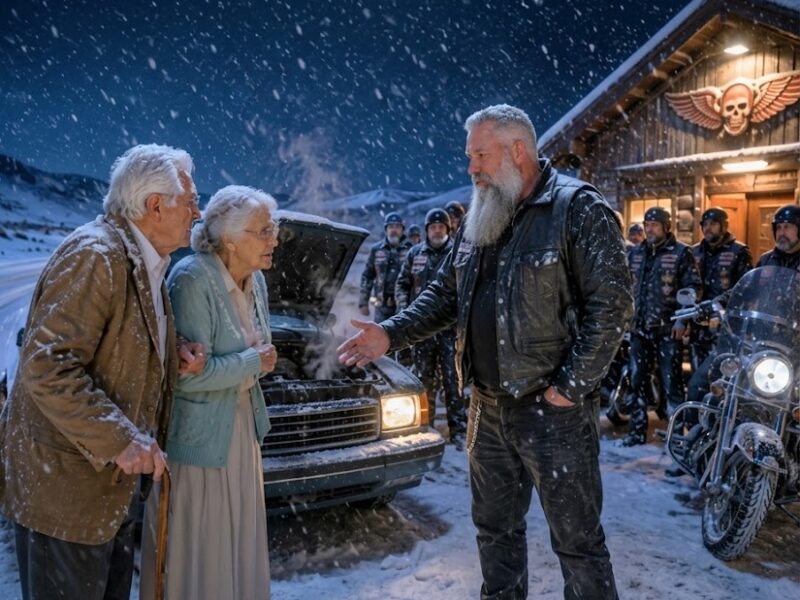
An elderly couple, too exhausted to take another step, asked a group of Hell’s Angels, “Can we stay just one night?” — and what those bikers did left everyone speechless.
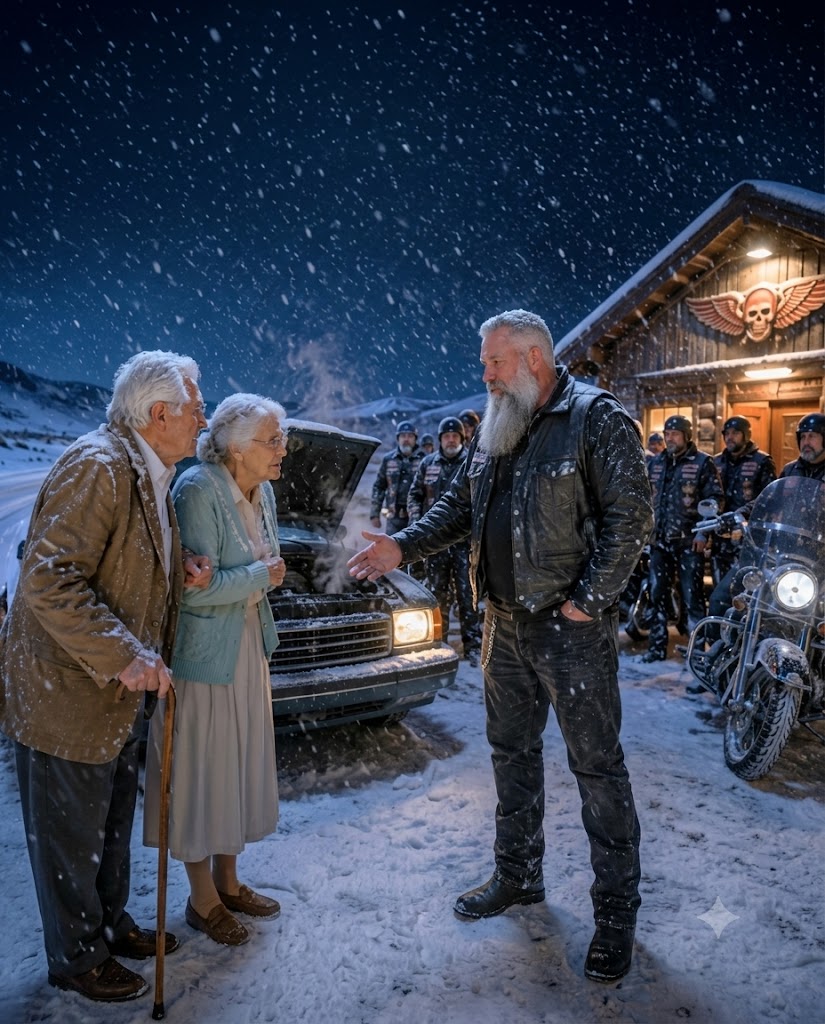
Chrome exhaust pipes don’t normally scream salvation, and leather cuts covered in skull patches aren’t the universal symbol for hospitality.
But when a broken-down Buick stranded two terrified octogenarians on a desolate stretch of Nevada Highway, a pack of notorious bikers became their only hope before nightfall.
Gravel crunched under the balding tires of the 1998 Buick LeSabre as it coasted to a pathetic, steaming halt on the shoulder of Route 50.
Aiden gripped the steering wheel with hands that looked like mapped topography, knuckles swollen with arthritis, skin thin and spotted.
Beside him, Myra let out a quiet, rattling breath.
The air conditioning had surrendered three hours ago somewhere outside of Ely.
Now the engine had joined it in death.
Aiden turned the key.
Click.
Nothing.
He tried again, pumping the gas pedal out of pure desperate habit.
The engine didn’t even bother to turn over.
A thick plume of gray steam hissed from beneath the hood, carrying the acrid scent of scorched coolant and melted rubber through the dashboard vents.
It was 5:00 in the afternoon.
The Nevada sun was beginning its slow descent, bleeding orange and bruised purple across the barren scrubland.
In an hour, the suffocating heat would vanish, replaced by a biting high desert cold that crept into a person’s marrow.
“Aiden.”
Myra’s voice was papery.
She clutched a floral handkerchief, dabbing at the sweat pooling in the deep lines around her mouth.
“Just a little overheated, Marty,” Aiden lied.
He stared out the windshield at the endless ribbon of cracked asphalt.
There wasn’t another car in sight.
There hadn’t been for forty miles.
He pushed his door open.
The heat hit him like an open oven, instantly sapping the moisture from his eyes.
His knees popped in protest as he stood.
He walked around to the front of the Buick, wrapping his handkerchief around his hand before blindly feeling for the hood latch.
It popped with a groan.
Steam billowed upward, forcing him to step back and cough.
A massive crack spiderwebbed down the plastic side of the radiator.
Green fluid pooled on the hot asphalt, bubbling and baking into the tar.
They were done.
Aiden looked at his wife through the bug-splattered windshield.
Myra was seventy-nine.
She had a heart condition that required pills they kept in a small cooler in the back seat.
A cooler whose ice had long since melted into lukewarm water.
He was eighty-one, running on two replaced hips and a stubborn streak that was currently failing him.
They were supposed to be in Reno by nightfall to see a specialist.
Instead, they were sitting targets in the middle of nowhere.
He pulled out his cell phone.
No service.
Just a glaring message that said, “Emergency calls only,” though even those wouldn’t connect without a tower.
He leaned against the warm metal of the fender, rubbing his chest.
A creeping dread, cold and sharp, began to uncoil in his stomach.
People died out here.
It was a simple, brutal fact of the American West.
The elements didn’t care if you were a good person.
They didn’t care if you had been married for fifty-two years.
Or if you had raised three kids who were now too busy to drive you to a doctor’s appointment.
The desert just swallowed you whole.
Then he felt it.
Before he heard the noise, he felt a low vibration in the soles of his orthopedic shoes.
It traveled up through his bad hips, a steady, rhythmic thrumming that seemed to shake the stagnant air.
Aiden turned, squinting down the shimmering heat waves of the highway.
A black mass was moving toward them.
As it got closer, the vibration resolved into a deafening roar.
Motorcycles.
Not two or three.
A dozen.
Maybe more.
They rode in a tight, disciplined formation, kicking up a storm of dirt and exhaust.
The sun glinted off polished chrome and matte black helmets.
Aiden swallowed hard.
He watched the news.
He knew what large packs of bikers meant.
He instinctively moved toward Myra’s door, placing his frail body between the oncoming machines and his wife.
The pack didn’t blow past them.
The lead rider raised a thick gloved hand, holding up two fingers.
The roar of the engines changed pitch, dropping into a heavy, syncopated idle as the group slowed.
They boxed the Buick in.
Four bikes pulled up ahead, four stopped behind, and three idled parallel to the driver’s side.
The sheer volume of the noise was terrifying, a mechanical growl that made Aiden’s chest cavity vibrate.
Aiden stared at the man who had parked closest to him.
He was riding a massive customized Harley-Davidson Road Glide.
The man kicked his stand down and killed the engine.
One by one, the other riders followed suit.
The sudden silence that fell over the highway was heavier somehow than the noise had been.
The man swung his leg over the saddle and stood.
He was entirely too large, standing easily over six-foot-two, broad-shouldered and thick with muscle and age.
A ragged gray beard spilled down the front of his chest.
He wore a heavy leather vest over a black t-shirt.
On the back of the vest, curved across his shoulders in red and white lettering, were the words: “Hells Angels.”
Below it, the infamous winged death head stared blankly at Aiden.
Aiden felt his heart kick against his ribs.
He gripped the door handle behind his back.
“Problems?” the man asked.
His voice was gravelly, quiet, but carrying easily in the still desert air.
Aiden cleared his throat.
It took him two tries to find his voice.
“Radiator,” he said, pointing a shaking finger at the green puddle under the car.
“I think she blew.”
The big man didn’t respond immediately.
He walked slowly toward the front of the Buick, his heavy boots scraping against the asphalt.
He didn’t look at Aiden.
He looked at the car, leaning down to inspect the damage.
He reached out with a bare, calloused hand, tracing the crack in the plastic.
A massive silver ring shaped like a skull glinted on his index finger.
Two other bikers dismounted and walked over.
One was younger, maybe in his thirties, with a neck covered in jagged, faded tattoos.
The other was older, lean and wiry, wearing a greasy denim cut and a pair of dark aviator sunglasses.
“Cracked housing, Garrett,” the wiry man said, peering over the big man’s shoulder.
“Coolant’s bone dry. Block’s probably warped to hell if he kept driving it after the warning light came on.”
Garrett, the big man, straightened up.
He finally turned his gaze to Aiden.
His eyes were pale blue, set deep into a face mapped with sun damage and old scars.
There was no warmth in them, but there was no outright malice either.
Just a heavy, calculating stillness.
“You got a AAA?” Garrett asked.
“I—yes, but I don’t have a signal,” Aiden stammered.
He hated how weak he sounded.
He hated that he was terrified of these men.
Garrett pulled a battered smartphone from his pocket, glanced at the screen, and shoved it back.
“Nobody does out here. Dead zone for another thirty miles.”
Aiden looked back into the car.
Myra was staring at the bikers, her eyes wide behind her thick glasses.
She looked incredibly small against the beige upholstery.
The temperature inside the car was steadily rising.
“Look,” Aiden said, trying to summon whatever authority an eighty-one-year-old retired accountant could muster.
“We don’t want any trouble. We’re just trying to get to Reno.”
The younger biker with the neck tattoos let out a short, harsh laugh.
“You ain’t getting to Reno in this piece of crap, Pops.”
Garrett held up a hand.
The younger man instantly shut his mouth, stepping back.
The discipline was immediate and absolute.
Garrett stepped closer to Aiden.
Aiden flinched, pressing his back against the car door, but Garrett just looked past him, peering through the window at Myra.
“Your old lady okay?” Garrett asked, his voice dropping a fraction of a decibel.
“She has a heart condition,” Aiden said, the words spilling out in a rush of desperate honesty.
“She needs her medication. It’s in the cooler, but it has to stay cold, and the ice melted. It’s too hot out here for her. The sun is going down, and I know it gets freezing at night.”
Aiden stopped.
He was rambling.
He looked at the patch on Garrett’s chest.
“President.”
Aiden swallowed his pride.
He swallowed his fear.
He looked at the towering, intimidating man and saw the absolute end of his options.
The nearest town was miles away.
The highway was empty.
His car was dead.
“We can’t walk anymore,” Aiden said, his voice cracking.
He gestured vaguely down the road.
“Can we—can we stay one night?”
It was a ridiculous question.
He didn’t even know what he was asking.
Was he asking to sleep on the shoulder while the bikers stood guard?
Was he asking them to drive to town and send a tow truck?
He just knew they couldn’t survive out here alone.
Garrett stared at him.
The silence stretched.
The other bikers stood completely motionless, watching their president.
Aiden could hear the ticking of the cooling motorcycle engines, the faint hiss of the Buick’s dying radiator, and the ragged thumping of his own heart.
For a long, agonizing moment, Garrett did nothing.
He just looked at the desperate, sweating old man in front of him.
Then he turned his head and looked down the highway.
“Toby!” Garrett barked, his voice suddenly cutting through the quiet.
A young man near the back of the pack, wearing a plain black vest with a “Prospect” patch, jogged forward.
“Yeah, boss?”
“Bring the chase rig up,” Garrett ordered.
Toby nodded, breaking into a run toward the rear of the formation.
Aiden hadn’t noticed it before, but trailing a quarter-mile behind the motorcycles was a heavy-duty black Ford F-350 hauling an enclosed trailer.
The truck slowly rolled forward, its diesel engine grumbling, and pulled onto the shoulder directly behind the broken-down Buick.
Garrett turned back to Aiden.
“Get your wife. Get your bags.”
Aiden blinked.
“What? You’re not—we’re not staying here?”
Garrett said flatly, “Sun drops. It hits forty degrees out here. She won’t make it to midnight.”
“Where are we going?” Aiden asked, hesitating.
Garrett didn’t smile.
He just stepped aside, leaving a clear path to the Ford.
“We got a clubhouse in Eureka, about forty-five minutes east. It ain’t the Ritz, but it’s got AC and a working fridge for her pills.”
Aiden hesitated.
He was being invited into a Hells Angels compound.
Everything he had ever read, every late-night documentary he had ever watched, screamed at him to run the other way.
But as he looked at Garrett’s impassive face, he realized something profound.
These men didn’t have to offer him anything.
They could have ridden right past.
They could have stripped the car and left them for dead.
Instead, they had stopped.
Aiden opened the car door.
“Marty,” he said gently.
“We’re going to get a ride.”
He helped her unbuckle.
She was weak, her legs shaking as she tried to stand.
Before Aiden could bear her weight, the wiry older biker with the aviators stepped in.
“Allow me, ma’am,” the biker said.
He didn’t wait for permission.
He slipped a heavily tattooed arm under Myra’s shoulders, supporting her with surprising gentleness, taking almost all of her weight off her fragile legs.
He walked her slowly toward the running truck.
Aiden quickly grabbed the melted cooler and their two small overnight bags from the back seat.
When he turned around, Myra was already seated in the air-conditioned cab of the truck, the prospect named Toby adjusting the seat belt across her chest.
Garrett stood by the Buick, writing something down on a small notepad.
He tore the sheet off and handed it to Aiden.
“Tow company in Ely,” Garrett said.
“Friend of ours. When you get cell service tomorrow, you call that number. Tell him Garrett sent you. He won’t charge you the out-of-network fee.”
Aiden looked down at the paper, then up at the towering biker.
His throat felt tight.
“I—I don’t know what to say. Thank you.”
“Don’t thank me yet,” Garrett muttered, turning back toward his Road Glide.
“You haven’t seen the guest room.”
Within three minutes, the Buick was locked and abandoned on the shoulder.
Aiden sat in the spacious back seat of the truck next to Myra, the cold air from the vents blasting over them, bringing instant, dizzying relief.
The truck fell into line behind the pack of motorcycles.
As they rolled down the darkening highway, surrounded by the deafening roar of twenty Harleys, Aiden held his wife’s hand.
He watched the massive, leather-clad backs of the men riding ahead of them.
He had expected violence.
He had expected cruelty.
What he got instead was a ruthless, efficient kind of mercy.
And as the neon lights of a distant town finally began to flicker on the horizon, Aiden realized they were safe.
The convoy exited the highway onto a cracked two-lane road.
The transition from the smooth asphalt of Route 50 to the neglected pavement jarred Aiden’s teeth.
Beside him, Myra slept against the truck’s window, her breathing shallow but steady in the cool, climate-controlled cabin.
Toby, the young prospect driving, kept his eyes locked on the taillights of the bikes ahead, offering no small talk.
They pulled into an industrial park on the outskirts of a town that barely registered as a smudge of light against the black desert sky.
A high chain-link fence topped with concertina wire surrounded a windowless cinder block building.
Security cameras stared down from the corners.
The bikes filed through a heavy rolling gate.
Toby followed, putting the truck in park near a row of steel dumpsters.
“We’re here,” Toby said, killing the engine.
Aiden stepped out.
The desert air had plummeted by thirty degrees.
The biting cold immediately sank into his thin slacks.
He hurried to the other side to help Myra down, but Rick, the wiry older biker, was already there.
“I got her, Aiden,” Rick said.
The use of his first name startled Aiden.
He hadn’t realized they had exchanged names.
They walked toward a heavy steel door at the side of the building.
Garrett stood holding it open.
The noise inside was a low rumble of heavy boots on concrete, the clack of pool balls, and muffled classic rock from a jukebox.
Aiden braced himself.
He expected chaos.
He expected a scene straight out of a sensationalized police report.
Instead, he stepped into a space that smelled heavily of stale cigarette smoke, pine sol, and old leather.
A massive wooden bar dominated the left wall, backed by mirrors and bottles of liquor.
Pool tables occupied the center of the room.
About fifteen men wearing Hells Angels cuts were scattered around, some holding beers, others leaning against the pool tables.
The moment Garrett walked in with Aiden and Myra, the jukebox cut off abruptly.
Someone had pulled the plug.
The clacking of pool balls ceased.
Fifteen pairs of hardened eyes turned toward the door.
The silence was absolute.
Aiden felt his stomach drop.
“We got guests,” Garrett announced, his voice carrying effortlessly.
“Keep the volume down. Anybody wants to blast the stereo, take it outside.”
A collective, muted nod went around the room.
The men returned to their conversations, their voices noticeably lowered to hushed murmurs.
It was a bizarre display of disciplined restraint.
“The cooler,” Aiden said, holding up the dripping plastic box.
“Her pills.”
Garrett pointed to a massive commercial refrigerator behind the bar.
A heavily bearded man wearing a “Sergeant-at-Arms” patch stepped aside, opening the glass door.
He ruthlessly shoved a dozen long-neck beers out of the way, making a large empty space on the middle shelf.
Aiden slid the damp, plastic-wrapped boxes of medication into the cold air.
“Room’s in the back,” Garrett said, motioning down a dark hallway.
They led Aiden and Myra past a heavily padlocked steel door and into a small, windowless room.
It wasn’t a guest room.
It was clearly a crash pad for members who had drunk too much to ride.
The walls were painted a dull, scuffed gray.
But dominating the space was a massive, surprisingly clean king-sized bed pushed against the far wall.
The sheets were crisp white, smelling faintly of industrial bleach.
A small space heater hummed in the corner, fighting back the chill of the cinder block walls.
“Bathroom is two doors down,” Rick said, helping Myra sit on the edge of the mattress.
She sank into the soft bedding with a heavy sigh.
“Water’s hot. Don’t use the blue towels. Those are for oil spills.”
“Thank you,” Myra whispered.
Her voice was barely audible.
Rick nodded, tipping his chin.
He turned and walked out, pulling the door shut behind him with a solid click.
Aiden stood in the quiet room.
He looked at the peeling paint, the heavy steel door, and then at his wife, who was already pulling her shoes off, looking more comfortable than she had all day.
He unzipped their overnight bag and grabbed her nightgown.
Once Myra was settled and asleep, Aiden found himself restless.
The adrenaline of the breakdown was fading, leaving behind a jittery exhaustion that made sleep impossible.
He opened the bedroom door and walked down the hallway toward the main room.
He paused at the edge of the bar area.
The bikers were still there.
A few were playing a slow game of eight-ball.
Garrett was sitting at a heavy oak table in the corner, dismantling a carburetor on a shop towel.
The intimidating president of the charter, a man who likely had a file an inch thick at the FBI, was meticulously cleaning a brass jet with a toothbrush.
The bartender, a younger guy with a scar bisecting his left eyebrow, caught Aiden’s eye.
He didn’t ask what Aiden wanted.
He just grabbed a clean glass, filled it with ice from a stainless bin, poured tap water, and slid it across the polished wood.
Aiden walked over and picked it up.
The ice clinked loudly.
“Thank you.”
The bartender gave a single nod and went back to wiping down the counter.
Aiden took a long drink.
He watched the men.
He noticed the heavy scars on knuckles, the faded prison ink bleeding under shirt collars, the sheer physical density of these outlaws.
Yet nobody looked at him with hostility.
He was practically invisible, a ghost haunting their sanctuary.
They had carved out a brutal existence in a harsh world, yet they had seamlessly absorbed two fragile strangers into their ecosystem without a second thought.
He finished the water, set the glass down, and walked back to the quiet gray room.
For the first time since the Buick’s engine died, Aiden closed his eyes and slept.
The heavy steel door of the clubhouse groaned open.
Harsh, blinding Nevada sunlight flooded the dim interior.
Aiden squinted, holding a steaming mug of black coffee in both hands.
The air outside was crisp and dry, carrying the scent of dust and sagebrush.
It was 7:00 a.m.
Myra was still asleep in the back room, her breathing deep and untroubled.
Her color had returned.
The rest in the cool room, combined with the refrigerated medication, had pulled her back from the edge of a dangerous physical collapse.
Aiden walked out onto the concrete apron in front of the building.
The row of Harley-Davidsons sat silent, lined up with military precision, their chrome catching the morning glare.
Garrett was already outside.
He leaned against the front fender of his black Road Glide, smoking a cigarette.
In the daylight, he looked older, the deep lines around his eyes and mouth carved by decades of wind and hard living.
He wore his heavy leather cut over a plain gray t-shirt.
Aiden walked over to him.
He didn’t know the etiquette.
He didn’t know how to exist in this space.
“Morning,” Garrett grunted, exhaling a thin stream of gray smoke into the clear air.
“Good morning,” Aiden replied.
He looked down at the coffee mug in his hands.
The rim was chipped.
“Your bartender makes a strong pot.”
“Keeps them awake,” Garrett said, flicking ash onto the concrete.
“Sleep okay?”
“I did. More importantly, Myra did.”
Aiden looked up, meeting Garrett’s pale blue eyes.
“I checked her vitals this morning. She’s stable. If we had stayed out on that highway—”
Aiden let the sentence hang.
They both knew the end of that thought.
Garrett didn’t offer a polite platitude.
He just took another drag of his cigarette.
“Desert doesn’t care who you are. It’ll strip the meat right off your bones.”
The rumble of a heavy diesel engine interrupted them.
A massive flatbed tow truck swung through the open gates of the compound.
The truck was painted a faded, sun-beaten yellow.
The words “Ely Tow & Recovery” stenciled in cracked black paint on the doors.
The truck hissed to a halt near the dumpsters.
The driver, a heavy-set man in grease-stained overalls, hopped out.
He didn’t look at Aiden.
He walked straight to Garrett and extended a hand.
Garrett shook it.
“Got your message, Garrett,” the driver said.
He had a thick, gravelly voice.
“Car’s a green Buick out on 50.”
“Yeah,” Garrett said.
“Radiator’s blown. Block might be warped.”
The driver pulled a clipboard from his truck.
“I’ll haul it to the yard. Look at it by noon. If it’s just the radiator, I can have it patched and filled by tomorrow. If the block is cracked, it’s scrap metal.”
Aiden stepped forward.
He reached into his back pocket and pulled out his leather wallet.
It felt thin and inadequate.
“How much for the tow?”
The driver looked at Aiden, then looked at Garrett.
Garrett gave a nearly imperceptible shake of his head.
“Tow’s on the house,” the driver said, turning his attention back to his clipboard.
“We’ll talk parts and labor when I see the damage.”
Aiden opened his mouth to protest, but Garrett cut him off.
“Put your wallet away, Aiden.”
The president’s voice was low, carrying that same unquestionable authority from the highway.
“I can’t let you do that,” Aiden insisted, his pride flaring up.
A stubborn remnant of a life spent paying his own way.
“You men have already done enough. You gave up your room. You gave us shelter. I have money.”
Garrett dropped his cigarette and crushed it beneath the heel of his heavy boot.
He stepped closer to Aiden, towering over the older man.
“Keep your money for the doctor in Reno,” Garrett said.
“You think we need your fifty bucks? We brought you here because I ain’t watching a man’s wife die on the side of my road. That’s it. There’s no invoice.”
Aiden stared at him.
He saw the absolute finality in the biker’s face.
There was no room for argument.
It wasn’t charity.
It was a rough, undeniable code of conduct.
“How are we supposed to get to Reno?” Aiden asked, his voice softening.
Garrett turned toward the open door of the clubhouse.
“Toby!” he yelled.
A few seconds later, the young prospect jogged out, holding a set of keys.
“Toby is driving down to Reno to pick up some parts,” Garrett said, looking back at Aiden.
“He’s taking the chase rig. The truck’s got plenty of room in the back. He’ll drop you and your old lady at the hospital.”
It was a lie.
Aiden knew it was a lie.
Toby wasn’t picking up parts.
Garrett was dispatching a prospect to drive them three hours across the state just to make sure they got to their appointment.
Aiden looked at the patch on Garrett’s chest.
The winged skull stared back, a symbol designed to invoke fear and compliance.
For a moment, Aiden felt a profound, heavy ache in his chest.
He had spent his entire life following the rules, paying his taxes, judging men who looked like Garrett from the safety of his suburban living room.
He had thought the world was divided into neat categories of good and bad, safe and dangerous.
The desert had burned those categories away in a single afternoon.
“I don’t know your last name,” Aiden said quietly.
“You don’t need to,” Garrett replied.
By 8:30, Myra was awake and seated comfortably in the back of the black Ford F-350.
Toby had already loaded their bags and the cooler into the cab.
The tow truck had departed to retrieve the dead Buick.
Aiden stood by the open passenger door of the truck.
Garrett stood on the concrete, his hands shoved deep into the pockets of his jeans.
Several other bikers had wandered out to smoke and watch the departure.
Nobody waved.
Nobody smiled.
Aiden reached out his hand.
Garrett looked at it for a moment.
Then he pulled his hand from his pocket and took Aiden’s grip.
The biker’s hand was massive, hard as stone, the skull ring digging slightly into Aiden’s palm.
It was a firm, grounding handshake.
“Safe travels, Aiden,” Garrett said.
“Thank you, Garrett. For everything.”
Aiden climbed into the truck, shutting the heavy door.
The engine roared to life, the diesel rumble shaking the chassis.
Toby put the truck in gear and pulled out of the compound, the heavy metal gates sliding shut behind them.
As the truck rolled down the cracked pavement toward the highway, Aiden looked through the tinted back window.
The cinder block building shrank in the distance.
The row of motorcycles became a blur of chrome.
“Aiden?” Myra asked, her hand finding his in the wide back seat.
“I’m here, Marty,” he said, squeezing her fingers.
“They were very quiet men,” she observed softly.
Aiden looked straight ahead at the vast, unforgiving expanse of the Nevada desert stretching out before them.
“Yes,” he said.
“They were.”
He settled back into the leather seat, watching the barren landscape roll by, deeply aware that the only reason they were still moving forward was because of the outlaws they had left behind.
Sometimes the people society fears the most are the only ones willing to stop when the world drives by.
True humanity doesn’t always wear a suit.
Sometimes it wears worn leather and rides a Harley.
—
The drive to Reno took just under three hours.
Toby kept the truck at a steady seventy, the diesel humming beneath them as the desert slowly gave way to the jagged silhouette of the Sierra Nevada foothills.
Myra dozed for most of the ride, her head resting against a folded jacket Toby had offered her without a word.
Aiden watched the landscape change through the window, his mind replaying the events of the past eighteen hours like a film he couldn’t stop.
He thought about the way Garrett had looked at the cracked radiator, his calloused fingers tracing the damage with the same care a surgeon might use.
He thought about Rick, the wiry older biker, supporting Myra’s weight with a gentleness that seemed almost out of place against his tattooed arms and grease-stained denim.
He thought about the bartender sliding a glass of ice water across the polished wood without being asked.
None of it made sense.
All of it made perfect sense.
They pulled into the parking lot of Saint Mary’s Regional Medical Center just after eleven-thirty.
Toby killed the engine and turned in his seat, looking back at them through the partition.
“You need help getting her inside?”
“I think we can manage,” Aiden said.
“But thank you. For all of this.”
Toby shrugged, a faint flush creeping up his neck.
“Just doing what Garrett said.”
Aiden opened his door and stepped out into the bright Reno morning.
The air was cooler here, tinged with the faint smell of pine and exhaust from the nearby freeway.
He helped Myra down from the truck, her legs steadier now than they had been the day before.
She clutched his arm as they walked toward the emergency room entrance.
Toby retrieved their bags from the back and set them on the curb.
“Garrett said to tell you the tow company will call you when the car’s ready. If it’s fixable.”
“And if it’s not?” Aiden asked.
Toby shrugged again.
“Then I guess you’re renting a car.”
He climbed back into the truck and pulled away, the black Ford disappearing into the flow of morning traffic.
Aiden stood on the sidewalk, the overnight bags at his feet, his wife’s hand warm against his arm.
“You didn’t get his last name either,” Myra said.
“No,” Aiden admitted.
“I didn’t.”
They walked through the automatic doors into the sterile, brightly lit lobby of the emergency room.
The intake nurse was a middle-aged woman with kind eyes and a no-nonsense manner.
She took one look at Myra’s pale face and the medication list Aiden handed her and immediately ushered them into a triage room.
A doctor appeared within twenty minutes, a young woman with a stethoscope draped around her neck and a tablet in her hand.
She listened to Myra’s heart, checked her oxygen levels, and reviewed the medication list.
“You did the right thing coming in,” the doctor said, her voice calm but serious.
“Her heart rate is elevated, and her blood pressure is lower than I’d like. But she’s stable. If you’d waited another day, though—”
She didn’t finish the sentence.
She didn’t need to.
Aiden sat in a hard plastic chair beside Myra’s bed, holding her hand while the nurses drew blood and hooked up monitors.
The beeping of the machines was steady, reassuring.
Myra looked at him, her eyes clearer than they had been in days.
“You look tired, Aiden.”
“I’m fine.”
“You’re lying.”
He smiled, a tired, genuine smile.
“Maybe a little.”
She squeezed his hand.
“Those men. The ones who helped us. They weren’t what I expected.”
“No,” Aiden agreed.
“They weren’t.”
“I kept waiting for them to ask for something. Money. A favor. Something.”
“They didn’t want anything, Marty.”
“That’s what I can’t understand,” she said softly.
“People don’t just help strangers anymore. Not like that.”
Aiden thought about Garrett’s pale blue eyes, the way he had looked at Myra through the car window and asked if she was okay.
He thought about the way the entire clubhouse had fallen silent when they walked in, not out of hostility, but out of respect.
He thought about the clean sheets and the space heater and the refrigerator full of medication.
“They do,” he said finally.
“Just not the people we expect.”
Myra was admitted to the cardiac unit for observation.
The doctors wanted to keep her overnight, maybe two, to run tests and adjust her medication.
Aiden sat by her bed until visiting hours ended, then walked down to the cafeteria and bought a cup of coffee that tasted like burnt water.
He found a payphone near the lobby and dug the folded piece of paper from his pocket.
The tow company in Ely.
He dialed the number, his fingers trembling slightly.
A gruff voice answered on the second ring.
“Ely Tow and Recovery.”
“Hello, I’m calling about a green Buick LeSabre. Garrett—Garrett from the Hells Angels gave me this number.”
There was a pause.
“Garrett sent you?”
“Yes, sir.”
Another pause, then a low chuckle.
“Alright. We picked up your car about an hour ago. Radiator’s shot, but the block looks okay. I can have it patched and refilled by tomorrow afternoon. Where are you staying?”
Aiden gave him the name of a motel near the hospital, a cheap place with flickering neon and thin walls.
“I’ll have it delivered there,” the man said.
“What do I owe you?”
“Nothing.”
“I can’t—”
“Garrett already took care of it. Don’t worry about it.”
The line went dead.
Aiden stood in the lobby, the payphone receiver still pressed to his ear, the dial tone buzzing in his ear.
Garrett already took care of it.
He didn’t know what that meant.
He didn’t know if Garrett had paid the bill himself or if the tow company was simply doing him a favor.
He didn’t know if he would ever see Garrett again.
But he knew, with a certainty that settled deep in his bones, that he would never forget him.
The next two days passed in a blur of hospital visits and cheap motel coffee.
The doctors adjusted Myra’s medication and ran a battery of tests.
By the third morning, she was sitting up in bed, color in her cheeks, complaining about the hospital food.
“You’re cleared to go home,” the doctor said, handing Aiden a stack of discharge papers.
“Just make sure she takes her medication on schedule and follows up with her regular cardiologist.”
Aiden nodded, tucking the papers into his bag.
He helped Myra into her coat and walked her out to the lobby, where a taxi was waiting to take them to the motel.
The Buick was parked in the lot when they arrived, its hood polished, a new radiator gleaming beneath.
Aiden stood in front of it, running his hand along the fender.
It looked better than it had in years.
He opened the door for Myra and helped her into the passenger seat, then climbed behind the wheel.
The engine turned over on the first try, purring smoothly.
He sat there for a moment, his hands on the steering wheel, staring out at the neon sign of the motel.
“Are you okay?” Myra asked.
“Yeah,” he said.
“I’m okay.”
He pulled out of the lot and onto the highway, heading west toward California.
The desert stretched out before them, vast and indifferent, the same desert that had nearly killed them three days earlier.
But it didn’t feel the same.
It felt smaller somehow, less threatening.
Or maybe he felt bigger.
They drove for six hours, stopping twice for gas and once for lunch at a diner off the interstate.
Myra slept for most of the drive, her head resting against the window, a small smile on her lips.
Aiden kept his eyes on the road, his mind drifting back to the cinder block clubhouse and the men who had saved them.
He thought about the code they lived by, a code that existed outside the neat boundaries of law and society.
A code that said you helped a stranger in need, no questions asked.
A code that said you didn’t take credit for kindness.
A code that said you did what was right because it was right, not because you expected a reward.
He thought about the way Garrett had looked at him, not with pity, but with a kind of recognition.
A recognition that they were both just men, doing the best they could in a world that didn’t always make sense.
He thought about the skull ring on Garrett’s finger, the winged death head on his back.
Symbols designed to inspire fear.
Symbols that had meant nothing when it mattered.
They pulled into their driveway just after sunset, the familiar silhouette of their suburban house rising against the twilight sky.
Aiden killed the engine and sat there for a moment, looking at the house he had lived in for forty years.
It looked the same as always.
But something had changed.
He walked around to help Myra out of the car, and they stood together in the driveway, looking at the house.
“Home,” Myra said softly.
“Yeah,” Aiden said.
“Home.”
They walked inside, and Aiden turned on the lights, and the house came alive around them.
The cat meowed from the kitchen, demanding dinner.
The phone blinked with messages from their children, asking if they were okay.
The mail piled up on the hall table, bills and junk and catalogs.
Life, resuming.
Aiden fed the cat and made a cup of tea for Myra and sat down at the kitchen table, staring out the window at the darkening sky.
He thought about Garrett and Rick and Toby and the bartender with the scar.
He thought about the tow truck driver who had refused his money.
He thought about the clean sheets and the space heater and the water glass sliding across the polished wood.
He thought about the words Garrett had said to him, standing in the parking lot of the clubhouse.
“You don’t need to.”
Aiden didn’t know Garrett’s last name.
He didn’t know where he lived or what he did when he wasn’t riding his motorcycle or running his club.
He didn’t know anything about him, really.
But he knew something about the kind of man he was.
And that was enough.
Two weeks later, Aiden sat down at his computer and typed out a letter.
He didn’t know if it would reach Garrett.
He didn’t know if Garrett would read it.
But he needed to write it.
Dear Garrett,
My wife and I were the couple you helped on Route 50 two weeks ago.
I don’t know if you remember us.
You probably help a lot of people.
But we haven’t stopped thinking about you and your men since that night.
Myra is doing well.
The doctors in Reno adjusted her medication, and she’s back to her old self.
She’s been cooking up a storm, which is good, because I’ve missed her pot roast.
I wanted to thank you.
I know I said it that morning, but I don’t think I said it enough.
You didn’t have to stop.
You didn’t have to help us.
You could have kept riding.
But you didn’t.
You gave us a ride and a room and a place to sleep.
You gave my wife her medication and a warm bed.
You gave us hope when we had none.
I spent my whole life thinking I knew what kind of people rode motorcycles and wore leather vests with skulls on them.
I was wrong.
You showed me that kindness doesn’t always look the way we expect it to.
You showed me that good people come in all shapes and sizes and colors and creeds.
You showed me that sometimes the people we fear the most are the ones who end up saving us.
I don’t know if you’ll ever read this letter.
I don’t know if you’ll care.
But I wanted you to know that you made a difference.
You saved our lives.
And I will never forget it.
Sincerely,
Aiden
He mailed the letter to the clubhouse in Eureka, addressing it simply to “Garrett, President, Hells Angels.”
He didn’t know if it would reach him.
He didn’t know if Garrett would read it or throw it away.
But it didn’t matter.
What mattered was that he had written it.
What mattered was that he had said thank you.
What mattered was that he had acknowledged the gift he had been given.
Three weeks later, a plain white envelope appeared in Aiden’s mailbox.
There was no return address.
Inside was a single sheet of paper, folded neatly.
The handwriting was rough and uneven, the letters formed with a heavy hand.
Aiden,
Got your letter.
Glad your wife is doing better.
You don’t owe me anything.
You don’t owe us anything.
We did what anyone should do.
But I’m glad you wrote.
It’s nice to know we made a difference.
Take care of your wife.
Take care of yourself.
Ride safe.
Garrett
Aiden read the letter three times, then folded it carefully and tucked it into the drawer of his nightstand.
He didn’t know what it meant.
He didn’t know if he would ever see Garrett again.
But he knew, with a certainty that settled deep in his heart, that he would never forget him.
Sometimes the people society fears the most are the only ones willing to stop when the world drives by.
True humanity doesn’t always wear a suit.
Sometimes it wears worn leather and rides a Harley.
Sometimes it has a gray beard and a skull ring and a patch on its chest that says “President.”
Sometimes it looks like the last person you would expect.
And sometimes that’s exactly what makes it so powerful.
Aiden sat on the porch of his house, watching the sun set over the suburban skyline, a cup of coffee in his hand.
Myra was inside, humming to herself as she cooked dinner.
The cat was curled up at his feet, purring softly.
Life had returned to normal.
But something had changed.
He had changed.
He had learned that the world was not divided into neat categories of good and bad, safe and dangerous.
He had learned that people were complicated, and that kindness could come from the most unexpected places.
He had learned that sometimes the people we fear the most are the ones who end up saving us.
He had learned that true humanity doesn’t always wear a suit.
Sometimes it wears worn leather and rides a Harley.
And sometimes that’s exactly what makes it so beautiful.
He took a sip of his coffee and smiled.
The sun dipped below the horizon, painting the sky in shades of orange and purple and gold.
It was a beautiful evening.
It was a beautiful life.
And he was grateful for all of it.
For every moment.
For every person.
For every unexpected kindness.
He set his cup down and walked inside, closing the door behind him.
Myra looked up from the stove and smiled.
“Dinner’s almost ready.”
“I’ll set the table,” he said.
And he did.
And they ate together, in the warm light of their kitchen, talking about nothing and everything.
And when they went to bed that night, Aiden lay awake for a while, staring at the ceiling, thinking about the desert and the bikers and the strange, beautiful twist of fate that had brought them together.
He thought about the words Garrett had said to him, standing in the parking lot of the clubhouse, the morning sun rising over the Nevada desert.
“Desert doesn’t care who you are. It’ll strip the meat right off your bones.”
But Garrett had cared.
His men had cared.
They had stopped when the world drove by.
They had helped when no one else would.
They had saved two strangers, not because they expected a reward, but because it was the right thing to do.
And that, Aiden realized, was the most beautiful thing of all.
He closed his eyes and let sleep take him.
And in his dreams, he was riding a Harley, the wind in his hair, the sun on his face, a pack of bikers at his side.
And he was free.
The End.









