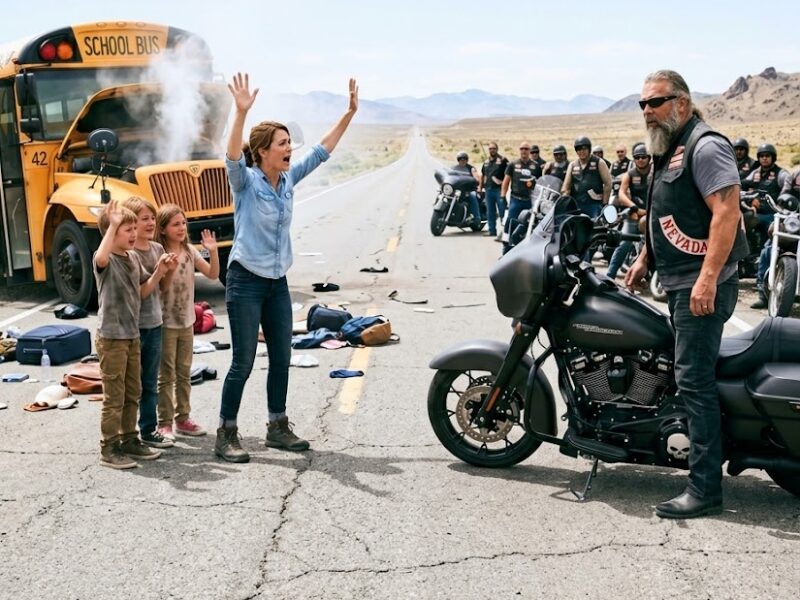
An elderly couple collapsed on the roadside, whispering, “Please… we can’t walk anymore.” What a group of Hell’s Angels did next left everyone speechless.
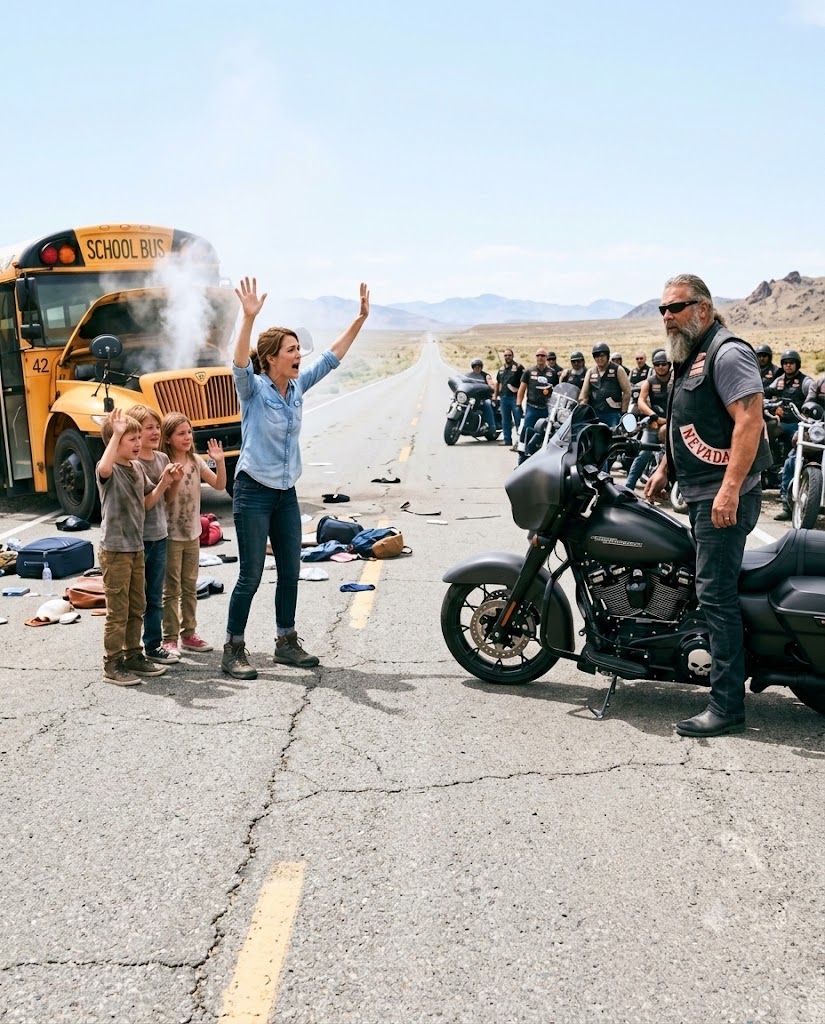
Asphalt blistered under the July sun, radiating a suffocating heat that tasted like copper and exhaust. Nobody expected salvation on this forsaken stretch of Nevada Highway, least of all from a roaring pack of scarred leather, heavy chrome, and men who looked entirely capable of murder. Heat did not just exist out here, it possessed a physical weight. It pressed down on Brenda’s shoulders, settled into the damp crease of her neck, and squeezed the remaining moisture from her lungs with every shallow breath. It was a suffocating, unrelenting force smelling of melted rubber and the sickly sweet tang of evaporated antifreeze. Three hours ago, the heavily dented 15-passenger van had violently shuddered, belched a plume of thick white smoke over the windshield, and died. Gary, a well-meaning but fundamentally useless volunteer whose hands hadn’t stopped shaking since, had managed to wrestle the dead weight of the vehicle onto the gravel shoulder before the engine seized completely. Now, they were stranded. Highway 50, the loneliest road in America.
Brenda wiped a gritty mixture of dust and sweat from her forehead using the back of her wrist. She was 38, a social worker running on black coffee and a chronically depleted sense of optimism. She hadn’t signed up to be a martyr. She had signed up to chaperone six foster kids to a subsidized summer camp in the mountains, a rare week away from the concrete and chaos of the city. Instead, she was watching them wilt on the side of a highway where the air distorted in shimmering, watery waves. “Brenda, my head hurts.” The voice belonged to Toby, a 10-year-old boy sitting in the dirt with his knees pulled to his chest. His usually bright face was flushed a dangerous, mottled crimson. The cheap zinc sunscreen smeared on his nose had melted into greasy streaks. “I know, buddy,” Brenda rasped. Her own voice sounded foreign, entirely stripped of moisture. She swallowed, grimacing at the sensation of sandpaper sliding down her throat. “Just keep your head down. Try to stay in the shadow.”
The shade was pathetic. It came from a single rusted billboard advertising a diner that had likely closed a decade ago. It cast a narrow, slanted rectangle of gray onto the baked earth, forcing the six children, Brenda, and Gary to huddle dangerously close to the white line of the highway. They had run out of water 90 minutes ago. The two plastic gallon jugs Gary had packed were drained, the lukewarm liquid gulped down in an initial wave of panic that Brenda had tried and failed to control. “We should have stayed in the van,” Gary mumbled. He was pacing a tight, erratic circle just outside the billboard’s shade. His khaki shirt was stained dark under the arms, and his bald head was blistering pink. “The van is an oven, Gary,” Brenda snapped, the irritation flaring hot and fast in her chest. She instantly regretted the harshness. Gary wasn’t to blame for a blown radiator, but she needed somewhere to direct the terrifying knot of panic tightening in her gut. “The thermometer on the dash said 114 before the battery died. If we stayed in there, we’d be cooking.”
She looked down at the kids. Lilly, the youngest at seven, was leaning heavily against Toby, her eyes half closed, her breathing shallow and rapid. There were no tears left. Dehydration had stolen even that small comfort. Two hours ago, Brenda had made a call. Not on her cell phone, the screen displayed a mocking no service across the top, but a judgment call. The map in the glove box had shown a gas station roughly 3 miles ahead. Believing that sitting still was a death sentence, she had rallied the exhausted kids, forced them to leave the suffocating metal box of the van, and started walking. It had been a disastrous mistake. The heat radiating off the asphalt had baked them from the bottom up. Every passing semi-truck, and there had only been three, blasted them with a wall of hot, gritty wind that nearly knocked the smaller kids off their feet. After a mile, Lily had collapsed. Toby had thrown up a meager splash of yellow bile. Brenda’s own legs had felt like lead pipes, her heart hammering a frantic, terrifying rhythm against her ribs. Defeated, terrified, and acutely aware that she had made a bad situation worse, Brenda had ordered them to turn around. They hadn’t even made it back to the van. They had collapsed here under the rusty billboard, half a mile from their dead vehicle.
“I’m going to let these kids die out here,” Brenda thought. The realization wasn’t dramatic. It was a cold, quiet dread that settled into her bones despite the staggering heat. She looked down at her hands. They were trembling. She wanted a cigarette so badly her teeth ached, an old habit clawing its way back to the surface in the face of sheer panic. She closed her eyes, listening to the desolate sounds of the desert, the dry rustle of dead sagebrush, the rhythmic wheezing breath of Gary pacing behind her. “Look!” Gary croaked suddenly, his voice cracking violently. Brenda’s eyes snapped open. Down the highway, shimmering through the heat mirages, a black SUV was approaching. It was moving fast, a sleek, modern machine with heavily tinted windows. Adrenaline, sharp and painful, spiked in Brenda’s veins. She scrambled to her feet, her joints popping in protest, ignoring the wave of dizziness that threatened to topple her. “Get up! Wave your hands!” she yelled, her voice tearing in her dry throat. Gary rushed toward the shoulder, waving his arms in wide, desperate arcs. Brenda joined him, stepping dangerously close to the asphalt, lifting her arms, pleading with every ounce of her remaining energy. “Please see us. Please stop. Look at the kids.”
The SUV grew larger. The aggressive hum of its tires on the pavement growing louder. Brenda could see the reflection of the desert in its polished hood. She could almost feel the blast of the air conditioning that must be running inside. The driver didn’t tap the brakes. They didn’t drift toward the shoulder. The SUV blew past them at 80 miles an hour. The backdraft hit Brenda like a physical blow, a rush of hot exhaust and dust that forced her to stagger backward. She choked on the grit, coughing violently as she watched the tail lights shrink into the distance. She stood frozen, the dust settling slowly around her boots. A profound, crushing emptiness washed over her. It wasn’t just the heat anymore. It was the isolation, the sheer indifference of the world. Behind her, Lily let out a weak, raspy whimper. Toby didn’t say a word. He just let his head drop onto his knees. Brenda turned back to them, her vision swimming. She had no comforting words left, no false promises. The brutal reality of the desert was stripping away all her defenses, leaving only a raw, terrified animal instinct to survive, and even that was fading.
Vibrations started in the soles of Brenda’s boots before her ears picked up the sound. It was a low, guttural thrumming that seemed to rise from the earth itself, vibrating through the asphalt and up her aching legs. She was sitting in the dirt now, having given up the pretense of standing guard. Her head was bowed between her knees, trying to block out the blinding glare of the sun reflecting off the road. At first, she thought it was thunder, a cruel tease of a desert storm that would never arrive. But the rhythm was too mechanical, too aggressive. Gary stopped his frantic pacing, freezing like a frightened rabbit. “Do you hear that?” Brenda slowly lifted her head. The sun hammered her eyes, forcing her to squint into the distance from where the SUV had disappeared. It started as a dark smudge on the horizon, a swarm. As the seconds ticked by, the dark smudge resolved into individual shapes, and the low thrumming escalated into a deafening, chest-rattling roar. Motorcycles. Not two or three, a pack. The sound was apocalyptic. The snarling of heavily modified V-twin engines drowning out the wind, the heat, and Brenda’s own frantic thoughts. As they closed the distance, the smell hit them, unburnt gasoline, hot oil, and the sharp metallic scent of ozone. Brenda’s stomach plummeted, trading the slow death of dehydration for a sudden, sharp spike of visceral fear.
There were at least 20 of them. They rode in a tight, disciplined, staggered formation. They were entirely clad in black leather, despite the suffocating heat. Denim vests, heavily patched, fluttered wildly in the wind. Long beards whipped against broad chests. They looked massive, intimidating, a rolling thunderstorm of grease and metal. On their backs, the unmistakable arc of a top rocker, a winged death’s head in the center, and a bottom rocker, Hells Angels. “Oh god,” Brenda thought, her breath catching in her painfully dry throat. All the news reports, all the whispered rumors and sensationalized documentaries flooded her exhausted brain. Gangs, violence, outlaws. “Brenda,” Gary squeaked, retreating backwards until his shoulders hit the rusted metal pole of the billboard. “Brenda, don’t look at them. Just look down.” But Brenda couldn’t look away. The lead rider, a mountain of a man on a matte black Harley with ape hanger handlebars, spotted the huddled group. He didn’t just pass by like the SUV. He raised a heavy, gloved hand, holding up two fingers. The entire pack began to decelerate. The roar of the engines changed pitch, dropping into a heavy, synchronized idle that shook the ground. Tires crunched onto the gravel shoulder, kicking up clouds of white dust. They were pulling over, right in front of them.
Panic, cold and sharp, cut through the lethargy of heat exhaustion. Brenda scrambled to her feet, her knees trembling so badly she nearly fell again. She instinctively moved in front of the children, spreading her arms slightly, a pathetic human shield against 2,500 pounds of roaring machinery and hardened men. The bikers formed a semicircle around the billboard, effectively blocking the group in. They cut their engines one by one. The sudden absence of the deafening roar was almost worse. It was replaced by the terrifying ticking sounds of cooling metal, the squeak of leather, and the heavy thud of boots hitting the gravel as kickstands were dropped. No one spoke. The silence stretched, thick and suffocating. Brenda’s heart hammered against her ribs. She looked at the men dismounting. They were covered in road grime, their faces weathered and unsmiling behind dark sunglasses. Tattoos snaked up thick necks and across knuckles. They smelled of sweat, stale tobacco, and exhaust. There was nothing friendly about them. They looked annoyed, inconvenienced, and inherently dangerous.
The lead rider stepped forward. He pulled off his sunglasses, revealing eyes that were a pale, piercing blue surrounded by deep sun lines. His beard was graying and matted with dust. The patch on his chest read “President.” He looked at the broken-down van half a mile back, then at the rusty billboard, and finally, his gaze settled heavily on Brenda. Brenda forced herself to meet his eyes. She wanted to sound authoritative, to demand they leave, but her mouth was hopelessly dry. When she opened her mouth, the sound that came out was a pathetic, raspy croak. “We don’t have any money.” The man stared at her. He didn’t blink. He slowly reached a hand into the deep leather pocket of his vest. Gary let out a whimpering sound behind her. Brenda tensed, bracing for the glint of a weapon, her mind racing with terrified, chaotic thoughts of how to throw herself over the kids. Before the man’s hand emerged from his vest, a small shape pushed past Brenda’s leg. It was Toby. The 10-year-old was barely standing. He was swaying on his feet, his face entirely devoid of color now, save for the dark, bruised-looking bags under his eyes. He stumbled forward, stopping two feet away from the massive biker. Brenda lunged to grab the back of Toby’s shirt, but her exhausted legs gave out. She dropped to one knee in the dirt, gasping.
Toby looked up at the towering man in leather. The boy didn’t see the patches. He didn’t know the reputation. He just saw an adult standing upright when he could no longer manage it himself. Toby’s voice was barely a whisper, thin and ragged like torn paper. “Please,” Toby said, his eyes rolling back slightly. “We can’t walk anymore.” Toby’s knees buckled. He pitched forward, face-first toward the gravel. He never hit the ground. Thick, calloused hands caught the boy before his face hit the gravel. The movement was a violent blur, a sudden eruption of kinetic energy that defied the oppressive, stagnant heat of the highway. The towering man with a graying beard had dropped to one knee, his heavy leather boots crunching into the dirt, cradling Toby’s limp body with an urgent, almost brutal efficiency. Brenda screamed. It wasn’t a heroic battle cry. It was a pathetic, jagged sound torn from a parched throat. She scrambled forward on her hands and knees, the sharp stones of the shoulder tearing at her jeans and biting into her palms. Her frantic brain, fueled by exhaustion and protective instinct, screamed that they were taking him. “Get away from him,” she rasped, swatting uselessly at the thick leather of the man’s vest. Her fists connected with heavy denim and rigid muscle, feeling entirely insignificant, like a moth battering against a brick wall.
The President ignored her completely. He didn’t swat her away, he just absorbed the weak blows. He laid Toby flat on his back in the meager dust. “Cooler. Now,” the President barked. His voice was a low, gravelly rumble that commanded absolute authority. It wasn’t a request. The frozen tableau of the motorcycle pack shattered instantly. The intimidating wall of leather and chrome dissolved into a chaotic blur of coordinated action. Kickstands scraped against the asphalt. Heavy saddlebags were unsnapped with loud, sharp pops. Men who looked like they belonged in maximum security lockups were sprinting across the highway shoulder, their heavy boots kicking up clouds of white alkaline dust. A younger biker with a deeply scarred jaw and a bandana tied around his forehead slid to his knees beside the President. He held a massive, dented thermos. He didn’t bother unscrewing the cap, he ripped it off and tipped the container. Brenda lunged forward again, a fresh wave of panic cresting in her chest. “They’re drowning him.” The water didn’t go into Toby’s mouth. The young biker splashed the freezing liquid directly onto the boy’s chest, drenching his faded T-shirt before pouring a steady stream over Toby’s forehead and neck. The smell of wet dirt and sudden, sharp condensation hit Brenda’s nose.
“Get her off me, Cole,” the President muttered, his focus entirely on the unconscious boy. He was pressing two thick fingers against the pulse point on Toby’s neck, his pale blue eyes narrowed in concentration. A hand clamped onto Brenda’s shoulder. It was heavy and immovable. She was hauled backward with a firm, relentless pressure and deposited unceremoniously onto her rear in the dirt. “Sit down, lady, before you drop, too.” A voice rumbled above her. She looked up into the face of a man entirely covered in faded prison tattoos, a ragged scar bisecting his left eyebrow. He thrust a plastic water bottle into her chest. Condensation beaded on the outside, leaving wet trails down the smooth plastic. “Drink it slow. You chug it, you’ll puke it right back up into the dirt.” Brenda stared at the bottle. Her hands shook violently as she took it. The plastic was cold, real, actual cold. It felt alien in this oven of a desert. She unscrewed the cap, her knuckles white, and brought it to her lips. The water tasted metallic, heavily imbued with the flavor of plastic, and it was the greatest thing she had ever consumed. She wanted to drain it in one massive, agonizing gulp, but the tattooed man’s warning echoed in her ears. She forced herself to take a small sip, then another. The cool liquid slid down her sandpaper throat, a soothing balm that seemed to instantly clear a fraction of the fog in her brain.
Around her, the scene had shifted into a bizarre triage. Gary was still pinned against the rusted pole of the billboard, hyperventilating. His eyes squeezed shut, as if believing he could make the terrifying bikers disappear through sheer force of will. A massive, bearded man in a cut-off denim vest simply walked up to him, grabbed the collar of Gary’s khaki shirt, and yanked him forward into the shade of a parked Harley. The biker shoved a canteen into Gary’s hands and pointed a thick, grease-stained finger at his face. “Drink,” the biker ordered. Gary whimpered, nodded frantically, and began to sip. The rest of the children, Lily, Sam, Maya, and Leo, were huddled together, staring with wide, terrified eyes at the giants surrounding them. They looked like fragile, dusty sparrows cornered by wolves. Cole, the biker with the scarred jaw, moved toward them. He didn’t smile. There was no attempt at false comfort or gentle coaxing. He simply unclipped a heavy, insulated jug from his bike and sat down cross-legged in the dirt right in front of them, bringing himself down to their eye level. “Line up,” Cole grunted, popping the lid. Maya, the oldest of the girls at 12, hesitated, looking wildly toward Brenda. Brenda, still clutching her own water bottle, managed a weak, trembling nod. Cole didn’t hand them the jug. He knew better. He pulled a stack of small, waxed paper cups from his saddlebag, poured a modest amount into each, and handed them out. “Slow sips,” he commanded. When Leo, a deeply sunburned 8-year-old, tried to gulp his down, Cole reached out and pinched the bottom of the cup, forcing the boy to stop. “I said slow, kid. You’ll make yourself sick.”
Brenda watched, her heart still hammering a frantic rhythm against her ribs, but the cold spike of mortal terror was slowly receding, replaced by a profound, disorienting confusion. These men were rough, abrupt, and entirely terrifying. Yet their hands moved with practiced, mechanical care. She turned her attention back to Toby. The President had dragged the boy fully into the slanted shadow of the billboard. He had pulled a clean, folded white bandana from his back pocket, soaked it in water, and draped it over the back of Toby’s neck. Slowly, agonizingly, Toby’s eyelashes fluttered. A weak groan escaped his cracked lips. “There he is,” the President muttered, the harsh lines of his face softening for a fraction of a second. He lifted Toby’s head slightly, bringing a canteen to the boy’s mouth. “Just wet your lips, son. Don’t swallow yet.” Toby weakly obeyed, the water pooling and spilling down his chin, cutting clean tracks through the thick layer of grime on his face. Brenda let out a ragged, shuddering breath. The sound was horribly loud in her own ears. The tears she hadn’t been able to shed earlier suddenly sprang to her eyes, stinging fiercely. She wiped them away with the dirty back of her hand, leaving muddy smears across her cheeks. The tattooed man standing over her looked down, his expression unreadable behind dark sunglasses. “You the one in charge of this outfit?” Brenda nodded weakly, swallowing a mouthful of cold water. “Yes, I’m a social worker. They’re foster kids.” The man grunted, a sound of mild disgust. He turned his head and spat into the dust. “Well, social worker, you picked a hell of a place to take a nature walk.”
The metallic clatter of tools echoed sharply across the desolate highway, breaking the tense silence. Fifteen minutes had passed. The immediate, suffocating threat of heatstroke had been beaten back with cold water, soaked bandannas, and the tactical deployment of motorcycle jackets to create artificial shade. The kids were sitting quietly, their breathing leveled out, clutching their paper cups like talismans. Toby was awake, though lethargic, leaning heavily against the President’s thick, leather-clad leg. Brenda’s legs were finally steady enough to support her weight. She stood, brushing the dirt from her jeans, and watched a biker they called Rat trudge back from the direction of their dead van. Rat was a wiry, older man whose knuckles were entirely stained black with ingrained engine grease. He walked up to the President, wiping his hands on a filthy rag. “Well?” the President asked, not looking up from where he was checking Toby’s pulse again. “She’s cooked, Wyatt,” Rat said, shaking his head. His voice sounded like it had been dragged across broken glass. “Radiator blew completely. Cracked the water pump housing. Block is probably warped from the heat. That thing ain’t moving another inch without a tow truck and a miracle.” Brenda’s stomach plummeted, a cold lead weight settling in her gut. She had known the van was dead, but hearing it confirmed by someone who clearly knew machinery finalized their desperation.
“I don’t have cell service,” Brenda said, stepping forward. Her voice was stronger now, though it still held a raspy edge. “We tried walking to a gas station. The map said it was 3 miles.” Wyatt, the President, finally looked up at her. The pale blue of his eyes was unnerving, completely devoid of warmth or pity. It was the look of a man evaluating a complicated logistical problem. “Map’s old,” Wyatt said bluntly. “That station boarded up five years ago. Next working town with a landline is Ely. That’s 32 miles east.” Thirty-two miles. The number echoed in Brenda’s head. They wouldn’t have made it. They would have died walking toward a ghost town. The absolute certainty of this realization made her dizzy. “We need a tow,” Gary piped up from the background. He had recovered enough to pace again, though he kept a wide, nervous berth from the surrounding bikers. “Can you guys, can you ride ahead and call a tow truck for us?” Wyatt slowly stood up. He was at least 6-foot-4, a mountain of muscle and leather that cast a long, imposing shadow. He turned his gaze on Gary. The look was so heavy, so entirely dismissive, that Gary instantly stopped pacing and pressed his back against the billboard pole again.
“Tow truck out of Ely takes three hours to get out here on a good day,” Wyatt said, his voice dropping into a low, dangerous register. “Sun’s still climbing. It’s going to hit 120 on the asphalt by mid-afternoon. You leave these kids out here for three more hours, they cook. Period.” He didn’t wait for a response. He turned his back on Gary and looked at his men. “Mount up. We’re taking them.” The order hung in the thick air for a split second before the pack moved. There was no argument, no hesitation, no complaints about the inconvenience. Engines began to fire up, a staggered deafening chorus of V-twins shattering the desert quiet once more. Brenda’s brain short-circuited. “Wait, what? Taking us? How?” Wyatt turned back to her. He pointed a thick gloved finger at the heavy customized touring bikes, the baggers with the wide padded passenger seats. “Four on the baggers, two on the cruisers. You and him,” he gestured toward Gary, “ride on the softails.” “No,” Brenda blurted out, the word escaping before she could process it. “No, I can’t. I can’t put these children on motorcycles. It’s dangerous. It’s against every protocol. I am responsible for them.”
Wyatt stepped into her personal space. He didn’t touch her, but his sheer mass was terrifying. She could smell the stale sweat, the tobacco smoke deeply ingrained in his vest, and the sharp tang of hot engine oil. “Look around, lady,” Wyatt growled, his voice barely audible over the roaring engines. “Protocol died when your van died. You got two choices. You put these kids on my bikes and they live to see air conditioning, or you stay here, wait for a tow truck that ain’t coming, and I watch the buzzards pick you clean tomorrow morning. Choose.” It wasn’t a choice. It was a surrender. Brenda looked at the kids. They were exhausted, filthy, and entirely vulnerable. She looked at the heavy machinery, the roaring engines, the scarred men in outlaw leather. It was a nightmare scenario for any social worker. It was immediate termination if her supervisor ever found out. It was also their only way out. “Okay,” Brenda whispered, the fight completely draining out of her. “Okay. Please.” Wyatt grunted, stepping back. He whistled sharply, a piercing sound that cut through the engine noise. He pointed at specific bikers. “Cole, Rat, Jesse, Boyd, you take the little ones. Keep them in the middle of the pack.”
What followed was the most surreal 10 minutes of Brenda’s life. She watched, completely paralyzed by a mix of fear and bizarre awe, as these hardened outlaws secured her fragile foster children to their massive machines. Cole hoisted Maya onto the back of his black touring bike. He didn’t offer a reassuring smile. Instead, he pulled a thick leather belt from his saddlebag and literally strapped the girl’s waist to his own belt loops. “Wrap your arms around me,” Cole shouted over his shoulder. “If you let go, this belt keeps you from bouncing off. Don’t let go.” Jesse, a biker whose arms were entirely covered in a tapestry of skull tattoos, was gently tying a heavy flannel shirt around Lily’s waist, securing her to the bar behind his seat. He checked the knot twice, pulling it tight enough to secure her, but not enough to restrict her breathing. When it was Brenda’s turn, the tattooed man with the scarred eyebrow pulled his bike alongside her. It was a stripped-down, aggressive-looking machine with barely enough room for a passenger. “Climb on,” he yelled. “Put your feet on the pegs. Don’t lean unless I lean.” Brenda threw her leg over the hot leather seat. The heat radiating from the chrome exhaust pipe instantly roasted her calf through her jeans. She reached out, her trembling hands resting on the man’s thick leather vest. The material was hot, rigid, and smelled violently of the road.
Wyatt swung a leg over his own bike, Toby securely wedged between him and the high backrest. He kicked the bike into gear with a heavy clunk. He looked back over his shoulder, his eyes scanning the formation, doing a silent head count. He caught Brenda’s eye. There was no reassurance in his gaze, just cold determination. He raised his left arm, rolling his hand forward. The roar escalated into a deafening unified scream. The pack lurched forward, tires biting into the asphalt. Brenda was thrown backward, her fingers desperately digging into the scarred leather of the biker in front of her. The wind hit her face, a furnace blast of hot air, as the broken-down van, the rusted billboard, and the suffocating stillness of the desert shoulder rapidly shrank into the distance. They were flying down the loneliest road in America, captive to a pack of outlaws, entirely at the mercy of men who owed them nothing. Wind did not simply blow at 80 miles an hour, it battered. It transformed the hot desert air into a physical abrasive entity that tore violently at Brenda’s loose cotton shirt and forced her to squint through narrow watering slits. Her thighs burned, locked in a terrified rigid clamp against the narrow passenger seat. Every seam in the asphalt sent a jarring shockwave straight up her spine, rattling her teeth. She clung to the scarred leather vest of the biker in front of her, a man whose name she didn’t even know, her fingernails digging desperately into the thick sun-baked hide. She smelled hot rubber, unburnt hydrocarbons, and the sharp sour tang of the man’s sweat. It was sensory overload, brutal, and entirely overwhelming.
Yet, as the miles disappeared beneath the spinning chrome wheels, a strange, terrifying rhythm began to emerge. The pack did not ride chaotically. They moved as a single, heavily armored organism. When Wyatt shifted slightly to the left to avoid the bloated carcass of a coyote, the entire formation drifted left in perfect unspoken synchronization. They effectively walled off the right lane, creating a rolling fortress of noise and steel around the bikes carrying the children. Brenda risked a glance over the tattooed man’s shoulder. Directly ahead, Wyatt’s massive frame acted as a windbreak for Toby. The boy was no longer slumped. He had both arms wrapped tightly around the President’s thick waist, his cheek pressed firmly against the Wing Deaths Head patch on the back of Wyatt’s vest. To his right, Cole was riding with one hand casually resting on his left thigh, his other hand firmly guiding the heavy touring bike. Maya sat behind him, strapped to his belt, her face buried in his back, shielded from the brutal wind. They were terrifying men. They were violent men. But right now, on this forsaken stretch of Highway 50, they were the most careful creatures on Earth. Thirty minutes later, the shimmering mirages on the horizon broke apart, revealing the sharp, geometric outlines of civilization. The outskirts of Ely materialized through the dust. The low thrum of the pack began to decelerate. The sudden drop in speed felt like falling. The wind stopped roaring in Brenda’s ears, replaced by the heavy synchronized idling of 20 motorcycle engines echoing off the concrete walls of a massive commercial truck stop.
They pulled up to the main entrance, monopolizing six parking spaces. As the engines were cut one by one, the silence that followed was jarring, leaving a persistent ringing in Brenda’s ears. “Legs down. Slow,” the man in front of her grunted. Brenda unclenched her grip and swung a trembling leg over the exhaust pipe. The moment her boots hit the concrete, her knees violently buckled. She didn’t fall. The biker caught her roughly by the elbow, steadying her until the jelly-like weakness in her muscles subsided. Around them, the organized chaos of dismounting began. Cole unbuckled his belt, lifting Maya off the bike and setting her gently on the pavement. Jesse untied the flannel shirt securing Lily. Wyatt kicked his stand down and practically carried Toby, the boy still pale but undeniably alert, toward the sliding glass doors of the truck stop. Brenda rushed forward, gathering the kids like a frantic shepherd. They stumbled through the automatic doors. The blast of central air conditioning hit them like a physical wall of ice. It was glorious. It smelled of floor wax, stale coffee, and refrigerated hot dogs, but to Brenda it was the smell of absolute salvation. She collapsed into a molded plastic booth near the entrance, pulling Toby and Lily in with her. Gary practically threw himself onto a nearby stool, burying his face in his hands, his shoulders shaking.
The heavy glass doors slid open again. Wyatt walked in, followed by Cole and Rat. The sheer size of them instantly shrank the expansive convenience store. Conversations at the cashier counter died instantly. A trucker holding a large fountain drink froze, his eyes locked on the heavily patched leather vests. Wyatt ignored the stares. He walked directly to the refrigerated coolers lining the back wall. He yanked the heavy glass door open and began pulling out massive plastic bottles of blue sports drink, tucking them under his arm until he looked like he was hoarding firewood. He walked over to Brenda’s booth and dropped the bottles onto the laminate table with a heavy plastic clatter. “Drink. Half now, half in 10 minutes,” Wyatt ordered, his voice echoing slightly in the quiet store. He looked at Toby, his pale blue eyes scanning the boy’s face, checking his color. Wyatt didn’t wait for a thank you. He turned and walked to the front counter. The teenage cashier looked entirely paralyzed, his hand hovering over the barcode scanner. Wyatt reached into his deep leather pocket, pulled out a thick wad of crumpled bills, and peeled off three hundred-dollar bills, slapping them onto the counter. “Call the heavy wrecker out of town. Tell him there’s a dead 15-passenger van near mile marker 82. Pay him for the hook and the tow.” Wyatt pointed a thick finger at the teenager. “You make sure he goes right now.” The kid nodded frantically. “Yes, sir.”
Wyatt turned back toward the doors. Cole and Rat were already outside firing up their engines. Brenda scrambled out of the booth, her legs finally holding her weight. “Wait,” she called out, her voice cracking. Wyatt paused, one heavy boot resting on the rubber mat of the automatic doors. He looked back at her over his shoulder. “I—” Brenda swallowed hard, the magnitude of what had just happened crashing down on her. The protocol she had shattered, the lives they had saved, the absolute contradiction of the men standing before her. “Thank you. You saved my kids. I don’t know how to repay you.” Wyatt stared at her. His expression didn’t soften. He didn’t offer a warm smile or a platitude. He just adjusted the heavy leather strap of his vest. “Keep them out of the sun, social worker,” Wyatt rasped. He stepped through the doors. Ten seconds later, the deafening, chest-rattling roar of V-twin engines erupted outside the glass. Brenda watched through the window as the pack pulled out onto the highway, falling back into their tight, staggered formation. Within moments, they were just a dark, roaring smudge against the brutal Nevada horizon, leaving nothing behind but the faint smell of exhaust and a profound, echoing silence. Sometimes, salvation arrives wrapped in scarred leather and deafening chrome.
—
The tow truck arrived 40 minutes later, a heavy-duty wrecker with a driver who looked like he’d seen everything and was surprised by nothing. He hooked up the dead van with mechanical efficiency while Brenda and Gary gathered the kids near the air-conditioned oasis of the truck stop’s convenience store. The children were quiet, subdued, sipping their sports drinks and staring at nothing in particular. The adrenaline crash had hit them all differently. Maya sat cross-legged on the linoleum floor, methodically peeling the label off her water bottle. Leo had fallen asleep against Gary’s leg, his sunburned face finally relaxed. Toby sat beside Brenda in the booth, his small hand resting on her forearm, as if afraid she might disappear if he let go. “Brenda?” Toby’s voice was still hoarse, but the color was returning to his cheeks. “Those men. They were scary.” Brenda looked down at him, her throat tight. “Yeah, buddy. They were.” “But they helped us.” Toby’s brow furrowed, trying to reconcile the contradiction. “Why did they help us if they’re scary?” Brenda thought about this for a long moment. She thought about the leather belts strapped around waists, the flannel shirts tied with careful knots, the cold water poured with precision rather than panic. She thought about Wyatt’s pale blue eyes, devoid of warmth but filled with cold, calculated determination. She thought about the three hundred-dollar bills slapped on the counter without hesitation.
“I don’t know, Toby,” she said honestly. “Sometimes people aren’t what they look like on the outside. Sometimes the scariest-looking people are the ones who understand what it means to be scared.” Toby nodded slowly, accepting this with the simple faith of a child. “I’m glad they came,” he said quietly. “Me too, buddy,” Brenda whispered, pulling him closer. “Me too.” The tow truck driver walked into the store, wiping his hands on a rag. He was a grizzled man in his sixties, with a face like cracked leather and eyes that had seen too much desert sun. He walked up to Brenda’s booth and dropped a receipt on the table. “Van’s hooked up. I’ll take it to my shop in Ely. Radiator’s shot, water pump’s cracked, and the block’s probably warped. Gonna be a few days before I can even tell you what it’ll cost to fix.” Brenda nodded, too exhausted to process the financial implications. “Thank you. We appreciate it.” The driver hesitated, looking around the store as if checking for eavesdroppers. “Those bikers. The ones who brought you in.” Brenda tensed. “What about them?” The driver scratched his chin, his expression unreadable. “They paid for the tow. Left three hundred with the cashier. Told him to make sure I got out here right away.” Brenda stared at him. “They paid for the tow?” “Yep. And they left something else.” The driver reached into his pocket and pulled out a folded piece of paper, worn at the edges. “One of them handed this to the cashier. Said to give it to the social worker lady when she was ready to leave.”
Brenda took the paper with trembling hands. She unfolded it slowly. The handwriting was rough, blocky, the letters pressed hard into the paper as if written with a heavy hand and a heavier pen. It was short. Five sentences. She read it once, then again. Then she folded it carefully and tucked it into her pocket, her eyes stinging with tears she refused to shed in front of the kids. “What does it say?” Gary asked, finally emerging from his shell of shock. Brenda shook her head. “Nothing. Just… directions to a motel. Somewhere we can stay tonight.” It was a lie, but a small one. The note said more than that. It said things Brenda would carry with her for the rest of her life. It said: “Kids need shade and water. Motel 6 on Aultman. Rooms are paid for. Don’t let them see the sun again today. You did good, social worker. Wyatt.” She didn’t know how he had arranged it. She didn’t know how he had known they would need a place to stay. But she knew, with absolute certainty, that the rooms would be there, that they would be paid for, and that the man who signed his name at the bottom of that note had done more for her and her kids in three hours than most people had done in three years.
The motel was exactly where the note said it would be. The clerk behind the desk didn’t bat an eye when Brenda gave her name, just handed over two room keys and a receipt marked “PAID IN FULL.” The rooms were clean, the air conditioning worked, and the showers had hot water. Brenda stood under the spray for 20 minutes, letting the water wash away the dust and sweat and fear of the longest day of her life. When she emerged, wrapped in a thin motel towel, she found Toby sitting on the edge of the bed, staring at the television but not really watching it. “Brenda?” he said, without looking away from the screen. “Yeah, buddy?” “I want to be like them when I grow up.” Brenda froze, her heart clenching. “Like who?” Toby finally looked at her, his young face serious and thoughtful. “The scary men. I want to help people like they helped us. I want to be the one who shows up when everyone else drives by.” Brenda sat down on the bed beside him, pulling him into a hug. “You already are, Toby,” she whispered. “You already are.”
The next morning, Brenda called her supervisor at the county office. She expected anger, a formal reprimand, maybe even termination. What she got was something else entirely. “Brenda, I’ve been trying to reach you for hours,” her supervisor, a no-nonsense woman named Diane, said the moment she picked up. “Your phone kept going to voicemail. We had a report of a stranded van on Highway 50. We were about to send a search party.” Brenda closed her eyes, the weight of the past 24 hours pressing down on her. “We’re okay. We’re in Ely. The van broke down, but we got a ride into town.” “A ride? From who?” Brenda hesitated. How could she explain? How could she make someone understand the surreal, terrifying, beautiful truth of what had happened? “Some motorcyclists stopped to help,” she said carefully. “They gave us water and brought us into town.” There was a long pause on the other end of the line. “Motorcyclists,” Diane repeated, her voice flat. “On Highway 50. In July.” “I know how it sounds.” “Brenda, do you have any idea how many times we get reports of outlaw motorcycle gangs in that area? Do you know how dangerous—” “They saved us, Diane.” Brenda’s voice was firm, cutting through her supervisor’s rising panic. “They saved my kids. They gave them water and shade and carried them on their bikes for 32 miles. They paid for a tow truck and put us up in a motel. They didn’t ask for anything. They didn’t want anything. They just… helped.”
Another long pause. “I want a full report on my desk by Monday morning,” Diane said finally. “Every detail. Every name. Every patch you saw. I want to know exactly who these people were.” Brenda thought about Wyatt’s pale blue eyes, about the note folded in her pocket, about the man who had knelt in the dirt to catch a falling child. “I’ll write the report,” she said. “But I’m not going to apologize for accepting help when my kids were dying.” She hung up before Diane could respond. The report took her three hours to write. She wrote about the heat, the broken van, the futile walk toward a gas station that no longer existed. She wrote about the SUV that blew past them without slowing down. She wrote about the roar of engines, the wall of leather and chrome, the terrifying moment when she thought they were going to be robbed or worse. And then she wrote about the water, the shade, the careful hands strapping children to motorcycles with leather belts and flannel shirts. She wrote about Wyatt, the President, who caught Toby before he hit the ground and didn’t let go until the boy was safe. She wrote about Cole, who sat cross-legged in the dirt and pinched the bottom of a paper cup to keep an 8-year-old from drinking too fast. She wrote about the note, though she kept the original tucked away in her wallet, a private talisman she would carry for years to come. When she finished, she read it over once, then hit send. She didn’t know what would happen next. She didn’t know if she would be fired, reprimanded, or quietly transferred to a desk job. She didn’t care. Her kids were alive. Her kids were safe. Nothing else mattered.
Three days later, the van was fixed. The bill was steep, $2,800, but Brenda’s supervisor had authorized the expense without comment. The drive back to the city was quiet, the kids subdued but healthy, their sunburns fading to tan, their dehydration a distant memory. Brenda drove with both hands on the wheel, her eyes on the road, her mind still back on that stretch of Highway 50. She kept the note in her wallet. She pulled it out sometimes, when the days were long and the system was broken and she wondered why she still did this job. She read the words, traced the blocky handwriting with her finger, and remembered. Remembered the roar of engines, the wall of leather, the cold water on her parched throat. Remembered Toby’s voice, barely a whisper: “Please. We can’t walk anymore.” Remembered the man who caught him. Six months later, Brenda received an envelope in the mail. No return address, just her name and the address of the group home where she worked, written in the same blocky handwriting she had come to know. Inside was a single photograph. It showed a group of men in leather vests, standing in front of their motorcycles on a desert highway. Wyatt was in the center, his arms crossed, his face unsmiling. Cole stood to his left, the scarred jaw visible even in the grainy image. Rat was on the right, wiping his hands on a rag. At the bottom of the photograph, in the same blocky handwriting, was a single line: “Kids still staying out of the sun? — W.”
Brenda laughed, a sound that startled the other social workers in the break room. She tucked the photograph into her wallet, next to the note. She didn’t know how they had found her. She didn’t know why they had bothered. She only knew that sometimes, salvation arrived wrapped in scarred leather and deafening chrome. Sometimes, the people you were taught to fear were the ones who showed up when everyone else drove by. Sometimes, the scariest-looking people were the ones who understood what it meant to be scared. She looked at the photograph one more time, then closed her wallet and got back to work. There were kids who needed her. There were kids who needed shade and water and someone to catch them when they fell. And Brenda would be there. Because Wyatt was right. She did good. And she wasn’t done yet.
The memory never faded. It stayed with her, vivid and sharp, through every case, every child, every long night spent filling out paperwork in the dim light of the group home’s office. She told the story sometimes, to new social workers who were struggling, who wondered if they had made the right choice, who were thinking about quitting. She told them about the heat, the van, the walk toward a gas station that didn’t exist. She told them about the SUV that didn’t stop and the motorcycles that did. She told them about the men in leather who knelt in the dirt and poured water on a dying boy’s chest. “They weren’t heroes,” she would say. “They were just people. Rough people. Scary people. People who had probably done terrible things and would probably do terrible things again. But in that moment, on that highway, they were exactly what we needed. They were exactly who we needed.” She would pause then, letting the weight of the story settle. “You never know who’s going to save you. You never know who’s going to show up when everyone else drives by. All you can do is keep showing up for your kids. Keep being there. Keep doing good. And maybe, one day, someone will tell a story about you. Someone will remember that you were there when it mattered.”
The photograph stayed in her wallet. The note stayed in her wallet. And every July, when the asphalt started to blister and the heat started to shimmer, Brenda would think about that day. She would think about the roar of engines, the wall of leather, the cold water on her throat. She would think about Toby’s voice, barely a whisper, and the man who caught him before he hit the ground. She would think about the long, empty highway, and the pack of outlaws who turned it into a lifeline. And she would smile. Because sometimes, the loneliest road in America wasn’t so lonely after all. Sometimes, salvation arrived wrapped in scarred leather and deafening chrome. Sometimes, the people you were taught to fear were the ones who showed up when everyone else drove by. Sometimes, the scariest-looking people were the ones who understood what it meant to be scared. And sometimes, just sometimes, a group of outlaws on motorcycles could be the answer to a prayer you didn’t even know you had said.
—
The story didn’t end there, of course. Stories like that never really end. They echo. They ripple. They change the people who lived them and the people who heard them. Brenda went back to work. She kept showing up. She kept fighting for kids who didn’t have anyone else to fight for them. She kept driving them to summer camp and doctor’s appointments and court hearings, always with one eye on the gas gauge and one eye on the sky. She never broke down on a lonely highway again, but she thought about it. She thought about what she would do, who she would call, how she would protect the kids in her care. She thought about Wyatt, about Cole, about Rat and Jesse and Boyd. She thought about the way they had moved, coordinated and precise, a single organism with a single purpose. She thought about the way they had looked at her kids, not with pity or contempt, but with something else entirely. Something she couldn’t quite name. Something that looked a lot like understanding.
She told the story to a journalist once, a young woman doing a piece on foster care in Nevada. The journalist was skeptical at first, her eyebrows raised, her pen poised over her notebook. “Hells Angels?” she repeated, her voice flat with disbelief. “The Hells Angels saved you?” Brenda nodded. “They did.” “And you’re not afraid of them? You’re not worried they’ll come back, ask for something, expect a favor?” Brenda thought about the note in her wallet, the photograph tucked behind her ID. “No,” she said. “I’m not afraid of them. I’m grateful to them. There’s a difference.” The journalist didn’t look convinced, but she wrote the story anyway. It ran in a small local paper, buried between an article about a school board meeting and a piece about a new bakery opening downtown. Brenda didn’t expect anyone to read it. She didn’t expect it to matter. But a week later, she received another envelope. No return address, the same blocky handwriting. Inside was a newspaper clipping, the story she had told, folded neatly in quarters. At the bottom, in that familiar blocky script, was a single line: “Page 12. Good picture.” Brenda laughed out loud, startling the other social workers in the break room. She tucked the clipping into her wallet, next to the note and the photograph. She didn’t know how they kept finding her. She didn’t know why they kept bothering. She only knew that she was grateful. Grateful for the cold water, the careful hands, the roaring engines that had carried her kids to safety. Grateful for the men who had shown her that heroes don’t always look the part. Grateful for the reminder that sometimes, the people you were taught to fear were the ones who showed up when everyone else drove by.
She kept the note. She kept the photograph. She kept the clipping. She kept them all, tucked into her wallet, a private collection of proof that the world was stranger and kinder and more complicated than she had ever imagined. She pulled them out sometimes, when the days were long and the system was broken and she wondered why she still did this job. She looked at Wyatt’s blocky handwriting, at the photograph of the men in leather, at the newspaper clipping with her story in black and white. And she remembered. Remembered the heat, the van, the walk toward a gas station that didn’t exist. Remembered the SUV that didn’t stop and the motorcycles that did. Remembered Toby’s voice, barely a whisper, and the man who caught him before he hit the ground. Remembered the cold water on her parched throat and the careful hands strapping children to motorcycles. Remembered the note, the motel, the three hundred dollars left with a teenage cashier. Remembered the men who had saved her kids and asked for nothing in return. She remembered all of it. And she smiled. Because sometimes, the loneliest road in America wasn’t so lonely after all. Sometimes, salvation arrived wrapped in scarred leather and deafening chrome. Sometimes, the people you were taught to fear were the ones who showed up when everyone else drove by. Sometimes, the scariest-looking people were the ones who understood what it meant to be scared. And sometimes, just sometimes, a group of outlaws on motorcycles could be the answer to a prayer you didn’t even know you had said.
She never saw them again. Not in person, anyway. But she saw them in her dreams, sometimes. The roar of engines, the wall of chrome, the pale blue eyes of a man who knelt in the dirt to catch a falling child. She saw them in the faces of the kids she helped, the ones who came to her broken and scared and left a little less broken, a little less scared. She saw them in the mirror, sometimes, when she was tired and dirty and covered in the grime of a system that didn’t always work. She saw them in the moments when she had to choose, when she had to decide between protocol and compassion, between playing it safe and doing what was right. She saw them in the note, in the photograph, in the clipping. She saw them in the words she carried with her, the words that had become a kind of mantra, a reminder of what mattered. “You did good, social worker. Keep them out of the sun.” She did good. She kept them out of the sun. And she never stopped. Because that was what mattered. That was what saved lives. That was what made the loneliest road in America a little less lonely. Not the protocols, not the paperwork, not the rules and regulations that were supposed to keep everyone safe. But the people. The people who showed up. The people who cared. The people who were willing to break the rules when the rules were wrong. The people who understood that sometimes, salvation arrived wrapped in scarred leather and deafening chrome. The people who knew that sometimes, the scariest-looking people were the ones who understood what it meant to be scared.
Brenda never found out their real names. She never learned where they came from or where they were going. She never knew why they had chosen to stop on that lonely stretch of highway, why they had chosen to help when everyone else drove by. She never asked. She didn’t need to. Some things didn’t need to be explained. Some things just needed to be accepted, with gratitude and humility and a quiet, abiding faith in the strange, unpredictable kindness of strangers. She kept the note. She kept the photograph. She kept the clipping. And she kept the story, alive and vivid, ready to be told to anyone who needed to hear it. Because stories mattered. Stories saved lives. Stories reminded people that they were not alone, that help could come from the most unexpected places, that salvation could arrive wrapped in scarred leather and deafening chrome. She told the story to new social workers, to struggling parents, to kids who had lost their way. She told it to anyone who would listen. And every time she told it, she felt the heat of that July sun, the weight of that suffocating air, the cold shock of that first sip of water. She felt the fear and the relief and the overwhelming, bone-deep gratitude. She felt all of it. And she knew, with absolute certainty, that she would carry it with her forever. The story, the note, the photograph, the clipping. The memory of the men who had saved her kids. The memory of the loneliest road in America. The memory of salvation, wrapped in scarred leather and deafening chrome.
—
*If this raw, true-to-life encounter left you completely speechless, hit that like button and subscribe to our channel so you never miss a story that shatters expectations. What would you have done if you were stranded on that highway? Drop a comment below and share your thoughts. Don’t forget to share this video with a friend to remind them that true heroes don’t always look the part. Stay safe out there.*









