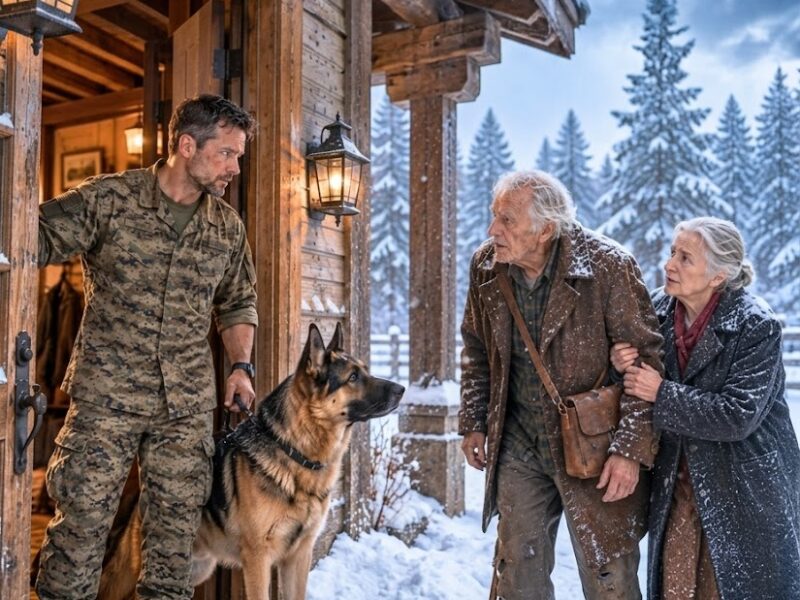
An Elderly Couple Begged a Marine for Shelter—Then the Old Man Asked a Question That Stopped Him Cold
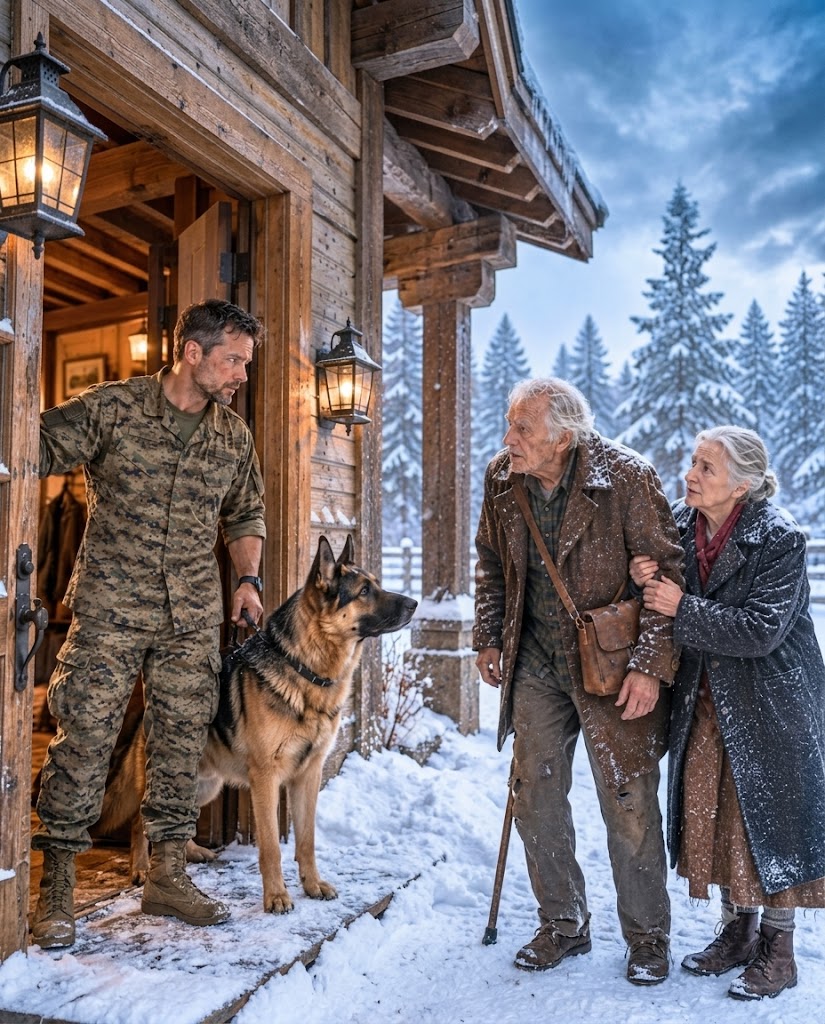
They asked for only one night of shelter, but the moment the old man stepped inside, he stared at a faded blue door that had been locked since Silas’s father died.
“The blue door,” he whispered. “It’s still here.”
Silas had never seen him before.
Then Vesper, his German Shepherd, left the Marine’s side and began watching the stranger.
Silas didn’t know it yet, but something had just reached his door after waiting 17 years to find him.
Late December had buried the pine country outside Coeur d’Alene, Idaho, beneath a clean white silence, the kind that swallowed tire noise, softened rooftops, and made even the wind through the trees sound distant.
Gunnery Sergeant Silas Redern stood at the kitchen window with one hand wrapped around a cooling mug of coffee, watching snow gather along the split-rail fence his father had built before age and illness weakened his hands.
At 43, Silas still carried the compact strength of a career Marine.
Six-foot-two, broad through the shoulders without being bulky.
Short dark brown hair beginning to silver at the temples, gray-green eyes that rarely rested anywhere for long, and a hard angular face marked by a thin scar near the left side of his jaw.
He kept his beard trimmed to rough stubble, more from indifference than style.
People sometimes mistook his quietness for calm.
It was not calm.
Calm was something a man felt.
Silas had simply become very good at containing what he felt.
At his left leg lay Vesper, a seven-year-old German Shepherd with a heavy black-and-tan winter coat, amber-brown eyes, erect ears, and the disciplined stillness of a working canine who had learned that movement should have purpose.
Vesper had served beside Silas long enough that the two communicated more often through posture than command.
There was one habit Silas had come to trust completely.
Vesper stayed on his left side unless something mattered more than routine.
Silas’s world had become small since his last deployment.
The old house, the surrounding timber, Vesper, firewood, coffee, maintenance that never quite ended.
He had stopped answering most invitations into town because every conversation eventually reached the same question.
When was he going back?
What came next?
How was he doing?
Silas hated the last one most.
Inside the breast pocket of his winter field jacket, his fingers sometimes found the scratched metal edge of a dog tag belonging to Staff Sergeant Adrian Cole, a lean, sharp-witted Marine with close-cropped black hair, a narrow face, and the kind of dry humor that could cut through the worst day in a unit.
Adrian had been one of the few men who could tell Silas he was wrong without turning it into a challenge.
He had also been the man Silas had left inside a collapsing structure.
The report said Silas had followed orders.
The report said he had gotten two wounded Marines, the remaining team, and Vesper beyond the collapse zone after Adrian disappeared from radio contact inside the burning building.
The report said going back without a known location would likely have killed more men.
The building had come down anyway.
Adrian had never come out.
Silas understood every tactical reason behind the decision.
Understanding had never been the problem.
He still believed in God.
That was almost worse.
It was easier, he sometimes thought, to imagine there was nobody listening than to believe someone had watched him walk away and still expected him to ask for mercy.
Vesper’s ears suddenly lifted.
Silas looked down.
The dog rose without a sound and crossed toward the front window.
That was enough.
Silas sat down the mug and followed his gaze.
Two figures were moving slowly along the snow-covered road, dark shapes between the white shoulders of the pines.
They were old, and one was leaning heavily on the other.
By the time Silas opened the front door, Vesper was beside him again, alert but quiet.
The man approaching the porch was tall despite a pronounced stoop, perhaps five-eleven, though age had pulled him downward.
His name, Silas soon learned, was Orson Bellweather.
He was 78, thin beneath a worn brown wool coat, with sparse silver hair swept back from a deeply lined forehead, pale blue eyes, and large hands roughened by decades of carpentry work.
His fingers trembled faintly from cold, or something else Silas could not yet name.
There was kindness in Orson’s face, but also strain, as though he were constantly trying to hold on to a thought before it slipped away.
The woman supporting him was Lenora Bellweather, 75, barely five-foot-four, with soft gray hair tied low at the nape of her neck, light skin reddened by the cold, and a faded navy winter coat buttoned carefully to her throat.
She looked physically tired, but emotionally composed.
Nothing in her expression asked for pity.
“Our Buick quit on us,” she said. “A little over a mile back. We tried calling roadside service, but there’s barely a signal.”
Silas glanced past them toward the road.
“You walked all that way?”
“We didn’t see another house.”
Lenora hesitated only once.
“We just need somewhere dry until morning. If that’s all right.”
Silas felt the familiar tightening in his chest that came whenever somebody needed something he had not planned to give.
Responsibility had become dangerous in his mind because responsibility led to names, and names led to memory.
Vesper stepped forward, not toward Lenora, toward Orson.
The old man looked down at the German Shepherd and gave a tired smile.
“Well, you’re a serious fellow.”
Vesper did not wag his tail.
He only watched Orson’s balance.
Silas noticed.
He also noticed the leather satchel hanging diagonally across Orson’s chest.
The old man had carried it more carefully than he carried himself.
“One night,” Silas said at last. “Road service should make it through tomorrow.”
Lenora nodded.
“That’s more than enough.”
Silas stepped aside.
The warmth of the house touched them first.
Lenora exhaled quietly as she entered.
Orson followed, brushing snow from his boots, then stopped so abruptly that Lenora nearly walked into him.
His eyes had fixed on the end of the hallway.
Silas followed his gaze.
A faded blue wooden door stood there beneath years of dust and age, its brass knob dulled almost brown.
Behind it was his father’s old workshop.
The room had remained locked since before the funeral.
Orson stared at it.
Something changed in his face.
Not surprise.
Recognition.
“The blue door,” he whispered.
Silas turned toward him.
Orson took one unsteady step closer.
“It’s still here.”
Every muscle in Silas’s body tightened.
“How do you know about that door?”
Orson looked at him, but for a few seconds, the old man seemed lost inside the question.
Then his hand went to the worn leather satchel.
“Your father used to say I’d know I had the right house when I saw it.”
Silas said nothing.
Orson lowered the satchel onto the kitchen table, opened the buckle with fingers that now trembled more visibly, and reached inside.
He removed a small wooden box.
Two initials had been carved into its lid.
His father’s initials.
Orson pushed the box across the table.
“Your father gave me this 17 years ago.”
Silas did not touch it.
“He told me not to mail it, not to give it to anyone else.”
Orson’s pale eyes lifted to his.
“He asked me to carry it until I could put it in your hands.”
Silas stared at the box long after both elderly strangers had gone to the guest room.
He never opened it.
Hours later, when the house had settled into darkness, he reached down beside his chair out of habit.
Vesper was not there.
Silas looked toward the hallway.
The German Shepherd lay halfway between Silas and the guest room, head raised, ears forward, facing the closed door behind which Orson slept.
For the first time since coming home to Idaho, Vesper had chosen to leave Silas’s side.
And Silas had no idea why.
Morning came, pale and windless, with fresh snow pressed against the porch steps and the road beyond the pines reduced to two shallow grooves disappearing beneath white.
Silas had been awake since five.
The wooden box remained exactly where he had left it, high on the kitchen shelf, close enough to see but far enough that touching it would require a decision.
He had made coffee, fed Vesper, cleared part of the porch, and checked his phone three times before roadside service finally returned his call.
A dispatcher explained that overnight conditions had backed up several recoveries, and the Bellweathers’ Buick would have to wait until the following day.
Silas ended the call and stared through the kitchen window longer than necessary.
“One more night,” he told Lenora when she entered.
She accepted the news without complaint.
“We’ve imposed enough already.”
“You didn’t make the road freeze.”
“No,” she said quietly. “But we did knock on your door.”
That answer stayed with him.
Orson appeared a few minutes later, and Vesper immediately rose from beside the stove.
Silas watched the dog cross the room and stop near the old man.
There was nothing dramatic about it.
No bark, no pawing, no trained alert.
Vesper simply positioned himself where he could watch Orson move.
The first incident came before noon.
Orson opened the back door, apparently intending to look at the woods, and stepped toward the three snow-dusted porch steps.
Vesper moved sideways across the top step and stopped.
Orson chuckled and tried to go around him.
The dog shifted with him.
“Seems I need permission.”
Silas watched from the doorway.
“Take the rail.”
Orson looked at the railing as though he had forgotten it was there.
Then he wrapped one hand around it.
Only then did Vesper move.
Later, Orson rose quickly from a kitchen chair and swayed.
Vesper was against his leg before Silas could cross the room, offering enough solid weight for the old man to steady himself.
Orson rested a hand briefly between the dog’s ears.
Silas felt something cold move through him that had nothing to do with winter.
Vesper was not diagnosing anything.
Silas knew better than to romanticize a working dog’s instincts.
But the German Shepherd had spent years reading human movement.
Weight shifts, breathing, hesitation, tension before action.
Something about Orson’s movement kept drawing his attention.
Lenora noticed Silas watching.
That afternoon, while Orson slept in the guest room, she sat across from Silas at the kitchen table.
“There’s something I should have told you last night.”
Silas waited.
“We don’t have a final diagnosis yet, but Orson’s been having cognitive and neurological problems.”
She folded her hands tightly together.
“Some days you wouldn’t know anything was wrong. Other days, he’ll ask me a name he’s known for 20 years. He’ll walk into a room and forget why he went there. Last month, he forgot where we parked and spent 20 minutes insisting somebody had stolen the car.”
Her voice remained steady until the last sentence.
Silas glanced toward the hallway.
“How long?”
“Long enough that pretending stopped helping.”
Lenora explained that they had briefly tried an assisted living facility in Washington.
Orson had hated it, not because the staff had been cruel, but because every ordinary choice had begun to feel like something requiring permission.
When he could walk, where he could sit, what risks he was allowed to take.
They had left before any permanent arrangement was made.
They had planned to stay near a nephew outside Spokane, but that arrangement had fallen apart shortly before the trip.
Lenora offered no villain and no accusation.
Circumstances had simply changed.
“So where are you going?” Silas asked.
Lenora looked toward the window.
“I don’t know.”
Three words should not have felt like weight.
Silas knew what responsibility did.
First, it asked for a night.
Then it acquired a face, then a name.
Eventually, there was someone you could fail.
He stood.
“The tow gets here tomorrow.”
It sounded colder than he intended.
Lenora understood anyway.
“Yes,” she said. “Tomorrow.”
That night, Silas checked the locks before bed.
At 2:17 a.m., he woke without knowing why.
The house was too quiet.
He reached toward the floor beside the bed.
Empty.
“Vesper.”
Nothing.
Silas was moving before he finished saying the name.
He reached the kitchen and saw the back door standing several inches open, snow blowing across the threshold.
The guest room door was open, too.
Lenora appeared behind him in her robe.
“Orson.”
Silas saw her face change.
“I’ll find him.”
He pulled on boots and his winter jacket, grabbed a flashlight, and stepped outside.
Two sets of tracks crossed the yard.
A man’s uneven footprints and Vesper’s paw prints running alongside them.
Silas followed.
The trail entered the pines behind the property.
After several hundred yards, his flashlight caught amber eyes between the trees.
Vesper stood ahead, waited until Silas saw him, then turned and continued.
“Good boy. Show me.”
Another hundred yards brought Silas to a clearing he had not visited in years.
An abandoned wooden chapel stood among the trees.
Its narrow roof sagged slightly beneath the snow.
Weather had stripped much of the paint from its walls, and a chain hung across the front doors.
Above them, beneath a small wooden arch, was a bronze bell, green with age.
Orson stood at the entrance.
“Orson.”
The old man turned.
There was no recognition in his expression for one terrible second.
Then it returned.
“Silas.”
“Yeah.”
Silas approached slowly.
“What are you doing out here?”
Orson looked at the chapel.
“I don’t know.”
His voice cracked with something deeper than fear.
“I know this place. I just can’t remember why.”
He reached toward a weathered timber beside the door.
His fingertips moved over two shallow marks in the wood.
Then he stopped.
“I measured this.”
Silas said nothing.
“I cut this beam twice because the first one was wrong.”
Orson looked upward toward the roof.
“I stood up there.”
His breathing changed.
“There was a man with me.”
Silas felt the dog tag inside his jacket shift as he moved closer.
“What man?”
Orson stared at the silent bell.
“He said someday we’d hear that ring.”
Then the old man turned toward Silas.
“Your father.”
For several seconds, only snow moved between them.
Silas had inherited the property.
He knew where his father kept tools, which floorboard creaked outside the bedroom, which fence post had been replaced three times.
But he had never known his father had anything to do with this place.
“Let’s get you home.”
On the walk back, Vesper did not return to Silas’s left side.
He stayed beside Orson.
Silas noticed every step.
Lenora was waiting at the door when they returned.
She wrapped both arms around her husband without speaking.
Silas closed and locked the door, then stood alone in the kitchen, looking at the wooden box.
This time, Orson came to him.
“I think we’ve waited long enough.”
He lifted the box from the shelf and opened it himself.
Silas expected letters.
Instead, Orson reached inside and removed an old brass key.
Neither man spoke as they walked to the end of the hallway.
Orson placed the key in the lock of the faded blue door.
It turned, and for the first time in years, the door to Silas Redern’s father’s workshop began to open.
By morning, the snowfall had thinned to scattered flakes, and a weak gray light filtered through the pines, settling against the windows of a room that had remained closed for years.
Silas stood beyond the blue door without moving.
The workshop smelled of old cedar, machine oil, and dust.
His father’s workbench occupied the far wall, scarred by blades and years of use, with a hand plane resting beside a rusted square as though its owner had simply stepped outside.
Pencil measurements climbed one section of wall in small, precise marks.
On a peg hung an old leather apron.
Silas recognized it immediately.
He remembered seeing his father wear it when Silas was young, before deployments and funerals and all the things they had eventually learned not to discuss.
Vesper remained near the doorway.
Orson entered more slowly.
Unlike the night before at the chapel, he did not appear lost.
His hand moved across the edge of the workbench.
“He never threw anything away.”
Silas looked at him.
“You were in here many times.”
Orson crossed toward several rolls of yellowed paper standing in a corner.
He selected one almost without hesitation and carried it to the bench.
When he unrolled it, Silas saw elevations, measurements, roof angles, and a narrow bell arch drawn in pencil.
The chapel.
“You built it with him.”
“Restored it,” Orson corrected. “Most of it was already there. Barely.”
Seventeen years earlier, Orson explained, he had still been working as a carpenter while taking occasional jobs repairing old pianos and church organs.
Wood made sense to him.
So did mechanisms.
A warped soundboard, a loose joint, a roof pulling away from its frame.
Each problem left evidence if a man was patient enough to look.
Silas’s father had approached him about the abandoned chapel.
“He didn’t want a church exactly,” Orson said. “Not the way most people mean it.”
Silas’s expression hardened slightly.
Orson noticed.
“He believed in God, but he knew wounded men don’t always want a sermon.”
That made Silas listen.
The idea had been simple.
Restore the chapel and leave it open to service members, veterans, and military families who needed somewhere quiet when life became too heavy.
No intake forms, no obligation to pray, no demand to explain.
A room, a stove, coffee, a telephone, and somebody willing to sit without asking a man to become whole before he was ready.
“A place to stop before you got so lost you couldn’t ask for help,” Orson said.
Silas looked back at the plans.
“Why didn’t he finish?”
“His health.”
The answer was quiet.
By the time the roof was sound and the bell support had been repaired, Silas’s father could no longer work full days.
Then not half days.
Eventually, the project stopped entirely.
“The bell?” Silas asked.
Orson shook his head.
“Never rang.”
The wooden box was still open on the bench.
Beneath the place where the key had rested were photographs, folded notes, and several envelopes.
Silas picked up a photograph.
His father stood beside a younger Orson in front of the chapel.
Orson was broader then, his silver hair still mostly brown, both hands gripping a carpenter’s level.
Beside him stood Silas’s father, thinner than Silas remembered him from those years, but smiling.
Silas had almost forgotten that smile.
He opened the first letter, then another.
The words slowly revealed a man Silas had never known.
Years before, during his own military service, his father had been involved in a training accident.
Several men had been caught in a damaged structure.
He helped get more than one out.
Another serviceman remained trapped when conditions became too dangerous to re-enter.
His father obeyed the order to stay out.
The trapped man died.
The investigation cleared him.
He never cleared himself.
Silas lowered the page.
Something hot and violent rose beneath his ribs.
“You knew?”
Orson did not pretend otherwise.
“Yes.”
“He told you?”
Silas laughed once without humor.
“He told you.”
Vesper raised his head.
“My whole life that man told me duty meant making the decision you could live with.”
Orson remained silent.
“He knew.”
Silas struck the letter against the workbench.
“He knew what this feels like.”
His voice broke on the final word, and that made him angrier.
“He watched me come home. He watched me stop sleeping. He watched me sit at his table and barely speak, and he never told me.”
“He was ashamed.”
“So was I.”
The words landed harder than the anger.
Orson looked down.
“Maybe that was the problem.”
Silas turned away.
For years, he had wanted one person to tell him how a man lived after making the correct decision and still losing someone.
His father had possessed that same wound and had carried it silently to the grave.
Orson reached into the box and handed him a folded note.
“This was written to me.”
Silas opened it.
His father’s handwriting had weakened, but the sentence was clear.
If my son ever comes home carrying more than he can put down, don’t tell him to be strong. Give him somewhere useful to carry it.
Silas read it twice, then a third time.
Behind him, Orson lowered himself into the old chair.
“I was afraid I’d wait too long.”
Silas looked up.
“There are mornings now when I know I’ve forgotten something, but I can’t tell what it is. I was scared someday I’d remember the box and forget you, or remember you and forget what I promised your father.”
For the first time, Silas understood why the old man had guarded that leather satchel through the snow.
Orson had not merely carried a box for 17 years.
He had been racing his own disappearing memory to deliver it.
Silas searched the remaining papers until he found an unfinished letter.
It ended halfway down the second page.
There was no signature.
The final complete sentence stopped him.
A man can survive leaving someone behind. What destroys him is believing he has no right to keep walking.
Afterward, Silas’s hand went into his pocket.
His fingers closed around Adrian Cole’s scratched dog tag.
For years, he had called it remembrance, loyalty, a debt.
But standing in his father’s workshop, Silas finally allowed himself to consider something uglier.
Maybe he had turned Adrian’s death into a sentence because punishment was easier than forgiveness.
Maybe refusing to live had never brought Adrian one inch closer to home.
Silas closed his fist around the tag until its edge hurt.
He did not forgive himself that morning.
He did not know how.
But for the first time, he wondered whether surviving was actually the betrayal.
The next afternoon, Silas walked alone through the pines to the abandoned chapel.
Vesper followed but remained several steps behind.
Silas stood beneath the old bronze bell.
Snow had collected along its upper rim.
He reached up and brushed it away, then rubbed years of dirt and green residue from the metal until a narrow strip of bronze appeared beneath.
The rope hung within reach.
Silas wrapped his hand around it.
He thought of his father.
He thought of Adrian.
Then he released the rope.
The bell remained silent.
Not yet.
Three days after Silas stood beneath the silent chapel bell, winter tightened around the property again, frosting the windows before dawn and turning every shaded patch of snow beneath the pines hard as stone.
Lenora made the call from Silas’s kitchen.
After Orson’s walk into the woods, she could no longer convince herself that staying awake longer or watching him more closely constituted a plan.
She contacted the Washington facility where they had briefly stayed and requested copies of his evaluations so she could arrange follow-up care near Coeur d’Alene.
She expected paperwork.
She did not expect Dr. Malcolm Vane to appear at Silas’s house two days later.
Malcolm was 59, just under six feet, with a narrow upright build, iron-gray hair combed neatly away from a high forehead, a clean-shaven rectangular face, and dark eyes that seemed trained to notice liabilities before personalities.
His charcoal overcoat was practical rather than expensive.
His boots carried road salt around the soles, and he spoke with the controlled precision of a man accustomed to families becoming angry when he told them things they did not want to hear.
Years of overseeing cognitively vulnerable residents had hardened one conviction in him.
Independence mattered only while a person could survive its consequences.
Beside him stood Aaron Shaw, a records coordinator in her early forties, medium height with curly auburn hair, wire-framed glasses, and a canvas document case held against her chest.
She introduced herself politely and then mostly remained silent.
Silas did not invite Malcolm farther than the kitchen until Lenora said, “I asked for the records.”
“I know,” Malcolm replied. “And your request raised concerns.”
Lenora’s face tightened.
Malcolm opened the file.
During their short stay in Washington, Lenora had signed documents authorizing evaluation of Orson’s decision-making capacity and allowing staff to coordinate care if his condition created immediate safety concerns.
She admitted she had signed some of them while frightened and exhausted.
“I thought they were evaluation forms.”
“Some were,” Malcolm said. “Some addressed what happens when an evaluation raises risk.”
Orson sat at the table listening.
“You could ask me,” he said.
Malcolm turned toward him.
“Then I will.”
He did.
Did Orson remember leaving the house at night?
Not at first.
Did he know how far he had walked?
No.
Did he understand what could have happened?
Orson looked toward the window.
“I do now.”
Malcolm then faced Silas.
“How far?”
“Four hundred, maybe 600 meters.”
“What was the temperature?”
“Below freezing.”
“And if the dog hadn’t followed him?”
Silas’s jaw tightened.
Malcolm continued.
“Are you trained in cognitive care?”
“No.”
“If Mr. Bellweather falls outside next time, what part of caring about him prevents hypothermia?”
Silas pushed his chair back.
“Watch yourself.”
“I am.”
The calmness of Malcolm’s answer irritated him more than aggression would have.
“Caring about him does not make you qualified to keep him safe.”
Silence filled the kitchen.
Silas wanted to throw the man out.
What stopped him was the fact that part of the sentence was true.
Lenora’s hands had begun trembling.
“I’m afraid, too,” she said.
Orson turned toward her.
She looked at her husband with an expression Silas wished he had not seen.
“I’m afraid one morning you’ll wake up and look at me, and I’ll be a stranger.”
Orson reached for her hand.
Lenora held it, then looked at Malcolm.
“But safety is not the same thing as living.”
The words struck Silas somewhere old.
A burning structure, two wounded Marines, a collapsing roof.
Adrian somewhere beyond radio contact.
Get the men you have out.
Silas had obeyed.
Adrian had died.
Ever since, some damaged part of Silas had translated safety into abandonment.
If he protected what remained, perhaps it meant he had surrendered what was lost.
He looked at Orson, then Malcolm.
“What would adequate support actually require?”
Malcolm paused.
That was the first question all morning that changed his expression.
He began answering.
Silas took notes.
By afternoon, anger had become a plan.
He contacted a local clinician experienced in geriatric cognitive assessment and arranged an independent evaluation.
The ground-floor study became Orson and Lenora’s bedroom so stairs would no longer be necessary at night.
Silas installed simple door chimes and sensors, improved lighting from the back entrance toward the driveway, and placed emergency numbers beside both phones.
Lenora agreed that Orson would wear an identification bracelet when outside the property.
They established what to do if he became disoriented, where to search first, when to call 911, and which responsibilities Lenora could no longer safely carry alone.
Vesper remained part of the household routine, nothing more.
Silas refused to turn the dog’s attention into a medical promise.
The independent assessment took place over the following days.
It did not offer the certainty anyone wanted.
Orson showed measurable impairment, particularly with short-term recall and orientation, but he could still understand his circumstances, express consistent preferences, weigh basic risks, and participate meaningfully in decisions about where and how he lived.
Malcolm reviewed the findings at Silas’s kitchen table.
Aaron also clarified the Washington documents.
They permitted evaluation and care coordination.
They did not grant Malcolm unilateral authority to remove Orson from his wife or determine his residence.
Malcolm closed the folder.
“So he stays.”
Orson looked directly at him.
“I decide whether I stay.”
A faint tension crossed Malcolm’s mouth.
“For now, yes.”
Silas almost objected to the wording, then stopped because Malcolm was right about that, too.
No evaluation could promise what Orson would be capable of six months from now.
Before leaving, Malcolm stood on the porch and watched Orson sitting beneath a blanket near the railing.
Vesper lay beside his chair, chin resting across his front paws.
“I hope you’re right about him,” Malcolm said.
Silas followed his gaze.
“I don’t know that I am.”
Malcolm looked surprised.
Silas continued.
“If the situation changes, the plan changes.”
For the first time, Malcolm gave a small nod.
“There may come a day when this isn’t enough.”
“I know.”
Malcolm walked toward his car.
Silas remained on the porch after the vehicle disappeared between the pines.
He had spent years believing there were only two choices.
Hold on or abandon.
Save or betray.
Return for Adrian or live with leaving him behind.
But Orson’s life could not be reduced to two choices.
Neither could his own.
Silas looked through the window at Lenora preparing coffee while Orson tried to remember where she kept the spoons.
Nothing about the scene was safe from loss.
Orson might worsen.
Lenora might someday face the mourning she feared.
Vesper would grow old.
Everyone Silas allowed himself to love could eventually leave him.
He finally understood what isolation had bought him.
For years he had kept people at a distance, kept faith at a distance, kept even hope far enough away that losing it could not hurt.
He had made himself very safe, and in doing so, Silas Redern had nearly stopped living.
By February, winter had begun loosening its grip on the country outside Coeur d’Alene, leaving longer afternoons, dripping eaves, and dark patches of earth beneath the pines where snow had finally started to retreat.
Silas stopped thinking about leaving Idaho.
He never announced the decision.
There was no dramatic conversation at the kitchen table.
He simply began making choices that assumed he would still be there when spring arrived.
The small guest house on the property became the Bellweathers’ home.
Silas widened the path leading to it, improved the exterior lighting, removed two raised thresholds, added grab rails where they were needed, and connected the door sensors to the same system used at the main house.
Orson and Lenora paid toward utilities, groceries, and repairs.
When Silas tried to refuse the first check, Orson pushed it back across the table.
“I’m losing pieces of my memory,” he said. “Not my dignity.”
Silas accepted it.
That mattered more than generosity.
Then they returned to the chapel.
Work gave the remaining winter a rhythm.
Silas repaired damaged roof boards, reinforced part of the floor, replaced rotten trim, and followed pencil marks his father had made on plans 17 years earlier.
Sometimes he would stop with a hammer in his hand and realize he was completing a measurement his father had begun.
Orson could no longer safely handle the heavy work, but his hands remembered things his mind occasionally misplaced.
One afternoon, he spent 10 minutes searching for a carpenter’s square that was sitting beside him, then glanced at a newly fitted frame and immediately frowned.
“Wrong.”
Silas checked it.
The angle was off by an eighth of an inch.
Orson said it was.
Silas smiled despite himself.
“Show-off.”
Orson smiled back.
Lenora found her own work.
She contacted military families, veterans, local support groups, and people who might understand what the chapel was meant to be.
She never advertised it as a cure.
It was simply a place where someone could sit without being required to explain why sitting alone had become difficult.
Vesper spent many afternoons beside Orson.
Nobody commanded him there.
Silas noticed, but he no longer interpreted the dog’s absence from his left side as something being taken from him.
By late winter, the chapel was ready.
There was no grand opening.
A handful of people came the first morning.
Two military families, an older veteran who walked with a cane, and a young Marine with tired eyes who entered without introducing himself and chose the chair farthest from everyone else.
Silas recognized that kind of silence.
Years earlier, he might have tried to fill it.
Instead, he put coffee on the table and left the young man alone.
The Marine eventually wrapped both hands around the warm cup.
That was enough.
Outside, Orson stood beneath the little wooden arch and looked upward.
The bronze bell was clean now.
Silas followed his gaze.
Seventeen years.
His father had repaired the support but never heard what he had been working toward.
Silas reached for the rope.
He pulled.
The bell struck once.
The sound rolled through the chapel timbers and outward between the snow-covered pines, deeper and warmer than Silas expected.
Birds lifted from a distant tree.
Lenora placed one hand over her mouth.
Orson closed his eyes.
He said nothing.
Neither did Silas.
Some things did not improve when explained.
The bell rang again, and the work his father had left unfinished finally had a voice.
Several mornings later, sunlight lay bright and cold across the guest house porch.
Orson sat beneath a wool blanket while Vesper rested nearby.
Silas approached, carrying two mugs of coffee.
Orson looked up, his expression changed.
Not fear.
Effort.
Silas stopped.
The old man studied his face for several long seconds.
“I’m sorry, son.”
Silas waited.
“Your name slipped away from me.”
Something inside Silas tightened.
“Silas.”
Orson repeated it softly.
“Silas.”
Then he nodded.
“That’s right.”
Vesper rose and walked to him, placing his muzzle across Orson’s knee.
Recognition arrived immediately.
Orson smiled and ran his weathered fingers between the German Shepherd’s ears.
“But I know you.”
Vesper’s tail touched the porch once.
“There you are, Marine.”
Silas turned toward the trees before Lenora could see his eyes.
The moment hurt, but pain no longer meant he had made the wrong choice by loving what could be lost.
That night, Silas walked to the chapel alone.
He carried his father’s unfinished letter in one hand.
In the other was Adrian Cole’s scratched dog tag.
For years the metal had lived against his body like evidence.
Some days he had touched it to remember Adrian.
Other days, though he had refused to admit it, he had touched it to remind himself of the punishment he believed he owed.
Silas placed the letter on a small wooden table near the front of the chapel.
Then he set Adrian’s tag beside it.
He remained standing.
There were no answers waiting in the room, no explanation for why one man survived a collapsing building and another did not.
No sentence in his father’s letters that could reverse a decision made in seconds.
No prayer capable of returning Adrian to the men who had carried his absence home.
Silas bowed his head.
“If I have to carry him for the rest of my life, show me how to carry him forward instead of backward.”
Silence followed.
Once that silence would have felt like rejection.
Tonight it did not.
Silas stood there long enough to understand that faith did not require the wound to disappear.
Perhaps forgiveness did not mean declaring that nothing terrible had happened.
Perhaps it meant refusing to make the terrible thing the final authority over everything that came afterward.
He left the dog tag beside the letter.
Then he stepped outside.
Vesper was waiting near the chapel door.
Silas looked beyond him toward the snow-covered road visible through the pines.
For months he had looked at that road and imagined leaving somewhere else, another assignment, another town, anywhere that asked nothing of him except movement.
Tonight no such thought came.
He turned his head.
Through the trees, warm yellow light glowed from the Bellweathers’ small house.
Two elderly silhouettes moved behind the window.
One paused, the other crossed slowly toward it.
Nobody called Silas home.
Nobody needed to.
He looked down at Vesper.
The German Shepherd stepped forward.
For weeks, Vesper had repeatedly chosen Orson when the old man needed him more.
Now there was no one to steady, no one lost in the snow, no one who needed watching.
Vesper moved into his old place at Silas’s left side.
Silas turned his back on the road.
Together, Marine and canine walked through the pines toward the light.
Maybe God’s miracles do not always arrive by changing what happened.
Sometimes the miracle is that He sends someone into our lives who changes what happens next.
Silas could not bring Adrian back.
Orson could not stop his memories from fading.
But through an elderly couple, a faithful dog, an unfinished chapel, and a promise carried for 17 years, God showed a wounded Marine that surviving was not a betrayal.
His life could still become something useful, something loving, something that carried the past forward instead of backward.
Perhaps someone reading this is carrying a loss, a regret, or a guilt that no one else can see.
You may not understand why God allowed that chapter of your life to happen.
But unanswered questions do not mean God has abandoned your story.
Sometimes His answer is not an explanation.
Sometimes it is another door, another person, another purpose, and the strength to take one more step.
If this story touched your heart, share it with someone who may need that reminder today.
Tell us in the comments what part spoke to you most, and subscribe to the channel for more stories of faith, loyalty, healing, and second chances.
May God bless you and your family, give peace to the burdens you carry, protect those you love, and guide your steps toward the light He still has waiting for you.
Amen.









