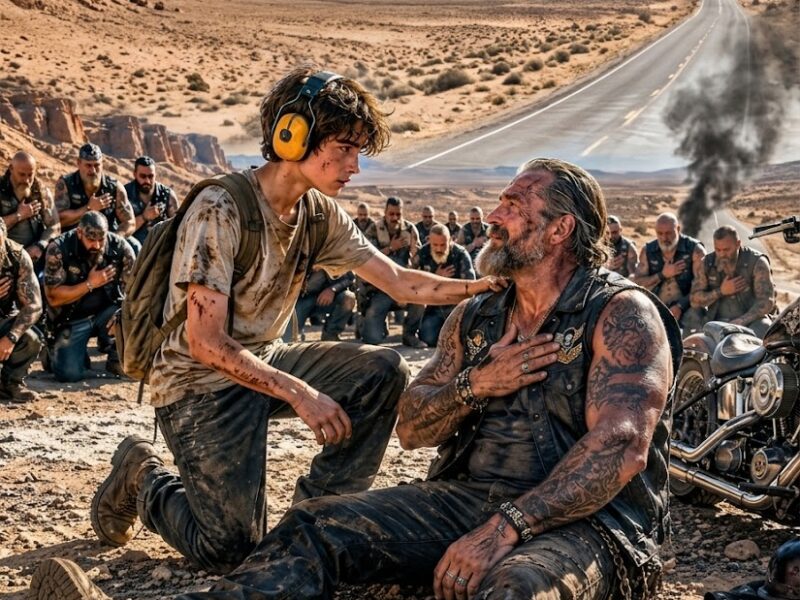
An autistic teen dragged a Hells Angel from a burning wreck. Then the entire charter knelt before him.
**Part 1**
The Nevada sky was a white-hot anvil pressing down on Highway 50, the two-lane ribbon of asphalt that mapmakers liked to call the loneliest road in America.
Heat shimmer rose off the blacktop in oily waves, and the only sound for miles was the dry rattle of scrub brush and the distant hum of a single engine.
Seventeen-year-old Leo Harrison didn’t mind the loneliness one bit.
To most people, the emptiness out here felt like punishment, a place where the silence got so loud it made your ears ring. To Leo, it was the only quiet he could trust.
He wore heavy yellow 3M Peltor ear defenders clamped over his ears even in the middle of July, because a refrigerator hum in a normal kitchen felt to him like a dentist’s drill boring straight into his skull.
The fluorescent lights at his high school flickered like strobe lights, and a crowded hallway felt like standing inside a jet engine.
Out here, there was just wind and rock and the clean, predictable logic of leverage and mass.
—
Leo dragged his rusted red Radio Flyer wagon along the gravel shoulder, its little wheels crunching over the stones in a rhythm he found soothing.
Inside the wagon lay his prize for the afternoon: a heavy rig strut he’d spotted half-buried in the dirt, the kind of discarded truck part most people would walk right past.
Leo saw tensile strength where other people saw trash.
He saw load-bearing angles where other people saw rust.
He was calculating the strut’s estimated yield point in his head, lips moving silently, when the world behind him tore itself apart.
—
A convoy of twelve Hell’s Angels was eating up the highway at eighty miles an hour, their straight-piped Harley-Davidsons roaring in a chain of thunder that rolled across the desert floor.
Leading the pack rode Richard “Grizzly” Coleman, the charter’s fifty-year-old president, a man with a scarred jawline and eyes that assessed everything like a threat.
Bringing up the rear as tail gunner was Tommy “Wrench” Gallagher, six-foot-four and two hundred fifty pounds of grease-stained muscle, riding a custom Panhead chopper he had rebuilt from the ground up with his own hands.
Wrench loved that machine more than most men love their wives, and he was lagging nearly a quarter mile behind the pack because the big bike was running heavy today.
Then a dilapidated logging semi in the opposite lane blew a retread, and the explosion cracked across the desert like a cannon shot.
A steel-belted chunk of rubber the size of a manhole cover—a road gator—shot across the asphalt directly into Wrench’s path at eighty miles an hour.
There was no time to swerve.
—
The front tire of the chopper struck the debris dead-on, and the bike’s front end jerked violently into a death wobble that no pair of human hands could correct.
Wrench fought the handlebars with everything he had, but physics had already signed the paperwork.
The seven-hundred-pound machine careened off the shoulder, plowed through the gravel, and launched over the lip of a steep rocky ravine.
It flipped in midair, and Wrench sailed over the handlebars, crashing brutally into the dry riverbed below as a cascade of rocks and dust followed him down.
A microsecond later, the Harley slammed down directly on top of his right leg with a sickening crunch of breaking bone and tearing metal.
The impact ruptured the custom fuel tank, and high-octane gasoline flooded over the scorching engine block and severed, sparking battery cables.
Whoosh.
A ball of orange flame erupted from the ravine and sent a thick plume of acrid black smoke into the merciless Nevada sky.
A mile ahead, the roar of eleven other motorcycles drowned out the sound of the crash, and the charter kept riding, completely unaware that one of their own was pinned beneath a raging inferno.
But Leo saw it all.
—
He stood two hundred yards away, the metal strut slipping from his fingers, the concussive force of the exploding tire rattling his rib cage even through his ear defenders.
He stared at the rising black smoke, his heart hammering against his sternum, and panic—cold and sharp and familiar—threatened to lock every muscle in his body.
He hated fire. He hated chaos. His nervous system had spent seventeen years learning to curl up and shut down when the world got too loud.
But another part of his brain, the part that organized chaos into neat mathematical certainties, overrode the fear with a single, precise thought: fuel source, ignition point, thermal runaway.
Leo knew the remaining gasoline in that tank would reach a critical pressure threshold in exactly three to four minutes.
When it did, a boiling liquid expanding vapor explosion would incinerate anything within a twenty-foot radius.
He didn’t think about being brave.
He just started running toward the smoke.
—
The heat radiating from the ravine was suffocating as Leo scrambled down the steep shale-covered embankment, slipping once and tearing the skin off his palms and knees.
He barely registered the pain.
At the bottom of the dry riverbed, he found a scene straight out of hell.
The Harley lay on its side, the rear half engulfed in aggressive, licking flames that crept slowly toward the front, and pinned squarely beneath the blazing engine block was Wrench.
The biker’s leather cut was scraped and torn, a deep laceration across his forehead had painted his face red, and his eyes were rolling back in his head as he groaned in sheer agony.
“Help,” Wrench rasped weakly, clawing at the dirt. “Help me.”
The stench of burning rubber, melting wire, and roasting flesh made Leo’s stomach heave, and the flames roared at a volume that punched straight through his ear defenders.
He wanted to scream. He wanted to run.
Instead, he looked at the motorcycle and did the math.
—
Mass: approximately 315 kilograms. Downward force: 3,087 newtons. Human lifting capacity: insufficient.
Leo couldn’t lift it, and neither could a strong grown man deadlifting a hot, awkward engine block from a bad angle.
He needed mechanical advantage. He needed a class-one lever.
His eyes darted around the crash site and locked onto a rusted steel fence post half-buried in the wash, about five feet long.
He grabbed it, ignoring the rough rust slicing into his already bleeding palms, and kicked a basketball-sized granite boulder as close to the burning bike as he dared.
The flames were licking at Wrench’s heavy leather boots now, and the heat was so intense it singed the hair on Leo’s arms.
“Hold on!” Leo stammered, his voice cracking, barely audible over the roaring fire.
He jammed the steel pole under the heavy frame of the Harley and rested its midpoint squarely on the granite boulder.
Then he scrambled to the far end and threw his entire hundred-ten-pound body onto it—not just pushing, but hanging from it, wrapping his arms and legs around the metal and letting gravity do what his muscles couldn’t.
The pole groaned and bowed under the pressure.
For a terrifying second, nothing happened.
—
Then, with a harsh scrape of metal on stone, the burning motorcycle slowly hoisted upward.
Three inches. Five inches. Eight inches.
Wrench, operating on pure adrenaline and the primal instinct to survive, felt the crushing weight release and screamed through clenched teeth.
He dug his elbows into the dirt and violently dragged his body backward, sliding his shattered leg out from beneath the chassis.
The second he was clear, the pole snapped out from under Leo and the burning motorcycle slammed back down into the dirt, crushing the exact spot where Wrench’s leg had been two seconds earlier.
But they weren’t safe yet.
The flames were reaching the fuel tank’s main housing, and the metal was glowing cherry red.
Leo scrambled to Wrench, grabbed the thick leather collar of the man’s Hell’s Angels cut, dug his heels into the gravel, and pulled with hysterical, frantic strength.
Ten feet. Fifteen feet. Twenty feet.
He dragged the massive biker behind a large outcropping of rock just as a deafening boom echoed through the canyon.
The fuel tank detonated, and a shockwave of heat and concussive force blasted over them, showering the dry riverbed with flaming debris and chunks of shrapnel.
Leo threw himself over Wrench’s chest and covered the man’s face as burning fragments rained down around them.
—
When the debris settled, Leo sat up, gasping for air.
The motorcycle was nothing but a blackened, twisting skeleton of metal, and Wrench was completely unconscious.
Worse, a massive pool of dark arterial blood was rapidly soaking into the dry dirt beneath the biker’s mangled leg—the femoral artery had been nicked by a shard of bone.
Leo’s mind flashed to an anatomy textbook he had memorized in the ninth grade: exsanguination from the femoral artery occurs in approximately three to five minutes.
Hands shaking violently, he ripped his heavy canvas backpack off his shoulders and tore at the thick nylon strap, breaking the plastic buckle with a sharp rock.
He wrapped the strap high up on Wrench’s massive thigh, just below the groin, and grabbed a heavy metal wrench that had been thrown from the biker’s saddlebags during the crash.
He tied a knot around the wrench and twisted it frantically—once, twice, three times—until the nylon dug viciously into Wrench’s flesh.
The dark flow of blood slowed, then finally stopped.
Leo tied the wrench in place, his chest heaving, his hands coated in the biker’s blood.
—
The sensory overload had reached its absolute peak—the smell of blood and fire, the searing heat, the violent roaring in his ears.
It was too much.
Leo collapsed back against the rocks, pulled his knees to his chest, clamped his hands over his yellow ear defenders, and began to rock back and forth, humming a low, repetitive monotone note to ground himself in the chaos.
He didn’t hear the thunder returning.
Up on the highway, Grizzly and the rest of the charter had realized their tail gunner was missing, and they had doubled back fast and hard until they saw the plume of thick black smoke rising from the ravine.
Eleven heavy motorcycles skidded to a halt on the shoulder, and Grizzly leapt off his bike before the kickstand was even down.
He and three other patched members—hard, dangerous men with rap sheets and bad tempers—scrambled down the embankment with heavy tactical knives and steel mags in their belts, because in their world an ambush was always a possibility.
They rounded the rock outcropping and froze.
There was Wrench, their brother, pale as a ghost, unconscious and covered in blood.
And sitting right next to him was a scrawny, trembling teenager, rocking back and forth, his hands and clothes literally soaked in Wrench’s blood.
To the Hell’s Angels, the scene translated instantly into the worst possible scenario.
—
“Hey!” Grizzly roared, his voice booming like a cannon in the canyon as he leveled a heavy steel pipe at the boy. “What the hell did you do to him?”
Leo’s eyes shot open wide with sheer terror.
He looked at the four massive, furious men advancing on him, and his throat closed up completely.
The words evaporated.
He pushed himself backward against the rock, curling into a tight fetal position, entirely nonverbal, waiting for the blows to fall.
The shadow of Richard “Grizzly” Coleman fell over Leo like a descending vault door.
“I asked you a question, you little freak,” Grizzly bellowed, his voice echoing off the canyon walls.
He lunged forward and grabbed the collar of Leo’s faded t-shirt, intending to haul the trembling boy to his feet.
Leo didn’t fight back. He couldn’t. His nervous system had completely short-circuited.
He squeezed his eyes shut, pressed his hands harder against his yellow ear defenders, and let out a continuous high-pitched hum, bracing for the physical strike he knew was coming.
“Grizzly, stop. Drop him now.”
The sharp, authoritative command didn’t come from Leo.
It came from a wiry gray-bearded biker named Bones, the charter’s unofficial medic, who was already kneeling in the bloody dirt beside Wrench and assessing the catastrophic damage to the massive man’s leg.
Grizzly hesitated, his grip loosening on Leo’s shirt.
“I said drop him. Look at the leg,” Bones barked, pointing a bloodstained finger at Wrench’s thigh.
Grizzly and the other bikers stepped closer, their heavy boots crunching in the gravel, and looked down.
High up on Wrench’s massive thigh, just inches below the femoral artery, a thick nylon backpack strap was wrapped violently tight, and twisted into the knot serving as a makeshift windlass was a heavy steel wrench.
The crude but mathematically flawless tourniquet had totally arrested the arterial spurting.
“The femoral artery is nicked,” Bones said, his voice dropping to a hushed, awed register. “If this wasn’t here, Wrench would have bled out in three minutes. This kid didn’t hurt him, Grizzly. He saved his life.”
—
Grizzly released Leo’s shirt entirely and took a step back, the fury draining from his face and replaced by profound confusion.
He looked at the frail hundred-ten-pound teenager rocking in the dirt, then at the smoldering seven-hundred-pound motorcycle twenty feet away.
“How the hell did he get him out from under that?” Grizzly muttered, looking at the cratered earth. “Wrench is two-fifty. The bike is seven hundred. The kid weighs less than my front tire.”
Another biker, a quiet tracker named Colt, walked over to the burned chassis of the Harley and studied the scene like a crime scene investigator.
He saw the deep, frantic drag marks in the dirt leading from the bike to where Wrench now lay.
He saw the basketball-sized granite boulder, and then he saw the rusted steel fence post, bowed and snapped in half, resting precisely on the rock.
“Leverage,” Colt said quietly, turning to look at Leo with a profound, sudden reverence. “The kid built a class-one lever. He used the rock as a fulcrum and his own body weight to pry a seven-hundred-pound burning Panhead off Wrench. Then he dragged him twenty feet before the tank blew.”
A heavy, stunned silence fell over the violent men.
They were outlaws, men who solved problems with brute force and intimidation, yet they were staring at a boy who had defeated physics, fire, and death using nothing but a rusted pole and pure intellect.
—
Suddenly the silence was shattered by a deafening, rhythmic chopping sound.
A medevac helicopter, called in by the rest of the charter up on the highway, was cresting the canyon ridge, its massive rotors beating against the hot desert air and kicking up a blinding sandstorm in the dry riverbed.
The noise was apocalyptic, a thundering concussive roar that shook the very fillings in their teeth.
For Grizzly and his men, it was the sound of salvation.
For Leo, it was absolute torture.
The teenager screamed a raw, panicked sound that was instantly drowned out by the rotors, and he dropped his ear defenders, curling into a tight ball and hyperventilating as the rotor wash pelted his raw, bleeding skin with sharp sand.
The auditory and tactile overload was pushing his autistic brain toward a total neurological shutdown.
Grizzly saw the boy violently trembling, his hands clawing at his own ears, and the outlaw president didn’t understand autism, but he understood brotherhood and he understood a debt.
“Shield him!” Grizzly roared over the deafening downdraft.
He didn’t need to ask twice.
Instantly, four massive leather-clad Hell’s Angels turned their backs to the descending helicopter and formed a tight human wall around Leo.
Grizzly dropped to his knees right in front of the boy and pulled off his heavy leather cut—the sacred vest bearing the Hell’s Angels death head, a garment outlaws would literally die to protect.
He draped the thick leather over Leo’s head and shoulders, physically blocking out the flying sand, the blistering wind, and the chaotic noise.
“You’re safe, kid!” Grizzly shouted over the roar, refusing to make aggressive eye contact, sensing the boy needed space. “We got you. Nobody touches you. You hear me? We got you.”
Beneath the heavy, exhaust-scented leather, surrounded by a fortress of massive men, Leo’s hyperventilation slowly began to subside.
He was in the dark. He was shielded.
For the first time that day, he felt safe.
—
**Part 2**
Three months is a long time in the world of high school, where memories are short and cruelty is a daily currency.
It was late October, and the crisp autumn air had finally broken the Nevada heat.
Leo Harrison was back to his routine, navigating the treacherous hallways of his rural public high school.
The burn scars on his palms and knees had healed into shiny pink tissue, but internally little had changed.
He was still the weird kid. He still wore his yellow 3M ear defenders. He still avoided eye contact.
The story of the crash had made a brief appearance in the local paper, but high schoolers rarely cared about things that didn’t directly involve them, and to the student body, Leo was just a prime target.
It was 3:15 p.m., dismissal time, and the main courtyard was packed with hundreds of students rushing to the buses.
Leo was walking near the edge of campus, pulling his rusted Radio Flyer wagon, which was currently loaded with a heavy discarded alternator he had found near the auto-shop dumpsters.
“Hey, Rainman.”
Leo stiffened.
It was Brad, a heavy-set varsity linebacker who made a sport of terrorizing anyone smaller than him, and he and three of his friends blocked the sidewalk in matching letterman jackets.
Leo stopped, keeping his eyes firmly fixed on Brad’s sneakers. He didn’t speak. He just wanted to go home and dismantle the alternator.
“What kind of garbage you collecting today, freak?” Brad sneered, stepping forward and kicking the side of the red wagon.
The wagon tipped, and the heavy alternator spilled out, rolling into the dirt with a heavy thud.
Leo let out a distressed, sharp breath and dropped to his knees, his hands hovering over the dropped metal, his routine violently disrupted.
“Leave it,” Brad commanded, stepping on the alternator. “You’re a scavenger, Leo. Just a weird little—”
Brad never finished his sentence.
—
It started as a low rumble, a vibration that shook the loose gravel on the sidewalk.
Then it escalated into a deafening, unified roar of high-octane combustion.
Conversations across the courtyard stopped dead. Teachers froze. The school security guard dropped his radio.
Turning off the main highway and pulling directly into the school’s circular driveway wasn’t a school bus.
It was a column of fifty straight-piped Harley-Davidson motorcycles—the entire West Coast charter of the Hell’s Angels, riding in a flawless, intimidating V formation.
The sea of students parted like the Red Sea, falling back in absolute terror as the massive machines rolled to a synchronized halt, effectively blockading the entire front of the school.
The engines were killed in unison, leaving a heavy ringing silence in the air.
Fifty men wearing heavy denim, combat boots, and black leather cuts bearing the winged death head dismounted.
Leading the pack was Grizzly.
Beside him, leaning heavily on a custom-machined aluminum cane, was Tommy “Wrench” Gallagher.
Wrench had a massive titanium rod holding his right femur together and a pronounced limp, but he was alive.
The Hell’s Angels didn’t look at the teachers. They didn’t look at the security guard. They marched in a solid block directly toward the edge of the courtyard.
Brad and his friends went pale, the blood draining completely from the linebacker’s face.
He stumbled backward, tripping over his own feet, desperately trying to put distance between himself and the approaching outlaws.
Grizzly stopped five feet from Brad, and the fifty-year-old president didn’t say a word.
He just leveled a cold, dead stare at the high school bully—a look that promised absolute, unchecked violence.
Brad swallowed hard, turned on his heel, and sprinted away in sheer panic, abandoning his friends, who quickly followed suit.
—
Leo was still kneeling on the ground, his hands covering his ears, overwhelmed by the sudden arrival of the motorcycles.
The heavy thud of boots stopped right in front of him, and he squeezed his eyes shut.
Slowly, carefully, Wrench lowered his massive frame down onto the pavement, sitting cross-legged in the dirt right across from Leo, making himself as small and non-threatening as possible.
Grizzly stood behind him, signaling for the rest of the fifty bikers to hold their perimeter.
“Hey, kid,” Wrench said, his voice a low, gentle rumble. He deliberately looked down at the dirt, knowing eye contact would only stress the boy out. “Sorry about the noise. We wanted to catch you before you went home.”
Leo slowly lowered his hands from his yellow ear defenders.
He recognized the heavy leather boots, and he looked up, his eyes darting to the Hell’s Angels patch on Wrench’s chest and then quickly away.
“You left something in the desert,” Wrench said softly.
He reached into his leather vest and pulled out a heavy object, placing it gently on the pavement and sliding it across the dirt until it bumped against Leo’s knee.
Leo looked down.
It was the heavy steel wrench he had used as a makeshift windlass, but it had been transformed—the blood cleaned away, the steel mirror-polished until it gleamed in the afternoon sun, and deeply engraved into the handle in immaculate custom tooling were the words: *To Leo, our brother, our blood.*
“I was in the hospital for a month,” Wrench continued, staring at the rusted alternator on the ground. “Doctors said if you hadn’t built that lever, I’d be ash. If you hadn’t tied that knot, I’d have bled out before the chopper even took off. You gave me my life back, Leo.”
Leo tentatively reached out, his fingertips tracing the engraved letters on the polished steel. The cold, logical precision of the metal grounded him.
“Tensile strength,” Leo whispered, his voice barely audible. “The lever was—it was just physics.”
“Maybe to you,” Grizzly said, his deep voice carrying over the silent courtyard. “To us, it’s a debt we can never repay.”
Grizzly took a step back and looked at the fifty hardened outlaws behind him—men who bowed to no law, no government, and no king.
He raised his right fist into the air.
—
In perfect unison, fifty Hell’s Angels stepped back.
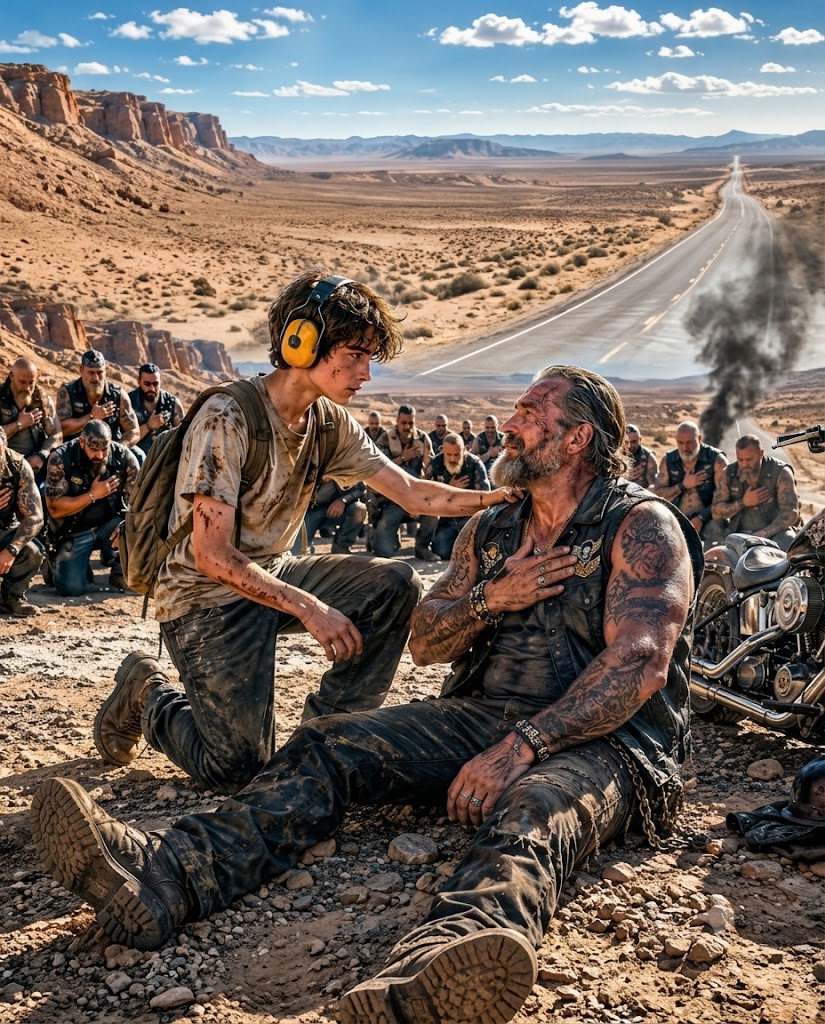
With a heavy rustle of leather and the clinking of heavy chains, every single member of the charter dropped down to one knee right there on the high school pavement.
The teachers gasped. The students watching from the safety of the buses were paralyzed in shock.
It was a gesture of ultimate, unquestionable submission and respect—they were kneeling to a boy who couldn’t look them in the eye, physically lowering themselves to show him that he was towering above them all.
Wrench, still sitting in the dirt, reached out and gently placed the heavy alternator back into Leo’s red wagon.
“You ever need anything,” Wrench said softly, tapping the polished wrench now resting in Leo’s hands, “you show that to anyone wearing our patch, they’ll move mountains for you. You hear me, kid? You got an army now.”
Leo sat in the dirt, surrounded by a kneeling legion of outlaws.
He looked at the polished wrench, running his thumb over the engraved metal, and a small, subtle smile broke across his face.
For the first time in his life, the deafening volume of the world around him didn’t feel terrifying.
It felt like a choir of thunder.
And for once, the thunder was entirely on his side.
—
**Part 3**
Word traveled through the Nevada desert faster than any motorcycle could ride.
By Thanksgiving, the story of the autistic kid who built a lever and saved a Hell’s Angel had reached every truck stop, diner, and garage from Carson City to Ely.
Truckers on Highway 50 started waving at Leo when they saw him walking the shoulder with his red wagon.
A waitress at the Silver Springs diner refused to let him pay for a slice of pie, and when he tried to leave exact change on the table anyway, she chased him out the door and stuffed it back into his pocket.
The charter didn’t forget him, either.
Every few weeks, a single Harley would rumble into the high school parking lot, and a patched member would climb off carrying something Leo had mentioned once, in passing, to Wrench.
A box of scrap titanium bolts. A broken hydraulic jack that Leo repaired in an afternoon and returned in perfect working order.
A used physics textbook from a community college bookstore, its margins already filled with the previous owner’s notes, which Leo read cover to cover in three days and then annotated further in pencil so small it looked like lace.
—
The social workers and the school district noticed the change before Leo did.
His special education teacher, Mrs. Alvarez, had spent years watching Leo eat lunch alone in the resource room with his ear defenders on and his eyes fixed on the table.
Now she watched him sit on the low wall by the courtyard, still wearing his defenders, still not making eye contact, but surrounded.
Not by the football players. By a rotating cast of kids who had heard the story and decided, for their own reasons, that the weird scavenger kid was worth knowing.
A girl named Priya from the robotics club asked him to help debug a gear train.
A quiet freshman named Marcus, who flinched at loud noises the same way Leo did, started sitting next to him at lunch without saying a word, and Leo found that the silence between them was the comfortable kind.
“I don’t get it,” Leo told his therapist during their Thursday session, his hands wrapped around a smooth river stone she kept in a bowl on her desk. “Nothing about me changed. I’m still the same. The noise is still loud. The lights are still—”
“You’re right,” Dr. Chen said. “Nothing about you changed. The world around you changed. That’s allowed to feel strange.”
—
The charter’s official gesture came in December, and it arrived in a way Leo could actually understand.
Wrench called ahead—through Mrs. Alvarez, because he had learned that calling Leo directly was a mistake after the first three attempts had sent Leo into a spiral of anxiety about what to say—and asked if the kid would be willing to look at a mechanical problem.
One of the charter’s older members, a man named Dutch who ran a custom fabrication shop outside Fallon, had a lift table that kept binding under load.
Three mechanics had tried to fix it. None of them had.
Leo walked into the shop wearing his ear defenders and a plain gray hoodie, and Dutch—a mountain of a man with hands like catcher’s mitts—took one look at him and said, “Kitchen’s in the back, kid. Coffee’s fresh. Take your time.”
Leo took forty minutes.
He walked around the lift table three times, measured the hydraulic cylinder stroke with a tape he pulled from his pocket, watched the binding happen twice, and then asked for a flashlight and a piece of chalk.
He drew two arrows on the concrete floor, then a third, then explained in a flat monotone that the guide rails were out of parallel by eleven-thousandths of an inch, that the wear pattern on the left-side gib confirmed it, and that shimming the rear mount by a quarter inch would correct the bind without replacing a single part.
Dutch stared at the chalk arrows for a long moment, then looked at Leo, then at Wrench, who was leaning on his cane in the doorway with a grin splitting his beard.
“That’s a two-thousand-dollar fix he just saved me,” Dutch said. “And he did it with a piece of chalk.”
—
The charter paid Leo that winter—not in cash, which he wouldn’t accept, but in something better.
They set up a small workshop in the back of Dutch’s fabrication shop, with a proper bench, a vise, and a lock on the door, and they told Leo it was his whenever he wanted it.
He spent that winter turning scrap into functional things: a bottle jack rebuilt from three broken ones, a set of shelves for Mrs. Alvarez’s classroom, a hand-cranked winch he designed from scratch and tested to a hundred and fifty percent of its rated load before he would let anyone use it.
The charter members who stopped by didn’t always talk to him. Sometimes they just worked on their own bikes nearby, the comfortable silence of a garage wrapping around them both.
Wrench came by most weekends, his cane clacking on the concrete, and he and Leo developed a language that needed very few words.
Wrench would point at a problem. Leo would look at it. Sometimes Leo would shake his head and hand Wrench a different tool. Sometimes he would just nod, and Wrench would nod back, and that was the whole conversation.
—
The spring brought one more thing, and it was the thing Leo had never expected.
A letter arrived at the house, addressed to him in careful block letters, with a Nevada state seal in the corner.
It was an official commendation from the state’s emergency medical services board, recognizing a civilian act of extraordinary lifesaving intervention on Highway 50 the previous July.
Enclosed was a small medal and an invitation to a ceremony in Carson City.
Leo read the letter four times, folded it along its original creases, and put it in the drawer where he kept his father’s old watch and the polished wrench.
He didn’t go to the ceremony. The auditorium would be too loud, the lights too bright, the handshakes too much.
But he did write back, in handwriting so precise it looked printed, a single paragraph explaining that he appreciated the recognition and that the tourniquet had been a simple application of pressure and torsion, and that he hoped the board would consider funding first-aid training in rural high schools so that more people would know what to do when the nearest ambulance was forty minutes away.
The board wrote back six weeks later to say they had approved a pilot program, and they wanted to know if he would be willing to review the curriculum.
—
The last piece of the story happened on an ordinary Tuesday, in the same courtyard where fifty motorcycles had once idled in formation.
Brad, the linebacker, had spent the year in a slow, quiet decline.
His friends had drifted away after the motorcycle incident, not because they feared the Hell’s Angels, but because they had watched him sprint from a fight he had started and something in their teenage calculus of loyalty had shifted.
He sat alone at lunch now, and on this particular Tuesday, he was sitting on the low wall near the courtyard edge, staring at nothing.
Leo walked past with his red wagon, on his way to the auto-shop dumpsters, and he slowed down.
He didn’t say anything. He didn’t look Brad in the eye. But he stopped, and he reached into the wagon, and he pulled out the polished steel wrench—the one with the engraving—and he set it on the wall next to Brad, and then he kept walking.
Brad stared at the wrench for a long time. Then he picked it up, turned it over in his hands, and read the words engraved on the handle.
He was still holding it when the bell rang.
—
That evening, Leo sat in Dutch’s shop with the garage door cracked open to let in the cool desert air.
Wrench was there, and Grizzly, and Bones, and Dutch, and a few others, and they were arguing about a carburetor in the way that men argue about things they don’t actually care about.
Leo was at his bench, sketching a design for a low-cost lever-based lifting aid that could be built from scrap and stored in the trunk of a car, something a person with no training could use to free someone trapped under a vehicle.
He had the dimensions worked out. He had the materials list down to the last bolt. He was calculating the mechanical advantage for the third time, because the first two calculations had assumed a fulcrum that was too narrow to be stable in gravel.
Grizzly wandered over with a soda in his hand and looked at the sketch over Leo’s shoulder.
“What’s that?” he asked.
“Insurance,” Leo said, without looking up.
Grizzly thought about that for a moment. Then he nodded, and he went back to the carburetor argument, and the shop filled with the low rumble of men who had once been something else entirely, and were now, in their own way, something close to family.
Outside, the desert was quiet. The loneliest road in America stretched into the dark, empty and patient, waiting for the next person who would need to be saved.
Leo looked up from his sketch, just for a moment, at the polished wrench hanging on the wall above his bench.
He smiled, and he went back to work.
—
—
**If this story of unlikely brotherhood and quiet courage moved you, share it with someone who needs to hear that heroes come in every shape and size—and that sometimes the loudest thunder belongs to the people who never asked for the storm.**









