An Arrogant Billionaire Humiliated His Fiancée Before Everyone—Then the Quiet Maid Revealed Who She Really Was
Perfect. Please smile. Okay, smile. People should think you’re happy.
That was the first thing Dylan ever said to me on the night he decided to make me his showpiece.
I was standing in the corner of his mother’s marble-floored banquet hall in Houston, Texas, wearing a gown that cost more than my mother made in three years, and I felt like a mannequin in a window display.
“Smile, Victoria,” he whispered through his teeth, his fingers digging into my waist just hard enough to leave a mark. “You should be grateful. Without me, you wouldn’t even be standing in a place like this.”
I smiled.
God help me, I smiled.
I was twenty-two years old, a senior at the University of Houston, and I was engaged to the son of the richest man in the state—a man who had spent every day since our engagement reminding me that I was nothing but the daughter of his mother’s housekeeper.
My mother, Sarah, had worked for the Adams family for over fifteen years.
She had scrubbed their toilets, cooked their meals, ironed their clothes, and raised me in a small apartment on the east side of the city while Chief Adams—Dylan’s father—paid for my education from elementary school all the way through college.
That was the debt that hung over our heads like a storm cloud.
That was the leash that kept us tethered to a family that never let us forget we were beneath them.
And Dylan Adams—the heir to Adams Group, a billion-dollar conglomerate—was the worst of them all.
He had returned from London three months before our engagement, fresh off a decade of parties, private jets, and women whose names he couldn’t remember.
His father, Chief Michael Adams, had given him an ultimatum: prove you’re a man, or lose everything.
“Get married,” Chief Adams had said. “Not to any woman. To a woman of character. Someone who can influence your life for good. You have three months.”
Dylan had laughed it off at first.
He called ten of his girlfriends. Ten. Every single one of them turned him down.
“You’re a serial cheat, Dylan,” one of them said. “It’s not worth it.”
“Please lose my number,” said another.
His mother, Vivian, had suggested blind dates with the daughters of her wealthy friends.
Every one of them walked out on him.
“He’s too proud,” one said.
“He’s not mature enough for marriage,” said another.
So Dylan did what rich men do when the world refuses to cooperate.
He found a poor girl.
He found me.
—
I didn’t know it at the time, but my mother had once been in love with Chief Adams.
Not the Chief Adams I knew—the stern, gray-haired man who wrote checks for my tuition and never asked for anything in return.
No. My mother had loved Adiwali Adams, the young man who worked alongside his father in the early days of the company, before the billions, before the mansions, before the wife his mother had chosen for him.
She had been his house help.
She had been nineteen.
He had been twenty-three.
And when his mother found out that Sarah was carrying his child, she chased her out of the house with a warning that still made my mother tremble when she spoke of it.
“If you ever come back,” Vivian had said, “I will make sure you disappear forever.”
So my mother disappeared.
She changed her name, moved to a different city, and raised me alone, believing that the man she loved had abandoned her.
She never knew that Vivian had told her son that Sarah had died in a car accident.
She never knew that Adiwali had grieved her for years, married a woman he didn’t love, and buried himself in work to escape the emptiness.
She never knew that the man who paid my school fees—the man who gave us a home, who treated us with a kindness that always felt slightly strange—was my father.
I didn’t know any of this either.
Not until the night Dylan humiliated me in front of three hundred guests at his mother’s birthday party.
—
The party was supposed to be my introduction to Houston society.
Vivian had spent months planning it—the flowers, the caterers, the string quartet, the photographer who followed me around like a shadow, capturing every forced smile, every nervous glance, every moment of quiet humiliation.
“Smile, Victoria,” Vivian had said as we posed for pictures. “People should think you’re happy.”
I smiled.
Dylan stood beside me, his hand on my lower back, his lips curled into a smirk that never reached his eyes.
“Honestly,” he said, loud enough for the guests around us to hear, “anyone seeing you tonight will think you’re the daughter of a senator. Or maybe the daughter of some billionaire.”
The guests laughed.
“Nobody here would believe she’s actually the maid’s daughter.”
More laughter.
“This dress alone must cost a fortune,” one of Vivian’s friends said, touching the silk fabric of my gown with manicured fingers. “You’ve really transformed her.”
“Of course I did,” Dylan said. “Without me, she’d still be following her mother around with a bucket and mop.”
My mother was standing twenty feet away, wearing her maid’s uniform because Vivian had insisted she “remember her place.”
She heard every word.
I watched her face crumple, watched her turn away, watched her shoulders shake as she pretended to adjust the silverware on the buffet table.
“Dylan, please,” I whispered. “Not today.”
“No,” he said, his eyes bright with something that looked almost like joy. “Today is the perfect day.”
He raised his glass.
“Ladies and gentlemen,” he called out, and the room fell silent. “Since we’re all one big family tonight, I want to introduce someone very special.”
He pulled me forward.
“My fiancée, Victoria. Beautiful, isn’t she? Looking at her now, you’d think she comes from one of the richest homes in Texas. You might even think she’s a governor’s daughter.”
He paused.
The guests laughed.
“But guess what?” he continued. “Her mother has spent most of her life washing my mother’s dishes. The dress she’s wearing tonight costs more than everything her mother has saved in her entire life. So tell me—shouldn’t she be thanking me instead of acting proud?”
My face burned.
My hands trembled.
And then, from the back of the room, a voice cut through the laughter like a blade.
“ENOUGH.”
Everyone turned.
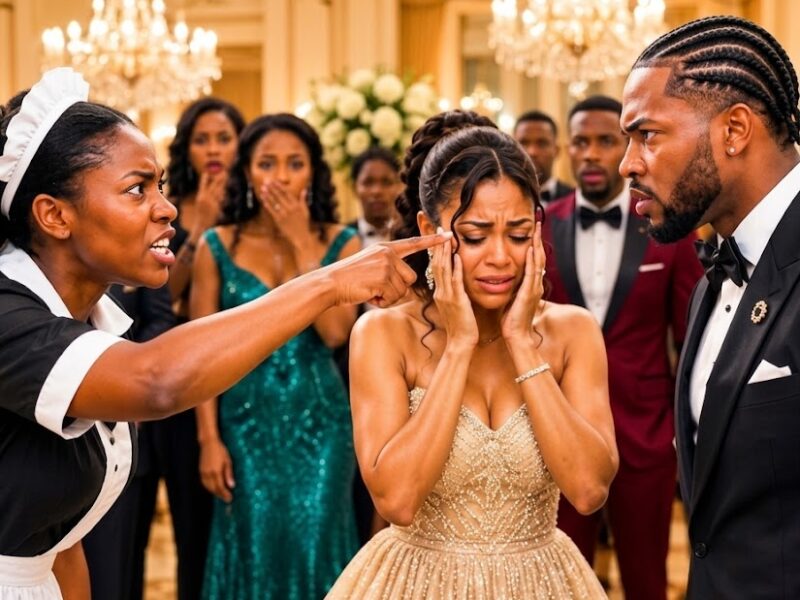
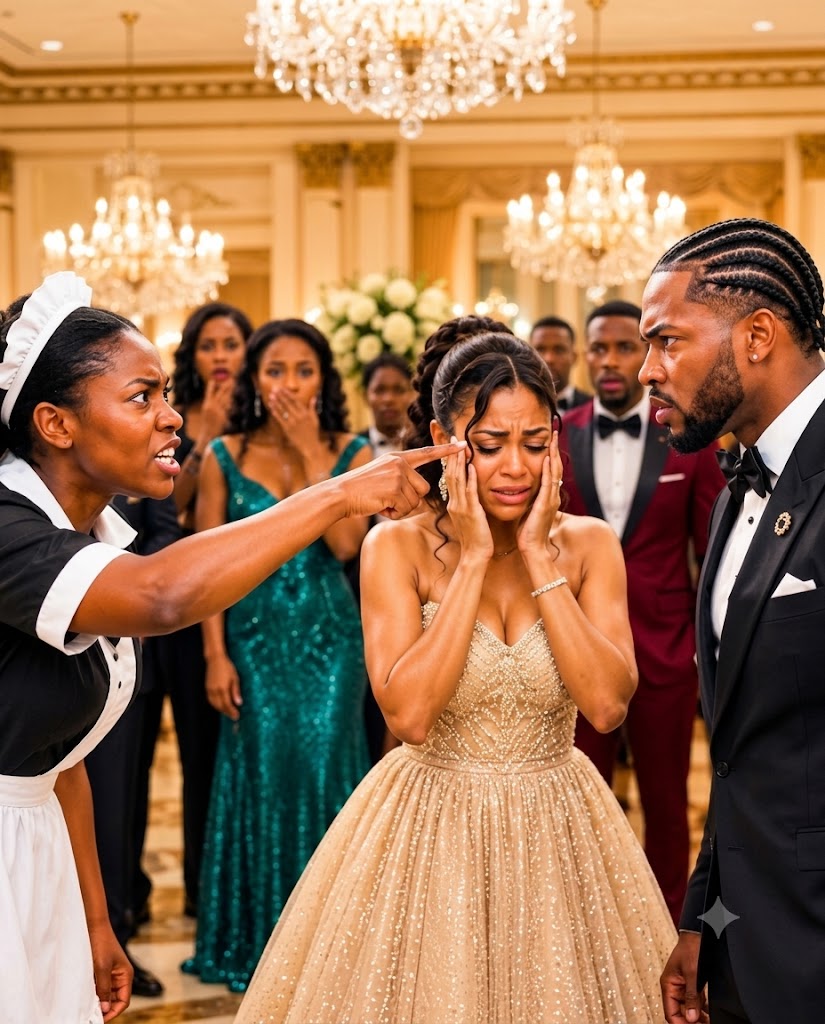
My mother was standing in the middle of the ballroom, her uniform wrinkled, her hands shaking, her eyes blazing with a fury I had never seen before.
“I have watched you humiliate this woman over and over again,” she said, her voice cracking but steady. “Every single day, you find a new way to make her cry. I kept quiet because I thought one day you would grow up. But I can’t watch this anymore.”
Dylan’s smirk faltered.
“You think you’re better than her because you were born into a rich family?” my mother continued. “No. You’re only fortunate. Money is a privilege. It doesn’t make you a better human being.”
The room was dead silent.
“You call yourself a man?” she said. “No. You’re still a little boy spoiled by your father’s riches. Because a real man doesn’t humiliate the woman he’s supposed to love. But you—you’ve only shown everyone here that you’ve grown in age, not in character.”
Dylan stepped toward her, his face twisted with rage.
“Go on,” my mother said, her voice dropping to a whisper. “Try it. I dare you. Touch me and I’ll drive my head straight into your mouth. You’ll see your teeth lying on this floor.”
“How dare you?” Vivian shrieked, pushing through the crowd. “How dare a maid speak to my son like that?”
My mother turned to face her.
“If this is what money has taught him,” she said, “then I’d rather remain poor for the rest of my life.”
—
The police arrived twenty minutes later.
Vivian had called the commissioner herself, her voice dripping with righteous indignation as she demanded that my mother be arrested for “causing a disturbance.”
Two officers led my mother out of the ballroom in handcuffs while three hundred guests watched in stunned silence.
I tried to follow her.
Dylan grabbed my arm.
“Don’t,” he said. “You’ll only make it worse.”
I stood there, frozen, as my mother was shoved into the back of a police car.
The last thing I saw was her face pressed against the window, her eyes meeting mine, her lips forming the same words she had whispered to me every night before I went to sleep.
Be strong.
—
The video went viral by morning.
Someone had recorded the entire confrontation on their phone—my mother’s speech, Dylan’s humiliation, Vivian’s shriek, the police leading my mother away in handcuffs.
By noon, it had been shared fifty thousand times.
By evening, it was on every news channel in the country.
“Adams Family Scandal,” the headlines read. “Billionaire Heir Humiliates Fiancée, Maid Arrested for Defending Her.”
The comments were brutal.
“Look at Victoria’s face. She’s crying while apologizing. Those rich people think money gives them the right to treat others like slaves.”
“Somebody needs to investigate the Adams family. This is wickedness.”
“Money isn’t everything. This is why many poor people are afraid to speak.”
But the comments weren’t the worst part.
The worst part was the apology video.
Vivian had demanded that my mother and I record a public apology, admitting that we had disrespected the Adams family and that we were grateful for everything they had done for us.
We recorded it in the living room of Dylan’s mansion, sitting on a couch that cost more than our apartment.
I read the words Vivian had written for us.
“I apologize for the disrespect shown by my daughter’s friend, Ella, towards Madame Vivian and the Adams family.”
My voice cracked.
“My daughter and I are grateful for everything the Adams family has done for us.”
Tears streamed down my face.
“We appreciate the kindness Chief Adams has shown us over the years, and we recognize the honor of this marriage.”
I wanted to scream.
I wanted to throw the script in Vivian’s face and walk out.
But I couldn’t.
Because my mother was still in police custody.
Because Vivian had promised to make her life a living hell if I didn’t cooperate.
Because I was twenty-two years old, and I had never felt more powerless in my entire life.
—
The apology video made everything worse.
Within hours, it had been viewed ten million times.
People weren’t just angry anymore.
They were furious.
“This is no apology,” one commenter wrote. “This is intimidation. Look at Victoria’s face. She’s crying while apologizing.”
“Those rich people think money gives them the right to treat others like slaves.”
“Somebody needs to investigate the Adams family. This is wickedness.”
A hashtag started trending: #JusticeForVictoria.
A civil rights organization offered to represent my mother for free.
A state senator tweeted that she was “deeply disturbed” by the video and would be “looking into the matter.”
And somewhere in the middle of all this chaos, a man I had never met was watching the video on his phone, his hands trembling, his eyes filling with tears.
His name was Adiwali Adams.
Chief Adiwali Adams.
The founder of Adiwali Holdings, one of the largest investment firms in West Africa.
The man who owned the largest percentage of shares in Adams Group.
And, though I wouldn’t know it for another two weeks, my father.
—
“Sir, is everything all right?”
Adiwali looked up from his phone, his eyes red, his face pale.
“Where is Sarah?” he asked.
The assistant shifted uncomfortably.
“Sir?”
“Sarah. The woman who worked for my mother. The woman who—” He stopped, his voice breaking. “I need to find her. I need to find her now.”
The assistant nodded and left the room.
Adiwali stared at the screen again, at the video that had been shared millions of times, at the woman he had loved twenty-five years ago, at the daughter he had never known existed.
“Sarah,” he whispered. “Why didn’t you look for me? Or did someone stop you?”
He didn’t know the answer yet.
But he would.
—
The next morning, Chief Adams walked into the living room where my mother and I were sitting, waiting for Vivian to decide our fate.
He looked older than I had ever seen him—his shoulders slumped, his eyes tired, his face etched with something that looked like shame.
“Sarah,” he said. “Victoria. I owe both of you a sincere apology.”
My mother looked up, startled.
“I never imagined things had gone this far,” he continued. “If I had known my son was treating Victoria this way, I would have stopped it long ago.”
“Sir,” my mother said, her voice barely a whisper. “Dylan has been humiliating my daughter for a long time. We endured it because we believed things would change after what happened at Madame Vivian’s birthday party. I am no longer certain my daughter will ever be safe with him.”
Chief Adams nodded slowly.
“Then there will be no wedding,” he said. “At least not for now. I honestly didn’t know my son had become this spoiled and arrogant. I knew he could be stubborn, but I never imagined he could humiliate the woman he was supposed to marry.”
He turned to me.
“Victoria, why didn’t you come to me? Why did you keep everything to yourself?”
I swallowed hard.
“Sir, I wanted to tell you many times,” I said. “But Madame Vivian warned me never to report Dylan to you. She said if I ever did, she would make sure my mother would lose her job.”
Chief Adams’s face darkened.
“Vivian said that?”
“Yes, sir.”
He was silent for a long moment.
Then he spoke.
“Sarah, you have served this family faithfully for many years. This week, I’m officially retiring you. You’ve worked hard enough. Whether Victoria eventually marries Dylan or not, I will still fulfill my promise to you.”
My mother’s eyes filled with tears.
“Thank you so much, sir. You’ve always treated me with kindness. May God continue to bless you.”
“There’s one more thing,” I said.
Chief Adams looked at me.
“Please help Ella,” I said. “She only defended me. If she hadn’t spoken up that day, things would have been even worse. She doesn’t deserve to remain in police custody because she stood up for what was right.”
“Don’t worry about Ella,” Chief Adams said. “I’ll personally handle it today. She’ll be released as soon as possible.”
“Thank you, sir.”
“No one who stood for justice should suffer because of my family’s mistakes.”
—
Chief Adiwali Adams arrived at the mansion two hours later.
He walked through the front door like a man who owned the place—which, technically, he did. He owned the largest percentage of shares in Adams Group. He could have bought and sold Chief Adams ten times over.
Vivian met him in the foyer, her face pale, her hands clasped nervously in front of her.
“Chief Adiwali,” she said, her voice trembling. “What an honor. Welcome. Please come in. To what do we owe this unexpected visit?”
“I am not here for pleasantries, Adams,” Adiwali said, his voice cold. “I am here for a woman named Sarah. I was informed she works in this house.”
Vivian’s face went white.
“Sarah? Our housekeeper? What business could you possibly have with Sarah?”
“That is between her and me.”
“Chief Adiwali, perhaps there’s been some misunderstanding. Sarah is only one of the domestic staff in this house. Surely a man of your status couldn’t possibly have any business with—”
“Madam,” Adiwali interrupted, his voice sharp. “I did not ask for your opinion of her position. I asked to see Sarah. Now, will someone kindly call her, or should I search this house myself?”
Vivian opened her mouth to respond, but Chief Adams stepped forward.
“Adiwali,” he said, his voice calm but strained. “Please. Let’s discuss this in private.”
“There is nothing to discuss. I want to see Sarah.”
“Sarah!” Chief Adams called out. “Sarah, please come here.”
My mother appeared at the top of the stairs, her face confused, her hands shaking.
She froze when she saw Adiwali.
“Sarah,” he breathed. “It’s really you.”
“Adiwali?” she whispered. “Why are you here? After everything that happened, why are you here now?”
“I’ve searched for you for years.”
“Search for me? Your mother made sure I disappeared from your life.”
“What do you mean?”
“After you traveled abroad, she found out I was carrying your child. She said I wasn’t worthy of her son, that she had already chosen another woman for you. She threatened to kill me if I ever came back to that house or tried to contact you. I had no choice but to disappear.”
Adiwali’s face crumpled.
“My mother,” he said, his voice breaking. “My mother told me you had returned to your village and that you died in a car accident. And I believed her.”
He stepped closer.
“I’m sorry for all you went through. You should have tried to contact me.”
“I never stopped loving you,” my mother said, tears streaming down her face. “But I was trying to stay alive.”
Adiwali reached out and took her hand.
“Sarah,” he said. “Is my daughter Victoria?”
My mother nodded.
“Yes.”
“Victoria is my daughter,” Adiwali said, his voice rising. “The same Victoria Dylan has been humiliating.”
He turned to Chief Adams, his eyes blazing.
“Adams, your son will pay for every humiliation he has inflicted on my daughter.”
—
The next few weeks were a blur.
My mother and I moved into Adiwali’s mansion—a sprawling estate on the west side of Houston, complete with a private pool, a tennis court, and a garden that stretched for acres.
It was bigger than Chief Adams’s house.
It was bigger than anything I had ever seen.
“Mom,” I said, standing in the doorway of my new bedroom, “this place is beautiful. It’s even more beautiful than Chief Adams’s house.”
My father—my father—smiled.
“Your father has worked hard for everything you see,” he said.
I liked the way he said that.
Your father.
I had spent twenty-two years believing I didn’t have one.
Now I had a father who was even more influential and even wealthier than the man who had paid for my education.
Adiwali took me shopping, bought me a car, introduced me to his business partners.
He told me stories about my mother—how they had met, how they had fallen in love, how he had promised to come back for her after his studies abroad.
“I never stopped loving her,” he said. “Even after I got married, something was always missing. That marriage happened because of family pressure. When my wife passed away five years ago, I buried myself in work. Business became my escape. I never thought about marrying again.”
He paused.
“But seeing you again, Sarah, I feel like the part of my life that was missing has finally come back.”
He turned to my mother.
“We’ve lost twenty-five years. I don’t want to lose another day. Will you marry me?”
My mother cried.
I cried.
Even Ella—who had been released from police custody the same day Chief Adams made the call—cried.
“Yes,” my mother said. “Yes, I’ll marry you.”
—
Dylan didn’t take the news well.
He showed up at our new house three days after the engagement announcement, his face haggard, his eyes bloodshot.
“Victoria,” he said, standing in the doorway. “Can we talk?”
I crossed my arms.
“We’re talking.”
“I’ve been thinking a lot. I think I was beginning to like you. I regret everything I did to you.”
I laughed.
“You regret everything you did to me? You humiliated me in front of three hundred people. You made me apologize for something I didn’t do. You treated me like I was nothing.”
“I know. I was wrong.”
“You were wrong? That’s all you have to say?”
“I want to make it right.”
“How?”
He hesitated.
“The wedding can still happen. You’re beautiful, respectful, and now we know you’re Chief Adiwali’s daughter. You’re exactly the kind of woman my dad wanted for me.”
I stared at him.
“You think I would marry you after everything you did?”
“Victoria, please—”
“No.”
“But—”
“No. You don’t love me. You never loved me. You only wanted me because your father told you to find a woman of character. And now you want me back because you found out I’m rich.”
“That’s not true.”
“It is true. And you know what? I feel sorry for you.”
He flinched.
“You’re a man who’s only grown in age, not in character. And until you learn to treat people with dignity, you’ll never be happy.”
I closed the door in his face.
—
The court wedding was small.
Just family—my mother, my father, Ella, Chief Adams, and a few of Adiwali’s closest friends.
Vivian and Dylan weren’t invited.
But they showed up anyway.
Vivian stood in the back of the courtroom, her face pale, her hands clasped in front of her.
Dylan stood beside her, his eyes fixed on me.
After the ceremony, Vivian approached my mother.
“Sarah,” she said, her voice trembling. “Please forgive me. I never imagined things would end like this.”
My mother looked at her for a long moment.
“Madam,” she said. “I’ve forgiven you. I’ve also forgiven Dylan. If he hadn’t humiliated us in public, Chief Adiwali would never have found us. Sometimes the very thing people used to mock us is what God uses to bless us.”
Vivian’s eyes filled with tears.
“I’m so ashamed. Please talk to Chief Adiwali for us. He’s a major shareholder in my husband’s company. If he pulls out, everything we’ve built could collapse.”
“Chief Adams has always been good to us,” my mother said. “He paid my daughter’s school fees from primary school until she graduated. We’ll speak to Adiwali on his behalf.”
“Thank you,” Vivian whispered. “I truly appreciate it.”
—
Dylan approached me as I was leaving the courthouse.
“Victoria,” he said. “I’m sorry. Everything that happened has taught me a lesson. I’ll never look down on or disrespect anyone again.”
I looked at him.
“I don’t have anything against you,” I said. “If not for what happened that day, my mom might still be working as a maid. God used that painful moment to write a new chapter in our lives. I’ve forgiven you.”
“Thank you,” he said.
“But I don’t want to see you again.”
He nodded slowly.
“I understand.”
He turned and walked away.
I watched him go, and I felt something I hadn’t expected.
Not anger.
Not resentment.
Just sadness.
Sadness for the man he could have been.
Sadness for the life he could have had.
—
The viral video that had once been my humiliation became my platform.
I started speaking out about toxic relationships, about the way wealth can corrupt, about the importance of character over money.
I appeared on talk shows, gave interviews, wrote articles.
People called me brave.
They called my mother a hero.
They called Ella a warrior.
And somewhere in the middle of all the attention, I realized something.
The same situation people use to mock you today may become the very path God uses to elevate you tomorrow.
My mother had been humiliated for years.
She had been treated like she was nothing.
And yet, in the end, she had married the man she loved, the father of her child, the billionaire who had been searching for her all along.
Ella had been arrested for defending me.
And yet, in the end, she had been offered a job at my father’s company, a job she would start as soon as she graduated.
And me?
I had been the maid’s daughter.
The girl who didn’t belong.
The girl who was supposed to be grateful for scraps.
And yet, in the end, I had found my father, my voice, and my future.
—
Six months after the wedding, I was walking through downtown Houston when I saw a familiar face.
Dylan was standing outside a coffee shop, wearing a suit that looked slightly too big for him, holding a briefcase that looked slightly too new.
He was working for a small marketing firm, I had heard.
He had refused his father’s help.
He had wanted to make it on his own.
“Victoria,” he said, his voice surprised. “It’s good to see you.”
“You too,” I said.
And I meant it.
We stood there for a moment, two people who had once been engaged, two people who had once hated each other.
“I’m sorry,” he said. “For everything.”
“I know.”
“I’ve been in therapy. It’s helping.”
“I’m glad.”
He smiled—a real smile, not the smirk I remembered.
“You were right, you know. About character. About the way I treated people. I’ve been trying to change.”
“That’s all anyone can do.”
He nodded.
“Take care of yourself, Victoria.”
“You too, Dylan.”
I walked away, and I didn’t look back.
—
That night, I sat in my father’s garden, watching the sun set over the Houston skyline.
My mother sat beside me, her hand in mine.
“Mom,” I said. “Do you ever regret it? Everything we went through?”
She was quiet for a moment.
“No,” she said. “Because everything we went through led us here.”
She squeezed my hand.
“Sometimes what people used to mock you is exactly what God uses to elevate you. That’s why we should never give up. Never look down on anyone because of their present condition.”
I thought about the bracelet.
The one Dylan had told me to throw away.
The one my mother had given me when I was twelve years old, the only thing of value she had owned, a small silver band with a single pearl that had belonged to her own mother.
I still had it.
I had worn it under my sleeve on the day of the wedding, hidden from Vivian’s eyes, hidden from Dylan’s cruelty.
It was a reminder of where I came from.
And it was a reminder of what I had survived.
“True greatness is measured by character, not by wealth,” my mother said. “Never forget that.”
I looked at her.
“I won’t.”
And I didn’t.
—
The video—the one that had started it all—still existed somewhere on the internet.
People still watched it.
People still commented on it.
Some of them praised my mother for her bravery.
Some of them criticized Dylan for his cruelty.
Some of them asked what had happened to the maid’s daughter, the girl who had been humiliated by her billionaire fiancé.
And if they looked hard enough, they would find the answer.
They would find a woman who had found her father, married the love of her life, and built a life she was proud of.
They would find a woman who had learned that the same situation people use to mock you can become the very path God uses to elevate you.
They would find a woman who had discovered that true greatness is measured by character, not by wealth.
And they would find a mother who had been a maid, a father who had been searching, and a daughter who had refused to be broken.
That was the story.
That was the truth.
And that was the ending that no one—not Dylan, not Vivian, not anyone—had seen coming.
—
The sun had set by the time my mother and I walked back inside.
My father was waiting for us in the living room, a glass of wine in his hand, a smile on his face.
“Everything okay?” he asked.
“Everything is perfect,” I said.
And for the first time in my life, I believed it.
—
I never saw Dylan again after that day.
I heard he eventually got married to someone he met in therapy—a woman who had also grown up wealthy, who had also struggled with her own demons.
I heard they were happy.
I hoped they were.
Because everyone deserves a second chance.
Everyone deserves the opportunity to grow.
And everyone—no matter where they come from, no matter how much money they have, no matter what the world thinks of them—deserves to be treated with love, respect, and kindness.
That was the lesson I had learned.
That was the lesson I would carry with me for the rest of my life.
And that was the lesson I hoped the world would learn from my story.
Because in the end, true greatness is measured by character, not by wealth.
And love—real love—doesn’t humiliate.
It elevates.









