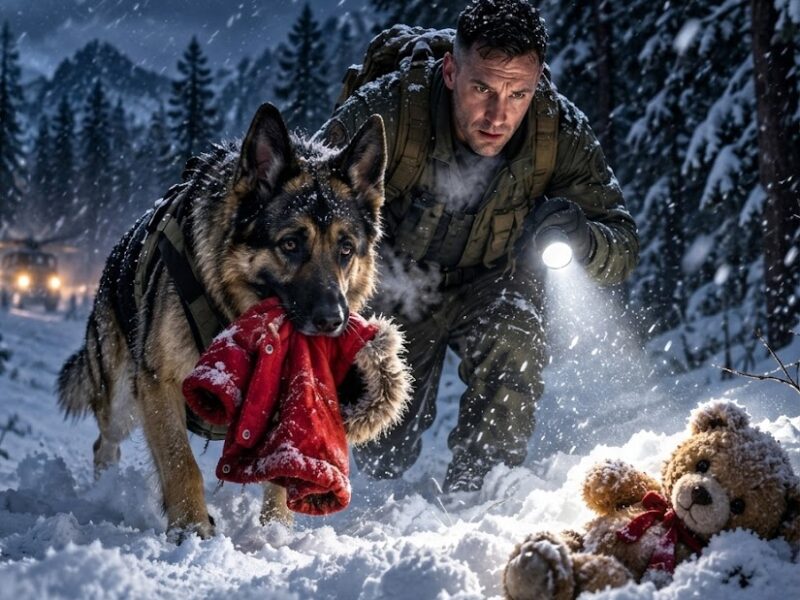
An abandoned K-9 was found carrying a child’s coat in his mouth. Then a Marine followed him into the storm—and everything changed.
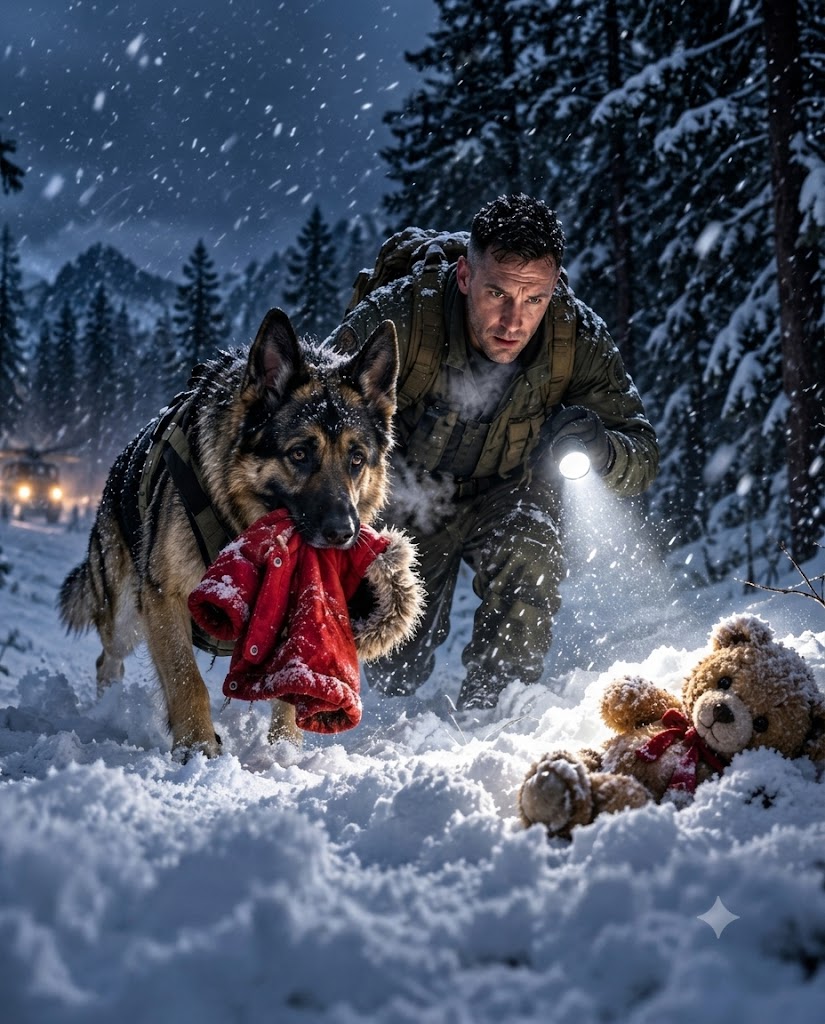
He brought back only her coat. By the time the abandoned K-9 reached the Blue Pine service station, the storm had erased the highway behind him. Snow swept across the parking lot in long white sheets, swallowing tire tracks, fence posts, and the dark shoulders of the Montana mountains. The German Shepherd moved through it with his head low and his body leaning into the wind. Ice clung to the sable fur along his back. One ear carried an old tear near the tip, and the pads of his paws left faint, uneven marks that vanished almost as soon as they appeared. Yet he did not stop. Between his jaws hung a small red winter coat. It was made for a child.
Staff Sergeant Cole Bennett saw the dog through the fogged window beside the coffee machine. At first, he thought the shape was a branch tumbling across the lot. Then the station’s security light caught two amber eyes and the bright strip of red cloth beneath them. Cole set down his paper cup. He was thirty-eight, tall and broad-shouldered, with close-cut brown hair and the weathered stillness of a Marine who had spent years learning how to remain calm when everything around him was not. A pale scar rested near his right temple. His left shoulder still ached when the temperature dropped—an old training injury, reminding him that the body kept records even when the mind tried to move on.
The German Shepherd reached the glass door and struck it once with his paw. Not wildly. Deliberately. Cole crossed the empty station while the night clerk looked up from behind the counter. “That dog yours?” the man asked. “No.” The K-9 hit the glass again. Cole unlocked the door and the wind rushed inside, carrying the scent of wet pine, gasoline, and frozen earth. The dog did not enter. He stood beneath the yellow light, breathing hard. The red coat still held carefully between his teeth.
“Easy, buddy,” Cole said. His voice was low—the same voice he once used around frightened recruits and nervous working dogs. “Come inside.” The shepherd stared at him. Snow gathered along his muzzle. His legs trembled, but he remained outside. Cole crouched and held out an empty hand. The dog’s eyes dropped briefly to his fingers, checking them, then lifted again. That small movement made something tighten in Cole’s chest. This was not the behavior of a stray. The shepherd had been trained to read hands.
Cole moved slowly, reached for the coat, and waited. After a long moment, the dog released it. The fabric fell into Cole’s palms, cold and wet, carrying the faint smell of wood smoke and children’s shampoo beneath the snow. A silver star was stitched near one pocket. One sleeve had been turned inside out, and three of the plastic buttons were missing. Cole searched the parking lot, expecting headlights or a frightened parent to emerge from the storm. There was nothing beyond the pumps—only darkness and wind.
“Where did you get this?” he asked. The shepherd turned his head toward the northern tree line. Cole opened the coat. Inside the left pocket, his fingers found a purple knit glove, small enough to fit an eight-year-old. He pressed it between his palms. It was damp, but not frozen. It still held a trace of warmth. Cole looked sharply at the dog. Someone’s out there. The shepherd stepped backward, then faced the forest.
Cole reached into a display basket near the door, tore open a package of dried beef, and placed a piece on the ground. The dog glanced at it but did not eat. Cole set down a bowl of water. The shepherd took two quick laps, stopped, and returned to the coat. He caught the hem between his teeth and tugged it toward the doorway. The movement was weak, but unmistakable. “You want me to follow you?” The station clerk approached with a phone held against his ear. “Sheriff’s office says a school activity van lost contact near Black Ridge about forty minutes ago. Roads are closing fast.” Cole’s eyes remained on the dog. “Any children missing?” “They don’t know yet.”
The shepherd suddenly dropped the coat and struck the tile three times with his right paw. Tap. Tap. Tap. Cole went still. It was too measured to be panic, too precise to be chance. He had seen working dogs use trained alerts before, but never one exactly like this. The dog leaned forward and pressed his nose against the red fabric. Cole searched the second pocket. His fingers touched paper. He unfolded a damp, creased note written in blue crayon. The letters were uneven but careful. At the top was a drawing of a girl beside a German Shepherd. Beneath it were six words. Dad said, Atlas always comes back.
Cole read the sentence twice. “Atlas,” he whispered. The K-9’s ears lifted. For the first time, the dog stepped closer—not into the warmth. Toward Cole. His amber eyes held a tired urgency that needed no translation. Somewhere beyond the service station, beyond the road, disappearing beneath snow, a child was waiting for the dog she believed would return. Atlas seized the red coat once more, turned toward the storm, and took three determined steps into the white. Then he stopped and looked back.
Cole reached for his field jacket, rescue rope, flashlight, and thermal blanket. The clerk began to protest, but Cole was already fastening the collar of his coat. Outside, Atlas waited beneath the failing security light, shivering, but ready. Cole opened the door. The storm reached for them both. “All right, soldier,” he said. “Show me the way.” Atlas turned north and vanished into the snow, carrying the child’s coat like a promise.
The first hundred yards disappeared behind them almost at once. Cole kept the service station light over his shoulder until it became a weak yellow coin in the blowing snow. Then nothing at all. Atlas moved ahead with the red coat held high enough to keep it from dragging, choosing the edge of the highway where the wind had scraped the pavement nearly bare. He did not run. He conserved himself. Every twenty or thirty feet, he glanced back to make sure Cole was still there, and each time his eyes carried the same silent command. Keep moving.
The temperature had fallen below twenty degrees, and the wind made it feel colder. Snow struck Cole’s face in hard, dry grains. His injured shoulder tightened beneath his jacket as he adjusted the rescue rope across his chest, but he did not slow. He had followed working dogs before in training fields and disaster drills, and he knew the difference between panic and purpose. Atlas was not wandering. He was navigating.
At the first intersection, the shepherd stopped beside a half-buried road marker and raised his nose. He tested the wind from the west, then the north. His ears shifted independently, sorting sounds Cole could not hear. After several seconds, Atlas turned onto an unplowed county road leading toward Black Ridge. Cole lifted his phone. One bar of service flickered, vanished, then returned. A call came through before he could dial.
“Staff Sergeant Bennett?” a woman asked. Her voice was firm, but wind and radio static cut around every word. “This is Sheriff Clare Dawson. The clerk at Blue Pine gave us your number.” “I’m about a quarter mile north of the station,” Cole said. “I’m following a German Shepherd carrying a child’s coat.” Silence held for half a breath. “We have confirmed one child missing from the activity van. Ellie Harper, eight years old, red coat, purple gloves, brown boots.” Cole looked at the fabric between Atlas’s teeth. “The dog knows her.” “How can you be sure?” “There was a note in the pocket. It named him Atlas.”
At the sound of his name, the shepherd looked back. His pace did not break. Sheriff Dawson lowered her voice. “The van was last seen near the old Black Ridge access road. Search crews are trying to approach from the south, but two snowplows are stuck near the pass. Do not go beyond the county maintenance shed. That terrain drops sharply after the tree line.” Cole watched Atlas choose a narrow trail hidden beneath drifting snow. “Sheriff, I don’t think he intends to stop at the shed.” “Then make him stop. You’re alone out there.”
Cole understood the order. He also understood the dog. “I’ll keep the line open as long as I have service.” A gust tore across the road and swallowed the signal. The call ended. Atlas climbed the shallow embankment and reached the maintenance shed—a small cinder-block building with a metal roof and a green door crusted with ice. Cole caught up and tested the handle. Unlocked. Inside, he found an emergency cot, a propane heater, road flares, and two heavy wool blankets. It was the safest place they had seen since leaving the station.
“Atlas. Inside.” The dog stood at the threshold, coat still clenched between his teeth. Cole pointed. “Come.” Atlas’s front paw lifted, then settled again. He looked past Cole into the dim shelter, checked the corners, and backed away. Cole tried another command. “Heel.” The response was immediate. Atlas moved to Cole’s left side and sat, posture straight despite the tremor in his legs. Cole felt the first true chill that had nothing to do with the storm. A stray would not know that position. An abandoned pet might remember sit or stay, but this was cleaner than obedience. Atlas aligned himself with Cole’s knee, leaving room for movement, eyes forward, waiting for the next instruction.
Cole knelt and examined him without touching. Beneath the wet fur, the dog was leaner than he had appeared at the station. A broad band of flattened hair circled his neck, rubbed thin in two places. Not the mark of a normal collar. Something heavier had rested there for weeks, perhaps months. Near his chest, a narrow patch of fur had been worn by repeated friction—a chain or rough tether. Cole held out his hand. Atlas inspected the palm first, then the wrist, then allowed two fingers to touch the side of his neck. No growl, no retreat. Only patience. “Someone taught you well,” Cole murmured. “Then someone forgot what they owed you.”
Atlas lowered the coat and nudged it toward the trail. Cole opened a package of emergency food from the shed and placed several pieces near the dog. Atlas smelled them once and turned away. Cole poured water into a collapsible cup. The shepherd drank only enough to wet his tongue, then stepped back into the snow. He would accept neither warmth nor rest while Ellie remained outside. Cole secured one blanket beneath his jacket and tied the second around his pack. When he emerged, Atlas was standing beside a cluster of tracks almost erased by the wind.
Cole aimed his flashlight downward. The prints were too disturbed to identify clearly, but one small impression showed the rounded edge of a child’s boot. Atlas pressed his nose close to it and inhaled. Then he moved to a broken pine branch, smelled the bark, and looked north. Cole’s phone briefly found service again. A message from Sheriff Dawson appeared. Ellie’s mother confirms Atlas was her father’s K-9. More details coming. Cole stared at the words. Her father’s K-9. Past tense. He looked at the dog, but Atlas had already begun to pull away.
“Wait.” The shepherd stopped. Cole pointed to the red coat. “Leave it.” Atlas placed it carefully at Cole’s feet. “Guard.” The dog stepped over the coat, facing outward, body positioned between the cloth and the dark trees. The response was flawless. Cole folded the coat inside the emergency blanket and secured it to his pack, protecting the scent and keeping his hands free. When he stood, Atlas remained in place until Cole said, “Release.” Only then did the dog turn toward the mountain.
The old training was still there, buried beneath hunger, cold, and whatever lonely miles had brought him to Blue Pine. Cole switched on the second flashlight and clipped it to his chest. “You found a Marine,” he said softly. “Now take me to Ellie.” Atlas stepped from the road onto the hidden trail. Before following, Cole looked back once at the shelter, its open doorway offering heat, blankets, and the reasonable choice. Then the wind swung the door shut. Atlas did not look back. He crossed beneath the first line of pines, and Cole followed him into the white silence beyond.
The trail narrowed beneath the pines until the highway might as well have belonged to another world. Snow gathered in the branches overhead, bending them low across the path, and every gust sent a pale curtain whispering down through the darkness. Cole kept Atlas within the beam of his chest light. Sometimes the German Shepherd was no more than a moving outline ahead of him, a pair of upright ears and a sable back cutting through the white. Yet the dog never disappeared for long. Whenever the distance between them grew beyond thirty feet, Atlas stopped, turned, and waited until Cole caught up. Then he moved again.
There was discipline in it—not impatience, not fear. A mission measured one careful stretch at a time. Cole checked his watch. Twenty-three minutes had passed since they left the maintenance shed. At their pace, they had covered a little more than a mile, though the deepening snow made it feel like three. His shoulder burned beneath the strap of his pack. He shifted the weight to his other side and kept going.
Atlas reached a split in the trail where both paths had vanished beneath fresh drifts. He lowered his nose, moved several feet to the left, then returned to a broken fir tree leaning over the trail. He stood on his hind legs and pressed both front paws against the trunk. Cole watched him scrape away a patch of snow, exposing dark bark beneath. Then Atlas dropped down, circled the tree once, and continued north. Cole touched the mark as he passed. It was not random. The dog had chosen a landmark tall enough to remain visible if the lower trail disappeared.
Fifty yards later, Atlas stopped at a weathered fence post and repeated the behavior, clearing snow from one side before moving on. At the edge of a shallow creek, he pushed aside a fallen branch with his muzzle and left it angled toward the direction they had come. Cole stared at the branch, then back at the marks behind them. A quiet realization settled over him. Atlas was not simply finding Ellie. He was building a way home.
“Smart boy,” Cole said, though the words came out thin beneath the wind. Atlas glanced back once. His tail did not wag. There was no room in him for praise yet.
The creek had frozen unevenly, a dark ribbon beneath layers of windblown powder. Atlas tested the surface with one paw and immediately stepped away. He moved upstream until he found a narrow crossing where stones rose through the ice. Cole followed, planting each boot carefully. Halfway across, the ice gave a low groan. The sound carried through him like an old memory. For one breath, he was no longer in Montana. He was back at a mountain training range in Colorado, standing beneath sleet, while a young Marine named Owen Price called from beyond a washed-out ravine.
Cole had ordered the team to wait for proper equipment. It had been the correct decision. Everyone had told him so. But the storm had worsened, and help had arrived too late to bring Owen back conscious. The official report called it an unavoidable accident. Cole had carried the word unavoidable for two years and never believed it. The ice groaned again. Atlas stepped onto the bank, turned, and fixed his eyes on Cole. He did not bark. He simply waited. Cole placed one boot on the final stone and climbed out of the creek. “I’m coming,” he said. The words were meant for the dog, but some part of him offered them to the night behind him.
They continued uphill. The trees grew closer together, protecting the trail from the worst of the wind. Atlas paused beside a low boulder and sniffed a patch of exposed moss. He moved in a tight circle, returned to the same place, and inhaled again. Cole knelt beside him. Caught beneath the edge of the rock was a thread of red wool. It matched the coat in his pack. Nearby, the snow held a shallow print no larger than Cole’s palm. A child’s boot, fresh enough that its edges had not completely softened. Ellie came this way.
Atlas pressed his nose to the print, then lifted his head toward the ridge. His body became still. Cole heard nothing but the wind passing through needles and his own breathing inside his collar. Atlas took three steps forward, stopped at another tree, and cleared the bark with his paw. One more marker. One more promise of return. Then a sound rolled from somewhere ahead. Distant and heavy. Snow shifting along the mountain. Cole looked upward. The darkness beyond the trees seemed to move. We need to pick up the pace.
Atlas did not run. Instead, he chose a new path along higher ground, away from the steep slope. Cole followed and understood. The dog was not leading him into danger blindly. He was reading the mountain, the wind, and the changing weight of snow. Every choice served two lives, maybe three. Cole tightened the strap across his chest and moved closer. For the first time, Atlas allowed him to walk at his side. Together, they crossed beneath the leaning pines, leaving behind a chain of small, deliberate signs that pointed through the storm toward home.
The trees thinned without warning, and the mountain opened before them. Wind rushed across the exposed slope with enough force to bend Cole forward. Thirty yards below, something pale rested against a stand of young aspens. At first, it looked like a drift shaped by chance. Then his light caught a strip of yellow paint and the black outline of a rear window. The activity van lay on its side, half buried beneath snow. Atlas stopped so suddenly that Cole nearly stepped into him. The German Shepherd lowered his body, ears fixed forward, every muscle drawn tight beneath his wet coat.
Cole studied the slope. It fell sharply toward the wreck, broken by rocks, brush, and patches of ice hidden beneath fresh powder. “Stay close,” he said. Atlas moved first, choosing a path between two clusters of pine roots where the ground held firm. Cole followed sideways, driving his boots deep before trusting each step. The wind carried the faint scent of rubber and cold metal. Nothing moved near the van. No voices rose from inside. No light answered his own.
When they reached it, Cole brushed snow from the rear door and pulled the handle. It opened only a few inches before the frame caught against the ground. Atlas circled to the front, sniffing rapidly along the windshield and passenger side. Cole climbed onto the upper side of the van, cleared the sliding door, and forced it open. The interior smelled of wet fabric, spilled juice, and the bitter dust of a discharged safety device. Small backpacks rested against the windows. A blue lunchbox lay open near the driver’s seat. The cabin was empty.
Cole aimed his flashlight across every row, hoping for movement and fearing the stillness. “Ellie.” His voice struck the metal walls and returned smaller. No answer came. He climbed inside and found several emergency blankets missing from their storage compartment. A first aid pouch had been opened. Someone had left the van after the accident, perhaps searching for shelter before the storm grew worse. Atlas gave one short bark outside.
Cole followed the sound to the downhill side. The dog stood beside a patch of disturbed snow near the rear wheel. Cole knelt and uncovered a brown child’s boot. It matched the description Sheriff Dawson had given him. The laces were still tied. Snow had collected inside it, but not enough to hide the faint warmth Cole imagined against his palm. Atlas smelled the boot, then turned toward the edge of the slope. A series of shallow marks led away from the van. Some were footprints. Others looked like places where small hands or knees had pressed into the snow. They ended near a narrow drop.
Between two rock shelves, Cole’s breathing slowed. He approached carefully, lowering himself onto one knee before directing his light over the edge. The beam reached a tangle of branches twenty feet below, then vanished into blowing white. He saw no coat, no movement, no sign of a child. “Ellie,” he called again. Only the storm answered. Atlas came beside him but did not look down. Instead, he turned his nose toward the van, moved past the abandoned boot, and climbed several feet uphill. Cole frowned. The tracks end here. Atlas continued upward.
Cole looked once more into the darkness below. The simplest answer pressed against him. A frightened child had left the van, lost her footing, and disappeared over the edge. The thought carried the same heavy certainty he had felt at the creek years earlier, when waiting had seemed reasonable until it became permanent. He shifted closer, searching for another angle. Atlas rushed back and caught the sleeve of Cole’s jacket between his teeth. The pull was controlled but urgent. “Easy.” Atlas pulled again. A low cracking sound moved beneath the snow.
Cole looked down. A thin line had opened beside his left boot. The shelf beneath him was separating from the slope. He pushed backward as the outer section gave way, sliding quietly into the ravine in a cloud of powder. Atlas released his sleeve only when Cole reached firm ground. For several seconds, man and dog remained still. Cole placed one hand against the shepherd’s neck. “You knew.” Atlas was already looking uphill. He returned to the brown boot, smelled it once, then followed a second trail Cole had overlooked.
The prints were larger and deeper than Ellie’s. Between them ran a narrow groove, as though something had been dragged or carried across the snow. Someone had found the child after she left the van. Cole rose and swept his light across the trees. On a low branch hung a torn strip of silver emergency blanket, twisting in the wind. Farther uphill, another strip had been tied around a trunk. Atlas moved toward it, nose low, pace quickening. The wreck had never been his destination. It was only the place where he had recovered Ellie’s scent and the coat she had sent with him.
Cole took the child’s boot, secured it inside his pack, and followed. Atlas climbed through the aspens until he reached the first pine above the slope. There, he scratched snow from the bark, adding another marker to the path home. Then he lifted his head and listened. Somewhere beyond the ridge, hidden beneath the wind, something answered with a faint metallic sound. Atlas turned toward it and ran.
Atlas vanished between the trees before Cole could call him back. The metallic sound came again, faint and uneven, carried through the storm like a spoon tapping the rim of a distant cup. Cole pushed uphill, branches brushing his shoulders, boots sinking nearly to the ankle with every step. His chest light flickered once, dimmed, then returned. Ahead, Atlas stopped on a narrow shelf of ground where the pines opened toward the ridge. The German Shepherd stood perfectly still. His head was raised. His eyes were closed. Snow gathered along his lashes and the dark line of his muzzle, but he did not shake it away.
Cole reached for his radio. “Sheriff Dawson, this is Bennett. I have found the van. It is empty. I am tracking north toward the ridge.” Static answered. He adjusted the channel and tried again. Nothing. His phone showed no service. The mountain had closed around them. Atlas opened his eyes and turned slightly east. Cole listened. At first, there was only the wind moving through the upper branches, low and restless. Then came three thin notes. Not metal this time. A whistle. Short. Short. Long.
Atlas stepped forward. His entire body changed. The exhaustion remained, but something older rose through it. Something trained and remembered. He waited through several seconds of silence. The three notes came again. Short. Short. Long. Cole felt the cold settle deeper beneath his jacket. He knew that pattern. Years earlier, during a joint training exercise in North Carolina, Sergeant Daniel Harper had used the same signal whenever distance, machinery, or weather made spoken commands useless. Two quick notes to gain attention. One longer note to call his dog home.
Daniel had claimed Atlas could hear it through an engine yard, across open water, even beneath heavy rain. Cole had laughed at the time. Daniel had only smiled and said, “He doesn’t listen for the whistle. He listens for me.” The memory arrived so clearly that Cole could almost see him again—standing beside a training fence with rolled sleeves, sunlight on his face, one hand resting between the ears of a younger German Shepherd. Cole looked at Atlas. “Daniel.” The dog turned sharply. Not toward the whistle. Toward Cole.
For one suspended moment, the storm seemed to draw back from them. Cole lowered himself to one knee. “Daniel Harper.” Atlas crossed the space between them and pressed his nose against Cole’s chest, directly over the inner pocket where his identification tags rested. His breath came fast and warm through the fabric. Then he stepped away and looked toward the ridge once more. Cole reached beneath the loose fur around the dog’s neck. Earlier at the maintenance shed, he had felt something narrow under the coat but had assumed it was part of an old collar. Now his fingers found a small metal chain worn dark with age.
He drew it gently into the light. A broken identification tag hung from it. Only half the original piece remained. Snow had filled the stamped letters, and Cole wiped the surface with his glove. Harper, Daniel. The service number below. It had been cut in half with the metal. Cole stared until the letters blurred. Daniel had died four years earlier after an illness that moved faster than anyone expected. Cole had been overseas when the final message came. There had been no last visit, no handshake, no chance to fulfill the promise made during a quiet night on base when Daniel had spoken about his daughter.
“If anything ever happens to me,” he had said, “make sure Ellie knows she was the best thing I ever did.” Cole had promised. Then duty, grief, and distance had turned the promise into a silence he carried without naming. He had sent flowers. He had written a letter he never mailed. He had told himself the family needed space. Now Daniel’s dog stood before him in a Montana storm, thin from abandonment, wearing half of a dead Marine’s tag and leading him toward Daniel’s missing child. The whistle sounded a third time, weaker than before. Short. Short. Long.
Atlas answered with one sharp bark and started forward. Cole rose, but his hand remained closed around the broken tag for one more second. “I remember,” he whispered. The words were nearly lost to the wind. Atlas looked back. Cole secured the tag beneath the dog’s fur and tightened the strap of his pack. The red coat rested inside, protected by the emergency blanket. The brown boot was beside it. Two pieces of a child’s path. Two signs that she was still somewhere ahead.
They crossed the ridge together. Beyond it, the ground descended into a narrow basin sheltered from the worst of the wind. Through the trees, Cole saw the dark outline of an old fire lookout station, its roof sagging beneath snow. A strip of silver emergency blanket had been tied to the railing. Atlas moved faster. Then the whistle came once more from inside the ruined structure. No longer three notes—only one trembling breath of sound. Atlas ran toward it, and Cole followed, knowing at last that the dog had not found him by chance. He had found the one man who still owed Daniel Harper a promise.
Ellie Harper had stopped feeling her toes before the sun disappeared. She sat beneath the leaning wall of the old fire lookout station with one knee drawn to her chest and the other leg stretched beneath a fallen section of railing. Nothing was broken. She knew that because she could still move her foot a little, but the wood had pinned her boot against the floor, and every attempt to pull free made the structure creak above her. Snow drifted through the missing windows and gathered in the corners. The air smelled of old timber, wet wool, and the sharp smoke of an emergency flare that had burned out nearly an hour earlier.
Ellie held a small metal whistle between both hands. Her fingers trembled so badly that she had to press them against her lips to keep from dropping it. Short, short, long. Her father had taught her the signal when she was five years old. He used to stand at the far end of the backyard while Atlas waited beside her, alert and proud, his sable coat shining beneath the Carolina sun. “Two quick ones, so he knows it’s you,” Daniel Harper had said. “One long one so he knows where home is.” Ellie had practiced until Atlas came every time, running across the grass and stopping gently in front of her. Daniel would laugh, kneel beside them, and say that a good dog did not only follow commands. A good dog remembered promises.
Three years had passed since her father died, but Ellie still carried the whistle in the pocket of every winter coat. She had carried it that afternoon when the activity van slid from the mountain road. The driver and the other children had climbed toward a service trail after the accident, but Ellie had gone back for her backpack when the snow began falling harder. By the time she stepped outside again, the voices had vanished into the wind. She had followed what she believed were their tracks until she lost one boot in a deep drift and saw the lookout station through the trees. She reached it just before darkness. Then the weakened railing shifted and trapped her leg. She had called until her throat hurt. No one answered.
Atlas came after the first stars appeared. At first, Ellie thought the large shape in the doorway was a wolf. Then the dog stepped into the pale light from the snow, and she saw the torn tip of his ear, the amber eyes, and the half tag beneath his neck. “Atlas,” she whispered. The German Shepherd froze. His ears lifted. Then he crossed the room and pressed his face into her hands. Ellie buried her fingers in his wet fur and began to cry without making a sound. Her mother had told her Atlas had disappeared from the retirement home two years earlier. They had searched shelters, called former handlers, and posted his picture across three states. No one found him. Yet somehow, on the worst night of Ellie’s life, he had walked out of the storm.
His ribs showed beneath his coat. Ice covered his paws. A worn circle around his neck showed where something heavy had once held him in place. Still, he had found her. Atlas tried to pull the railing with his teeth, but it would not move. He circled the room, searching for another way, then returned and lay against Ellie’s side. His body gave her warmth, though he shook almost as badly as she did. Ellie removed her red coat and spread it over his back. “You need it more,” she told him. Atlas immediately pushed the coat toward her with his nose. “No, listen.” She pointed toward the door. “You have to get help.” The dog refused to move.
Ellie remembered how her father had trained him to carry gloves, ropes, and messages. She folded the coat, held it near his mouth, and gave the command Daniel once used. “Take.” Atlas accepted it gently. “Find.” He looked toward the door, then back at her. Ellie touched the broken identification tag under his fur. “Find a Marine.” The words seemed foolish in an empty mountain station, but Atlas understood something in her voice. He walked to the doorway, stopped, and looked back one final time. “I’ll be here,” Ellie promised. “Go.” Atlas disappeared into the snow, carrying her coat.
After that, Ellie measured time by the wind. She blew the whistle whenever she had enough breath. Short, short, long. Sometimes she imagined she heard Atlas barking far away. Sometimes the old station groaned, and snow slipped from the roof in soft, heavy waves. She wrapped an emergency blanket around her shoulders and thought about her mother waiting at home. She thought about her father telling her that courage did not mean feeling unafraid. It meant choosing the next right thing while fear walked beside you. Ellie raised the whistle again. The first note was weak. The second barely sounded. Before she could finish the third, a bark came from beyond the trees.
Her eyes opened wide. Another bark followed. Closer now. Then Atlas appeared at the broken doorway without the red coat. Behind him came a tall man in a snow-covered field jacket carrying a flashlight and a rescue pack. Ellie recognized the pale scar near his temple from an old photograph on her mother’s mantle. Her father stood beside him in that picture. Both men younger, both smiling beneath a bright desert sky. The stranger entered carefully and lowered himself beside her. “Ellie Harper?” She nodded. His voice softened. “My name is Cole Bennett. I served with your father.”
Atlas pressed against her shoulder as Cole examined the railing across her leg. Ellie reached for the dog’s neck, her small fingers finding the half tag. “He came back,” she whispered. Cole looked at Atlas, then at the snow filling the doorway behind them. “Yes,” he said. “And this time he didn’t come alone.”
Cole placed his flashlight on the floor and studied the fallen railing across Ellie’s leg. The timber had once bordered the lookout platform, but years of snow and wind had softened it. One end rested beneath a section of collapsed wall. The other had wedged between two floorboards. Moving it carelessly could bring more of the structure down. Atlas stood beside Ellie, his body pressed against her shoulder, watching Cole’s hands. “Can you feel your foot?” Cole asked. Ellie nodded. “It’s cold, but I can move my toes.” “Good. Keep doing that for me.”
Cole removed the thermal blanket from his pack and wrapped it around her, leaving only her face uncovered. Then he took out the red coat. Ellie’s tired eyes brightened when she saw it. “He found you.” “He made sure I understood.” Cole tucked the coat around her chest beneath the blanket. The fabric still carried the scent of snow and pine, but it brought something warmer with it now. Proof that her message had crossed the mountain. Proof that Atlas had kept moving when most creatures would have chosen shelter.
Cole examined the railing again. If he could raise it two inches, Ellie might slide her leg free. He placed both hands beneath the timber and tested the weight. His injured shoulder tightened immediately. He ignored it and shifted closer. “When I lift, pull your foot toward me slowly.” Ellie gripped the blanket. “What about Atlas?” “He stays beside you.” The German Shepherd lowered himself without being told, curling against her untrapped side. Ellie rested one hand on his neck. Cole counted softly. “One. Two. Three.”
He lifted. The timber rose less than an inch. Pain traveled from his shoulder to the base of his neck, but he held it. Ellie tried to move. Her boot scraped against the floor, then stopped. “It won’t come free again.” Cole changed his grip and lifted harder. The old boards beneath his knee gave a quiet crack. Dust drifted from the ceiling. Atlas raised his head. His ears turned toward the roof. Cole saw the warning in his posture and lowered the railing before the floor shifted further.
A shallow gap opened between two boards near his left hand. Cold air moved through it from the darkness below. The lookout station had been built above a storage level, and part of that lower frame had already collapsed. They did not have much time. Cole reached for his radio. Static. He tried his phone. No signal. The storm had cut them off completely. “Are they coming?” Ellie asked. Cole looked at her pale face, then at the snow filling the doorway. “They’re looking for us.” It was true, though he did not know how far away they were.
Atlas stood and crossed to Cole’s pack. He sniffed along the open flap, pushed aside the first aid pouch, and caught the rescue rope between his teeth. Cole watched as the dog dragged it across the floor and placed it beside the railing. Then Atlas stepped around the trapped beam, nosed the rope toward a standing support post, and looked at Cole. The answer was so simple that Cole nearly laughed. Not because anything was funny, but because the dog had seen what he had missed. “You want leverage.” Atlas struck the floor once with his paw.
Cole looped the rope around the strongest section of railing and fed the other end behind the support post. It would create a basic pulley—enough to redirect the weight away from his injured shoulder. He pulled slowly. The line tightened. The railing rose a fraction. “That’s it,” he whispered. Ellie began sliding her foot toward him. Then the wind struck the station broadside. The building groaned. Snow spilled through the roof opening, and the support post shifted half an inch. The rope slipped.
Cole lunged forward and caught it before the railing dropped, but the sudden movement sent a sharp wave through his shoulder. His grip weakened. Atlas moved at once. He seized the loose end of the rope and pulled backward, paws braced against the floor. The line tightened again. Together, man and dog held the timber above Ellie’s leg. “Move now,” Cole said. Ellie pulled. Her boot cleared the narrow gap, but her heel caught against a broken board. Cole reached for her ankle with one hand while holding the rope with the other. The floor beneath him tilted. His shoulder gave way, and he dropped to one knee.
Atlas released the rope only long enough to push the rescue pack beneath it, preventing the line from sliding back through the post. Then he returned to Ellie and lay across her legs, shielding them from falling snow. Cole stared at him. Atlas had chosen without hesitation. He had steadied the rope, protected the child, and given Cole the few seconds he needed to breathe. “You’ve done this before,” Cole said. The shepherd met his eyes, calm and waiting.
Cole secured the rope around the support post with a locking knot. The railing remained raised. He freed Ellie’s heel and drew her gently toward him until both legs were clear. She gasped, then wrapped her arms around Atlas’s neck. The dog pressed closer, warming her with his body. Cole sat back against the wall, one hand holding his shoulder. The rescue was not over. The roof continued to sag. The storm continued to deepen, and the path home waited somewhere beyond the trees. But Ellie was free.
Atlas looked from the child to the Marine, then toward the doorway, as if reminding them both that survival was not a single moment. It was the next right choice, followed by another. The station shifted again, deeper this time, and a thin stream of snow poured through the broken roof. Cole pushed himself upright and tested his shoulder. Pain answered immediately, but the joint still moved. That was enough. Ellie sat wrapped in the thermal blanket and red coat, one hand buried in Atlas’s fur. Her freed leg trembled when she tried to bend it. “Can you stand?” Cole asked. “I think so.”
He helped her to her feet. She leaned against him for one second, then placed most of her weight on the stronger leg. Atlas stayed close, watching every movement. Outside, the storm had changed. The wind no longer came in steady waves. It struck from different directions, swirling through the basin and filling the trail faster than Cole could see it. The markers Atlas had left would matter now. Cole secured Ellie against his back with the rescue rope, using the emergency blanket as padding between them. “It might be uncomfortable,” he said. “But I need both hands free.” Ellie nodded. “What about Atlas?” “He leads us out.”
The dog moved to the doorway, then stopped, his ears lifted toward the roof. A low groan passed through the structure. Cole understood the warning. We leave now. He stepped into the storm with Ellie held close behind him. Atlas went first, following the line of trees toward the ridge. The small strips of silver blanket tied along the route flashed whenever Cole’s light touched them. Farther down, the patches of exposed bark Atlas had cleared from the trunks stood out as dark marks against the white. Every sign pointed home.
They had gone less than two hundred feet when the ground shook with a heavy, muffled sound. Cole turned. The lookout station settled inward beneath the weight of snow, its roof folding quietly into the walls. Ellie buried her face against his shoulder. Atlas looked back once, then continued. The mountain had taken the shelter, but not the three souls who had left it in time. Cole followed the dog across the ridge. His breath came harder now. Each step pulled at his shoulder, and Ellie’s weight pressed against the injury. He said nothing. Atlas slowed whenever Cole slowed, never allowing more than twenty feet between them.
At the top of the ridge, the wind nearly forced Cole sideways. He lowered himself and moved with one knee bent, keeping Ellie close to his center. Atlas crawled forward, belly near the snow, until they reached the protection of the first pines. “You all right?” Cole asked. “Yes,” Ellie whispered. Then after a pause, “My dad said Marines don’t leave people behind.” Cole stared into the moving beam of his flashlight. “Your father was right.” He said, “Atlas knew that, too.” The dog looked back at the sound of his name. Cole managed a tired smile. “Atlas may understand it better than most people.”
They reached the narrow creek crossing. Snow had covered the stones, and the ice beneath them had darkened. Cole could not carry Ellie across safely while balancing on the uneven surface. He lowered her onto the bank and studied the rescue rope. The only secure tree stood on the opposite side. Atlas entered the creek bed, tested the edge, then moved upstream to a fallen log. Cole had not noticed it before. It rested above the ice, wide enough for careful passage. The dog crossed first and waited.
Cole secured Ellie again and followed, placing each boot flat against the bark. Halfway across, his shoulder weakened. He paused. The creek moved silently beneath the thin ice. “Don’t look down,” he told Ellie. “I’m not,” she said. “I’m looking at Atlas.” The shepherd stood on the far bank, steady and still, amber eyes fixed on them. Cole drew one breath, then another, and completed the crossing. When his boots reached solid ground, Atlas pressed his head briefly against Cole’s hand. There was no celebration—only recognition. Keep going.
By the time they reached the maintenance shed, the trail behind them had nearly vanished. The door was buried halfway by drifting snow, but Cole forced it open. He lowered Ellie onto the emergency cot, started the propane heater, and wrapped another wool blanket around her. Atlas remained at the entrance, looking back toward the forest. “Inside,” Cole said. This time, the dog obeyed. He crossed the threshold and lay beside Ellie, though his ears remained alert.
Cole found a road flare in the supply cabinet and stepped outside. The first flare burned bright red but disappeared into the snow within seconds. He climbed onto the shallow embankment and lit another, holding it above his head. The red glow reflected through the trees like a small sunrise. At first, nothing answered. Then Atlas rose. His ears turned toward the south. He ran outside and barked once, waited, barked again. Far beyond the storm came the faint chopping rhythm of helicopter blades.
Cole lifted the flare higher. A searchlight swept across the ridge, passed over them, then returned. Ellie stood in the doorway wrapped in blankets, one hand resting on Atlas’s back. The shepherd barked until the light settled on all three of them. Cole looked at the dog who had crossed the mountain alone, found the one Marine connected to his past, and returned for the child who still believed in him. Atlas had carried more than a message through the storm. He had carried a promise, and he had refused to set it down.
The helicopter reached the county hospital just after dawn. By then, the storm had softened into light snow, and the eastern sky had begun to pale above the mountains. Ellie was carried inside beneath warm blankets, her red coat folded across her chest. Cole walked beside the medical team until a nurse asked him to stop at the treatment room doors. Atlas stopped with him. The German Shepherd had allowed rescuers to lift him into the aircraft, but he had refused every place that put distance between himself and Ellie. Now he stood beneath the bright hospital lights, wet fur drying in uneven waves, eyes fixed on the closed doors.
Cole lowered himself into a chair along the hallway. The pain in his shoulder had deepened, and a medic had wrapped it tightly, but he barely noticed. Atlas remained standing. “She’s safe,” Cole told him. The dog did not look away. Sheriff Clare Dawson arrived twenty minutes later carrying Cole’s pack and the brown boot recovered near the van. Snow still clung to the shoulders of her uniform coat. “The driver and the other children made it to a ranger shelter south of the ridge,” she said. “Everyone is accounted for.” Cole released a breath he had been holding since the van.
Dawson looked at Atlas. “We checked the tag. Daniel Harper was his handler. After Sergeant Harper died, Atlas was transferred to a private retirement placement in Idaho. The records say he disappeared two years ago.” “He didn’t disappear,” Cole said. Dawson’s expression tightened. “No. It appears the placement failed inspection several months later. By then, the property had been abandoned. Atlas was gone, and no one could prove what happened.” Cole looked at the worn ring around the shepherd’s neck, the faded place where a chain had rested. Atlas had survived whatever came after that. He had crossed distances no report could explain. And when Ellie needed him, he had remembered the way home.
Footsteps approached from the far end of the hall. A woman in a gray sweater hurried toward them, her dark blonde hair loose around a face pale with exhaustion. “Atlas,” she whispered. The dog turned. Megan Harper stopped several feet away, one hand rising to her mouth. For a moment, neither moved. Then Atlas crossed the hallway. Slowly, he smelled her coat, her hands, and the air around her, as if searching through years. Megan knelt. “It’s me,” she said. “It’s Megan.” Atlas pressed his forehead against her shoulder. She wrapped both arms around him and closed her eyes. No one in the hallway spoke.
Cole watched the dog stand inside an embrace he had been denied for far too long. When Megan finally looked up, she recognized Cole. “Daniel kept your picture on his desk.” Cole nodded, unable to find an easy answer. “I should have come sooner.” Megan rested one hand on Atlas’s neck. “You came when Ellie needed you.”
The treatment room door opened. A doctor stepped into the hall and smiled. Ellie had mild frostbite in two toes, a strained ankle, and exhaustion, but she would recover completely. Atlas entered the room before anyone invited him. Ellie lay beneath a white blanket with a cup of warm apple juice between her hands. Her face brightened when she saw him. “You waited.” Atlas rested his head beside her arm. She touched the half-identification tag beneath his fur, then looked at Cole standing near the door. “Did my dad send him?”
The room grew quiet. Cole could have spoken about scent, training, memory, or chance. All of those things were possible. None felt complete. “I think your father taught him how to keep a promise,” he said. Ellie considered that, then nodded as though it made perfect sense.
Three weeks later, the red coat hung beside the front door of the Harper home. Megan had washed it, repaired the missing buttons, and stitched the torn sleeve by hand. The silver star remained over the pocket. Beneath it rested a small wooden hook for Atlas’s leash, though he rarely needed one. His bed stood near the fireplace, but most nights he slept outside Ellie’s room—no longer because he feared being left, but because guarding her was the place he chose.
Cole visited every Sunday. At first, he stayed only for coffee. Then he began helping repair the back fence, carrying groceries, and sorting through boxes Daniel had left behind. One afternoon, Megan gave him the letter he had written years earlier but never mailed. Daniel had kept an unfinished copy of his own beside it. The last line read, “Tell Cole he is still family, even when he forgets.” Cole folded the page carefully and placed it near his identification tags.
Winter passed. On the first clear morning of spring, Ellie stepped outside wearing the repaired red coat. Atlas waited beside the porch, his coat fuller now, his body strong again. Cole stood near the gate while sunlight moved across the wet grass. Ellie touched the old tag at Atlas’s neck. “You came back,” she whispered. Atlas looked toward her, then toward Cole. His tail moved once. Together, they walked down the path beneath the sky, washed clean by snow. The coat was no longer a signal of danger. The tag was no longer only a piece of loss. And the dog who had once been left with nowhere to belong now moved between the child and the Marine as though he had always known the road would end here—at a home where no one would ever be abandoned again.









