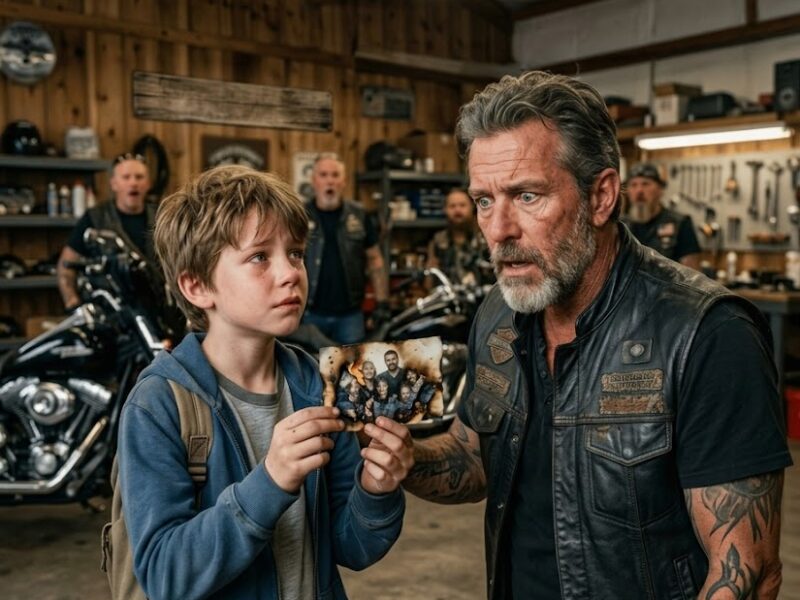
An 11-year-old walked up to a group of bikers and asked, “Can we take a new family photo?” They went silent.
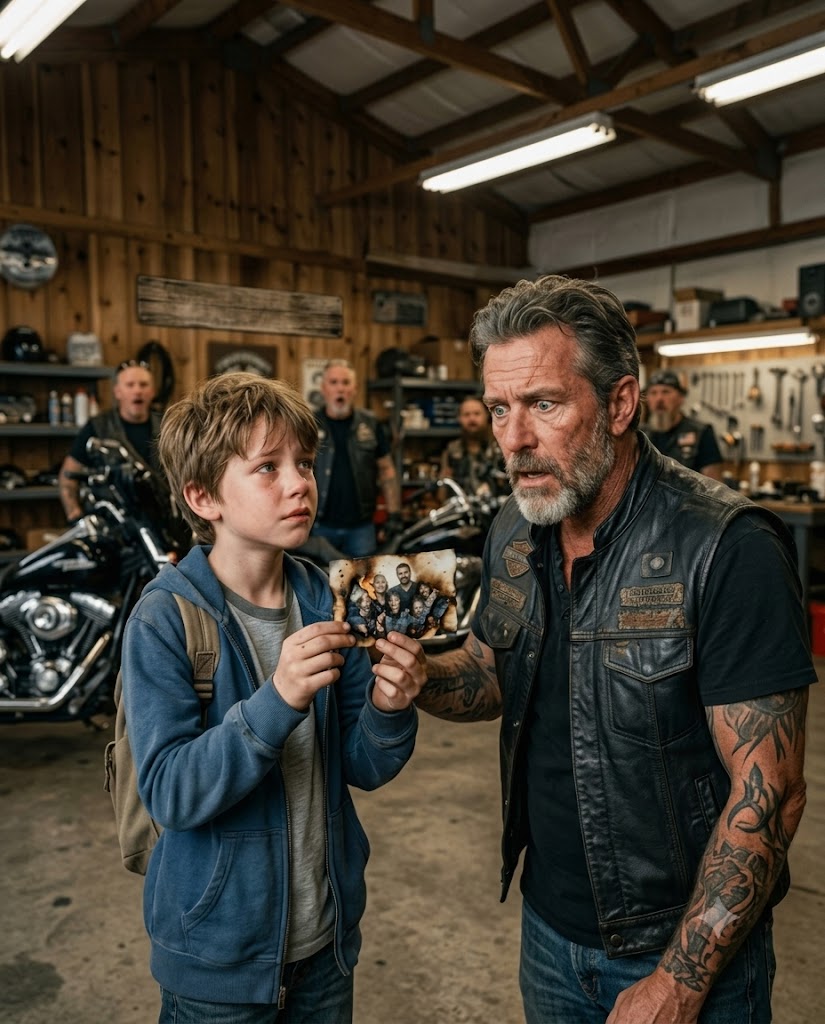
The kid appeared just before nine, right when Wesley was counting the register.
He was small for eleven, narrow shoulders, jeans that bunched at the ankles, backpack hanging off one strap like he’d been carrying it for miles.
But it was his hands that made Wesley pause mid-count.
The boy held something carefully between his palms, the way you’d cup water you were afraid of spilling.
“We’re about to close,” Marcus called from the back, not unkindly.
The boy didn’t move, just stood there in the doorway of the Nighthawks clubhouse, fluorescent light cutting across half his face.
His sneakers had holes near the toes.
Wesley sat down the cash drawer. “You lost, kid?”
“No, sir.” The voice came out steady, practiced, like he’d rehearsed this. “I need to ask you something.”
There was a quality to his stillness that Wesley recognized, the kind that came from learning early that moving too fast got you noticed in the wrong ways.
He’d seen it in his daughter’s eyes during their last visit, the one where social workers watched from plastic chairs while Amanda pretended not to recognize his voice.
“All right,” Wesley said. “Ask.”
The boy stepped forward and opened his hands.
It was a photograph, or what remained of one.
The edges were black and curled, most of the image consumed by fire.
Only one corner survived, a piece no bigger than a playing card showing part of a woman’s smile and a child’s hand gripping her sleeve.
The emulsion had bubbled and cracked, but you could still make out the faded colors of a kitchen in the background.
Yellow walls, a calendar with cartoon dogs.
“My stepdad burned it,” the boy said, matter of fact. “Last week. He said the past doesn’t matter anymore. That I need to stop acting like it does.”
Wesley’s throat went tight.
He didn’t reach for the photo.
“It was the only one I had of me and my mom together.”
Before the boy swallowed, before he came around, Marcus had stopped wiping down tables.
Two other members, Tank and Luis, stood in the doorway to the garage, grease still on their hands.
Nobody spoke.
The kid looked directly at Wesley then, and there it was again, that terrible ancient stillness.
“I was thinking maybe you could help me take a new one. A family picture. So I’d have proof I belonged somewhere.”
Wesley felt the weight of every word, each one settling somewhere he couldn’t shake off.
He had spent six years building walls between himself and sentences like that.
After the divorce, after Amanda went into the system, after the supervised visits turned into canceled visits turned into nothing at all, he’d learned to keep requests at arm’s length.
You couldn’t disappoint people if you never promised them anything.
But this kid wasn’t asking for promises.
He was asking for evidence, documentation, the kind of proof Wesley himself had tried to provide in family court, showing up to every hearing with calendars and receipts and character witnesses.
None of it enough to convince a judge that a man who’d spent two decades in an MC could be trusted with his own daughter.
“What’s your name?” Wesley asked.
“Marty.”
“Where’s your mom now, Marty?”
Something flickered across the boy’s face. “I don’t know. She left last winter. Ray, my stepdad, says she’s sorting things out, that she’ll come back when she’s ready.”
The lie sat obvious in the space between them.
Marty knew it was a lie.
Wesley knew he knew.
“And Ray sent you here?”
“No, sir. He doesn’t know I left.”
Marcus muttered something under his breath.
Tank crossed his arms, jaw working.
Wesley should have called someone.
Child services. The police. Someone whose job description included knowing what to do with eleven-year-olds holding burned photographs.
Instead, he said, “You eaten today?”
Marty’s hesitation was answer enough.
“Marcus, get him something from the fridge.” Wesley kept his eyes on the kid. “Sit down, Marty. We’re going to figure this out.”
Twenty minutes later, after Marty had eaten two sandwiches and half a bag of chips without saying a word, Wesley made a decision that surprised him.
“All right,” he said. “We’ll take your picture.”
Marty looked up, mayonnaise still on his lip. “Really?”
“Really. But not inside. Outside, with the bikes.”
Wesley stood, ignoring the looks from Marcus and Tank.
“You want a family picture? We do it properly.”
They assembled in the parking lot under the sodium lights.
Six of them in total, including Jax, who just pulled in on his Harley.
Nobody asked questions.
When Wesley said, “Line up,” they lined up.
Marty stood in the center, uncertain, his hands hanging at his sides like he’d forgotten what they were for.
Wesley positioned himself to the kid’s left, not touching him, just close enough that the camera would catch them in the same frame.
“Luis, you’re taking it,” Wesley said, handing over his phone.
“I don’t know about this, Wes,” Luis muttered.
But he raised the camera anyway.
“Just take the damn picture.”
The flash went off.
Once, twice, three times.
When Wesley checked the screen, what he saw wasn’t a family.
It was a group of men who’d forgotten how to arrange their faces into anything resembling warmth, standing around a kid who looked like he was waiting for permission to breathe.
But Marty stared at that image like it was oxygen itself.
“Can I have it?”
His voice had gone small again.
Wesley sent it to the clubhouse printer, watched as Marty carefully slid the warm paper into a plastic sleeve pulled from his backpack, the kind kids used for baseball cards.
The boy’s hands shook slightly as he tucked it away, like he was afraid it might combust if he wasn’t careful.
“Thank you,” Marty whispered.
Wesley drove him back to Ray’s house himself, got the address without asking too many questions.
When Marty climbed out of the truck, Wesley said, “Same time next month. We’ll take another one.”
Marty turned back, eyes wide. “You mean it?”
“I mean it.”
He watched the kid walk up the cracked driveway to a house with bars on the windows and a dead lawn.
Watched him pull out his key and let himself into darkness.
Wesley sat there for a full minute after the door closed, engine idling, thinking about proof and photographs and all the ways a person could be erased.
Then he put the truck in gear and drove home to his empty house, where the only photos on the walls were of motorcycles and men who’d never ask him for anything that mattered.
—
By March, nobody pretended the photos were about anything except showing up.
Marty showed up on the last Saturday of every month with the precision of someone who’d learned that consistency was a luxury.
Wesley noticed the backpack getting heavier, the way the kid adjusted the straps more frequently.
Seven photos became eight, then nine.
The plastic sleeve had been replaced by a small binder with clear pages.
The club stopped making excuses about why they showed up those Saturdays.
Tank arrived with his hair combed.
Luis wore shirts without oil stains.
Marcus brought his good boots instead of the work ones with the blown-out sole.
Nobody talked about it.
They just lined up when Wesley gave the nod.
Mrs. Chen had been teaching long enough to notice what others missed.
The kid who stopped flinching, the one who suddenly remembered to eat lunch.
Marty’s transformation was quieter than most, but unmistakable.
He stopped flinching during fire drills.
It was a small thing, but when the alarm went off in November, Marty had dropped under his desk so fast that Mrs. Chen had to coax him out ten minutes after everyone else had filed back inside.
By February, he just stood up and walked to the door with the others, hands steady at his sides.
His drawings changed, too.
In September, every self-portrait he drew showed a figure alone, small, off to the edge of the page, surrounded by white space.
By April, his art projects included buildings, motorcycles, faces that weren’t his own.
In one sketch, he drew himself standing among a group of men, all of them the same height.
When Mrs. Chen pointed out the proportions were off, Marty had simply said, “That’s how it feels.”
She mentioned it to the school counselor during their monthly check-in.
“I don’t know what changed at home, but something did. He’s still quiet, but it’s different now. He doesn’t watch the door anymore. Doesn’t check where the exits are before sitting down.”
At the clubhouse, Wesley started keeping a folder.
Nothing formal, just the photos printed in order, each one dated on the back.
April’s picture showed Marty with his hands in his pockets instead of hanging limp.
May’s caught him mid-laugh at something Jax had said.
June’s was the first one where he looked directly at the camera without that rehearsed blankness.
Ray noticed too, but his observations came with edges.
“You’re getting ideas,” he told Marty one evening, voice flat in that way that made the kid’s shoulders hunch. “Spending time with those bikers, thinking you’re part of something.”
Marty didn’t respond.
He’d learned that silence was safer than defense.
“Boys who don’t know their place end up disappointed,” Ray continued, then walked away, leaving the threat hanging in the kitchen air.
Two weeks later, Marty showed up for the July photo wearing a t-shirt despite the heat.
When he reached up to adjust his backpack, the fabric rode up, exposing a bruise across his shoulder blade, deep purple spreading into green at the edges.
The kind that came from impact, not accident.
Wesley saw it.
So did Marcus.
Neither of them said anything directly.
Wesley had learned years ago that pushing too hard made kids shut down, and he couldn’t afford for Marty to stop showing up.
Instead, after the photo, Wesley handed him a disposable camera, the cheap kind from the drugstore with twenty-seven exposures.
“You can take pictures between our monthly ones,” Wesley said, keeping his tone casual. “If you want.”
Marty stared at the camera like it might evaporate. “Of what?”
“Whatever matters to you.”
The kid’s hands trembled slightly as he accepted it, fingers wrapping carefully around the plastic body.
“Thank you.”
“Don’t mention it.”
But Marty did mention it.
Three days later, he came back to the clubhouse after school, the first time he’d shown up outside their schedule.
He didn’t say why he was there, just sat at one of the tables doing homework while Marcus worked on an engine and Wesley handled paperwork in the office.
After an hour, Marty packed up his books.
“I took some pictures,” he said, producing the camera, “but I don’t know how to get them developed.”
Wesley drove him to the pharmacy, waited while the clerk explained it would take an hour, then bought them both ice cream from the shop next door.
They ate in the truck, neither of them filling the silence with unnecessary words.
When the photos came back, Marty didn’t show them to Wesley, just tucked the envelope into his backpack alongside the binder.
But his shoulders sat differently afterward, less hunched, more certain of the space they occupied.
That month’s photo showed something the previous ones hadn’t.
Marty standing without trying.
He simply existed in the frame without needing permission first, like he’d stopped expecting things to disappear.
The other club members looked different, too.
Tank’s hand rested on Marty’s shoulder, casual in a way that suggested he’d forgotten to be careful about it.
Twelve photos in the binder now.
Twelve months of proof.
Wesley filed the latest one in his folder and tried not to think about what would happen if Ray decided Marty’s place wasn’t with people who showed up.
—
But three weeks later on a Wednesday afternoon, his phone rang.
School secretary, controlled panic in her voice.
“There’s a situation with Marty. His stepfather is here. We need you.”
Wesley was in the truck before she finished the sentence.
Marcus riding shotgun without being asked.
They made the fifty-minute drive in nine.
When they arrived, Ray stood in the principal’s office, one hand wrapped around Marty’s bicep.
The kid’s face blank in that old practiced way, the same blankness from the first night he’d walked into the clubhouse holding ashes.
Only now Wesley knew what it looked like when Marty didn’t have to perform that emptiness.
And he wasn’t about to let the kid disappear back into it.
Wesley walked into the principal’s office like he belonged there.
Ray’s grip on Marty’s arm tightened.
The kid’s face had gone completely smooth, that terrifying blankness that erased everything they’d built over twelve months.
“And you are?” the principal asked, half standing behind her desk.
“Emergency contact,” Wesley said evenly. “Wesley Grant. I’m in the system.”
He’d added himself three months back after Marty had shown up with fingerprint bruises on his forearm that he’d explained away as falling against the banister.
The school counselor had been hesitant but desperate.
Ray rarely answered calls, and there was no other family on file.
Ray’s eyes narrowed. “You have no authority here.”
“Neither do you, apparently.” Wesley kept his voice level, turning to the counselor. “What’s happening?”
The counselor, a young woman named Sarah who looked like she’d aged five years in the past hour, glanced nervously between them.
“Mr. Patterson arrived during lunch requesting immediate removal of Marty from school. No advanced notice, no documentation. When we asked for clarification, he became insistent.”
“I’m his legal guardian,” Ray said. “I don’t need permission to take my own kid.”
“Stepfather,” Wesley corrected quietly. “And where’s Marty’s mother?”
Ray’s jaw locked.
Something shifted behind his eyes. “That’s none of your concern.”
“It became my concern when you made it mine.” Wesley pulled out his phone. “Sarah, I’m calling Gina Reeves. She’s a family attorney. And Marcus here—” he gestured to Marcus, who’d positioned himself near the door, “—works with CPS. We’re going to sort this out properly.”
“You can’t just—” Ray started.
“I can, actually. Because right now you’re refusing to answer basic questions about a child’s primary guardian, and you’re attempting to remove him from school in the middle of the day without cause.”
Wesley’s voice never rose.
“So we’re going to wait for the proper authorities, and you’re going to explain where Marty’s mother has been.”
Ray’s hand dropped from Marty’s arm.
“She’s traveling for work.”
“What kind of work?” Marcus asked, pulling out a notepad.
“That’s private.”
“Not when a minor is involved. It isn’t.”
Gina arrived in twenty minutes, professional in a way that made the room’s temperature drop.
She asked three questions that Ray couldn’t answer.
Where is the mother currently?
When did you last speak with her?
Do you have legal custody documentation?
Three questions, and Ray had no answers that held together.
The mother wasn’t traveling.
She’d left without warning, no forwarding address, no contact since.
Ray had kept Marty because reporting her disappearance seemed like more trouble than it was worth.
He’d forged her signature on school forms, never legally adopted the boy or filed for guardianship.
He’d simply kept him.
By the time CPS arrived ninety minutes later, Marty hadn’t said a single word.
He sat in the counselor’s office, hands folded in his lap, while adults decided his future in the adjacent room.
Wesley sat with him, didn’t try to fill the silence with reassurances he couldn’t guarantee.
“Are they going to take me somewhere?” Marty finally asked, voice barely above a whisper.
“Probably. For tonight, at least.”
“Can I bring my backpack?”
“Yeah, kid. You can bring your backpack.”
—
The emergency placement happened fast.
Protocol when a guardian’s legal status dissolved mid-crisis.
A foster home across town, temporary until they could sort out relatives or more permanent options.
The case worker was kind but efficient, the way people got when they’d processed too many cases to absorb each one individually.
Marty was allowed to pack one bag from Ray’s house.
Supervised.
Wesley drove him there, watched as the kid moved through rooms like a ghost, collecting only essentials.
Clothes, toothbrush, the binder.
He reached for it first.
At the foster home, a tidy ranch with a swing set in the yard and motivational posters on the walls, Marty thanked the case worker politely, shook hands with the foster parents, and disappeared into the bedroom they’d assigned him.
Wesley left his number.
“He can call anytime.”
That night, Marty spread the photos across an unfamiliar bedspread and counted them.
They’d taken two extras during good months.
He arranged them in chronological order, studying each one like he was memorizing evidence.
The foster mother knocked softly. “You okay, honey?”
“Yes, ma’am.”
She didn’t push.
But an hour later, she called the case worker.
“He’s not upset. That’s what worries me. He’s too calm.”
The case worker made a note in the file, then called Wesley.
“He keeps looking at photographs. Do you know anything about that?”
“Yeah,” Wesley said. “I know about that.”
“The court date is set for next week. They’re going to ask Marty where he feels safest.” She paused. “Off the record, you should be there.”
Wesley sat in his kitchen after the call ended, staring at the folder he’d been keeping, the photos, more than a year of documented care and consistency Wesley couldn’t fake even if he wanted to.
He’d lost Amanda to a system that decided consistency wasn’t enough, that his past outweighed his present.
He’d spent six years believing he didn’t get second chances.
But Marty wasn’t asking for a second chance.
He was asking for the first one to count.
Wesley opened his laptop and started typing an email to Gina.
Subject line: Custody Evaluation. What do I need?
In a house across town, Marty pulled out the February photo, the one where Wesley’s hand rested on his shoulder for the first time.
He held it carefully, like the burned photograph he’d carried into the clubhouse a year ago.
Only this one wasn’t ashes.
This one was proof that someone stayed.
—
The courthouse smelled like floor wax and recycled air.
Wesley sat three rows back, hands folded, watching Marty at the front table beside his court-appointed attorney.
The kid wore clothes the foster family had bought him, khakis and a button-up that was slightly too big.
He looked smaller than he had in jeans and a t-shirt at the clubhouse.
Ray sat on the opposite side with a public defender who looked like he’d rather be anywhere else.
The stepdad kept his eyes forward, jaw tight.
Gina had coached Wesley the night before.
“You’re not a party to this case. You’re a witness to Marty’s stability and routine. Don’t oversell. Let the evidence speak.”
The evidence sat in a manila folder on the attorney’s table.
Every photo they’d taken.
Dates written in Wesley’s handwriting on each back.
Proof that couldn’t be argued with.
The judge was a woman in her fifties with reading glasses on a chain and tired eyes of someone who’d heard every excuse, believed none of them, and made decisions anyway.
She reviewed the case file without expression, occasionally making notes.
Ray’s defense crumbled quickly under questioning.
No, he couldn’t provide proof of the mother’s whereabouts.
No, he hadn’t filed a missing person report.
No, he didn’t have legal custody documentation.
When asked why he’d kept Marty without proper authority, he said it seemed easier than getting the system involved.
The judge’s pen stopped moving.
“Easier for whom?”
Ray didn’t answer.
Marty’s attorney presented the photographs methodically, explaining the monthly ritual, the documented consistency, the transformation visible in the progression.
She called Mrs. Chen, who testified about the changes in Marty’s behavior, the decreased anxiety, the improved engagement, the drawings that went from solitary figures to connected groups.
Then she called Wesley.
He walked to the stand feeling like every bad decision he’d ever made was tattooed on his forehead.
The motorcycle club, the divorce, the custody battle he’d lost with Amanda.
But the attorney didn’t ask about any of that.
She asked about the photos.
“Can you explain how this monthly ritual began?”
Wesley kept his eyes on Marty.
“He asked for help taking a family picture.”
“So you took one. And you continued for over a year. Why?”
“Because he kept showing up. And I figured if someone’s going to show up consistently for you, the least you can do is show up for them.”
The judge leaned forward slightly. “Mr. Grant, are you seeking custody of Marty?”
Wesley’s throat went dry.
“If the court thinks that’s appropriate. Yes, ma’am. I’ve started the evaluation process.”
“Do you understand the responsibility involved?”
“Yes, ma’am. I lost custody of my own daughter years ago. I understand exactly what’s at stake.”
The honesty seemed to catch the judge off guard.
She studied him for a long moment, then nodded. “You may step down.”
The final testimony came from Marty himself.
The judge’s voice softened when she addressed him.
“Marty, I need to ask you some questions. You can take your time answering.”
“Yes, ma’am.”
“Where do you feel safest?”
Marty reached for the binder in front of him, the one he’d brought from the foster home, the one he’d been holding throughout the entire hearing.
He opened it carefully, flipping through the plastic sleeves until he found the most recent photo.
It had been taken three weeks ago, unscheduled.
Marty had called the clubhouse in tears.
Ray had destroyed the disposable camera and the photos it contained, said the kid was wasting time on stupid things.
Wesley had simply driven over, picked him up, taken him back to the clubhouse.
In the photo, Marty sat on Wesley’s motorcycle, helmet too big on his head, grinning like the world had just expanded to include possibilities he hadn’t known existed.
Wesley stood beside the bike, one hand resting on the handlebar.
He looked like he’d forgotten the camera was there.
Natural in a way staged photos never capture.
Marty held it up for the judge to see.
“I already have a family,” he said quietly. “We just had to take a picture so I could prove it.”
The courtroom went completely silent.
The judge removed her glasses, studied the photograph, then looked at the progression of images in the file before her.
Nearly two years of documented care, monthly photos, plus several taken outside the ritual.
Twenty-three pieces of evidence that someone had showed up consistently without legal obligation or blood relation.
“I’m granting temporary custody to Mr. Grant pending full evaluation,” she said. “Permanency hearing in six months.”
Wesley’s hands started shaking.
Marty turned in his chair, eyes wide and uncertain, like he was afraid to believe what he just heard.
Outside the courthouse, Marty didn’t cry.
He just stood on the steps, backpack on both shoulders, looking at Wesley like he was trying to solve an equation.
“You meant it,” Marty said. “About showing up.”
“Yeah, kid. I meant it.”
—
One month later, they took another photo.
But this time, Marty held the camera.
He’d grown two inches, filled out slightly from consistent meals and the absence of fear.
He stood straighter, moved through space like he had permission to occupy it.
He framed the shot carefully.
The club members arranged casually around the garage, Wesley in the center this time, hands in his pockets.
Marty clicked the shutter and studied the preview screen for a long moment.
Then he looked up.
“Can we take one more? I want to be in this one, too.”
They reset.
Someone else held the camera.
Marty stood next to Wesley, not touching, but close.
The way family does when they’ve moved past performing connection and into simply existing together.
When the photo printed, Marty didn’t put it in the binder.
He pinned it to the wall of his new room, the room in Wesley’s house that still smelled like fresh paint and possibility.
The room with the window facing the street, where he could see who was coming and didn’t have to brace himself when he heard footsteps.
The binder sat on his desk, full but not finished.
Because some families aren’t born in a moment.
They happen in small increments, one photo then another, even when you’re not sure what you’re building yet, until the weight of them becomes impossible to ignore.
Proving month after month that belonging isn’t something you lose when someone burns the evidence.
It’s something you create, frame by frame, until no one can take it away.
Sometimes family isn’t about blood or legal papers.
It’s about who stays when staying is the hardest thing to do.
—
The permanency hearing arrived six months later, on a Tuesday morning that started with pancakes and ended with a judge’s signature.
Wesley had learned to make pancakes the way Marty liked them, edges crispy, center soft, with too much syrup and a side of bacon that Wesley pretended not to notice when Marty stole from his plate.
They’d settled into something that looked like routine, though neither of them used that word out loud, as if naming it might jinx it.
Marty had his own room now, the one with the window facing the street.
He’d painted it himself, a shade of blue he’d picked from a paint chip at the hardware store, holding it up to the light for ten minutes before deciding.
Wesley had let him, even though the color reminded him of a swimming pool he’d once fallen into as a kid.
The club had adjusted too.
Tank started teaching Marty how to work on engines, patient in a way nobody had ever seen him be patient about anything.
Luis brought over old motorcycle magazines, the kind with glossy photos and technical specs, and left them on the coffee table without comment.
Marcus, who’d never had kids of his own, started calling Marty “kid” in a way that sounded almost paternal.
Even Jax, who rarely spoke unless spoken to, had given Marty a leather jacket that was too big but would fit eventually, with the Nighthawks patch sewn onto the back.
“It’s a loan,” Jax had said, gruff. “You grow into it, you keep it.”
Marty had worn it every day for a week, even when it was too warm, even when the sleeves hung past his fingers.
But the hearing loomed, a date circled on the calendar like a threat.
Gina had prepared them both, running through questions and answers until Marty could recite them in his sleep.
“The judge will want to know you’re stable,” she’d said. “That you’re safe. That Wesley can provide for you.”
Marty had nodded, serious in a way that made him look older than eleven.
“I know what to say.”
The morning of the hearing, Wesley woke before dawn, staring at the ceiling and running through every worst-case scenario.
What if the judge changed her mind?
What if someone from Wesley’s past showed up to testify against him?
What if Ray had found a lawyer who could poke holes in their story?
He got up, made coffee, and stood at the kitchen window watching the sun rise over the neighbor’s fence.
Marty appeared an hour later, hair still wet from the shower, wearing the button-up shirt they’d bought specifically for court.
It was still slightly too big, but less so than before.
“You ready?” Wesley asked.
“No,” Marty said honestly. “But I’m here.”
That was enough.
—
The courtroom was smaller this time, a family court annex with wood-paneled walls and a single window that looked out onto a parking lot.
The judge was the same woman, her glasses still on a chain, her expression still unreadable.
Ray was there, sitting alone this time.
His public defender had been replaced by a private attorney, a sleek man in a gray suit who looked like he charged by the minute.
Wesley felt his stomach tighten.
Gina noticed too, her jaw setting as she reviewed her notes.
The hearing started with procedural matters, legal jargon that Wesley couldn’t follow, words like “parental fitness” and “best interest standard” and “burden of proof.”
He focused on Marty, sitting beside him, hands folded on the table.
The kid looked calm, but Wesley could see the tension in his shoulders, the way he was holding his breath without realizing it.
Then Ray’s attorney called his first witness.
A woman Wesley didn’t recognize, mid-forties, sharp suit, introduced as a “family friend.”
She testified that Ray had been a devoted stepfather, that Marty had always seemed well-cared for, that she’d never seen any signs of abuse or neglect.
Wesley’s hands clenched under the table.
Gina didn’t react, just made notes on her legal pad.
The second witness was a neighbor, who testified that Ray had always been polite, that the house had always been quiet, that she’d never had any reason to call the authorities.
Wesley wanted to stand up, to shout that quiet didn’t mean safe, that politeness didn’t mean kindness, that the absence of evidence wasn’t evidence of absence.
But he stayed seated, jaw tight, watching the judge’s expression for any sign of doubt.
Then Ray’s attorney called his final witness.
“Mrs. Patterson,” he said. “Marty’s mother.”
The courtroom went still.
Wesley turned to look at Marty, whose face had gone pale, his hands gripping the edge of the table.
A woman walked in from the back of the room, thin, tired, wearing clothes that looked like they’d been bought at a thrift store.
She kept her eyes down, not looking at Marty, not looking at Ray, just walking to the witness stand like she was walking to her own execution.
“Mrs. Patterson,” the attorney said, “can you tell us where you’ve been for the past two years?”
She swallowed, hands twisting in her lap. “I… I had some problems. I needed to get away. I didn’t…”
“Did you abandon your son?”
The word hung in the air like a slap.
“I didn’t mean to. I just… I couldn’t…”
“Did you leave him with Mr. Patterson, knowing he had no legal right to custody?”
“I didn’t know what else to do.”
“And during those two years, did you make any effort to contact your son? To check on his welfare? To provide any support?”
Her silence was answer enough.
Gina stood for cross-examination.
“Mrs. Patterson, when you left, did you leave Marty in what you believed to be a safe environment?”
“I thought Ray would take care of him.”
“Did you have any reason to believe Ray might be violent? Might hurt your son?”
She hesitated, eyes flickering to Ray, then away.
“I didn’t know. I just… I needed to leave.”
“And now? Why are you here now?”
The attorney for Ray answered before she could.
“Mrs. Patterson has returned to reclaim custody of her son. She’s been in contact with Mr. Patterson, and they’ve agreed to work together to provide Marty with a stable home.”
Wesley felt the floor drop out from under him.
He looked at Marty, who was staring at his mother like he was seeing a ghost.
The judge leaned forward.
“Mrs. Patterson, is it your intention to seek custody of your son?”
“I… yes. I want to make things right.”
Gina didn’t flinch.
“Mrs. Patterson, where have you been living for the past two years? What have you been doing to address whatever ‘problems’ caused you to leave?”
“I’ve been… I’ve been getting help. I’m better now.”
“Can you provide documentation of that treatment? Proof of stable housing? A plan for how you’ll care for Marty?”
The woman’s silence was deafening.
Gina turned to the judge.
“Your Honor, Mrs. Patterson abandoned her son two years ago without any contact. She has no stable housing, no documented treatment, no plan for Marty’s care. Meanwhile, my client, Mr. Grant, has provided consistent, documented care for over eighteen months. He has a stable home, a support network, and a proven track record of putting Marty’s needs first.”
The judge nodded slowly, making notes.
Ray’s attorney tried to recover, arguing that a mother’s bond with her child was irreplaceable, that Ray and Mrs. Patterson were willing to attend counseling, that they deserved a chance to be a family.
But the judge’s pen kept moving, and Wesley began to hope.
—
The final ruling came an hour later.
The judge removed her glasses, folded them carefully on the desk, and looked directly at Marty.
“Mr. Grant has demonstrated remarkable commitment to your well-being. The evidence shows consistent care, stable housing, and a support system that has been present for over a year and a half. Your mother, while present today, has not demonstrated the same level of commitment or stability.”
She paused, letting the words sink in.
“However, I am not granting full adoption at this time. Instead, I am extending temporary custody to Mr. Grant for an additional year, with regular check-ins and a requirement that Mrs. Patterson complete a treatment program and demonstrate stable housing before any custody modification is considered.”
Wesley’s heart pounded.
It wasn’t the victory he’d hoped for, but it was enough.
It was more than enough.
Marty turned to him, eyes bright, and for the first time in months, Wesley saw something he hadn’t seen before.
Hope, unfiltered and unafraid.
Outside the courthouse, Marty didn’t run to Wesley.
He walked to his mother first, standing in front of her, looking up at her face.
She was crying, hands shaking, reaching for him.
Marty didn’t take her hand.
“I waited for you,” he said quietly. “Every day. I waited for you to come back.”
“I know. I’m sorry. I’m so sorry.”
“I used to think you left because of me. That I did something wrong.”
“No. No, sweetheart, it wasn’t you. It was never you.”
Marty nodded slowly, absorbing her words.
Then he stepped back, toward Wesley, who was standing a few feet away, giving them space.
“I need to stay with Wesley now,” Marty said. “I need to know what it feels like to be somewhere that doesn’t disappear.”
His mother nodded, tears streaming down her face.
“I understand. I’ll… I’ll do better. I’ll get better. And maybe someday…”
“Maybe someday,” Marty echoed.
Then he turned and walked to Wesley, who put a hand on his shoulder, solid and steady.
“You okay?” Wesley asked.
“I don’t know,” Marty said honestly. “But I’m here.”
“That’s enough.”
—
The drive home was quiet, but not the heavy kind.
Marty stared out the window, watching the city pass by, his reflection ghosting over the buildings and cars.
Wesley kept both hands on the wheel, letting the silence settle into something comfortable.
When they pulled into the driveway, Marty didn’t move, just sat there, looking at the house.
“Wesley?”
“Yeah?”
“Are you going to adopt me? Eventually?”
Wesley’s throat tightened.
“If you want me to. Yeah.”
“I think I do.” Marty paused. “I think I want to have the same last name. So it’s official.”
“Then we’ll make it official. As soon as we can.”
Marty nodded, then climbed out of the truck, backpack slung over one shoulder.
Wesley followed, locking the door behind them, watching as Marty walked into the house like he belonged there, because he did.
That night, they took another photo.
Not a formal one, not with the club lined up in the parking lot.
Just the two of them, Marty holding the camera at arm’s length, Wesley leaning in, both of them smiling in a way that looked almost natural.
Marty printed it the next day at the pharmacy, slid it into the binder, and placed the binder on the shelf in his room, next to the others.
Twenty-four photos now.
Two years of proof.
And counting.
—
The months that followed were quiet, the kind of quiet that came from routines settling into place.
Wesley learned to cook more than pancakes, though he never quite mastered anything beyond the basics.
Marty learned to ride a bike, then a dirt bike, then, eventually, one of the smaller motorcycles that Tank had fixed up specifically for him.
The club adjusted, the way families did when they added a new member.
Marty started calling Tank “Uncle Tank,” which made Tank pretend to be annoyed but secretly beam.
Luis taught Marty how to play poker, badly, and Marcus taught him how to fish, patiently, even when Marty was too impatient to sit still.
Jax, who’d never been good with words, gave Marty a leather tool kit with a note that said, “For the kid who’s going to fix things.”
Wesley framed it.
Mrs. Patterson started sending letters, then emails, then calls.
Marty read the letters, answered the emails, took the calls, but always with a distance that Wesley recognized.
He was protecting himself, the way he’d learned to.
The way Wesley had learned to.
But slowly, carefully, Marty started to let her back in.
Not all the way. Not yet. But enough.
She completed her treatment program.
She found stable housing.
She started attending weekly meetings, the kind that helped her put her life back together piece by piece.
Wesley didn’t trust her, not entirely, but he trusted Marty’s judgment.
And Marty, who had spent two years learning what consistency felt like, had decided to give her one more chance.
Not because she deserved it, but because he did.
—
The adoption hearing was in June, a year after the custody ruling.
Wesley wore a suit he’d bought specifically for the occasion, dark gray, slightly uncomfortable.
Marty wore a button-up shirt that actually fit this time, white, with a clip-on tie that he’d insisted on wearing even though Wesley had offered to teach him how to tie a real one.
“No, I want the clip-on,” Marty had said. “It’s easier.”
“You’re going to look like a waiter.”
“I’m going to look like someone who doesn’t need help with his tie.”
Wesley had laughed, and they’d driven to the courthouse together.
The judge from the previous hearings wasn’t there.
This was a different judge, a man in his sixties with kind eyes and a gentle voice.
He asked Wesley the standard questions.
Do you understand the legal responsibilities of adoption?
Yes.
Do you agree to provide for Marty’s physical, emotional, and educational needs?
Yes.
Are you prepared to be his permanent legal guardian?
Yes.
Then he asked Marty.
Do you understand what adoption means?
Yes.
Do you want Wesley to be your legal parent?
Yes.
Why?
Marty paused, thinking.
“Because he shows up,” he said finally. “Even when it’s hard. Even when I’m not easy to be around. He stays. And I want to have the same last name so everyone knows we’re family.”
The judge smiled, signed the paperwork, and said, “Congratulations.”
Just like that.
Wesley’s hands were shaking, but he was smiling, really smiling, for the first time in years.
Marty turned to him, eyes bright.
“Can we take a picture?”
“Yeah, kid. We can take a picture.”
They took it on the courthouse steps, someone else holding the phone, Marty standing next to Wesley, both of them grinning like idiots.
Wesley framed it, hung it on the wall in the hallway, next to the other photos.
The folder was full now, but it didn’t matter.
They’d take more.
They’d keep taking them, month after month, year after year, until the walls of Wesley’s house were covered in proof.
Proof that family wasn’t about blood.
It was about showing up.
And staying.
—
Marty was twelve when he first called Wesley “Dad.”
It was a Saturday morning, pancake morning, the kind of morning that had become sacred.
Wesley was at the stove, flipping pancakes, Marty was at the table, sketching something in his notebook.
“Hey, Dad,” Marty said, without looking up. “Can you pass the syrup?”
Wesley froze, spatula in midair.
Marty looked up, realized what he’d said, and went still.
“I mean… sorry. I didn’t mean to…”
“Don’t apologize,” Wesley said, voice rough. “Pass the syrup, son.”
Marty smiled, a real smile, the kind that reached his eyes.
And Wesley felt something crack open in his chest, something that had been closed off for years, maybe decades.
He passed the syrup.
They ate pancakes.
They took a photo.
The binder grew.
—
Marty was thirteen when he won his first dirt bike race.
Wesley was in the stands, next to Tank and Luis, cheering louder than anyone.
Marty crossed the finish line, covered in dust, grinning like he’d just won the lottery.
Wesley took a photo, the kind of photo that would go in the binder, right next to the first one, the burned one, the one that started everything.
Later that night, after the celebration, after the pizza and the cake and the speeches, Marty pulled out the burned corner, the one with his mother’s smile and his own small hand gripping her sleeve.
He looked at it for a long time, then carefully placed it in the binder, next to the adoption photo.
“That’s the beginning,” he told Wesley. “And this is the middle. And someday, there’ll be an end. But not for a long time.”
Wesley put his arm around Marty’s shoulders.
“Not for a long time,” he echoed.
They took another photo.
The binder grew.
—
Marty was fourteen when his mother completed her program and asked to see him.
Wesley was nervous, more nervous than Marty, though he tried not to show it.
They met at a diner, neutral ground, the kind of place with vinyl booths and bad coffee.
She was thinner than before, but healthier, less fragile.
She cried when she saw Marty, and he let her hug him, not quite melting into it, but not pulling away either.
“You’ve grown,” she said.
“Yeah,” Marty said. “I do that.”
She laughed, a watery laugh, and Wesley saw something in her face that looked like hope.
They talked for an hour, about small things, safe things, the kind of things you talked about when you were still figuring out how to be in each other’s lives.
When they left, Marty was quiet, but not sad.
“She’s doing better,” he said.
“Yeah,” Wesley agreed. “She is.”
“Maybe someday she’ll be okay. Like, really okay.”
“Maybe.”
Marty nodded, then looked at Wesley.
“But I’m already okay. I’m already good. Because of you.”
Wesley’s throat tightened.
“Because of me,” he repeated.
“Yeah. Because you showed up.”
They took a photo.
The binder grew.
—
Marty was fifteen when he started working at the clubhouse, officially, not just hanging around.
He swept the floors, organized the tools, learned how to do oil changes and tire rotations.
Wesley watched him, proud in a way that words couldn’t capture.
The kid who’d walked in holding ashes had become a teenager who knew how to change a spark plug, how to balance a carburetor, how to hold his own in a world that had once seemed so foreign.
They took a photo, of course.
The binder grew.
—
Marty was sixteen when he got his driver’s license.
Wesley taught him in the same truck he’d driven to Ray’s house that first night, the same truck that had idled in the driveway while Wesley thought about proof and photographs and all the ways a person could be erased.
Marty passed on the first try, grinning when he got his license, holding it up like a trophy.
“I can drive,” he said.
“I know,” Wesley said. “Now drive us home.”
They took a photo.
The binder grew.
—
Marty was seventeen when he said he wanted to join the Nighthawks, for real, not just as the kid who hung around.
Wesley was proud, but scared, the way any parent was scared when their kid chose a path that came with risks.
“You know what this means,” Wesley said. “The rules. The responsibilities. The way people look at you when they find out.”
“I know,” Marty said. “But I also know what it means to have people who show up. And I want to be that for someone else someday.”
Wesley nodded, then hugged his son.
Not the way he hugged him when he was eleven.
Different, more certain, the way you hugged someone you knew was about to become their own person.
They took a photo.
The binder grew.
—
Marty was eighteen when he moved out, into a small apartment across town, close enough to visit but far enough to be his own.
Wesley helped him move, carried boxes up three flights of stairs, complained about his knees.
“You’re not that old,” Marty said.
“I’m old enough.”
They set up the apartment, hung curtains, arranged furniture.
And when it was done, Marty put the binder on a shelf, next to a framed photo of him and Wesley on the courthouse steps.
“Can I take the burned one?” Marty asked. “The first one. I want to put it in the frame, but I want to keep the binder complete.”
Wesley nodded.
“Take it. It’s yours.”
Marty carefully removed the burned corner from the binder, placed it in a frame, and hung it on the wall.
“That’s the beginning,” he said. “And this is the middle.”
“And someday there’ll be an end,” Wesley said.
“But not for a long time.”
They took a photo.
The binder grew.
—
Wesley was sixty-two when he retired from the club, stepping down, letting the younger members take over.
Marty was thirty-five, married, with a daughter of his own, a little girl named Amara who had Wesley’s eyes and Marty’s stubbornness.
They took photos constantly, the way families did, the way they’d always done.
The binder had grown, expanded, become three binders, then four.
The first photo, the burned corner, was still there, still a reminder.
But it was just one piece of a much larger story now.
Wesley was in his workshop when Marty walked in, holding Amara’s hand.
Amara was six, small for her age, with a gap-toothed smile and a habit of asking questions that made adults think.
“Grandpa Wes,” she said, climbing onto his lap. “Dad says you used to take pictures with your friends. Can we take one now?”
Wesley looked at Marty, who was smiling, holding up his phone.
“Sure, sweetheart,” Wesley said. “We can take one.”
They posed, Wesley and Amara and Marty, three generations of a family that had been built photo by photo, frame by frame.
The flash went off.
Amara giggled.
And Wesley felt something settle in his chest, something that had taken decades to fully form.
A life built on showing up.
A family built on proof.
A story that would continue long after he was gone.
They took a photo.
The binder grew.
—
Some families aren’t born in a moment.
They happen in small increments, one photo at a time, even when you’re not sure what you’re building yet.
Until the weight of them becomes impossible to ignore.
Proving month after month that belonging isn’t something you lose when someone burns the evidence.
It’s something you create, frame by frame, until no one can take it away.
Sometimes family isn’t about blood or legal papers.
It’s about who stays when staying is the hardest thing to do.
—
*What would you have done in Wesley’s position? Would you have taken that first photo?*









