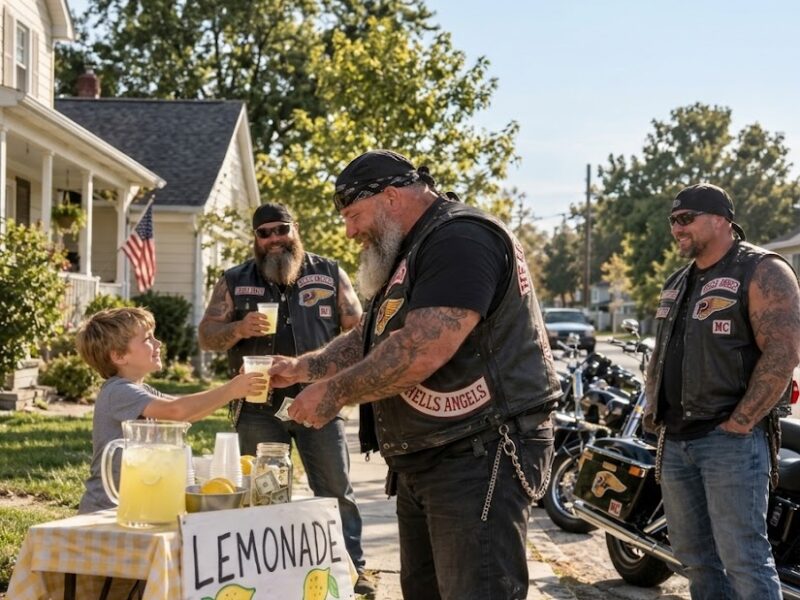
All summer long, a boy only sold lemonade to bikers. When one regular finally asked why, the answer broke him.
The deputy’s boots stopped three feet from my card table. Pack it up, son. Right now.
I was 11 years old. In my coffee can I had $842. On my front door, a bank had taped a date. And in my pocket, folded small and soft from years of handling, was a postcard from a stranger to my dead father.
Behind me, a motorcycle engine rolled to a stop. I didn’t turn around. For nine Saturdays, one man had watched me turn away every customer on this road but one kind. Now he was standing at my back, and the answer I’d been hiding all summer was about to change both our lives.
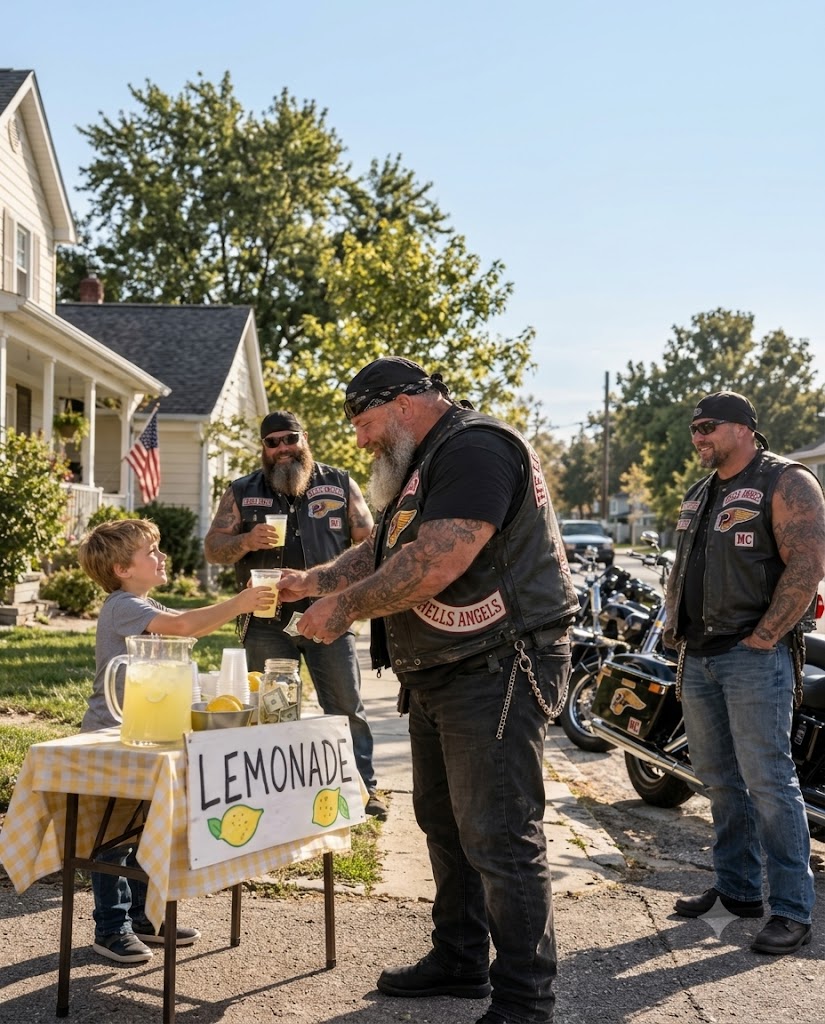
The sign was cut from the lid of a moving box, and the letters had been traced over so many times with a black marker that they bled into the cardboard. Lemonade, two dollars. And underneath in smaller print: riders only.
Aaron Pruitt, 11 years old, stood behind a folding card table at the gravel pullout where Mount Rushmore Road bends out of Keystone, South Dakota, and watched a white minivan slow down. It was the ninth one of the morning. The thermometer nailed to the pine behind him read 91 degrees, and it was not yet 10:30.
The minivan’s window came down. A man in a Cubs cap leaned across his wife. Hey buddy, how much for two lemonades?
I’m sorry, sir, I only sell to motorcyclists.
The man laughed, then saw the boy wasn’t joking. Even if I pay double?
Yes, sir. Even then.
Well, that’s the strangest business plan I ever heard. The window went up. The minivan pulled back onto the road, and in the rear seat, a little girl pressed her face to the glass and stared at Aaron until the bend swallowed her.
Aaron wiped his palms on his shorts. He did not feel good about it. His mother had raised him to be polite to everybody, and every no cost him something. But he had made a rule at the end of May, and a rule that bent for minivans was just a suggestion.
On the table sat a plastic cooler of lemonade, a stack of paper cups, and a coffee can with a slot cut in the lid. A strip of masking tape ran across the can, and in careful block capitals Aaron had written: GARAGE FUND.
Next to it lay a spiral notebook. Down three pages ran a column that never seemed to end, with the name of every rider who had ever stopped and the town they came from. Omaha. Tulsa. Billings. Fargo. Oakdale. Aaron had never been to any of those places. He knew exactly where each one sat on the map above his bed.
At 10:40, a sound rolled up the hill from the south, low and steady, like thunder that had decided to follow the road. Aaron’s shoulders came down from around his ears. He stood up straighter.
Four motorcycles crested the rise in a loose line, chrome flashing in the sun, and the lead rider lifted two fingers off the grip. Aaron lifted two back. That was how it worked. Nobody had taught him. He had picked it up from his father, who had done it from the porch of the garage for as long as Aaron could remember.
The bikes rolled into the pullout and went quiet one by one. The silence afterward was so big you could hear the pine needles ticking in the heat. Morning, young man, said a woman in a leather vest, pulling off her helmet. Her hair was gray and cut short, and her face was creased by wind. We saw the sign from the top of the hill. Is it true? Riders only?
Yes, ma’am. Lemonades, two dollars, fresh this morning. It’s my mom’s recipe, except I use more lemons.
Four, please.
He poured them carefully, the way he had practiced, filling each cup to a quarter inch under the rim so nobody had to carry a spill. The riders paid, and one of the men, wide as a refrigerator and bearded to the collarbone, folded a twenty into the coffee can without a word.
That’s too much, sir. It’s only eight dollars.
Then I’ll owe you for next time. The big man shrugged. What’s the fund for, son?
Aaron felt the question the way you feel a stare that isn’t there. Just something I’m working on, he said, and opened the notebook. Where are you folks from?
Sioux Falls.
He wrote it down. Sioux Falls. The woman watched him do it, curiosity flickering across her face, but she didn’t push. They never did. Not at first. They drank their lemonade, thanked him, fired up their engines, and rolled off toward Needles Highway.
The boy stood in the dust and the heat with his notebook and his rule, and the feeling that the day had only just started to be worth something. At 11:15, the regular arrived.
Aaron heard him before he saw him. Every bike had a voice, and this one he had learned by heart. A deep, patient rumble with a small hitch at idle, like a man clearing his throat before saying something he’d rather not say.
The motorcycle was an old black touring bike with more miles on it than the odometer admitted. The rider was somewhere in his late fifties with a gray mustache, a weathered denim vest over a faded T-shirt, and the squinting, patient face of someone who had spent decades looking down long roads.
The patch on his back read Sundown Riders MC. Beneath it, a smaller one said Road Captain. His name was Charles Hollis. Aaron knew that only because Charles had told him on the first Saturday, the same way he said everything—briefly, as if each word cost him money.
Aaron, Charles said, killing the engine.
Mr. Hollis.
Charles.
Mr. Charles.
One corner of the mustache moved. That was about as close to a smile as the man got. Close enough.
This was the ninth Saturday in a row. Charles drove up from Hermosa every weekend, parked in the same spot, drank the same lemonade, and paid with the same crisp five-dollar bill, refusing change. In nine weeks, he had never asked a single question.
Today, he took his cup, drank half of it standing beside his bike, and watched. A pickup truck slowed, read the sign, and drove on. A couple on a cruiser pulled in, bought two cups, and left a generous tip.
Then a man on a thin road bike in a helmet and spandex came pedaling hard up the grade and looked at the stand with open longing. I’m sorry, sir, Aaron said. Riders only.
I’m a rider, the cyclist wheezed. Pedal-powered motorcycle, sir.
Aaron felt terrible. The cyclist shook his head and pedaled on, and the sound of his chain faded down the hill.
Charles set down his cup. Nine weeks of silence ended with a sound like a gate swinging open. Kid, I’ve been standing here nine Saturdays. He looked at the cardboard sign, then the coffee can, then the notebook. You turned away eleven customers this morning, and every one of them had money. I counted. Everybody else in this county would sell lemonade to a lamppost. So why only bikers?
Aaron’s stomach tightened. For nine weeks he had hoped for the question. And for nine weeks he had been afraid of it. He looked at the notebook. He looked at the road.
I can’t tell you yet, he said.
Can’t or won’t?
Can’t. It’s not finished. He swallowed. Come back next Saturday and bring somebody who’s been riding this road longer than you have.
Charles studied him for a long moment, the way you would read a gauge. Then he finished the lemonade, folded his five-dollar bill into the can, and pulled on his helmet. Next Saturday, he said. The engine caught, and he rolled away toward the south.
Aaron picked up his pencil and wrote one word at the bottom of the page and underlined it twice. Hollis. Beside it, he wrote a number. Ten.
Ray Toiver had one rule about Keystone, and the rule was simple. The Sundown Riders did not talk about it. The club met on Tuesday nights in a converted feed store in Hermosa, a long, low building with a corrugated roof and a hand-painted sign over the door.
Inside it smelled like motor oil, burnt coffee, and thirty years of cigar smoke that no amount of scrubbing had ever fully beaten. Twenty-six members sat on mismatched folding chairs and a couch donated by somebody’s late aunt.
At the head of the room, on a stool nobody else was allowed to touch, sat Ray—sixty-three years old, silver ponytail, forearms like fence posts, and a voice that sounded as if it had been dragged behind a pickup truck. New business, Ray said. Anybody?
Charles Hollis raised two fingers off his knee, the same way he lifted them off a handlebar. In nine years as road captain, he had spoken at maybe a dozen meetings, so the room went quiet before he opened his mouth. There’s a kid in Keystone.
Ray’s eyes narrowed. Keystone?
Lemonade stand at the pullout past the gas station. Eleven years old, give or take. His sign says riders only. He turns away everybody else, even people waving cash.
A low murmur went around the room. Gus Mercer, a round, cheerful man who ran the club’s grill and answered to the nickname Biscuit, leaned forward with interest. Lonnie Fisk, the youngest member at twenty-nine, stopped picking at the label on his root beer.
Every Saturday, nine weeks, Charles said. He writes down where each rider’s from. Keeps the money in a coffee can marked garage fund. I asked him why. He told me to come back with somebody who’s been riding that road longer than I have.
That’s a scam with a baby face, Ray said flatly.
Maybe.
Don’t maybe me, Charles. You know what that town did to us last August? Eleven parking tickets in one weekend. Eleven. Then the council passed an ordinance on group rides down Main Street. As if we were a parade of locusts. Keystone loves us when we’re buying gas and hates us when we’re loud. Don’t tell me that place raised a kid who sells lemonade out of the goodness of his heart.
He never said it was goodness, Charles replied evenly. He said he can’t tell me yet.
Mysterious, Gus said. I like mysterious.
Mysterious is how scams start, Ray said.
Or how scared kids tell the truth. The voice came from the back corner. Tess Vance, forty-six, worked nights as an emergency room nurse in Rapid City and had a gift for noticing what people left out of their stories. She had been sitting with her arms crossed and her boots up on a crate. Now she put them down. I’ve sat across from a lot of people who couldn’t say the real thing right away. Usually, it’s because the real thing is heavy.
Ray looked at her for a long moment. Tess looked right back. In twelve years of membership, nobody had ever won a staring contest with her. Saturday, Tess said. I’m going with Charles. I want to see this kid.
I’ll go, Gus said. For the lemonade.
Ray exhaled through his nose. Fine, go look. But you don’t speak for this club, and not one dollar of club money leaves this building without a vote. Understand?
Understood, Charles said. He didn’t mention that he had been thinking about the boy for nine days straight, or that the hitch in his own chest when he saw that cardboard sign was something he had not felt in a very long time.
On Saturday, the temperature hit 94 before noon, and a thin haze of smoke from a distant wildfire made the Black Hills look like a faded photograph. Three motorcycles pulled into the pullout in a neat line, and Aaron, who had been rearranging his paper cups for the fourth time, looked up and went completely still.
He counted them. Then he counted them again. You brought two, he said.
Two, Charles agreed. This is Tess. This is Gus.
Ma’am, sir. Aaron’s voice came out smaller than he wanted. He opened the notebook to the last page, clicked his pencil, and wrote beside Hollis: 10. Then he looked up. Do you two know the road?
Fifteen years, Tess said.
Twenty-two, said Gus. And my knees remember every mile of it.
Aaron nodded slowly, as if completing a very long arithmetic problem. He picked up the cardboard sign and flipped it over. On the back in marker he wrote: Back in 20 minutes. Then he pulled the ice chest into the shade of the pine tree, took a breath, and said, Follow me. It’s 200 yards.
They walked behind him down a gravel lane that curved away from the highway through a stand of ponderosa pines. The air smelled of sap and sunbaked dust. Aaron walked fast, hands jammed in his pockets, and he did not look back once—because looking back, Charles realized, would have given him time to change his mind.
The lane ended at a clearing. At its edge stood a small white house with a porch swing and a flower bed that had given up, the marigolds gone brown and brittle. Beside it sat a cinderblock shop, its rolling door painted a brick red that had faded to the color of an old wound.
Above the door, hand-lettered in white paint, a sign read: Pruitt’s Garage. And beneath, smaller: All Makes, All Roads. A padlock hung on the door. Next to the padlock, sealed in a clear plastic sleeve and held by four strips of yellow tape, was a legal notice.
The bank’s selling it, Aaron said. His voice was flat, careful—the voice of a boy who had practiced the sentence alone in his room. September 12th. The garage and the house. We live behind the shop. My mom says we’re behind on the payment since my dad died. It’s $9,640 to catch up, and that’s by the 12th, or it all goes up for auction. He nodded at the coffee can he had carried in the crook of his arm. I have $842.
Tess’s hand drifted to her mouth. Gus took his cap off. But Charles Hollis was not looking at the notice. He was looking at the sign. All Makes, All Roads. He read it once, then again, and something moved behind his weathered face like a shape surfacing in dark water.
Pruitt, he said quietly.
Yes, sir.
Your father. His name was Wayne.
Aaron stared at him. How do you know that?
Charles didn’t answer. He stood in the dust in front of that red door, and somewhere deep in his memory, a rainy night on Iron Mountain Road began to turn over, slow and rough, like an engine that had not been started in eight years.
For a while, nobody spoke. A woodpecker hammered somewhere in the pines. Heat shimmered above the gravel. Eight years ago, Charles finally said, I rode this road in October with my wife on the back of my bike. Her name was Joan. We’d been to a rally in Sturgis, and we were coming down Iron Mountain Road in the dark when a storm rolled in off the plains. Rain so hard I couldn’t see the reflectors. About a mile past the pigtail bridges, the primary chain snapped.
Gus winced. Middle of nowhere.
Middle of nowhere. No cell service. We sat on the shoulder for forty minutes while Joan shivered under my jacket and a lot of cars drove right past us. He rubbed his mustache with his thumb. Then a flatbed truck pulled over. A tall guy climbed out in a rain slicker, took one look at us, and said, Let’s get you warm first, bike second.
That was my dad, Aaron whispered.
He loaded my bike on that truck. He drove us here at eleven at night. He opened this door, turned on the heater, and fixed that chain with a flashlight in his teeth. His wife brought out grilled cheese sandwiches and coffee for Joan. Charles looked toward the house, and for an instant his eyes seemed far away. And there was a little kid asleep on a couch with his feet hanging off. Three years old, maybe.
Aaron’s face had gone very still.
When I tried to pay, your father just shook his head. He said, Next time you see somebody stranded on the road, that’s what you owe me. I told him I’d send a card. I told him I’d come back. Charles’s voice thinned. I never did. Joan passed that next spring. I stopped riding for a long time. By the time I got back on, I’d lost track of the exit. I never knew he was gone.
The silence stretched until Aaron broke it. He set the coffee can on the ground and went to the garage door. From his pocket he drew a key on a bootlace, unlocked the padlock, and shouldered the heavy door up on its track. A wave of cool air that smelled like grease, rubber, and old metal rolled out into the sunlight.
I’ll show you why, he said.
Along the back wall of the garage, above a workbench still littered with tools, hung a long corkboard that ran the full width of the shop. It was crowded edge to edge with postcards, handwritten notes, photographs, and cutout newspaper clippings—hundreds of them, overlapping like shingles. Some were from Montana, some from Ohio. One was from a rider in Nova Scotia. Faded Polaroids showed grinning strangers sitting on motorcycles in front of this very door.
Tess stepped closer. Thank-you cards, she said.
Four hundred twelve, Aaron said. I counted. My dad kept every one. He used to say riders were the only customers who always came back to say thanks. Cars break down. People curse about it and never think of you again. But riders send postcards. He said that meant they understood how it felt to be stuck on the road with nobody coming.
He pulled one card from the center of the board and held it carefully, the way you hold something that can break. The card was soft at the corners from handling. This was his favorite. It’s signed RT. He read it out loud whenever the garage was slow. I don’t know who RT is.
He tucked it into his shirt pocket and kept talking fast, as if afraid he would stop. When my dad died two winters ago, it was his heart. He was forty-one. The church parking lot filled up with motorcycles. Sixty-three of them. I counted them from the front pew. They stood in the back in their leather with their hats in their hands, and then they left. Nobody talked to us. I think they didn’t know how.
He swallowed. I never got to tell them thank you for coming. And when the bank letter showed up this May, I thought—my dad was good enough for sixty-three bikers to ride across state lines. Maybe they’d still remember him.
So the lemonade, Tess said softly.
I couldn’t ask for money. Mom would never let me, and it would be charity. But if it’s lemonade, nobody can call it charity. He wiped his eyes with the heel of his hand, furious at himself. And I write down every town because someday, if it works, I’m going to send each one a thank-you card. Like my dad’s board, but backwards.
Charles Hollis turned away and stood for a long time with his back to them, looking at the red door.
The week that followed was a hard one. On Wednesday afternoon, a sheriff’s cruiser pulled into the pullout and Deputy Mark Gentry climbed out, hitching up his belt. He was thirty-five, polite, and clearly uncomfortable. Aaron, I hate to do this. We got a complaint about the stand. You need a vendor’s permit. It’s seventy-five dollars plus a health department inspection, and you can’t set up on the highway right of way.
Who complained?
A council member. Gentry looked at the road, not at the boy. She says the motorcycles block the shoulder. Look, I’ll give you till Saturday. After that, I have to shut you down.
Seventy-five dollars. Aaron stared at the can. He had made a rule never to touch the garage fund.
When his mother’s old Buick bumped into the pullout twenty minutes later, he knew by the sound of the engine that she already knew. Kelly Pruitt, thirty-eight, still wore her diner apron under her jacket, and her face was as pale and tight as a fist. She had worked a double shift. She had heard from three customers by lunchtime.
Get in the car.
Mom.
Aaron, in the car.
In the kitchen, she dropped her keys on the counter so hard they skidded. How long?
Since May.
Since May. She put both hands on her head. I told you I’d handle it. I told you that bank was my problem. I have been working sixty hours a week to keep this roof over you, and you’ve been out on the highway in the heat carrying it for me. Her voice cracked in the middle of the sentence. You are eleven years old. Your father would have wanted you to be a kid.
She stopped. They both stood there in the sudden quiet, breathing hard.
Kelly sank into a chair, and when she spoke again it was almost a whisper. I’ve been lying to you too. I took a job in Rapid City. We start on the 15th. I’ve been packing boxes at night so you wouldn’t see. I couldn’t tell you. I can’t save the house, honey. I’ve tried every way I know. And I couldn’t stand watching you try.
Aaron said nothing. The kitchen clock ticked above the refrigerator, and out the window the red garage door shimmered in the heat.
It rained for the next five days—the cold, slanting rain that sweeps the Black Hills in late summer and empties the roads of motorcycles. Aaron did not go back to the pullout. He sat on his bed and looked at the map with its pushpins, forty-one of them now, and wondered what kind of fool he was.
On Saturday morning, the sky cleared, and Charles Hollis rode into Keystone with Tess and Gus behind him. The pullout was empty. The folding table was gone. The cardboard sign leaned against the pine tree, and taped to its face was a piece of notebook paper. Closed. Thank you for the lemonade. —AP
Charles read the note twice. Then he folded it carefully, put it in his vest, and without a word turned his bike toward the gravel lane.
Kelly Pruitt answered the door in a faded T-shirt with cardboard boxes stacked in the hallway behind her. She looked at the three riders on her porch with the weariness of someone who had stopped expecting good news.
Mrs. Pruitt, Charles said, removing his helmet. My name is Charles Hollis. Your husband fixed my bike eight years ago in a storm and wouldn’t take a dime. I never thanked him. I’m not here to give you money.
Good, she said. Because I’d turn it down.
I know. He almost smiled. That’s why I’m asking for something else. Twenty minutes of your time, and permission to bring your son to a meeting.
Kelly looked past him at the three motorcycles parked in her gravel yard. Then she looked behind her at the hallway, where Aaron sat on the stairs with his chin on his knees, pretending not to listen. What kind of meeting? she asked.
The kind where people decide whether they’re a club or a family.
On Tuesday evening, the feed store in Hermosa smelled the way it always did, and it was packed. Word travels fast through a club, and word had traveled that Charles was bringing someone. Twenty-six Sundown Riders sat in their folding chairs, and in the middle of them stood an eleven-year-old boy with a spiral notebook clutched to his chest and his mother’s hand on his shoulder.
Ray Toiver sat on his stool with his arms folded. Charles tells me you have something to say, Ray said.
Aaron’s mouth was dry as paper. He had practiced it in his head all the way here in the back seat of his mother’s Buick. Every word now seemed to have fallen out through a hole. Then he saw the name on the vest in bold white thread over Ray’s left pocket. Toiver.
He reached into his shirt pocket, his fingers closed around the soft old postcard, and he found his voice. My dad was Wayne Pruitt, he said. He had a garage in Keystone. He fixed a lot of motorcycles. He never turned anybody away, and he kept all the thank-you cards on a corkboard in his shop. There are four hundred twelve of them. He took a step forward. I’m not here for charity. I’m here because my father believed riders were the people who always came back, and I wanted to know if that was true.
Son, Ray said, not unkindly. This club doesn’t bail out towns that spit on us. I’m sorry about your father, but the answer is no.
Sir, I have one card I want to read. Then I’ll go.
Ray gestured with two fingers. Go ahead.
Aaron unfolded the card with shaking hands. The cardboard was yellowed, the ink slightly blurred where a thumb had rubbed it for years. He read aloud: Wayne, you fixed my alternator at midnight for the price of a cup of coffee and told me to go home to my wife. She’d given up on me. I walked in at two in the morning, and she was still sitting up. I haven’t forgotten it. RT, Sundown Riders, Hermosa.
The feed store went completely silent. Ray Toiver’s arms had come unfolded, and his face—creased by sun and sixty-three hard years—did something that nobody in that room had ever seen it do. It went slack.
Let me see that, he said, hoarsely.
Aaron crossed the floor and handed it over. Ray held the card in both hands. He read it, and read it again. Then he took off his glasses, wiped them on his sleeve, and put them back on.
I wrote this thirteen years ago, he said to nobody. In a motel parking lot in the rain. Dolores was still alive. She stayed up for me that night, like it says. I used to tell her about that man for a year, and then after the town started writing us up, I stopped riding through Keystone. I told myself I didn’t want to give them my money. His thumb moved across the old ink. I didn’t want to find out he was gone, so I never asked.
He looked up at Aaron for the first time that night. There was nothing hard in his eyes. He kept it. Thirteen years, he kept it. He read it out loud on slow days.
Aaron said it was his favorite.
Ray did not speak for a long time. When he did, his voice had dropped nearly to a whisper. Put it to a vote.
Ray, Gus began.
I said, put it to a vote. Not for a handout. We’re buying lemonade starting Saturday from the best salesman in Keystone County. He lifted his head and looked around the room. All in favor?
Twenty-five hands went up in the air before he finished the sentence. Ray Toiver raised his own last, slowly, as if it weighed a hundred pounds. Twenty-six.
Kelly, standing at the back, had covered her face with both hands.
Charles used the notebook. Tess spread the word through every regional rider forum, every motorcycle club she knew, and every name in Aaron’s careful handwriting. Sioux Falls. Omaha. Billings. Fargo. The calls went out all week.
Ray Toiver paid the seventy-five dollars for the vendor’s permit out of his own wallet and delivered it personally to the courthouse. Deputy Gentry, learning what had happened, quietly told his sergeant he would be working traffic detail on the highway that Saturday on his own time.
On September 6th, the sun rose over the Black Hills clear and gold. By eight, Aaron had set up his folding table at the pullout, and Kelly stood next to him with a hundred pounds of lemons and a look of stunned terror.
At nine, they heard it. A low sound, like the earth clearing its throat, rolled up the hill from the south. Then it grew. Aaron went still behind the table as the first rider crested the rise, and then another, and then a river of them—chrome and leather and flags and headlights filling both lanes of Mount Rushmore Road as far as the eye could see.
The gray-haired woman from Sioux Falls was at the front. Behind her rode the bearded man who had dropped a twenty into the coffee can in July. They had a hundred riders with them.
By ten, the pullout had overflowed. By eleven, bikes lined both shoulders for a mile. Deputy Gentry stood in the road in his reflective vest, waving them in with a grin he couldn’t suppress. People came from Rapid City, from Spearfish, from Cheyenne and Billings and Omaha—from towns Aaron had only ever pinned on a map.
The line for lemonade wound out of the pullout, down the lane, and halfway to the garage. Kelly stared at it. She turned to her son with tears already running down her cheeks. Aaron, honey, I can’t take this. It’s too much. It’s charity.
He looked at the line. Then he looked at her. Mom, it’s not charity, he said. It’s lemonade.
She laughed—a startled, broken laugh—and then she picked up the pitcher and began to pour.
By four o’clock, the coffee can had been emptied into five-gallon buckets three times. Tess counted at a folding table beneath the pine, with Gus guarding the cash and Ray standing beside her like a sentry, arms crossed, eyes suspiciously wet. When she was done, she stood up. She cleared her throat.
Eleven thousand, two hundred fourteen dollars.
Nobody cheered at first. The silence was so complete that Aaron could hear the wind in the pines. Then from somewhere in the crowd, one rider lifted two fingers off an imaginary handlebar. Then another. Then another. Hundreds of hands rose into the afternoon light—two fingers each, the oldest salute on the road.
Aaron lifted his own two fingers, and for the first time in two years, he cried without trying to hide it.
On Monday morning, Kelly Pruitt walked into the First Black Hills Bank wearing her best blouse and carrying a cashier’s check in a manila envelope. The loan officer, Harold Williams, was sixty and soft-spoken, with reading glasses on a cord. He had signed Wayne Pruitt’s original mortgage himself years ago, and he had spent two years dreading this exact appointment from the other side of the desk.
He opened the envelope. He looked at the amount. He looked at the woman across from him. I understand it was a lemonade stand, he said carefully.
Yes, sir.
I’ve worked in this building thirty-one years, Mrs. Pruitt, and that is a first. He took off his glasses and polished them against his tie. I’ll process the reinstatement this morning. The sale is canceled, and I’d like to say that I’m sorry it ever got this far.
It wasn’t your fault.
It was a little bit my fault, Harold Williams said, and he was quiet for a moment. I’ll sign the paperwork myself.
The extra money—nearly sixteen hundred dollars—became the first month’s operating budget for something nobody had planned.
The first Saturday in October dawned cold and crisp, with frost on the pine needles and woodsmoke curling from chimneys across Keystone. Aaron woke up early and walked out onto the porch in his jacket and stopped. There were forty motorcycles in the gravel yard. They had come in the dark.
Gus Mercer was already at work with a propane stove, making breakfast for thirty. Lonnie Fisk, balanced on a ladder, was repainting the faded red door, and next to him Tess, in paint-spattered coveralls, was touching up the lettering above it. Pruitt’s Garage. All Makes, All Roads.
Inside the shop, a dozen members were sweeping, oiling tools, and hanging fresh lights from the rafters. Somebody had started the old compressor. It coughed, shuddered, and came back to life with a rattling hum.
Morning, Aaron, Charles Hollis said, coming around the corner with two cups of coffee. He passed one to Kelly, who stood in the doorway in her robe, shaking her head and smiling. Hope you don’t mind. We took a vote.
Another one, Kelly said.
Unanimous, said Ray Toiver, who had come up behind him carrying a box of tools nearly as big as himself. He set it down on the workbench. The Sundown Riders are going to keep this shop open. Weekends, evenings, whatever it takes. Mrs. Pruitt, you run it. We just turn the wrenches. Wayne’s the one who fixed the rain for people on the road. Somebody ought to keep doing that.
Kelly’s eyes filled again. I don’t know the first thing about running a garage.
Neither did he, once, Ray said. He learned. So will you. And you won’t be doing it alone.
For two days afterward, riders drifted through the shop. Some stayed an hour, others stayed all day. They shared sandwiches. They swapped stories about Wayne—the ones Aaron had never heard. The night he towed a stranded family of five in a blizzard. The summer he rebuilt a veteran’s engine for free and mailed him the bill marked paid in full by the road.
Aaron sat on a stool in the corner with his notebook and listened until his hand cramped from writing.
Late on Sunday afternoon, as the light turned gold and long shadows crossed the floor, Ray Toiver took down the corkboard. He and Gus carried it out of the shop to the front wall, where it would hang in the daylight, and Ray set it back on its hooks himself. He stood there a moment, looking at four hundred twelve postcards. Then he took a pushpin from his pocket and added one more.
It was a small new card. Wayne, thank you for the alternator. Thank you for the grilled cheese. I never got to say it. We’ll keep the lights on. Ray Toiver, Sundown Riders.
He stepped back, cleared his throat, and went to stand with his arms crossed beside the door, pretending to examine the weather.
Charles waited until the others had drifted away. Then, in the thin light, he took a card out of his own vest. It was creased from a hundred miles of carrying, written in a careful, old-fashioned hand. He pinned it to the board in the lower right corner, beside a photo of a Nebraska couple in matching helmets.
Wayne, it read. Joan and I never sent this card. Eight years late, and it still isn’t enough. You taught me that the road is only as good as the people who stop on it. I’m stopping now. Thank you. Charles Hollis.
Aaron had come up beside him without a sound. Mr. Charles.
Charles.
Charles. The boy looked at the card. You never asked me again about the lemonade.
I didn’t need to. I got my answer on the tenth Saturday.
I wasn’t really selling lemonade, Aaron said slowly. I was asking somebody to remember my dad.
Charles set a big, weathered hand on the boy’s shoulder. It was a heavy hand and a gentle one. Everybody here remembered, son. You just had to give us a place to stand.
Aaron nodded. He watched the riders in the yard—laughing, working, passing a thermos from hand to hand. Strangers three months ago, and something else now—and felt a thing in his chest he hadn’t felt since the funeral, a thing he finally had a word for. Belonging. It wasn’t one person coming back. It was a whole road full of them.
The following summer, a new cardboard sign appeared at the pullout where Mount Rushmore Road bends out of Keystone. The letters were painted, not traced, and a coat of weatherproof varnish protected them from the sun. Lemonade, two dollars. Everybody welcome. And underneath, in smaller letters: Riders get a refill.
A white minivan slowed, and a little girl in the back seat pressed her face to the glass. This time the man at the wheel grinned, and the window came down. Two lemonades, please.
Yes, sir, said Aaron Pruitt, twelve years old, and filled each cup to a quarter inch under the rim. Down the hill, thunder rolled in low and steady from the south. Aaron lifted two fingers into the air, and a hundred motorcycles lifted two back.









