A Young Woman Repaired a Marine’s Broken Truck—Then He Discovered the Heartbreaking Reason She Vanished Six Years Ago
The steering wheel suddenly pulled left on a dark road outside Knoxville.
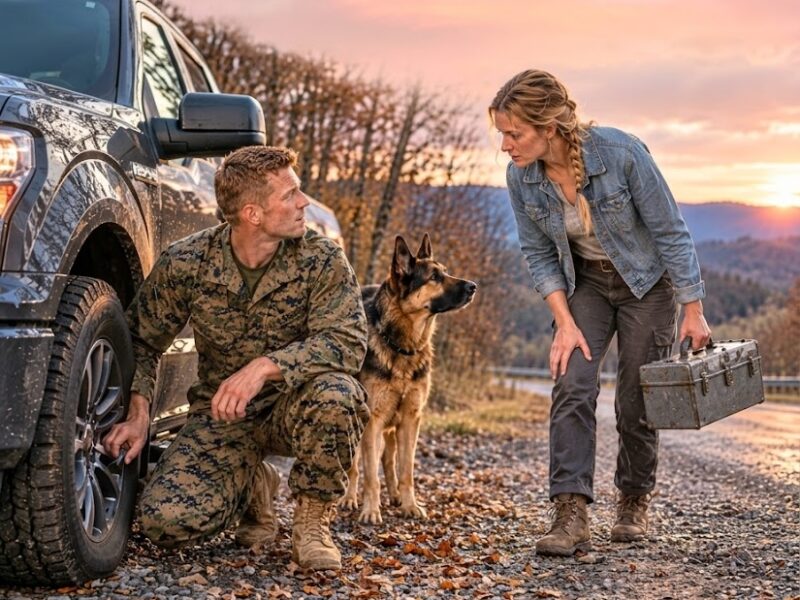
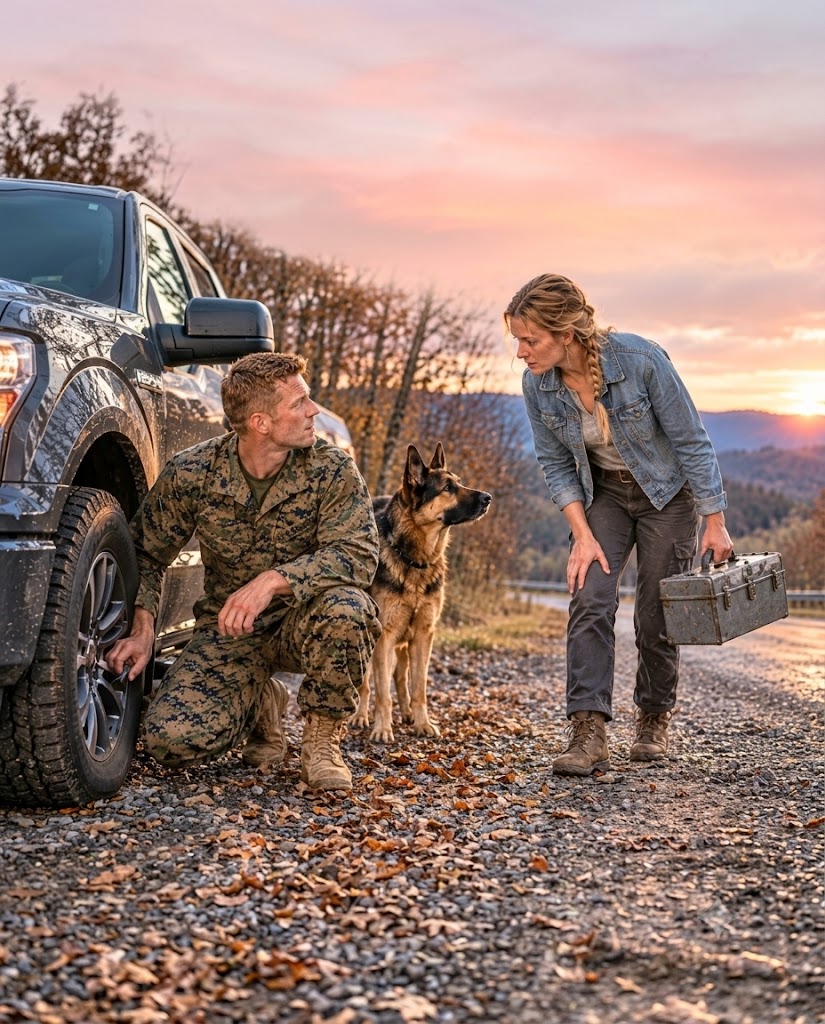
Before Gunnery Sergeant Rhett Callaway could inspect the damage, Mercer, his German Shepherd, was already focused on the front wheel.
Then a young woman stopped with a toolbox.
She examined the truck, handed Rhett a bar, and watched him start to pull.
“Don’t pull yet.”
Three words made the Marine stop.
The next morning, Rhett looked through a dusty workshop window and saw heavy recovery equipment untouched for years.
Why had a woman this skilled walked away nearly six years ago?
Late November had stripped the hills east of Knoxville, Tennessee, down to bare branches and brown fields.
By 6:15 p.m., the last daylight was fading behind the ridges, and cold air settled over the narrow two-lane road.
Gunnery Sergeant Rhett Callaway felt the steering wheel twitch once beneath his hands, then again harder.
At 41, Rhett had the lean, durable build of a man who had spent most of his adult life carrying weight without complaining about it.
He stood just under six feet with close-cropped light auburn hair, weathered fair skin, a straight nose broken once years ago, and deep-set green-brown eyes.
He was clean-shaven and wore a faded olive field jacket over a black crewneck shirt, dark jeans, and brown leather boots.
Years in the Marine Corps had taught him something more useful than confidence.
When a machine gave you a warning, arrogance was a poor substitute for stopping.
The Ford F-150 suddenly pulled left.
A sharp metallic knock came from beneath the front end.
Rhett eased off the accelerator and guided the truck onto the gravel shoulder.
Behind him, Mercer was already upright.
The seven-year-old German Shepherd had served in the military working dog program, including search and tracking work.
When Mercer retired, Rhett adopted him.
He was powerful but proportionate, with a rich black and red coat, a defined black saddle, erect ears, dark intelligent eyes, and subtle age around his muzzle.
He waited until Rhett opened the door before jumping down, then moved around the truck without barking.
Easy.
Mercer slowed near the left front wheel.
His nose worked close to the tire and undercarriage before his head tilted toward a faint sound Rhett could barely hear.
Rhett crouched beside him.
Nothing was visibly broken, but there was more play in the wheel than he liked.
So, we agree, he murmured.
Mercer stared at him.
We’re not driving it.
Nearly ten minutes later, an older Chevrolet Silverado passed, stopped thirty yards ahead, then backed toward him.
A woman climbed out carrying a steel toolbox.
She looked to be in her early thirties, perhaps five foot seven, with a lean, work-hardened frame.
Her dark blonde hair was pulled into a practical low braid, loose strands framing a sun-freckled face reddened slightly by the cold.
Gray-green eyes took in Rhett, Mercer, the truck, and the road in one sweep.
She wore a dark brown work jacket over a gray Henley, dark work pants, and worn leather boots marked by old grease and red Tennessee dirt.
There was nothing unfriendly about her, but she moved like someone who had stopped wasting words where observation would do.
You lose steering?
Not completely.
Pulling?
Left, knock underneath.
She set down the toolbox.
Start it.
No introduction, no small talk.
Rhett almost smiled.
He climbed inside while she crouched beside the wheel.
At her direction, he held the brake and turned the steering slowly left, then right.
She watched the movement, changed position, checked underneath, then asked him to do it again.
Mercer remained several feet away, watching her quietly.
Finally, the woman stood.
You’ve got wear in the linkage and enough movement that I wouldn’t trust it at speed.
Can it make a garage?
If you’re patient.
She opened her toolbox.
Ten minutes later, Rhett was kneeling opposite her while she positioned a tool and handed him a short bar.
To keep several loose sockets out of the gravel, she had set them temporarily on the passenger side floorboard through the open door.
Pressure toward me.
Slow.
Rhett began pulling.
Don’t pull yet.
His hands stopped instantly.
Something changed in her face, not fear exactly, but a flash of recognition too sharp for what they were doing beside a pickup truck.
She shifted the tool perhaps two inches, checked the angle again, then nodded.
Now.
Rhett applied pressure.
This time the part moved cleanly.
He looked at her differently after that.
She did not simply understand the part.
She understood what happened when weight, metal, leverage, and human impatience met at the wrong angle.
When they finished, Rhett reached for his wallet.
She closed the toolbox.
No.
You stopped for a stranger in the dark, and now the stranger can get off the side of the road.
At least let me give you thirty-five dollars.
He paused.
Excuse me?
Thirty-five miles per hour maximum.
This gets you to a garage.
It does not make your truck fixed.
The corner of her mouth moved slightly.
Marines follow instructions, don’t they?
Occasionally.
She picked up the toolbox.
Tessa Marlowe.
Rhett Calloway.
Her eyes shifted toward Mercer.
And him?
Mercer.
Mercer gave her a long, measured look.
Tessa nodded once.
When her Silverado pulled away, Rhett noticed faded lettering beneath years of scratches on the driver’s door.
Marlow Recovery and Rigging.
The next morning, a local mechanic properly replaced the worn components.
Ed Barlow was a stocky man in his late fifties with thinning gray hair, oil-darkened hands, and the blunt friendliness of someone accustomed to explaining expensive problems before breakfast.
When Rhett mentioned who had stabilized the truck, Ed stopped tightening a bolt.
Marlow?
Tessa.
The mechanic looked at him.
Ten years ago, anybody hauling heavy equipment around here knew that name.
He returned to the truck.
Rhett waited, but Ed offered nothing else.
He might have left Knoxville that morning if Mercer had not pushed his nose beneath the passenger seat while Rhett was loading his bag.
Something rolled across the floorboard.
Rhett reached down and found a heavy socket marked with a single engraved M.
An hour later, the Ford turned onto a narrow gravel drive outside a modest house surrounded by bare hardwoods.
Tessa’s Silverado sat beside it.
Behind the house stood a long workshop with three closed bay doors.
Tessa came around the side of the building as Rhett stepped out.
Surprise crossed her face when he held up the socket.
Thought you might want this.
She looked at the engraved M.
I wondered where that went.
A gust moved through the property.
Somewhere behind the closed doors, metal chain tapped softly against metal.
Mercer’s ears rose.
He turned toward the workshop.
Rhett followed his gaze to a dusty side window.
Beyond the glass sat the silhouette of a massive recovery truck.
Industrial winches lined one wall.
Pulley blocks, anchors, rigging chains, shackles, and heavy equipment occupied organized racks beneath a layer of dust.
Nothing looked abandoned.
It looked paused.
Your father’s? Rhett asked.
Tessa’s expression changed.
Was.
And yours?
For several seconds, she said nothing.
Once.
How long?
Almost six years.
Rhett looked from the workshop to the woman who had known exactly when to stop his hands the night before.
Why walk away from something you were that good at?
Tessa’s fingers tightened around the socket.
Whatever answer had risen in her never reached her mouth.
She turned toward the house.
Coffee?
Rhett followed.
Mercer remained behind for another moment, staring at the three closed doors before finally turning after them.
Behind him, the chain inside the dark workshop moved once more.
Morning light came thin and colorless through the kitchen windows, leaving frost bright along the shaded edge of Tessa Marlow’s yard.
The wind had eased, but the hills beyond the house remained hard and gray beneath a washed-out Tennessee sky.
Rhett sat at the small kitchen table with both hands around a mug of coffee.
Mercer rested near the back door, his dark head between his forepaws, eyes half-closed, but ears still tracking every sound from outside.
Tessa stood at the counter pouring her own cup.
She had traded the work jacket for a faded charcoal overshirt with the sleeves pushed to her forearms.
There were pale scars across two knuckles and a narrow white line near her left wrist, the kind of marks earned gradually rather than dramatically.
Rhett had not mentioned the workshop again.
That seemed to bother her more than another question would have.
You’re not going to ask?
Figured you’d tell me if you wanted me to know.
Tessa leaned against the counter and studied him.
My father started Marlow Recovery before I was born.
Added rigging later when the jobs got bigger.
She glanced toward the window facing the closed building.
As a kid, I thought everybody’s father came home smelling like hydraulic oil.
The memory almost produced a smile.
She told Rhett about spending Saturday sweeping the shop floor and sorting shackles while her father worked.
At fourteen, she was allowed to ride along to straightforward jobs where she stayed well outside the danger zone and watched.
Her father never began by teaching her how to pull something.
He taught her where not to stand, what could fail, and where thousands of pounds would travel if they did.
My father taught me to read a load before he taught me to drive.
By her early twenties, watching had become working.
Tessa learned recovery planning, rigging, anchor selection, winch systems, and the less glamorous discipline of refusing shortcuts.
When her father’s health began failing, he gradually stepped away from the physically demanding work.
Tessa took on more responsibility until clients stopped asking whether Mr. Marlow was coming and started asking what Tessa wanted them to do.
He’s still around? Rhett asked.
Yeah, lives a few hours away now.
Quiet place.
Hates that I called to remind him about his appointments.
That time she did smile.
He calls it harassment.
Sounds serious.
Apparently, I’m relentless.
The smile disappeared when her eyes drifted toward the workshop again.
Her father had retired.
Tessa had not.
She had simply stopped.
Before Rhett could decide whether to ask why, tires rolled over gravel outside.
Mercer lifted his head.
A black GMC pickup stopped near the house.
The man who stepped out was forty-nine, about six feet tall, thick through the chest without being heavy, with iron gray hair cut short at the sides and a weather-lined rectangular face.
Brock Halden wore a dark canvas coat over a pale button-down shirt, clean work boots, and neatly trimmed salt-and-pepper stubble.
He carried himself with the controlled impatience of a man accustomed to schedules, invoices, and other people solving problems before they reached him.
Nothing in his manner was openly hostile.
If anything, his politeness seemed practiced from years of negotiating with landowners, contractors, and county officials.
His eyes briefly settled on Rhett, then Mercer.
Tessa.
Brock.
He held a document envelope.
Halden Stone and Transport was expanding a quarry several miles away.
Brock wanted to purchase a strip along the rear of Tessa’s property that would shorten the access route for heavy trucks and eliminate a longer loop around the ridge.
He named a figure.
Rhett kept his expression neutral.
It was not a casual offer.
Tessa barely looked at the paperwork.
No.
Brock exhaled through his nose.
You haven’t seen the revised number.
I heard it.
It’s more than that strip is worth.
Then you should have no trouble buying somebody else’s.
Something passed across Brock’s face, not anger, recognition.
You always did make simple things difficult.
Tessa’s gaze hardened.
And you always called them simple when somebody else carried the risk.
Silence settled across the kitchen.
Rhett looked from one to the other.
Brock folded the envelope once against his palm.
The offer stays open.
The answer doesn’t.
He left without raising his voice.
Only after the GMC disappeared did Mercer lower his head again.
Rhett took another drink of coffee.
That about the land?
Tessa looked toward the road.
Today it was.
She offered nothing more.
By mid-afternoon, Rhett had packed his bag into the Ford.
The sky had darkened earlier than expected with low clouds gathering above the ridges.
He intended to get beyond Knoxville before nightfall, but he stopped at Tessa’s property once more before leaving.
She was outside beside the Silverado when a deep diesel rumble approached from the county road.
Mercer turned first.
A heavy tractor appeared around the bend pulling a lowboy trailer carrying a massive crawler excavator.
Escort vehicles bracketed the load.
The machine sat low over multiple axles, its steel tracks muddy from recent work.
As the convoy passed, a short metallic chatter broke through the engine noise.
Mercer’s ears snapped forward.
Tessa straightened.
Her entire posture changed.
Not alarm, attention.
She walked toward the edge of her property, remaining clear of the roadway as the convoy slowed near an intersection.
Her eyes moved across the trailer, chains, binders, and the position of the excavator.
Rhett came alongside her.
What?
Maybe nothing.
One tie-down chain ran at an angle she did not like.
The load itself had not visibly shifted, but Tessa watched the chain under tension as though everything else around her had gone quiet.
One of the Halden employees, a broad young driver in a reflective jacket, stepped down during the brief stop.
At Tessa’s request, he looked over the questionable tie-down, tested what he could without unloading tension, and said it remained within their operating limits.
Tessa shook her head.
I’d reset it.
That’ll take time.
That’s cheaper than finding out I’m right.
Another pickup arrived.
Brock stepped out.
His expression tightened when he saw Tessa beside the convoy.
We’re already behind.
That doesn’t change the angle.
My driver checked it.
He checked tension.
I’m talking about how it’s carrying the load.
Brock looked at the excavator, then at her.
Are you saying that chain is going to fail?
Tessa did not answer immediately.
Rhett watched her carefully.
It would have been easy for her to say yes, easy to turn concern into certainty and force Brock to defend himself.
She did not.
No.
Brock spread one hand.
Then what are you saying?
Tessa kept her eyes on the load.
I’m saying I wouldn’t put my name on it.
For the first time, something colder entered Brock’s expression.
He knew what those words meant coming from her.
But after another conversation with his driver, Brock gave the signal to continue.
The diesel engine rose again.
Tessa could not legally order the convoy to stop, and she made no attempt to pretend otherwise.
She stood beside Rhett and Mercer as the lowboy moved away, the crawler excavator disappearing slowly around the wooded bend.
Rhett watched until the escort lights vanished.
You think something’s going to happen?
I don’t know.
Tessa’s eyes remained fixed on the empty road.
That’s the reason to check.
Rhett said nothing.
He remembered her voice beside his disabled Ford the night before.
Don’t pull yet.
Until that moment, he had thought it was an instruction.
Watching Tessa stare after the disappearing convoy, he began to understand it might have been something else entirely, a rule she had learned only after discovering what could happen when someone ignored it.
By 10:40 that night, cold rain had swallowed the hills east of Knoxville.
Water sheeted across the blacktop.
Bare trees bent in the wind, and visibility beyond the headlights had narrowed to a trembling tunnel of gray.
Rhett had made less than twenty miles before deciding the road was no place to prove a point.
The Ford was repaired, but the temperature was dropping, runoff was crossing the pavement, and the hill roads ahead were getting slick.
He turned into a roadside motel near the highway, carried his bag inside, and decided daylight could have the rest of the drive.
Mercer settled near the door, still and watchful, until the first siren passed.
Then another followed, then two more.
The German Shepherd rose before Rhett reached the window.
Red emergency lights flashed through the rain, moving toward the same ridge road the Halden convoy had taken earlier.
Rhett felt the connection before he had evidence for it, and that was precisely why he refused to treat the feeling as fact.
He put on his jacket, loaded Mercer into the Ford, and followed at a distance.
He found the road blocked several miles later and pulled off well before the emergency perimeter.
Beyond the barricade, portable floodlights illuminated a scene carved into rain and mud.
The Halden tractor sat diagonally near the edge of the road.
Its lowboy trailer had dropped partly off the shoulder, one side lower than the other, and the crawler excavator had shifted enough that its position looked wrong even to Rhett.
Farther down the slope, rescuers were working toward two injured men who could not yet be safely moved.
A Chevrolet Silverado arrived behind the emergency vehicles.
Tessa stepped out.
For several seconds, she did not move.
The woman who had watched the convoy with such controlled attention that afternoon now stood with one hand gripping her truck door.
Floodlights washed the color from her face, her eyes fixed not on the injured workers, but on the recovery cables being unloaded beside the road.
Rhett approached only when she noticed him.
You came.
Cal Hensley called me.
Cal was a veteran volunteer rescue member in his early sixties, a wiry man with a white mustache and a rain hood pulled over thinning silver hair.
He had worked several scenes with Marlow Recovery years earlier and remembered that Tessa had handled load calculations and recovery planning rather than merely accompanying her father.
When he heard what had gone over the shoulder, he had called the one person nearby whose experience matched the problem.
Tessa looked back toward the wreck.
Six years was a long time to avoid something, not long enough to forget it.
You don’t know anybody at Halden, Rhett said.
Her jaw tightened.
No.
A crew began unspooling cable.
Tessa’s eyes followed it.
But I know what I’m looking at.
She walked toward the command area.
Captain Lenora Say, forty-six, was the incident commander, a lean woman of medium height with auburn hair tucked beneath a rescue helmet and sharp green eyes set in a narrow weathered face.
Years of technical rescue work had given her a calm that did not depend on silence around her.
Radios cracked, engines idled, and people shouted updates, yet she listened without appearing hurried.
After confirming Tessa’s experience through Cal and asking several precise questions about her background, Lenora made the boundary clear.
You advise.
My people and the recovery operator make the moves.
That’s all I’m here for.
The heavy recovery operator was Dale Rusk, fifty-three, a broad-backed man with a shaved head, a close gray beard, and heavy forearms visible beneath rolled waterproof sleeves.
He had spent almost thirty years around wreckers and heavy loads, enough time to distrust both bravado and unsolicited expertise.
He acknowledged Tessa with a nod but did not surrender an inch of responsibility.
His initial plan was to reposition the tractor first, opening better access to the trailer.
Tessa walked the safe perimeter, studying the trailer orientation, the excavator, the slope, and the lines Dale’s crew was preparing.
Then she stopped.
Don’t pull yet.
Dale turned.
Tessa pointed, careful not to enter the hazard zone.
If the tractor comes uphill first, the trailer can rotate around that low side.
The machine’s already moved.
If the deck turns, your excavator has somewhere to go.
Dale looked toward the trapped workers below.
Toward them.
I think so.
Not I know.
Not trust me.
Dale took a light, checked the geometry himself, then called one of his operators over.
They worked through the load path together.
Finally, Dale looked at Lenora.
She’s right.
We need another anchor.
Restrain the machine independently before we touch the tractor.
Lenora changed the plan.
The next half hour became a controlled sequence of movement measured in inches.
Dale’s crew established an independent restraint on the excavator.
Tessa remained beside him, answering when asked, occasionally pointing out a possible failure path, but never reaching for controls that were not hers.
Rhett watched her become quieter as the work intensified.
The hesitation he had seen beside her Silverado disappeared, replaced by concentration so complete that even the rain seemed unable to reach her.
Then a rescuer approached Lenora with a clipboard.
We’ve got a headcount problem.
Three men had been associated with the tractor and support vehicle on the final leg.
Only two had been located.
A worker recorded in the support truck had apparently transferred into the tractor shortly before the accident, but the roster had not been updated.
Lenora immediately redirected personnel.
Mercer, standing beside Rhett outside the operational area, lifted his head.
His nose turned toward the dark slope below the road.
He took two steps toward the brush and stopped at the end of the lead.
Rhett did not release him.
Captain.
Lenora turned.
Mercer’s former military working dog.
He has search experience.
If you want him working, he can work.
Lenora considered the terrain, then assigned a rescue technician to accompany them.
Stay inside the route my technician gives you.
Yes, ma’am.
The technician, a compact man in his thirties named Owen Price, led them down a safer line along the slope.
Mercer changed the moment Rhett gave the search command.
His movements became deliberate, nose sampling wet vegetation and disturbed ground while Rhett allowed him enough lead to work without sending him blindly into unstable terrain.
Twenty yards down, Mercer pulled toward a dense patch of brush, then stopped.
Rhett saw a boot.
Here.
Owen reached the worker first.
The man was unconscious, soaked and bleeding from the scalp, but when Owen checked him, his answer came quickly.
Pulse.
He’s breathing.
Rhett closed one hand briefly against Mercer’s wet shoulder.
Good boy.
Above them, the recovery operation continued.
The excavator was secured independently before Dale allowed any pull on the tractor.
Once the machine could no longer shift toward the lower slope, the tractor was repositioned and rescuers gained safer access to the other two trapped workers.
One by one, all three men were brought out alive.
Near midnight, the machinery finally went quiet.
Tessa stood beyond the floodlights with rain running from her braid and down the shoulders of her brown jacket.
Her hands hung at her sides.
One of them was trembling.
Rhett came to stand near her but said nothing.
She stared at the secured excavator.
Six years earlier, Tessa Marlowe had walked away from a recovery scene, believing she had no right ever to stand in one again.
Tonight, she had stood in one.
She had felt the old fear.
She had heard the old warning inside herself.
And this time, when her judgment told her to stop, she had listened.
Morning came cold and washed clean after the storm.
Water still ran through roadside ditches east of Knoxville, but the rain had passed, leaving broken clouds above the ridges and the wreck site quiet beneath a pale November sky.
Tessa returned shortly after sunrise because investigators needed her account of what she had observed before the convoy left and during the recovery.
She gave them exactly that.
She described the tie-down angle that had concerned her, the metallic chatter she and Rhett had noticed, and the position of the load when she first saw it after the accident.
When asked what had caused the crash, she refused to guess.
Weather had been poor.
The road had been wet.
The trailer had left the pavement.
Several factors could have mattered.
She only asked that the relevant chains, binders, and damaged tie-down components be preserved for examination before anyone decided what they meant.
Then she went home.
The harder investigation was waiting behind her house.
Rhett found her sitting on the concrete step outside the workshop shortly before noon.
Mercer walked beside him, the German Shepherd moving with his usual measured calm.
Tessa had changed into dry clothes, but exhaustion remained around her eyes.
A key ring rested loosely between her hands.
Rhett sat several feet away.
He did not ask.
For a long time, Tessa watched the closed bay doors.
I was twenty-eight.
Rhett stayed quiet.
My dad was already stepping away by then.
His health had gotten worse, and everybody kept asking whether Marlow could still handle the big jobs without him.
She rolled one key between her fingers.
I wanted the answer to be yes.
By twenty-eight, Tessa had years of field experience behind her.
She knew rigging, recovery geometry, anchors, and load behavior.
That was what made the memory harder to carry.
She had not been inexperienced when the mistake happened.
A heavy loader had overturned on a sloped work site.
Brock Halden’s company was much smaller then and depended on keeping projects moving.
Marlow Recovery needed the work just as badly.
Tessa had studied the first recovery plan and disliked it immediately.
The primary anchor was weaker than she wanted.
The pull angle left too little margin if the machine shifted.
The ground beneath one side had been disturbed enough that she did not trust how it would react under load.
I said stop.
What changed? Rhett asked.
Nothing that should have.
Brock had a deadline.
Tessa had payroll approaching, repair bills on two trucks, and a father whose company she was terrified of losing months after taking responsibility for most of it.
Nobody threatened her.
Nobody forced her hand.
That mattered to her because blaming someone else would have been easier.
I changed the rigging, improved the angle, added enough that I could tell myself it was acceptable.
Her fingers closed around the keys.
But you still didn’t believe it.
Tessa looked at him.
No.
They pulled anyway.
The loader moved farther than expected.
One anchor shifted.
The load traveled in the direction Tessa had already identified as the danger path, and a crewman was caught before the operation could be stopped.
He survived.
That fact had become both mercy and punishment in Tessa’s memory.
The man endured multiple surgeries and months of rehabilitation before eventually returning to an ordinary life.
Tessa knew because she had quietly kept track of his recovery long after he stopped working around heavy equipment.
I knew better before we started.
Rhett said nothing.
The first thing that failed wasn’t the rigging.
Her voice lowered.
It was me saying yes.
Marlow Recovery and Rigging closed not long afterward.
No board had revoked Tessa’s knowledge.
No court had told her she could never work again.
She simply stopped accepting jobs, parked the equipment, locked the doors, and convinced herself that staying away was the responsible thing to do.
For six years she had called it accountability.
Only recently had she begun to wonder how much of it had actually been punishment.
Late that afternoon, Brock’s GMC came up the gravel drive.
He approached alone.
The controlled confidence Rhett had seen the day before was diminished.
Brock looked older in the flat light, fatigue deepening the lines beside his mouth.
I heard all three made it.
They did, Tessa said.
Brock nodded once, for a moment that appeared to matter more than anything else.
Then he looked toward her.
Investigators talked to me.
They talked to everybody.
You told them about the tie-down.
I told them what I saw.
The road was wet.
That shoulder gave way.
You know as well as I do that there can be more than one cause.
Yes.
Brock seemed surprised by the answer.
Tessa continued, That’s why they’re investigating.
He shifted his weight.
You made judgment calls, too, Tess.
The old nickname landed harder than the accusation.
Rhett remained near the porch.
He did not move between them.
Tessa looked at Brock steadily.
Six years ago, I knew better and said yes.
Her eyes moved toward the workshop.
I’ve spent six years learning what that cost me.
Then she looked back at him.
I’m not saying yes again.
Brock’s jaw tightened, but there was no threat in what followed.
He simply nodded.
Then he left.
The GMC disappeared beyond the trees.
Tessa remained where she was.
After a while, she walked toward the workshop.
Rhett and Mercer followed but stopped several paces behind her.
The key resisted at first.
Tessa tried again.
The lock turned.
She wrapped both hands around the bottom edge of the center bay door and pulled.
The rollers complained overhead.
Dust shook loose from the frame.
For one second, she stopped with the door only a foot above the concrete.
Rhett did not touch it.
Tessa closed her eyes.
Then pulled again.
The door rose.
Late afternoon light entered a room that had spent almost six years in darkness.
It crossed the old recovery truck first, then steel racks holding pulley blocks, shackles, hooks, and carefully coiled chains.
Dust covered the surfaces, but underneath it, everything remained where she had left it.
Tessa stepped inside.
Mercer followed several feet, then quietly lowered himself beside her boots.
She looked down at the German Shepherd.
Her hand hesitated before resting between his ears.
I thought closing the doors would make it stop hurting.
Rhett stood just inside the doorway.
Did it?
Tessa looked toward the equipment, the old truck, the workbench where her father had once taught her to inspect every piece of gear before trusting it with someone’s life.
No.
Nothing else needed to be said.
Rhett did not tell her she had suffered enough.
He did not tell her one good decision could erase a bad one.
He did not ask whether Marlow Recovery was coming back.
He simply stayed.
Outside, the November light faded behind the Tennessee hills.
Inside, Mercer remained beside Tessa while her hand rested quietly on his head.
For nearly six years the workshop had ended every day behind a locked door.
That evening darkness came, and Tessa left the door open.
The days after the accident turned clear and colder with frost whitening the fields east of Knoxville each morning.
Behind Tessa Marlowe’s house, one workshop door remained open whenever she was home, even when the November wind made the building difficult to warm.
The investigation moved without her.
Independent examination found evidence of pre-existing wear and elongation in some of the tie-down equipment recovered from the trailer.
Maintenance records showed that replacement of certain components had previously been recommended but had not yet been completed.
None of that turned the accident into a simple story.
The wet roadway, shoulder conditions, vehicle movement, operating decisions, and equipment condition all remained part of the larger examination.
Halden Stone and Transport faced a broader review of its maintenance records, inspection practices, and heavy haul procedures while investigators and the appropriate authorities were left to determine responsibility.
Tessa did not chase every update.
For six years she had lived as though every consequence had to remain hers forever.
Now she understood there was another kind of responsibility.
Saying what she knew, admitting what she did not, and allowing other people to carry the parts that belonged to them.
Rhett found her one morning sorting old shackles across the workbench.
You were right, he said.
Tessa shook her head.
I was concerned.
That isn’t the same thing.
Rhett leaned against the edge of the bench.
A lot of people wouldn’t bother making that distinction.
They should.
She picked up a shackle, examined its pin, then placed it in a discard bin.
Six years earlier, Tessa had believed expertise meant being certain.
If she were good enough, experienced enough, careful enough, then she should always know exactly what would happen.
One terrible decision had destroyed that illusion.
And because she could no longer promise herself certainty, she had decided she could no longer trust herself at all.
Now she saw the flaw in that thinking.
Experience was not certainty.
Sometimes experience was simply knowing when there was enough doubt to stop.
Opening the workshop did not mean reopening Marlow Recovery and Rigging.
Tessa had no desire to return to midnight wreck calls, overturned machinery, and a business built around accepting the next dangerous job.
Instead, after several weeks of consideration, she contacted a regional vocational training program that offered instruction in industrial maintenance and equipment operations.
What began as one conversation became a proposal.
Practical training in rigging fundamentals, load management, recovery planning, and equipment safety.
Taught somewhere students could work around real hardware rather than diagrams alone.
The old Marlow workshop changed slowly.
Every change was inspected.
Questionable equipment was removed rather than kept for sentimental reasons.
Winches were serviced.
Blocks were cleaned and checked.
Hooks, slings, shackles, and anchors were organized into training stations.
The recovery truck remained, but now students gathered around it with notebooks instead of emergency radios.
The building that had preserved Tessa’s silence began filling with questions.
She discovered she liked questions.
Weeks after the first class was scheduled, Tessa called her father.
She stood outside while the phone rang, looking at all three bay doors.
He already knew what she was doing.
News had apparently traveled through old friends before Tessa found the nerve to tell him herself.
Her father listened without interrupting.
Then he asked only one thing.
You open all three doors?
Tessa looked at them.
Sunlight crossed the concrete through every opening.
All three.
There was a pause.
Good.
That was it.
No speech about forgiveness.
No declaration that he had always believed in her.
Her father had spent a lifetime teaching her that unnecessary movement around heavy equipment created unnecessary risk, and apparently, age had not made him more generous with unnecessary words.
After the call ended, Tessa remained outside for a long time.
Then she went back to work.
By late winter, the workshop no longer smelled abandoned.
On one cold afternoon, a young trainee named Evan Cole, twenty-two, stood beside a practice recovery setup preparing to tension a line.
Evan was tall and narrow-shouldered with sandy hair that constantly fell over his forehead and the restless confidence of someone eager to demonstrate what he had learned.
He had grown up repairing farm equipment with an uncle and understood machinery well enough to become impatient with fundamentals.
The exact kind of student Tessa watched most carefully.
His hand reached for the control.
Don’t pull yet.
Evan froze.
The class went quiet.
Tessa did not approach the rigging.
If that anchor fails, where does twenty tons go?
Evan looked from the line to the anchor.
His expression changed.
He stepped sideways, following the imaginary failure path with his eyes.
Across the work zone.
And who’s standing there?
Two people.
Tessa waited.
Evan released the line completely.
I need to reset it.
She nodded.
He did.
Tessa never touched the equipment.
Watching him rebuild the setup, she understood something she could not have understood six years earlier.
Her experience did not have to prove that she would never make another mistake.
It could teach someone else to stop before making one.
Months had passed since the night on the hill when a familiar engine sounded outside.
Tessa looked through the open bay.
A Ford F-150 rolled into the yard.
Rhett climbed out wearing the same olive field jacket she remembered, though the Tennessee winter had begun surrendering to a softer season.
Mercer jumped down after him.
The seven-year-old German Shepherd landing with controlled ease before looking toward the workshop as if he had never forgotten it.
Tessa walked outside.
She looked deliberately at the Ford.
Truck giving you trouble again?
No.
Then what are you doing here?
Rhett glanced down at Mercer.
He wanted to come back.
Tessa looked at the German Shepherd.
Did he?
Wouldn’t shut up about it.
Mercer stood silently between them.
Tessa stared at Rhett.
Then she laughed.
It was the first time he had heard her do it without restraint.
Later, as students began gathering inside, Rhett reached into his jacket and placed something on the workbench.
The socket marked M.
Tessa looked at it, then pushed it back.
Keep it.
You sure?
You might need it someday.
Rhett turned the socket between his fingers.
And if I do?
Tessa met his eyes.
Then you’ll know where to find me.
Neither of them looked away quickly.
Nothing more was required.
Behind Tessa, another class was beginning.
Someone rolled a cart of inspected chains across the concrete.
Questions rose around the old recovery truck.
Sunlight entered through three open bay doors.
For years, Tessa had believed a second chance meant somehow returning to the woman she had been before one terrible decision.
She had been wrong about that, too.
Healing had never asked her to go backward.
Sometimes it began with opening a door you had kept closed for too long and finding the courage to walk through it as someone changed.
Sometimes the miracle we pray for isn’t the chance to erase what happened.
Sometimes it’s the strength to finally open the door we’ve kept closed because of it.
Tessa spent six years believing one terrible decision had taken away her right to trust herself again.
But perhaps God doesn’t always answer by removing our scars.
Sometimes He places the right people in our path, gives us another moment to choose differently, and quietly reminds us that our worst mistake does not have to become the rest of our story.
In everyday life, we all carry doors we’re afraid to open.
Regrets, failures, relationships we’ve lost, or dreams we abandoned because we no longer believed we deserved another chance.
Healing may not happen all at once.
Sometimes it begins with one small decision to stop running, turn the key, and step forward.
If this story touched your heart, share it with someone who may need that reminder today.
Tell us in the comments what second chances mean to you.
And may God bless you and your family, protect those you love, and give you strength for whatever door you are trying to open today.









