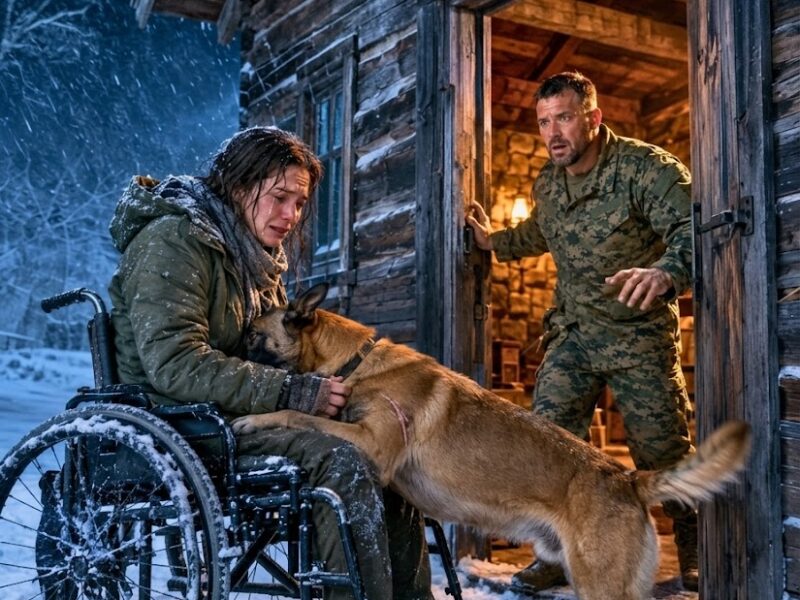
A woman in a wheelchair knocked on his cabin door in the middle of nowhere — and his K9 recognized her before he ever could.
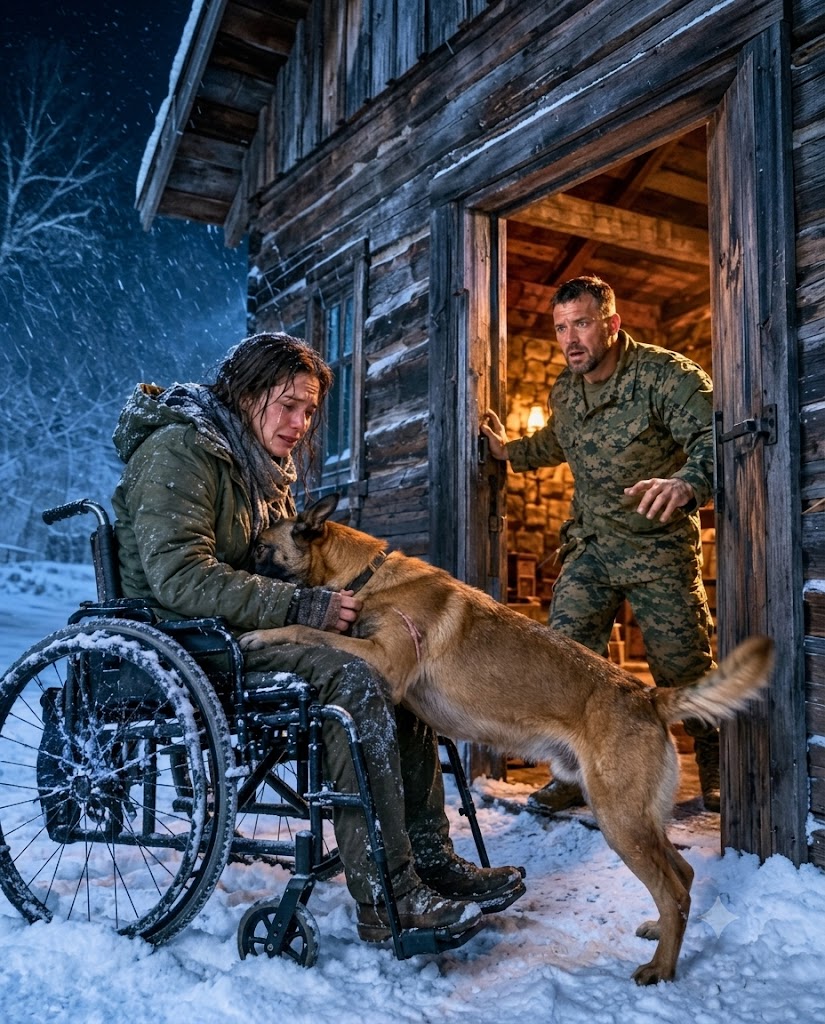
The woman in a wheelchair knocked on his cabin door.
His K9 knew her before he did.
The snow came down so hard that night that the trail up the mountain had all but vanished.
Ethan Cole had lived through eleven winters in this cabin, and he knew one thing for certain.
Nobody knocked on his door at 10:00 on a night like this.
Not the mail carrier, not a neighbor — the nearest one lived over twenty miles down the ridge.
Not a lost hiker, because no hiker in their right mind would be out in a storm that could kill a healthy man in under an hour.
Nobody.
And yet the knock came anyway.
Three of them, slow, weak, as if the hand that made them had spent the very last of its strength.
Ethan was sitting by the wood stove, a mug of cold black coffee going untouched in his hand.
He froze.
The crackle of the fire seemed to fade into something distant and small.
And that old instinct — the instinct of a special operations man, the thing he thought he had buried along with his uniform, folded and shoved to the bottom of a foot locker he never opened — came roaring back to life inside his chest.
But it wasn’t the knock that made him rise from his chair.
It was the dog.
Argo, the sable-coated Belgian Malinois, nine years old, with a long white scar running down his left shoulder.
The dog who had walked through three deployments and one particular hell with him.
A hell that neither of them ever revisited out loud.
That dog was standing in the middle of the room.
All four legs locked, ears pricked straight up.
But he wasn’t growling.
For eleven years, every strange sound — a deer in the brush, a gust against the shutters, a branch cracking under snow — every one of them had earned a low warning growl from Argo.
That was his job.
That was his nature.
A war dog never trusts silence.
And yet now he did not growl.
He whined.
A soft, trembling whine pulled up from somewhere deep in his chest.
A sound Ethan had heard exactly once before in his life.
On the worst day of it, on a stretch of dust and blood in Kandahar.
Then Argo moved toward the door — not with a soldier’s caution, but with something else, something Ethan couldn’t name.
His tail began to wag, slow, uncertain, then faster and faster.
He pressed his nose to the crack beneath the door and breathed in deep, again and again.
And then he began to scratch at the wood, frantic, desperate, like a puppy begging to be let out.
Ethan had never once seen him behave this way.
“Argo,” he said quietly.
But the dog didn’t obey.
For the first time in his life, Argo ignored a direct command from his handler.
Ethan set the mug down, took the heavy flashlight off the shelf by the door, and crossed the room.
His heart was hammering harder than it had any right to.
He threw the bolt and pulled the thick wooden door open.
The cold and the snow slammed into his face, and there, under the weak yellow glow of the porch light, in the middle of that howling white, was a woman in a wheelchair.
She looked like she had gone to war with the mountain to reach this door.
The wheelchair — one of those rugged models with oversized wheels built for rough ground — was caked in snow.
Her hands, in worn wool gloves gone thin at the fingertips, were red and shaking.
The scarf around her chin had frozen stiff.
Her hair, dark brown, was plastered wet against her forehead.
But her eyes — those gray, ash-colored eyes — held no panic in them at all.
Only a strange, steady calm.
The calm of a person who has traveled an impossibly long way and has finally arrived where she needed to be.
“I’m sorry,” she said.
Her voice cracked and hoarse from the cold.
“I know it’s late.”
Ethan stood frozen in the doorway.
His mind raced through a dozen questions at once.
How did she get up here?
Where was her vehicle?
Who brought her?
That trail could kill a strong man on foot in this weather, let alone a woman alone in a chair.
But he never got the chance to ask a single one of them.
Because Argo shot out the door.
“Argo—”
Ethan lunged after him, his hand grabbing at empty air.
But the dog did not attack.
He stopped dead just in front of the wheelchair.
Then he sank low, head dropped, and pressed his big skull into the woman’s lap as gently as if she were made of glass.
He burrowed into her.
He shook.
And from his throat came the sound that Ethan would remember for the rest of his life.
A cry — an actual cry — the sound of a creature who has found something he believed he had lost forever.
The woman bent over him.
Her trembling hands cupped the dog’s head, and she broke down and wept.
“Hey, baby,” she whispered through her tears.
“Hey, Argo. You still remember me? You still remember me, sweet boy?”
Ethan felt as though the ground beneath his feet had just tilted.
This dog.
His dog.
The dog who had slept at the foot of his bed for a decade.
The dog who would not permit a stranger within ten feet of him.
This dog knew her.
He knew her before Ethan had any idea what was happening.
Ethan swallowed hard.
“Who are you?”
The woman looked up at him.
Her tears mixed with the snowmelt on her cheeks.
“My name is Clare,” she said.
“Clare Reyes.”
The name went through him like a cold blade.
Reyes?
No.
It couldn’t be.
“I’m Daniel’s wife,” she said, her voice breaking apart.
“Daniel Reyes. Do you remember my husband, Sergeant Cole?”
And in that moment, standing in the doorway of the cabin he had built to forget, Ethan Cole — the man who had spent eleven years running from a single name — felt the entire world he had so carefully constructed to bury the past collapse in on itself.
—
He brought her inside.
It took some doing.
The cabin door had never been built for a wheelchair, and the ice-glazed threshold was slick as a mirror.
Ethan lifted both her and the chair with the same arms that had once carried wounded brothers across open ground under fire.
She was lighter than he expected.
Heartbreakingly light.
He set her by the wood stove, draped the only wool blanket he owned over her shoulders, and poured her a mug of hot tea.
Argo would not leave her side.
He lay down across her feet, chin resting on the wheel of her chair.
His brown eyes turned up to her as if he was afraid that if he blinked, she might disappear again.
Ethan lowered himself into the chair across from her.
He had no idea where to begin.
Eleven years.
Eleven years since he had said the name Daniel Reyes out loud.
“How did you get up here?” he finally asked — the safest question he could find.
“There was a kind man driving a logging truck,” Clare said, both hands wrapped around the mug for its warmth.
“He let me off at the bottom of the trail. Said he couldn’t take the road any higher because of the snow. Told me I was crazy.”
She smiled faintly.
“He was probably right. From there, I pushed myself up. It took a while.”
“That trail is nearly two miles, all uphill.”
“I know,” she said softly.
“I’ve been looking for you for three years, Sergeant Cole. Two more miles at the end of it wasn’t going to stop me.”
Ethan dropped his gaze.
He laced his hands together, knuckles going white.
“Don’t call me Sergeant anymore,” he said.
“I’m out. Have been a long time.”
“I know. I know all about what you did afterward.”
Her voice gentled.
“You vanished. Cut off contact with everyone in the unit. Didn’t come to the memorial. Didn’t answer a single letter. You sold your house, emptied your savings, and came up this mountain with Daniel’s dog.”
She looked down at Argo.
“And you disappeared off the face of the earth.”
Ethan said nothing, because every word of it was true.
“You thought that if you ran far enough,” Clare went on, “you could outrun what happened over there, didn’t you?”
He raised his eyes to hers, and for the first time in years, Ethan Cole felt the sting of tears at the corners of them.
“You don’t understand,” he said, his voice going thick.
“You don’t understand what happened that day.”
Clare set the mug down.
She looked directly into his eyes.
“So tell me,” she said.
“Tell me about the day my husband died.”
—
Ethan stood up.
He moved to the window and stared out at the white nothing beyond it.
Argo lifted his head, tracked him with his eyes, then turned back to Clare.
He was silent for a long time.
Then he began.
“Daniel was the lead K9 handler for our team,” he said, his voice flat and even, like a man reading a report he had rehearsed ten thousand times in his own head.
“He and Argo were inseparable. You know that. You’re the one who raised Argo from a pup.”
“I found him at a dumpster,” Clare said quietly.
“He was no bigger than my fist. Half-starved. Daniel said I was insane for bringing him home.”
She laughed, sad and small.
“And then six months later, Daniel was the one crying when we had to give him up for military training. He said, ‘He’s not our dog anymore. He’s a soldier now.'”
Ethan nodded.
“And he was the best soldier any of us ever had.”
He closed his eyes.
The memory rushed back, sharp as a knife.
“We had a mission that day. Recon on a village suspected of being a weapons cache. It was supposed to be simple — in, verify, out. But it was a setup. The second we moved in, the whole place lit up. Gunfire from every direction. We were pinned between two lines of it, in the open, with no good cover.”
His voice began to shake.
“Argo caught the buried bomb at the edge of the road before any of us stepped on it. He saved the whole team. Dropped and signaled it exactly the way he was trained. But when we started to pull back, there was a shooter on a rooftop. He had eyes on me. I never saw him. I was down on one knee, patching up a brother who’d taken a round in the leg. And I—”
He stopped.
“I never saw him.”
Ethan opened his eyes.
He looked down at his own hands.
“Daniel saw. He shouted, and he threw himself at me and knocked me flat.”
The room went silent as held breath.
Only the fire.
“The round meant for me,” Ethan said, and his voice finally shattered, “took him in the chest instead. He died in my arms in the dirt of Kandahar while Argo lay across his body and howled. That dog would not leave him. We had to physically pull him off to recover the body. He fought us the whole way.”
He turned back to Clare.
Tears ran freely down his face now, and he no longer tried to stop them.
“Your husband died for me, Clare. He traded his life for mine. And I’m nothing. I was just a grunt who didn’t get his head up in time. He had you. He had a family. What did I have? I had nobody. The man who should have died that day was me.”
He sank down against the windowsill, and the broad shoulders of the operator he had once been shook.
“That’s why I ran up here. Because every time I looked in a mirror, I saw his face. Because I couldn’t live with the fact that I was breathing air that should have been his. Because I couldn’t face you. You, Clare — the woman I took a husband from.”
—
For a long moment, Clare said nothing.
Then she did something that stunned him.
She wheeled the chair slowly, with effort, across the room to where he sat by the window.
Argo padded alongside her.
She reached out and laid a trembling hand on his shoulder.
“Ethan,” she said gently.
“Look at me.”
He raised his head.
“Do you know why I’m in this chair?” she asked.
He shook his head.
Clare drew a deep breath.
“The night they came to tell me Daniel was dead,” she began, “I was driving home from work. My phone rang. It was Daniel’s commanding officer. He said the words that no wife ever wants to hear.”
Her eyes welled.
“I don’t remember what I did after that. I only remember the headlights. A truck. And then the dark.”
Ethan went rigid.
“I lost the use of my legs the same night I lost Daniel,” Clare said.
“The same night. In under an hour, I lost my husband and I lost my ability to walk. Both at once.”
“Clare,” Ethan whispered.
“I didn’t know. I had no idea.”
“How could you?” She smiled through the tears.
“You were already up on this mountain.”
She tightened her grip on his shoulder.
“But this is what I need you to understand, Ethan. For three years, while I learned everything over from the beginning — how to sit up, how to feed myself, how to live inside a body that no longer answered me — do you know what kept me going?”
He shook his head.
“This thought,” she said.
“That Daniel died the way he lived — by protecting someone. He didn’t die for nothing, Ethan. He died to save a life. He died to save you.”
She bent down and put her hand on Argo’s head.
“And if he were here right now, if he could see what you’ve done with the gift he gave you, if he could see you hiding on this mountain, chewing yourself alive with guilt, living like a ghost for eleven years — do you know what he’d say?”
Ethan couldn’t answer.
“He’d say,” Clare said, her voice breaking but steady, “you idiot. I didn’t die so you could throw your own life away.”
—
It took Ethan a moment to find his voice again.
“You came all this way,” he said, “just to tell me that?”
Clare shook her head.
“No. I came for another reason, too.”
She reached inside her coat and drew out something wrapped carefully in a waterproof pouch, protected from the snow.
An envelope, old and yellowed at the edges, handled so many times over the years that the folds had worn soft and thin.
“After Daniel died,” she said, “the Army sent his personal effects back. In the bottom of his ruck, I found this.”
She held the envelope out to him.
Ethan looked down at it.
On the front, in a familiar, sprawling scrawl he recognized instantly, were the words: *To Ethan. If you’re reading this, it means I didn’t make it home. Read it, you stubborn idiot.*
Ethan’s hand began to tremble.
“He wrote letters to everyone in the unit,” Clare said quietly.
“The thing you soldiers call a ‘just in case’ letter. In case the worst happened. Most men never write theirs. But Daniel did. He wrote one for me, one for his mother, and one for you.”
She looked at him.
“I’ve held this letter for three years, Ethan. I couldn’t find you. Nobody knew where you were. You disappeared completely. But I never once thought about throwing it away. Because I knew — I knew — that one day I’d find you. And I had to put it in your hand. It was my husband’s last wish.”
Ethan took the letter as if it might crumble to dust in his fingers.
He traced the letters of his own name.
“How did you find me?” he asked in a voice barely above a whisper.
Clare smiled.
“The dog, actually.”
“What?”
“Six months ago, a hunter posted a photo on a local forum for this county. He’d taken it from a distance. A man and a Malinois on a mountain slope. He wrote something like, ‘Anybody know the hermit who lives up on Hollow Mountain with the military dog?'”
She shrugged.
“I’d spent three years chasing every trace of Argo I could find. I set an alert for every post that mentioned a Malinois within three hundred miles. When I saw that photo—”
Her voice caught.
“I recognized him instantly. After all those years, I still knew my own dog. The way he holds his ears. The scar on his shoulder. I knew right away it was Argo. And if Argo was alive, then it meant—”
“Then it meant I was alive, too,” Ethan finished.
She nodded.
He looked down at the dog lying between them.
Argo.
Daniel’s dog.
Clare’s dog.
The dog who had drawn these two strangers back together across a distance of years and grief.
The dog who had known her before he did.
Now he understood why.
The dog had never forgotten.
Through eleven years, buried beneath all those layers of war and dust and memory, Argo had held on to the scent of the first person who had ever saved him.
The woman who had pulled him, half-dead, out of a dumpster.
The scent of home.
The scent of family.
“Read it, Ethan,” Clare said softly.
“He’s been waiting eleven years.”
—
Ethan opened the envelope with shaking hands.
Inside was a single sheet of paper, folded in four.
He opened it, and he began to read.
His voice cracking on nearly every word.
*Ethan,*
*If you’re reading this, I’m gone. And I’d bet my last dollar you’re tearing yourself apart over it. Am I right?*
*I know you. You’re the guy who carries the whole world on his shoulders and blames himself for everything, including the weather.*
*So listen to me, you stubborn idiot. If I died to save you, then it was my call. Not your fault. Mine. I chose it. I’d choose it a thousand times over. Because that’s what we do for each other. That’s what brotherhood means. You’d have done the exact same thing for me. I know you would have.*
*So don’t you dare sit there and turn my death into a weight you have to carry.*
*I’ve got one thing to ask of you, and you’re not allowed to say no to a dead man. Those are the rules.*
*Take care of Argo. He’s a good soldier, but he’s just a kid on the inside. He’s going to need you. And I think I know you’re going to need him, too.*
*And Ethan — live. Don’t just exist. Don’t disappear. Don’t let my death become the excuse you use to stop living. Find something that makes life worth living. Do it for me if you won’t do it for yourself.*
*Look after Clare if she ever needs it. She’s stronger than the two of us put together. But even the strongest people need someone in their corner sometimes.*
*See you on the other side, brother. But not too soon. Live long. Live fully. That’s an order.*
*Your brother,*
*Daniel*
—
When Ethan finished reading, the whole cabin fell silent except for the sound of his weeping.
He buried his face in his hands and cried.
Cried in a way he had not allowed himself to cry in eleven years.
He cried for Daniel.
He cried for the years he had thrown away.
He cried for all those lonely winters on the mountain, when the forgiveness he had needed to hear had been sitting in the coat pocket of a dead man, waiting to be delivered.
Argo rose.
He rested his big head on Ethan’s knee and whined softly, as if to say, *It’s all right now. It’s over now.*
Clare reached out and laid a hand on his back.
“He forgave you, Ethan,” she said gently.
“He forgave you eleven years ago. It’s time you forgave yourself.”
—
The storm eased just before dawn.
Ethan didn’t sleep.
He sat by the wood stove all night, reading the letter over and over while Clare slept on the couch he had padded with cushions for her.
Argo lay between them, head turned toward Clare, one paw draped over her leg as if making sure she wouldn’t leave again.
When the first light of morning pushed through the snow-heavy pines and touched the window, Clare woke.
She found Ethan making coffee, but something about him had changed.
His shoulders no longer hunched forward.
There was something in his eyes now that hadn’t been there the night before.
Not happiness — it was far too early for happiness — but something close to peace.
“Morning,” he said, setting a mug in front of her.
“Morning,” she answered.
They sat in silence for a while, watching the dawn turn the snow outside from gray to pale rose.
Argo made his rounds, nuzzling first one of them and then the other, his tail wagging without pause, as though he couldn’t quite believe his own good fortune.
“Where will you go now?” Ethan finally asked.
Clare took a sip of coffee.
“I’ve got a small apartment down in the town at the foot of the mountain. Millbrook. I moved there three months ago, after I saw the photo. To be closer. Just in case.”
She smiled.
“Just in case I really did find you.”
“Millbrook’s only forty minutes from here,” Ethan said.
“I know.”
He looked down into his own mug.
There was something he wanted to say and didn’t know how.
In the end, he just said it plainly.
“Don’t go yet. Stay a while longer. The road’s still buried. It’s dangerous.”
Clare looked at him, and she understood that he was speaking about something more than a road.
“Okay,” she said.
“I’ll stay a while longer.”
—
She stayed three days.
Over those three days, something began to shift inside the cabin that had held nothing but silence and ghosts for so long.
Ethan told her about Daniel.
Not about his death, but about his life.
About the pranks he pulled in the barracks.
About the way he always stashed chocolate in his ruck and passed it around the whole team on the longest, darkest nights.
About his truly terrible singing voice, which he inflicted on everyone at full volume every single morning.
Clare laughed until she cried, and then laughed some more.
And she told him about the Daniel she had known.
The man who had proposed to her three times before she said yes.
The man who had taught himself to braid hair so he could do their daughter’s when she—
“You have a daughter?” Ethan asked, stunned.
Clare stopped.
Then she took out her phone, pulled up a photo, and turned it toward him.
A little girl, maybe eleven years old, with Daniel’s eyes and Clare’s smile.
“Her name is Maya,” Clare said softly.
“She was born six months after Daniel died. She never met her father.”
She looked at Ethan.
“But she knows every story about him. And now—”
She smiled.
“Now I’ve got a whole book of new ones to tell her. From her father’s best friend.”
Ethan stared at the photo.
Daniel’s eyes looked back at him through the face of a child he’d never known existed.
And in that moment, something cracked and thawed in his chest.
The ice that had frozen there for eleven years.
He wasn’t alone.
He had never been alone.
There was a whole family he had left behind when he ran up this mountain.
Daniel’s family.
And somehow, in a way he couldn’t explain, it was his family, too.
—
On the fourth day, the snow had melted enough to travel.
Ethan drove his beat-up old pickup down the mountain, taking Clare back to Millbrook.
Argo rode in the back seat, his head out the window, ears streaming in the wind, happy in the way that only a dog can be happy.
When they reached her apartment, Ethan helped her inside.
And there, waiting by the window, was the little girl from the photograph.
Maya.
She ran to throw her arms around her mother.
Then she saw the dog.
Argo — the war dog, the dog who let no stranger near — walked up to the girl, sat down in front of her, and lifted one paw.
Maya knelt down and wrapped her arms around his neck.
“Is this Argo?” she whispered.
“Mom. Dad’s dog.”
“Yes, baby,” Clare answered, tears sliding down her face.
“This is Argo. He’s come home.”
Then Maya looked up at Ethan — the tall man standing hesitant in the doorway, unsure whether he belonged there at all.
“And who are you?” she asked.
Ethan opened his mouth.
He meant to say, *I’m just an old friend of your father’s.*
But the words snagged in his throat.
It was Clare who answered.
“This is Ethan,” she said.
“He was your dad’s best friend. Your dad saved his life. And Ethan promised him he’d take care of us.”
Maya looked at Ethan with Daniel’s eyes.
Then she smiled — that same smile, the one Ethan had seen on his friend’s face in his final moment.
And she said, “Then you’re family. Dad always said, ‘Your team is your family.'”
And Ethan Cole — the man who had spent eleven years believing he deserved nothing, belonged nowhere, had no one left in the world — sank to his knees and held the daughter of the man who had saved his life.
While the dog who had brought them all back together sat beside them, tail wagging, brown eyes bright in the sun.
—
A year went by.
The cabin on Hollow Mountain wasn’t empty anymore.
Ethan had built a ramp for the wheelchair at the front steps and a bedroom on the ground floor.
On weekends, Clare and Maya came up the mountain.
They hiked the trails together — Ethan pushing Clare’s chair over the rough stretches, Maya running ahead with Argo, her laughter ringing out through the pines.
Ethan had gone back to work.
He trained search-and-rescue dogs for the county recovery team.
As it turned out, everything he’d learned alongside Daniel and Argo in the service still had value.
It could still save lives.
Argo, old now, no longer went out into the field, but he sat beside Ethan through every training session, supervising the young dogs with the stern eye of a veteran.
On a summer evening, as the sun dropped behind the ridge, Ethan sat on the porch with Clare.
Maya was out on the grass playing with Argo.
In Ethan’s hands was Daniel’s letter.
He still kept it on him — laminated now, to preserve it.
“You know,” Clare said, “I used to think I came up here to hand you that letter. To carry out Daniel’s last wish, so that I could finally let go. Move on.”
Ethan looked at her.
“But I was wrong,” she said quietly.
“I didn’t come up here to let go of Daniel. I came to find him again.”
“In you. In all the stories you carry around with you.”
She smiled.
“And I found him. He’s still here. He’s all around us.”
Ethan reached out and took her hand.
Out on the grass, Maya shrieked with delight as Argo rolled over in the grass.
The old dog looked up at the evening sky, then turned his head toward the porch — toward the two people sitting there, hand in hand.
And Ethan thought — maybe it was only his imagination, but he wanted to believe it — that somewhere, somehow, Daniel was smiling.
Because the dog had completed his final mission.
He hadn’t just recognized the woman in the wheelchair before the man she’d come to find.
He had brought a broken family back home.
*Don’t just exist. Live. Live full.*









