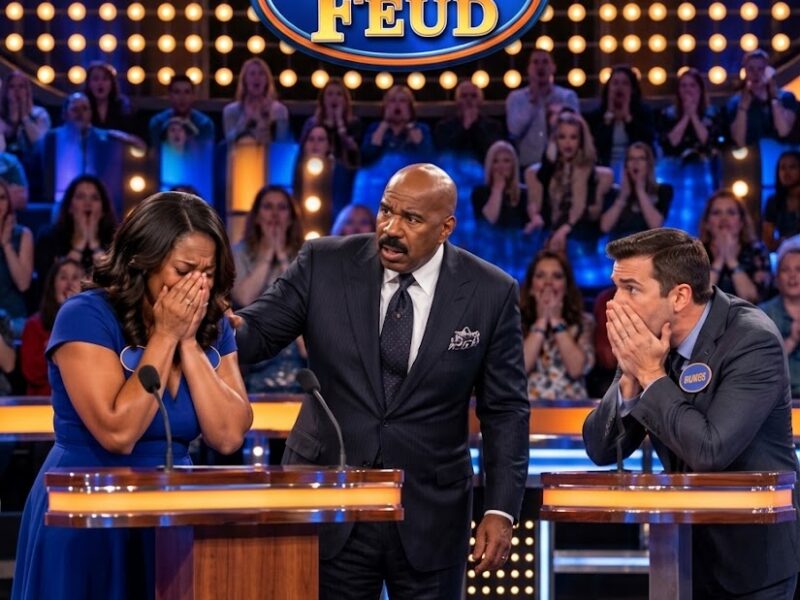
A wife had been hiding a secret through every single round of Family Feud. She told no one. Not her family. Not her friends. But when she finally broke, Steve Harvey was the first person she told.
**Part 1**
There are days on Family Feud when everything runs exactly the way it is supposed to.
The jokes land, the buzzers sound on cue, the families play hard, and everyone goes home happy.
And then there are days that nobody plans for — days when something happens in that studio that is so real, so human, so completely unexpected that the game itself stops mattering.
That the lights and the cameras and the scoreboards all fade into the background, and what is left is just people.
Real people with real lives and real hearts, standing in front of the whole world, telling the truth.
This was one of those days.
And if you have ever loved someone so deeply that you held their secret like it was made of glass — if you have ever carried something beautiful and terrifying at the same time — then what happened on that stage is going to stay with you for a long time.
So if this is your first time here, welcome.
And if you have been watching for a while, you already know that sometimes the most powerful moments on this show have nothing to do with winning.
Hit that like button and stay with us, because this story is one you are going to want to hear from the very beginning.
It was a Thursday afternoon in the Family Feud studio in Atlanta, Georgia.
The audience was full. The energy was high. And Steve Harvey was in his element — moving between families, working the crowd, doing what he has always done better than almost anyone alive, which is making people feel like they are exactly where they are supposed to be.
Two families had shown up that day, ready to compete.
On one side stood the Okafor family from Houston, Texas.
On the other stood the Brennan family from Nashville, Tennessee.
The Brennans were a family that anyone would recognize — not famous, not extraordinary by the world’s measures. Just good, solid, real people.
The kind of family you see at a neighborhood cookout. The kind of people who show up when something goes wrong and never ask to be thanked.
Patrick Brennan was 47 years old, broad-shouldered with graying hair at his temples and a laugh that came from somewhere deep.
He had spent the last 21 years working as a water systems technician for the city of Nashville — the man who made sure the pipes held and the water ran clean and nobody had to think about where it came from.
He was the kind of man who did important work quietly, who did not need to be noticed to feel good about himself, and who measured his life by whether the people he loved were doing all right.
Standing beside him was his wife, Carla Brennan, 44 years old.
She was a kindergarten teacher at an elementary school three miles from their house, and she had been teaching five-year-olds how to read and how to be kind to each other for 16 years.
She was small and quick, with bright eyes that missed nothing and a way of listening that made whoever she was talking to feel like the most important person in the room.
She and Patrick had been married for 19 years.
They had a son named Theo who was 16, sitting in the front row of the studio audience with his grandmother on one side and his uncle on the other, wearing a shirt that said “Brennan Family” in iron-on letters that Carla had pressed on herself the night before.
Carla had spent all of the previous evening getting everyone ready.
She had ironed the shirts, packed the snacks for the drive, reminded Patrick three times about the parking situation, and sat up past midnight making sure every detail was handled.
Patrick had teased her about it, told her she was treating a game show like a military operation.
She had laughed and told him someone had to.
And then she had gone to the bathroom, closed the door, and stood at the sink for a long time looking at herself in the mirror.
She was holding a secret.
She had been holding it for six weeks.
She had decided, very carefully and very deliberately, that today was the day she was going to let it go.
The game began the way games always begin — with noise and laughter and the Brennan family throwing themselves into every round like it was the most fun they had ever had.
Patrick was fast on the buzzer.
His brother Dennis, who had driven up from Memphis for the occasion, matched him answer for answer.
Their sister Kesha covered the questions nobody else could get.
The family clicked together the way families do when they actually like each other, which is rarer than television makes it seem.
Steve Harvey had zeroed in on Patrick Brennan within the first two minutes.
There was something about Patrick’s combination of confidence and complete inability to keep a straight face that Steve could not leave alone.
He grilled Patrick about his job. He asked whether Patrick had ever accidentally turned off the water to his own house.
He asked whether Carla had a backup plan in case Patrick’s answers cost them the game.
Patrick played along with everything, giving as good as he got, and the audience loved every second of it.
But Steve had also noticed Carla — not in a dramatic way, not in the way of someone who had spotted something wrong.
Just the way a man who has spent decades watching people notices the small things.
The way Carla laughed at all the right moments, but her eyes were doing something slightly different.
The way she stayed close to Patrick without being obvious about it.
The way she checked on Theo in the audience once, twice, three times during the first round — not nervously, but with intention, like someone confirming a plan.
Steve filed it away. He did not say anything. He kept the game moving.
The Brennan family won the main game.
Patrick grabbed Dennis and nearly lifted him off the ground.
Theo was on his feet in the audience, both fists in the air.
Carla clapped and smiled, and she leaned into Patrick when he hugged her.
And she closed her eyes for just a moment, with her cheek against his shoulder.
She was counting down.
Fast Money — the moment she had been waiting for.
Patrick went first.
He was funny about it — made a show of cracking his neck, adjusting his collar, telling Steve he was ready to close this thing out.
Steve sent him back and started the timer, and Patrick answered all five questions in a voice so loud the microphone barely needed to pick it up.
He scored 106 points.
He came back to the sideline pumping his fist, telling Carla she just needed to get 94.
“Ninety-four,” he said, like it was nothing. “You got this easy.”
Carla looked at her husband.
She reached up and straightened the collar of his shirt.
It did not need straightening. She just needed to touch him for a second.
“I love you,” she said.
Patrick blinked.
They had been married 19 years, and he knew every version of his wife’s voice.
This one was different. This was not the voice she used at a game show.
This was something else.
His smile shifted slightly.
“You okay?” he said quietly.
“I will be,” she said. “Watch.”
And she walked up to the podium.
Steve Harvey met her there.
He started to go into his pregame setup — the warm smile, the question about whether she was ready, the smooth transition into the mechanics of the final round.
But Carla spoke first.
“Mr. Harvey,” she said. “Can I say something before we start?”
Steve paused.
He looked at her face.
He had done this long enough to know that this was not a joke or a stunt or a bit the family had planned for entertainment.
He lowered his card.
“Of course you can,” he said. “Take all the time you need.”
Carla turned.
She looked at Patrick on the sideline, at Dennis and Kesha standing beside him, at Theo in the front row with his grandmother.
She looked at all of them for one long moment.
And then she turned back to Steve Harvey, because she had decided that she was going to say this once, out loud, for the first time — and she wanted to say it to him first.
To this man she had never met before today, but who felt in this moment like exactly the right person to receive it.
“Six weeks ago,” she said, her voice clear and steady, “I found out that I am pregnant.”
The studio went absolutely silent.
Steve Harvey stood very still.
“Patrick doesn’t know,” Carla continued. “Nobody knows. I found out the morning we got the call that we had been selected for the show, and I have been carrying it by myself ever since.”
She paused.
“I wanted to tell him somewhere that felt like — like a celebration already. Somewhere where happiness was already in the room.”
She paused again.
“I figured this was as good a place as any.”
For one full second, nobody moved.
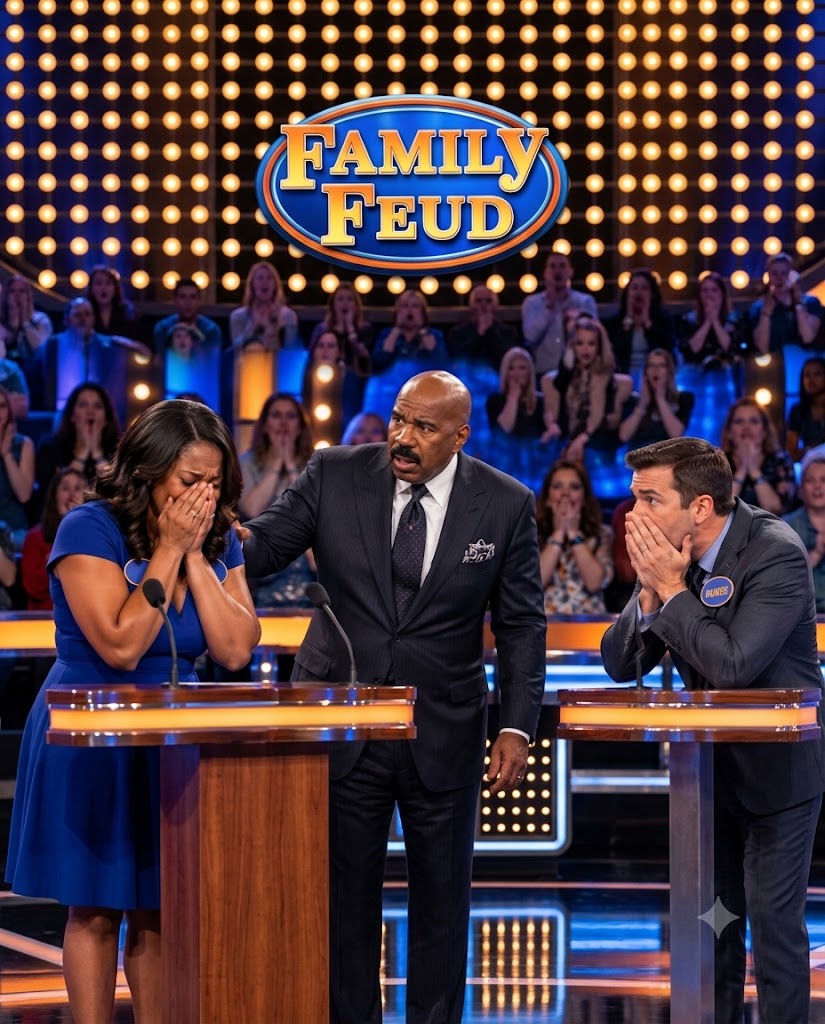
Then Patrick Brennan made a sound that was not quite a word.
It was the sound a person makes when something hits them so deep that language does not arrive in time.
He took one step forward, then another.
His brother Dennis reached out and grabbed his arm — not to stop him, but just because he needed to hold on to something.
Kesha had both hands pressed to her face.
In the front row, Theo had gone completely still, his eyes wide, his mouth slightly open, trying to process what he had just heard his mother say.
Patrick crossed the stage.
He was not running. He was walking fast, purposefully, like a man who had one single goal, and nothing was going to slow him down.
He reached Carla at the podium, and he put both hands on her face, and he looked at her the way you look at someone when you are trying to see all of them at once.
“Are you serious?” he whispered.
“I am serious,” she said.
He pulled her in and held her, and she held him back.
And the studio audience — strangers, every single one of them — rose to their feet without being asked, because some moments demand it.
Because some moments are so purely human that the only right response is to stand up and witness them.
Steve Harvey stood to the side and let it happen.
He was not rushing anything. He was not cueing the music or moving to the next segment.
He was just standing there.
And if you watched him closely, you could see that the man was working very hard to hold himself together.
Patrick finally pulled back enough to see Carla’s face.
He was not trying to hide anything. He was not performing for the cameras.
He was just a 47-year-old man who had just become a father again, standing in a television studio in front of hundreds of strangers, completely undone — and completely okay with it.
“Six weeks,” he said.
“Six weeks,” she confirmed.
“You carried that for six weeks by yourself.”
“I wanted it to feel like good news when you heard it,” she said. “I didn’t want to tell you on a Tuesday night after dinner. I wanted it to feel like something.”
Patrick laughed — a short, overwhelmed, grateful sound.
“Carla,” he said.
“I know,” she said.
“That is the most —” He stopped. Started again. “That is the most you thing I have ever heard.”
Steve Harvey stepped forward.
His voice when he spoke was quieter than his usual studio voice.
“Carla,” he said gently, “I have been doing this for a long time. I have heard a lot of things in this studio. But I need to tell you — I have never been the first person somebody told something like that to.”
He shook his head slightly.
“I am genuinely honored.”
Carla laughed, and it was a real laugh — the kind that comes when the weight finally lifts.
“I figured you’d handle it well.”
“I am barely handling it,” Steve said, which made the audience laugh through their tears.
He turned to Patrick.
“Patrick. Forty-seven years old. Water systems technician. Family man.”
He paused.
“Father again.”
Patrick pressed his lips together and nodded. He did not trust himself to speak in full sentences yet.
“How are you feeling?” Steve asked.
Patrick looked at Carla.
“I feel like I need to sit down,” he said. “And also like I have never felt more awake in my entire life.”
“That,” Steve said, turning to the audience, “is exactly what it feels like.”
The audience applauded again, and Steve let it run.
He was in no hurry. Nobody in that studio was in any hurry.
The scoreboard could wait. The clock could wait.
What was happening at this podium was more important than any of it.
Theo had made his way from the front row to the edge of the stage.
A production assistant had quietly let him through, because some things you just allow.
He stood at the base of the steps, and when Carla saw him, she reached out, and he came up and hugged his mother.
And Patrick wrapped his arm around both of them.
And the three of them stood there — or four of them, really, counting the one nobody could see yet.
And the studio held its breath.
Steve waited until they had their moment.
Then, very gently, he said, “Carla, we still have a game to finish.”
She pulled back and looked at him.
Her eyes were wet, and her makeup was not what it had been at the start of the show, and she had never looked more like herself.
“I know,” she said. “Let’s go.”
She stepped back to the podium. She put her hands flat on the surface.
She took one slow breath.
And she played.
The questions came.
Carla answered each one with a calm that seemed impossible given what had just happened — and yet made complete sense once you understood who she was.
She was a woman who had held a secret for six weeks without cracking.
She was a woman who had planned this moment down to its smallest detail — who had chosen this room, and this day, and this person standing across from her.
She did not rattle easily.
She answered from instinct, from honesty, from the same clarity that had carried her through six weeks of mornings alone with the biggest news of her life.
When the board revealed her scores, the numbers climbed.
The audience counted with each answer.
When the final total appeared, it was 98 points — four more than they needed.
The Brennan family had won.
Patrick raised both arms over his head.
Dennis tackled him from the side.
Kesha was already crying and clapping at the same time.
Theo stood in the middle of all of it with the biggest smile of his young life.
And Carla stood at the podium and watched her family celebrate.
And she let herself feel all of it — the relief, the joy, the six weeks of careful quiet finally breaking open into something loud and warm and real.
Steve put a hand on her shoulder.
“You planned this whole thing,” he said — not accusingly, just with admiration.
“I planned the telling,” she said. “The winning was a bonus.”
Steve laughed.
“It was a real one.”
The episode aired four weeks later.
The clip of Carla’s announcement spread across the internet within hours of the broadcast.
Not because of the game show result, but because of what she had said about why she had chosen that moment.
The phrase she had used.
“I wanted it to feel like good news when you heard it.”
It was shared and reposted and quoted by people who had never watched a single episode of Family Feud in their lives — by people who did not know Patrick or Carla or anyone in the Brennan family.
Because it touched something true that lives in everyone.
Everyone has had a moment when they held something important, waiting for the right time and the right place.
Carla had just said out loud what most people feel privately — that the way you deliver news shapes how it lands.
That love is not only about the thing you share, but about the care you take in the sharing of it.
A teacher in Michigan showed the clip to her staff at a professional development day.
A pastor in Georgia referenced it in a Sunday sermon about the nature of timing and trust.
A young woman in her twenties posted online that watching Carla had made her rethink the way she was holding her own good news — waiting for the perfect moment that never came.
And that maybe the perfect moment was just any moment where the people you loved were all in the same room.
Patrick went back to work the Monday after the taping.
His co-workers at the city water department had watched the episode and were waiting for him.
There was a handmade banner in the break room. Someone had brought donuts.
His supervisor, a quiet man named Gerald who had worked alongside Patrick for 15 years, shook his hand and said simply, “Congratulations twice.”
Patrick said that was the best way anyone had put it.
Carla’s students did not know what had happened on television.
They were five years old, and the concept of a game show was only slightly more interesting to them than long division.
But their teacher came back to school that Monday with something different in her.
A lightness. An openness. An absence of the quiet weight she had been carrying.
Children that age cannot name what they are sensing, but they sense it.
The classroom felt easier that week. More laughter made it through the afternoon hours. More songs.
The assistant teacher told Carla on Friday that it had been one of the better weeks they’d had all year.
Carla said she felt the same way.
Steve Harvey talked about the Brennan family in an interview that ran in a television magazine two months after the episode aired.
He was asked about the moments from his hosting career that had caught him genuinely off guard.
And he mentioned Carla without hesitation.
He said that in all his years of doing the show, he had never been the first person to receive news like that — and that it had changed something small but real in the way he thought about his role on the program.
“People think I’m just out there running a game,” he said. “And I am. That’s my job. But sometimes people bring things into that studio that are bigger than the game. And my job in those moments is just to get out of the way and let it happen.”
“Carla Brennan taught me something that day. She reminded me that joy — real joy — is not something you stumble into. Sometimes it’s something you plan for. Sometimes you love somebody enough to build them the right room to receive good news in.”
“That’s what she did. She built him that room. And I just happened to be standing in it.”
The baby was a girl.
They named her June, after Carla’s grandmother.
She was born on a warm morning in the spring, and Patrick held her first, and he stood at the hospital window with her in his arms for a long time, saying nothing, just looking at her face.
Theo sat in the chair beside the bed, eating chips from the vending machine and trying very hard to look like he was not crying — which did not work at all.
Carla watched her family from her hospital bed and thought about the moment at the podium.
About the silence that had filled the studio when she said the words.
About Patrick’s face when he crossed the stage.
About Steve Harvey’s voice.
“I have never been the first person somebody told something like that to.”
And about the audience rising to their feet — strangers who owed her nothing, standing up because the moment asked them to.
She had planned the telling.
She had not planned any of what came after it — the kindness of strangers online, the letters from people she had never met, the message from a woman in Arizona who said she had been trying to find the courage to tell her husband something important for three months, and watching Carla had finally given her the push she needed.
The message from a man in Ohio who said he had shown the clip to his daughter, who was afraid to share good news with her family because good news had always seemed to invite bad luck in their house — and that his daughter had watched Carla and said, “Maybe it’s okay to just say it out loud.”
Carla wrote back to every message she could find.
She was a kindergarten teacher. She understood that the smallest things you said to people could stick with them for years in ways you never expected.
She had spent 16 years saying small, true things to five-year-olds, watching them grow into people who remembered.
She knew the math of it.
A good word placed in the right moment multiplies.
She had placed hers in a television studio on a Thursday afternoon, in front of a man she had never met, with her husband standing 20 feet away.
And it had multiplied.
Patrick still worked his route, still fixed the pipes and checked the systems and made sure the water ran clean.
He had told people at work about the Family Feud episode with the same pride he talked about everything good in his life — straightforwardly, without embellishment, because the truth of it was already extraordinary enough.
He said what happened on that stage had not changed who he was.
It had just confirmed it.
Confirmed that he had married the right person.
Confirmed that 19 years of choosing the same woman day after day had led him to a moment like that one — standing in a bright room, hearing the best news of his life, surrounded by people who were glad for him.
He said it was the best Thursday he had ever had.
Carla said she had always liked Thursdays.
June Brennan was three months old when her parents brought her back to Nashville and set her down in the house where her brother had grown up — in the room they had painted soft yellow over a long weekend in February, with music playing and Theo inexplicably insisting on helping despite never having painted anything before in his life.
The walls were not perfect.
There were uneven patches near the window and a spot above the closet where the roller left a mark.
Patrick had offered to fix it.
Carla had told him to leave it.
She wanted June to grow up in a room where you could see the evidence of the people who had loved her before she arrived.
That, Steve Harvey said later in a short post he put on social media when the Brennans sent him a photo of the baby, was the most Carla Brennan thing he had ever heard.
He had that right.
Some people carry good news the way they carry everything else — lightly, quickly, getting it out the door as fast as possible.
Carla Brennan had carried hers for six weeks with both hands, carefully, the way you carry something that matters.
She had waited for the right room and the right moment and the right light.
She had walked up to a game show podium with $20,000 on the line and the biggest news of her life in her chest, and she had looked the host in the eye and she had said the thing.
She had wanted it to feel like good news when he heard it.
It did.
It still does.
And if you are sitting somewhere right now holding something you have been waiting to say — something good, something true, something that deserves a bright room — maybe Carla Brennan’s story is the reminder you needed.
That the moment does not have to be perfect.
That the room does not have to be a television studio.
That the right time is any time when the people you love are standing close enough to catch you when the news finally lands.
Say the thing.
That’s the whole lesson. That’s all of it.
If this story reached you today, do us a favor.
Hit that like button and share it with somebody who needs to hear it.
We will be back with another story that proves that the best moments on this show have nothing to do with the scoreboard.
We will see you then.









