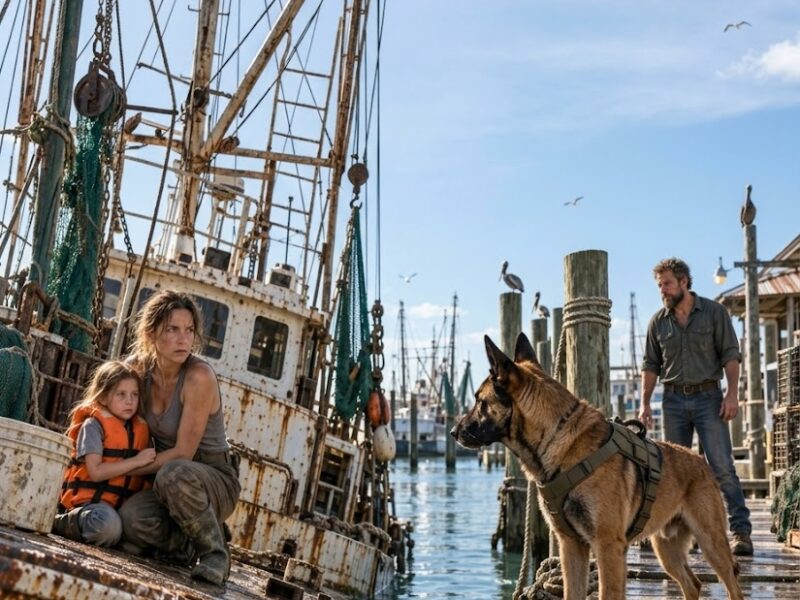
A widow and her little daughter were sleeping on a sinking boat — until a Navy SEAL’s K9 refused to leave the dock.
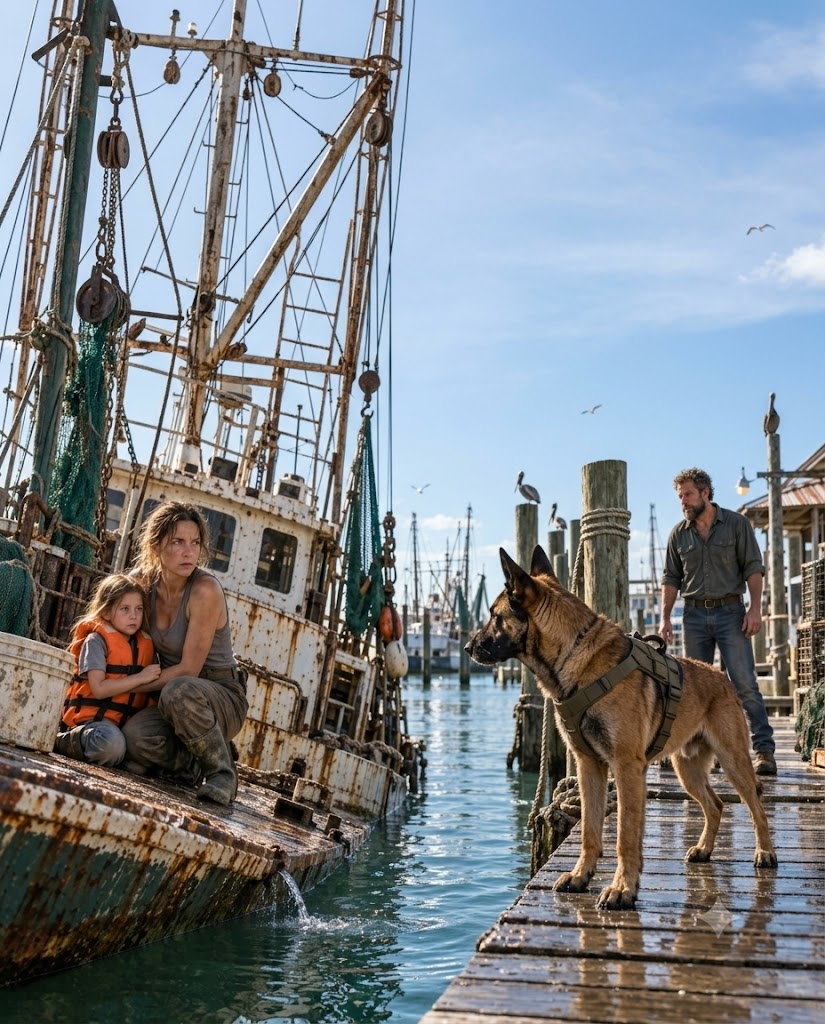
Aranzis County, Texas. August 2013.
The morning Cole Ryland found them, the tide was so low the channel showed its bones.
Kilo went out to the end of the dock and stopped.
The Malinois had been retired for two years and had spent most of that time deciding which parts of retirement he was willing to accept.
He still cleared a room before he lay down in it.
He still counted people.
And that morning he walked past the fuel pump, past the ice chest, past the pelican that usually earned at least a look, and stood at the last piling with his ears forward and his weight shifted onto his front feet.
Cole followed him.
At the far end of the slip sat a shrimp trawler that had not run in a long time.
Her outriggers were folded, and rust had come down her hull in long orange streaks.
She was low in the stern, lower than a boat should sit, and there was a plastic bucket bailing line running over her rail into the water.
A girl was asleep on the foredeck in an adult life vest, curled up in the shade of the wheelhouse.
Cole was forty-one years old.
He had come back to Port Evil eleven days earlier to bury his father and settle a boatyard he had never wanted.
And in eleven days, nobody had mentioned that a child was sleeping at the end of his dock.
The wheelhouse door opened.
A woman came out with a gaff hook held low against her leg, the way you hold something you have already decided you are willing to use.
She saw the dog first, then the man.
She did not call out.
She did not explain.
She crossed to the girl, put a hand on her shoulder without waking her all the way, and moved her behind the wheelhouse door.
Then she looked at Cole and said, “This slip belongs to you now.”
Not a question, not an apology, a fact she had clearly been waiting eleven days to have handed back to her.
Cole thought he had found a woman with nowhere left to go.
Before the summer was over, he would learn she had chosen that slip on purpose, that she had turned down two safer places to stay, and that what she was refusing to leave behind was still down there in the dark under her own hull.
Cole’s father had run Ryland Marine for thirty-eight years out of four buildings and a travel lift that had been old when Cole was in high school.
Three of the buildings still had roofs.
Cole had spent twenty years going where he was sent and had learned that the safest way to live in a place is to keep your good boots by the door.
By forty-one, he was very good at arriving, learning the routine, doing the work, and leaving before the place could get any grip on him.
Kilo had adapted to civilian life with less difficulty and more opinions.
The eight-year-old Malinois still worked the ground in a loose arc every time he got out of the truck.
He still watched hands, but retirement had introduced him to air conditioning, and he had taken to it the way a man takes to religion late in life, completely, and with hostility toward anyone who questioned it.
They had come down to the far slips that morning because the county had sent a letter about derelict vessels.
Cole owned three, and one that somebody was living on.
Her name was Nell Arseno.
She told him that much and nothing else.
Her daughter was seven and was named Junie and had woken up and was now watching Kilo with the specific stillness of a child who has been told not to touch strange dogs and is doing the math on whether the rule applies here.
“How long have you been on here?” Cole asked.
“Since March.”
“She’s taking water.”
“She’s been taking water since March.”
Cole looked at the bailing line, the bucket, the extension cord running up to a pedestal that should not have had power to it.
“You’ve got a pump.”
“I’ve got a bilge pump that runs when the marina remembers to leave that pedestal on.”
She said it flatly without complaint, which somehow made it land harder.
“It’s been off since Sunday.”
“That’s five days. I’m aware.”
Behind her, the stern sat noticeably lower than the bow.
The boat had maybe a week, and the child had a life vest on at seven in the morning in a slip, which meant her mother had already thought about the night it went down and made her peace with it.
“I’m going to turn your power back on,” he said.
Nell’s chin came up.
“I’m not asking you for anything.”
“I noticed. I want to be clear about it.”
“You’ve been clear.”
Cole was already walking to the pedestal box.
“You can pay me for the electricity. It’s about nine dollars a month.”
He heard her exhale behind him.
Not gratitude.
Something more like a woman recalculating.
Kilo had not moved from the end of the dock the entire time.
The breaker on that pedestal had not tripped.
It had been switched off and the cover closed, which is a different thing.
When Cole asked who had done it, Nell told him Ival Ice and Seafood managed the transient slips for a hack before his father died.
“Royce Lambert. You know him?”
“I knew his father.”
“Then you don’t know him,” Nell said, and went back inside the wheelhouse.
Ival Ice and Seafood sat at the mouth of the channel in a long white building with a loading dock and a flake ice machine that ran twenty-two hours a day in summer.
Royce Lambert had inherited it the same way Cole had inherited the yard, except Royce had wanted it.
He came out to meet Cole in the parking lot with his hand already extended, which Cole noted.
Men who are comfortable make you come to them.
“Cole Ryland. I was sorry about Walt. He was a fixture.”
Royce was fifty.
Suncured co-op logo on his shirt.
“You staying or selling?”
“Haven’t decided.”
“Well, come see me before you list it. I’ve got an interest in that corner.”
“I’ve got a woman living on a boat in my far slip.”
The smile did not change, which was the tell.
It should have changed.
Confusion. Irritation. Something.
“Nell,” Royce shook his head slowly. “Sadly, that’s a hard one.”
“Her power was switched off. That’s a safety issue.”
“Cole, that vessel is not seaworthy and it’s not certified for liveaboard. If she goes down at the dock with a child on her, that’s on the marina and by extension, it’s on your yard now. I turned it off to force the issue, and I’ll tell you honestly, I’d turn it off again.”
It was, Cole had to admit, a completely reasonable answer.
“Where’s she supposed to go?”
“I offered her a room over the ice house in April. Free. She turned it down. Reverend Gidre’s wife offered her the back apartment at the parsonage in May. Turned that down, too.”
Royce spread his hand.
“At some point, a person’s choices are their own.”
“Why would she turn those down?”
“Because Tobias drowned off that boat, and they never brought him up,” Royce said. “And she’s decided she’s not leaving until they do. I’ve watched that woman say no to every kind of help there is. You’ll get your turn.”
Cole drove back along the channel road with the heat coming off the shell lots in waves.
It was a good story.
It explained the boat, the refusal, the gaff hook, the way she had said, “I’m not asking you for anything,” like a sentence she had worn smooth.
It explained everything except one thing, and it would be another six weeks before Cole understood what.
He put the Marlene on a proper shore pump that afternoon, not as a favor.
He told Nell it was a liability decision and let her believe it, and she accepted it on those terms, which were the only terms on which she accepted anything.
It took four days for her to speak to him first.
She came up the dock at six in the morning while he was replacing a rotted deck board.
“Junie’s been giving your dog ice,” she said. “I told her to stop.”
Cole set the board down.
“He’s earned ice.”
Nell almost smiled.
It did not get all the way there.
“The stuffing box on my shaft is weeping. That’s where most of it’s coming from. Not the hull.”
Cole looked up at her.
“You checked.”
“I’ve been on boats since I was six years old. I know what a weeping stuffing box sounds like at two in the morning.”
She said it evenly.
“I need a packing kit. Three-sixteenths flax graphite. I can do the work. I can’t get the part.”
“Why not?”
“Because the only chandler within forty miles is inside that white building at the mouth of the channel,” Nell said. “And I’m not welcome to buy there.”
Cole was quiet for a second.
“Write it down,” he said. “I’m going to Corpus Thursday.”
He brought back the packing kit, a case of oil, and a marine battery he claimed was surplus and was not.
Nell did the work herself.
She hung upside down in that engine bay in ninety-six-degree heat for three hours with a flashlight in her teeth.
And when she came out, her forearms were scraped raw and the weeping had stopped.
She wrote the price of the kit in a small notebook.
Cole saw her do it.
She had been doing it since the day he turned her power on.
Every dollar dated in a column.
Junie sat on the dock through all of it with her legs over the side and Kilo beside her.
And at some point in the afternoon, the dog rolled onto his hip and put his head across the girl’s ankle, which he had not done for a human being since Kandahar.
Cole watched that from the yard and felt something shift in his chest that he did not care for at all.
August turned into September without cooling off down on the Gulf.
That only means the storms start getting names.
Cole learned the shape of them slowly.
That Nell walked the shoreline at four in the morning with a bucket and came back with whatever she could sell and sold it in Rockport, not Port Evil, and never said why.
That Junie could name every boat in the fleet by the sound of its engine coming up the channel.
And that Nell knew fisheries law, not casually.
She corrected him one evening on the difference between a permit and a quota share, and did it with the impatience of a person who had explained it before to someone who should have understood it faster.
Cole did not ask why.
He had figured out by then that questions produced better answers from Nell Arseno when she had decided they belonged to him, and he had not been given very many yet.
So he worked instead.
He rebuilt the dock section by section.
He rewired three pedestals.
He got the travel lift certified.
And every morning at six, the shore pump was running.
And there was a girl in an orange life vest on the foredeck of a boat that should have been on the bottom, and a retired military dog waiting at the last piling for her to wake up.
The first real pressure came the second week of September.
And it did not look like pressure.
It looked like a letter.
Aranzis County Environmental Health notified Ryland Marine that a complaint had been received regarding discharge from a non-certified liveaboard vessel in slip forty-one, that an inspection would follow within thirty days, and that the yard operator would be held responsible for any violation found.
Then a second letter from the marina’s insurer noting the same vessel and advising that continued occupancy would be treated as a material change in risk.
Then Rusty Budro, who had tied up at Ryland Marine since 1994, came into the office looking at the floor and said he was moving to the co-op docks for the season.
“Nothing personal. Fuel credit’s better over there.”
Cole said he understood.
Rusty stood in the doorway a second longer.
“Cole, it ain’t the fuel credit.”
“I know it ain’t.”
“He’s got the ice,” Rusty said. “You can run a boat without a lot of things. You can’t run one without ice.”
Cole went down to slip forty-one that night with the letters folded in his back pocket and did not take them out.
Nell was on the aft deck splicing a dock line by lantern light.
Junie was asleep inside.
Kilo went aboard without being invited, which he had started doing in late August and which Cole had stopped correcting.
“Royce Lambert offered you a free room over the ice house,” Cole said. “And the parsonage. Why’d you say no?”
She tucked the strand, pulled it through, and finally looked up.
“Is this the part where you tell me you’ve been very patient? Because I’ve heard that speech from the church, from the county, from a woman at the school who was genuinely trying to help me and whose name I still feel bad about.”
Nell set the line down.
“It always ends the same way. You’re being unreasonable, and reasonable people would take the room.”
“I don’t think you’re unreasonable,” Cole said. “I think you’re the most reasonable person in this town, and that scares me a little. Because if you’re being reasonable, then there’s a reason, and I can’t see it.”
Nell was quiet.
Out on the water, something rolled and slapped and went under again.
“They told you I’m waiting for them to find Tobias.”
“They did.”
“That’s the version I let them have.”
She looked out at the channel.
“It’s easier. People know what to do with a woman who’s grieving wrong. They bring a casserole and they feel better and they go home.”
“And the real version?”
Nell looked at him for a long moment.
“Not tonight,” she said.
And Cole, who had spent twenty years being paid to take things by force when necessary, said, “All right.”
And sat down on the fish box and did not ask again.
The inspector came on a Tuesday.
His name was Alvin Pike.
He had been doing the job nineteen years, and he was, as far as Cole could tell, entirely honest.
He looked at the shore pump.
He looked at the discharge, which was raw channel water and nothing else.
He looked at the head, disconnected and sealed since March because Nell walked her daughter up to the yard bathroom four times a day rather than put anything overboard.
Pike wrote for a while on his clipboard.
“Ryland, off the record, who filed this complaint?”
“Anonymous. Says so on the letter.”
“It does.”
Pike clicked his pen.
“I’ve had four anonymous complaints out of this channel in eighteen months. All four were on vessels owned by widows of commercial captains.”
He looked up.
“That’s a hell of a coincidence for a county with nine hundred registered voters.”
Cole felt the back of his neck cool.
“Say that again.”
“I shouldn’t have said it the first time.”
Pike tore off the top sheet.
“You’re clean. I’m writing it up as compliant. And noting in my file that I found no basis for the complaint. That’s about all the help I’m allowed to be.”
He got halfway to his truck and turned around.
“Ryland, your daddy wouldn’t have needed me to tell him.”
That night, Cole sat at his father’s kitchen table with a legal pad and wrote down four words.
Widows. Boats. Ice. Quotas.
He did not know yet how they connected.
He knew they did.
And he knew he was not going to get it by asking Nell.
She had spent whatever she had on the aft deck of that boat and had told him what she was willing to tell him, and Cole had learned somewhere around his fourth deployment that the fastest way to lose a source is to push a person who is already deciding.
So he did the other thing.
He worked.
His father’s ledgers were in the office closet.
Thirty-eight years of haul-outs in Walt Ryland’s square capitals.
Every boat, every owner.
Three of them stopped Cole.
Gulf Sister. Last entry, 2010.
Anna May. 2011.
Marlene J. 2012.
Three captains, three funerals, three years.
Cole found that much at the library in Rockport in under an hour.
The federal permit database took four minutes more, and it was the part that turned his stomach.
All three families had lost their quota shares.
All three sets had gone to entities sharing one registered agent in Houston.
All three had transferred within ninety days of a burial.
Cole drove home on the causeway with the windows down and understood two things at once.
The first was that Royce Lambert had never been buying boats.
Boats were worthless.
He had been buying the paper that lets a boat earn.
The federal quota share, the pounds a vessel is permitted to land in a year.
Without it, a trawler is a rusting hole in the water.
With it, it is a business.
The second was that a widow with no income sixty days after a funeral, holding a stack of bills and a boat she cannot run, will sign almost anything a man in a clean shirt puts in front of her, especially if that man also decides whether she gets ice, fuel, credit, and a place to tie up.
It was not theft.
That was the beauty of it.
A series of perfectly legal transactions between a desperate seller and a willing buyer.
Each one signed, notarized, and filed.
Cole got to the yard at dusk.
Nell was on the dock with Junie, teaching her to throw a cast net, correcting her grip with two fingers.
He did not say any of it, because somewhere around the Copano Bay Bridge he had realized that Nell Arseno already knew.
She had known in March.
That was why she had not taken the room over the ice.
The last week of September, the weather turned.
Not a hurricane, just a low that sat off Matagorda and pushed four days of onshore wind and a tide running eighteen inches over normal.
The kind of thing the fleet does not even name.
At 2:40 in the morning, Kilo started barking.
Cole was out the door of the house in fourteen seconds with his boots unlaced.
He came around the corner of the paint shed and saw the dog planted at the head of the far dock, barking down the length of it in a way he had not barked since he was on the payroll.
Slip forty-one was wrong.
The Marlene was riding bow up and her stern quarter was in the water past the scupper line.
Both spring lines were slack.
Her forward line was holding her against the piling, and it was the only thing holding her at all.
Cole hit the dock running.
Nell’s wheelhouse door slammed open.
She came out with Junie against her hip, the child’s vest already on, a canvas bag over her shoulder, and Cole understood in that half second that she had rehearsed it, that she had lain awake and planned the order.
Child first. Bag second.
And had been ready for months.
The boat took another six inches while she crossed the deck.
Cole got a hand on the girl and swung her across to the dock.
Kilo took the child’s sleeve in his mouth.
Not hard.
Walked her four steps back from the edge and stood in front of her and did not move again.
Nell went back.
“Nell.”
She came out with a second bag, a gray plastic case, the kind that sealed.
She had it against her chest with both arms, and she came across the tilting deck to the rail, and Cole took her wrist and pulled her over, and the Marlene settled another foot and stopped, hung up on her own keel in five feet of mud.
They stood on the dock in the dark.
All four of them in the rain.
Junie was crying.
Nell was not.
She was holding the gray case and her hands were shaking around it.
And she was looking at the boat with an expression Cole could not read at all.
“The stern lines were cut,” Cole said.
“I know.”
“Not chafed. Cut.”
“I know.”
Her voice cracked once and came back level.
“Do you have somewhere for her to sleep?”
“Yes.”
“Then that’s the only thing I want tonight.”
They slept in the two spare rooms of Walt Ryland’s house, which had not had anyone in them since 2009.
In the morning, Cole made coffee and sat across from Nell at the kitchen table, and she put the gray case between them and opened it.
“Tobias kept records,” she said.
Inside were four spiral log books, a stack of photocopies in a freezer bag, and a small handheld recorder.
“He wasn’t a clever man. He was a stubborn one. He worked six seasons for Royce running the Marlene under lease before he saved enough to buy her. And the whole time he kept his own book, because his daddy told him a captain who trusts a company scale is a captain who works for free.”
She pulled the freezer bag closer.
“He started noticing in 2010. Small things. Then this.”
The photocopies were transfer federal quota share reassignments.
Six of them, each with a signature block and a notary stamp.
Cole read the first, then the second.
Then he stopped and went back.
Every one of the six was notarized by the same person, and on four of them, the notary’s seal was dated a full week before the signature.
“A notary certifies that a person signed in front of her on a given day,” Nell said quietly. “If the seal comes first, then either she stamped a blank form, or she wasn’t there, or the signature was added later.”
“Remy Ducet’s widow speaks Vietnamese and about forty words of English,” Nell said. “She told me at his funeral she signed papers about the boat. She thought she was giving up the mooring.”
Cole sat back.
“Tobias took this to somebody. A lawyer in Corpus who wanted four thousand dollars to look at it.”
Her jaw moved.
“We had eleven hundred. He said he’d get more proof. Get the other families to sign statements. And then it wouldn’t matter what it cost.”
“And then he drowned.”
“And then he drowned,” Nell said in flat water on a clear day two miles off the jetties in a boat he’d run for nine years.
Cole was very still.
“Do you think—”
“I think if I say what I think out loud in this county with a seven-year-old in the next room, then I’m a hysterical widow making an accusation.”
Her eyes were wet and absolutely steady.
“So now I don’t think anything. I have paper. Paper doesn’t get cold.”
“Hysterical. That’s why you stayed on the boat.”
“The case was in the flooded compartment under the wheelhouse. Solid salt water. September heat.”
She almost laughed.
“I couldn’t take it off her because the day I walked off that boat with a box in my arms, Royce would know I had it. And I couldn’t leave it because she was sinking. So I stayed on top of it and I bailed for six months.”
“For six months.”
Cole looked at the case and at the woman across the table and down the hall at the child asleep with a retired Malinois lying across her doorway like a threshold.
“All right,” he said. “Now it’s four thousand dollars and a lawyer.”
Nell shook her head.
“I don’t take—”
“I know.”
Cole stood, picked her notebook off the counter, the little one with the column of dates, and set it in front of her.
“So write it down.”
She looked at it a long moment.
Then she picked up the pen.
Dia Voss practiced out of a converted house in Portland, Texas, with a window unit and a paralegal who was also her sister.
She read for ninety minutes without speaking.
Then she took off her glasses.
“I want to be careful with you both, because I’ve had people come in here with a shoe box and a theory, and it costs them two years and their house.”
She held up a finger.
“Here’s what you don’t have. You don’t have anything about Mr. Arseno’s death. Nothing. If you walk into a hearing and imply it, you’ll lose everything else in the room and you’ll lose the families, too. Because they’ll be told you’re using their dead husbands to prosecute a fantasy.”
Nell’s face did not change.
“I know.”
“And what do we have?” Cole asked.
Dia put her glasses back on and slid one page to the center of the desk.
“The Ducet transfer form. You have a notary, a state-commissioned officer, whose seal is dated March 4th on a document signed March 11th. Four separate times. That is not a theory. That is a stamp and a date.”
She let that sit.
“And every notary in Texas is required by law to keep a bound sequential record. And if the journal doesn’t match, then the transfers are voidable. And the Fisheries Service pulls every share Ival Holdings has taken in since 2009 and freezes it while they audit. He can’t lease it, sell it, or borrow against it.”
She tapped the page.
“That is a man’s entire balance sheet stopped on a paperwork question. He will not let it happen quietly.”
Cole nodded slowly.
“Who’s the notary?”
Dia turned the page around.
“Carla Benoit,” she said. “Twenty-six years old. Front office clerk at Ival Ice and Seafood since she was nineteen.”
Royce Lambert did not wait.
On the ninth of October, the Marina Association notified Ryland Marine that its submerged lands lease was under review for non-conforming use, and that pending review, no vessel could be berthed in slips thirty-eight through forty-four.
Two days later, a woman from the school district called to ask, kindly and with real discomfort, whether Junie Arseno currently resided at a fixed address, because a concerned party had raised a question about residency, and a residency question in Texas eventually becomes a child protective services question.
Nell took that call at the kitchen counter.
She said, “Thank you,” and gave the address of Walt Ryland’s house, and spelled the street name twice, and hung up, and put both hands flat on the counter, and stood there breathing for about fifteen seconds.
Then she said, “He’s not coming after the boat anymore. He’s coming after her.”
“I know.”
Cole said, “You should put us out.”
Nell turned around.
“I’m serious. You have a business and your father’s name on it and no reason on this earth to stand in front of a man who owns the ice. You met us in August. It is October. Put us out and this stops for you today.”
“That’s true.”
“Then do it.”
Cole took a long time answering.
“I spent twenty years being sent to places where the local people had to decide whether to help us,” he said finally. “Every one of them had more to lose than I did. Every one of them knew what it would cost. And I’ve thought about maybe six of those people every week since.”
He shook his head.
“I’m not going to be the guy who did the math and got it right.”
Nell’s eyes shone.
She did not let it get further than that.
“That’s a terrible business decision.”
“It’s a real bad one.”
“Junie needs new shoes. There’s a place in Rockport.”
Nell laughed.
A short, surprised, unwilling sound, and she put her hand over her mouth like she’d been caught.
Kilo lifted his head off the floor, decided the noise was acceptable, and went back to sleep.
The Fisheries Service hearing convened in a federal building in Corpus Christi on the second Thursday in December.
In a room with fluorescent lights and forty folding chairs, Cole had expected a courtroom.
It was closer to a conference call with a flag in the corner.
The presiding officer was an administrative law judge named Ruth Okonkwo, who had spent eleven years doing nothing but quota transfer disputes and had a reputation for reading every page.
Royce Lambert came with two attorneys from Houston and a binder for each of them.
The widows came too.
Mrs. Ducet with her son translating.
Paul Tran’s daughter up from Brownsville.
Four other families Nell had spent three weeks finding, calling, and sitting with at kitchen tables, saying the same sentence over and over.
“I’m not asking you for money. I’m asking you to look at a date.”
Nell testified for fifty minutes.
She did not cry.
She did not accuse anyone of anything.
Asked about her husband’s death, she said, “The Coast Guard ruled it accidental drowning. I have no evidence to the contrary, and I’m not offering any.”
Dia said afterward that one sentence was worth more than everything else combined.
Then she walked the judge through the paper.
Dates, seals, signatures.
Six transfers, four bad stamps.
Lambert’s attorney cross-examined her on whether she was qualified to interpret notarial practices.
“Sir,” Nell said, “I’m qualified to read two numbers and tell you which one is bigger.”
Somebody in the back row made a noise and turned it into a cough.
Carla Benoit testified after the lunch recess.
Dia had gone to see her alone in October at a duplex off Church Street with a bird bath in the yard, and had come back to the truck and said only that the young woman had not denied anything, that she had said, quote, “I’d like to talk to my mother first.”
Twenty-six years old, a two-year-old at home, fourteen dollars an hour, and forty documents she had sealed but never seen signed, because the man who handed out the paychecks in a town with one employer had told her to.
She brought a bound journal in a plastic grocery sack and set it on the table like it weighed a great deal.
Dia asked her eleven questions, all about procedure.
When did you make your entries? Where was the journal kept? Who else had access to your seal? Was there ever an occasion when a document was brought to you already signed?
Carla answered every one in a voice that got steadier as it went.
Then Judge Okonkwo took off her reading glasses and asked the only question that mattered.
“Miss Benoit. On March 4th, 2011, did Marie Ducet appear before you?”
The room was extremely quiet.
“No, ma’am,” Carla said. “I’ve never met her.”
The hearing ended at 4:10.
Judge Okonkwo ruled from the bench without drama.
In about ninety seconds, the four transfers bearing defective acknowledgment were voided.
Every quota share held by Ival Holdings and its affiliates since January 2009 was placed under administrative suspension pending a full audit, with a referral to the Secretary of State on the Notarial Commission and a second referral Cole did not entirely follow, but which Dia wrote down and underlined twice.
Royce Lambert stood, buttoned his jacket, and walked out past the row of widows without looking at any of them.
He did not look at Nell either, which Cole thought later was probably the closest thing to an admission anyone was ever going to give.
None of it was over.
The audit ran fourteen months.
The referral cost Carla Benoit her commission and eventually her job.
She moved inland, got hired at a title company, and is, as far as anyone knows, doing all right.
Two of the six families had their shares back inside a year.
Two more spent another two years in it.
And nobody ever opened a file on what happened two miles off the jetties in March of 2013.
Nobody ever will.
Nell knows that.
She has made a kind of peace with it that Cole says he does not fully understand and has stopped asking her to explain.
What happened instead was smaller.
They raised the Marlene in February with a travel lift and two airbags and a man from Ingleside who did it for the cost of the diesel.
She came up ugly.
Cole walked around her in the yard with a hammer, tapping, and did not have to say anything, because Nell was walking behind him and had already heard the sound.
“She’s done,” Nell said.
She put her hand flat on the hull for a second.
Then she said, “Well, I’m not going to stand here and be sentimental about a boat that tried to drown my daughter,” and went to get the pressure washer, and Cole stood there another minute by himself.
They pulled the name board off her stern before she was cut up.
It hangs now on the wall of the yard office above the file cabinet.
Nell took the shares, not the boat.
There was no boat.
But the quota came back in her name that spring, and a quota share without a hull is a thing you lease to somebody who has one.
That is how Nell Arseno came to be, at thirty-five, a person the fleet had to be polite to.
She leased to Rusty Budro first, under market.
He tried to argue with her about it, and she told him the rate was the rate and to go catch something.
By the following summer, she was managing shares for four of the six families at a flat fee she had calculated herself and written on an index card taped inside the office door where anybody could read it.
Rusty called her the Ice Lady, which was a joke about Royce, and it stuck, and Nell pretended to hate it.
There was no moment, Cole has been asked, and there wasn’t one.
There was a Saturday in April, a year and some after the hearing, when Junie was eight and had learned to run the pressure washer badly, and Cole came around the corner of the paint shed and found his dog asleep in the shade under the office window with the girl’s shoes lined up next to him, because she had taken them off to walk in the wet.
And there was the bell.
Every commercial dock on that coast used to have one, a brass bell at the head of the pier that a boat rang coming in.
Once for a good trip, twice for trouble.
Ryland Marine’s had been green with corrosion since before Cole enlisted.
Nobody had rung it in twenty years.
Junie found it in March and asked what it was for.
Cole told her.
She asked if she could clean it.
He said it would take four hours and a lot of Brasso, and she said okay, and it took her three days, and on the third day she rang it once and every gull on the channel went up at the same time.
And Rusty Budro came out of his wheelhouse two hundred yards away with a wrench in his hand, thinking somebody was hurt.
After that, she rang it whenever a boat came in.
Any boat.
Everyone agreed it was deeply annoying.
Nobody asked her to stop.
And there was the last part, which was not really an event either.
Nell had moved into the little front house at the corner of the yard property in the fall.
It had been a rental once.
Cole spent October putting a roof on it, and they had gone around and around about the rent until she named a number that was too high, and he accepted it out of pure exhaustion.
That April Saturday, she came across the yard with two cups of coffee, like she had almost every morning for a year, and handed him one, and they stood looking at the channel.
“You could have sold this place in September,” Nell said. “Royce would have paid over market. You’d be somewhere with better weather and no dog hair and nobody ringing a bell at seven in the morning.”
Cole drank his coffee.
“I keep waiting for you to say the thing,” she said.
“What thing?”
“The thing men say about how you stayed for a reason.”
Cole thought about it a while.
Out past the jetties, the water was doing that hard silver thing it does in the middle of the day.
“I don’t think I stayed for a reason,” he said. “I think I stopped leaving.”
“Those aren’t the same.”
“No,” he said. “They’re not.”
Nell was quiet.
Then she reached over and took the empty cup out of his hand, because she was going back to the house anyway, and her fingers went across his knuckles doing it, and neither one of them said anything about it.
And she walked back across the yard.
That was all of it.
That was the whole thing.
At the end of the dock, Kilo lifted his head, watched her go, decided everyone was accounted for, and put it back down.
I have thought about that bell more than any other part of this.
It hung there green and silent for twenty years, and the boats kept coming in, and nobody was worse off for it.
That’s the thing about the small stuff.
You can lose it completely, and the days still work.
The bills get paid, the work gets done.
You can go a very long time in a life like that and never once call it lonely, because it doesn’t feel lonely.
It feels efficient.
And then a child cleans a bell badly over three days and rings it for a boat that isn’t even yours.
And you find out what the sound was for.
Cole. Nell. Junie. Kilo.
This is a dramatized story and the people in it are invented, but the arrangement underneath it isn’t.
In every small town on every coast, there is somebody holding on to a thing that costs them everything to hold and telling everyone a simpler story about it.
Because the simple story is the one people know how to answer.
Sometimes the bravest thing a person does isn’t the refusal.
It’s the day they finally let somebody carry one end of it.
I hope God gives us the eyes to see the people who are bailing quietly, and the sense to turn the power back on without making them ask.
And I hope when it’s our turn to be the one bailing, that somebody’s dog walks out to the end of the dock and refuses to leave.
If someone or a faithful dog once made a hard season feel less heavy for you, tell me about them below.
I read them.
And if grounded human and K-9 stories are what you came here for, you’re welcome to stay a while.









