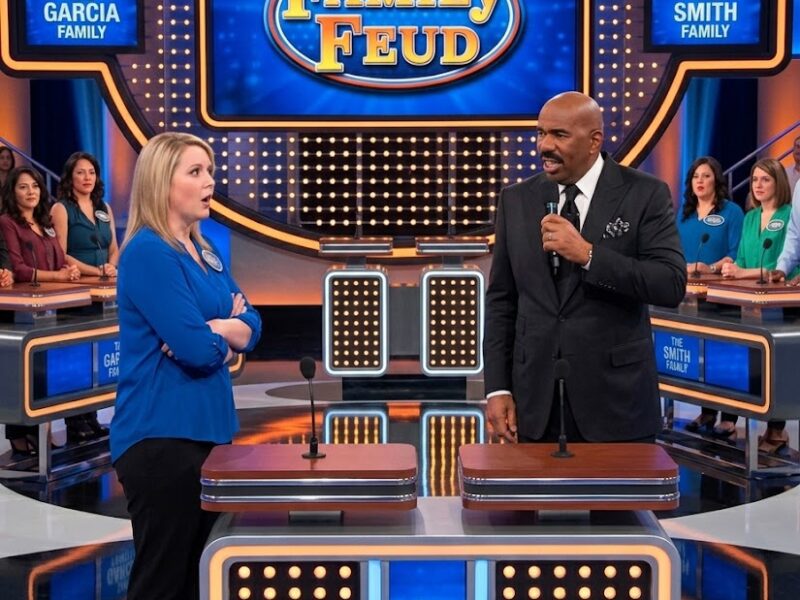
A white woman on Family Feud told a Hispanic family to “speak English or leave.” Steve Harvey didn’t laugh. He didn’t make a joke. He stopped the entire game.
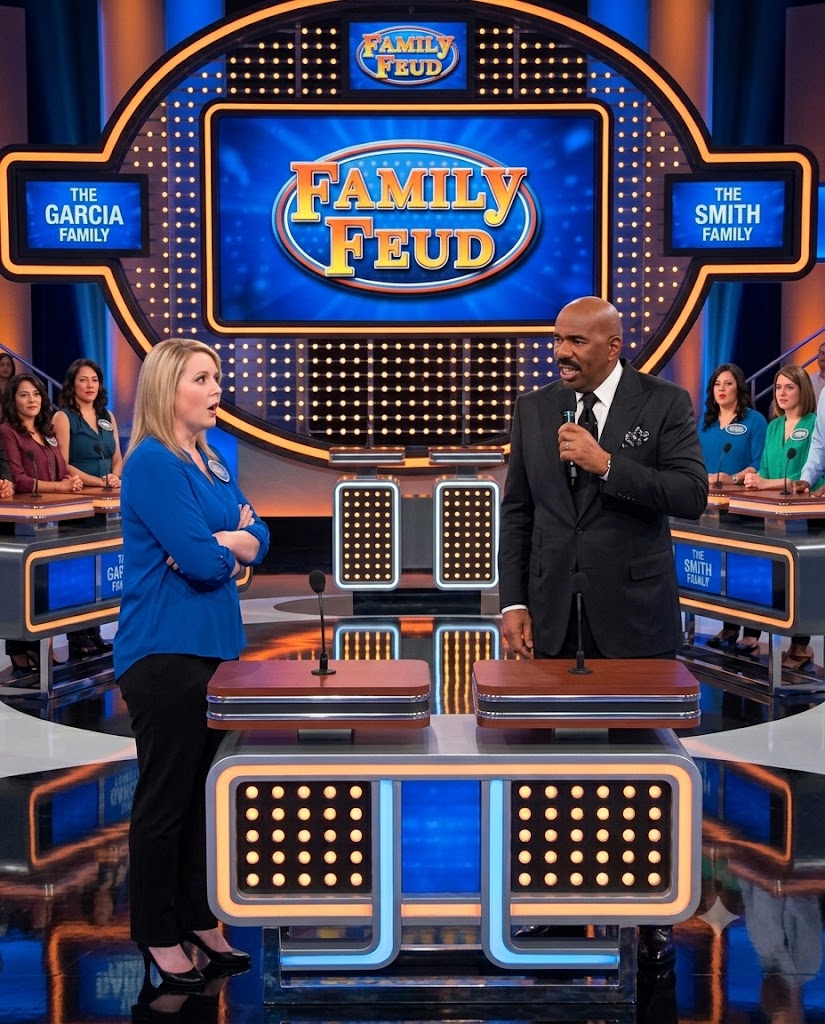
The studio lights in Atlanta burned hot enough to make the air shimmer, and two hundred people in the audience had no idea they were about to witness the most viral moment in the show’s history.
It was a Thursday afternoon in October 2024, and the Family Feud set was buzzing with the usual chaos—bright lights, loud music, and families warming up backstage while producers ran around with clipboards and headsets.
Nobody could have predicted that a single sentence, spoken by a woman who felt threatened by the sound of Spanish, would end up being watched over eighty million times in just one week.
Because what happened next wasn’t scripted, wasn’t rehearsed, and wasn’t supposed to be part of the show at all.
It started as just another taping, just another episode, just another Thursday—until it wasn’t.
—
On one side of the stage stood the Whitfield family from Nashville, Tennessee, a loud and confident group wearing matching t-shirts that said “Whitfield Winners” in bold white letters across the chest.
Karen Whitfield, the team captain, was a fifty-four-year-old retired office manager with perfectly styled hair and a smile that could turn cold in an instant.
She was there with her husband Doug, her daughter Megan, her son-in-law Tyler, and her nephew Brandon—all of them ready to play, all of them convinced they were going to win.
On the other side stood the Morales family from San Antonio, Texas—and their story was one that nobody in that studio could have fully understood just by looking at them.
Roberto Morales was sixty-one years old, a man with calloused hands and a quiet dignity that came from decades of hard work.
He had come to the United States from Mexico when he was just nineteen, with almost nothing in his pocket and a fire in his heart that refused to go out.
He worked construction for years, pouring concrete in the brutal Texas summer heat, saving every single dollar he could until he finally had enough to open his own auto repair shop.
He called it Morales and Sons, a small place on the west side of San Antonio with a hand-painted sign out front and a waiting room filled with mismatched chairs that had been donated by neighbors.
That shop wasn’t fancy, but Roberto built something more valuable than any luxury dealership could ever offer—he built a reputation for honesty.
He never overcharged anyone, and if a single mom came in who couldn’t afford the full repair, he’d fix it anyway and tell her to pay when she could.
Some of those people never paid, and Roberto didn’t care, because he always said the same thing: “We take care of our neighbors. That’s what we do.”
His wife Elena was the heart of the family, a woman who ran the books for the shop, cooked meals for the mechanics, and kept the whole operation together with a kind of quiet strength that held everything in place.
She spoke mostly Spanish at home because that’s how she grew up, and that’s what felt natural to her—but she also spoke English when she needed to, and there was nothing wrong with that.
Their oldest son Marco, thirty-four years old, was the one who had signed the family up for Family Feud in the first place.
He worked alongside his father at the shop every single day, learning the business from the ground up, believing in the same dream his father had carried across the border all those years ago.
Their daughter Sofia, twenty-eight, was a nurse at a local hospital, a woman who spent her days saving lives and her nights worrying about her patients.
And then there was little Luis, just seventeen years old, still in high school, already talking about becoming the first person in the family to go to college.
Marco had been sending in applications to Family Feud for three years—three years of filling out forms, making audition videos, waiting for callbacks that never came.
Then one day, the phone rang, and everything changed.
—
They were in.
The Morales family flew to Atlanta for the taping, and for Elena, it was her first time on an airplane.
She held Roberto’s hand during takeoff and whispered a prayer in Spanish, her fingers gripping his so tightly that her knuckles turned white.
When they landed, Luis pressed his face against the taxi window, staring at the Atlanta skyline like he was looking at another planet entirely.
They showed up to the studio wearing matching navy blue shirts that said “Morales Family” with a little Mexican flag and an American flag side by side underneath.
Sofia had designed them herself, staying up until two in the morning getting the iron-on transfers just right, because she wanted everything to be perfect.
When the cameras started rolling, Steve Harvey walked out and did his thing—shaking hands with both families, cracking jokes, getting the crowd going with that infectious energy that had made him a legend.
Everything was normal.
Everything was fun.
The game was about to begin.
And then everything changed.
—
It started small, almost imperceptibly, during the face-off round when Roberto stepped up to the podium.
Steve asked the question: “Name something a grandma always has in her purse.”
Roberto hit the buzzer first, but before he answered, he turned to Elena in the back row and said in Spanish, “Que siempre tienes en tu bolsa, mi amor?”
He was asking his wife what she always kept in her bag—it was instinct, pure and simple.
When Roberto got nervous, he went back to Spanish, because that’s just how his brain worked after sixty-one years of living in two languages.
Elena laughed and called out, “Dulces!” which means candy, and Roberto turned back to Steve with a grin.
“Candy, Steve. My wife says candy.”
The audience laughed, Steve laughed, and it was a sweet, funny moment that captured everything beautiful about a family that had built their lives across two cultures.
The answer was on the board—number two answer—and the Morales family celebrated with high-fives and hugs.
But not everyone thought it was funny.
Karen Whitfield, standing at the other podium, rolled her eyes so hard that her whole head moved.
She didn’t say anything yet, but you could see it on her face, that tight-lipped disapproval that simmered beneath the surface.
The cameras caught it, and the audience noticed, but the game continued because that’s what happens when you’re live on set and nobody wants to make a scene.
The Morales family was doing well—they won the first round, then the second, building momentum with every correct answer.
Elena kept cheering from the back row in Spanish, her voice ringing out across the studio like a bell of pure joy.
“Andale, mijo!” she’d yell when Marco gave a good answer, her hands cupped around her mouth.
“Eso es!” when something went right, her face lit up with pride that couldn’t be contained by any single language.
The audience loved it—her energy was infectious, her joy was genuine, and her love for her family was written on every inch of her face.
But Karen was getting frustrated.
Her family was losing, and every time Elena cheered in Spanish, Karen’s jaw tightened a little more.
—
Then came round three, and the question was simple: “Name something you’d find at a 4th of July barbecue.”
Sofia stepped up for the Morales family, her navy blue shirt crisp and her ponytail swinging as she buzzed in first.
“Hot dogs,” she said, her voice clear and confident.
Number one answer.
The Morales family erupted—Marco pumped his fist, Luis jumped out of his seat, and Roberto clapped his hands together with a laugh that came from deep in his chest.
Elena jumped out of her seat and shouted, “Mi hija es la más inteligente!”—my daughter is the smartest—her voice soaring above the noise.
The whole family was hugging and high-fiving, a whirlwind of joy and celebration that filled the studio with warmth.
That’s when Karen Whitfield lost it.
She stepped away from the podium, turned toward the Morales family, and said it loud enough for every microphone in the room to pick up.
“Oh my god, this is America. Can you people speak English? Speak English or just leave.”
The studio went dead silent.
Two hundred people in that audience, and you could hear the air conditioning humming in the background like a distant swarm of bees.
Elena’s smile disappeared, replaced by a look of confusion and hurt that cut through the air like a knife.
Roberto’s face went hard and still, the way a man’s face goes when he’s spent a lifetime being told he doesn’t belong and has learned to swallow the pain instead of showing it.
Young Luis looked at the ground, his ears turning red, his hands shoved deep into his pockets like he wished he could disappear.
Sofia put her arm around her mother, her jaw set tight, her eyes blazing with a protective fury that she was struggling to contain.
Marco took one step forward, his fists tight at his sides, his body coiled like a spring ready to snap.
But Roberto put a hand on his son’s shoulder.
He didn’t say a word—he just shook his head, a silent command that carried more weight than any shouted argument ever could.
Not here.
Not like this.
—
Steve Harvey had been standing near the center podium, and he had heard everything.
The producers were already moving, talking into their headsets, trying to figure out what to do because this was a live taping and there was no script for this.
But Steve didn’t wait for the producers.
He didn’t wait for anyone.
He walked slowly across the stage toward Karen Whitfield, and the way he walked told you everything.
It wasn’t angry.
It wasn’t aggressive.
It was measured, deliberate, like a man who had thought about this moment his whole life and finally had the chance to say what needed to be said.
He stopped right in front of Karen, and the camera zoomed in so close that you could see the sweat on his forehead.
And in a voice that was quiet but carried through every speaker in that studio, Steve Harvey said:
“Ma’am, I need you to hear me right now. I’ve been doing this show for a long time. I’ve had families from every corner of this country and every corner of this world stand on this stage. And I have never, not once, told any family they had to change who they are to be here.”
Karen started to say something, but Steve held up his hand like a crossing guard stopping traffic.
“I’m talking right now.”
The words hung in the air, heavy and final, and Karen’s mouth closed.
“That family right there,” Steve continued, pointing toward the Morales family, “they speak two languages. Do you understand what that means? That means they can do something you can’t. That’s not a weakness. That’s a superpower.”
The audience was completely still, every person leaning forward, every eye fixed on the stage.
“And the fact that they’re standing on this stage, playing this game, laughing and loving each other in whatever language feels right to them—that’s exactly what this show is about. That’s exactly what this country is about.”
The audience started clapping.
It began slowly from the back row, a few scattered hands coming together, and then it rolled forward like a wave until the entire studio was on its feet.
A standing ovation.
—
But Steve wasn’t finished.
He turned to the Morales family and walked toward them, his footsteps echoing in the sudden silence that fell as the applause faded.
“Mr. Morales, Mrs. Morales, you do not owe anyone an apology for being who you are. Not today, not ever. Your language is beautiful. Your family is beautiful. And you belong on this stage just as much as anybody.”
Elena was crying.
She couldn’t hold it back anymore, and the tears streamed down her face like rain on a windowpane.
But they weren’t sad tears—they were tears of release, of recognition, of being seen after a lifetime of feeling invisible.
She reached out and grabbed Steve’s hand with both of hers and said through her tears, “Gracias, Señor Harvey. Gracias.”
Steve squeezed her hand and said, “You don’t need to thank me. I should be thanking you for bringing your family here today.”
Then he turned back to the cameras.
He looked directly into the lens, and in that moment, he wasn’t talking to the studio audience anymore.
He was talking to everyone at home.
“Let me say something to everybody watching this. America has never had just one language. America has never had just one culture. The strength of this country has always been that people from everywhere can come here and build a life. If you have a problem with someone speaking their own language, the problem isn’t them. The problem is you.”
The ovation that followed was the longest in the show’s history.
The producers later confirmed it lasted nearly a full minute before they could get the taping back on track.
—
As for Karen Whitfield, she stood there frozen, her face pale and her hands trembling at her sides.
Her own family looked uncomfortable—her daughter Megan was staring at the floor, her husband Doug had his arms crossed and his jaw tight, the way someone looks when they know something has gone very wrong but don’t know how to fix it.
The producers quietly escorted the Whitfield family off stage and brought in an alternate family to finish the taping.
The game continued with a replacement family, and the Morales family played like they had something to prove—and maybe they did.
But it wasn’t anger that fueled them.
It was pride.
Elena cheered even louder than before, because she wasn’t going to let anyone take her voice away.
Every time one of her kids gave a good answer, she stood up and let the whole studio hear how proud she was.
In Spanish, in English, in whatever language felt right.
They won the game.
They made it to fast money, and Marco and Sofia played together, hitting 287 points and winning $2,000.
The whole family rushed the stage—Roberto lifted Elena off the ground in a hug, Luis was jumping up and down, and Sofia had tears running down her face.
But the moment that really mattered happened after the cameras were supposed to stop rolling.
Except they didn’t.
The producers kept filming because they could feel something important was about to happen.
—
Steve walked over to Roberto and put his hand on the older man’s shoulder.
“Tell me about your shop, Mr. Morales.”
Roberto, a man who fixed engines for a living and never talked about himself, looked at Steve Harvey and started telling his story.
How he crossed the border at nineteen.
How he worked in the heat until his hands cracked and bled.
How he saved for seven years before he could open his shop.
How he named it Morales and Sons even before Marco was born because he believed that one day his children would stand beside him.
“And now look,” Roberto said, his voice breaking. “My son works with me every day. My daughter saves lives at the hospital. My youngest boy is going to be the first one in our family to go to college. We did this. My wife and I, we built this in two languages.”
Steve had to turn away from the camera for a moment to collect himself.
When he turned back, he said something that the crew later said was the most real they had ever seen him.
“Mr. Morales, I grew up poor. I grew up black in America. I know what it feels like to walk into a room and have people decide who you are before you open your mouth. What happened today was wrong. But what you and your family represent is everything that’s right. You don’t just fix cars. You fix the idea that this country only belongs to one kind of person.”
Then Steve did something nobody expected.
He pulled out his phone right there on stage and called his foundation director.
With the Morales family standing right there, he arranged a $25,000 scholarship for Luis to go to college—on top of the $2,000 they had already won.
Luis, the seventeen-year-old kid who had been quiet the entire show, who had watched someone try to humiliate his family, who had stared at the ground when Karen told them to leave—that kid broke down crying.
He grabbed Steve and hugged him so hard the microphone clipped.
“I’m going to make you proud, Mr. Harvey,” Luis said. “I’m going to make my family proud.”
Steve looked at him and said, “Son, you already have.”
—
When the episode aired two weeks later, it didn’t just go viral.
It went nuclear.
The clip of Steve’s response was watched over eighty million times in the first week alone.
It was shared in classrooms, played at diversity training seminars, and featured on every major news outlet in the country.
News anchors choked up watching it.
Teachers showed it to their students.
Parents played it at dinner tables and asked their kids, “What would you have done?”
But here’s where the story takes a turn that nobody expected.
People started showing up at Morales and Sons.
Not to get their cars fixed—just to shake Roberto’s hand.
To bring Elena flowers.
To tell the family that they mattered.
One woman drove three hours from Houston—she was Mexican-American, a teacher, and she brought her entire fifth-grade class’s letters, all handwritten, telling the Morales family that they were heroes.
Elena read every single one.
She put them on the wall of the shop’s waiting room, right next to the family photo from Family Feud.
Business at the shop tripled in two months.
Roberto had to hire four new mechanics.
Marco started a second location on the East Side of San Antonio, and they kept the same rule Roberto had always lived by: if someone can’t pay, you help them anyway.
Sofia’s hospital colleagues threw her a surprise party when the episode aired, printing her face on a cake with the caption “Nuestra estrella”—our star.
She laughed so hard she cried.
Luis got accepted to the University of Texas at San Antonio with a full scholarship, partially funded by Steve Harvey’s foundation.
He chose to study engineering.
On his first day of college, he wore the same navy blue Morales family shirt he had worn on Family Feud.
When a professor asked him about it, Luis told the whole story.
Half the lecture hall was in tears by the end.
—
Steve Harvey visited the shop six months later, bringing a camera crew for a follow-up segment.
When he walked into the garage and saw those handwritten letters on the wall, he stopped and stared at them for a long time without saying anything.
Then he turned to Roberto and said, “You know what you built here? You didn’t just build a shop—you built proof that the American dream still works, if people let it.”
Roberto smiled.
“Mr. Harvey, I don’t know about the American dream. I just know that I love my family. I love my work, and I love this country, even when it doesn’t love me back.”
Now, here’s the part of the story that a lot of people don’t know about.
And it’s the part that matters most.
—
Three months after the episode aired, Karen Whitfield’s daughter Megan sent a private message to Sofia Morales on social media.
It was long.
It was raw.
And it was an apology.
Megan wrote that watching her mother say those words on national television was the worst moment of her life.
She said she grew up hearing comments like that at home and never questioned them—but seeing the Morales family’s reaction, seeing Roberto hold his son back, seeing Elena’s smile disappear, seeing Luis look at the ground, it broke something open inside her.
She said she had been in therapy since the episode aired, trying to unlearn things she had been taught her whole life.
Sofia could have ignored that message.
She could have told Megan off—she would have been justified.
But she didn’t.
She wrote back: “Thank you for being honest. Growth takes courage. My parents taught me that people can change. I believe that.”
They kept talking, slowly and carefully, over months.
And eventually, Megan drove to San Antonio to meet the Morales family in person.
Elena made her a plate of food and sat with her at the kitchen table and didn’t say a single word about what had happened on the show.
She just fed her and treated her like a guest, because that’s who Elena is.
When Steve Harvey heard about it, he said it was the most beautiful ending he could have imagined.
“That’s not just forgiveness,” he said. “That’s grace. That’s a family so strong that even the person who tried to tear them down ended up being healed by them.”
—
One year later, the Morales family went back on Family Feud for a special All-Stars episode.
Before the game started, Steve asked Roberto if he had any words for the audience.
Roberto, a man who fixed cars and rarely gave speeches, looked into the camera and said in clear, steady English:
“My wife and I, we speak two languages, but there is one language that everybody understands—respect. You don’t need to learn Spanish. You don’t need to learn English. You just need to learn respect. That’s the only language this world really needs.”
The audience gave him a standing ovation.
Steve Harvey wiped his eyes with his suit jacket.
Elena, standing behind her husband, whispered in Spanish, “Ese es mi hombre.”
That’s my man.
—
Look, I know this is just a YouTube video.
I know you’re watching this on your phone or your laptop, and you’ve got a hundred other things you could be doing right now.
But I want to ask you something real.
When was the last time you stood up for someone who was being treated unfairly?
Not online.
Not in a comment section.
In real life—face to face, the way Steve Harvey did.
Roberto Morales didn’t need a game show to prove he belongs in this country.
He proved it every day for forty years.
Elena didn’t need anyone’s permission to speak her own language.
And Luis didn’t need a scholarship to be worthy of college.
They already were all of those things before they ever stepped on that stage.
But sometimes it takes one moment, one person willing to say “This is wrong,” to remind the world what’s right.
If this story moved you, hit that like button.
Not for us—for the Morales family.
For every family that has ever been told they don’t belong.
Subscribe if you want more stories about real people doing extraordinary things.
And share this video with someone who needs to hear it.
You never know who’s having the worst day of their life and just needs to see one story that reminds them that good people still exist.
Roberto said it best.
You don’t need to learn Spanish.
You don’t need to learn English.
You just need to learn respect.
—
The studio lights dimmed that Thursday afternoon in October 2024, and the audience filed out into the Atlanta evening, many of them still wiping tears from their eyes.
Nobody knew yet that they had just witnessed something that would echo across the country for years to come.
Nobody knew that a single moment of cruelty would be transformed into a movement of kindness.
Nobody knew that a family from San Antonio, Texas, would become a symbol of everything that makes America beautiful.
But Roberto knew.
Elena knew.
Marco, Sofia, and Luis knew.
They had always known.
They had known it every time they opened the doors of Morales and Sons, every time they fixed a car for someone who couldn’t pay, every time they sat around the dinner table speaking two languages and loving each other in both of them.
They had known it when they stepped onto that stage, and they knew it when they walked off.
And now, thanks to Steve Harvey, thanks to eighty million people who watched and shared and cried, thanks to a nation that was reminded of something it had forgotten—everyone else knew it too.
The Morales family didn’t just win a game show that day.
They won something far more important.
They won the right to be seen, to be heard, to be celebrated for exactly who they were.
And that’s a prize that no amount of money could ever buy.
—
Karen Whitfield never appeared on Family Feud again.
She never issued a public apology, never spoke to the press, never acknowledged what she had done in any official capacity.
But her daughter Megan did.
Megan became an advocate for bilingual education, speaking at schools and community centers about the importance of respecting other cultures.
She never mentioned her mother by name, but everyone knew who she was talking about when she said she had grown up in a house where differences were feared instead of celebrated.
“I learned something from the Morales family,” Megan said at one event, her voice steady but her hands trembling. “I learned that love doesn’t have a language. I learned that respect doesn’t have a border. And I learned that it’s never too late to change who you are and what you believe.”
The audience applauded, and somewhere in the back of the room, a woman who looked a lot like Elena Morales wiped a tear from her eye.
Because that’s the thing about grace—it doesn’t just heal the person who receives it.
It heals the person who gives it too.
—
The Morales family’s story spread far beyond the Family Feud stage.
Documentary filmmakers reached out, wanting to tell their story in a longer format.
Book publishers called, asking if they would consider writing a memoir.
Universities invited Roberto and Elena to speak at graduation ceremonies, to share their wisdom with young people who were just starting their own journeys.
They said yes to some of it and no to most of it, because at the end of the day, they were still just a family who ran an auto repair shop in San Antonio.
They still got up early every morning.
They still opened the doors at seven sharp.
They still fixed cars and changed oil and rotated tires and did all the small, unglamorous things that had built their life together.
But now, when people came in, they didn’t just see a mechanic and his wife.
They saw heroes.
They saw a family that had stood up to hatred and won.
They saw proof that the American dream was still alive, still possible, still worth fighting for.
And every time someone walked through that door and shook Roberto’s hand, he would smile and say the same thing:
“Welcome to Morales and Sons. How can we help you today?”
Because that’s who he was.
That’s who they all were.
People who helped.
People who loved.
People who believed that respect wasn’t something you demanded—it was something you gave.
And that, more than anything else, was the lesson that the Morales family taught America.
Not through speeches or protests or angry words.
But through the quiet, steady example of a life lived with dignity and grace.
—
The night the All-Stars episode aired, the Morales family gathered in their living room to watch it together.
Elena made enchiladas and rice and beans, and the whole house smelled like love and cumin and something that couldn’t be put into words.
They sat on the couch, all six of them, and watched themselves on television—watched the moment when Karen Whitfield told them to speak English or leave, watched Steve Harvey walk across that stage and change everything.
Luis was the first one to cry.
Then Sofia.
Then Elena.
Roberto stayed dry-eyed, but his hand found Elena’s and held it tight.
When the show ended, when the credits rolled and the screen went dark, they sat in silence for a long moment.
Then Marco spoke.
“We did good, didn’t we?”
Roberto nodded.
“We did good.”
And that was all that needed to be said.
Because sometimes, the most powerful words are the simplest ones.
Sometimes, the greatest victories are the quietest ones.
Sometimes, the most important thing you can do is just be who you are, unapologetically, in a world that wants you to be something else.
The Morales family knew that.
They had always known it.
And now, thanks to one Thursday afternoon in October 2024, so did millions of other people.
The end.
—
But wait.
There’s one more thing you should know.
Six months after the All-Stars episode aired, Roberto received a letter in the mail.
It was handwritten, on plain white paper, with no return address.
The handwriting was shaky, like the person writing it hadn’t written a letter in years.
Roberto opened it at the kitchen table, with Elena watching over his shoulder.
It said:
“Mr. Morales,
I don’t know if you remember me. My name is Karen Whitfield. I was the woman who said those terrible things to your family on Family Feud.
I’m not writing this to ask for forgiveness. I don’t deserve it. I’m writing this because I need you to know that what you did—the way you held your son back, the way you didn’t fight back, the way you just stood there with dignity—it changed something in me.
I’ve been in therapy for months. I’ve been reading books about racism and bias and privilege. I’ve been trying to understand why I said what I said, why I felt so threatened by your family’s language, why I thought it was okay to tell someone they didn’t belong.
I still don’t have all the answers. But I know one thing for sure: I was wrong. I was so wrong. And I’m sorry.
I’m sorry for the pain I caused you and your family. I’m sorry for the way I treated you. I’m sorry for being the kind of person who would say something like that to another human being.
I know an apology doesn’t undo what I did. But I wanted you to hear it anyway.
Your family is beautiful. Your language is beautiful. And you belong here just as much as anyone.
Thank you for teaching me that.
Karen Whitfield”
Roberto read the letter three times.
Then he folded it carefully and put it in his pocket.
He didn’t say anything for a long time.
Elena waited, her hand on his shoulder, her heart aching for the man she had loved for forty years.
Finally, Roberto spoke.
“She’s learning,” he said. “That’s all we can ask.”
And then he went back to work.
Because that’s what Roberto Morales did.
He fixed cars.
He loved his family.
And he believed, against all evidence to the contrary, that people could change.
That was his superpower.
That was his gift.
And that was the lesson he left behind for all of us.
You don’t need to learn Spanish.
You don’t need to learn English.
You just need to learn respect.
And if you can do that, if you can open your heart to people who are different from you, if you can see the humanity in every single person you meet—then you’ll understand what the Morales family understood all along.
That we’re all just trying to make it.
That we’re all just trying to find our way home.
And that the only language that really matters is the one that speaks to the heart.
—
The story of what happened on that Family Feud stage in October 2024 didn’t end when the cameras stopped rolling.
It didn’t end when the episode aired.
It didn’t end when the Morales family went back for the All-Stars episode.
It didn’t even end when Karen Whitfield sent that letter.
It’s still happening.
It’s happening every time someone watches that clip and feels something shift inside them.
It’s happening every time a teacher shows it to a classroom full of kids and asks them what they would have done.
It’s happening every time a family sits down at the dinner table and talks about respect and kindness and what it means to truly see another person.
The Morales family didn’t just win a game show.
They won something much bigger.
They won a place in the hearts of millions of people who had never met them but felt like they knew them.
They won the knowledge that their story—their beautiful, complicated, bilingual story—had made a difference in the world.
And that’s a prize that no amount of money could ever buy.
Roberto said it best.
You don’t need to learn Spanish.
You don’t need to learn English.
You just need to learn respect.
That’s the only language this world really needs.
And if we can all learn to speak it, then maybe—just maybe—we can build a world where no one ever has to be told to speak English or leave again.
Because everyone belongs.
Everyone deserves to be heard.
And everyone deserves to be loved.
That’s the lesson of the Morales family.
That’s the lesson of Steve Harvey.
That’s the lesson of that Thursday afternoon in October 2024, when a woman said something terrible and a nation learned something beautiful.
The end.
Or maybe—just maybe—the beginning.









