A white VIP didn’t know the quiet Black man in seat 2A owned the airline. She took his seat anyway—and regretted it.
Part 1
The rain had turned the terminal windows at Hartsfield-Jackson into gray mirrors, and Quincy Monroe stood at Gate B14 watching his own reflection blur against the tarmac lights. He was sixty-three years old, dressed in a faded charcoal sweater soft at the elbows, and he was holding a funeral card so worn the edges had gone smooth as river stone. The name printed across the front in simple black letters was Harold Whitaker. In nine hours, Quincy would stand in a small warm church in Savannah and bury the only man who had ever believed in him before there was anything to believe in.
He had booked a single first-class seat under his own name. Seat 2A. Window. No car waiting, no manager tipped off, no welcome committee. He wanted to sit quietly, watch the clouds roll past, and remember his friend in peace. He came as he was. A cloth bag that had traveled with him for decades. A paperback. A bottle of water. That single white card.
The gate agent had smiled at him when he handed over his boarding pass. A real smile, the kind that reached the eyes. “Welcome aboard, Mr. Monroe. Anything I can get for you before we push back?” He had asked for water. No rush. He found 2A, slid the cloth bag beneath the seat in front of him, and lowered himself into place with the small groan of a man who had earned every one of his years. Rain streaked the window in long silver lines. He pressed the card flat against his knee and let his eyes close.
He did not know that the next ten minutes would test a promise he had made to himself over cold coffee that morning. Whatever this day brought, he would arrive calm. For Harold, of all people, he would hold himself together.
Then from the front of the cabin, a sharp voice sliced clean through the quiet.
“You have got to be kidding me.”
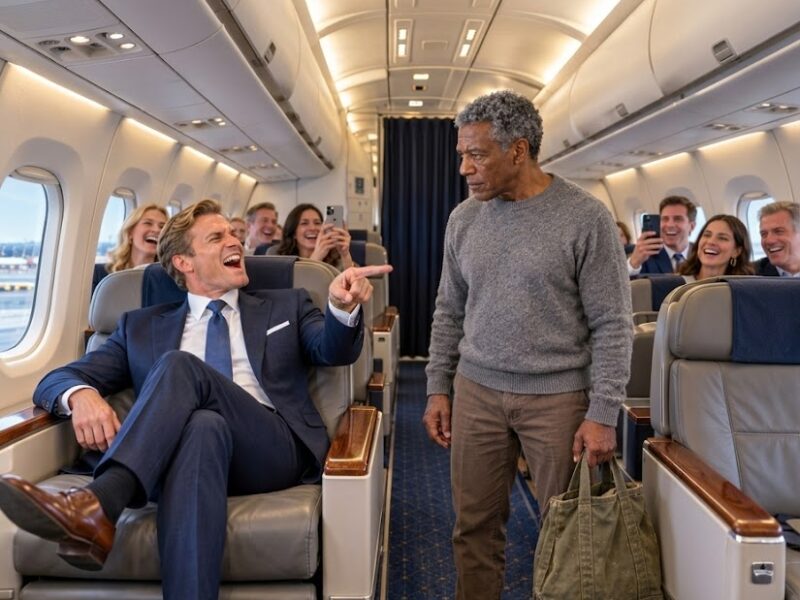
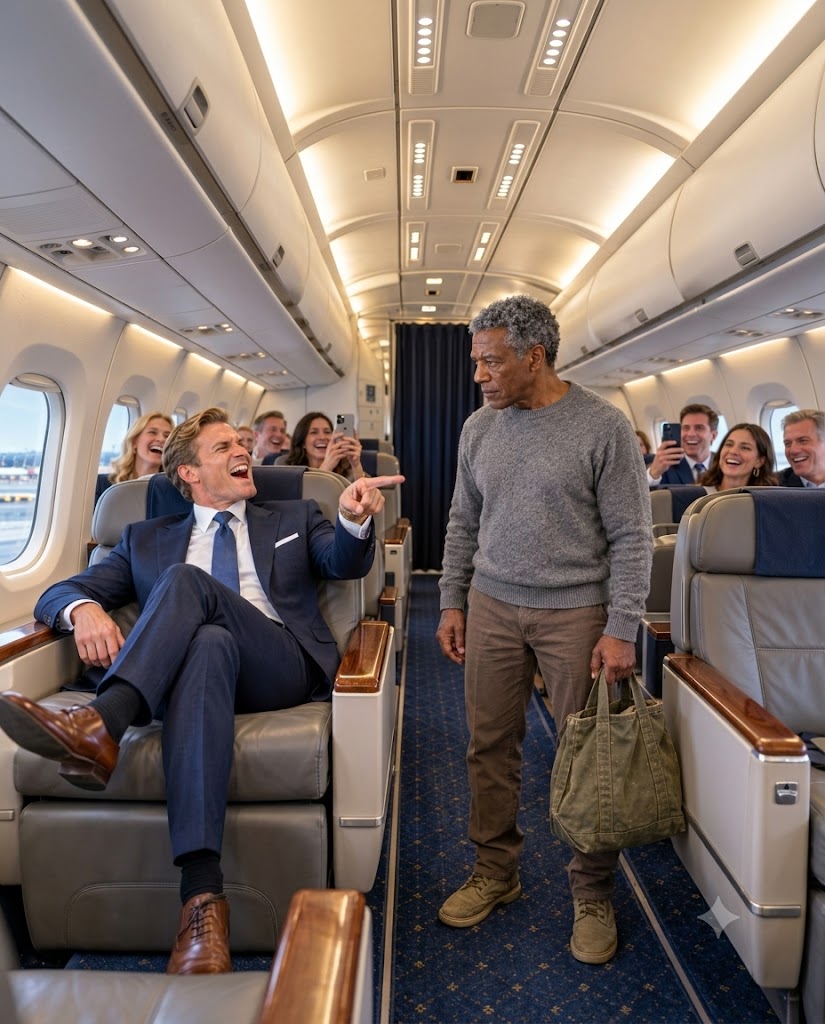
Preston Vaughn came down the aisle like he owned the carpet under his shoes. He dragged a leather carry-on behind him, checked the seat numbers with a flick of his eyes, and stopped dead at row two. His gaze landed on the man in the gray sweater sitting by the window, and his whole face changed. The polite boredom drained out of it. Something colder slid in to take its place.
“There’s been a mistake,” he announced loud enough for half the cabin to hear. “Somebody’s put the wrong person up front.”
Quincy looked up from the window. “I don’t believe so.”
“You don’t believe so?” Preston let out a short, ugly laugh. “Let me guess how this went. Economy was full, so you wandered up here, found an empty-looking seat, and figured nobody would say anything.” He shook his head slowly, almost pityingly. “This is first class. People like you don’t sit in first class.”
The words hung there in the recycled air. A woman two rows back stopped scrolling her phone. A businessman lowered his newspaper by an inch and did not raise it again.
“I have a ticket for this seat,” Quincy said. His voice stayed level, unhurried. “2A by the window.”
“Sure you do.” Preston turned his head toward the galley and raised a hand like a man summoning a waiter at a slow restaurant. “Excuse me. Hello. I need someone up here right now.”
The senior purser was already moving. She had been watching this man in the sweater since the worn shoes first walked past her station. Her name was Diane Foster, and she had been flying this route for eleven years. She had seen every kind of passenger. She had learned to read them in a single glance. The sweater. The cloth bag. The shoes. She had already filed him away.
“Is there a problem, sir?”
“There’s absolutely a problem,” Preston said. “This gentleman is sitting in a premium cabin, and I would bet my watch—and it’s a very good watch—that he does not have the ticket for it. So check it. Go on, check it right here in front of everybody.”
Quincy drew a slow breath through his nose. He reached into the pocket of his sweater, pulled out his boarding pass, and held it up without a single word. The seat number was printed clear and black at the top. 2A.
The purser leaned in and glanced at it. Her face flickered just for half a second—just enough—and then it went flat and professional again. And here was the moment she could have ended the whole thing with one sentence. She did not. Instead, she turned to Quincy as if he were the one making trouble.
“Sir,” she said in a voice smooth as glass. “It might be easier for everyone if you simply found another seat.”
“Easier for who?” Quincy asked quietly.
She didn’t answer that. She didn’t have an answer that would survive being said out loud. Preston smelled the opening and shoved his way straight into it.
“See? Even she knows. You’re making a scene, old man. Nobody up here wants you in that chair. Do us all a favor and move to the back where you belong.”
Quincy didn’t move. He folded his hands over the soft cloth bag on his lap and turned his face back toward the window—the way a man does when he has made a deliberate decision not to feed a fire that is trying very hard to spread. That silence did something to Preston. He wasn’t used to being ignored. He was used to rooms rearranging themselves around his wishes, to people stepping aside, to a certain kind of nervous hurry when he raised his voice. And here was a man in a thrift-store sweater simply refusing to perform the fear he expected.
“Oh, so now you’ve gone deaf.” Preston stepped closer until he was standing right over the seat, his body blocking the aisle entirely. “I fly this route every single month. Every month. I know what belongs up here and what doesn’t. And you—” he jabbed a finger down toward the gray sweater, the soft bag, the still and folded hands— “you do not belong up here. Not the seat, not the cabin, not any of it.”
A few passengers shifted in their seats, uncomfortable now. One man near the window muttered, “Come on, man. Leave him alone.” But he said it into his own lap, not loud enough to count. And the instant Preston’s eyes swept across the rows looking for the source, the man found something fascinating in his magazine. Nobody stood up. Nobody stepped into the aisle. Nobody put a body between the quiet man and the loud one.
And Quincy had seen this exact silence before—in bank lobbies, in waiting rooms, in boardrooms long ago. The silence of people who know something is wrong and have quietly decided it isn’t their problem to fix.
Preston circled back for another pass, feeding on the attention. “I travel a hundred thousand miles a year with this airline,” he said loud, performing now for the rows behind him. “A hundred thousand. You think they seat people like me next to people like you? There’s an order to things. There’s a reason some of us ride up front and some of us ride in the back. You’ve just forgotten your place for a minute, that’s all. I’m doing you a favor, reminding you of it.”
“I haven’t forgotten anything,” Quincy said.
“No? Then explain the sweater. Explain the bag. Explain the shoes.” Preston ticked them off on his fingers like evidence laid out in a trial. “Everything about you says you’re lost, friend. Everything. So let me make it very simple for you. Up or out. Your choice.”
Quincy turned from the window and looked at him—really looked at him. The way a man studies a storm he has already decided to let pass over him. He had met a hundred Prestons in his life. He had sat across desks from them, signed the deals that made them rich, watched them smile at his money while their eyes slid right past his face. He knew the exact shape of this man without needing a single detail of his life.
“You keep saying people like me,” Quincy said quietly. “I’ve been hearing that sentence for sixty years. It has never once meant what the person saying it thought it meant.”
For half a second, something flickered behind Preston’s eyes. Not shame, not quite, but the small cornered awareness that the old man was not reacting the way he was supposed to. It unsettled him, and an unsettled Preston only ever had the one gear. He got louder.
“Don’t you dare lecture me.” He stabbed a finger down toward the seat. “I asked you three times. Three. Now I’m done asking.”
A woman across the aisle finally spoke up, her voice thin and uncertain. “Sir, maybe just leave the gentleman be. He isn’t bothering anyone.”
Preston rounded on her so fast that she shrank back into her seat. “Was I talking to you? No. Then mind your own business.”
She looked down at her hands. She did not speak again. And that was the lesson the whole cabin absorbed in a single breath. That defending the old man carried a cost, and the loud man was more than happy to collect it on the spot. So the silence came back heavier than before. And in that silence, Quincy understood with a weariness older than the flight itself that no one was coming. No one ever really came. You learned eventually to be your own rescue.
Preston reached down and grabbed the cloth bag off Quincy’s lap. “Tell you what. Let’s start by getting rid of your garbage.”
“That’s mine,” Quincy said. And for the first time, a thin edge appeared beneath the calm. “Please put it down.”
Preston did not put it down. He swung it out into the aisle and it hit the carpet with a soft, awful thud. The zipper gaped open. A paperback slid halfway out—and a small white card. The funeral card spilled free and skated across the floor, landing face up. Harold Whitaker’s name in plain and public view.
For one single breath, Quincy’s composure cracked straight down the middle. His eyes dropped to that card lying on the dirty cabin floor, to his friend’s name beneath a stranger’s shoe, and something in his chest pulled painfully tight. Nine hours. A promise to stay calm. And now this.
The young flight attendant—the one who had promised him water—had been frozen near the galley, a glass still in her hand. Now she hurried forward and crouched down to rescue the card, her fingers trembling. “Sir, I’m—I’m so sorry,” she whispered. “Here, let me—”
She started to lift it toward Quincy, but the purser’s voice snapped out and stopped her cold. “Hannah. Leave it. Do not get involved.”
Hannah’s hand froze in the air, the card pinched between two fingers, caught in the space between doing what was right and keeping the job she clearly needed. She looked at the purser. She looked at the old man in the sweater. And slowly, under the weight of that stare, her hand began to lower back toward the floor.
Preston saw his chance to end it on his own terms, and he took it without a flicker of hesitation. Before Quincy could even reach for the fallen card, Preston stepped in front of him, planted one hand on the seatback, and lowered himself straight down into 2A—into Quincy’s seat, the one by the window, the one he had chosen precisely because he wanted to watch the clouds and remember a dead man in peace.
“There,” Preston said, settling his shoulders back and stretching his legs out long into the extra room. “Problem solved. I’ll take this one. It’s wasted on you anyway. You can stand in the aisle until the crew figures out where to dump you.”
The cabin went very, very still. And now here was the picture. Plain for everyone to see. Quincy on his feet, pressed up against the seat in front of him. Nowhere to sit. A grown man standing in the aisle of an aircraft he could buy outright with a signature while a stranger lounged in his stolen seat and grinned.
He could have shouted. He could have said one sentence—a single true sentence—and watched the whole thing collapse. The words were right there. He didn’t say them. He thought of Harold. He thought of the service waiting in nine hours, the handful of gray-haired friends who would gather in a small warm church, the promise he had made to himself over cold coffee that morning. He thought of every room in his long life where someone had studied his clothes and decided in a heartbeat exactly who he was and exactly what he was worth. He had survived every one of those rooms the same way. By refusing to get loud. By refusing to become the angry thing they were already so sure he was.
So he stood quiet, steady, spine straight—and somehow that stillness filled the cabin louder than any shout could have. Standing there, hemmed in against the seatback, he let his mind go somewhere else, somewhere it had traveled many times before. He thought about the first office he had ever rented, so small the door struck the desk whenever it opened. He thought about the bankers who had looked at him and seen a risk instead of a man. He thought about Harold, who had looked at the exact same person and seen a future worth signing his name beside. One life, two completely different verdicts—decided by nothing more than whether the other person chose to truly look or chose only to glance.
Preston had chosen to glance. Preston would always choose to glance. And Quincy had stopped expecting the Prestons of the world to do anything else a very long time ago. What still surprised him—what would probably always surprise him—was how many other people in a room would watch it happen and simply wait for it to be over.
Preston, of course, read it as weakness. Men like Preston always did. “Would you look at this guy?” he said, turning to address the whole cabin now, warming to his audience. He pulled out his phone and tapped the screen and raised it, pointing the camera directly at Quincy’s face. “Everybody say hello. This right here is what happens when they let just anybody buy a ticket. Man shows up in a sweater he probably found in a donation bin, and he thinks that earns him a window seat in first.”
He laughed at his own cleverness. “Smile for me. Come on, you’re about to be famous. The guy who tried to sneak into first class and got caught.”
The little red dot glowed. The phone hovered inches from Quincy’s face, close enough that he could see his own tired reflection in the dark glass beside the lens.
“Please stop recording me,” Quincy said.
“Or what?” Preston leaned back deeper into the stolen seat, utterly at ease, enjoying every second. “Go on, tell me. What exactly is a man like you going to do about it?”
A couple of people laughed—nervous, ugly little laughs, the kind people let slip when they’re simply relieved the cruelty isn’t pointed at them. Preston drank it in. He held the phone steady on Quincy’s face and narrated for his future audience like a man who had never once in his life been told no and made to mean it.
“Look at those hands,” he said. “Working hands. Nothing wrong with honest work, don’t get me wrong. But honest work doesn’t buy seat 2A. So either somebody up here made a very expensive mistake, or our friend is a liar. And I don’t think it’s a mistake.”
He finally lowered the phone an inch, pleased with himself. “Crew, are we handling this, or do I need to make a few calls of my own when we land? Because I know people. I know a lot of people.”
It was the magic phrase—the one that had worked in every restaurant and every lobby he had ever bullied his way through. I know people. And it worked here too, in the worst possible way. And that was the moment the purser made her choice. The choice that would, within the hour, cost her the career she was trying so hard to protect. She could have told Preston to go sit in his own assigned seat. She could have pulled up the manifest on the galley screen and ended the entire scene in thirty seconds. Instead, she wanted the wealthy man in the expensive suit to be comfortable and pleased, and she wanted the inconvenient man in the gray sweater to simply vanish from her cabin and her evening.
She stepped to the forward wall, lifted the inner phone to the flight deck, and when she spoke, her voice came out crisp, calm, and completely official. “Flight deck, purser. We have a non-compliant passenger in the forward cabin, refusing crew instructions and creating a disturbance. Requesting the captain come back to remove him prior to departure.”
A low ripple of disbelief moved through the rows. Non-compliant. Creating a disturbance. The only person in that cabin who had raised his voice, thrown anything, or blocked the aisle was the man now reclining smugly in the window seat with a phone in his hand.
“That’s backwards,” someone muttered from a few rows back. “She’s got it backwards.”
But it stayed a mutter. It always stayed a mutter. The purser set the interphone back in its cradle. Then she stepped close to Quincy and laid her hand firmly on his elbow, as if to walk him forward toward the door herself.
“Sir, the captain has been notified. I’m going to need you to come with me now. You are being removed from this aircraft.”
Hannah’s eyes went wide and she blurted out, “Ma’am, he didn’t do anything. He showed me his pass. It says 2A. I saw it.”
“That is enough, Hannah.” The purser didn’t even turn her head. “Not another word, or you’ll be explaining yourself to scheduling tonight.”
Hannah’s mouth closed. Her eyes shone. She stayed where she was, the funeral card still cradled in her shaking hand, and said nothing more—and hated herself for it.
Quincy looked down at the hand gripping his arm. Then he looked at the card in Hannah’s trembling fingers. Then he looked slowly at the faces of the passengers all around him. Every one of them watching. More than one of them filming. Not one of them rising. His jaw tightened until the muscle stood out. And then, with the deep weariness of a man who had stood in this exact spot a hundred times across a lifetime, in a hundred different rooms, he took one step toward the front of the plane. Not because he was afraid of her, or of Preston, or of any of them. He took the step because he refused—he would always refuse—to be dragged.
Each step was its own small eternity. He felt the eyes on him, the lenses tracking him, the heat of a cabin full of people who had quietly decided this was a show put on for their benefit. He kept his chin level and his pace slow. He would not hurry. Hurrying was exactly what they wanted—the little scramble of a cornered man. And he would not give it to them. He had walked out of rooms like this one before. Not planes, but rooms. So many rooms. And he had learned somewhere along the way that the walk itself was a kind of statement. You do not get to make me run.
Behind him, without even realizing she had done it, Hannah pressed the funeral card to her own chest, as if she could keep it safe for him until all of this was somehow over. The whole cabin watched him walk, phones held high, no one moving to stop it. A man on his way to bury his oldest friend, being marched off his own airline like a thief in front of a hundred strangers.
And at that precise moment, the latch on the cockpit door clicked and the handle began to turn.
The captain stepped out into the forward galley, cap in one hand, fully expecting to deal with some drunk or some screamer. He had come out because the purser had called him and because the law left him no choice. On any aircraft, he and he alone held the authority to remove a passenger before departure, and a crew report of a non-compliant, disruptive traveler was something he was required to handle with his own eyes and his own judgment. So Walter Sanders—nearly twenty years flying this same route, a steady man, not easily rattled—walked out of the flight deck braced to find a troublemaker.
What he found instead was a quiet old man in a gray sweater being steered toward the door by his own senior purser, while a man in an expensive suit lounged in the window seat behind them with a phone in his hand.
“All right,” Walter said, lifting a palm, his voice even and firm. “Everybody take a breath for me. Let’s slow this down. Who exactly is the passenger we’re—”
He stopped. Because in that same instant, a few rows back, the man in the charcoal suit closed his laptop with a sharp snap, rose to his feet in the aisle, and spoke in a voice that carried the full length of the cabin.
“Mr. Monroe.”
Gregory Coleman stepped out into the aisle, and the easy, polished confidence of a senior executive drained straight out of his face, replaced by something very close to alarm. He was one of the only people in the entire company who had ever sat across a boardroom table from the man who had founded it. He had shaken that hand. He knew that face the way you know a face you do not expect to see standing in an airplane aisle being pushed toward the door.
“Mr. Monroe. Sir, I didn’t know you were on this flight.” He turned sharp and fast now—toward the purser, toward the man in the stolen seat, toward the hand still clamped around the old man’s elbow. “Would someone please tell me what in the world is happening here?”
The purser’s careful smile froze on her face. “I’m—I’m sorry, Mr.—who?”
Walter had already turned to the forward console. He pulled up the passenger manifest with two taps and ran his eyes down the first-class list, seat by seat, until he reached 2A. The name sat there in plain ordinary letters. He read it once. His stomach dropped. He read it a second time to be sure. The blood drained out of his face. Monroe, Q. The founder. The majority shareholder. The name printed on the incorporation papers of the entire airline. The man whose signature was, in a direct and literal sense, the reason that every single person wearing that uniform had a paycheck to take home—the captain included.
And his own purser had just radioed the flight deck to have that man thrown off the plane like a stowaway.
“Take your hand off him,” Walter said. His voice came out low, and it shook with something that was not quite anger and not quite fear, but a cold mixture of both. “Ma’am, take your hand off that man right now.”
The purser released Quincy’s elbow as if it had suddenly turned to hot iron. Preston was still half reclined in the window seat, phone loose in his fingers, the grin not yet fully gone from his face. He looked from the captain to the executive to the old man in the gray sweater and then back again, and a cold crawling feeling began to climb slowly up the back of his neck.
“Wait,” he said. His voice had lost its edge. “Wait, what’s—what’s going on? Who is he? Somebody just—who is this guy?”
Gregory Coleman looked at him the way a man looks at something unpleasant stuck to the bottom of his shoe. “That man,” he said slowly and clearly, so that every row could hear it, “founded this airline. He owns the majority of the company whose name is painted on the tail of this aircraft. He owns the seat you took from him. He owns the plane you are sitting in right now.”
The sentence landed on the cabin like a dropped tray. A single sharp gasp, then a rising wave of whispers, then the unmistakable shuffle of a dozen people suddenly understanding that they had just filmed something very different from whatever they had thought they were filming. The woman who had been told to mind her own business put a hand over her mouth. The businessman with the newspaper sat frozen, the pages forgotten in his lap. The phone slipped in Preston’s hand. He fumbled it, nearly dropped it, caught it against his chest.
Quincy said nothing at first. He simply bent down, picked his cloth bag up off the floor, brushed it off once with his palm, and then gently took the funeral card from Hannah’s still-shaking fingers. “Thank you,” he murmured to her. And he pressed the card flat against his chest, exactly the way he had at the very beginning of all this.
Then he turned, unhurried, and looked at the man sitting in his seat. And for the first time, he smiled—a small, tired, and genuinely terrible smile.
“You asked me what a man like me was going to do about it,” Quincy said very quietly. “Sit back down and watch.”
The cabin was so silent now that the only sound was the rain drumming against the fuselage. Preston scrambled up out of 2A as if the cushion beneath him had turned to ice. “Sir—Mr. Monroe—this is—this is all a huge misunderstanding. Okay? I didn’t know. How could I possibly have known? You weren’t—I mean, you weren’t exactly dressed like—”
“Like what?” Quincy asked.
Preston’s mouth opened and then it closed again. There was no way to finish that sentence that would not bury him deeper, and some small surviving part of him understood that.
“You didn’t do any of this because of a sweater,” Quincy said. His voice was calm, almost gentle, which somehow made it land harder. “You did it because you were absolutely certain that no one in this cabin would stop you. And you were very nearly right. That’s the part worth thinking about.”
He turned to the captain. “Captain Sanders, I’m sorry you were pulled into the middle of this. You came back here because you were told there was a dangerous passenger refusing orders and creating a disturbance. There was no such passenger. There was only a man sitting quietly in his own seat holding a card.”
Walter straightened, his jaw set. “Understood, sir. And I promise you it will not stand.”
Quincy’s gaze moved slowly to the purser. She had gone chalk pale, her smooth professional mask cracked clean through. “You held my boarding pass in your own hand,” he said. “You read the seat on it. It was correct. And then you decided that the man holding it still didn’t deserve the chair he’d paid for. Then you picked up that phone and told the flight deck a lie. A lie that could have ended my evening in an airport security office, missing the only funeral I’ll ever get to attend for my friend.”
He paused, letting that settle in the quiet. “What is your name?”
“Diane,” she whispered. Her throat worked. “Diane Foster.”
“Ms. Foster, you’re relieved of your duties for the remainder of this flight. The captain will document everything, and the company will handle the rest through the proper process. A real one. With a hearing where you’ll get to explain yourself—which is a great deal more than you were willing to offer me five minutes ago.”
Diane opened her mouth, searched for something, found nothing at all, and stepped backward into the galley. Her hands were shaking now, every bit as badly as Hannah’s had been.
Then Quincy did the thing that no one in that cabin expected. He turned deliberately to the young flight attendant. “You picked my card up off that floor,” he said. “You were told twice to leave it, and you reached for it anyway. You spoke up when speaking up could have cost you your job tonight. That took something.” He paused. “What’s your name?”
“Hannah, sir,” she managed. “Hannah Reed.”
“Thank you, Hannah. I promise you I won’t forget it.”
He said it plainly, without ceremony, but the simple weight of it made her eyes brim over. A few rows back, Gregory Coleman already had his phone pressed to his ear, speaking in a low, rapid voice to someone on the ground—the machinery of the company beginning to turn. And Preston stood alone in the middle of the aisle, forgotten, shrinking smaller by the second, suddenly and horribly aware that every single passenger who had filmed the quiet old man being humiliated had now turned their cameras on him.
“Please,” Preston tried one last desperate time. “Mr. Monroe, can we—can we keep this between us? I’ll make it right. Whatever it takes. A donation. Anything. Just not like this.”
Quincy eased himself back down into 2A by the window, where he had been all along. He set the cloth bag on his lap and laid the white card carefully on his knee. “It was never between us,” he said, not even bothering to look up at him. “You made certain of that the moment you turned the camera on and invited everyone to watch.”
The engines began to spin up with a rising hum. The aircraft eased back from the gate at last, into the gray and the rain. Quincy looked out the window and, for just a moment, let his eyes fall closed. But down on the ground, in a dozen phones already finding the airport signal, the video of a quiet old man standing in an aisle with a funeral card against his chest was quietly finishing its upload.
And one of those files was about to travel further than anyone on that plane could imagine.
Part 2
The clip hit the internet before the aircraft even reached cruising altitude. Someone two rows back had filmed nearly all of it—the insults, the bag thrown into the aisle, the stolen window seat, the purser’s hand clamped on the old man’s arm, the long walk toward the door. They trimmed it, captioned it in six blunt words, and posted it. By the time the plane leveled off above the clouds, it had been shared tens of thousands of times. By the time the wheels touched down in Savannah, it had been watched by millions of people who had never heard the name Monroe in their lives.
And that was the strange, aching heart of it. People still didn’t know Quincy’s face. That had been the entire design of his life. But they knew exactly what they had watched. A man standing quietly in an aisle holding a funeral card against his chest while a stranger lounged in his seat and a uniformed crew member picked up a phone to have him thrown off the plane. The comment sections filled with the same question asked ten thousand different ways. How many times does this happen when there’s no camera rolling? When there’s no captain to open that door at the last second and no one on board who happens to know the quiet man’s name?
News programs picked it up within a day. They didn’t have his name either, but they had the footage, and they ran it beside panel discussions about how often ordinary people get judged and dismissed in the space of a single glance. Strangers who had been treated the very same way—in stores, in lobbies, in waiting rooms—shared their own versions by the thousands beneath the clip. Something about the quiet dignity of the man in the aisle, the way he never shouted, never begged, only held that small card against his chest, had struck a nerve far deeper than ordinary outrage. It looked like every quiet injustice anyone had ever swallowed whole and then told themselves to forget.
The airline’s communications team braced for the usual playbook—the careful non-apology, the statement full of soft words that admit nothing. Instead, the instruction came down from the very top of the company, and it startled everyone who received it. Do not spin this. Do not bury it. Tell the truth, and then fix the thing that’s actually broken.
The internal investigation was fast and it was clean, because almost none of the facts were in dispute. Diane Foster was given every single step of the process she had refused to give Quincy—a formal hearing, a genuine chance to explain herself, a careful review of the cabin recordings and the flight deck log. She said more than once that she had only been trying to keep the peace and manage a difficult passenger. But the recording showed a valid boarding pass in her hand, and the flight deck log held the words she had spoken into the interphone. The two did not match. Her employment with the airline was ended—documented, and final, and quiet. No one dragged her anywhere. No one humiliated her in front of a cabin full of strangers. It was simply, cleanly over, which was its own kind of answer.
Preston Vaughn did not get off so quietly. It turned out that his company had spent the better part of a year chasing a major logistics contract—a deal to move freight across the country on the cargo side of a certain airline. The paperwork was all but signed. He had bragged about it at dinners, dropped it into conversations, called it the deal that was going to define the next decade of his career. The airline was Meridian Air. And so the final review of that contract landed, inevitably, on the desk of the one man Preston had spent four minutes humiliating at thirty-one thousand feet.
Quincy did not send a cruel message. He did not pick up a phone to gloat, or post anything, or say a single word in public about any of it. He simply declined to do business—which was entirely his right as the man who owned the company—and let the attorneys write the short, cold, two-paragraph letter that ended the deal for good. Word travels remarkably fast among the sort of people who sign large checks. Within a few weeks, two other partners had quietly stepped back from Preston’s company. Suddenly very busy. Suddenly unreachable. The video took care of the rest. His name, which had once been a key that opened every door in the city, now made rooms go silent in a way he had never once experienced from the comfortable side.
But Quincy was not a man who measured justice by how far an enemy could be made to fall. He had seen too much of his own life to confuse humiliation with repair. A week after the flight, he walked into a company boardroom in person for the first time in years, and the executives who had only ever heard his voice on a speaker phone sat up very straight in their chairs.
He did not spend a single minute of that meeting talking about Preston Vaughn. He talked instead about Diane Foster—and about all the Diane Fosters they had never happened to catch on camera.
“One passenger decided to film it,” he told the room, his hands folded on the table. “That is the only reason any of us are sitting here. One phone. I don’t want to run a company that does the right thing only when it’s being recorded. I want to build one that does the right thing when it’s absolutely certain no one is watching.”
Then he made it real, and specific, and hard to wriggle out of. Retraining across every single base for every crew—not a glossy slideshow, but an honest reckoning with the way people get judged by a sweater and a pair of worn shoes before they ever open their mouths. A confidential reporting line that bypassed the entire chain of command and went straight to an independent outside office, so that the next young crew member in the next cabin would never again have to choose in real time between doing what was right and keeping the job that fed them. And Hannah Reed—the one person on that flight who had reached for the card—was promoted. Her small act of courage was written directly into the training the whole company would now have to sit through.
By the time it was all finished, the story had stopped being about a man who got humiliated in an airplane aisle. It had quietly become a story about what that man chose to build out of it. But there was still one last place Quincy had to be. One promise made that rainy morning over a soft white card that he had not yet managed to keep.
Savannah was warm and green and still the afternoon they finally laid Harold Whitaker to rest. Quincy arrived the way he always arrived—quietly, in no one’s spotlight, at the edge of things. He wore a dark suit this time, out of respect for the day, but the same soft cloth bag still hung at his side, and inside it the white card had been handled so many times it was nearly smooth as silk. He stood at the back of the small gathering and listened to people speak about a man who had believed in others long before those others ever learned to believe in themselves. A man who handed out chairs no one else would offer and signatures no one else would risk.
When it came to be his turn to say something, Quincy didn’t say very much at all. He told them about a handshake across a cluttered desk, about a seat in the corner that nobody else had wanted, about a loan that no bank in the city would ever have touched—signed by a man who looked past a secondhand jacket and saw something worth betting on.
“He told me to build the thing that matters,” Quincy said, his voice steady in the warm, quiet room. “And not to build my name. For thirty years, I did my best to live by that. And then, just a few days ago, a complete stranger on an airplane reminded me exactly why it matters.”
He looked down at the small card held in his weathered hands. “People will show you precisely who they are in the moments when they’re certain you are no one. I’ve learned that lesson more times than I can count. The only question that ever really mattered was what I decided to do with what they showed me.”
When the service was over and the room began to empty, he walked slowly to the front and laid the funeral card down gently on the polished wood of the casket. “I kept my promise,” he said, too softly for anyone else to hear. “I stayed calm. And then I turned it into something good, just like you always told me to. Rest easy, old friend.”
Weeks later, back at the company, a letter arrived on Hannah Reed’s new desk. It was handwritten in careful, old-fashioned script on a single plain sheet. It thanked her once again, and it said, “That courage shown in the moment when it genuinely costs you something is the only kind of courage that ever truly counts.” It was signed with a single name—a name she had said out loud without knowing it that day in the cabin, and one she now knew by heart. She had it framed, and she hung it where she could see it at the start of every shift. She never did tell most of her co-workers who had written it. Somehow, that felt like the whole point.
The man had spent his entire life making sure the work spoke for him instead of his name. And she decided she could do that one small thing for him in return. As for the man in seat 2A, he went right back to the shadows he had always preferred to live in. No interviews, no magazine covers, no ribbon cuttings. Just the quiet work, and a worn cloth bag, and a window seat somewhere high above the clouds where an old man could sit in peace and remember his friends.
Because the richest lesson he ever learned had never cost him a single dollar. It was simply this. The way a person treats someone they are certain is powerless will tell you everything you will ever need to know about who they truly are. And the people who hold real power—the quiet kind that lasts—almost never feel the need to announce it.
Three things. First, Quincy didn’t dress down to test anyone. He wasn’t undercover. He wasn’t playing a game. He was going to bury his friend. That’s it. A sweater whose elbows had softened over years. Shoes that had walked through airports a thousand times. A cloth bag with a paperback and a funeral card. And just that—just that—was enough for an entire cabin to decide he was nothing. Nobody needed evidence. Nobody needed a reason. A glance was a verdict. Woo—the sentence. That’s how fast the world writes you off. Not with a trial, but with a glance.
Second, one person reached for a card. One. Hannah didn’t know who Quincy was. Didn’t know what he owned. She saw a funeral card fall from an old man’s hands, and she picked it up. That’s not heroism. That’s the bare minimum of being human. And the fact that she was the only one out of an entire first-class cabin full of people who could afford everything except basic decency tells you everything about the distance between comfort and conscience.
Third, Quincy could have burnt it all down publicly. Instead, he walked into a boardroom and said the one thing no executive wanted to hear. “I don’t want to run a company that does the right thing only when it’s being recorded.” That sentence should be the first slide in every corporate training on earth. Not the last. The first.
So here’s what Harold taught Quincy—and what Quincy is teaching you. Don’t build your name. Build the thing that matters. Because names fade. But the way you treat people when nobody’s filming, that lasts forever.









