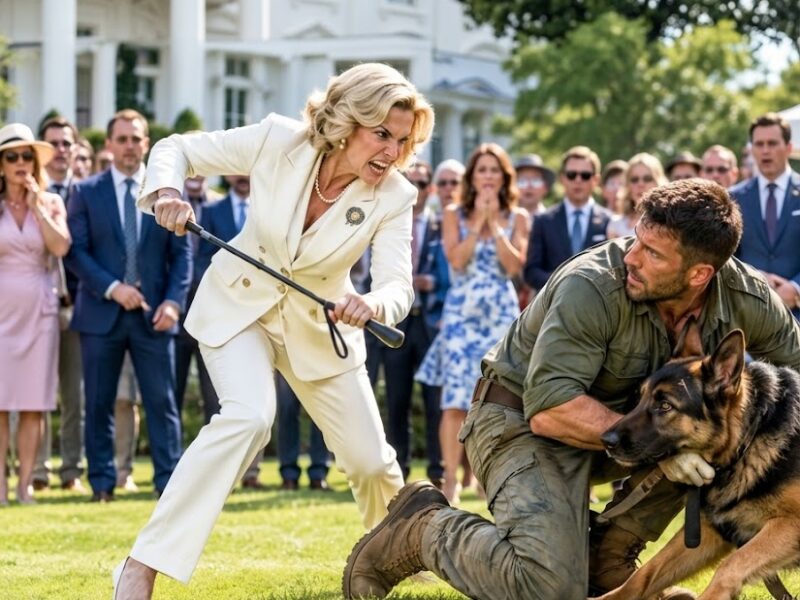
A wealthy woman slapped a German Shepherd at a private event — she had no idea his owner was an active-duty Navy SEAL.
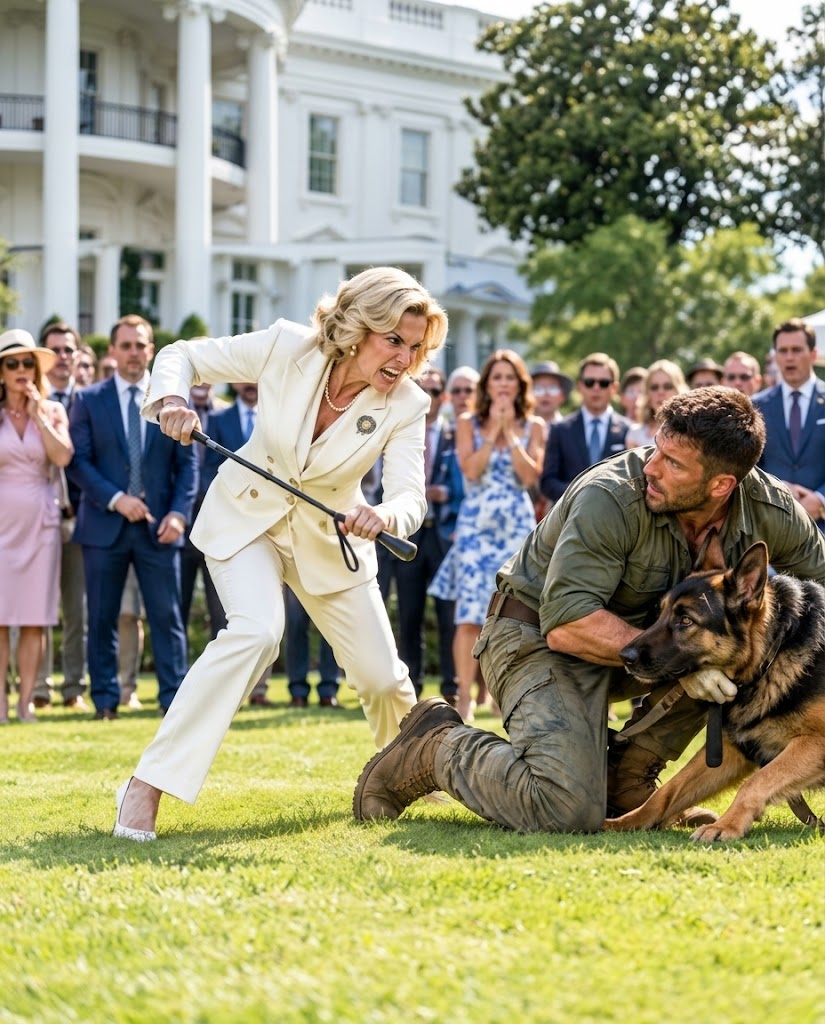
The riding crop came down hard across Blade’s shoulders, and fifty people standing on the manicured grass of the Hartwell Sporting Reserve watched it happen and said absolutely nothing.
Not the event director, not the judges, not a single one of the wealthy men and women who had spent the last three hours praising each other’s champion dogs and expensive gear.
None of them knew who the quiet man in the worn field boots was.
None of them knew what Blade had done in a courtyard in Kandahar Province four years ago, and none of them understood in that still afternoon air that they had just made the worst collective mistake of their comfortable lives.
Reev had arrived at the Hartwell Sporting Reserve just before 8:00 in the morning.
He drove his old Tacoma down the cedar-lined gravel drive, past the sign that read, “Lonear Field Trial Classic. Invitation Only.”
He parked between a gleaming silver truck with a polished dog trailer and a brand new Land Cruiser with a custom kennel built into the bed.
He sat in the cab for a moment.
That was a habit he had not been able to shake, sitting still in a vehicle before moving into an unknown environment, reading it, cataloging the exits and the angles and the flow of people.
He was thirty-six years old, though he looked older around the eyes.
He wore an olive field shirt, worn canvas pants, and lace-up boots that had seen genuine use.
His jaw carried a few days of dark stubble.
He moved the way men move when they have spent years in environments where noise and wasted motion cost lives.
He opened the rear door of the cab.
Blade was already up and waiting.
The German Shepherd stepped down onto the gravel with quiet authority.
He was enormous.
Eighty-five pounds of dense muscle under a black and tan coat that was patchy in two places.
A wide band of scar tissue crossed his right haunch.
A smaller scar notched the base of his left ear.
His dark eyes were calm and absolutely focused.
He pressed his flank against Reev’s leg and scanned the grounds.
Reev clipped on the field lead and they walked toward the registration tent.
The Lonear Field Trial Classic was the most prestigious gun dog event in Texas.
It drew English pointers and setters, Vizslas, Brittanys, and German Shorthaired Pointers.
All of them bred to perfection, groomed to perfection, owned by people who spent more on their dogs’ nutrition plans than most people earned in a month.
The reserve itself was beautiful.
Rolling hill country terrain, live oaks casting shade over the starting lines, white tents with wooden floors set up for the judges and VIP guests.
The stares began at the parking area and did not stop.
A man in pressed khakis walked his Vizsla past them and pulled the dog to the far side of the path without breaking stride.
A woman in a monogrammed vest stopped talking entirely, her eyes moving from Blade’s scarred haunch up to Reev’s plain shirt and back down again.
A group near the water station leaned into each other and whispered.
Reev did not change his pace.
The registration desk was staffed by a young woman named Kelsey.
She had short red hair and a clipboard and the efficient manner of someone who had been on her feet since 6:00 in the morning.
She looked at Blade the way most people in this place did not, with simple curiosity rather than revulsion.
“Checking in,” Reev said.
“Reev. I’ve got the open division slot for the 10:00 brace.”
Kelsey scrolled her tablet.
“Got you right here. And this is Blade?”
“That’s right.”
She handed him the entry packet without any hesitation or commentary.
She was the first person at this event who looked him in the eye.
“Your brace starts at the northeast stake,” she said.
“Judge Whitmore will brief handlers at 9:45.”
“Thank you.”
He walked Blade toward the holding area near the trial course.
The course stretched out across three hundred acres of native grass, cedar brakes, and creek bottoms.
Gun dogs were meant to range wide, find birds, hold their point, and honor the work of their bracemate.
It demanded instinct, discipline, and nerve.
Blade had all three in abundance.
The blanks fired by the judge’s pistol during the preliminary brace hit the air with two sharp cracks.
Blade’s ears flattened instantly.
He dropped his head.
He shifted his weight from paw to paw, his nails scrabbling against the hard ground.
Combat dogs carried their service in their bodies the same way their handlers did.
The stimulus came from nowhere and the nervous system answered before the mind could catch it.
People nearby pulled away.
Reev dropped to one knee.
He did not reach out to calm the dog with a petting hand.
He did not make soothing noises.
He understood that what Blade needed in that moment was not comfort.
He needed a job.
Reev snapped his fingers once, sharp and clean.
Blade’s head came up, his eyes locked on Reev’s face.
“Focus,” Reev said.
It was quiet. Not soft. Firm.
The trembling stopped.
Blade’s ears came up.
His chest squared.
He shifted from triggered animal to deployed operator.
In the span of two seconds, he looked at Reev and waited.
“Hold.”
Blade sat perfectly still.
The people nearby stared.
They had expensive trainers and they had expensive dogs.
None of their dogs had just done that.
They went back to their conversations without acknowledging what they had seen.
People who have never truly needed anything are often allergic to recognizing genuine competence in others.
It disrupts a narrative they have spent a great deal of money maintaining.
A black Suburban pulled into the VIP lot.
A driver opened the rear door.
Porsche stepped onto the gravel in tooled leather boots, cream-colored riding pants, and a jacket with a club crest stitched above the pocket.
She was somewhere in her early fifties, with platinum hair cut to the jaw and eyes the pale color of a winter sky.
She moved with absolute certainty, the way a person moves when they have never walked into a room and wondered whether they belonged there.
At the end of her custom lead was Finch, a champion English Pointer with an orange and white coat that looked freshly painted.
Finch had won the Classic two years running.
Porsche had already determined today would be the third.
She was the founding sponsor of the Lonear Classic.
She had endowed the trophy and funded the expansion of the course.
She treated both facts as a lifetime appointment to authority.
She walked through the holding area with the deliberate pace of an inspection and she stopped when she reached Reev.
She looked at Blade.
She took in the scarring on the haunch, the missing fur, the patchy coat.
She looked at Reev’s worn boots and canvas shirt.
Her expression moved through several stages in the span of three seconds.
“Excuse me.”
Her voice carried the easy volume of someone accustomed to being heard.
“This is the competitor holding area. The public walkway is past the white fence.”
“I’m in the 10:00 brace,” Reev said.
She blinked.
“That brace is invitation only.”
“I have an invitation.”
She looked at Blade again.
“I don’t know who told you this animal was appropriate for a field trial, but I can assure you he’s not.”
She gestured at the dog with her crop.
“Look at him. He’s a liability. This event carries insurance requirements. An animal in that physical condition shouldn’t be near the course.”
“He’s healthy,” Reev said.
“He’s registered and cleared.”
Porsche’s chin came up.
“I’m going to speak with Stuart.”
Stuart was the event director, a thin man in his late forties with a sun visor and the anxious energy of someone who had spent the last decade trying to make Porsche happy.
She found him near the judge’s tent.
The conversation lasted ninety seconds.
Porsche spoke.
Stuart nodded repeatedly.
He walked over to Reev with his clipboard held in front of him like a small shield.
“Sir, I appreciate your interest in the Classic, but—”
“His paperwork is complete,” Kelsey said from behind him.
She had walked over from the registration desk.
She held her tablet out, screen facing Stuart.
“Entry fee paid. Field trial license current. Veterinary clearance on file. He meets every requirement we have.”
Stuart looked at Porsche, then at the tablet, then at Porsche again.
Some men fail, not because they lack the knowledge of what is right, but because they lack the nerve to act on it when it costs them something.
“Mrs. Porsche is the founding sponsor,” Stuart said quietly.
“She has concerns about the—about the optics of this entry.”
“The optics,” Kelsey repeated flatly.
“He stays,” Reev said.
He said it once with the flat finality of a man who had communicated under conditions where a repeated order wasted time nobody had.
He looked at Stuart and did not look away until Stuart looked down at his clipboard.
Porsche studied Reev with cold eyes.
“When your dog fails to complete the course, I’ll make certain you’re not invited back.”
She paused.
“When your dog fails anywhere else in this state, I’ll make certain of that, too.”
She left with Finch moving perfectly at her side.
They called Reev’s brace at 9:58.
He walked to the northeast stake with Blade on lead, unclipped him at the marshal’s signal, and stepped back.
The marshal fired the starting pistol.
Blade did not move like a bird dog.
He moved like something else entirely.
He read the wind with his nose, quartered the ground in clean, systematic sweeps, and covered the terrain at a pace that looked effortless and was devastating in its efficiency.
When he caught scent, a covey of bobwhite holding tight in a grass clump forty yards out, he froze.
He pointed with his entire body, every muscle locked, his right foreleg lifted, his tail ran perfectly straight.
He became in that moment a statue of absolute concentration.
The judges on horseback exchanged a look.
Reev walked in quietly behind him, flushed the birds.
The marshal fired the blank, and Blade held his point through the shot without flinching.
Not a tremor.
Three years in combat had acquainted him with louder sounds.
When the brace ended, one of the ride-along judges wrote something in her notebook and underlined it twice.
Blade’s score was posted on the board twenty minutes later.
It was the highest of the morning session.
A ripple moved through the crowd near the scoreboard.
People stopped pretending not to look.
Porsche did not look at the scoreboard at all.
She stood near the water station with Finch and a group of regular companions, other club founders, a state senator’s wife, two men in matching vests.
She held her riding crop in her right hand and tapped it against her boot in a slow, even rhythm.
There is a particular brand of cruelty that disguises itself as grievance.
It tells itself it is defending something. Standards. Order. A right way of doing things.
What it is actually defending is a self-image so fragile that genuine excellence in the wrong person feels like a personal attack.
Porsche crossed the grass toward the resting area where Reev sat on a hay bale, running his hand along Blade’s back.
She did not come to talk.
She stopped close enough that her shadow crossed Reev’s face.
She raised the riding crop, a heavy leather-wrapped handle with a braided shaft, and brought it down across Blade’s right haunch, directly onto the scar tissue.
The sound was a hard, flat crack.
Blade yelped.
The impact drove his hindquarters into the ground.
His lips pulled back.
His teeth showed for less than a second.
A reflex from an animal that had survived real violence and knew what it meant when something struck without warning.
“Blade!” Reev’s voice was immediate, low and absolute.
“Hold.”
The dog’s mouth closed.
His haunches trembled.
He stayed down.
Porsche stood over them.
Crop raised, chest heaving.
Her expression said she had wanted the dog to snap.
She had wanted a justification.
Fifty people stood on the grass of the Hartwell Sporting Reserve.
Judges. Volunteers. Handlers. Men and women who had spent years discussing the ethical treatment of working animals.
Not one of them moved.
The judges on horseback studied the tree line.
Stuart found something important on his clipboard.
The senator’s wife turned to look at a hawk circling above the far creek.
Kelsey took one step forward, stopped, and looked at the ground.
There is a word for what happens when decent people witness something indecent and choose comfort over conscience.
The word is complicity.
It does not announce itself.
It arrives quietly, wearing the face of prudence.
Reev did not stand up immediately.
He placed his hands on either side of Blade’s face and looked at the dog’s eyes.
He checked the haunch with slow, careful fingers.
He felt the heat radiating off the old scar tissue where the crop had landed.
He felt the muscle bunched and spasming underneath.
The anger came up through him like something physical.
He had spent fourteen years in situations where controlled violence was the appropriate and correct response.
His body knew exactly what to do with this feeling.
He set it aside.
He stood up and looked at Porsche.
He did not raise his voice.
He did not move toward her.
He looked at her the way he looked at a threat he was choosing not to engage.
Fully calm. Without any fear. And without any warmth.
Porsche felt the quality of that look and took a step back before she realized she was doing it.
“Your animal is aggressive,” she said.
Her voice was steady, but she gripped the crop handle hard enough to whiten her knuckles.
“You saw it yourself. He nearly bit me.”
“He didn’t touch you,” Reev said.
“I felt threatened.”
She looked around the crowd, found no validation, and manufactured certainty instead.
“Stuart, get this man off the property.”
Stuart came forward with the expression of a man who would rather be anywhere else on Earth.
“Sir, I think it would be best if you and your dog—for the remainder of the afternoon—”
But Porsche had already turned to Stuart and said two sentences.
One named the amount of the check she wrote to this reserve every year.
The second made clear what would happen to that check if Reev was not removed from the property within five minutes.
Stuart looked at Reev with genuine misery in his eyes.
“I’m sorry,” he said, and he meant it, which made no practical difference at all.
Reev picked up Blade’s lead.
He looked at the crowd, at the judges on horseback, at the scoreboard where Blade’s number sat at the top of the morning column.
He looked at Kelsey, who was blinking hard.
“Come on, buddy,” he said softly.
Blade rose and pressed against his leg.
They walked toward the parking area.
The crowd parted without a word.
The only sound was the wind moving through the live oaks and the distant call of a bobwhite somewhere in the cedar break.
Reev reached the Tacoma and opened the rear door.
He lifted Blade carefully, keeping his hands away from the injured haunch.
He settled the dog onto the blanket in the back seat and stood there with his hand resting on the dog’s side.
Blade looked up at him with his dark, calm eyes.
He was not confused.
He trusted Reev the way soldiers trust each other when they have been through things that cannot be explained to anyone who hasn’t been there.
“We’re done here,” Reev said quietly.
He closed the door.
He walked around to the driver’s side.
He put his hands on the wheel and looked at the cedar trees at the edge of the lot.
He turned the key.
The smoke reached him before he had the truck in reverse.
It was a gray-white column rising from the far side of the reserve.
From the direction of the equipment barn, a large timber-frame structure where the reserve stored its ATVs, gear, and maintenance supplies.
The column thickened as he watched it.
Then the alarm hit.
Reev was already out of the truck.
He pulled Blade from the back seat.
The dog hit the gravel and his nose went up immediately, reading the smoke on the wind.
He was not afraid of fire.
He had been trained to work in environments far worse than burning timber.
His body shifted into something focused and still.
They ran toward the barn.
The fire had started in the feed room, an electrical fault in the rear wall, as investigators would later confirm.
The main barn doors stood open and smoke poured out in dense rolling waves.
Flames were visible through the gaps in the siding near the back.
The event’s two-person security team stood at the entrance shouting at people to stay back, which nobody was doing.
Porsche arrived at a dead run.
It was not something anyone at this event had ever seen her do.
Her riding jacket was gone.
Her platinum hair was loose.
She was screaming a name.
“Max! Max!”
Max was eight years old.
He had spent the morning bored at the field trial and had wandered over to the equipment barn because there were four-wheelers inside and four-wheelers were interesting.
He had been in the back room when the fire started.
A volunteer grabbed Porsche’s arm to keep her from running into the smoke.
She wrenched free and got three steps toward the doors before the heat drove her back.
She dropped to her knees in the gravel and screamed his name again.
The first fire engine from the county was six minutes out.
The dispatcher had confirmed it.
Six minutes was a reasonable response time under normal conditions.
Under these conditions, with a timber-frame barn fully engaged at the rear and a child somewhere inside, six minutes was an enormous stretch of time.
Reev had already assessed the structure.
He crouched next to Blade.
He cupped the dog’s muzzle in both hands and looked at him directly.
He pointed to a small blue jacket that had fallen near the entrance.
Max had shed it in the heat.
“Seek,” Reev said.
“Find.”
Blade dropped his nose to the jacket for three seconds.
Then he raised his head, read the air, and moved.
He did not run.
He moved low and steady.
The way he moved in confined spaces where speed was less important than precision.
He went through the south wall’s narrower side door where the smoke was thinner.
He disappeared into the gray.
Reev followed him.
He pulled his field shirt over his mouth and kept low.
The heat was significant.
The rear wall was fully involved.
Visibility dropped to eight feet.
Blade worked in silence.
He crossed the main floor, past the ATVs, past the overturned tool rack, past the burning rear wall where the fire had begun eating through the timber framing.
He turned toward the tack room on the left side, a smaller enclosed space with a heavy door pushed mostly shut.
He stopped at the door and sat.
Reev hit the door with his shoulder.
It swung open.
The smoke inside was dense, but the fire had not reached here yet.
Max lay on the concrete floor near the back wall, unconscious from the smoke, curled against the baseboard where the air was fractionally cleaner.
Reev crossed to the boy in four steps.
He scooped him up and turned for the door.
Blade was already moving back toward the side entrance, low and fast.
He knew the route.
He had memorized it going in.
They came out through the side door, and the fresh air hit them like cold water.
Reev moved twenty yards from the structure and laid Max on the grass.
He checked his airway. Breathing, shallow but moving.
He looked up and said one word to the nearest person.
“Paramedic.”
People ran.
The county fire engine rolled through the reserve gate ninety seconds later.
Two paramedics jumped from the second truck.
They reached Max, assessed him quickly, and had him on a gurney and into oxygen in under three minutes.
Porsche was already there.
She fell over her son and held his face in both hands.
Whatever she said to him was too quiet to hear.
Max’s eyes opened.
He coughed.
He looked past his mother’s shoulder and found the large dog sitting in the grass six feet away, watching him with dark, steady eyes.
“Is that the dog?” Max whispered.
Porsche turned.
She looked at Blade.
She looked at the raw redness across his haunch where the crop had landed.
She looked at the singed fur along his back where he had moved close to the fire.
She had no words.
The architecture of everything she believed about herself was quietly coming down around her, and she sat in the rubble of it without making a sound.
A county sheriff’s vehicle pulled into the reserve.
Deputy Hargrove stepped out, a broad-shouldered woman in her mid-forties who moved with the same economy of motion that Reev did.
She gathered information from the paramedics and the fire captain in quick professional exchanges.
Then she saw Reev.
She looked at him for a moment with her head tilted slightly.
The way a person looks at someone they are fairly certain they recognize but need one more second to place.
“Senior Chief Reev,” she said.
He looked at her.
He recognized her from a joint operation briefing in another state, another life.
She had been Army then, before she transitioned to county law enforcement.
“Hargrove,” he said.
She nodded once.
Then she looked at Blade.
She looked at the welts on the dog’s haunch.
The ones that were not from the fire, the ones with the distinct mark of a leather crop.
“Who did that?” she asked.
Her voice was entirely even.
Nobody answered immediately.
Then Stuart stepped forward.
He was pale and had clearly made a decision that had cost him something.
“Mrs. Porsche,” he said, and pointed.
“During the event, she struck the dog with her riding crop. I witnessed it. Approximately fifty other people witnessed it.”
Hargrove turned and looked at Porsche.
Porsche was still kneeling beside the gurney.
She had her son’s hand in both of hers.
She looked up at the deputy with eyes that were red-rimmed and had nothing left in them that resembled authority.
“I didn’t know,” she said.
“A military working dog,” Hargrove said, “is protected under federal statute, same as a law enforcement K9.”
“Assault of an MWD carries a federal charge.”
She paused one beat.
“That’s before we add the state animal cruelty statutes.”
Porsche looked at her son, then at Blade, then at her hands.
“I’ll cooperate,” she said quietly.
“Whatever you need.”
The reserve’s executive director, a lean man named Carl who had driven from San Antonio the moment the emergency notification hit his phone, arrived while the fire crews were wetting down the barn’s remains.
He spoke with Hargrove, then with Kelsey, then with three of the event judges who came forward of their own accord to provide statements.
He found Stuart and listened to the director’s full account without interrupting once.
Then he walked over to where Reev sat on the tailgate of his Tacoma, working debris out of Blade’s coat with a careful hand.
Carl introduced himself.
He did not extend his hand.
He read the moment and understood that a handshake was not what was needed here.
“I’ve been briefed on everything that happened today,” he said.
“I want to apologize directly. What was done to your dog was inexcusable. We’re covering whatever veterinary care he needs in full. And we’re also looking at the staffing decisions that allowed a guest to remove a legitimate competitor from the grounds.”
Reev looked up.
“Take care of the girl at the registration desk. She did the right thing when nobody else would.”
Carl nodded, already noted.
Reev went back to tending to Blade.
The German Shepherd’s eyes were half-closed.
He was tired.
It had been a long day, and his haunch hurt, and he had run through a burning building, which even for a dog with his resume was a significant thing.
“The invitation stands,” Carl added, “for next year and any other year. No conditions.”
Reev did not respond to that.
He ran his hand along the dog’s scarred flank and felt the muscle ease under his touch, the way it always did when they were close and quiet and the work was finished.
Society often mistakes the trappings of status for the substance of worth.
It is an error that costs nothing until the moment it costs everything.
Then the ledger corrects itself with a brutality that no amount of money can negotiate away.
Porsche sat in the back of Hargrove’s vehicle.
Her son was being treated at the scene and would be fine.
That was the thing she was allowed to hold on to.
Blade lay on the blanket in the back seat of the Tacoma, his nose twitching at intervals as the evening breeze moved through the cedar trees.
Reev drove out of the Hartwell Sporting Reserve as the last of the smoke dissolved into the pale Texas sky.
He drove without the radio on.
This narrator has watched a great many things unfold in places built by people who believe their money made them permanent.
They are never permanent.
The walls they build are always, in the end, the walls they are trapped behind when the real emergency arrives.
What no one in that crowd expected was the dog.
Not the soldier.
People have built enough stories around soldiers that they have learned to hold them at a comfortable distance, to admire from a row of folding chairs, to thank briefly and then turn back to their iced tea.
The admiration is real enough.
It just doesn’t move anyone’s feet.
The dog moves differently.
Blade did not save Max because the boy deserved it more than anyone else.
He did not save him because grace was owed or because the ledger needed balancing.
He saved him because Reev pointed and the dog trusted Reev and there was a child alive on the other side of the smoke.
That is the whole of it.
That is everything.
Reev reached the highway and turned south.
The cedar brakes gave way to open country.
The evening light came in low and golden across the dashboard and caught in the dust on the windshield and made the world look for a moment like something worth the cost of protecting.
He reached back and rested his hand on Blade’s head.
The dog’s tail moved once, slow and certain, the way it always did.
They drove on.
—
*End of Part 1. The story continues with the aftermath—the federal investigation, the community’s reckoning, and the quiet heroism that changed everything.*









