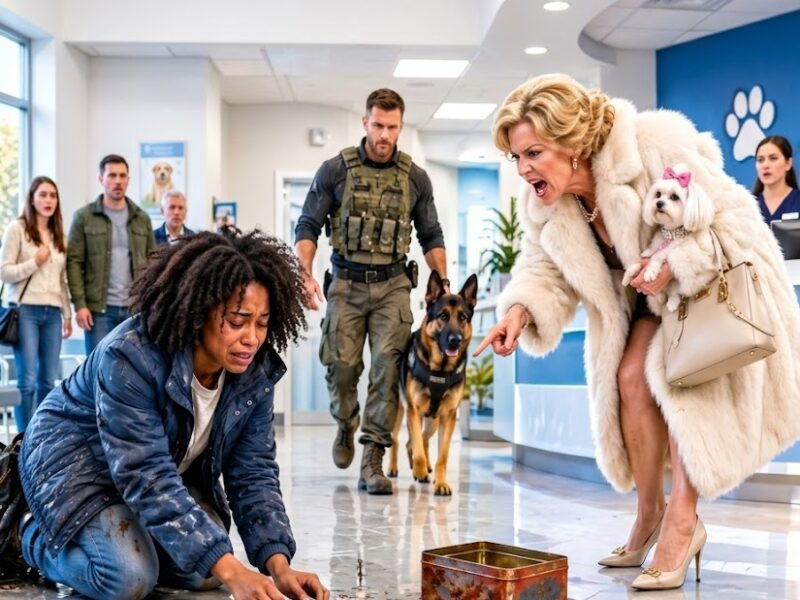
A wealthy woman humiliated a poor Black student at the vet clinic — until a Navy SEAL and his dog walked in and shut it down cold.
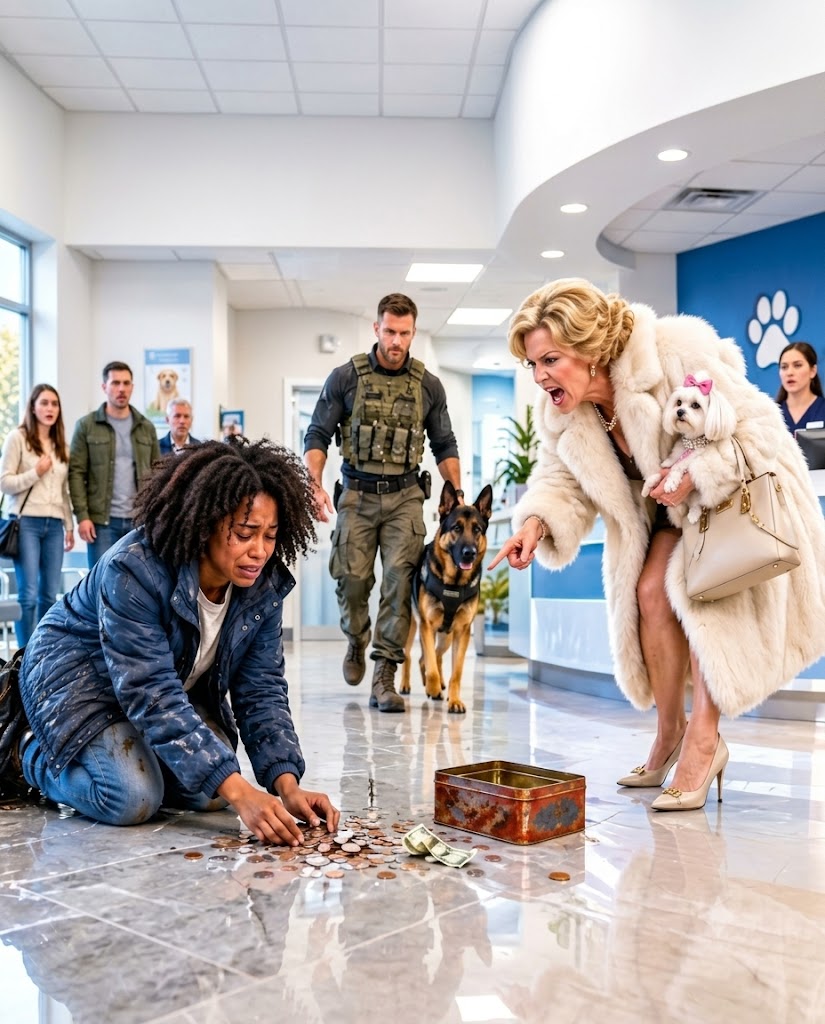
The rusted tin hit the marble floor like a gunshot.
Coins erupted in every direction — quarters, dimes, nickels, pennies bouncing and skipping and spinning across the bright white tile of the Harborview Animal Hospital waiting room in Charleston, South Carolina.
A crumpled five-dollar bill drifted down slow and landed in a puddle of rainwater near a woman’s expensive heels.
The woman did not step back to let it rest.
She shifted her weight forward and let her boot sole press the wet bill flat against the floor.
Imani dropped to her knees.
She was twenty-one years old, a pre-nursing student at the College of Charleston, five feet four inches of quiet exhaustion in a second-hand rain jacket that hadn’t been dry since Tuesday.
Her dark locks were plastered flat against her neck.
Her sneakers squeaked with every step she took across the polished floor.
She had run six blocks through a December rainstorm because the bus didn’t come and she couldn’t spare the ride-share fee.
She had not eaten since yesterday afternoon.
On the reception counter above her, her dog Peanut lay curled on the white surface shaking.
Peanut was a seven-pound Beagle mix with caramel and white fur.
Imani had adopted him from a shelter three years ago, the week she’d moved into her first apartment and cried for four straight hours from loneliness.
He had pressed his small warm body against her leg and slept there the entire night.
She had not felt alone once since then.
Tonight, she’d come home from her second shift of the day — four hours cashiering at a pharmacy after six hours stocking shelves at a warehouse — and found him collapsed on the bathroom tile, eyes glassy, breathing shallow and fast, belly swollen in a way that made her stomach drop.
She had wrapped him in her only dry towel and run.
The receptionist’s name tag read Wendy.
Wendy had looked at Imani the way people look at a spill on a new carpet — polite surface, real annoyance underneath.
She’d quoted the emergency consultation fee, one hundred sixty-five dollars paid upfront, non-negotiable.
She’d watched without expression as Imani pulled a tin cookie box from her wet backpack.
The same tin that had held peanut brittle the Christmas before, now repurposed as her emergency savings, and began counting out bills and coins on the spotless counter.
Imani had gotten to one hundred forty-eight dollars.
She needed seventeen more dollars.
She was still explaining, still begging Wendy to let the vet at least look at him, still promising she could come back tomorrow with the rest, when the door opened behind her.
The smell of cold air and expensive perfume rolled into the waiting room together.
Her name was Cecily.
She walked in like she owned the building, which if she didn’t, it wasn’t for lack of funds.
She wore a cream-colored fur coat that swept her calves.
Her rings caught the light.
A small Maltese with a painted toenail and a rhinestone collar rode in the crook of her arm like a clutch bag.
She was somewhere in her late fifties and carried herself with the particular confidence of a woman who had never once in her life been told to wait.
She did not acknowledge Imani.
She sailed directly toward the counter.
“Wendy, sweetheart.”
Her voice was the kind of smooth that comes from years of charity galas and country club lunches.
“I have Duchess’s conditioning appointment. I know we’re a few minutes early, but the parking was absolutely terrible. Can we get started?”
Wendy’s entire posture changed.
The stiff professionalism dropped away.
A real smile appeared.
“Of course, Mrs. Aldgate. We’ll get Duchess right in. Just let me clear the desk.”
That was when Cecily finally looked at Imani.
She looked the way people look at something they don’t want to touch.
Her eyes moved from the wet sneakers to the battered backpack to the coins still piled on the counter.
Her nose wrinkled almost imperceptibly.
She took one precise step to the side, angling her body away.
“I’m sorry,” Cecily said, not sounding sorry at all. “Are you still here?”
Imani did not look up.
“I just need a minute.”
“This counter is being used, dear.”
Cecily set her expensive leather bag on the surface with a deliberate thud.
She positioned it squarely beside Imani’s tin.
“Some of us have actual appointments.”
Peanut let out a low, pained whimper.
Imani reached out and touched his flank.
Her hand was shaking.
“He’s really sick. I’m almost done counting.”
Cecily looked at the coins.
She looked at the crumpled bills.
She looked at Imani kneeling on the floor, still damp from the rain, eyes red from crying before she even got to the clinic, and Cecily smiled.
It was a slow smile, the kind that does not reach the eyes.
“Honey.”
She said the word gently, the way people use gentleness as a weapon.
“If you can’t afford a vet bill, you should not have a dog. That is not an insult. That is simply the truth. These animals require resources. If you picked up a stray to feel good about yourself, that’s sweet, but the rest of us shouldn’t have to accommodate your financial reality.”
The words landed one by one.
Imani felt each one.
She had heard variations of this her entire life.
In grocery stores when she counted change at the register.
In financial aid offices when she explained why she couldn’t pay the campus housing deposit.
In professors’ offices, when she asked for an extension because her night shift had run four hours long.
She had developed a skin for it, a necessary callus.
But tonight her dog was sick.
Tonight she was soaked and starving and eight dollars short.
Tonight the callus wasn’t thick enough.
“I take care of him.”
Her voice came out quieter than she intended.
“I take better care of him than most people take care of anything they love.”
Cecily laughed.
It was a short, bright sound.
“That is adorable.”
She turned back to Wendy and began describing Duchess’s upcoming grooming schedule.
Imani reached for her tin box.
And then, whether Cecily moved her bag on purpose or simply didn’t care enough to be careful, the leather bag swept sideways and caught the edge of the tin.
The tin went off the counter.
Every coin Imani had saved over six weeks of skipped lunches and extra shifts scattered across the marble floor in a wide, ringing arc.
The sound bounced off the walls, off the high ceiling, off the faces of the other people in the waiting room who had been watching quietly from their chairs.
None of them stood up.
Cecily glanced down.
“You should pick that up before someone slips.”
Something cracked inside Imani that she had been holding together for a long time.
She put her hand on the floor to steady herself.
She started to crawl toward the nearest coins.
Her jeans soaked through instantly where the wet had pooled on the tile.
She picked up a quarter, a dime, a soaked penny with Lincoln’s face pressed against the grout.
She kept her head down.
If she looked up, she would cry.
If she cried in front of this woman, she would never stop.
The waiting room remained silent.
Then a sound moved through that silence, slow and even and heavy with purpose, the measured fall of thick boot soles on marble.
Bryce had been sitting in the far corner of the waiting room for twenty minutes, waiting to have Halo’s left rear paw checked after a long training hike two days ago.
He was thirty-three years old, active duty Navy SEAL on ten days of leave.
He had the kind of stillness that combat builds in a person, not calm exactly, but controlled.
Everywhere he went, some part of him was already doing threat assessment, reading the room, categorizing.
He had been reading this room since the moment the woman in the fur coat walked in.
He stood up.
Halo rose with him.
The German Shepherd was black and tan, heavily muscled, with a tactical harness, and the focused attention of a dog that had worked real operations.
His name meant something specific to Bryce.
On their first overseas deployment, Halo had found a buried pressure device forty feet ahead of the team and sat down in the path, calm as stone, waiting for Bryce to see him.
That dog had put a circle of protection around every man on that patrol.
The name fit.
Halo walked at Bryce’s left side, step for step, as Bryce moved across the waiting room toward the scattered coins.
He stopped a few feet from Cecily.
She looked at him the way wealthy people sometimes look at soldiers, with a thin layer of admiration papering over the baseline assumption that social class determines who gets deference in a room.
She took in the military cut hair, the worn jacket, the massive dog.
She adjusted her Maltese in her arms.
“Excuse me,” she said, “this doesn’t involve you.”
“It does now.”
Bryce’s voice was level, not loud, not hostile, just absolutely certain.
He looked at Imani.
She had stopped crawling.
She was looking up at him with the raw, disbelieving expression of someone who has been invisible for so long that attention of any kind feels like a mistake, like it must be meant for someone else.
Bryce stepped around Cecily and crouched down to the floor.
He reached out and picked up a handful of coins.
He placed them carefully into the tin, which had landed open on its side.
“Hello.”
The German Shepherd moved immediately.
He walked forward, placed his body between Imani and Cecily, and sat.
His head was up.
His eyes were fixed on the woman in the fur coat with the steady, unblinking attention of an animal trained to neutralize threats.
Cecily stepped back sharply.
“Get that dog away from me.”
“He’s not touching you,” Bryce said. He kept gathering coins, unhurried. “He’s just standing there. Like everyone else in this room should have been doing ten minutes ago.”
“I am a paying client of this establishment. I have been coming here for six years. I spend—”
“I don’t care.”
Bryce stood up to his full height.
He looked at Cecily without anger and without drama.
Just the calm, total attention of a man who has looked at genuinely dangerous things and learned to distinguish them from people who only believe they are.
“You knocked her money onto the floor. You’re going to pick it up.”
Cecily’s face went through several expressions in quick succession.
“I most certainly am not.”
“Then you’re going to stand here and watch me do it. And everyone in this room is going to watch you watch me. Your choice.”
Silence.
One of the seated pet owners, a man in a gray coat holding a cat carrier, quietly stood up.
He walked over and crouched down.
He started picking up dimes.
He didn’t say anything.
He just started picking them up.
A teenage girl in the corner got up next.
Then a woman in her forties.
Cecily looked around the room.
The audience she had assumed was safely on her side had rearranged itself.
The air had changed.
She was no longer in charge of this room’s gravity.
Someone else was.
“This is absurd,” she said, but her voice had lost something.
Bryce had finished gathering the last of the coins.
He set the tin on the counter beside Peanut.
He looked at Cecily with the same flat patient expression.
“Apologize to her.”
“I did not do anything that requires—”
“You told her she shouldn’t own a dog.”
His voice dropped to barely above a whisper, which somehow made it carry better than a shout.
“You called her financial situation a choice she made on everyone else. Then you knocked her savings on the floor. Apologize.”
The waiting room held its breath.
Cecily was a woman who had not apologized under pressure in a very long time.
The muscles around her jaw worked.
Her Maltese shifted in her arms and let out a small nervous sound.
She looked at Imani, who was on her feet now, hand resting on Peanut’s back, watching this unfold with wide exhausted eyes.
“I’m sorry,” Cecily said, flat, reluctant, barely enough. “I may have been harsh.”
There is a particular kind of victory that does not look like triumph.
It looks like relief.
It looks like a person whose shoulders dropped two inches, as if someone has just removed something heavy from them.
Imani nodded once.
She didn’t smile.
She turned back to Peanut.
Cecily walked to the far end of the counter and stood there in silence.
She did not make eye contact with anyone.
Bryce pulled a card from his wallet.
He set it on the counter in front of Wendy.
The receptionist looked at it, then at him, then at Imani.
“Run it for her consultation,” he said, “and the medication, whatever he needs tonight.”
Imani spun around.
“No, you can’t do that. I don’t know you. I can’t—”
“You can.”
He met her eyes.
His were gray-blue and steady.
“Let someone help you tonight.”
Peanut let out a thin, rasping cough.
They both looked at him.
Imani looked back at Bryce.
Her throat worked.
She didn’t say anything.
She gave a small, tight nod.
The vet, Dr. Keen, silver-haired and efficient, came out within three minutes of Wendy’s call.
She examined Peanut with careful hands, took his temperature, pressed gently on his abdomen.
She told Imani he had a gastrointestinal obstruction and needed an overnight stay and IV fluids and medication.
She was direct and kind.
She told Imani the dog was going to be okay.
Imani pressed her face into Peanut’s fur before they took him to the back.
Bryce stood a few feet away, giving her room.
Halo sat at attention beside him.
When the vet techs disappeared through the back door with the small caramel dog, Imani turned around.
She looked like someone who had just been held underwater for a long time and finally surfaced.
“Thank you,” she said.
It came out rough around the edges.
“Don’t thank me.”
He picked up his military jacket from his waiting room chair and draped it over her wet shoulders without ceremony, the way you hand someone an umbrella in the rain.
“You were fighting for him. All I did was stand next to you while you did it.”
She gripped the lapels of the jacket.
It smelled like cedar and cold air and clean wool.
“I’m Imani.”
She said it like she was offering something.
“Bryce.”
She looked up at him.
“Why did you do this? Nobody does this.”
He was quiet for a moment.
Not because he didn’t have an answer, because he was choosing the right one.
“What are you studying?” he asked instead.
She blinked.
“Pre-med. Pre-nursing, actually. I want to design better prosthetics. Biomedical engineering, eventually. That’s the plan, anyway.”
A short, exhausted laugh.
“If I can keep the lights on long enough to get there.”
He nodded.
Like she had said something that made sense to him.
Like she was exactly the kind of person the world needed more of, and he already knew it without knowing her at all.
“Don’t drop the plan,” he said.
“Keep the lights on. The people who make it to where you’re trying to go are the ones who don’t give themselves permission to stop.”
He gave Halo a quiet command.
The dog stood and fell into step beside him.
Bryce walked out through the glass doors into the December rain without looking back.
Imani stood in the waiting room of Harborview Animal Hospital with a stranger’s jacket around her shoulders and seventeen dollars of coins in a battered tin and an enormous, aching sense that something important had just happened.
Though she could not yet name what it was.
She did not know his last name.
She did not know his unit or where he was stationed or where he went when the doors closed behind him.
She only knew she was going to remember this night for the rest of her life.
Some moments don’t announce themselves.
They arrive quietly, looking like emergencies.
Then they stay forever.
—
Eight years is a long time.
Long enough to earn a degree and then another.
Long enough to found a company in a spare bedroom and move it to a real office and then to a building with your name beside the door.
Long enough to lose a dog you loved and carry the grief quietly and let it remind you what matters.
Imani Adeyemi was twenty-nine now, chief executive of Meridian Medical Technologies in Raleigh, North Carolina.
A firm she had built from a senior thesis project on neural interface prosthetics into a forty-person company with two pending FDA submissions and a reputation for doing work that actually reached the people who needed it most.
She still thought about that night in Charleston.
She still had the jacket.
She kept it in the bottom drawer of her desk at the office, folded in a cloth bag.
She had brought it with her from her dorm room to her first apartment to every office she had ever occupied.
It was her compass.
On the nights when the board wanted to push her toward the profitable path instead of the right one, she opened the drawer and looked at it.
She was looking at it the morning her assistant, Omar, walked in with the morning intake files.
“Financial screening came back on the trial candidates,” Omar said.
He set a thin stack of folders on her desk.
“Eleven candidates passed physical qualification. Four cleared the financial threshold. Seven were declined.”
“Leave the declined stack.”
He set it down and left without asking why.
He had worked with her long enough to know.
Imani pulled the first declined folder.
She read through the summary.
Suitable nerve density. Good muscle preservation. Insufficient personal funds for experimental hardware.
She moved to the second, then the third.
The fourth folder had a photograph clipped to the inside cover.
She stopped.
The man in the photograph was sitting in a wheelchair.
His hair was cut close.
His face was harder than she remembered.
Older, weathered by years she hadn’t witnessed.
His eyes were gray-blue and pointed off-camera with the same flat, self-contained attention she had seen in a veterinary waiting room on a winter night a long time ago.
Beside the wheelchair, a large German Shepherd sat at attention.
The dog’s muzzle was grayer now, but the harness was the same.
Imani sat very still for a moment.
Then she read the file.
Bryce Harlan, thirty-seven, formerly Commander, Naval Special Warfare Command.
Medically separated eight months ago following a combat injury in the Kandahar province.
A buried IED during a hostage extraction.
He had gotten the hostages out.
He had thrown his dog clear of the blast radius.
He had not gotten himself out in time.
The lower half of his right leg was gone.
The standard prosthetic was incompatible with his residual anatomy.
He was in constant pain.
He had declined three follow-up surgical consultations.
The VA records noted significant depressive withdrawal from daily activity.
He had driven up from Jacksonville for his Meridian evaluation that morning.
Physical qualification, exceptional.
Financial qualification, declined.
The paperwork was already stamped.
Imani stood up so fast her chair rolled back and hit the credenza.
“Omar!”
Her voice carried through the glass wall of her office.
Omar appeared in the doorway immediately.
He took one look at her face and straightened up.
“Where is this patient right now?”
She held up the folder.
Omar checked his tablet.
“He just left the evaluation suite on three. He’d be heading to the parking garage.”
“He drove up from Jacksonville. That’s about five hours. If he’s already in the elevator, stop him.”
“Mrs. Adeyemi, the board is—”
“I don’t care what the board is doing. Get someone to the parking garage right now. Do not let that man drive away from this building.”
Omar was already moving.
Imani reached into the bottom drawer of her desk.
She pulled out the cloth bag.
She unfolded the jacket — olive green, worn at the cuffs, cleaned more times than she could count.
She held it against her chest for a moment with both arms.
Then she walked out of her office and waited.
The parking garage was three stories of fluorescent concrete.
Bryce had loaded himself back into his modified truck with the slow, deliberate movements of a man who had learned to conserve energy because pain was a fixed cost he could not eliminate.
He had the door open.
He had his hands on the frame.
A young man in a pressed shirt came sprinting across the concrete breathing hard, waving one arm.
“Commander Harlan, please, we need five minutes.”
Bryce looked at him without expression.
“I signed the declination form.”
“Mrs. Adeyemi would like to speak with you personally. She asked us to stop you before you left.”
The young man put his hands on his knees.
“She said it’s important. She said five minutes.”
Bryce closed his truck door.
He was not the kind of man who believed in miracles.
He had stopped believing in them somewhere around his third deployment.
But he was also not the kind of man who drove five hours somewhere just to turn around without hearing what someone had to say.
“Five minutes,” he said.
The executive floor smelled like clean air and coffee.
The kind of office that had been designed to make people feel the weight of money without being vulgar about it.
Bryce rolled his chair into the center of the space and looked around.
Then, Halo did something he almost never did.
The German Shepherd, older now, gray at the ears, but still carrying himself like a soldier, broke position.
He trotted across the carpet toward the woman standing near the window.
He stopped behind her and pressed his nose against her hand and made a sound that Bryce had only ever heard him make in the quiet after operations, when the danger was over and the world had gone safe again.
The woman turned around.
She had the same dark locks, pinned back now.
The same eyes, but older, steadier, carrying something behind them that looked like everything she’d built and everything it had cost.
She wore a tailored blazer and good shoes, and she stood like someone who had learned to take up space in rooms that were designed to exclude her.
She was smiling, but she was also blinking hard.
Bryce looked at her for a long moment.
He searched her face the way he searched unfamiliar terrain, looking for the thing that told him what he was actually dealing with.
It took him ten full seconds.
Then, he knew.
“Imani,” he said.
Her name came out quiet, like something he had kept somewhere and hadn’t expected to need.
She walked around her desk.
She held out the jacket — his jacket, his actual jacket, clean and folded with the same care someone gives to something they have treated as sacred.
She held it out to him with both hands.
“I told you I’d track you down,” she said.
Her voice was rough at the edges.
“Eight years is longer than I planned, but I kept my word.”
Bryce stared at the jacket.
He looked at her.
He looked back at the jacket.
“You built this company. You told me not to stop.”
She set the jacket on his lap and took one step back.
“I design neural prosthetics because I wanted to help people who fell through the cracks. People the system priced out. People who got there too late or didn’t have the right insurance or couldn’t fill the gap.”
She paused.
“I didn’t know it would be you, but when I saw your file this morning, I understood why I built it.”
Bryce looked down at his right leg, at the space below the knee where nothing was anymore.
His jaw tightened.
“Imani, what you’ve built is worth something. This company is worth something. I’m not going to let you compromise that for—”
“You’re not compromising anything.”
She pulled a folder from under her arm and opened it to the last page.
Her signature was already on the line.
“I approved your file ninety minutes ago. Full sponsorship from my personal equity. The hardware, the surgery, the neural calibration, twelve weeks of adaptive rehabilitation, everything.”
He stared at her.
“That’s close to a million and a half dollars.”
“It’s a debt with interest.”
She dropped to one knee on the carpet.
Without ceremony, without drama, the way he had once crouched on a cold marble floor to pick up her pennies, she looked him in the eye.
“Peanut lived five more years after that night. He slept on my feet every night until he couldn’t anymore. I finished my degree because you told me to. I built this because he needed somewhere to put all of it.”
Her voice broke slightly and she let it break.
“You didn’t leave me on that floor. I’m not leaving you in a parking garage.”
The silence in the office was the kind that holds something important inside it.
Halo walked over and rested his gray muzzle on Bryce’s knee.
Bryce looked at the dog.
He looked at the woman.
He looked at the jacket on his lap, that faded, careful, improbable thing she had carried across eight years and two lives and kept ready for this exact moment.
The hardened places in him, the ones built by fifteen years of war and eight months of loss, did not crumble all at once.
But something in them shifted.
Something let go.
He pressed his fist against his mouth.
He turned his face slightly to the side.
The way people do when they are trying to hold something in and failing.
He didn’t hold it in.
The tears came quietly.
No sound, no shaking, just the slow, honest release of a man who had been holding his jaw tight for a very long time against a weight too large to carry alone.
Imani put her hand on his shoulder and left it there.
She didn’t say anything.
She just stayed.
Outside the windows of Meridian Medical Technologies, Raleigh moved through its ordinary Tuesday morning.
Traffic lights cycling, coffee cups handed through drive-thru windows, a thousand unremarkable acts of people moving through their lives.
None of them knew that upstairs, on the executive floor, two people who had each once been at their lowest point were sitting together in the aftermath of everything it had taken to get them here.
This is what the narrator has come to believe after watching how this story unfolded across eight years and two cities and a dozen hard winters.
Kindness does not disappear.
It moves.
It changes form.
It passes from person to person in the dark, carried forward by the ones who received it at the exact moment they needed it most until it arrives, transformed, multiplied, impossible, right back at the door of the person who sent it out.
Bryce had stepped forward in a veterinary waiting room because a girl was on her knees on a cold floor, and he was the only one willing to stand up.
He had not done it to be repaid.
He had not done it because he expected anything in return.
He had done it because he was built to protect people.
And protection is not something you switch off when the uniform comes off.
And Imani had built a company that healed people because a stranger had once crouched on the floor beside her and showed her that someone thought she was worth the effort.
That is the full length of the circle.
That is how far a single act of decency can travel.
—
Six months later, Bryce stood at the edge of the Raleigh Waterfront Park on a cool March morning.
The new leg was carbon fiber and warm metal and something remarkable.
Responsive in ways his nervous system recognized, connected in ways that felt, on good days, almost biological.
Not perfect.
Nothing was, but enough.
More than enough.
He started walking.
Halo trotted beside him, gray muzzle, steady eyes, same dog.
After a few hundred feet, Bryce picked up his pace, then more.
He was not running yet, but he could feel it, the possibility of it somewhere ahead of him in the morning air.
He thought about a girl on her knees in a veterinary clinic, gathering her coins from the floor while the room watched and did nothing.
He thought about how she had looked at him when he walked over, like she was not sure he was real.
He hoped he had looked something like that this morning standing in her office holding an old jacket.
Learning that the world had been paying attention all along, just on a longer schedule than he’d expected.
The path curved along the river.
The sun came through the trees in long slanted bars of light.
Bryce walked forward into it and Halo walked with him.
And for the first time in a very long time, neither of them was heading into anything that felt like darkness.









