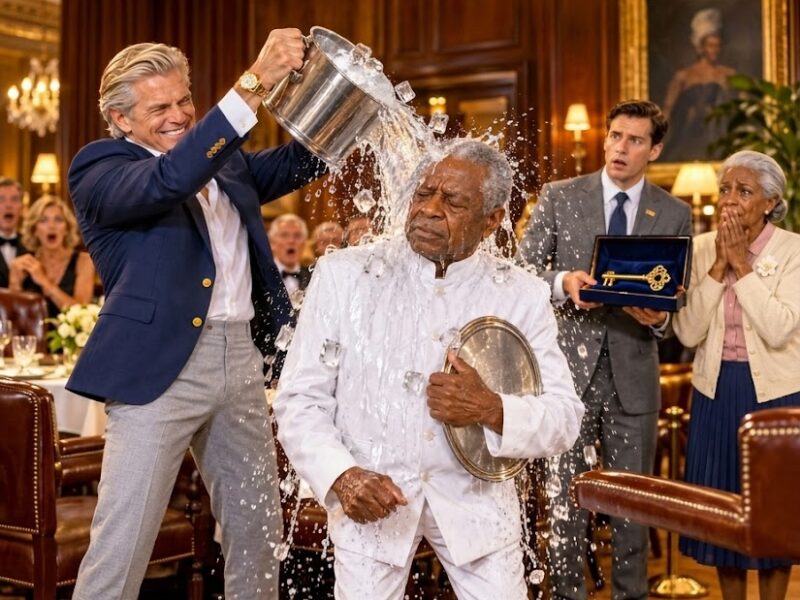
A Wealthy Guest Smiled While Drenching an Elderly Black Waiter—Minutes Later, the Board Introduced Him as the New Owner
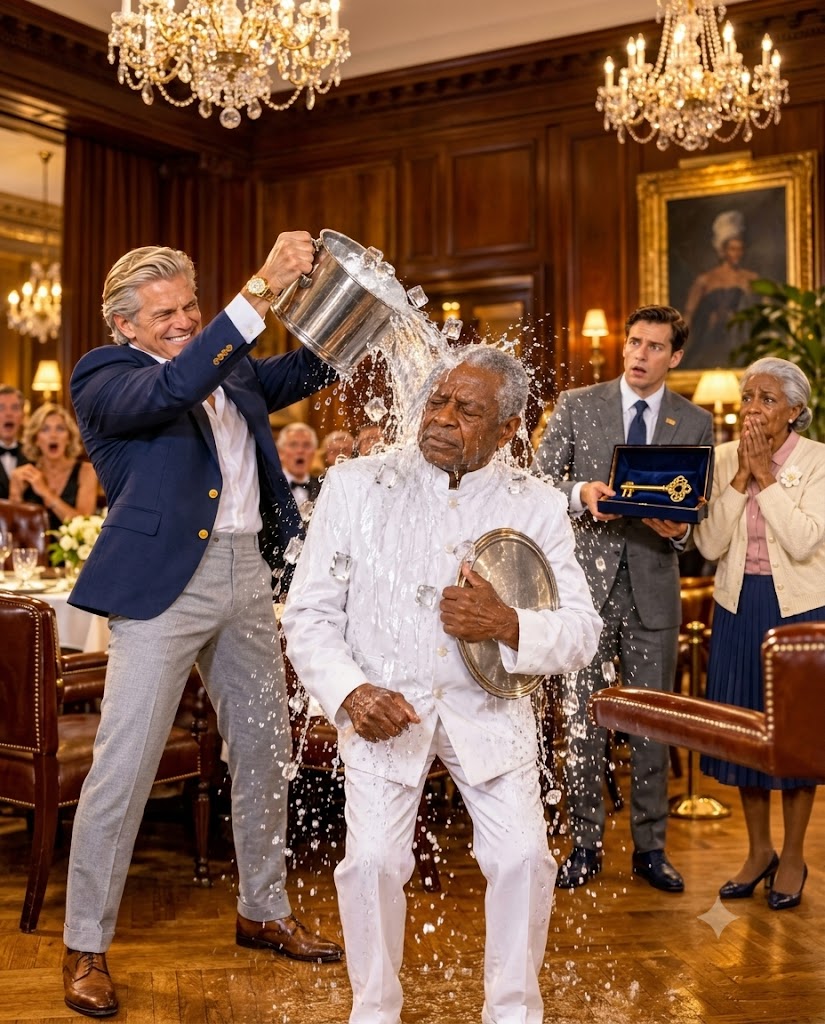
The ice water hit Harold’s chest like a fist.
It spread fast through the white cotton uniform, plastering the fabric to his skin, and he felt it run down his ribs and soak into the waistband of his trousers. The glass rolled across the terrace stones and stopped against a chair leg with a small, polite clink.
Grant Pierce was still smiling.
That was the thing Harold would remember later — not the cold, not the humiliation, not the way the whole terrace had gone silent — but the smile. Wide and easy and completely untouched.
“Oops,” Grant said.
—
Harold stood very still.
Sixty-seven years old, six days into a temporary server job at a club he had owned for three months, and he stood there dripping while four hundred members of the Briarwood Country Club pretended not to watch. A woman at table nine put her hand over her mouth. A man at the bar turned his back.
The June sun was warm on Harold’s shoulders, but the water was cold.
“Mr. Pierce,” Harold said.
“Harold, right?” Grant straightened his tie. “The agency sent you. Temporary. Six days through Saturday.”
“Yes, sir.”
“You know what you did wrong?”
Harold looked at the empty glass on the ground. He looked at the dark stain spreading across Grant Pierce’s tailored jacket. He looked at the members who had seen everything and would say nothing.
“I believe I was standing too close to the table, sir.”
“There it is.” Grant smiled again. “You were standing too close. That’s a fifty-dollar cleaning bill for the jacket, by the way. I’ll take it out of your last check.”
Harold said nothing.
“Something to add?” Grant asked.
“No, sir.”
“Good man.” Grant turned away. “Table nine’s waiting on bread. Pick up your feet. Those shoes squeak on my floor.”
—
Harold walked to the service station and picked up the bread basket.
His hands were steady. They had been steady for forty years of floors and tables and trays, and they did not fail him now. He carried the basket to table nine and set it down and smiled at the woman in the blue dress.
“Fresh bread, ma’am. Would you like more water?”
“Thank you,” she said. She did not look at his wet shirt. “We’re fine.”
He moved on.
Behind him, he heard Grant’s voice rise and fall — the easy confidence of a man who had never been challenged, never been questioned, never had to explain himself to anyone who mattered. Nine years as general manager. Forty-one staff. Three resignations in two months.
Harold had read every one of those resignation letters.
—
The locker room was empty at three o’clock.
Harold sat on the bench and took off his shoes. Forty years of floors, he thought. Gel insoles in locker nine. His back ached. His knees ached. The wet shirt had dried into something stiff and unpleasant against his skin.
He pulled a small notebook from his jacket pocket and opened it to the last page.
He wrote: *June 14. Ice water. $50. Table six incident.* Then he closed the notebook and put it back.
The door opened. Denise came in with a stack of napkins and stopped when she saw him.
“You okay?” she asked.
“I’m fine.”
“That was — ” She shook her head. “He does that. Not the water thing, specifically, but — that. The way he talks to people. He’s been doing it for years.”
“Three resignations in two months,” Harold said.
“Out of forty-one staff. Yes.” Denise set the napkins down. “You’re the fourth person to bring that up. Mr. Sloan, Mr. Caraway, me.”
“What about you?”
“I’m still here.” She smiled, but it didn’t reach her eyes. “Rent’s due on the first. I just paid for a night class I can’t take now. Restaurant management. Funny, right?”
“It isn’t funny.”
“No.” She looked at him. “It really isn’t.”
—
Harold walked home through the back door.
That was what he had told them in his interview — boys like him came in the back door, went home the same way. Summer of ’75, he had bussed tables on that terrace when he was sixteen. He knew where that door was. He knew the smell of the dumpsters and the sound the screen door made when it swung shut.
He had never thought he would be using it again at sixty-seven.
His apartment was four blocks from the club — a small place he had rented for this job, nothing like the houses he owned in Hartford and Boston. The furniture was rented. The dishes were paper. The only thing he had brought from home was a photograph of his mother.
She had called him Harold. No one else ever had.
He sat at the kitchen table and opened the notebook again.
*Three resignations in two months,* he read. *Grant Pierce, general manager, nine years. Rules enforced selectively. Rule 1: first name on the page gets the table. Rule 12: be nice to the staff. Nobody’s ever enforced rule 12.*
He turned the page.
*Mrs. Johnson. 46 years a member. Saturday is her 80th birthday. She booked table one for Founders Dinner in June. I watched her write it.*
He closed the notebook.
—
Saturday morning, Harold was at the club by seven-thirty.
The terrace was still empty. The fountain was running. The tablecloths were crisp and white and absolutely perfect, and table one sat by the fountain with a view of the course that had not changed in forty years.
Harold set the table by himself.
Water from the right. Clear from the left. Smile at everybody.
He was smoothing the last napkin when he heard footsteps behind him.
“Harold.”
He turned. Evelyn Johnson stood in the doorway, wearing a pale blue dress and a smile that made her look twenty years younger than she was.
“Mrs. Johnson. Happy birthday.”
“Thank you.” She walked toward him, slow and careful, and stopped at table one. “I’ve been sitting here since I was thirty-four years old. My husband proposed to me on this terrace. He’s been gone eleven years now, and I still come here every Saturday.”
“It’s your table,” Harold said.
“I know.” She looked at him. “I watched her write it. First name in the book. That’s the rule.”
“That’s the rule.”
“You’re new.”
“Since Tuesday, ma’am.”
She studied him for a moment. “You’re not really new, are you?”
Harold said nothing.
“I didn’t think so.” She sat down and laid her purse on the table. “I’ll have the salmon. No sauce.”
—
By noon, the terrace was full.
Harold moved through the tables with the rhythm of a man who had never done anything else. He had run nine hotels and he had bussed tables when he was sixteen, and both of those things were true, and neither of them mattered as much as the tray in his hands and the water glass on the table and the smile he gave to every member who looked his way.
Grant Pierce came out at twelve-fifteen.
He was wearing a fresh jacket, light gray, and he walked across the terrace like a man who owned it. Harold watched him from the service station. Grant stopped at table one, leaned down, said something to Mrs. Johnson, and laughed at his own joke.
Mrs. Johnson did not laugh.
That was the first thing that caught Harold’s attention. The second thing was the way Grant looked up, scanning the terrace, and the way his eyes stopped on Harold.
“Harold,” Grant called. “Table one. Mr. Sloan is waiting.”
Harold picked up the bread basket and walked to table one.
Bradley Sloan sat with his back to the fountain, and his fingers drummed on the tablecloth as if he were timing something. He had been a member for thirty-two years. He had brought in forty new members last year. He had paid for the roof over the bar.
“Unsweetened tea,” Sloan said. “No lemon. Salmon, no sauce.”
“Yes, sir.”
“And Harold — ”
Harold paused.
“Get it right this time.”
—
Harold brought the salmon.
He plated it himself. He had worked the line at Briarwood for two weeks, and he knew the recipe, and he had watched the chef prepare it three times that morning. It was perfect. The salmon was flaky and the sauce was absent and the plate was clean.
He set it down in front of Bradley Sloan.
Sloan looked at it. Then he looked at Harold.
“It’s cold.”
“It just came off the grill, sir.”
“Then the grill’s cold.” Sloan pushed the plate away. “Take it back, Pops.”
Harold picked up the plate.
“I’m sorry, sir. I’ll have them make another.”
“See that you do.”
—
In the kitchen, the chef studied the salmon and shook his head.
“He does this every week,” the chef said. “He sends it back every time. Plate it anyway.”
“He’s doing it to prove a point.”
“Of course he is.” The chef scraped the salmon into the trash and started again. “It’s not about the food. It’s never about the food. He wants to remind everyone who’s paying.”
“Who pays for the roof over the bar?”
The chef looked at him. “He does. Everybody knows. He brought in forty new members last year. He owns this club.”
“No,” Harold said quietly. “He doesn’t.”
The chef didn’t hear him.
—
At eight o’clock, the terrace was lit with candles.
The Founders Dinner had begun in 1921, and it had been held on that terrace every year since, and the tradition had survived wars and recessions and the death of every original founder. Grant stood at the front of the terrace, looking out at the members with the easy confidence of a man about to deliver a speech he had given many times before.
“Good evening, everyone. Welcome to Founders Dinner.”
Harold stood at the back of the terrace, by the service station, and listened.
“Since 1921, this terrace has stood for one thing. Tradition. Same tables, same families, same standards. For nine years, I’ve had the honor of running it. And I can promise our new owner, the next nine will be even better.”
The new owner.
Harold felt something shift in his chest.
“Tonight, we add a new chapter. Ladies and gentlemen, please welcome the new owner of Briarwood, Mr. Harold Barnes.”
The applause started.
Harold did not move.
—
He walked to the front of the terrace.
The water was still soaking through his jacket from where Bradley Sloan had knocked over his glass, but Harold had not changed, because he had no other jacket, and he had not asked for one, because asking would have meant explaining.
He walked past table one. Mrs. Johnson looked at him.
She knew.
He walked past table nine. The woman in the blue dress looked at him.
She knew, too.
He walked to where Grant stood, and he stopped, and he looked at the man who had smiled while soaking him in ice water, who had made him say “sir” while threatening his rent, who had been the general manager of Briarwood for nine years and had never been challenged by anyone.
“Good evening, Mr. Barnes,” Harold said.
Grant’s face went white.
“Harold?”
“Harold Lee Banks.”
—
The silence was absolute.
Every table on the terrace had gone quiet. Every eye was on Harold. He could feel the water still soaking through his jacket, and he could feel the weight of sixty-seven years, and he could feel the cold, and he could feel the heat, and he stood there and let them all look.
“Mr. Banks,” Grant said. His voice cracked on the second syllable. “I had no idea.”
“I know.”
“I — ” Grant laughed. It was a horrible sound. “If I had known who you were — ”
“You would have treated me differently.” Harold reached into his pocket and pulled out a small roll of bills. “Fifty dollars for the dry cleaning, Mr. Sloan.”
Bradley Sloan stared at him.
“I won’t need it,” Sloan said.
“That’s the thing.” Harold set the bills on the table. “You do.”
—
He turned to the members.
“Rule 12 of this club says that members shall treat staff with courtesy. Violations may result in termination of membership. I’m not going to read the rule to you. You all know it. You’ve known it for years. Some of you have lived by it. Most of you have not.”
He looked at Grant.
“This man has enforced every rule in the book except the ones that protect people. He has booked tables over the heads of members who reserved them in June. He has fired employees for keeping their word. He has taken cleaning bills out of paychecks for incidents he caused himself.”
Grant started to speak.
“I was there,” Harold said. “I was the one he soaked. I was the one he threatened. I was the one he told to pick up my feet. And I know I’m not the only one.”
Denise stepped forward from the side of the terrace.
“I was at the side bar on Friday,” she said. “Polishing the same glass. I watched him write over Mrs. Johnson’s reservation. She booked table one in June. He crossed her name out and wrote someone else’s.”
“She’s lying,” Grant said.
“She’s not,” Harold said. “And you’re not the general manager anymore. Your contract pays you out every dollar of it. I’ll need the badge.”
—
Grant did not move.
“You’re throwing out the man who pays for your roof?”
“The roof will be fine.”
“Forty members came here because of me. Do you want to see how many walk out with me?”
“Anyone who wants to leave with Mr. Sloan is welcome to.”
The members did not move.
One man stood up at the back of the terrace — a man in a dark suit who had been a member for twenty years — and walked to the front door. He paused, looked at Grant, and shook his head.
“I’m not leaving because of him,” the man said. “I’m leaving because of what I saw.”
He walked out.
For a moment, no one else moved. Then another member stood up. Then another. Then three more.
By the time the doors closed, twelve members had left.
—
Harold turned to Mrs. Johnson.
“Mrs. Johnson.”
“Yes, Mr. Banks?”
“I believe you have a cake.”
“The kitchen has a cake.”
“Then let’s have the cake.”
Denise brought the cake herself. It was a small thing, white and delicate, with a candle on top, and she carried it through the quiet terrace with more dignity than Harold had seen in years.
“Happy birthday to you,” Harold sang.
The members picked it up. The terrace filled with music.
Mrs. Johnson blew out the candle.
“Forty-six years on this terrace,” she said. “No owner ever carried my cake.”
“I carried a lot of them out here in ’75,” Harold said. “Never got to stay for the singing. Every night I went home through the back.”
He looked at Denise.
“Starting tonight, the dining room is yours.”
She stared at him. “What?”
“You heard me. You know how this works. You know the book. You know the rules. You know what’s right.” Harold smiled. “Rule 12. Be nice to the staff. Now you’re the staff.”
“I — ”
“You’ll need a raise. We’ll talk tomorrow.”
—
At eleven-thirty, Harold walked into section three.
The shoes were new. They did not squeak.
Denise stood at the service station, studying the floor plan. She looked up when he came in.
“You’re on my floor at eleven-thirty,” she said.
“Yes, ma’am.”
“Section three.”
“Yes, ma’am.”
She looked at his shoes.
“And those shoes still squeak?”
Harold took a step. The soles were silent.
“No, ma’am. First day you go around the side. That’s how they did me.”
Denise smiled. Then she looked past him, at the young man hovering in the doorway.
“You’re Jamal?”
“Yes, ma’am.”
“You’re new?”
“Since yesterday, ma’am.”
“This way.”
She led him through the service station, past the lockers, toward the terrace door. Harold watched them go.
—
The morning sun was rising over the golf course.
Harold stood at the service station and looked out at the terrace. Table one was set for Mrs. Johnson. Table nine was set for the woman in the blue dress. The fountain was running, and the ice water was gone, and the $50 was back in his pocket.
He pulled out the notebook and opened it to the last page.
*June 14. Ice water. $50. Table six incident.*
He crossed it out.
Below it, he wrote:
*June 15. Mrs. Johnson’s birthday. Cake. $50 returned.*
He closed the notebook.
—
Epilogue
—
The story of Harold Lee Banks spread through Briarwood faster than the ice water had spread through his shirt.
By Monday, everyone knew. By Tuesday, the story had reached the regional papers. By Wednesday, a reporter from the Hartford Courant had shown up at the front gate asking for an interview.
Harold declined.
But the story got out anyway. It always did. A member told a friend, who told a reporter, who told a producer, who called the club and asked for Harold Banks. The producer wanted to option the story. He wanted to turn it into a limited series, maybe, or a documentary, or a book.
“What would you call it?” Harold asked.
“I don’t know,” the producer said. “Rich Man Smiled While Soaking an Old Black Waiter in Ice Water. Then the Waiter Was Named Owner.”
Harold laughed. It was the first time he had laughed in two weeks.
“That’s terrible.”
“I know. We’ll work on it.”
—
The twelve members who had walked out never came back.
They joined a new club two miles away — an anonymous glass-and-steel building with a view of the highway — and they told themselves they were better off. Grant Pierce was not invited to join. He had called Harold three times after the dinner, each time with a new offer, each time more desperate than the last.
Harold did not return the calls.
The money from Grant’s contract was paid out in full, and Grant had moved to Florida, and Harold had heard that he was trying to start a new club in Miami. He had not heard how it was going.
—
Denise ran the dining room for six months before Harold promoted her to general manager.
She was the first woman to hold the position. She was the youngest. She was the first to have come up through the service station, past the gel insoles and the $50 cleaning bills, and she knew every corner of the club because she had cleaned them.
Her office was on the second floor. It had a window that faced the terrace, and on clear days she could see table one by the fountain, and she could see Harold eating lunch there, alone, with a notebook on the table and a cup of unsweetened tea, no lemon.
He ate salmon every day. No sauce.
—
The club changed slowly.
The first change was the $50. Harold abolished cleaning bills for staff. “If a member spills a glass,” he said, “that’s a member’s problem, not a staff problem.”
The second change was the book. He moved it from the front desk to the back office, and he kept it there, and he wrote his name in it every morning before anyone else wrote theirs.
The third change was Rule 12.
He enforced it.
The first member to violate it was a man named Arthur Chen, who had been a member for twenty years, and who had once thrown a napkin at a server and said “Get me someone who speaks English.” Arthur was not a bad man. He was tired and sick and his wife had died that spring, and he had said something he should not have said.
Harold called him personally.
“Arthur, this is Harold Banks.”
“Mr. Banks. I’ve heard a lot about you.”
“I’ve heard a lot about you, too. The napkin.”
There was a pause. “That was months ago.”
“I know. But I’ve been watching. The way you treat the staff — the way you talk to them, the way you ask for things, the way you say please — you’re not doing it.”
“I’m a member. I pay my dues.”
“So do we all.” Harold’s voice was quiet. “Arthur, the staff have served this club for years. They have served you for years. They deserve your courtesy. Not your generosity. Your courtesy.”
Another pause.
“I’m sorry,” Arthur said.
“Don’t apologize to me. Apologize to the server.”
—
Arthur Chen apologized.
He apologized the next day, in public, in the dining room, in front of everyone. The server was a young man named Marcus, who had been working at Briarwood for three months and who had never heard a member apologize for anything.
“Thank you,” Marcus said.
“No,” Arthur said. “Thank you.”
—
The terrace was the last thing to change.
It had been set the same way since 1921 — same tables, same families, same standards — and Harold did not change the tables or the families or the standards. He changed the people.
The servers were allowed to speak to members without waiting for permission. They were allowed to sit at the tables after their shifts, if they wanted. They were allowed to use the front door.
The first server to walk through the front door was Jamal.
He was twenty-three years old, and he had been working at Briarwood for six months, and he had come up through the back door, the same way Harold had. He walked through the front door on a Tuesday morning, holding a tray of coffee, and he set it down at table one.
“Morning, Mrs. Johnson.”
“It’s Tuesday,” she said. “It had better be.”
“Yes, ma’am.”
He smiled at her. She smiled back.
—
Harold watched from the service station.
The sun was warm on his shoulders. The fountain was running. The terrace was full of members and servers and coffee and cake, and the $50 was still in his pocket, and the notebook was still in his jacket.
He pulled it out and opened it to the last page.
*June 14. Ice water. $50. Table six incident.*
*June 15. Mrs. Johnson’s birthday. Cake. $50 returned.*
Below that, in the same careful handwriting:
*December 15. Jamal through the front door. Coffee for Mrs. Johnson. No ice water.*
He closed the notebook.
—
The reporter finally got her interview.
She was young, maybe thirty, and she had been calling for months, and Harold had finally agreed to meet her at the club. She sat at table one by the fountain and asked him questions, and he answered them, and the whole time she was writing in her notebook and looking at him like he was a story she could not quite believe.
“Mr. Banks,” she said, “why did you do it?”
“Why did I do what?”
“Go undercover. Spend six days as a server. Soak your own shirt. Take the abuse.”
Harold looked out at the terrace. The sun was setting behind the course, and the tablecloths were crisp and white, and the water glasses were clean.
“In 1975,” he said, “I was sixteen years old. I worked on this terrace for a summer. I bussed tables. I cleared glasses. I went home through the back door every night.”
The reporter waited.
“I remember the way people talked to me. I remember the way they looked at me. Like I wasn’t there. Like I was part of the furniture. And I remember thinking — if I ever got to be on the other side of the table, I would do things differently.”
“And did you?”
“I tried.”
The reporter wrote something down. “The title,” she said. “The one the producer suggested. Rich Man Smiled While Soaking an Old Black Waiter in Ice Water. Then the Waiter Was Named Owner. What do you think of it?”
Harold smiled.
“I think it’s a story,” he said. “And stories change things. They tell us who we are. They tell us who we could be.”
He stood up.
“Now, if you’ll excuse me, I have a table to set.”
—
He walked to the service station and picked up a tray of water glasses.
The sun was warm on his shoulders. The fountain was running. The terrace was quiet, waiting.
He carried the tray to table one. He set the glasses down. He smiled at Mrs. Johnson.
“Water from the right,” he said. “Clear from the left. Smile at everybody.”
“Everybody?” she asked.
“Everybody.”
—
The notebook stayed in his pocket for years.
He added to it every day — small things, mostly. A server who had been promoted. A member who had apologized. A rule that had been enforced. A $50 that had been returned.
On the last page, in handwriting that was slightly older and slightly shakier, he wrote:
*Rule 12. Be nice to the staff. Enforced.*
*Nobody’s ever enforced rule 12.*
*Until now.*
—
The club still stands.
The terrace is still there. The fountain still runs. The tablecloths are still crisp and white, and the water glasses are still clean, and the members are still the same families who have been coming for generations.
The book is still there, too, in the back office, where no one can see it unless they know where to look. The first name on the page is still Mrs. Johnson. The second is Harold Banks. The third is Denise.
And on the wall of the service station, where the servers leave their bags and their coats and their gel insoles, there is a small framed photograph of an old man in a white jacket. Underneath it, in careful handwriting, is a single line:
*Everybody goes through the front door.*
—
Harold died at eighty-one.
He had been setting tables at Briarwood for fourteen years — as owner, as manager, as server, as friend. He had carried cakes and poured coffee and cleared plates and smiled at every member. He had never once gone through the back door.
Mrs. Johnson attended his funeral. She was ninety-four years old, and she had outlived her husband and her friends and every original member of the club, and she stood by the graveside in a pale blue dress and said nothing.
Denise attended. She was fifty-two years old, and she had been the general manager of Briarwood for fourteen years, and she had learned everything she knew from a man who had soaked his own shirt.
Jamal attended. He was thirty-seven years old, and he was the first server to walk through the front door, and he had never forgotten the man who had opened it.
The reporter attended. She was forty-seven years old, and she had written a book about the man who had smiled while soaking an old Black waiter in ice water — a book that had sold 200,000 copies and been translated into nine languages and turned into a documentary that had won an award she could not pronounce.
She stood by the graveside and looked at the small crowd and thought about the title.
*Rich Man Smiled While Soaking an Old Black Waiter in Ice Water. Then the Waiter Was Named Owner.*
She had never liked the title.
But it was true.
—
After the funeral, they went back to the club.
They sat at table one by the fountain — Mrs. Johnson, Denise, Jamal, the reporter, and a few others who had known him — and they ordered salmon, no sauce, and unsweetened tea, no lemon, and they talked about the man who had spent six days as a server and fourteen years as an owner and had never forgotten what it felt like to be invisible.
“He carried my cake,” Mrs. Johnson said. “Forty-six years on this terrace, and no owner ever carried my cake.”
“He carried mine,” Denise said. “On my first day as general manager. He said, ‘Rule 12.'”
Jamal said nothing. He was looking at the service station, at the framed photograph on the wall, at the single line of handwriting underneath.
*Everybody goes through the front door.*
He stood up and walked to the service station and picked up a tray of water glasses.
The sun was warm on his shoulders. The fountain was running. The terrace was full.
He carried the tray to table one and set the glasses down.
“Water from the right,” he said. “Clear from the left. Smile at everybody.”
“Everybody?” Mrs. Johnson asked.
“Everybody.”
—
He smiled.
The terrace was quiet. The ice water was gone. The $50 was in his pocket, and it was not a cleaning bill, and it was not a punishment, and it was not a symbol of anything.
It was just $50.
And the man who had earned it had earned it by walking through the front door.
—
**THE END**









