
A Wealthy Guest Mocked the Black Maid and Threw $7,000 at Her—Then Her Dance Silenced the Ballroom
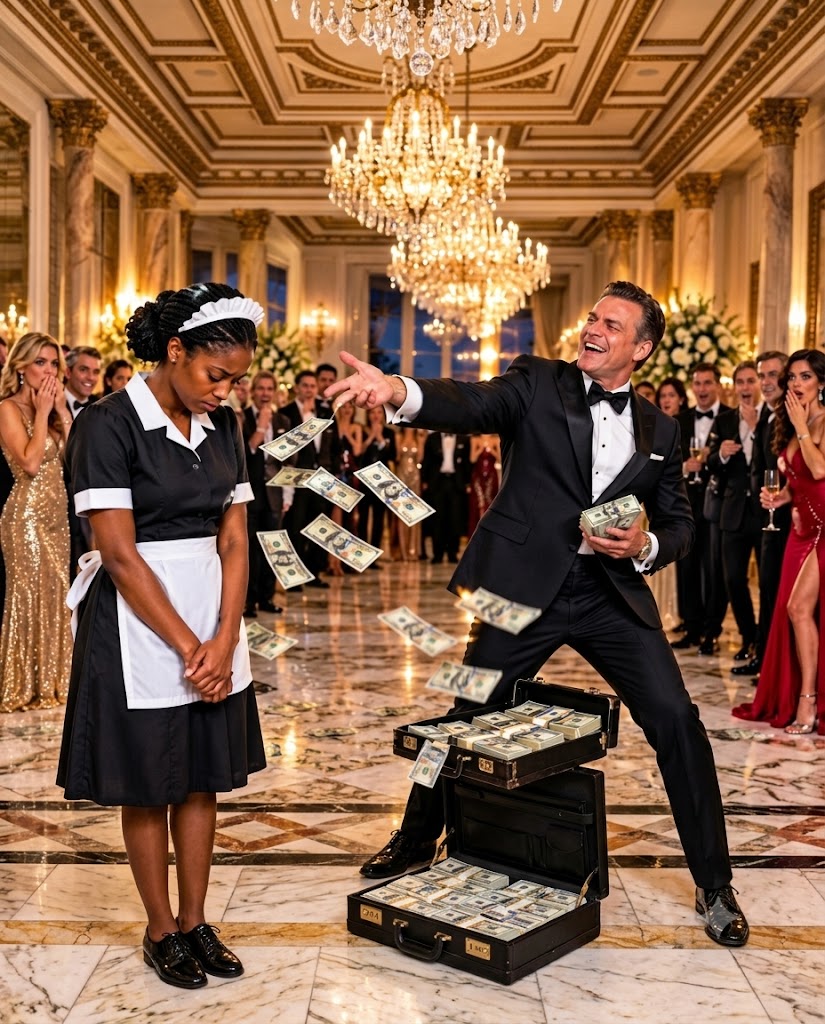
The bills didn’t fall gently.
They exploded outward like a hand of cards thrown in anger, some sliding under the grand piano, others landing in the folds of a woman’s evening gown, and a few drifting lazily onto the white rose centerpiece that had cost more than most people’s monthly rent.
Seven thousand dollars, counted and banded and pristine only seconds before, now lay scattered across the polished marble floor of the Callaway mansion’s ballroom like confetti after a parade nobody wanted.
At the center of that storm of money, no one knelt.
That was the strange part.
The woman the bills were thrown at didn’t kneel, didn’t flinch, didn’t scramble.
She stood perfectly still, her hands folded in front of her plain black uniform, her eyes fixed not on the cash but on the man who had thrown it.
Her name was Dorothy May Simmons.
She was sixty-one years old.
And for the past eleven years, she had scrubbed the floors, dusted the chandeliers, and ironed the shirts of the very family now watching her with a mixture of horror, embarrassment, and from one man in particular, cold amusement.
That man was Richard Callaway III, heir to one of the largest real estate fortunes on the East Coast.
On this particular Saturday evening, the guest of honor at his own engagement party, he stood over Dorothy with his silk tie slightly loosened, a champagne flush creeping up his neck, and a smile that didn’t belong anywhere near a smile.
“That’s more than you make in six months,” he said loud enough for the string quartet to nearly miss a note.
“Consider it a tip for existing.”
A ripple moved through the crowd of sixty guests.
Somewhere near the bar, a woman’s hand flew to her mouth.
Near the terrace doors, two of Richard’s business associates exchanged a look that said they’d remember this moment for a long time, though not for reasons Richard would enjoy.
His father, absent from the room in that instant, would later say he wished he’d walked in one minute sooner.
But in that moment, nobody moved to help Dorothy.
Nobody handed her a napkin to dry hands that weren’t wet.
Nobody said a word in her defense.
The room simply watched the way rooms full of comfortable people often do when cruelty happens in front of them, with silence dressed up as politeness.
Dorothy looked down at the money scattered around her black orthopedic shoes.
Seven thousand dollars.
She had done the math instantly, the way people who have spent decades stretching every dollar always can.
Seven thousand dollars was two months of rent for her and her granddaughter.
It was new tires for the fifteen-year-old sedan that groaned every time she turned the key.
It was the dental work she’d been postponing since spring.
It would have been so easy to kneel.
Nobody would have blamed her.
Bending down, gathering the bills with trembling hands, murmuring a quiet, “Thank you, sir.”
That was the script Richard had written in his head before he ever opened that envelope.
He wanted the moment.
He wanted, in front of his fiancée and his father’s oldest friends, to remind the room exactly where a woman like Dorothy stood in the order of things.
But Dorothy May Simmons did not kneel.
Instead, something shifted behind her eyes.
Something the guests couldn’t name yet but would spend the rest of the night trying to understand.
It wasn’t defeat.
It wasn’t even the practiced patience she wore like a second uniform every day of her working life.
It was recognition.
Recognition of the moment for exactly what it was, and a quiet, private decision about how she was going to answer it.
And then, instead of crying, instead of scrambling for the money at her feet, Dorothy did something nobody in that house had ever seen her do.
She smiled.
Not a small, polite service-industry smile, the kind she’d perfected over eleven years of biting her tongue.
This was different.
This smile reached her eyes.
It carried something underneath it, something old and half-forgotten, something that had nothing to do with Richard Callaway or his money or his mansion at all.
The string quartet, unaware of the tension thickening the air, continued playing a slow, elegant waltz in the corner, the kind of music meant for background ambience, meant to be ignored.
But Dorothy wasn’t ignoring it anymore.
For the first time in over a decade, she was listening to it.
Richard blinked, confused by the smile, momentarily thrown off his own script.
He glanced toward his fiancée, expecting her to be laughing along with him.
She wasn’t.
Vanessa’s face had gone pale, her champagne glass frozen halfway to her lips.
Her eyes locked on Dorothy with an expression somewhere between fascination and dread, as if she already sensed that whatever happened next was going to matter far more than the diamond on her own finger.
The room held its breath.
And Dorothy May Simmons, standing in a pile of hundred-dollar bills meant to humiliate her, began ever so slightly to move.
To understand why Dorothy smiled instead of crying, you have to go back further than that ballroom, further than that mansion, back eleven years to the week her whole life folded in on itself.
Dorothy’s husband, James Simmons, had worked construction for twenty-six years.
Reliable, careful, the kind of man who checked his harness twice and still made sure the younger guys checked theirs too.
He died on a Tuesday in March when a scaffold he had warned his supervisor about three separate times finally gave way.
The company settled quietly, quickly, and for far less than the life it had taken.
Dorothy buried her husband on a Friday, and by the following Monday she was already calling every housekeeping agency in a fifty-mile radius because grief, it turned out, did not pay the mortgage.
She was fifty years old with a house that still owed twelve years of payments and a granddaughter, Aaliyah, who had come to live with her after Dorothy’s daughter struggled with addiction and eventually lost custody.
Dorothy didn’t hesitate.
She simply rearranged her entire life around the little girl’s needs without ever once calling it a sacrifice.
The agency placed her with the Callaways within her first month of searching.
Richard’s father, Walter, had built his fortune the hard way, through decades of real estate deals, sleepless nights, and a willingness to work with his hands long after he could afford not to.
He treated the household staff with a gruff but genuine respect.
Dorothy always said Walter Callaway was the kind of rich man who remembered you’d mentioned a headache the week before and asked if it had gotten better.
But Walter traveled constantly for business.
And in his absence, the house increasingly belonged to Richard.
First as a spoiled teenager home from boarding school, then as a college graduate who’d never once had to budget a semester’s textbooks, and eventually as the entitled young executive who now stood at the center of his own engagement party, throwing money at a woman’s feet.
Over eleven years, Dorothy absorbed a thousand small cruelties the way the ocean absorbs rain, quietly, without visible protest, because the alternative was unemployment and unemployment was a luxury she could not afford.
She’d been called “girl” by guests younger than her own son.
She’d once been accused in front of an entire dinner party of stealing a diamond bracelet that turned up three days later in the coat pocket of Richard’s college roommate.
No apology ever came from Richard or anyone else in that house.
She’d worked through two Thanksgivings while her own family ate without her because the Callaways needed the house presentable for guests.
She never argued.
She never quit.
Not because she lacked the spine for it.
Anyone who had buried a husband and raised a grandchild alone had spine enough for ten arguments.
But because arguing was a currency she simply could not spend.
Every insult swallowed was rent paid.
Every humiliation absorbed was another month of Aaliyah’s school tuition covered.
What almost nobody in that house knew, what Dorothy rarely spoke of even to her closest friends, was who she had been before any of this.
Before the construction accident, before the mortgage, before the Callaways, Dorothy May Simmons had been a dancer.
Trained rigorously in ballet as a girl, she transitioned into jazz and contemporary dance in her twenties, performing in small theaters across Atlanta and for one unforgettable season in a touring company that took her as far as New York.
She had once stood backstage in an auditorium so quiet before the curtain rose that she could hear her own heartbeat, certain that this, the stage, the music, the total surrender to movement, was exactly what she had been put on earth to do.
Marriage, motherhood, and eventually the slow erosion of opportunity had pulled her away from performing, the way life pulls most people away from the things they loved most fiercely in their twenties.
She told herself it was a phase she’d outgrown.
She packed the leotards into a box in the attic and told herself dancing was a young woman’s dream, not a grown woman’s responsibility.
But dreams, it turns out, don’t die.
They just go quiet.
For eleven years working in the Callaway mansion, Dorothy had learned to disappear into her role.
Invisible, efficient, silent.
She had learned to fold herself so small that people forgot she’d ever been anything but a maid.
On ordinary days, that invisibility protected her.
It let her survive humiliations that would have broken someone less practiced at swallowing pain.
But invisibility has a cost too.
It teaches you, slowly and quietly, to forget who you were before you needed to be invisible at all.
Standing in that ballroom, surrounded by scattered hundred-dollar bills and sixty silent witnesses, something in Dorothy finally refused to disappear.
The engagement party had been six months in the planning, orchestrated down to the smallest detail by a wedding coordinator flown in from Manhattan who charged more for a single evening than Dorothy earned in two months.
Sixty guests filled the Callaway ballroom.
Business partners in tailored suits, socialites in gowns that cost more than cars, a scattering of Walter’s old golfing friends who’d known the family since Richard was in diapers, and Vanessa’s parents, who had flown in from Chicago hoping to see their daughter marry into a family as stable as it was wealthy.
Waiters in white gloves circulated with silver trays of champagne.
A live string quartet positioned near the towering windows overlooking the estate’s gardens played softly enough to accompany conversation without overpowering it.
Ice sculptures shaped like intertwined swans slowly melted on either side of the dessert table, and a five-tier cake sat waiting in the kitchen, decorated with sugar orchids that had taken a pastry chef eleven hours to complete.
And Dorothy, invisible as always, exactly as she had trained herself to be, moved quietly through the crowd, refilling water glasses, clearing empty champagne flutes, straightening linens that guests had brushed askew.
She had worked dozens of Callaway events over the years and knew the choreography of service by heart.
Never make eye contact unless spoken to first.
Never speak unless spoken to.
Always move at the edges of the room rather than through its center.
Richard had been drinking since four o’clock that afternoon, well before the first guest arrived.
It wasn’t unusual.
Richard drank at most gatherings, using alcohol the way some men use volume, to fill space he didn’t know how to fill with substance.
By the time the party reached its second hour, his laughter had grown louder, his jokes crueler, his patience for anything that didn’t immediately serve his ego thinner than tissue paper.
It was nearly nine o’clock when the incident happened.
Dorothy was making her way through the crowd, balancing a tray of empty glasses, when her sleeve brushed against Richard’s jacket as she passed.
It was nothing.
The kind of incidental contact that happens a hundred times at any crowded party, forgotten within seconds by anyone with the emotional maturity to forget it.
Richard did not forget it.
He spun around, his champagne sloshing slightly over the rim of his glass, his face flushing with something that looked less like genuine anger and more like an opportunity he’d been waiting all evening to seize.
“Watch where you’re going,” he snapped loud enough that the nearest cluster of guests turned to look.
Dorothy immediately apologized, lowering her eyes in the practiced deference of eleven years.
“I’m so sorry, sir.”
She began to step around him, tray still balanced carefully in her hands.
But Richard wasn’t finished.
Something about the champagne, the crowd, the attention of the room, the presence of his fiancée and his father’s old friends, something about all of it combined into a perfect, poisonous cocktail of arrogance.
He wanted, suddenly and viciously, to perform.
He wanted to remind everyone in that room, his business partners who sometimes questioned whether he truly earned his position, his father’s old friends who remembered him as a spoiled child, even Vanessa herself, who had once made an offhand comment about how different Richard seemed from his more grounded father, exactly where people like Dorothy stood in the world Richard believed he controlled.
“You know what,” Richard said, his voice rising.
“Let me show you all something.”
He reached into the inner pocket of his jacket and pulled out a thick envelope, cash he’d been carrying for an unrelated real estate closing scheduled for Monday morning.
Money that technically belonged to an escrow account and not to him at all, though in that moment he clearly wasn’t thinking about details like that.
“You want money?” he said, tearing the envelope open with theatrical flourish.
“Here’s money.”
And then came the moment that would end up defining not just that evening but the rest of Richard Callaway III’s carefully constructed life.
He threw the bills, all seven thousand dollars of them, directly at Dorothy’s feet, scattering them across the marble floor in front of sixty stunned witnesses.
The string quartet, several measures into a piece nobody was truly listening to anymore, faltered slightly before continuing, uncertain whether to stop or keep playing through what was clearly no longer an ordinary party moment.
The words hung in the air longer than words usually do.
Consider it a tip for existing.
Six words delivered with a smirk.
And yet they carried the weight of every unspoken insult Dorothy had absorbed in eleven years of service, distilled into a single devastating sentence.
Guests gasped, some in genuine shock, hands flying to open mouths, eyes wide with the particular horror of watching something irreversible unfold in real time.
A few uncomfortably let out nervous laughter, the kind of reflexive sound people make when they’re not sure whether they’ve just witnessed a joke or a crime and are too cowardly to ask which.
Near the dessert table, an elderly guest, one of Walter’s old golfing partners, set down his champagne glass with a soft, disapproving click, his jaw tightening in a way that suggested he’d remember this moment for years.
Vanessa, Richard’s fiancée, had gone pale the instant the envelope tore open.
She stood frozen near the piano, her hand still holding a champagne flute she’d stopped drinking from, her eyes darting between her fiancé and the woman kneeling.
Except Dorothy wasn’t kneeling, which somehow made the scene even more unbearable to witness.
Vanessa had spent the last eight months telling herself that Richard’s occasional flashes of arrogance were simply the result of privilege he hadn’t yet learned to temper.
That beneath the bravado was a decent man she could shape into someone worthy of the life they were building together.
In that instant, watching bills scatter across the marble floor, watching the casual cruelty in her fiancé’s eyes, something in Vanessa’s carefully constructed narrative cracked.
This wasn’t charm.
This wasn’t the harmless arrogance of a man who’d simply never had to struggle.
This was cruelty dressed up in a five-thousand-dollar tuxedo, performed in front of an audience for maximum effect.
Richard, oblivious to the shift happening in his fiancée’s expression, was too caught up in his own performance to notice.
He surveyed the scattered bills with visible satisfaction, the way a man surveys a job well done, seemingly convinced that he had just delivered some kind of generous gesture rather than a calculated humiliation.
“There,” he said, adjusting his cufflinks with theatrical casualness.
“More generous than most people would ever be to the help.”
The word help landed like a slap.
Several guests visibly flinched.
Near the terrace doors, one of Richard’s business associates, a man named Gerald Whitfield who had spent fifteen years building relationships across the industry, quietly excused himself from the conversation he’d been having and stepped outside, later telling colleagues he simply couldn’t stomach staying in that room another minute.
Dorothy, for her part, remained motionless for what felt like an eternity but was likely no more than three or four seconds.
Every eye in the room, whether they wanted to admit it or not, was fixed on her, waiting to see what she would do, how she would respond, whether she would finally break after eleven years of composed silence.
She had every reason to break.
Seven thousand dollars scattered at her feet.
A room full of witnesses who had said nothing in her defense.
A man who had just publicly declared, in front of his own father’s closest associates, that her existence itself was something requiring compensation.
It would have been entirely understandable, expected even, for Dorothy to burst into tears, to storm out, to finally unleash eleven years of swallowed rage in one cathartic explosion.
Instead, Dorothy did the one thing nobody in that room could have predicted.
The one thing that would completely rewrite the power dynamics of the evening in ways Richard couldn’t possibly anticipate.
She looked down at the money scattered around her feet.
Really looked at it, taking in the absurdity of seven thousand dollars thrown across an imported Italian marble floor like table scraps tossed to a dog.
And then, slowly, deliberately, she lifted her gaze back to Richard.
And something in her expression shifted from the practiced neutrality of eleven years into something far more dangerous to Richard’s ego.
Genuine, unmistakable amusement.
“Is that supposed to hurt me?” she said quietly.
Quiet enough that only those closest could hear, but clear enough that the words seemed to ripple outward through the silent room anyway.
Richard blinked, momentarily thrown.
This wasn’t in his script.
For a long moment, nobody in that ballroom moved.
The string quartet had stopped entirely now, the musicians exchanging uncertain glances, unsure whether to continue playing through what had clearly become something far more significant than background ambience for polite conversation.
Dorothy looked at the scattered hundred-dollar bills once more.
Then, slowly, deliberately, she began to move.
It started small, barely perceptible really, a slight shift of her weight from one foot to the other.
A gentle roll of her shoulders that seemed to release some tension she’d carried for longer than anyone in that room could imagine.
Then her arms began to lift.
Not in the frantic, humiliated scramble everyone had expected, but with a controlled, deliberate grace that immediately silenced the last murmurs of nervous laughter in the room.
She began to sway her hips, gently at first, to the rhythm of a waltz the string quartet had abandoned playing minutes earlier but that seemed to exist now only in Dorothy’s memory.
A piece she recognized instantly from decades ago, from stages in Atlanta and New York that most of the people in this room could never have imagined she’d once graced.
Her eyes closed, her chin lifted, and Dorothy May Simmons began, unmistakably, to dance right there on top of the scattered hundred-dollar bills in the middle of the Callaway ballroom, in front of sixty stunned wedding guests who had gathered to celebrate an engagement that was quietly, irreversibly falling apart in real time.
The guests didn’t laugh anymore.
Whatever nervous, uncomfortable laughter had rippled through the room in the moments after Richard threw the money evaporated entirely, replaced by a confused, almost reverent silence.
Because humiliation isn’t supposed to look like this.
Humiliation is supposed to look like tears, like shame, like a woman scrambling to gather scattered bills with trembling hands while avoiding eye contact with everyone around her.
This looked like something else entirely.
This looked like liberation.
Dorothy’s movements, though rusty from decades of disuse, carried an unmistakable training beneath them.
The precise posture of ballet fundamentals, the fluid transitions of jazz choreography, the kind of muscle memory that survives even years of neglect because it was once carved so deeply into a body that it never truly disappears.
Her feet, still clad in the plain black orthopedic shoes she wore for comfort during twelve-hour shifts, moved with a lightness that seemed almost impossible given the circumstances.
One of the string quartet musicians, a young violinist barely out of conservatory, watched Dorothy’s movements with growing fascination.
Something in her posture, in the precision of her turns despite the scattered bills beneath her feet, told him this was not an untrained woman having a breakdown.
This was someone who had once been extraordinarily skilled, someone whose body remembered a language most people in this room had never learned to speak at all.
Almost instinctively, without any signal or instruction, the violinist began playing again, softly at first, then with growing confidence, matching the rhythm Dorothy had already established with her own body.
The cellist joined moments later, and then the rest of the quartet, until the abandoned waltz filled the ballroom once more, this time accompanying rather than merely witnessing Dorothy’s dance.
The effect was extraordinary.
What had begun as a scene of calculated humiliation had transformed, in the space of perhaps ninety seconds, into something the guests would struggle for years afterward to fully describe.
Dorothy moved through the scattered bills with the confidence of someone reclaiming territory that had always belonged to her, spinning slowly, her arms tracing arcs through the air that seemed to erase, piece by piece, eleven years of forced invisibility.
Richard stood frozen, his earlier smirk completely gone, replaced by an expression of genuine confusion that bordered on alarm.
This wasn’t the reaction he had engineered.
He had wanted humiliation, submission, a stark visual reminder to every person in this room of exactly where Dorothy, where people like Dorothy, belonged in the hierarchy he’d spent his entire life believing in.
Instead, he was watching something that looked disturbingly like triumph.
Vanessa, still standing near the piano, felt tears welling in her eyes for reasons she couldn’t fully articulate even to herself.
There was something almost unbearably moving about watching a woman transform public humiliation into private reclamation right there in front of everyone who had failed to defend her.
And then, just as Dorothy’s dance reached what felt like its natural crescendo, the ballroom’s front doors opened and a figure stepped inside whose presence would change everything that happened next.
What Richard Callaway III did not know, what almost nobody in that ballroom knew, save perhaps for one person who hadn’t yet arrived, was the full weight of who Dorothy May Simmons had once been.
Before the construction accident that took her husband.
Before the mortgage payments that never seemed to shrink no matter how carefully she budgeted.
Before eleven years of scrubbing marble floors and ironing shirts for a family that barely acknowledged her existence.
Dorothy had been a dancer of genuine professional caliber.
She’d started young, the way most serious dancers do, enrolled in ballet classes at age six by a mother who’d recognized something special in the way her daughter moved even as a toddler.
Something that couldn’t be taught but only nurtured.
By her teenage years, Dorothy was training six days a week, sacrificing typical adolescent social life for hours at the barre and the particular discipline required of anyone serious about a career in dance.
By her early twenties, she’d transitioned from classical ballet into jazz and contemporary dance, drawn to the expressive freedom those forms offered that strict classical technique sometimes constrained.
She performed in small theaters across Atlanta, building a modest but devoted following among the city’s contemporary dance community.
Critics who reviewed local performances occasionally singled her out, praising what one Atlanta arts writer once called a rare combination of technical precision and emotional generosity that audiences feel in their chests before they understand it in their minds.
Her big break, or what felt like it at the time, came when a touring dance company recruited her for a season that took her as far as New York City.
She remembered standing backstage before her first performance in a real Manhattan theater, hearing the particular hush of an audience settling into their seats, feeling a nervous electricity she’d never quite replicated in any other moment of her life before or since.
That season in New York remained, for decades afterward, the brightest point in Dorothy’s personal history.
A period she rarely spoke about, not because the memories were painful, but because they belonged to a version of herself that felt almost impossibly distant from the woman who now spent her days invisible in service to families who never asked about her past.
Life, as it so often does, pulled her in different directions.
She met James Simmons during that touring season, a construction worker with a steady laugh and an unwavering kindness that immediately distinguished him from the more self-absorbed men in the dance world Dorothy had grown accustomed to.
They married within two years.
Dorothy discovered she was pregnant not long after, and the practical realities of supporting a family on a dancer’s inconsistent income, combined with James’s growing construction career, gradually pulled her away from performing.
She told herself at the time that it was temporary, a pause, not an ending.
She packed her leotards, her pointe shoes, and years of accumulated dance memorabilia into a single box that eventually found its way into the attic of the small house she and James bought together.
She told herself she’d return to it once their daughter was older, once finances stabilized, once life offered her a natural window to step back onto a stage.
That window never fully opened.
Motherhood gave way to grandmotherhood when her daughter’s struggles with addiction left Dorothy raising Aaliyah largely on her own.
James’s accident and death eliminated whatever financial cushion might have allowed Dorothy to return, even part-time, to the dance world she’d once belonged to.
Survival became the only priority that mattered.
And survival, Dorothy learned quickly, left very little room for anything as impractical as artistic dreams.
But dreams, as Dorothy had discovered standing in that ballroom surrounded by scattered hundred-dollar bills, don’t actually disappear just because circumstances force you to set them aside.
They wait dormant somewhere in the muscle memory of a body that once knew exactly how to move through space with purpose and beauty.
One person in that room, however, did know about Dorothy’s history, though even he hadn’t fully understood the depth of it until this very moment.
Walter Callaway, Richard’s father, had attended a community theater performance decades earlier, long before his real estate empire had grown into the fortune it now represented, back when he was still a young man hungry for success but uncertain exactly how to achieve it.
He remembered with startling clarity, even after all these years, watching a young dancer named Dorothy Simmons perform a solo piece that had left the entire audience in reverent silence.
Something about her movement that evening, the discipline combined with raw emotional honesty, had stayed with Walter long after the performance ended, influencing in ways he rarely articulated even to himself the way he thought about ambition, sacrifice, and grace under pressure throughout his own career.
He never imagined, in all the years since, that he would one day walk into his own home and find that same woman scrubbing his floors.
Midway through Dorothy’s dance, as the string quartet’s rediscovered waltz filled the ballroom and sixty guests stood in stunned, reverent silence, the heavy front doors of the Callaway mansion swung open and Walter Callaway stepped inside.
He had been delayed at the airport.
A business trip to evaluate a potential development site in Charlotte had run longer than expected, and his flight back had been pushed by nearly three hours due to weather.
He’d texted Richard twice to apologize for missing the early part of the party, promising he’d arrive in time for the formal toast.
Nothing could have prepared him for what he walked into instead.
Walter froze just inside the entryway, his overcoat still draped over one arm, his eyes taking in the scene with the particular disorientation of someone stepping into a moment they cannot immediately parse.
Scattered hundred-dollar bills across his ballroom floor.
Sixty guests standing in absolute silence.
His son Richard standing rigid near the center of the room with an expression Walter had never seen on his face before, somewhere between confusion and dawning horror.
And in the middle of it all, moving with a grace that seemed to bend the very air around her, was a woman Walter recognized instantly, though it took his mind several long seconds to fully process what his eyes were telling him.
Dorothy, his housekeeper of eleven years, dancing.
But it wasn’t just the dancing that struck Walter with such immediate visceral force.
It was the specific quality of her movement, the precise extension of her arms, the controlled elegance of her turns, the particular way she seemed to inhabit the music rather than simply move alongside it.
Walter had seen movement like this exactly once before in his life, decades earlier, in a small community theater in a different city entirely, watching a young dancer whose name he’d never forgotten even after all these years.
Even after building an entire fortune and raising a family and accumulating enough wealth to insulate himself from ever having to think about that evening again.
“Dorothy.”
The name left Walter’s mouth almost involuntarily, quiet at first, then louder as the pieces began clicking into place with the force of a physical blow.
“Dorothy Simmons.”
Dorothy’s eyes opened.
Her dance slowed, then stopped entirely, her chest rising and falling from the exertion, sixty-one-year-old muscles reminding her gently but firmly that they hadn’t performed like this in decades.
She looked toward the entryway, toward the voice that had spoken her full name with such unmistakable recognition, and found Walter Callaway staring at her with an expression she’d never once seen from him in eleven years of employment.
Genuine, overwhelming astonishment.
“You remember me?” Dorothy asked quietly, her voice carrying across the silent ballroom.
“The Ashford Theater,” Walter said, crossing the room now, moving past his stunned son without so much as a glance in Richard’s direction.
“1994. You performed a solo. I don’t even remember the name of the piece, but I remember exactly how it felt to watch you dance. I was twenty-six years old, trying to convince myself I had what it took to build something real. And watching you that night taught me more about discipline and grace than any business seminar I ever attended afterward.”
The room remained utterly silent, sixty guests watching a moment unfold that none of them fully understood yet but all of them recognized as significant.
Walter reached the scattered bills at Dorothy’s feet and knelt down, not toward Dorothy but toward the money itself, gathering the crumpled hundred-dollar bills with deliberate, almost ceremonial care.
He stood, faced his son directly, and held out the gathered stack of cash.
“You don’t throw money at a woman like this,” Walter said, his voice carrying an authority that immediately silenced whatever half-formed explanation Richard had been attempting to construct.
“You don’t even deserve to stand in the same room as her.”
Richard opened his mouth, closed it again, opened it once more.
“Dad, I was just—”
“I know exactly what you were doing.” Walter cut him off, his voice low but carrying an unmistakable edge of controlled fury.
“I’ve watched you do it in smaller ways for years, and I told myself it was arrogance you’d grow out of. I was wrong.”
Walter turned away from his son and faced the sixty guests still watching in silence, their champagne glasses forgotten, their carefully rehearsed party conversation utterly abandoned in favor of whatever this moment was becoming.
“I want to tell you all something about this woman,” Walter said, his voice carrying easily across the now-silent ballroom.
“Dorothy May Simmons has worked in this house for eleven years. In that time, I have never once heard her raise her voice, never once seen her cut a corner, never once caught her in anything less than complete honesty and integrity. Including the time my own family falsely accused her of theft, an accusation that turned out to be entirely baseless and that none of us ever properly apologized for.”
Several guests exchanged uncomfortable glances, clearly remembering the incident Walter referenced, none of them having realized until this moment how significant an injustice it had actually been.
“What most of you don’t know,” Walter continued, “is that before she ever set foot in this house, Dorothy was a professional dancer. Trained, skilled, performing on stages from Atlanta to New York. She gave up a career she’d spent her entire life building because life demanded sacrifices most of the people in this room have never had to make. She buried a husband, raised a granddaughter alone, and worked eleven years in service to my family without a single word of complaint. Despite cruelties I am only now beginning to fully understand she endured on a regular basis.”
Dorothy stood quietly through this account, her breathing gradually returning to normal, her expression carrying a complicated mixture of embarrassment at the sudden attention and something like relief at finally, after eleven years, being truly seen.
Vanessa, still standing near the piano, found herself crying openly now, no longer bothering to hide the tears streaming down her face.
She looked at Richard, really looked at him the way she perhaps should have looked at him months earlier before agreeing to marry him, and saw with painful clarity exactly the kind of man he actually was beneath the charm and privilege she’d initially found so appealing.
“I can’t do this,” Vanessa said quietly, though the silence of the room carried her words easily to every corner.
She set down her champagne glass on the nearest table, removed the engagement ring from her finger with hands that trembled only slightly, and placed it gently beside the glass.
“I’m sorry, Richard. I thought I knew who you were.”
She left through the terrace doors without waiting for a response, her parents hurrying after her with expressions of profound embarrassment and, beneath that, quiet relief that their daughter had recognized this truth before it was too late.
Richard stood motionless in the center of his own engagement party, watching his fiancée walk out of his life, watching sixty guests who had once respected and admired him now regarding him with expressions ranging from disgust to pity, watching his father, a man whose approval Richard had spent his entire life chasing without ever quite earning, looking at him with something that felt disturbingly close to shame.
“Dad—” Richard tried again, his voice smaller now, stripped of its earlier arrogance.
“It was just money. I didn’t mean anything by it.”
Walter turned to face his son fully, and when he spoke, his voice carried none of the anger from moments earlier, only a profound, exhausted disappointment that somehow cut deeper than fury ever could.
“That’s exactly the problem, Richard. You didn’t mean anything by it. You threw seven thousand dollars at a woman’s feet without giving a single thought to what that money represented to her. Without considering for even a moment what it means to work eleven years in someone’s home and be treated, in front of sixty witnesses, like you don’t matter at all. That’s not carelessness. That’s cruelty. And I built this family’s fortune on principles that have nothing to do with the way you just behaved.”
The days following the engagement party unfolded with the particular cruelty of consequences that arrive not all at once but in a slow, grinding accumulation that gives the person experiencing them no single moment to brace against.
Vanessa didn’t return, not even for the conversation Richard had hoped might salvage things once emotions cooled.
Within a week, she’d moved out of the apartment they’d shared for the past year, arranged through a lawyer for her belongings to be collected while Richard was at work, and made clear through a brief formal message that the engagement was permanently over.
She later told a close friend that watching Richard humiliate Dorothy had been like watching a mask slip, revealing finally the person who’d been hiding underneath all along.
The social fallout proved even more damaging than the personal loss.
Word of what happened at the Callaway engagement party spread through the tightly connected social circles of the city’s business and philanthropic elite with remarkable speed.
Sixty witnesses meant sixty separate accounts, each retold with slight variations but all converging on the same essential truth: Richard Callaway III had thrown seven thousand dollars at his family’s longtime housekeeper and mocked her in front of an entire room of guests.
Gerald Whitfield, the business associate who had walked out onto the terrace rather than witness the scene, quietly withdrew from a joint venture he’d been negotiating with Richard for the better part of eight months, citing vague concerns about differences in business philosophy that everyone in their shared professional circle understood to mean something far more specific.
Other partnerships followed similar patterns, not dramatic public denunciations, since the business world rarely operates through such obvious confrontations, but a steady, quiet withdrawal of opportunities, invitations, and considerations that had previously flowed toward Richard largely because of his family name rather than his own accomplishments.
Doors that had always opened easily for a Callaway began, almost imperceptibly at first, to close.
Walter, for his part, took decisive action that went far beyond a single uncomfortable conversation at the party itself.
Within a month, he had initiated a comprehensive restructuring of the family trust that had, until that point, positioned Richard as the eventual successor to the Callaway real estate empire.
Working with the family’s legal team, Walter shifted greater control toward a board of independent trustees, explicitly citing concerns about Richard’s judgment and character that he was no longer willing to overlook in the name of paternal loyalty.
“I spent thirty years building something I could be proud of,” Walter told a small gathering of the company’s senior leadership during the transition announcement.
“And I won’t hand it to someone who doesn’t understand that everyone who works within it deserves basic human dignity, regardless of their position.”
Richard, stripped of the guaranteed succession he’d always assumed was his birthright, found himself, for the first time in his adult life, facing genuine professional uncertainty.
He would still inherit substantial wealth eventually.
Walter wasn’t cruel enough to disown his only son entirely.
But the clear, uncontested path to running the family empire had vanished, replaced by a probationary period during which Richard would need to actually demonstrate competence and character rather than simply waiting for inheritance to deliver him authority he hadn’t earned.
The seven thousand dollars Richard had thrown at Dorothy’s feet, meant as a casual, contemptuous gesture to reinforce his own sense of superiority, ended up costing him something far more valuable than money could ever measure.
His father’s unconditional trust, his fiancée’s love, and the reputation he’d spent his entire adult life building within circles that suddenly seemed far less forgiving of casual cruelty than he’d always assumed they would be.
For months afterward, Richard found himself replaying that evening obsessively, searching for the exact moment things had spiraled beyond his control, unable to fully accept that the moment in question had been entirely of his own creation.
Walter Callaway didn’t stop at simply apologizing to Dorothy, though he did that too, sincerely and repeatedly in the days following the party.
He understood, with the clarity of a man who had built an entire career on recognizing genuine value, that an apology alone couldn’t undo eleven years of accumulated indignities.
Nor could it restore the decades Dorothy had lost from a dance career she’d been forced to abandon.
So Walter did something more substantial.
Within two months of the engagement party, he had purchased and fully renovated a small commercial space in Dorothy’s own neighborhood, the same community where she’d raised her granddaughter, the same streets where local children had few enough opportunities for structured arts education.
He established a dance studio there, funded entirely through a trust he set up independent of the family’s main business holdings, and asked Dorothy, formally and respectfully, whether she would consider running it.
Dorothy’s first response was hesitation.
Eleven years of domestic service had trained her to distrust generous gestures from wealthy employers, to wonder what obligation or catch might be hiding beneath an offer that seemed, on its surface, too good to refuse.
But Walter made clear the studio came with no strings attached to her continued employment, no expectation of gratitude beyond what she felt was genuinely warranted, and complete creative control over how she wanted to run it.
She accepted three weeks later, after long conversations with Aaliyah, who had watched her grandmother sacrifice her own dreams for years and now finally had the chance to watch her reclaim them instead.
Today, nearly a year after that fateful engagement party, Dorothy May Simmons no longer scrubs the Callaway mansion’s marble floors.
The small studio Walter funded, which Dorothy named Second Act Dance Academy, has grown steadily since its opening, now serving nearly sixty children from the surrounding neighborhood, many of whom would never otherwise have access to formal dance instruction.
Dorothy teaches with the same discipline and technical precision she developed decades earlier during her own professional training, but tempered now with a patience and emotional generosity that comes from having lived a full, complicated life outside the insulated world of professional performance.
She tells her students often that dance isn’t just about technique.
It’s about refusing to let circumstances convince you that your dreams don’t matter.
She still remembers that night at the Callaway mansion vividly, though the memory has transformed considerably from what it might have become.
She doesn’t remember it primarily for the money thrown at her feet or even for Richard’s cruel words that briefly threatened to define the entire evening.
She remembers it instead as the moment she stopped allowing anyone else to determine her own worth.
“Seven thousand dollars,” Dorothy told a local newspaper reporter who covered the studio’s opening several months later, “was supposed to remind me of my place. Instead, it reminded me of who I actually was before I ever needed a place assigned to me by someone else.”
Walter visits the studio occasionally, usually unannounced.
Sometimes simply to watch a class from the back row without interrupting, sometimes to discuss expansion plans with Dorothy directly.
Their relationship, born from an uncomfortable moment of recognition at his son’s failed engagement party, has evolved into something neither of them anticipated: a genuine friendship built on mutual respect that neither wealth nor eleven years of employer-employee dynamics had previously allowed.
Richard, for his part, remains largely absent from both Dorothy’s life and his father’s daily business operations, working now at a smaller regional office where he’s slowly, uncertainly attempting to rebuild a professional reputation without the automatic deference his family name once guaranteed him.
Whether he’s genuinely learned anything from the consequences of that evening remains, even now, an open question.
But Dorothy doesn’t spend much time thinking about Richard anymore.
She has sixty students who need her attention, a granddaughter thriving in college on a scholarship Dorothy helped her earn, and a stage, however modest, that finally, after decades of waiting, belongs entirely to her again.
Some people try to buy your dignity, believing money alone can determine your worth.
Dorothy May Simmons proved, in front of sixty stunned witnesses and eventually an entire community, that it was never for sale to begin with.









