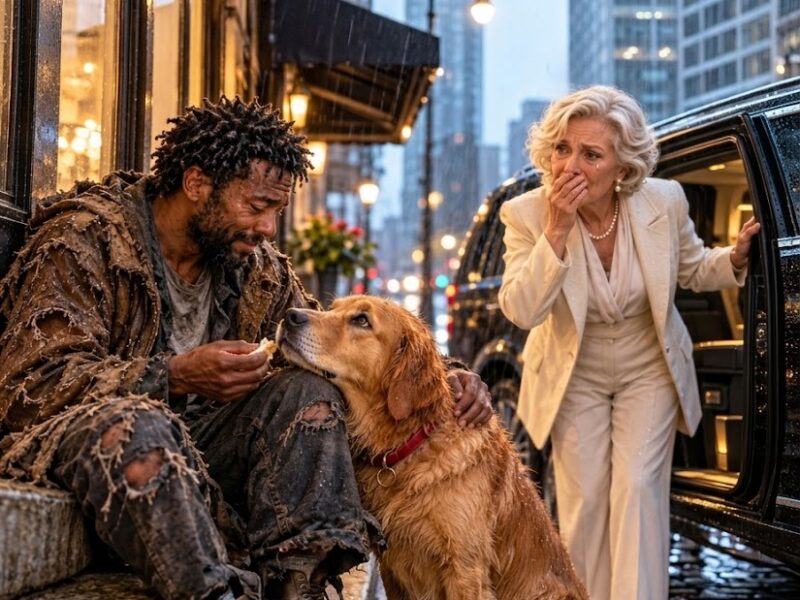
A Wealthy Family Humiliated a Homeless Man Outside Their Mansion—But Their Dog Refused to Leave Him, Exposing a Secret the Family Never Expected
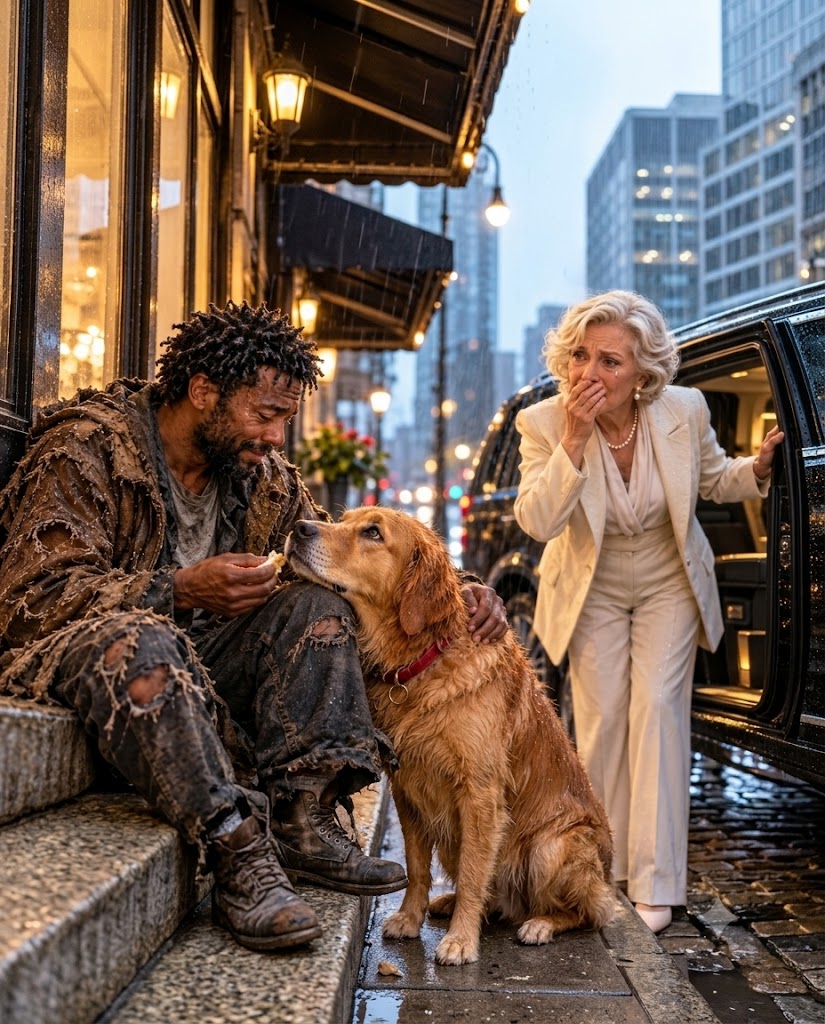
**Part 1**
The rain had been falling since Tuesday, turning the alley behind the Whitmore estate into a shallow river of oil-slick water and drowned leaves.
Daniel Marsh sat against the brick wall with his knees drawn up, a wool cap pulled low, watching the dog.
It was a sorry-looking thing—a brown and white mutt with ribs you could count through matted fur, one ear chewed to a rag, and eyes that held the kind of patience only the hungry understand.
The dog had appeared three days ago and had not left.
“Look at that,” Daniel muttered, tearing the last half of his turkey sandwich—day-old, gas-station quality—into two uneven pieces. “One stray feeding another.”
The dog’s tail gave a weak thump against the concrete.
“You picked the wrong man, buddy. I can’t even take care of myself.”
He set the larger piece on the wet ground and watched the animal devour it without a single wasted motion.
—
Two blocks east, the back gate of the Whitmore property swung open and a woman in a camel coat stepped out, a red leash dangling useless.
“Buddy? Buddy, sweetheart—” Evelyn Whitmore’s voice cracked against the rain. “Come back.”
The dog’s head lifted.
Daniel saw the moment of recognition—the ears snapping forward, the body tensing—and then the animal was gone, a brown blur sprinting down the alley and around the corner.
He stayed where he was.
It wasn’t his dog, wasn’t his problem, wasn’t his life anymore.
But the woman was still calling, and her voice had gone thin and frightened in a way that Daniel remembered from another lifetime, when he’d had a phone that rang and people who worried.
He pushed himself up and followed.
—
Evelyn Whitmore was kneeling on the wet sidewalk, arms around the muddy dog, when Daniel rounded the corner.
She looked up.
“You—were you taking care of him?”
“He was cold and hungry. That’s all.”
A man came striding down the driveway then, tall and silver-haired, wearing an overcoat that cost more than Daniel’s entire existence.
Richard Whitmore. CEO. Owner of half the commercial real estate north of the highway.
“Don’t give that man anything,” Richard said flatly. “He probably took the dog himself. How much were you planning to demand?”
“Nothing. Your dog followed me.”
“You expect us to believe that?”
Daniel met his eyes. “Ask your dog. He seems to know the truth.”
Evelyn’s hand went to Richard’s sleeve. “Richard, look at him. What did you do for Buddy?”
“He was hungry. I shared what I had.”
“Was that your lunch?”
“It was enough.”
Richard pulled a wallet from his pocket and peeled off two twenties, holding them out like a man feeding a meter.
“Here’s your reward. Now disappear.”
Daniel didn’t take the money.
“I didn’t feed him to get paid.”
The rain ticked against the pavement. Evelyn studied him with an expression he couldn’t name—something between calculation and pity.
“Do you have somewhere to go?”
“I manage.”
“I need someone to look after Buddy while I recover from a recent move,” she said. “A knee replacement. Eight weeks.”
Richard turned. “Evelyn, absolutely not.”
“I asked him, not you.” Her voice was quiet and immovable. “It’s paid work and there’s a room.”
“You don’t know me,” Daniel said.
“I know how my dog behaves around you.”
Richard’s jaw worked. “He’s homeless, Aunt Evelyn.”
“That’s where I sleep, not who I am.” Daniel wiped rain from his forehead. “You can refuse, but the offer is real.”
“Twenty dollars an hour, plus the room,” Evelyn said. “You’ll have meals with the staff.”
“I’ll work for my room. I won’t beg for it.”
Evelyn almost smiled. “Then we understand each other.”
—
The Whitmore house rose out of the trees like something out of a magazine—three stories of gray stone and black iron, a portico wide enough to drive a truck through, windows glowing gold in the fading afternoon.
“That’s a lot of house,” Daniel said, standing in the driveway with his duffel bag.
“Try not to touch anything,” Richard said.
Evelyn shot her nephew a look. “He’ll touch whatever his work requires.”
A silver sedan pulled up, and a woman in her sixties stepped out, sharp-eyed, carrying a leather satchel.
“Richard, why is there a homeless man in our car?”
“Staff,” Richard said. “Use the side entrance. He’s my guest until we arrange his employment.”
“I’ll show him where he belongs,” the woman said, and Daniel understood immediately that her name mattered less than what she’d decided about him.
She was Claire Whitmore, Richard’s wife. He learned that by dinner.
—
She led him through the kitchen corridor to a narrow stairwell that smelled of bleach and old wood, then down to a room barely wider than the bed it contained—a converted storage space with a single bulb, no window, and boxes stacked to the ceiling.
“You sleep back here,” Claire said.
“You said there was a room.”
“There it is.”
Daniel set his bag down. “I came to work, not to be punished.”
“Then start by remembering your place.”
He turned to face her, and something in his expression made her take half a step back—not fear, exactly, but recalibration.
“My place is wherever I stand without bowing to you, Mrs. Whitmore.”
A voice came from behind them. Grace, the housekeeper—a small woman with gray braids and eyes that missed nothing—stood in the doorway.
“That’s not a staff bedroom. It is now.”
Claire’s mouth thinned. “I make the decisions here.”
“Not all of them.”
Grace walked past her and touched Daniel’s sleeve. “Come with me. There’s a proper room near the laundry.”
—
The room was small—a twin bed, a dresser, a window that looked out on the side garden—but it was clean and dry and his.
“It’s small, but it’s yours while you’re working here,” Grace said.
“It’s more than I’ve had in a while.”
“He’ll need walks, feeding, and company. I’ll explain the rest.”
Daniel nodded. “Thank you. I’ll earn it.”
From the hall, Claire’s voice floated back like smoke. “Let’s see how long that lasts.”
—
Daniel met Buddy properly in the sun room at six the next morning.
The dog was curled in a wicker basket, and when Daniel knelt, the animal rose and pressed his head against Daniel’s chest with a sigh that sounded almost human.
“Easy, boy. You already had half my lunch.”
“He’s a good judge of character,” said a voice from the doorway.
Daniel looked up. A young woman stood there, maybe twenty-five, with dark hair pulled back and a tablet in one hand.
“I’m Lena. Mrs. Whitmore’s assistant. She asked me to show you the routine.”
“I’m ready.”
“He’s partial to the west garden. And he won’t eat if someone’s watching, so you’ll have to—”
“Leave the room. I figured that out on Tuesday.”
Lena’s eyebrows lifted. “Okay. Maybe you’re going to work out.”
—
The first three days were quiet.
Daniel walked Buddy four times a day, fed him, cleaned the sun room, and ate alone in the kitchen while the household moved around him like water around a stone.
On the fourth day, he was passing the east hall when he heard a sharp crack and a muttered curse.
Claire stood in the library doorway, staring at a broken cabinet door hanging off its hinge.
“Careless,” she said as Daniel approached.
He looked at the door. “You stepped in front of me.”
“Then clean it. That’s your job.”
Daniel crouched and examined the split wood. “I’m all right. That thing’s been broken for weeks. Loose dowel. Easy repair if you’ve got wood glue and a clamp.”
Claire paused. “You’re a carpenter.”
“I built furniture for sixteen years.”
“What happened?”
“The shop closed. I lost my apartment before I found another job.”
Claire said nothing for a long moment, then gestured at the cabinet. “You know what you’re doing. You fixed this?”
“It wasn’t broken beyond repair.”
“Could you look at this, too?” She pointed to a small writing desk, its drawer face split around the lock. “Someone forced it. The wood cracked around the screw.”
Daniel ran his thumb along the damage. “I can fix it. I’d need to take the drawer back to my room for a night.”
“Get your hands off that,” Richard said, appearing in the doorway. “I don’t want him near anything valuable.”
“What’s he doing now?” Claire asked.
“Looking through Aunt Evelyn’s things.”
“I asked him to repair the cabinet,” Claire said, and Daniel caught the flicker of something—not warmth, but a fracture in the united front.
Richard’s eyes moved to Daniel like a man reading a contract. “Don’t mistake a room and a meal for trust.”
“Trust is earned,” Daniel said.
“So is disrespect. Keep talking and you’ll be back on the sidewalk before dinner.”
—
The bracelet disappeared on a Thursday.
Daniel was in the library, fitting the repaired drawer back into the desk, when Claire’s voice cut through the house.
“That’s strange. My gold bracelet isn’t here.”
Richard appeared within seconds. “He was just standing beside the cabinet.”
“I never opened that box.”
“Then you won’t mind being searched.”
Daniel stood very still. “That’s everything. And you can look. Don’t throw my things around.”
Claire went through his duffel with the efficiency of a customs officer—flannel shirts, a toothbrush, a battered paperback, a photograph in a plastic sleeve.
Richard lifted the photograph. “Is this supposed to be worth something?”
“It is to me.”
He turned it over. A woman and a small girl on a porch, both laughing.
“Look at this junk,” Claire said.
“You can search my bag,” Daniel said. “You don’t get to call my life trash.”
“Remember whose house you’re in.”
“I know whose house it is. I’m still a man inside it.”
Richard stepped forward, hand raised—
“Mr. Whitmore, that’s enough.” Evelyn’s voice cracked across the room like a whip. “You will not strike anyone in my home.”
“Then tell your new employee to confess.”
“I didn’t take your bracelet. But I can see you don’t belong here.”
“That’s all I needed to know.”
—
“Daniel, wait.”
He was at the side door, bag in hand, when Evelyn caught him.
“Not until security checks everything,” Richard said behind her.
“Somebody control that animal,” Claire snapped.
Buddy had begun to growl—low and steady, deep in his chest—positioned between Daniel and Richard.
“Hey, easy, boy.” Daniel knelt and put a hand on the dog’s collar.
“Why won’t you let her look?” Richard demanded.
“Because my bag isn’t a public trash can.”
“Search him first and if you find anything, the police get the recording.”
“Record this, too,” Daniel said. “I’m not running.”
Evelyn stepped forward. “Turn out your coat pockets. Now.”
He did. Keys. A folded bus schedule. Forty-two dollars in ones and fives. A receipt from a hardware store.
“Happy?”
“He was inside the cabinet. Look at him.”
“I touched the hinge,” Daniel said. “Whoever took the bracelet touched the box. Those aren’t the same thing.”
“Search the cabinet,” Evelyn said quietly.
Claire’s face changed—a flicker, quickly buried.
Richard pulled the drawer open. Ran his hand along the back panel. Then along the lower edge.
“Nothing.”
“There. Your precious dog was wrong,” Claire said. “What else have you got?”
Richard turned to Daniel. “You should have taken the money when we offered it.”
“You seem awfully sure I won’t be believed.”
“Because nobody here owes you belief.”
Daniel was quiet for a moment. Then he looked at the cabinet.
“Wait. That’s not how this cabinet was built.”
Claire’s head snapped around. “Don’t touch the lower panel.”
“I never said which panel.”
Richard’s eyes narrowed. “I live here. I know the furniture.”
“Then open it,” Daniel said.
—
The lower panel came off with a sound like a breaking promise.
Inside the hollow space behind it: a gold bracelet, two silver spoons, and a pearl earring.
The room went very still.
“Claire,” Evelyn said.
“He repaired that cabinet,” Claire said quickly. “He could have put it there.”
“She knew where it was before anybody opened it,” Grace said from the doorway.
“You think that proves anything?”
“No,” Grace said. “But your face just told me enough. I was here when he worked. He never touched the back.”
“Twelve years here, Grace. Think carefully before you throw that away.”
“Don’t threaten her because your wife got caught,” Daniel said.
Richard rounded on him. “Fine. Keep your new hero. But when he costs you something you love, remember who warned you.”
—
Evelyn kept her word.
That evening she called Daniel into the study and set a contract on the desk.
“As promised, you may stay and work.”
“Thank you.”
“Richard wants you to sign this.” She slid a single sheet toward him. “Every employee answers for the animal in their care.”
Daniel read it twice. “This says if Buddy is lost, injured, or taken—my employment ends immediately and I forfeit wages.”
“It’s his standard language.”
“It’s not standard. It’s a trap.” He set down the pen. “I won’t sign away my right to tell the truth.”
“Then your room isn’t yours yet.”
“That’s not fair.”
“Fair is a word people use when they have no leverage,” Evelyn said quietly. “I’m asking you to trust me.”
Daniel looked at the contract. Then at the door where Buddy sat watching him, one ear cocked.
“I’ll sign it,” he said finally. “But I want one thing in writing. If I’m accused of something, I get to face my accuser in front of you. Not in front of Richard. In front of you.”
Evelyn’s pen hovered. “You think Richard is the danger.”
“I think a man who threatens a housekeeper of twelve years will do worse to a stranger.”
She wrote the clause in by hand and initialed it.
—
**Part 2**
Grace found him in the laundry room that night, folding towels.
“You’ve worked here twelve years,” Daniel said. “It would be a shame to leave with nothing.”
She didn’t look up. “I told Mrs. Whitmore what I saw.”
“Richard won’t forget that.”
“Next time, think about what you stand to lose.”
“I did.” Grace folded a towel with sharp, precise motions. “I have a daughter. She works the morning shifts at the clinic on Ninth. If I lose this job, she loses her tuition.”
Daniel was quiet.
“You don’t have to do this,” he said finally.
“It’s a shirt, Daniel, not a miracle.” She held up the laundry—Richard’s dress shirt, pressed and perfect. “Just don’t give him a reason to send you away.”
—
The next week passed in a strange, suspended rhythm.
Richard was cool but contained. Claire avoided the east hall entirely. Evelyn spent her mornings in physical therapy and her afternoons in the study, and Buddy followed Daniel everywhere like a shadow with a heartbeat.
On Friday, Lena found Daniel in the garden, sanding the edge of a repaired bookshelf.
“Mrs. Whitmore wants to see you in the garage,” she said. “Something about a wall.”
“Pick up the pace,” Richard said, striding past with a coffee cup. “Deliveries are coming through.”
Daniel wiped his hands. “Keep his leash tight.”
“Excuse me?”
“Nothing.”
He found Evelyn in the garage, standing before a section of wall that looked newer than the rest—fresh drywall, a coat of paint that didn’t quite match.
“Richard says there’s a leak in the studs behind this wall,” she said. “He wants it opened up.”
“Why me?”
“Because you’re the only person in this house who knows what a wall should look like.”
Daniel ran his palm along the surface. Then he crouched and checked the baseboard.
“This isn’t a leak repair.”
“What do you mean?”
“Look at the screws. They’re new, and they’re not original to this house. Someone built this section recently.” He straightened. “And they didn’t do a good job. There’s a gap at the bottom.”
Evelyn’s expression didn’t change, but her hand tightened on her cane.
“Open it,” she said.
—
The drywall came away in a single sheet.
Behind it was a small cavity, and in the cavity was a wooden crate, and in the crate was every piece of missing silver from the Whitmore estate—the serving platters, the candlesticks, the antique tea set that Evelyn had reported stolen in the spring.
Daniel stepped back.
“Nine thousand dollars,” Evelyn said softly. “That’s what the insurance company paid out. Nine thousand dollars, and a police report I filed against a man who turned out to be innocent.”
“Who built the wall?”
She didn’t answer. She didn’t have to.
From the doorway, Richard’s voice came flat and cold. “What have you done?”
“I opened a wall,” Daniel said. “On your aunt’s orders.”
“Evelyn, we need you now.”
Evelyn turned. “Ask him who built it.”
Richard’s jaw worked. “I don’t know what you’re talking about.”
“Ask her who left the dog.”
—
The rest of it came apart quickly.
Claire had taken Buddy from the sun room and driven him across town to a lot behind the old rail depot, where she’d left him with a bag of food and a blanket.
“I didn’t know he’d find his way back,” she said, weeping. “I didn’t know.”
“You knew,” Evelyn said. “You watched him come back, and you let me believe Daniel had lost him.”
Richard stepped between them. “If Daniel admits he failed, Grace keeps her job.”
“Excuse me?”
“Say you lost the dog,” Richard said, “and I’ll let this whole thing go. Grace stays. Claire keeps her position. Everyone moves on.”
Daniel shook his head. “I left Buddy in good hands. That’s the only thing I’ll admit.”
“Then you both lose.”
“Richard,” Evelyn said. “Stop.”
“Evelyn, stay out of—”
“Daniel, please leave while we search.”
Daniel looked at her. “You watched me give him my last food. Now you think I threw him away?”
“I don’t—”
“If Buddy comes back, tell him I didn’t leave him.”
He walked out the side door and down the driveway, and Buddy stood at the window, whining, until the gate closed.
—
“Where is he?”
Richard was pacing the sun room when Evelyn came in from the garden.
“Who?”
“Buddy.” She looked around. “He was right here.”
“Daniel says your employment papers need him.”
“Go on,” Richard said to Grace, who was folding a blanket. “I’ll watch him. I’ve got him.”
Grace didn’t move.
“I’ve got him,” Richard said again, and something in his voice made Grace set the blanket down and walk to the hall.
—
Evelyn found Daniel at the bus stop on Route 9, sitting on the concrete barrier with his duffel beside him.
“You called me in for this,” he said, standing. “You wanted a job. Learn to wait.”
“There’s a problem.”
“What problem?”
“Buddy is gone.”
Daniel stared at her. “What do you mean gone?”
“Richard said he had him. He sent Grace to the hall, and when she came back—”
“You trusted him with the dog?”
“He said he was watching—”
“You knew what he was.” Daniel’s voice was quiet and terrible. “You watched him threaten Grace. You watched him threaten me. And you left your dog with him.”
“I didn’t leave him. I went to find you.”
“Then we’re both fools.”
—
The garage door was locked.
Buddy’s barking came from behind it—sharp, frantic, then muffled, as if someone had covered the door with something heavy.
“He’s in there,” Daniel said.
“Richard changed the lock,” Evelyn said. “I tried my key. It won’t turn.”
“Then get a hammer.”
“Daniel—”
“Get a hammer, Evelyn. Or I’ll find one myself.”
—
Grace brought the key to the service entrance.
Walter, the groundskeeper, brought a sledgehammer.
“Are you sure?” Walter asked.
“I’m sure.”
Daniel took the hammer and struck the drywall in the center of the newest patch.
Buddy stopped barking.
He struck again, and the wall split, and light poured through, and a brown blur came flying out and into Daniel’s arms.
“Hey, hey, easy, easy—”
“Buddy—”
The dog was shaking, his muzzle wet, his tail going so hard it was almost a blur.
“He’s crying,” Evelyn said.
“He hears a noise and wants another reward,” Richard said from the doorway.
“Touch me again in front of her,” Daniel said.
“What?”
“I said—touch me again in front of her.”
Richard stepped forward—
Buddy snarled, a low and terrible sound, and Richard stopped.
“Martin,” Richard called. “Martin, get him off this property.”
Martin, the head of security, stepped into the garage and looked at the broken wall, and the dog, and the man on his knees holding him.
“I’m not doing this anymore,” Martin said.
“Excuse me?”
“I’ve watched you hit him and dare him to hit back. I’ve watched you threaten Grace. I’m done.”
“Then get out.”
“Fine.”
—
The evidence was in the wall behind Buddy’s prison.
A printed copy of the forged contract. A USB drive. A photograph of Claire holding the missing bracelet, taken from the estate’s own security footage.
“Where did these come from?” Evelyn asked.
“Richard,” Martin said. “He kept copies. In case he needed leverage.”
“I’m calling the police,” Evelyn said.
“911,” Richard said. “Go ahead. But I’ll tell them Daniel built the wall. All he did was sell the silver and pretend to find it.”
“Now you know what being broke feels like,” Claire said. “That’s why I won’t sell them out.”
“Back where you belong.” Richard grabbed Daniel’s arm.
“Don’t touch her again,” Daniel said.
“Take your hands off my people.”
The room went silent.
Evelyn stood in the doorway with a phone in her hand, and she was not shaking.
“I called 911,” she said. “I told them everything. Take your hands off my people.”
—
The police came at nine in the evening.
Richard Whitmore was arrested for theft, fraud, and assault. Claire was arrested for theft and filing a false police report. The silver was recovered. The forged contract was enough to void Daniel’s employment terms, and Evelyn rewrote the whole house’s policies before the end of the month.
—
“If they lose their jobs for standing beside me, I don’t want yours,” Daniel said.
“Grace, Walter, Martin—your work is safe,” Evelyn said. “Richard will never give you another order in this house.”
“You choose them over your own blood,” Claire said.
“Your access card,” Evelyn said.
—
The last conversation happened on the porch, three weeks later, when the paparazzi had finally stopped camping at the gate.
“You think this makes you one of us, Daniel?” Claire asked from the driveway, her car packed.
“No,” Daniel said. “I was somebody before I walked through your gate.”
Evelyn stood beside him. “I need a carpenter. Not someone to thank me for scraps.”
“Then I’ll earn every dollar.”
“Looks like he hired you, too,” Grace said, appearing with two cups of coffee.
“You gave him the last piece you had,” Evelyn said.
“He stayed when I had nothing,” Daniel said.
“You saved him.”
“We saved each other. I gave him half my bread when I had nothing. He gave me back my dignity when everyone tried to take it.”
—
Buddy slept at the foot of Daniel’s bed now, in the room with the window and the garden view.
The house was quiet in the mornings, and the sun came through the glass in bars of gold, and Daniel had started to build things again—a bookshelf here, a repaired drawer there—with wood glue and a clamp and the steady, patient hands of a man who had rebuilt his life one piece at a time.
Kindness is never wasted.
Daniel shared his last piece of bread with a hungry dog, expecting nothing in return.
But that simple act brought him friendship, dignity, and a new home.
Your worth is not measured by money or status, but by the compassion you show when you have almost nothing—and you give anyway.









