A Weak German Shepherd Blocked a Marine’s Truck—Where She Led Him Changed Three Lives Forever
Staff Sergeant Noah Mercer was driving his uncle’s old pickup through a snowy road outside Red Pine, Colorado, expecting another quiet morning.
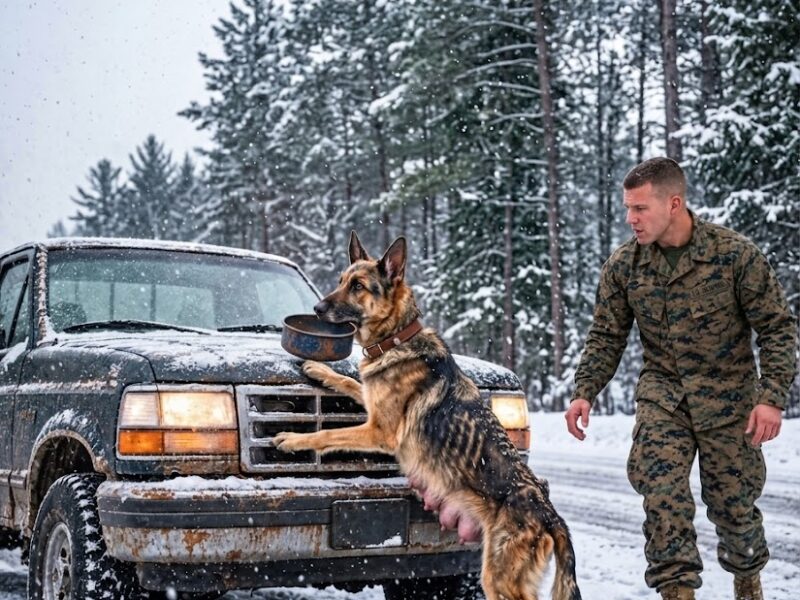
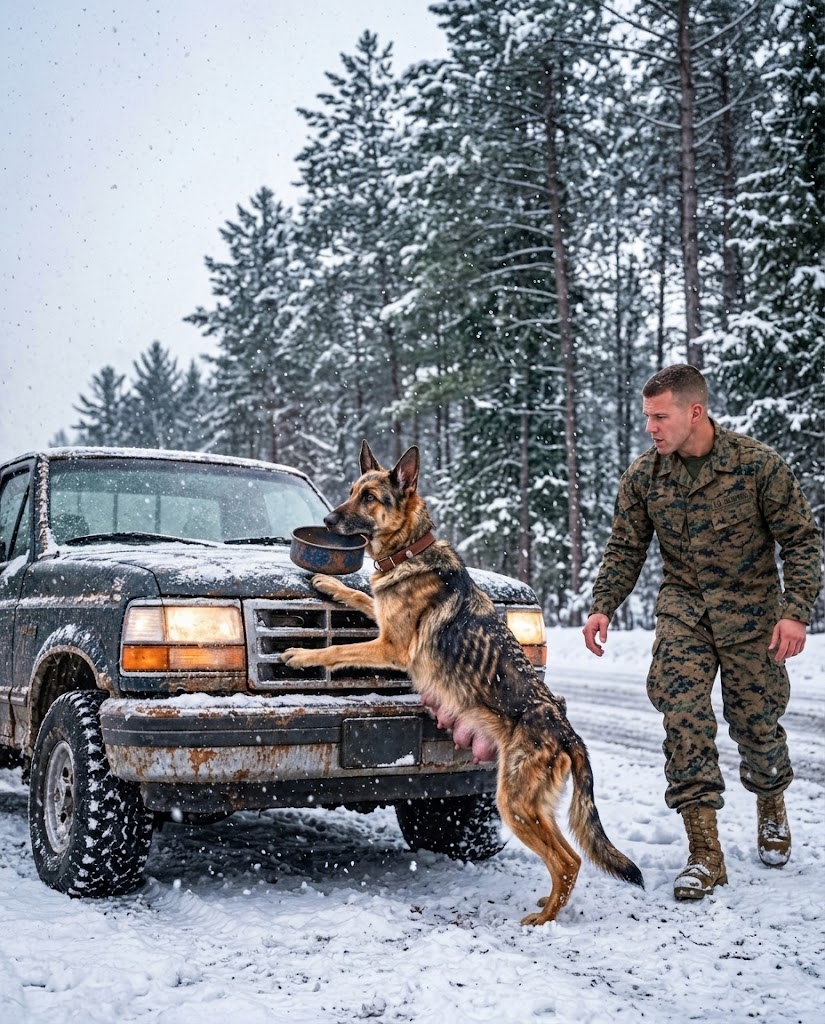
Then he saw a German Shepherd mother beside the road, thin, exhausted, and carrying a rusted blue bowl in her mouth.
She did not bark or beg.
She pressed her paws against the truck, stared at Noah, then turned toward an abandoned forest road.
Noah thought she was hungry, but when he offered food, she barely touched it.
Her nursing belly told him the truth.
Somewhere in the snow, puppies were waiting.
Why had this exhausted dog crossed the frozen woods with an empty bowl?
Who was she searching for?
And why did that old pickup matter to her?
What Noah found beyond the trees would lead him to four tiny lives, a missing Marine, and a purpose he never expected.
Snow had been falling over Red Pine, Colorado, since before sunrise, covering the mountain road, the pine branches, and the roofs of the scattered cabins in a soft layer of white.
By 8 that morning, the entire valley seemed quieter than usual, as if winter had asked the town to slow down for a while.
Staff Sergeant Noah Mercer drove an old dark pickup along the narrow road outside town.
Noah was 42 years old, 6’1″, broad through the shoulders with short brown hair cut close in the military style he had worn for most of his adult life.
Nearly 20 years in the United States Marine Corps had left him disciplined, observant, and comfortable with responsibility.
He was the kind of man who checked the weather twice before driving into the mountains and always kept a flashlight, blanket, water, and basic tools behind the seat.
But there were some things Noah had never learned how to prepare for.
In a few weeks, his military career would be over.
For most people, that might have sounded like freedom.
To Noah, it sounded like silence.
He had returned to Red Pine to settle the property of his late uncle, Walter Mercer, a quiet mechanic who had raised Noah through much of his teenage years.
Walter had been a stocky man with gray hair, permanently stained work shirts, and an unusual ability to make almost anyone feel welcome without saying much.
He had never married.
His garage had been his workplace, his gathering place.
And for Noah, the closest thing to a permanent childhood home.
Walter had passed away the previous spring.
Now the garage belonged to Noah.
There were papers from a real estate agent sitting on the passenger seat of the pickup.
All Noah had to do was clear the building, sign his name, and sell it.
Simple.
At least that was what he kept telling himself.
The pickup rounded a curve where the road passed close to a thick stand of pine trees.
That was when Noah saw something ahead.
At first, it looked like a dark shape beside the snowbank.
He slowed.
The shape moved.
Noah leaned slightly toward the windshield.
It was a German Shepherd.
The dog stood alone near the edge of the road, watching the truck approach.
But that was not what made Noah take his foot off the accelerator.
The German Shepherd was holding a bowl in her mouth.
It was an old metal bowl painted blue years ago, though much of the color had disappeared beneath scratches and patches of rust.
Noah stopped the pickup several yards away.
The dog did not run.
Instead, she walked toward him.
As she came closer, Noah could see her clearly.
She was a female German Shepherd, perhaps 6 years old, with black and tan fur, upright ears, intelligent amber-brown eyes, and a body that looked thinner than it should have been beneath her winter coat.
Snow clung to the fur along her back and shoulders.
She looked exhausted, but there was nothing uncertain about the way she approached him.
Noah remained inside for a moment.
“Where did you come from?” he said quietly.
The dog reached the front of the truck.
Then she did something even stranger.
She lifted herself onto her back legs and placed both front paws against the old bumper.
The blue bowl was still between her teeth.
Noah stared at her.
She was not attacking the truck.
She was not frightened by it.
It almost looked as though she were stopping him from leaving.
Noah shut off the engine.
He stepped outside slowly.
The cold immediately pressed through his uniform.
The German Shepherd dropped back onto all four paws and watched him.
“Easy,” Noah said.
His voice was calm.
Years in the Marines had taught him that rushing an uncertain situation rarely improved it.
He took one step closer.
The dog stayed where she was.
That was when Noah noticed her belly.
The fur underneath was thinner and the physical signs were unmistakable.
Noah stopped.
His expression changed.
“You’ve got puppies.”
The dog watched him without moving.
Suddenly, the old bowl made sense.
At least Noah thought it did.
She was hungry.
Maybe someone had abandoned her nearby.
Maybe she had been trying to find food for herself while caring for puppies somewhere in the woods.
Noah opened the pickup and reached behind the seat.
Walter had always kept supplies in the truck, and Noah had continued the habit.
There were emergency snacks, bottled water, and a small bag of dog food he had found in the garage two days earlier.
He poured some of the food into the blue bowl.
The German Shepherd stepped forward.
She ate only a few mouthfuls.
Then she stopped.
Noah frowned.
For an animal that looked this tired, he had expected her to finish everything.
Instead, the dog lifted her head and looked toward the forest.
Then back at Noah.
She picked up the bowl.
“Wait.”
The German Shepherd walked away from the pickup, not toward town, toward an old logging road almost hidden beneath the snow.
Noah knew the road.
Walter had once told him it had been used by timber crews decades earlier.
These days, almost nobody drove it during winter.
The dog walked perhaps 20 yards.
Then she stopped.
She turned.
Noah stood beside the pickup.
The two watched each other through the falling snow.
“Come back here,” Noah called.
The German Shepherd did not move.
She simply waited.
Noah took several steps toward her.
The dog immediately turned and walked a little farther down the logging road.
Then she stopped again.
That changed everything.
Noah looked at the bowl, then at the dog, then at the road, disappearing between the trees.
She was not wandering.
She was leading him.
Noah returned to the pickup and opened the passenger door to grab his flashlight.
The real estate papers slid slightly across the seat.
He looked at them for a moment.
Walter’s garage.
His final weeks in the Marines.
The future he had still not decided how to fill.
None of it seemed important right now.
Somewhere beyond those trees, a German Shepherd mother had left her puppies behind and walked into the snow carrying an empty blue bowl.
And she had chosen his truck to stop.
Noah closed the door.
He locked the pickup.
Then he looked down the logging road.
The dog was still there waiting.
Noah switched on the flashlight and started walking toward her.
The German Shepherd turned toward the forest, and this time Noah followed.
Noah had followed the German Shepherd only a short distance before the weather began to change.
The old logging road narrowed between tall pines, and fresh snow started falling harder through the branches.
The dog kept moving ahead, but Noah noticed something he had missed from beside the pickup.
Every few steps, her pace slowed.
She would stop, steady herself, then continue as if whatever waited beyond the trees mattered more than how tired she felt.
Noah had spent enough years making decisions in difficult conditions to recognize when determination was becoming exhaustion.
“Not today,” he said quietly.
The German Shepherd looked back at him for several seconds.
Neither moved.
Then Noah crouched and held out his hand.
“We’re getting you somewhere warm first.”
The dog seemed reluctant, but she finally allowed him to guide her back toward the truck.
Less than 40 minutes later, Noah pulled into the small parking lot of Red Pine Veterinary Clinic.
The clinic occupied a one-story cedar building near the edge of town.
Warm yellow light filled the windows, and a wooden sign above the entrance had faded from years of Colorado winters.
Dr. Clare Wittmann met Noah near the front desk.
Clare was 36, tall and slender with dark auburn hair tied into a practical ponytail and clear gray-green eyes that seemed to notice details before most people knew they were there.
She had worked in Red Pine for nearly nine years.
Around frightened animals, Clare was patient and soft-spoken.
Around people, she was more direct.
Years of treating neglected pets, working dogs, and injured wildlife had taught her that kindness mattered most when it was paired with practical action.
“What happened?” she asked.
“Found her outside town.”
Clare looked past Noah.
The German Shepherd stood near the doorway, still holding the blue bowl.
Clare’s expression changed.
“Sadie?”
Noah looked at her.
“You know her?”
Clare walked slowly forward.
The dog’s ears lifted.
“Sadie,” Clare repeated gently.
This time, the German Shepherd took one cautious step toward her.
Noah glanced between them.
“So that’s her name.”
Clare nodded.
“I’ve seen her before. Not often, but enough to remember her.”
Sadie finally released the blue bowl when Clare offered her some water.
Inside an examination room, Clare worked carefully while Noah stood nearby.
She estimated Sadie was around six years old.
Her coat was still thick and healthy in places, but she had clearly lost weight.
More importantly, Clare confirmed what Noah had already suspected.
“She’s nursing.”
Noah looked toward Sadie.
“How recently?”
“Probably within the last few weeks.”
That answer changed the room.
Noah folded his arms.
“So the puppies are still out there.”
“Most likely.”
Clare examined Sadie’s paws next.
She paused.
“What?”
Clare looked closer.
“These aren’t from one trip through the snow.”
Noah waited.
“She’s been traveling repeatedly. Snow, frozen ground, probably rocky sections, too. I can’t tell you exactly how far, but she’s been doing this for days.”
Noah thought about the logging road.
Sadie had not simply wandered onto it that morning.
It was a route she knew.
Clare finished the examination and wrapped Sadie in a clean blanket.
“She needs food, warmth, and rest before she tries anything else.”
Sadie immediately looked toward the blue bowl.
Noah noticed.
He picked it up and set it on the metal table.
“Maybe this can tell us something.”
Up close, the bowl looked even older than it had beside the road.
Most of the blue paint had chipped away near the rim.
Rust marked the bottom and dried mud covered one side.
Clare took a damp cloth and began cleaning it.
Slowly, something appeared beneath the dirt.
Two white letters.
T.A.
Beside them was a tiny painted pine tree.
Clare stopped wiping.
Noah noticed the change in her face.
“You recognize it.”
Clare turned the bowl toward the light.
“I recognize the tree.”
She explained that years earlier, several people around Red Pine had created an informal rescue network called the Pine Ridge Animal Network.
It was never a large shelter or official organization.
It was simply a group of residents who shared food, transported animals, found temporary homes, and helped people who could no longer care for pets alone.
The little pine tree had been their symbol.
“And T.A.?” Noah asked.
Clare looked toward Sadie.
“Thomas Avery.”
The name meant nothing to Noah.
Clare leaned against the counter.
“Thomas is 68, former Marine, tall, lean, gray beard, weathered face, usually wears the same brown canvas jacket until someone tells him it needs replacing.”
There was a small smile in her voice.
“He can be stubborn, but mostly because he spent years believing that if something needed doing, he should do it himself.”
Thomas had lived outside Red Pine for years in a cabin near the mountain roads.
After retiring, he became one of the most reliable volunteers in the rescue network.
If an elderly resident needed dog food delivered or someone found an abandoned animal during winter, Thomas usually appeared before anyone else.
Noah looked at Sadie.
“She belongs to him.”
“I’m not sure.”
Clare’s expression grew more serious.
“But Thomas hasn’t been in town for almost two weeks.”
Noah straightened.
“Has anyone checked on him?”
“People weren’t worried at first. Thomas disappears to his cabin for days all the time. He barely uses his phone.”
She looked again at the bowl.
“Now I’m wondering if we should have worried sooner.”
For a moment, the room became quiet.
Then Clare looked at Noah more carefully.
“Mercer?”
Noah nodded.
“Walter Mercer’s nephew.”
That surprised him.
“You knew my uncle?”
“Everybody knew Walter.”
Clare explained that Walter had repaired vehicles for many of the animal rescue volunteers.
More than once, someone arrived at the garage unable to afford a repair and left with the problem fixed.
“Anyway,” Noah gave a faint smile.
“That sounds like him.”
“There’s more.”
Clare told Noah that during Walter’s final months, he had talked about clearing part of the storage area behind his garage for something.
“What?”
“Dog food, blankets, maybe temporary kennels during bad winters.”
Noah stared at her.
Walter had never mentioned any of that.
To Noah, the garage had always been engines, old tools, coffee cups, and the smell of motor oil.
Clare seemed to read his expression.
“Maybe your uncle built more in Red Pine than you realized.”
Noah did not answer.
Across the room, Sadie suddenly stood.
Noah had picked up the blue bowl without noticing.
Sadie’s eyes locked onto it.
Then she walked toward him.
Clare opened the clinic door.
Cold air entered the hallway.
Sadie took the bowl gently from Noah’s hand and stepped outside.
She stopped beneath the falling snow.
Beyond the parking lot, the white mountains rose behind Red Pine.
Sadie looked toward them.
Noah followed her gaze.
This time he understood.
She was not asking for food.
She was trying to take him somewhere.
And someone named Thomas Avery might be waiting at the other end.
By morning, the storm had moved east.
The sky above Red Pine was still pale and heavy, but the wind had weakened, and the road outside town was visible again beneath a thin layer of fresh snow.
Noah returned to the veterinary clinic just after sunrise.
Sadie was already standing when he walked inside.
She looked stronger than she had the day before, though exhaustion still showed in the way she carried herself.
Her ears lifted when she saw Noah, and her eyes immediately moved toward the blue bowl resting near the wall.
Dr. Clare Wittmann had prepared food and water for her through the night, but even after resting, Sadie had never completely settled.
“She kept watching the door,” Clare said.
Noah looked at Sadie.
“Then I think we know where we’re going.”
Clare did not try to stop him.
She only reminded Noah that Sadie could not be pushed too hard.
“Whatever she was trying to reach had already waited long enough.”
Less than an hour later, Noah parked the old pickup near the same logging road where Sadie had tried to lead him the day before.
This time, there was no hesitation.
The moment her paws touched the snow, Sadie started forward.
Noah followed.
The logging road curved gradually uphill through thick pine forest.
Snow had softened the old tire tracks, and fallen branches forced Noah to slow several times.
Sadie seemed to know every turn.
After nearly half an hour, she left the main road.
Noah stopped.
Ahead was a narrow trail, almost invisible beneath the snow.
Sadie looked back once, then she continued.
The trail eventually opened into a small clearing where several abandoned forestry buildings stood between the trees.
Most were little more than weathered wooden structures left from decades earlier.
Sadie’s pace changed.
She began moving faster.
“Easy,” Noah called, but she was no longer interested in conserving energy.
She crossed the clearing and headed directly toward a low storage shed beside an old cabin.
Then she stopped at the door.
Noah heard something inside.
Not loud, just movement.
He stepped closer and carefully opened the door.
For a moment, he did not understand what he was seeing.
Then four small heads lifted from a pile of blankets.
German Shepherd puppies.
They were only a few weeks old, small enough to fit against one another beneath the folded fabric.
Their coats were still soft and uneven, each carrying slightly different patterns of black and tan.
One had a dark face with a narrow tan stripe above the eyes.
Another was lighter through the chest.
The smallest remained tucked beneath the others until Sadie entered.
The moment she saw them, everything about her changed.
She crossed the shed and lowered herself beside the puppies.
The four immediately pressed close to her.
Noah stood quietly near the doorway.
Now he understood why Sadie had eaten so little.
She had not been searching only for herself.
Every trip she made away from this place meant leaving four small lives behind.
Noah expected the shed to feel abandoned.
It did not.
A clean layer of older blankets covered the floor.
A plastic water container rested near one wall.
There was an open bag of dog food with only a small amount remaining.
A flashlight sat on a wooden crate beside basic animal care supplies.
Someone had prepared this place.
Someone had been coming back.
Noah looked toward the cabin.
“Thomas.”
Sadie lifted her head at the name.
That was enough.
Noah crossed the clearing and approached the cabin.
The door was unlocked.
Inside, the room was simple but organized.
There was a narrow cot, a small wood stove, shelves with canned food, maps pinned to one wall, and several boxes marked with animal supplies.
A heavy brown canvas jacket hung beside the door.
Noah picked it up.
A faded Marine Corps patch was stitched onto the shoulder.
Inside one pocket was a small identification card.
Thomas Avery.
Clare had been right.
This was Thomas’s place, and Sadie had been under his care.
Noah searched the cabin carefully, not looking for anything dramatic, only something that might explain where Thomas had gone.
On a table near the window sat a metal coffee thermos.
The coffee inside had gone cold long ago.
Beside it rested a pair of winter gloves.
Noah frowned.
A man planning to be gone for hours in these mountains would not normally leave his gloves behind.
Then he noticed a notebook beneath a folded map.
The cover was worn from use.
Inside were simple records, dog food deliveries, vaccination reminders, names of elderly residents who needed help with pets, descriptions of animals placed with temporary families.
Thomas had been keeping track of more lives than Noah expected.
A few pages mentioned Sadie, female German Shepherd, around six.
Calm around people, expecting puppies, needs quiet place.
Later entries became shorter.
Four pups all doing well.
Sadie eating more.
Noah turned another page.
Then he stopped.
Two words appeared in Thomas’s handwriting.
Walter’s garage.
Noah read the entry again.
Thomas had written that Walter Mercer offered the storage section behind his repair shop as an emergency winter space for dogs whenever weather made travel difficult.
Another note mentioned shelves for food, blankets, temporary kennels, a heater that Walter planned to repair.
Noah sat slowly at the edge of the table.
He had walked through that storage room several times since returning to Red Pine.
He had seen old shelves, empty corners, tools, and boxes.
He had assumed they were leftovers from Walter’s business.
Now they meant something else.
Walter had not simply been fixing cars for rescue volunteers.
He and Thomas had been building something together.
Noah thought about the real estate papers sitting inside the pickup.
Selling the garage suddenly felt less simple than it had two days earlier.
But that question could wait.
Thomas could not.
Noah returned outside.
Sadie was still beside her puppies.
He crouched near the shed.
“You found help?” he said softly.
For a few moments, Sadie stayed where she was.
Then she stood.
She crossed the floor, picked up the rusted blue bowl, and walked past Noah.
Instead of heading toward the pickup, she turned toward the far end of the clearing.
There was another narrow road there.
It climbed deeper into the mountains.
Sadie stopped at its entrance.
Then she looked back at Noah.
The puppies were safe, but her work was not finished.
And somewhere beyond that second trail, Thomas Avery was still missing.
Clare moved the four puppies to Red Pine Veterinary Clinic before noon.
She wrapped them in clean blankets, prepared a warm enclosure, and promised Noah she would keep Sadie nearby only as long as the German Shepherd was willing to stay.
That turned out to be less time than either of them expected.
Sadie paced near the clinic door.
She checked the puppies, rested for several minutes, then returned to the entrance again.
Her eyes remained fixed outside.
Noah watched her from across the room.
“She still wants to go back.”
Clare nodded.
“She knows the puppies are safe now.”
That was exactly what worried Noah.
If Sadie had completed only one part of whatever she had been trying to do, then Thomas Avery was still somewhere out in the mountains.
Noah returned to the notebook he had brought from the cabin.
Most of Thomas’s entries were ordinary records, food deliveries, animal checkups, names of elderly residents, weather conditions, and short reminders about locations where he left emergency supplies for animals during winter.
Near the final pages, Noah found something he had missed earlier.
Forest Road 17.
Check upper station before storm.
A date had been written beside it.
It was one of the last entries Thomas had made.
Clare pulled an old county map from a storage cabinet.
Noah spread it across the examination table.
Forest Road 17 curved farther north than the logging road they had already traveled.
It climbed along the mountain before ending near an old emergency rest station once used by forestry crews and volunteer search teams.
Clare frowned.
“That road has been closed.”
“How long since the last heavy snow?”
Noah studied the map.
“Then we need someone who knows the terrain.”
Clare made one phone call.
Twenty minutes later, Ranger Ray Hollis arrived.
Ray was 53, medium height, lean from years spent hiking mountain trails with a weathered face, short gray hair, and a neatly trimmed mustache.
He had worked in the surrounding forest district for more than two decades.
Ray rarely wasted words, and people in Red Pine trusted him because he never pretended conditions were safer than they really were.
After losing a close friend in a winter search many years earlier, he had become especially careful about mountain travel.
Ray listened while Noah explained what they had found.
Then he looked at Sadie.
“She led you to the cabin?”
Noah nodded.
“Then Thomas isn’t there.”
“No.”
Ray bent over the map.
“Forest Road 17 makes sense.”
He traced the route with one finger.
“There’s an old shelter up here, barely used anymore. If Thomas was checking supply points before the storm, he could have passed through this section.”
Ray also explained why earlier volunteers had not searched there.
The road had been considered inaccessible after the storm, and nobody had any reason to believe Thomas would be so far north.
Noah placed his hand over the location of the old station.
Sadie stood immediately, her ears lifted.
She stepped closer to the table.
Ray looked at Noah.
“That means something.”
“It does to me.”
They left Red Pine less than an hour later.
Clare stayed behind with the puppies.
Sadie rode with Noah and Ray in the old pickup.
For the first several miles, the road was manageable.
Then the snow deepened.
Ray eventually raised one hand.
“That’s far enough for the truck.”
Noah stopped.
Ahead, Forest Road 17 narrowed beneath drifts and fallen branches.
From there, they continued on foot.
Sadie moved ahead, slower than usual, but focused.
Ray watched her carefully.
“She knows this route.”
Noah had stopped doubting that.
They walked steadily through the trees.
At first, there was nothing except snow and pine.
Then Noah saw something caught against a low branch.
A short piece of worn fabric strap.
Ray examined it.
“Could be from a pack.”
They continued.
Farther up the trail, a shallow mark crossed the snow near the edge of the road.
It was old and partly covered, but Ray crouched beside it.
“Something was dragged here. Maybe equipment. Maybe someone pulling a bag.”
They did not speculate further.
Sadie kept moving.
Another hundred yards passed.
Then she stopped beside a tree.
Noah saw the object before Ray did.
A metal thermos lay partly buried in snow.
Noah picked it up.
There were two faded letters scratched into the side.
T.A.
Ray exhaled slowly.
“We’re close.”
The trees thinned near the top of the slope.
A small wooden structure appeared between them.
The old emergency rest station.
Its roof sagged slightly under the snow, but the building was still standing.
Sadie suddenly moved faster.
Noah followed.
The door opened with resistance.
Inside, near a small heater and several stacked supply boxes, sat an older man.
Thomas Avery was 68, tall even while seated.
Though age had narrowed his shoulders slightly, his gray beard had grown uneven, and his face carried the deeper lines of someone who had spent most of his life outdoors.
His brown canvas coat was wrapped tightly around him.
He looked tired but alert.
When the door opened, Thomas raised his head.
Sadie froze.
For one second, she simply stared at him.
Then she crossed the room.
Thomas’s expression changed completely.
“Sadie.”
He lowered himself carefully toward her.
Sadie reached him and placed the rusted blue bowl on the floor.
Thomas rested one hand against her neck.
“You found somebody.”
Noah looked away for a moment.
No explanation was needed.
Thomas later told them what had happened.
His small utility vehicle had become stuck farther down another service road while he was checking winter supply points.
He had tried to walk back toward the cabin, but pain in one leg forced him to stop at the emergency station.
The shelter had stored food, blankets, and water, enough to keep him safe.
But the old radio worked only intermittently, and the changing weather had prevented him from traveling farther.
He had expected help eventually.
What he had not expected was Sadie.
Ray began preparing for the trip back while Noah helped Thomas gather the few things he needed.
Thomas looked at him more closely.
“You said your name was Mercer.”
“Noah Mercer.”
Thomas became still.
“Walter’s boy?”
Noah gave a small nod.
“My uncle.”
Thomas smiled faintly.
“Walter talked about you all the time.”
Noah almost laughed.
“That doesn’t sound like Walter.”
“It does if you knew him long enough.”
Thomas reached into a small canvas bag and pulled out a folded envelope.
“Every postcard you sent him from wherever you were stationed, he kept.”
Noah stared at him.
“He told everybody you were doing something important.”
For years, Noah had assumed Walter had never known what to say about his military life.
Maybe he had been wrong.
Thomas looked down at Sadie.
Then back at Noah.
“Seems she knew exactly which Mercer to find.”
Outside, the wind moved softly through the trees.
Noah looked toward the trail they had just crossed.
He had entered the mountains looking for a missing man.
Somehow, the search was also leading him back toward someone he thought he had already lost.
Thomas Avery returned to Red Pine two days later.
He was still moving carefully, but the color had returned to his face, and Clare had finally stopped watching him as if he might ignore every instruction she gave him.
Thomas did not complain about the attention.
Not much, anyway.
He sat near the front window of Red Pine Veterinary Clinic with a blanket across his knees and a cup of coffee in one hand.
Sadie rested several feet away beside her puppies.
Finally calm now that the person she had been searching for was in the same room.
Noah stood near the counter.
There were still things he did not understand, especially one thing.
“By the bowl.”
Thomas looked toward Sadie.
“That was hers.”
Noah waited.
Thomas explained that he had found Sadie several months earlier near an isolated property outside Red Pine.
She was pregnant.
Cautious around strangers and clearly used to surviving without much help.
Thomas had never learned exactly where she came from.
What mattered to him was that she needed somewhere safe, so he brought her to the cabin.
The blue metal bowl had been sitting in the back of an old supply truck.
Thomas cleaned it, filled it with food, and placed it beside her every morning.
“At first, she wouldn’t eat if I stood too close,” Thomas said.
“Then one day, I turned around and she was following me.”
Not long after that, Sadie gave birth to four puppies.
Thomas prepared the small shed beside his cabin for them.
He added blankets, stored extra food, checked on them several times each day.
For weeks, the routine never changed until the morning Thomas left to check his winter supply points.
“I thought I’d be back before dark.”
He was not.
Sadie waited.
When Thomas failed to return, she began leaving the puppies for short periods.
At first, she followed the routes she had seen him use.
Then she went farther.
Thomas believed she had made the same journey more than once, always returning to the puppies before going out again.
Noah looked at the German Shepherd.
“So she was trying to find you.”
Thomas nodded.
“At first.”
Noah caught the distinction.
“At first?”
Thomas smiled faintly.
“When she couldn’t find me, she started looking for somebody who could.”
That was when Noah asked the question that had stayed with him since the first morning.
“Why me?”
Thomas laughed quietly.
“Not you.”
Noah raised an eyebrow.
“The truck.”
For a moment, Noah said nothing.
Thomas continued.
“That pickup was Walter’s.”
“I know.”
“What you don’t know is that I borrowed it all the time.”
Thomas explained that Walter had used the old pickup to transport bags of dog food, blankets, crates, and occasionally animals that needed to reach the clinic.
Sadie had seen it before, more than once.
“She didn’t know who was driving,” Thomas said.
“She knew the truck meant help.”
Noah thought back to the road.
Sadie standing in the snow, the bowl in her mouth.
The way she had walked directly toward the front bumper without hesitation.
It had never been random.
She had recognized something familiar, something Walter had made trustworthy long before Noah returned to Red Pine.
Later that afternoon, Thomas asked Noah to bring him the canvas bag recovered from the emergency station.
Inside was a large cream-colored envelope.
“I meant to give this back to Walter.”
Noah took it.
The handwriting across the front belonged to his uncle.
Inside was a folded sheet of paper, a drawing, not an architectural plan, just Walter’s rough sketch of the garage.
The repair bays were marked at the front.
Behind them, Walter had drawn shelves for dog food, a small heated room, several temporary kennels, a storage corner for blankets and medicine.
Noah looked at the page for a long time.
At the top, Walter had written one sentence.
Maybe one day this place can fix more than trucks.
Noah read it twice.
Thomas said nothing.
He did not need to.
For most of his life, Noah had thought of Walter as a mechanic who happened to help people.
Now he was beginning to understand that helping people had been the real work.
The garage had only been the place where Walter did it.
That evening, Noah returned there alone.
The building was cold and quiet.
He walked through the rear storage area.
For the first time, he did not see clutter.
He saw the sketch.
Shelves could fit along the wall.
There was room for a heater.
The old utility sink still worked.
A side entrance opened directly toward the yard.
His phone rang.
The real estate agent.
Noah looked at the unsigned paper sitting on Walter’s workbench.
Then at the storage room.
He answered.
“I need you to pause the sale.”
There was a short silence on the other end.
“For how long?”
“I don’t know yet.”
That was the truth.
Noah was not ready to promise anything more.
But for the first time since coming back, he was no longer certain that leaving Red Pine was the only plan.
The next morning, he arrived at the garage and found someone waiting outside.
Her name was Martha Keane, a 61-year-old retired school secretary with short silver hair, a round face, and the habit of organizing every problem before anyone asked.
She had known Walter for more than 20 years.
Her car was filled with folded blankets.
“I heard you might need these.”
Noah stared at the back seat.
“Who told you?”
Martha shrugged.
“Red Pine.”
By noon, another resident had brought bags of dog food.
Then Eli Benson, a 47-year-old electrician with broad hands, a shaved head, and a quiet, practical manner, stopped by after work.
He looked at the old heater.
“Walter asked me about this months ago.”
Noah glanced at him.
“What did you tell him?”
“That I’d fix it when he was ready.”
Eli opened his toolbox.
“Looks like he’s ready.”
Noah stood in the middle of the garage as people came and went.
Nobody asked what the building was becoming.
Nobody demanded a plan.
They simply remembered Walter and they showed up.
That was when Noah finally understood what his uncle had really left behind.
Not a garage, not a truck, not even a sketch.
Walter had left relationships, trust, people who still believed his work was worth continuing.
Across town, Sadie rested beside her puppies.
She had found the help she needed.
Now, without knowing it, she had also forced Noah to look at everything he had been preparing to leave behind.
And that night, the four sale papers remained unsigned.
Three months later, winter was finally beginning to release Red Pine.
Snow still rested beneath the pine trees and along the shaded sides of the mountain roads, but water now ran from rooftops in the afternoon, and patches of brown earth had begun appearing beside the highway.
Mercer Garage was still standing exactly where Walter had left it.
But one thing was missing.
The for sale sign.
Noah had taken it down weeks earlier.
The front half of the building still looked like a mechanic’s garage.
Walter’s old workbench remained against the wall.
Several tools still hung above it, and Noah had deliberately left the faded wooden stool where his uncle used to drink coffee every morning.
The back of the building was different.
It was not a large shelter.
Noah had never wanted it to become one.
Instead, there were several clean kennels, a small heated room, shelves filled with dog food, stacks of folded blankets, and a washing station near the rear entrance.
It was simply a place where an animal could stay for a few days when someone needed help.
Above the doorway hung a new wooden sign.
Blue Bowl Haven.
Thomas Avery stood beneath it one morning, looking up with his hands tucked into the pockets of his brown canvas jacket.
His recovery had been steady.
He still walked more carefully than before and occasionally used a cane on longer distances, but most of his old energy had returned.
“You know, Walter would complain about the sign,” Thomas said.
Noah looked up.
“Too expensive, too clean.”
Noah smiled.
“That sounded exactly right.”
Near the entrance, the original blue metal bowl rested on a small wooden shelf.
Noah had cleaned it, but had not repaired the chipped paint or hidden the rust marks.
Thomas had suggested replacing it with something nicer.
Noah refused.
The scratches belonged there.
So did the faded letters.
That bowl had once traveled through the snow because a dog had run out of other ways to ask for help.
Now it stayed beside the door as a reminder of why Blue Bowl Haven existed.
The four puppies had grown quickly.
Clare had made sure each one was healthy before allowing any adoption.
The smallest puppy went to an older couple who lived just outside Red Pine.
Another went home with a park employee and his family.
The other two were adopted by families Clare had known for years.
Noah had expected Sadie to become anxious when her puppies began leaving.
Instead, she seemed to understand.
She watched each family carefully.
Then, one by one, she allowed the puppies to go.
By the time the fourth puppy left, Sadie simply returned to her blanket near the clinic window and rested.
Her work as their mother had changed.
But it had not ended badly.
They were safe.
That was enough.
Blue Bowl Haven slowly became part of Red Pine.
Clare continued handling veterinary care whenever an animal arrived.
Ray Hollis helped with transportation during difficult weather, especially when the mountain roads became unreliable.
Thomas organized food deliveries, though Clare repeatedly reminded him that organizing did not mean carrying every bag himself.
People around town brought what they could, food, blankets, old crates, sometimes only a few dollars.
Nobody treated the place like a major organization.
That was not what Noah wanted.
He wanted it to remain what Walter and Thomas had first imagined, simple, useful, there when someone needed it.
During those same months, Noah officially finished his service in the Marine Corps.
For nearly 20 years, every stage of his life had been defined by schedules, orders, assignments, and destinations.
Then one morning, there was no next assignment.
At first, Noah expected that feeling to frighten him.
It did not.
He still did not have a perfect plan for the next 10 years.
For the first time, he understood he did not need one.
There were dogs that needed temporary homes.
There was an old building that always needed something repaired.
There were people in Red Pine who stopped by for coffee even when they had nothing to donate.
And there was Walter’s old pickup, still starting every morning despite making several noises Noah had promised himself he would investigate eventually.
There was only one question nobody had answered.
Sadie.
Several families had asked about adopting her.
Clare had carefully considered each one.
Thomas had even suggested that Sadie might enjoy living somewhere with a large yard and quiet surroundings.
But every time they discussed it, Noah noticed something.
Sadie was usually sitting beside him.
One late afternoon, Noah finished locking the rear door of Blue Bowl Haven.
Thomas was standing nearby, preparing to leave.
Noah walked toward the pickup.
Sadie was already there.
She was lying beside the passenger door.
Noah stopped.
“You waiting for somebody?”
Sadie stood.
Noah opened the passenger door.
Before he could say anything else, she climbed inside.
She turned once on the seat and looked at him.
Noah looked over the roof of the truck toward Thomas.
Thomas smiled.
“Looks like she already decided.”
Noah shook his head.
“You could have warned me.”
“I think she’s been warning you for three months.”
That evening, Sadie followed Noah into his house.
The same house had felt temporary when he first returned to Red Pine.
Boxes had remained unpacked.
Rooms had stayed mostly empty.
Noah had treated the place as somewhere he would leave sooner or later.
Sadie walked through it once, then she settled near the fireplace.
Noah watched her from the kitchen.
A few minutes later, he heard her paws moving across the wooden floor.
It was a small sound, but the house no longer seemed empty.
Noah sat beside her.
When he had first seen Sadie standing beside that snowy road, he had believed he was looking at a dog who needed someone to rescue her.
He had been wrong.
Sadie had protected four puppies.
She had refused to stop looking for Thomas.
She had carried an old blue bowl until she found someone who could understand.
And somehow along the way, she had kept Walter’s unfinished idea from disappearing.
Maybe she had done something else, too.
She had given Noah somewhere to belong when the life he had known for almost 20 years finally ended.
The next morning, the old pickup traveled down the same mountain road where everything had begun.
The snow banks were smaller now.
Sunlight passed between the trees.
Sadie sat in the passenger seat beside Noah, watching the road ahead.
There was no blue bowl between her teeth.
She did not need to carry it anymore.
It was back at Blue Bowl Haven, waiting beside the door, not as a symbol of what Sadie had lost, but of everything she had helped bring home.
You know what stays with me most about Sadie’s story?
It was never only the rusted blue bowl, the snow-covered road, or the sight of an exhausted German Shepherd mother standing in front of an old pickup, as if she somehow knew help had finally arrived.
It was the moment Noah understood that Sadie had never been searching for food for herself.
She had four puppies waiting in a cold mountain shelter, and somewhere beyond them was Thomas Avery, the man who had cared for her when she had nowhere else to go.
Sadie could have stayed beside her puppies and waited.
Instead, she kept walking.
Day after day, she carried that old bowl through the snow because someone she loved had not come home.
And maybe that is what made her choice of Noah so meaningful.
Sadie did not know Staff Sergeant Noah Mercer.
She did not know he was only weeks away from leaving the Marine Corps or that he had returned to Red Pine, believing there was nothing left for him there except an old garage to sell.
What she recognized was Walter’s pickup.
The same truck that had once carried food, blankets, and frightened animals to safety.
To Sadie, that truck meant one thing.
Someone inside might help.
She trusted a memory, and that small act of trust changed everything.
Because Noah stopped.
Four puppies were found and given safe homes.
Thomas was brought back from the mountains.
Clare, Ray, and the people of Red Pine found another reason to come together.
Walter Mercer’s unfinished dream was not sold and forgotten.
His old garage became Blue Bowl Haven, a place where animals could rest until they found their way home.
And Noah, a man who had spent almost 20 years knowing exactly where he was supposed to go next, finally discovered that sometimes purpose does not arrive as an order.
Sometimes it stands beside a snowy road with tired eyes and an old blue bowl between its teeth.
Maybe that was what God wanted Noah to see.
Not simply a dog asking for help, but a reminder that the things we think are ending may only be making room for something new.
Walter was gone, but his kindness remained.
Thomas had been lost, but he was found.
Sadie had been alone.
But she built a family around her without ever speaking a word, and Noah thought he was helping her find a home, only to realize she had quietly led him back to one of his own.
Tonight, I pray God blesses you, protects the people and animals you love, brings peace to the places in your heart that still feel uncertain, and gives you the courage to notice the small signs of someone asking for help.
If Sadie’s story touched your heart, write amen in the comments.
And if you believe in loyalty, faith, kindness, and second chances, subscribe and stay with us for more stories about the extraordinary bonds between people and dogs.
But Sadie’s blue bowl would not be the last ordinary object to carry an extraordinary message.
Wait until I tell you about the retired Marine who found an aging German Shepherd sitting alone beside an abandoned mountain motel guarding a weathered canvas bag that belonged to a police K9 handler who had vanished months earlier.
The dog refused to leave the parking lot even when snow began covering the road.
And when the Marine finally opened that old bag and discovered what had been protected inside, he realized the dog had not been waiting to be rescued.
He had been waiting for someone willing to finish one final promise.
Subscribe now because that next story begins with a dog who had already waited far too long.









