A Waitress Was Fired for Defending an Elderly Woman—Then the Woman’s Billionaire Son Walked In
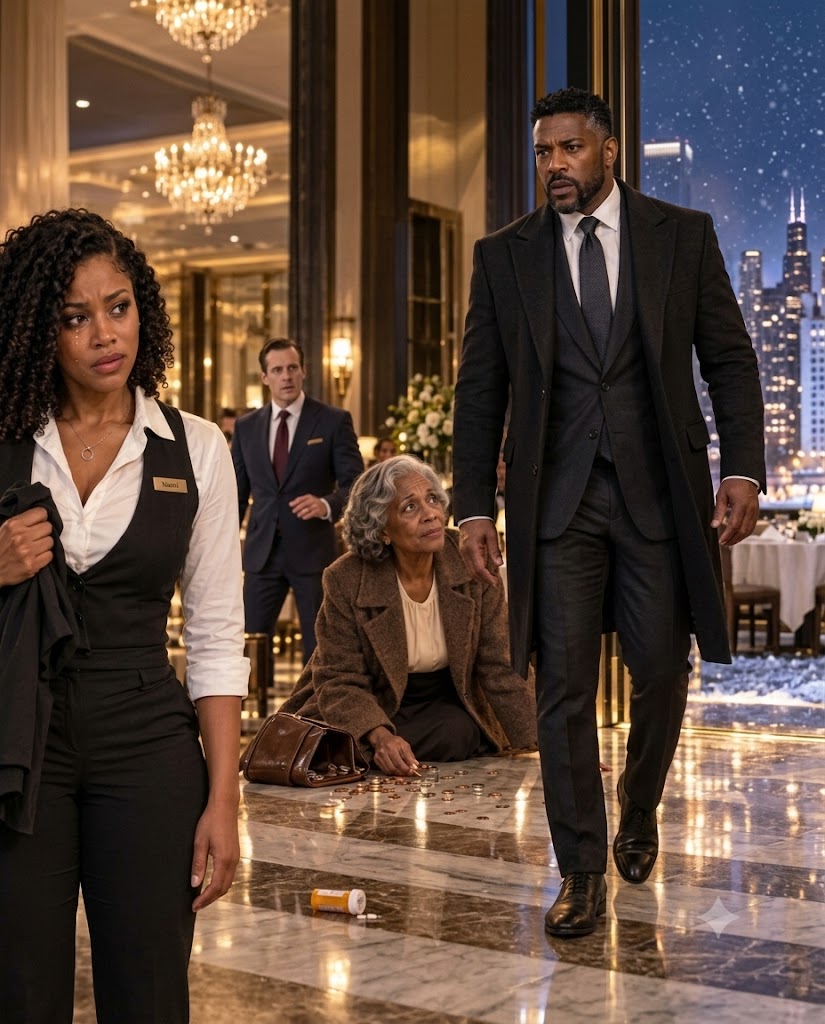
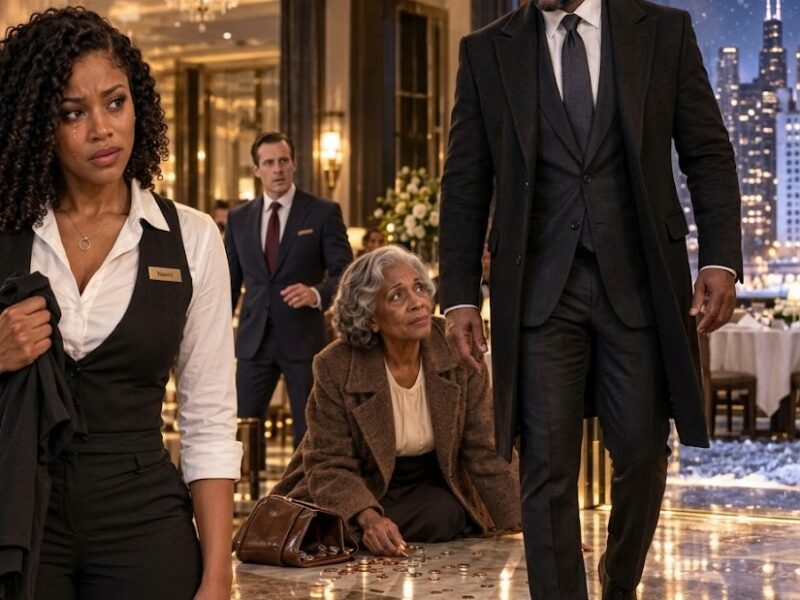
The dinner rush at The Lexington Grand had barely begun when the old woman stumbled through the private dining room doors. Her worn coat dripped rainwater onto the polished marble floor, and her purse had slipped from her trembling fingers, scattering pennies and nickels across the expensive carpet. She looked up at the shocked faces of the well-dressed patrons with confusion in her eyes.
“I’m sorry,” she whispered, her voice cracking. “My purse slipped.”
A man in a tailored suit set down his wine glass and scowled at the intrusion. “Someone should really stop people from wandering in here.”
A woman at the next table leaned toward her companion and murmured, “Maybe she’s collecting donations.”
The old woman’s head snapped up at that. “I’m not asking anyone for money.”
A tall man with slicked-back hair and a name tag that read “Bradley” strode toward her, his footsteps echoing against the vaulted ceiling. “Ma’am, I already asked you to leave.”
“And I told you I’m waiting for my son.”
“Then your son can meet you outside.”
“Outside?” The old woman’s voice wavered. “It’s raining.”
“This is a private dining area.”
“I thought this was a hotel.”
Bradley raised his hand and snapped his fingers. “Security.”
A young woman in a server’s uniform stepped forward from the kitchen entrance. Her name was Naomi Carter, and she had been working double shifts for three weeks straight. Dark circles shadowed her eyes, but her posture remained straight as she approached the scene.
“Bradley,” Naomi said quietly.
“Stay out of this.”
Naomi’s eyes dropped to the floor where the old woman still sat, her knees pressed against the cold marble. “She’s on the floor.”
“I can see that.”
“Then why is everybody standing around watching her?” Naomi took a step forward. “Naomi, don’t.”
“I can’t.” She knelt beside the old woman and began gathering the scattered coins. “Here, ma’am. I’ve got it.”
“You don’t have to do this.”
“Apparently, somebody does.”
Bradley’s face flushed red. “Get up.”
The old woman winced as she tried to rise. “Give me a second.”
“Get up.”
“Why?”
“Because I told you she’s leaving.”
Naomi rose to her feet and faced Bradley directly. “She’s someone’s mother, Bradley.”
“That is none of your concern.”
“You don’t get to humiliate her just because she doesn’t look rich enough for your restaurant.”
The dining room had gone silent. Every fork had stopped moving. Every conversation had died. Bradley’s jaw tightened, and his voice dropped to a dangerous whisper.
“This is ridiculous.”
“Then stop watching.”
A woman at a nearby table gasped. “Oh, Lord. And you’ve been warned about treating employees and guests like garbage.”
Bradley turned toward the voice, then back to Naomi. His hand moved to his waist where he kept his employee roster. “Take off your apron.”
“What?”
“You heard me.”
“Bradley—”
“You’re fired.”
The word hung in the air like a gunshot. Naomi’s hands trembled slightly, but she didn’t move.
“Bradley, come on. She has a daughter.”
“Stay out of it. Unless you want to join her.”
Naomi reached behind her back and untied the apron strings with deliberate slowness. She folded the white fabric once, then twice, and placed it on the nearest table.
“You know something?”
“What?”
“I’d rather lose this job than become the kind of person who could watch that happen and do nothing.”
Music drifted from the lobby speakers as Naomi turned toward the employee entrance. But before she could take three steps, a man’s voice cut through the silence.
“Employee entrance. Now.”
Naomi stopped and looked back. Bradley was pointing toward the service hallway, his face twisted with barely contained rage. But something in Naomi’s expression had changed. She wasn’t afraid anymore.
“Do you have somewhere warm to go?” she asked the old woman.
“Yes.”
Naomi reached into her pocket and pulled out a crumpled paper bag. “Take this anyway. This is dinner.”
“What about your family?”
“I’ll figure it out.”
“Leave,” Bradley repeated.
“I’m going.”
The old woman clutched the paper bag to her chest as Naomi walked away. For a long moment, nobody in the dining room moved. Then the front doors swung open, and a young man in an expensive suit stepped inside.
“Mom?”
The old woman looked up. “Mr. Westmore.”
“Mom.” The man rushed forward, his face pale. “Mom, where have you been? We’ve been calling you for two hours.”
“I’ve been learning.”
“Learning what?”
The old woman’s eyes swept across the room, taking in the shocked faces, the frozen servers, the man who had just fired an employee for showing basic human decency.
“What happens inside your hotel when nobody recognizes my last name?”
“What happened here?”
A man in a manager’s uniform appeared at Alexander’s elbow. “Sir, there has clearly been a misunderstanding.”
“No.”
“Mom—”
“He fired her.”
Alexander’s head turned slowly toward Bradley. “For what?”
“For treating me like a human being.”
“Mr. Westmore, I can explain—”
Music swelled from somewhere in the building as Alexander Westmore, heir to the Westmore Hotel Group and one of the wealthiest men in the country, took a step toward Bradley.
“Then you better pray your explanation is extraordinary.”
“Save it, Miss Carter,” Alexander said without turning around. “Miss Carter, please. I owe you an apology.”
The voice came from behind Naomi, who had stopped in the service hallway. She turned to find Alexander Westmore standing there, his expensive shoes clicking against the linoleum floor.
“You’re apologizing because she turned out to be your mother.” Naomi’s voice was steady. “Ask yourself whether you’d be standing there if she belonged to somebody poor.”
Alexander opened his mouth, then closed it.
“That’s what I thought.”
“Alexander,” the old woman called from the dining room.
“I know,” he called back.
“No, son. You don’t.”
—
Three hours earlier, Naomi Carter had been standing in her cramped apartment, searching for her daughter’s missing shoe.
“Mom, have you seen my other shoe?”
“Check under the couch.”
A pause. “Mom.”
“What?”
“You’re wearing it.”
Naomi looked down at her feet. Sure enough, one brown loafer and one white sneaker. She sighed and sat down heavily on the edge of the couch.
“I need a vacation.”
“You need coffee.”
“You’re eight. You’re not allowed to know that.”
Maya Carter appeared in the doorway, her backpack already slung over one shoulder. She had her father’s eyes, dark and thoughtful, and her mother’s stubborn chin.
“Can I ask you something?”
“Depends. Does it cost money?”
“Maybe $180.”
Naomi’s heart clenched, but she kept her face neutral. “It’s okay.”
“What’s okay?”
“I don’t have to go.”
“Do you want to go?”
“Everybody else is.”
“That wasn’t my question.”
Naomi looked at her daughter, really looked at her. Maya was growing up so fast, and there was so much Naomi couldn’t give her. But she could give her this.
“Yes.”
“Then you’re going.”
“But—”
“No buts before 7 in the morning.”
Maya’s eyes searched her mother’s face. “Are we broke?”
“We’re temporarily having a disagreement with money.”
“Who is winning right now?”
Naomi laughed despite herself. “Money.”
“Mom.” Maya’s voice was soft. “Hey, look at me.”
Naomi looked.
“I just don’t want you to be tired all the time.”
“I’m your mother. Being tired is part of the uniform.”
Maya was quiet for a moment. Then, “I miss Dad.”
Naomi pulled her daughter into a hug. “Me, too.”
—
The staff entrance of The Lexington Grand smelled like bleach and old coffee. Naomi pushed through the door and nearly collided with her best friend, Tasha Reed.
“You look terrible.”
“Good morning to you, too.”
“I’m your friend. Friends tell the truth.”
“Friends bring coffee, which is why I’m your best friend.”
Tasha handed over a paper cup. “I take back everything I’ve ever said about you.”
Naomi took a sip and felt the caffeine hit her bloodstream. “Bradley’s already angry. Is the sun also up?”
“Victoria Hail is coming tomorrow night.”
“That explains it.”
“They’re saying she’s practically engaged to Alexander Westmore.”
“Good for Alexander Westmore.”
“Billionaire Alexander Westmore. Does his money come with eight hours of sleep?”
“You are deeply unromantic.”
“Romance doesn’t pay the electric bill.”
“Carter.”
Naomi turned to see Kent, the floor manager, gesturing toward the conference room. “Kent.”
“Staff meeting.”
“And there goes breakfast.”
The staff meeting was the same as every other staff meeting. Bradley stood at the front of the room, his tie perfectly knotted, his hair perfectly styled, his smile perfectly fake.
“Tomorrow night’s dinner will include investors, board members, and private guests.”
“Understood.”
“There will be no mistakes.”
Naomi raised her hand. “Does breathing count?”
“Stop.”
“Something you’d like to share?”
“No.”
“Good. Because I’ve had enough of employees confusing opinions with authority.”
Naomi felt the words slip out before she could stop them. “And I’ve had enough of authority confusing itself with respect.”
The room went silent. Bradley’s eyes narrowed.
“One more incident.”
“Is that a threat?”
“It’s a professional warning.”
“Then professionally received.”
—
Across town, in a penthouse overlooking the city, Evelyn Westmore was having breakfast with her son.
“Your father had terrible hair.”
“You married him.”
“I was young.”
A man in a driver’s uniform appeared in the doorway. “Driver’s downstairs.”
“Cancel him.”
“For tonight?”
“For tomorrow.”
Alexander Westmore set down his coffee cup. “What are you planning?”
“Nothing.”
“That answer has frightened me since childhood.”
Evelyn smiled, but it didn’t reach her eyes. “Do you remember what your father said about hotels?”
“He said many things about hotels.”
“He said, ‘A hotel reveals your character when someone walks through the door who cannot do anything for you.'”
Alexander studied his mother’s face. “This is about those anonymous complaints.”
“Anonymous complaints involve your employees.”
“I’ll have legal investigate.”
“Legal.” Evelyn’s voice was sharp. “They’re trained to investigate.”
“And I’m trained to lead.”
“What exactly do you want me to do?”
“Listen.”
“I do listen. Only after somebody walks into your office wearing a suit.”
—
Naomi was halfway through her shift when she felt the sharp edge of a broken kitchen rack slice through her sleeve.
“This thing almost cut me again.”
“Didn’t you report it?” Tasha asked.
“Three times.”
“Of course you did.”
“Don’t start. I’m taking a picture.”
“Naomi, if somebody gets hurt, Bradley will suddenly forget anyone told him.”
Naomi snapped a photo of the jagged metal edge. “Thank you.”
“Remember, smile, serve, go home. That’s always the plan.”
“No saving people.”
“I’m not Batman.”
“You’re worse. Batman has money.”
—
The dinner service that night was chaos from the first reservation. Victoria Hail had arrived with an entourage of investors, all of them demanding attention, all of them watching every move the staff made. Naomi moved through the dining room like a ghost, refilling water glasses, clearing plates, avoiding eye contact.
Then the old woman walked through the door.
She was soaked from the rain, her gray hair plastered to her skull, her shoes leaving wet prints on the marble floor. She approached the hostess stand with a tentative smile.
“Good evening.”
“Reservation?”
“I’m meeting someone.”
“Name?”
“Westmore.”
The hostess scanned her tablet. “I don’t see anything under Westmore.”
“My son asked me to meet him.”
A man in a security uniform appeared at the hostess’s elbow. “Problem?”
“She says she’s meeting someone.”
“Who?”
“My son.”
“His name.”
The old woman’s smile faltered. “Does it matter in this restaurant?”
“Yes.” The security guard crossed his arms. “You’ll need to wait outside the restaurant.”
“You haven’t even asked whether I’d like a chair.”
“Because you’re not a guest.”
“You decided that very quickly.”
“Security.”
Naomi was already moving. She had watched the whole exchange from across the room, and something in her chest had tightened at the sight of the old woman’s trembling hands.
“Bradley, don’t.”
“Go back to your table.”
“Oh, ma’am.” Naomi knelt beside the old woman, who had sunk onto a nearby bench. “I’m fine.”
“No, you’re not.”
“Naomi.”
“One second.”
“You’re making a scene.”
“No.” Naomi stood and faced Bradley. “Everybody watching and doing nothing is making a scene.”
“Mom.”
The word came from the entrance. Naomi turned to see Alexander Westmore standing in the doorway, his face a mask of barely controlled fury.
“Hello, Alexander.”
“What happened?”
“Someone fed me.”
“Why are you holding food in a paper bag?”
“Because she thought I couldn’t afford dinner.”
Alexander’s eyes moved to Naomi. “You gave her your meal.”
“She looked hungry.”
“You didn’t know who she was.”
“Why should that matter?”
—
“You’re home.”
Maya looked up from her homework as Naomi walked through the door. “Hey, baby.”
“Why are you early?”
“I got fired.”
“Because of the science trip?”
“No, never.”
“Then why?”
“Because an old woman needed someone to stand beside her.”
“And they fired you for that?”
“Pretty much.”
Maya was quiet for a moment. Then she said, “Then your boss is stupid.”
“Maya, I’m serious.”
“I’m serious too.”
“Don’t tell your teacher I agreed.”
—
The next morning, the Westmore Hotel Group’s executive boardroom was filled with people who had never worked a service job in their lives. Alexander sat at the head of the table, his mother beside him, Victoria Hail at the opposite end.
“Why did you call an emergency meeting over a restaurant incident?”
“Sit.”
“Alexander, sit, Victoria.”
“I appreciate the opportunity to explain.”
“You’ll have one. The angle doesn’t show everything.”
“It shows me on the floor.”
“Mrs. Westmore, I sincerely apologize.”
Evelyn Westmore’s eyes were cold. “Would you apologize if I were Mrs. Nobody?”
“You’re suspended.”
“Alexander—”
“Not now.”
“You don’t suspend senior management because of a viral looking phone clip.”
“Viral looking? I mean, we need context.”
“Here’s context.”
Alexander slid a stack of papers across the table. “Where did these come from?”
“Interesting question.”
“No.”
—
Naomi was making breakfast for Maya when the knock came at the door. She opened it to find Alexander Westmore standing in the hallway, looking deeply uncomfortable.
“Good morning.”
“Still no.”
“I came to offer your job back.”
“I don’t want it.”
“With back pay.”
“No.”
“And compensation?”
“No.”
“Can I at least finish one sentence?”
“You’re very used to that, aren’t you?”
“Used to what?”
“People letting you finish.”
Alexander was quiet for a moment. “Five minutes.”
“Three.”
“Your daughter likes space.”
“You’re down to two minutes.”
“You were wrongfully terminated.”
“Yes.”
“I want to correct that.”
“Then correct what caused it.”
“Excuse me?”
“Do you think Bradley woke up yesterday and suddenly became cruel? He felt safe doing it.”
“Safe.”
“People don’t mistreat employees for years unless somebody above them isn’t looking.”
“I run dozens of properties.”
“Exactly.”
“You don’t know what my responsibilities are.”
“And you don’t know what your employees’ lives are.”
“Then what?”
“Don’t fix me, Mr. Westmore.”
“Then what?”
“Fix your hotel.”
—
Alexander was still standing in the hallway when his phone buzzed. His mother’s name appeared on the screen.
“Please tell me billionaires don’t have a family schedule for showing up at people’s homes.”
“Technically, I am not the billionaire.”
“That’s exactly what a billionaire’s mother would say.”
“Your building has too many stairs.”
“You came all this way to insult my building.”
“I came to apologize.”
“You didn’t fire me. I created the situation.”
“Why?”
“Because I wanted to know how people behaved when they thought I couldn’t help them. And I found out.”
“Then that’s a dangerous test. It cost you your job.”
“Bradley cost me my job.”
“Then help me understand how many other people he’s cost.”
Alexander reached into his jacket and pulled out a folded document. “What’s that?”
“Six-week consulting position.”
“You’re joking.”
“I’m 74. I don’t climb these stairs for jokes.”
“This number is wrong.”
“No.”
“Is this charity?”
“Absolutely not.”
“Then why me?”
“Because everyone else in that room knew who they were afraid of.”
“You were afraid too.”
“Terrified.”
“Exactly.”
—
The next day, Naomi walked through the front doors of The Lexington Grand for the first time as something other than an employee.
“Oh, absolutely not. Hello to you, too, girl. Look at you. I can’t breathe.”
“You came through the front door.”
“Apparently, I’m allowed now.”
“Miss Carter.”
“Mr. Westmore. Oh, don’t. I said nothing.”
“Is this really anonymous?”
“Alexander doesn’t get your name unless you agree.”
“You call him Alexander?”
“Focus.”
“The kitchen rack has been broken six months.”
“What else?”
“My mom died in March.”
“I’m sorry.”
“Bradley told me if I missed the weekend shift, I shouldn’t come back.”
“You worked?”
“Yeah.”
“The day after she died.”
“I wash dishes.”
“Read it.”
“Good afternoon to you, too. Read.”
“Bereavement leave denied.”
“His mother died.”
“That’s against policy.”
“Then your policy is a piece of paper nobody was enforcing.”
“You think I knew about this?”
“No.”
“That almost sounds worse.”
“It is.”
“You know, most billionaires just pay someone to entertain them.”
“How long have you been standing there?”
“Long enough to discover you’re annoyingly talented.”
“My father taught me.”
“You miss him?”
“Every day.”
“When?”
“Two years ago.”
“I’m sorry.”
“Your husband.”
“What about him?”
“You touch that every time someone mentions family.”
“His name was Marcus.”
“Was?”
“Car accident.”
“How long?”
“Four years.”
“Naomi. Don’t.”
“Don’t what?”
“Look at me like I’m going to break.”
“I don’t think you break easily.”
“Everybody breaks.”
“Maybe somebody.”
—
Victoria Hail was waiting in Alexander’s office when he returned.
“She spends a great deal of time with you.”
“She’s working.”
“So are hundreds of people.”
“What exactly is your point?”
“My point is that this waitress—”
“Consultant.”
“Fine. Consultant. She’s creating unnecessary disruption.”
“Twenty-three unresolved labor complaints aren’t unnecessary.”
“And you’re assuming they’re credible because she says so.”
“Why does this bother you so much?”
“Because somebody has to protect this company from emotional decisions.”
“Maybe emotional decisions aren’t our biggest problem.”
“Northbridge facilities.”
“What?”
“They charged you for staff training.”
“Yes.”
“They didn’t train us.”
“How do you know?”
“Because I worked here. $380,000 for training that never happened.”
“Let’s trace the vendor.”
“Now you sound useful.”
“You’re enjoying this.”
“Not remotely.”
“Hail Strategic Partners.”
“Hail.”
“Victoria’s family.”
“You didn’t know?”
“No.”
“Alexander.”
“I need air. Don’t confront her yet.”
“Why?”
“Because if she’s dirty and she realizes you know, everything disappears.”
“Remind me again why you were a waitress.”
“Life.”
—
Naomi was leaving the hotel when a figure stepped out of the shadows.
“What are you doing here?”
“I need to give you something.”
“Give it to the police.”
“Naomi, please.”
“Move your hand.”
“I’m sorry.”
“That word sounds strange coming from you.”
“Everything is here.”
“Everything what?”
“Payments, instructions, complaints. I was told I buried them.”
“You buried them?”
“Yes.”
“People came to you for help.”
“I know.”
“Derek worked the day after his mother died because of you.”
“I know.”
“Stop saying you know.”
“Victoria had enough on me to destroy my career.”
“So you destroyed everybody else’s first. This doesn’t make you brave.”
“I know. But it might finally make you useful.”
—
“Naomi, you found something.”
“Emails.”
“What is this?”
“Messages between you and Bradley.”
“I’ve never emailed Bradley privately.”
“They say you knew who my mother was.”
“You believe this?”
“I’m saying I need to verify it. That’s not what I asked.”
“Naomi.”
“Do you believe I staged getting fired?”
“I want to believe you didn’t.”
“You want to believe me?”
“That’s not what I meant.”
“No, that’s exactly what you meant.”
“Please don’t touch me.”
“Naomi—”
“I stood in front of Bradley when I had $28 in my bank account.”
“Naomi.”
“I didn’t know your mother had money.”
“I know.”
“No, you don’t. What do you want me to say?”
“Nothing.”
“Don’t walk away.”
“You finally learned exactly how powerful people punish the messenger.”
“Naomi.”
“Goodbye, Alexander.”
—
Maya was waiting when Naomi got home.
“Do you hate him?”
“Who?”
“Mr. Westmore.”
“Why do children ask questions adults spend thousands of dollars avoiding?”
“That’s not an answer.”
“No, I don’t hate him.”
“Then why?”
“Because sometimes somebody disappoints you more when you expected better.”
“Dad used to say being scared doesn’t mean you’re wrong.”
“When did he tell you that?”
“When I was scared to go swimming.”
“I forgot that.”
“I didn’t.”
“8:42.”
“Mom, what time was your school concert?”
“The one where Liam threw up. Yes.”
“Eight.”
“Your teacher sent videos.”
“Why?”
“Because somebody lied badly.”
“Naomi. Watch.”
“Maya’s concert.”
“8:41. The email was supposedly sent at 8:42.”
“You couldn’t have sent it.”
“Congratulations. I was wrong.”
“Yes. I should have believed you.”
“Yes.”
“I’m sorry.”
“Good.”
“That’s it.”
“Be better.”
“I will. Starting now.”
—
“What is that?”
“The forged documents were created on a machine registered to Victoria Hail’s executive office.”
“Victoria.”
“The board deserves to know that Alexander’s judgment has been compromised.”
“Compromised how?”
“By an employee with whom he has developed an inappropriate personal relationship.”
“Wow. Miss Carter, you found my worst angle.”
“This isn’t funny.”
“No. Forging evidence wasn’t funny either.”
“Excuse me.”
“We know.”
“Know what?”
“Northbridge.”
“I don’t know what you’re talking about.”
“You’re not as good at lying as you think. Nobody in this family has ever been good at lying.”
“Evelyn.”
“Although some of our associates have practiced.”
“I gave them everything.”
“You pathetic little coward.”
“You’re right. I was. $23 million.”
“What?”
“Fake maintenance contracts, fake training contracts, inflated security payments.”
“You really think this waitress understands corporate finance?”
“I understand when somebody charges $380,000 for training I never attended. Sometimes common sense is terribly inconvenient.”
“Everything I did protected the expansion.”
“You stole from us.”
“I moved money.”
“You forged documents.”
“Because she was poisoning you against me.”
“You did that yourself.”
“You think because his mother likes you that you belong here?”
“No. At least you’re realistic.”
“I think I belong wherever my work earns me a seat.”
“Exactly. You’re throwing away everything for people who don’t even care about you.”
“They’re employees.”
“Victoria.”
“Exactly.”
“No, that’s the part you never understood.”
“Miss Hail.”
“Don’t touch me.”
“Leave.”
“Naomi.”
“What?”
“I’m sorry.”
“For what part?”
“All of it.”
“That’s a lot.”
“I kept telling myself I was surviving.”
“Survival explains things.”
“Does that mean—”
“It doesn’t excuse them.”
“I understand.”
“Make sure you do.”
—
“Sit down.”
“Why does that sound threatening?”
“Because my mother has no patience.”
“I have plenty.”
“Do not encourage her.”
“Director of Employee Standards and Guest Dignity. Companywide.”
“No charity.”
“No charity.”
“This salary is very charitable.”
“I was going to say obscene. You’d be responsible for 42 properties.”
“I don’t have the degree.”
“Finish it.”
“What?”
“We’ll structure the schedule around school.”
“You’d let me go back?”
“No, darling. We’re asking you to go forward.”
—
“Mom, my bridge held 12 pounds.”
“12?”
“And Tyler’s broke at six.”
“We celebrate our own bridge, not Tyler’s suffering.”
“Hi, Mr. Westmore.”
“Hi, Maya.”
“Is one for my mom?”
“If she’ll accept it.”
“Take it. Thank you for your support.”
“You’re welcome.”
“She’s terrifying.”
“You have no idea.”
“Can I ask you something?”
“You’re a billionaire. Apparently, you can ask anybody anything.”
“I’m trying very hard not to be that man anymore. Ask.”
“Dinner.”
“What about it?”
“With me?”
“Are you nervous?”
“No.”
“You’re absolutely nervous.”
“Friday. 7.”
“I don’t know.”
“All right.”
“Pick me up at 6:45.”
“That’s a yes.”
“Don’t ruin it.”
—
Table 12 needed water before they asked. Naomi moved through the dining room with practiced ease, her new name tag catching the light.
“Look at you.”
“Look at me. Supervisor Reed.”
“Director Carter, please don’t.”
“Remember when Bradley said your mouth would get you fired?”
“Technically, it did.”
“Best firing ever.”
“Excuse me.”
“Good evening, sir.”
“I’m waiting for my daughter. She said she’d meet me here, but I’m early.”
“You’re welcome to wait.”
“I don’t want to be in the way.”
“You’re not.”
“I can’t really afford anything here.”
“Then I’ll bring you a coffee on us.”
“Really?”
“Really.”
“Tasha, I saw he didn’t hesitate.”
“Neither did you.”
—
“What a stunning lobby.”
“Thank you, Grandma Eve.”
“Eve, you’re not actually my grandma.”
“Excuse me, but you can stay.”
“How generous.”
“She’s adopted my mother.”
“Your mother adopted her first.”
“Probably.”
“Do you ever think about that night?”
“Every time I walk through these doors.”
“People still tell the story wrong.”
“How?”
“They say I helped your mother without knowing she was rich.”
“That’s what happened.”
“That’s not the point.”
“Then what’s the point?”
“What if she hadn’t been Evelyn Westmore? What if nobody had come through those doors?”
“She still would have deserved kindness.”
“Exactly.”
“You changed this place.”
“We changed it.”
“You hate giving me credit.”
“It keeps you humble.”
“Is it working?”
“Ask me in another year.”
“Alexander, if you’re going to kiss the woman, please do it before I fall asleep.”
“Evelyn, do it.”
“This family has no boundaries.”
“Your family.”
“Hopefully yours, too.”
“Slow down, billionaire.”
“Yes, ma’am.”
“You know what I learned?”
“What?”
“Sometimes losing the wrong place in your life is how you finally find where you belong.”
“And sometimes the woman you almost let walk away is the one who teaches you how to stay.”
“That was suspiciously romantic.”
“I’ve been practicing.”
“Keep practicing.”
“Are you two done talking yet?”
“Apparently.”
“Come here. Your daughter has decided we’re taking a family picture.”
“My daughter for now.”
“For now.”
“One miracle at a time.”
“Everybody smile. Is Alexander smiling?”
“Barely.”
“Smile.”
“I am.”
“Got it.”
“Yeah.”
“What?”
“We figured it out.”
—
The rain had stopped by the time Naomi walked through the employee entrance for the last time. She paused in the doorway, looking back at the dining room where an old woman had once fallen and a young waitress had refused to look away.
The floor had been polished since then. The tables had been rearranged. But the memory remained, etched into the marble like a scar that had healed but would never fully disappear.
“Mom?”
Naomi turned. Maya stood in the hallway, her backpack slung over one shoulder, her father’s eyes bright with curiosity.
“What are you doing here?”
“I wanted to see where it happened.”
“Where what happened?”
“Where you became my hero.”
Naomi felt tears prick at her eyes. “I’m not a hero, baby.”
“You stood up for someone who couldn’t stand up for herself. That’s what heroes do.”
“Heroes are supposed to have money. Or capes.”
“You have neither.”
“Thanks.”
Maya grinned. “But you have me.”
Naomi pulled her daughter into a hug. “That’s better than a cape.”
“Mom?”
“Yeah?”
“Can we get ice cream?”
“Did you finish your homework?”
“Mostly.”
“Mostly isn’t finished.”
“Mom.”
“Fine. But you’re paying.”
“I’m eight.”
“Exactly. Time to learn about money.”
—
Alexander Westmore stood at the window of his penthouse office, watching the city lights flicker to life below. His mother sat in the chair behind him, a cup of tea steaming in her hands.
“You’re thinking about her.”
“I’m always thinking about her.”
“Good.”
“She almost walked away.”
“But she didn’t.”
“She almost did.”
“Almost doesn’t count.”
Alexander turned from the window. “How did you know? That night. How did you know she was different?”
Evelyn smiled. “Because she didn’t ask who I was. She asked if I was okay.”
“That’s it?”
“That’s everything. Most people look at a person and see a wallet. She looked at me and saw a human being.”
“I almost fired her.”
“You almost made the biggest mistake of your life.”
“I know.”
“But you didn’t.”
“I almost did.”
“Almost doesn’t count.”
Alexander laughed despite himself. “You’re enjoying this.”
“Immensely.”
—
Naomi was tucking Maya into bed when her phone buzzed. A text from Alexander.
“Friday. 6:45. Don’t be late.”
She smiled and typed back. “Wouldn’t dream of it.”
“What are you smiling at?”
“Nothing.”
“Mom.”
“Go to sleep.”
“Was it Mr. Westmore?”
“Maya.”
“What? I’m just asking.”
“Sleep.”
“Fine. But I want details tomorrow.”
“There won’t be details.”
“There will be details.”
“Goodnight, Maya.”
“Goodnight, Mom. Say hi to Alexander for me.”
Naomi closed the door and leaned against it, her heart full in a way she hadn’t felt in years. Four years since Marcus had died. Four years of survival, of counting pennies, of working double shifts and coming home too tired to think.
Four years of forgetting what it felt like to hope.
She looked down at her phone and read Alexander’s message again. Then she typed a new one.
“Thank you.”
“For what?”
“For seeing me.”
The reply came quickly. “I see you. I always will.”
—
The Lexington Grand had changed. The kitchen rack had been replaced. The bereavement policy had been rewritten. Bradley had been escorted out by actual security, his face pale with shock as twenty-three employees watched in silence.
But some things remained the same.
The marble floor still gleamed. The chandeliers still sparkled. And every night, without fail, someone walked through the front doors who couldn’t do anything for the people inside.
Naomi made sure they were welcome.
She stood at the hostess stand on a rainy Tuesday evening, watching the door, waiting. A young woman in a worn coat pushed through the entrance, her eyes wide with uncertainty.
“Good evening.”
“I’m looking for my husband. He said he’d meet me here.”
“Name?”
“I don’t know if he made a reservation.”
“That’s okay. We’ll find him.”
The woman’s shoulders relaxed slightly. “Thank you.”
“Would you like a seat while you wait?”
“I don’t want to be in the way.”
“You’re not. You’re a guest.”
The woman smiled, and Naomi felt something shift in her chest. This was why she had stayed. This was why she had fought. Not for the money, not for the title, but for moments like this.
“Can I get you something to drink?”
“Water would be fine.”
“Coming right up.”
—
Alexander found her an hour later, standing by the window, watching the rain fall.
“You’re still here.”
“I’m always here.”
“It’s late.”
“I know.”
“You should go home.”
“I will. In a minute.”
Alexander stood beside her, their shoulders almost touching. “My mother wants to know if you’re coming to dinner on Sunday.”
“Tell her I’ll bring dessert.”
“She’ll like that.”
“How is she?”
“Terrifying as always.”
“Good. I’d hate for her to change.”
Alexander was quiet for a moment. Then he said, “I was wrong. About everything.”
“You were.”
“You’re not going to make this easy, are you?”
“Where’s the fun in easy?”
He laughed, and the sound echoed through the empty lobby. “You’re impossible.”
“I know.”
“I’m glad you stayed.”
“I know.”
“Are you ever going to let me finish a sentence?”
“Maybe. If you earn it.”
—
The family picture hung in the lobby of The Lexington Grand, right next to the front desk. It showed Evelyn Westmore in the center, her gray hair perfectly styled, her smile genuine. Alexander stood to her right, his arm around Naomi’s shoulders. Maya stood in front, holding a sign that said “Best Day Ever.”
Tasha was in the background, photobombing with a tray of coffee cups. The staff had signed the frame with messages like “Thank you for seeing us” and “You made this place better.”
Naomi walked past it every morning on her way to her office. She never stopped looking at it. Not because she was proud, though she was. Not because she was happy, though she was.
She looked at it because it reminded her of what was possible.
An old woman had fallen in a restaurant. A waitress had refused to look away. And a billion-dollar company had been forced to see the people it had spent years ignoring.
The rain had stopped. The floor had been polished. And somewhere, in a small apartment across town, an eight-year-old girl was dreaming of bridges that held twelve pounds.
“Mom?”
Naomi turned. Maya stood in the doorway of her office, holding a piece of paper.
“What’s that?”
“My report card.”
Naomi took the paper and scanned it. All A’s. Except for one B, in math.
“Math?”
“I’m working on it.”
“You better be. We don’t celebrate Tyler’s suffering in this family.”
Maya grinned. “But we celebrate our own bridges.”
“Exactly.”
“Can we get ice cream?”
“Did you finish your homework?”
“Mostly.”
“Maya.”
“Fine. Yes. I finished my homework.”
“Then yes. We can get ice cream.”
“With sprinkles?”
“Is there any other way?”
—
The night was clear, the stars bright above the city. Naomi and Maya walked hand in hand down the street, their breath visible in the cold air.
“Mom?”
“Yeah?”
“Are you happy?”
Naomi thought about the question. Four years ago, she had been surviving. Three years ago, she had been struggling. Two years ago, she had been tired.
Now?
“I’m getting there.”
“That’s not an answer.”
“It’s the best I’ve got.”
Maya squeezed her hand. “I’m happy.”
“Yeah?”
“Yeah. You’re not tired all the time anymore.”
“I’m still tired.”
“But not all the time.”
“No. Not all the time.”
They walked in silence for a moment. Then Maya said, “Do you think Dad would be proud?”
Naomi felt the familiar ache in her chest. “I think he’d be the proudest person in the world.”
“Even prouder than Alexander?”
“Even prouder.”
“Good.”
“Why good?”
“Because Dad was first.”
Naomi smiled. “Yes. Dad was first.”
—
The ice cream shop was closing when they arrived, but the owner recognized Naomi and let them in anyway. Maya ordered chocolate with sprinkles. Naomi ordered vanilla with caramel.
They sat in the window, watching the city lights flicker.
“Mom?”
“Yeah?”
“What’s the lesson?”
“What lesson?”
“From everything. From that night.”
Naomi thought about it. The old woman on the floor. Bradley’s cold eyes. Alexander’s apology.
“The lesson is that kindness doesn’t cost anything. But it’s worth everything.”
Maya nodded. “I like that.”
“Me too.”
“Can I ask you something else?”
“Depends. Does it cost money?”
“No. It’s free.”
“Then ask.”
“Are you going to marry Alexander?”
Naomi choked on her ice cream. “What?”
“You heard me.”
“Maya.”
“What? It’s a valid question.”
“We’re not talking about this.”
“Fine. But I want to be the flower girl.”
“You’re eight.”
“So?”
“You’re impossible.”
“I learned from the best.”
—
The walk home was quiet, but it was a comfortable quiet. The kind of quiet that comes from knowing you’re exactly where you’re supposed to be.
Naomi tucked Maya into bed and kissed her forehead.
“Goodnight, baby.”
“Goodnight, Mom.”
“I love you.”
“I love you too.”
“And Maya?”
“Yeah?”
“You can be the flower girl.”
Maya’s eyes flew open. “Really?”
“Really.”
“I knew it!”
“Go to sleep.”
“I’m going. I’m going.”
Naomi closed the door and leaned against it, smiling.
—
The next morning, she found a text from Alexander.
“Good morning.”
“Good morning.”
“I have a question.”
“Ask.”
“The director of employee standards and guest dignity. Does that position come with a plus-one?”
Naomi stared at her phone. Then she typed back.
“Are you asking me to be your plus-one?”
“I’m asking if the position comes with one.”
“That’s not an answer.”
“That’s what I learned from you.”
She laughed out loud. Then she typed:
“Yes. It comes with a plus-one.”
“Good.”
“Why good?”
“Because I need one for the gala next month.”
“That’s the only reason?”
“That’s the only reason.”
“You’re impossible.”
“I learned from the best.”
—
The gala was held in the grand ballroom of The Lexington Grand. The chandeliers sparkled. The band played softly. The guests arrived in limousines and designer gowns.
And Naomi Carter walked through the front doors on Alexander Westmore’s arm.
“Miss Carter.”
“Mr. Westmore.”
“You look beautiful.”
“You clean up okay yourself.”
“Just okay?”
“Don’t fish for compliments.”
“I’m not fishing. I’m—”
“Fishing.”
“Fine. I’m fishing.”
“Better.”
Evelyn Westmore appeared at their side, resplendent in silver and diamonds. “You’re late.”
“We’re fashionably late.”
“You’re thirty seconds late.”
“That’s fashionably.”
Evelyn’s eyes twinkled. “I like her.”
“I know.”
“Don’t mess this up.”
“I’m trying not to.”
“You better try harder.”
“Evelyn.”
“Alexander.”
“Please.”
“Fine. I’ll behave.”
“Thank you.”
“For now.”
—
The night was everything a gala should be. Champagne. Dancing. Laughter. But for Naomi, the best moment came when a young woman in a worn coat pushed through the service entrance.
“I’m sorry. I’m looking for my mother. She’s a server here.”
The security guard moved to intercept her, but Naomi stepped forward.
“It’s okay. She’s a guest.”
“She doesn’t look like a guest.”
“She’s a guest.”
The young woman’s eyes filled with tears. “Thank you.”
“Of course. Would you like a seat while you wait?”
“I don’t want to be in the way.”
“You’re not. You’re welcome here.”
Alexander appeared at Naomi’s elbow. “Everything okay?”
“Everything’s fine.”
“She looks familiar.”
“She looks like someone’s daughter.”
“Yes.”
“Then she’s welcome.”
Alexander smiled. “You’re something else, you know that?”
“I know.”
—
The gala ended at midnight. The guests went home. The staff cleaned up. And Naomi stood in the empty ballroom, looking at the spot where an old woman had once fallen.
Alexander joined her. “You’re thinking about that night.”
“I’m always thinking about that night.”
“Me too.”
“She could have been anyone.”
“I know.”
“But she wasn’t just anyone. She was your mother.”
“She was.”
“And that night changed everything.”
“It did.”
“What if she hadn’t been your mother? What if she had been nobody?”
Alexander was quiet for a moment. Then he said, “She still would have deserved kindness.”
Naomi nodded. “That’s the point.”
“What’s the point?”
“That everyone deserves kindness. Not just the people who can do something for you.”
“I know.”
“Do you?”
“I’m learning.”
“Good.”
“Naomi.”
“Yeah?”
“Thank you.”
“For what?”
“For not looking away.”
—
The next morning, Naomi found a small box on her desk. Inside was a keychain with a single word engraved on it: “Kindness.”
She smiled and attached it to her keys.
—
The Lexington Grand had changed. But the world had changed too. The story of the waitress who defended an old woman had spread far beyond the city. It had become a symbol of something bigger, something important.
People talked about it in coffee shops and office buildings. They shared it on social media and in classrooms. They told their children about the woman who had risked everything to help someone she didn’t know.
And somewhere, in a small apartment across town, an eight-year-old girl was writing a report for school.
“What did you learn from your mother’s story?”
Maya looked up at Naomi, who was making breakfast.
“I learned that being brave doesn’t mean you’re not scared. It means you do the right thing anyway.”
Naomi’s eyes filled with tears. “That’s exactly right.”
“Can I read you the rest?”
“I’d love that.”
Maya cleared her throat and began to read. “My mother taught me that everyone deserves kindness. Not just the people who can help you. Not just the people who look like you. Not just the people who have money. Everyone.”
“That’s beautiful.”
“Thanks. I got an A.”
“I’m not surprised.”
“The teacher said I should send it to a newspaper.”
“Maybe you should.”
“Really?”
“Really.”
“Mom?”
“Yeah?”
“I’m proud of you.”
Naomi felt the tears spill over. “I’m proud of you too, baby.”
—
The bridge held twelve pounds. Tyler’s broke at six. And somewhere, a waitress who had lost her job for doing the right thing had found something better than a paycheck.
She had found her purpose.
She had found her voice.
And she had found a family that saw her for who she was, not what she could do.
The rain had stopped. The sun was rising. And Naomi Carter was exactly where she belonged.
“Mom?”
“Yeah?”
“Can we get ice cream?”
“Did you finish your homework?”
“Mostly.”
“Maya.”
“Fine. Yes.”
“Then yes.”
“With sprinkles?”
“Is there any other way?”
—
The story didn’t end there. It never really ends. Because every day, someone walks through a door. Someone needs help. Someone deserves kindness.
And somewhere, a woman who was fired for defending an old woman is there to meet them.
Not because she has to.
But because she wants to.
And that’s the whole point.
—
Alexander Westmore stood at the window of his office, looking out at the city. His mother sat in the chair behind him, reading a book.
“Alexander?”
“Yes, Mother?”
“Are you going to stand there all day?”
“I’m thinking.”
“About what?”
“About that night.”
“It was a good night.”
“It was a terrible night.”
“It was a night that changed everything.”
Alexander turned from the window. “What if I had been too late? What if she had walked away?”
“She didn’t.”
“But what if she had?”
“Then you would have spent the rest of your life wondering what you missed.”
“I almost did.”
“But you didn’t.”
“I almost let her walk away.”
“But you didn’t.”
“Why do you keep saying that?”
“Because it’s true. You didn’t let her walk away. You followed her. You apologized. You changed.”
“I changed because of her.”
“Then don’t let her go.”
“I won’t.”
“Good.”
“I promise.”
“Then I’ll stop asking.”
“You’ll never stop asking.”
“You’re right. I won’t.”
—
The Lexington Grand was full. Every table was taken. Every seat was filled. And at the hostess stand, Naomi Carter greeted each guest with the same warmth she had shown an old woman on a rainy night.
“Welcome to The Lexington Grand.”
“Thank you.”
“Table for two?”
“Yes.”
“Right this way.”
She led them to a table by the window, where the city lights sparkled below. And as she set down their menus, she saw something that made her heart swell.
At the next table, a young man was helping an old woman into her chair. She was frail, her hands trembling, her purse slipping from her fingers. Coins scattered across the carpet.
And nobody in the dining room looked away.
Nobody called security.
Nobody asked her to leave.
Instead, a server knelt beside her and began gathering the coins. A man at the next table offered her his seat. A woman brought her a glass of water.
The young man looked up, confused. “What’s happening?”
The server smiled. “Someone set an example.”
—
The story had come full circle. And in the end, that was what mattered.
Not the money. Not the title. Not the power.
But the kindness of a waitress who refused to look away.
And the billionaire who learned to see.
—
“Mom?”
“Yeah?”
“Are you crying?”
“No.”
“You’re crying.”
“I’m not crying.”
“Mom.”
“Fine. I’m crying.”
“Why?”
“Because I’m happy.”
“Happy?”
“Yeah.”
“About what?”
“About everything.”
Maya hugged her mother. “I love you.”
“I love you too.”
“Can we get ice cream?”
“Did you finish your homework?”
“MOM.”
“I’m kidding. Let’s go.”
“With sprinkles?”
“Is there any other way?”
—
The sun set over the city, painting the sky in shades of gold and pink. And in a small ice cream shop, a mother and daughter sat in the window, watching the world go by.
“Mom?”
“Yeah?”
“What’s the lesson?”
“I thought we covered this.”
“We did. But I want to hear it again.”
Naomi smiled. “The lesson is that kindness doesn’t cost anything. But it’s worth everything.”
“And?”
“And that standing up for what’s right is always worth it. Even when it’s hard. Even when it costs you something.”
“Even when you lose your job?”
“Especially then.”
“Because someone has to.”
“Because someone has to.”
Maya nodded. “I’m going to be like you when I grow up.”
Naomi’s eyes filled with tears. “No, baby. You’re going to be better.”
“How?”
“By learning from my mistakes.”
“What mistakes?”
“Thinking I was too tired to care. Thinking I couldn’t make a difference. Thinking that one person couldn’t change anything.”
“But you did change things.”
“I know. But it took me a long time to learn.”
“Better late than never.”
“Where did you hear that?”
“Grandma Eve.”
“Of course.”
“She’s smart.”
“She’s terrifying.”
“She’s both.”
—
The night was quiet, the stars bright. Naomi and Maya walked home hand in hand, their breath visible in the cold air.
“Mom?”
“Yeah?”
“Thank you.”
“For what?”
“For not looking away.”
Naomi stopped walking. She knelt down to look her daughter in the eye.
“Thank you for reminding me why I shouldn’t.”
Maya hugged her. “I love you, Mom.”
“I love you too, baby.”
“Forever?”
“And always.”
—
The story didn’t end there. It never really ends. Because every day, someone walks through a door. Someone needs help. Someone deserves kindness.
And Naomi Carter was there to meet them.
Not because she had to.
But because she wanted to.
And that was the whole point.
—
The bridge held twelve pounds. Tyler’s broke at six. And a waitress who had lost her job for doing the right thing had found something better than a paycheck.
She had found her purpose.
She had found her voice.
And she had found a family that saw her for who she was.
The rain had stopped. The sun was rising. And Naomi Carter was exactly where she belonged.
—
“Mom?”
“Yeah?”
“Can we get ice cream?”
“Did you finish your homework?”
“Mostly.”
“Maya.”
“Fine. Yes.”
“Then yes.”
“With sprinkles?”
“Is there any other way?”
—
The End.









