A Waitress Was Fired for Defending a Poor Old Woman—Then the Woman’s Billionaire Son Walked In
Part 1
The rain in Lagos didn’t fall so much as it negotiated—drizzle, then downpour, then a sly pause that made umbrellas feel foolish. Amara Okafor stood under the awning of The Ivory Table in Victoria Island, her uniform pressed, her shoes already damp, her phone buzzing with a reminder about her mother’s medical tests. She was eighteen minutes late, and Victor Bamidele, the manager, was already asking for her twice. Inside, the restaurant gleamed like a stage set: white linen, crystal, a single old column near table eighteen that nobody had the courage to remove. Amara had learned that tables were not just tables here. They were verdicts.
“You’re late,” Victor said, not looking up from the briefing chart. “Your bonus is canceled.”
“Sir, I informed Toby that money is for my mother’s medical tests.”
“Your private problems do not change company standards.”
Amara felt the words land like a slap she wasn’t allowed to return. She had eleven months at The Ivory Table, and in that time she had learned to fold napkins into perfect peaks and to swallow insults without choking. Her mother, Grace, was waiting at home with a second tablet scheduled for two o’clock, and her sister, Adaeze, had sent another school payment reminder that morning. Amara had promised to handle it after her shift. She had promised a lot of things.
“Table eighteen is our priority,” Victor continued. “Vanessa Cole is coming with investors. No personal phones, no free items, and no unapproved guests near them.”
“What if a walk-in arrives before them?” Amara asked.
“Move the walk-in. The investors take priority.”
The words were still hanging in the air when the door opened and an older woman stepped in, dressed simply, carrying a small purse and a tiredness that had settled into her bones. She had no reservation. She asked for a table. She was told every table was reserved. She pointed to the empty ones. She was told they were being prepared. She asked what made a table suitable for her. Victor appeared. He said the woman didn’t belong. Amara looked at the old column, the only part of the room that felt human, and then she looked at the woman’s shoes—sensible, worn, wet.
“Please follow me,” Amara said. “Table eighteen is free for forty minutes.”
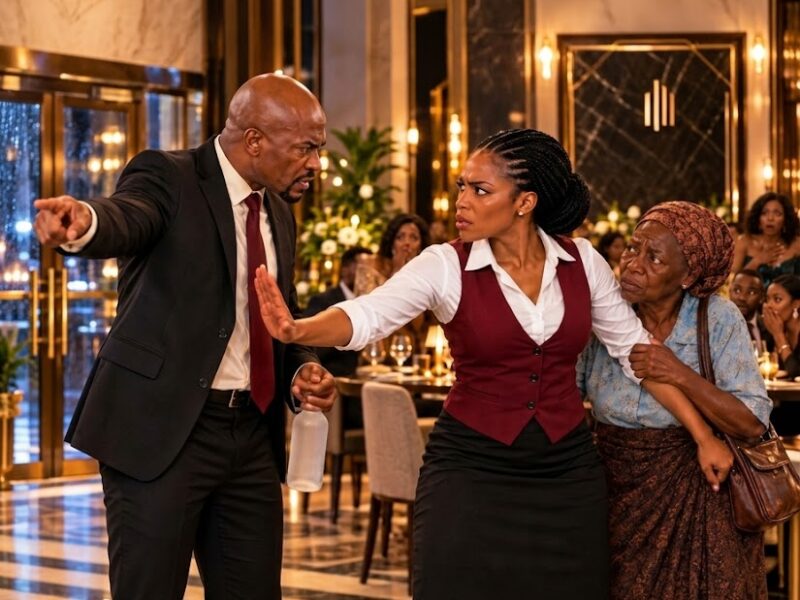
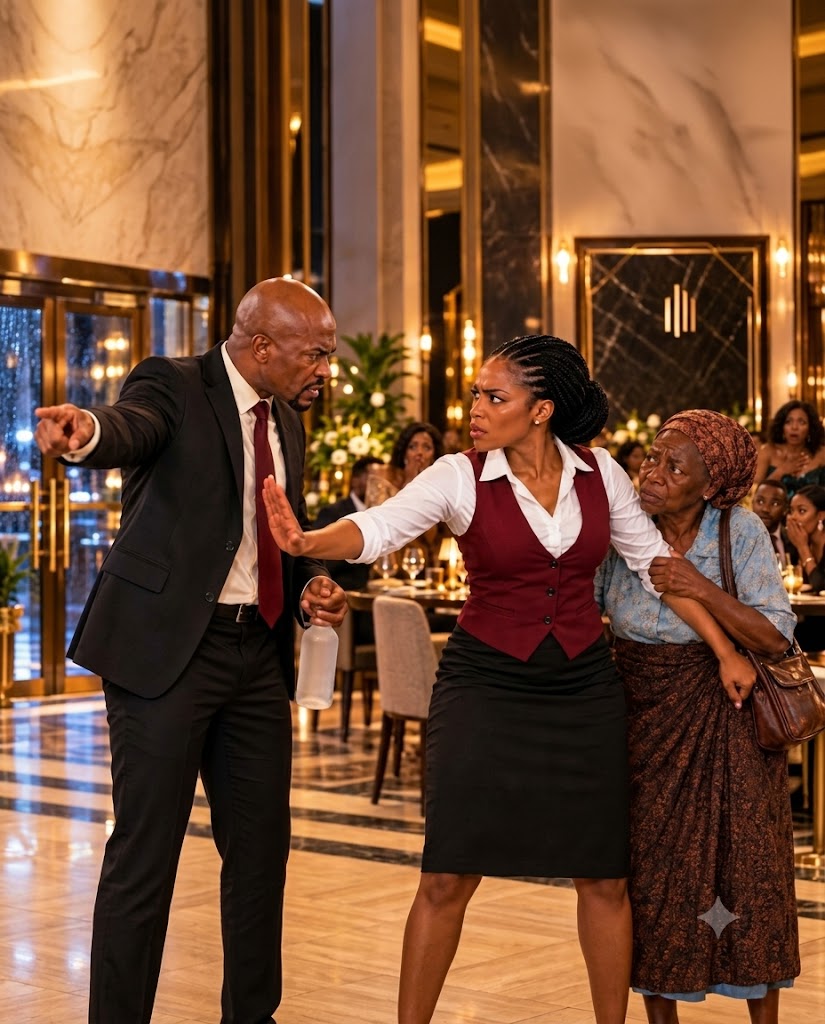
The woman sat. She ordered pepper soup with soft bread and water. She asked which meal Amara would serve her own mother. Amara said the pepper soup, warm and gentle. The woman smiled like she had just been given a gift she didn’t have to pay for. Then Victor came back. He said the table was reserved. He said the woman was a disturbance. He said Amara had exceeded her authority. The woman asked if her soup had exceeded its authority too. Amara brought the food. She warmed it when it cooled. She stood between the woman and the doorman when Victor ordered her removed. She heard herself say no one would touch her. She heard Victor tell her to remove her badge. She heard the word terminated.
“Write the truth in the report,” Amara said.
“What truth?”
“That I was fired because I would not help you humiliate an old woman.”
The woman’s name was Grace. She was not just any old woman. She was the mother of Daniel Nosu, the billionaire whose company owned sixty-two percent of the building. But Amara didn’t know that yet. She only knew that Grace had asked her to call her son, and that the son was coming. She only knew that her own mother was waiting at home, that her sister’s semester was in jeopardy, and that the bonus she had lost was supposed to pay for medical tests. She only knew that dignity had a price, and tonight it had been charged to her.
The rain kept negotiating. Amara stood beneath the awning with Grace, holding a bag of packaged food upright so it wouldn’t spill. Grace said her son worried when she traveled alone. Amara said she understood. Grace said kindness was optional, which is why it revealed character. Amara said nothing. She had already revealed hers. Now she just had to survive the consequences. The black Maybach pulled up fourteen minutes later, and a man stepped out with the kind of quiet that makes rooms go still. Daniel Nosu looked at his mother, then at Amara, then at the restaurant that had fired her for protecting a paying guest.
“Did Victor fire you for stopping the doorman?” he asked.
“He called it insubordination.”
“Did he touch you, Mom?”
“Not physically.”
Daniel nodded slowly. He asked Amara to come inside and tell him exactly what happened. She hesitated. She had just been fired. She had no badge, no backup, no bonus. But she had the truth, and the truth was the only thing Victor couldn’t take from her. She followed Daniel back into The Ivory Table, past the old column, past table eighteen, past Vanessa Cole and her investors, who were still sipping sparkling water and pretending not to watch. Victor appeared, surprised, then nervous, then something worse. Daniel didn’t raise his voice. He didn’t threaten. He simply asked Victor to explain, and when Victor tried to do it privately, Daniel said the truth didn’t need privacy.
“From the moment my mother entered, tell us exactly what happened,” Daniel said.
Amara told them. She told them about the empty tables, the reservation, the pepper soup, the spilled water, the doorman, the badge. Toby confirmed the order. The busboy confirmed the threat. The CCTV was preserved. The payment records were secured. Vanessa Cole called Grace a disturbance. Victor called it protecting a business meeting. Daniel called it something else. He suspended Victor pending an independent investigation. He kept Toby and the busboy employed with full pay. He asked Amara to participate in the investigation only if every worker could speak without losing a shift or a job. She agreed. Then she asked if the report would include what happened to Grace. Daniel said it would.
The old column stayed. The rain stopped. Amara went home to her mother, who was still waiting for her second tablet, and told her she had lost her job but kept her dignity. Grace Nosu went home with her son, who promised to come as a son and not as a man displaying power. The Ivory Table went back to being a restaurant, but it was no longer just a stage set. It was a place where a poor waitress had been fired for defending a poor old woman, and a billionaire had walked in and asked for the truth. The truth was written. The investigation began. And somewhere in Lagos, a school payment reminder was forwarded, a medical test was scheduled, and a woman who had been called a disturbance was finally seen.
Part 2
The morning after the rain, Amara woke before her alarm and stared at the ceiling of the small apartment she shared with her mother and sister. The ceiling had a water stain shaped like a question mark, and she had never been able to decide if that was a warning or a joke. Her phone showed three missed calls from Toby, one from an unknown number, and a text from her sister: “Did you handle the school thing?” Amara hadn’t handled anything. She had been fired. She had walked home in wet shoes. She had told her mother she was fine. She had lied.
Grace was already awake, sitting at the small kitchen table with her medicine and a glass of water. She looked at Amara with the kind of knowing that mothers develop after decades of pretending not to know. “You lost your job,” Grace said. It wasn’t a question. Amara nodded. Grace said nothing for a long moment. Then she said, “Good.” Amara blinked. “Good?” “You lost it for the right reason. That’s better than keeping it for the wrong one.” Amara wanted to argue. She wanted to say that rent was due, that the medical tests cost three hundred dollars, that Adaeze’s semester couldn’t be deferred forever. But she also knew her mother was right, and arguing with Grace Okafor was like arguing with the tide.
The unknown number called again while Amara was making tea. She answered. It was a woman named Adise, Daniel Nosu’s assistant. She said Mr. Nosu wanted to meet Amara at the restaurant that afternoon, not as a guest, not as an employee, but as a witness. She said the investigation would be conducted by an independent firm, and that Amara would be compensated for her time. Amara asked if Victor would be there. Adise said Victor had been suspended, and that his access to the building had been revoked. Amara asked if Vanessa Cole would be there. Adise paused. Then she said, “Miss Cole has been invited to provide a statement. She has not yet responded.” Amara said she would come.
The Ivory Table looked different in daylight. The white linen was still white, the crystal still crystal, but the old column seemed less like a relic and more like a witness. Daniel Nosu was already there, sitting at table eighteen with a laptop and a cup of black coffee. He stood when Amara entered. He thanked her for coming. He introduced her to the investigator, a woman named Helen who had the kind of calm that made people tell the truth without being asked. Helen asked Amara to walk her through the previous evening, step by step, from the moment she arrived late to the moment she removed her badge. Amara did. She didn’t embellish. She didn’t soften. She named Victor’s words, Vanessa’s words, the doorman’s hands, the spilled water, the packaged food, the rain.
When she finished, Helen asked, “Did anyone apologize to you?” Amara thought about it. Toby had said sorry. The busboy had said sorry. Grace had said sorry. But Victor had not. Vanessa had not. The restaurant had not. “No,” Amara said. “No one with power apologized.” Helen wrote that down. Daniel didn’t smile. He didn’t frown. He just listened. Then he asked Amara what she wanted. Not what she needed. What she wanted. Amara said she wanted her job back, but only if the rules changed. She wanted Victor to be held accountable, but not destroyed. She wanted Vanessa to understand that a paying customer was still a customer, even if she couldn’t afford the wine list. She wanted the busboy to keep his job. She wanted Toby to keep hers. She wanted the old column to stay. She wanted her mother’s medical tests to be paid for. She wanted her sister’s semester to continue. She wanted to stop being afraid.
Daniel nodded. He said he couldn’t promise everything, but he could promise an investigation that didn’t protect the powerful. He said the restaurant’s lease required lawful conduct, accurate records, and protection from discrimination. He said the evidence had been preserved. He said Victor’s suspension was just the beginning. Then he asked Amara if she would be willing to speak to the other staff, to make sure they knew they could tell the truth without losing their shifts. Amara said she would. She had already lost her shift. She had nothing left to lose except her silence.
The news traveled fast. By noon, a local blogger had posted a blurry photo of Grace Nosu under the awning, captioned “Billionaire’s mother humiliated at luxury restaurant.” By one o’clock, a television crew was parked outside The Ivory Table. By two o’clock, Vanessa Cole’s publicist had issued a statement saying Miss Cole was “deeply concerned” and “fully cooperating.” By three o’clock, Victor Bamidele had hired a lawyer who specialized in “reputational defense.” By four o’clock, Amara’s phone had twenty-nine missed calls from reporters, three from her sister, and one from her mother. She answered her mother’s call. Grace said, “Don’t talk to anyone who doesn’t ask how you’re doing first.” Amara laughed. It was the first time she had laughed all day.
That evening, Daniel Nosu held a press conference outside the restaurant. He didn’t stand behind a podium. He stood on the sidewalk, in the same spot where his mother had waited for the Maybach. He said the investigation was ongoing. He said Victor Bamidele had been suspended. He said the staff would be protected. He said the restaurant would undergo a review of its policies. He said his mother had been treated with disrespect, and that the waitress who defended her had been fired for doing the right thing. He said the waitress’s name was Amara Okafor, and that she had shown more courage than anyone in the building. He said he was not there as a billionaire. He was there as a son. Then he took questions. The first one was about Vanessa Cole. Daniel said, “Miss Cole will have her chance to explain her actions.” The second was about Victor. Daniel said, “Mr. Bamidele will have his chance to explain his.” The third was about Amara. Daniel said, “Amara has already explained hers. She told the truth. That’s more than most people did.”
Amara watched the press conference from her living room, her mother beside her, her sister on the phone. When Daniel said her name, Grace squeezed her hand. When Daniel said she had shown courage, Adaeze cheered. When Daniel said he was there as a son, Amara cried. She didn’t cry because she was sad. She cried because she was tired. She cried because she had spent eleven months swallowing insults and folding napkins, and now a billionaire was standing on a sidewalk saying her name like it mattered. She cried because her mother was alive, and her sister was still in school, and the old column was still standing. She cried because dignity had a price, and someone else had finally offered to pay it.
Part 3
The investigation took nine days. Helen interviewed every staff member, from the busboy to the sommelier. She reviewed the CCTV footage, the payment records, the staff schedules, the reservation logs. She found that table eighteen had been reserved for Vanessa Cole, but that the reservation had been made with a verbal confirmation and no deposit.
She found that table twenty-six, where Grace had been moved, was near the kitchen door and had a history of complaints. She found that Victor had threatened the busboy with dismissal before the accident, and that he had ordered the doorman to remove Grace without consulting security.
She found that Vanessa had called Grace “a disturbance” and had told Victor to “control your employee or find someone who can.” She found that Amara had been fired without a written warning, without a performance review, and without any prior disciplinary record. She found that the restaurant’s employee handbook had no policy for protecting staff who defended guests. She found that the old column had been scheduled for removal twice, and that both times the order had been canceled without explanation.
On the tenth day, Daniel Nosu called Amara into a meeting at the restaurant. Victor was there, sitting at a table with his lawyer. Vanessa Cole was there, sitting at another table with her publicist. Toby and the busboy were there. Grace was there. Helen was there. Daniel sat at table eighteen, the same table where Grace had eaten pepper soup, and he asked everyone to listen.
He said the investigation had found that Victor had abused his authority, that Vanessa had shown contempt for a paying guest, and that Amara had been wrongly terminated. He said Victor would not be reinstated. He said Vanessa would be asked to issue a written apology. He said Amara would be offered her job back, with back pay, and with a promotion to shift supervisor. He said Toby and the busboy would receive full pay for the days they had been suspended. He said the restaurant would adopt a new policy: no employee would be punished for defending a guest’s dignity. He said the old column would stay.
Victor’s lawyer tried to argue. He said Victor had been acting in the best interest of the restaurant. He said the investors were important. He said Amara had been insubordinate. Daniel listened. Then he said, “The investors are important. But they are not more important than my mother. And they are not more important than the truth.” Vanessa’s publicist tried to negotiate. She said Miss Cole would issue a statement, but not an apology.
She said Miss Cole had been “unaware of the full context.” Daniel said, “She was aware enough to call my mother a disturbance.” Vanessa said nothing. She looked at her phone. She looked at her publicist. She looked at the door. Then she said, “I’ll issue the apology.” Daniel nodded. He didn’t thank her. He didn’t smile. He just nodded.
Amara accepted the job. She accepted the back pay. She accepted the promotion. She accepted the apology from Victor, which was delivered in writing and read aloud by Helen. She accepted the apology from Vanessa, which was issued to the press and posted on the restaurant’s website. She accepted the new policy.
She accepted the old column. She accepted the fact that her mother’s medical tests would be paid for, and that her sister’s semester would continue. She accepted the fact that she had been fired for defending a poor old woman, and that a billionaire’s son had walked in and changed everything. She accepted the fact that dignity had a price, and that she had paid it, and that someone had finally reimbursed her.
The restaurant reopened the next day. The white linen was still white. The crystal still crystal. The old column still standing. But something had shifted. The staff walked differently. They spoke differently. They knew that if they defended a guest, they would be protected. They knew that if they told the truth, they would be heard.
They knew that the billionaire’s mother had eaten pepper soup at table eighteen, and that the waitress who served her had been fired, and that the waitress who served her had been rehired. They knew that the truth had been written, and that the truth had been read, and that the truth had been believed. They knew that dignity was not optional. It was required.
Amara walked into the restaurant on her first day back and saw Grace sitting at table eighteen. Grace was eating pepper soup with soft bread. She was drinking water. She was smiling. Amara walked over and said, “Good afternoon, ma.” Grace looked up and said, “Good afternoon, my daughter.” Amara said, “Is the soup warm enough?” Grace said, “It’s perfect.” Amara said, “Do you need anything else?” Grace said, “I need you to sit down.” Amara sat.
Grace said, “I came here forty years ago, when this was a different restaurant. I came here to remember. I didn’t come here to make trouble. But trouble came anyway. And you stood up for me. You lost your job for me. You told the truth for me. Now I’m telling the truth for you. You are not a disturbance. You are a blessing.” Amara didn’t know what to say. She just held Grace’s hand. The old column stood beside them. The rain had stopped. The truth had been written. And somewhere in Lagos, a school payment reminder was forwarded, a medical test was scheduled, and a woman who had been called a disturbance was finally seen.









