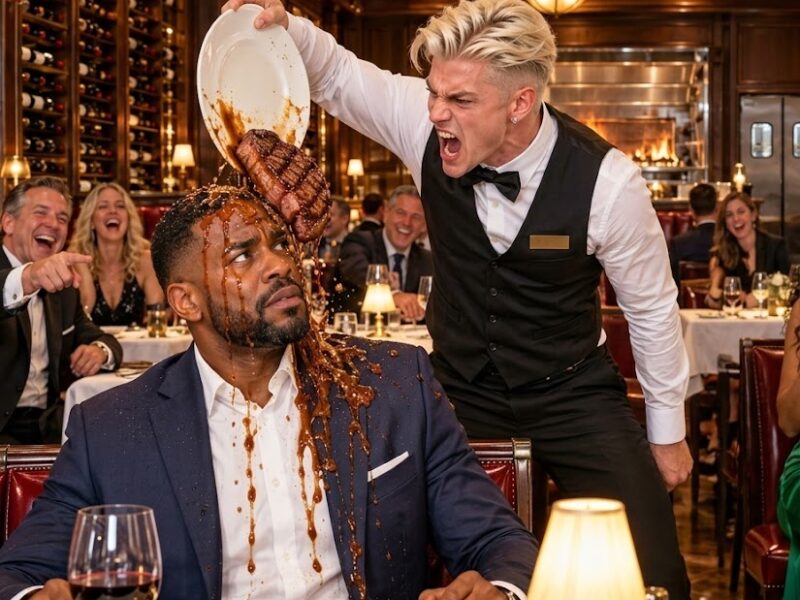
A waiter dumped a steak on a Black man’s head at a luxury dinner—unaware he was the Michelin Inspector.
**Part 1**
The reservation read “Reed, 8:00,” and the man who walked through the brass-trimmed doors of The Sterling Cut wore a navy suit that fit him like a second skin. The maître d’—a young man named Brett with hair slicked back so tight it looked painful—looked him up and down twice, the second time slower, as if he couldn’t quite believe what he was seeing. “Reed? Are you sure? We do have a dress code.”
Marcus Reed paused mid-step, his hand already moving toward the inside pocket of his jacket where his reservation confirmation sat folded in crisp thirds. “I am wearing a suit,” he said, his voice level, carrying the kind of quiet that doesn’t need volume to be heard. Brett’s smile flickered—not with warmth, but with something closer to a snicker he’d tried to swallow. “Table 12. By the kitchen.”
He gestured vaguely toward the rear of the dining room, where a swinging door released small puffs of steam and the clatter of pans. “Your waiter will be with you. Eventually.”
A woman at the bar laughed—a sharp, bright sound that cut through the low hum of conversation—and raised her glass toward a man in an expensive watch. “For you, Mr. Hale, the good bottle, always.” The man chuckled, leaning in, and the bartender poured something amber and top-shelf without being asked.
At the hostess stand, a woman with a tight bun and a tighter smile—Vivian Sterling, owner and reigning monarch of this particular kingdom—watched the exchange with the flat, patient expression of someone who had already decided how the night would go. “Naomi,” she said, without turning her head. “He is still waiting. Thirty minutes. I am timing it. Every minute.”
The woman beside her, Naomi Carter, glanced toward Table 12, then back at her boss. “Table 12 is still sitting there.”
“Vivian’s rule,” Vivian said, as if explaining gravity to a child. “Leave him alone long enough and he leaves.”
But Marcus Reed did not leave. He sat with his back straight, his hands folded on the white tablecloth, his eyes taking in everything—the crystal chandeliers, the marble floors, the way the servers moved around his table like water around a stone. He did not check his phone. He did not sigh or shift or flag anyone down. He simply waited, and the waiting itself seemed to fill the space around him.
At forty minutes, a waiter named Bryce finally sauntered over, his tray tucked under his arm like a surfboard. “Excuse me. I have been sitting here for forty minutes. Are you lost?” Bryce said, loud enough for the nearby tables to hear. “This is The Sterling Cut, sir. Not a buffet.”
Laughter rippled across the dining room. A woman at the next booth—Zoe, Naomi’s friend and roommate—snorted into her wine glass. A man in a gray suit leaned toward his companion and whispered something that made them both grin.
Bryce wasn’t finished. He looked Marcus up and down, his eyes lingering on the suit. “Nice suit. Did you rent it for tonight?”
The man at the bar—Hale—let out a snort that was more performance than reflex. Marcus didn’t flinch. “It is mine,” he said, and the simplicity of the statement hung in the air like a note that wouldn’t fade.
Bryce’s gaze dropped to the small black notebook on the table beside Marcus’s water glass. “And the little notebook? Writing a complaint?”
“Something like that,” Marcus said. He opened it, clicked his pen, and wrote something down without looking up. “Now, I would like to order. The ribeye, medium, with the house sauce.”
Bryce’s smile didn’t waver, but something behind his eyes tightened. “Sir, I think you came to the wrong place. There is a diner two blocks down.”
A woman at a nearby table—overheard, delighted—murmured, “Finally, someone said it.” Her companion nodded, and the two of them exchanged the kind of look that people share when they believe they’re on the winning side of a joke.
Marcus closed his notebook. “I have a reservation. Reed, Table 12. And I am staying.”
The dining room went quiet in that particular way that means everyone is listening without seeming to. Bryce’s jaw worked for a moment, then he smiled—a different smile, the one he used when he’d decided to make someone pay for a slight. “Fine. You want a steak? Here is your steak, sir.”
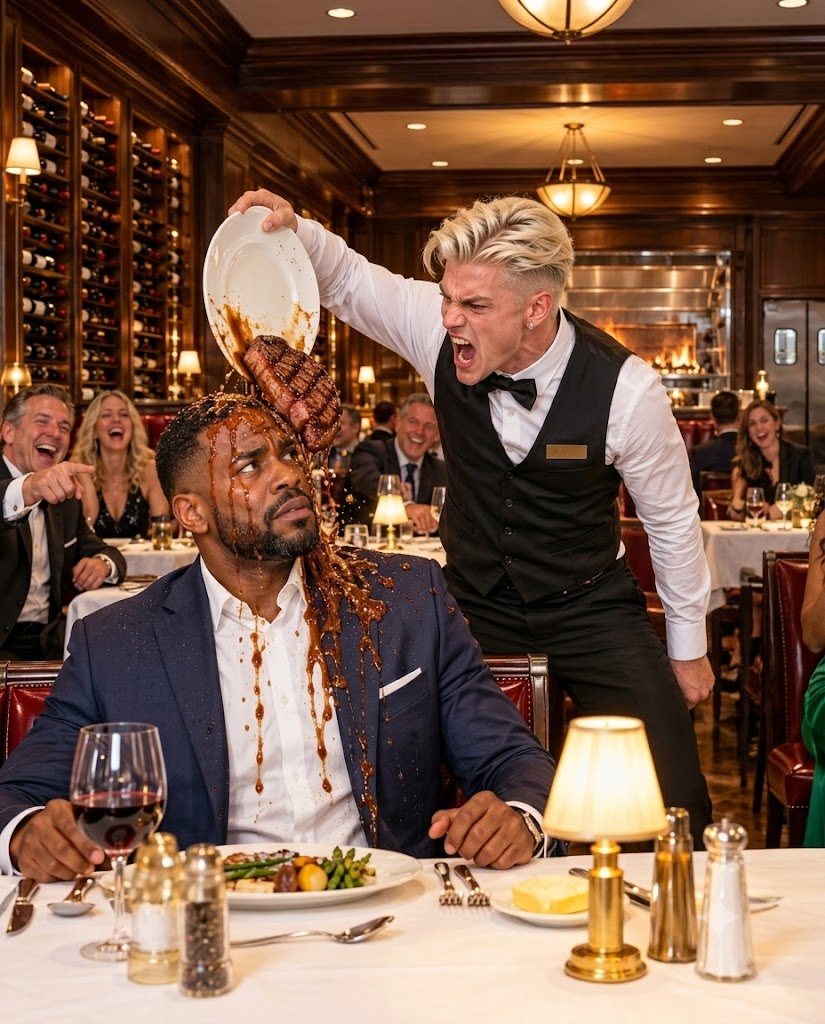
He lifted the plate from his tray—a beautiful ribeye, perfectly seared, still sizzling—and turned it over onto Marcus’s head. The meat slid down the side of Marcus’s face, leaving a trail of au jus and butter and rosemary. The plate clattered onto the table, spun once, and came to rest against Marcus’s water glass.
“Don’t,” someone said—Naomi, rising from her chair—but it was too late.
The room erupted. Gasps. A woman’s hand flew to her mouth. A man near the window said, “Oh my god,” and another echoed it, and then the whole restaurant seemed to be saying it at once: “Oh my god. Bryce. Oh my god.”
Vivian Sterling appeared as if summoned by the commotion, her heels clicking across the marble like a countdown. “What on earth is going on here?”
“He was causing a scene, Vivian,” Bryce said, his voice pitched to carry. “I was just—”
“Of course he was.” Vivian turned to Marcus, her eyes sweeping over the steak now dripping onto his shoulder, the brown stain spreading across his white shirt cuff. “Sir, you are disturbing my guests. Leave or I will have you removed.”
Marcus didn’t move. He didn’t wipe his face. He simply looked up at her with the steady, unhurried gaze of a man who had already seen the end of this story. “Ms. Sterling, your waiter just poured a plate over my head.”
“Then you should have taken the hint an hour ago.”
A woman in a chef’s coat—Lucia—pushed through the kitchen door, her face flushed with heat and fury. “Vivian? That was my plate. What did you do to him?”
“Back to the kitchen, Lucia,” Vivian said, without looking at her.
Lucia’s hands curled into fists at her sides. She looked at Marcus—really looked at him—and something passed between them, a flicker of recognition that had nothing to do with names. Then she turned and disappeared back through the swinging door.
Marcus reached into his pocket and pulled out a small wallet. He laid a fifty-dollar bill on the table—enough to cover a meal he never received—and stood up, the steak sliding off his shoulder and onto the chair behind him. “Fifty minutes,” he said. “Thank you for the dinner, Ms. Sterling. I will remember it.”
“Have a good night, sir,” Vivian said, her voice dripping with saccharine dismissal. “The diner is that way.”
Naomi Carter was already on her feet, her napkin falling to the floor. She looked around the dining room—at the faces frozen in various states of discomfort and amusement and shame—and said, loud enough to carry, “You should all be ashamed of yourselves. Sit down or leave with him.”
She grabbed her coat. Zoe grabbed hers. And as the two of them moved toward the door, a young woman at a table near the front—a woman who had been watching the whole thing with wide, horrified eyes—stood up and pulled the scarf from around her neck. “Sir, wait. Please, take my scarf.”
Marcus turned. The woman—her name was Elena, though he wouldn’t learn it until later—held out the scarf with trembling hands. “Thank you,” he said, and his voice was softer now, the steel replaced by something warmer. “You did not have to leave your dinner.”
“I filmed all fifty minutes,” Elena said, her voice dropping to a whisper. “Every second.”
Marcus looked at her for a long moment. Then he reached out and gently pushed the scarf back toward her. “Keep it safe. Please, do not post it yet.”
“Why not?”
“Because,” he said, “the story isn’t finished.”
Outside, the night air was cool and clean. Marcus stood on the sidewalk for a moment, the steak stain on his suit already attracting the curious glances of passersby. A woman in a black coat—Dianne Ward, though he didn’t introduce her yet—fell into step beside him. “That was worse than we expected,” she said quietly.
“It was exactly what we expected,” Marcus replied. “That’s the problem.”
They walked two blocks in silence. Then Marcus stopped in front of a narrow alleyway, where a warm light spilled from a side door. A woman in a chef’s coat—Lucia—stood in the doorway, her arms crossed against the cold. “You are the chef?” Marcus asked.
“I am.”
“And nobody leaves my kitchen hungry.” She gestured toward the alley, where a small table had been set up—not a fancy one, just a folding table with a clean white cloth, a single candle, and a chair. “Sit. I will not let you leave the street hungry.”
Marcus sat. Lucia disappeared into the kitchen and returned ten minutes later with a plate—a ribeye, medium, with a sauce that smelled like smoke and garlic and something sweet underneath. She set it down in front of him and stepped back. “Who taught you to cook like this?”
“My grandmother in Oaxaca. She said food is how you tell a stranger he is welcome.”
Marcus cut into the steak. It was perfect—better than perfect. “Then tonight you were the only one who said it.”
Naomi and Zoe appeared at the mouth of the alley, their coats pulled tight against the wind. “Can we sit with you?” Naomi asked.
“Please.” Marcus gestured to the empty chairs. “I am Marcus Reed.”
“Naomi Carter. And this is Zoe.”
Lucia watched them for a moment, then turned to go back inside. But before she could reach the door, a voice cut through the alley—Vivian Sterling, her heels clicking on the cobblestones like a warning. “Lucia! You are feeding him my food?”
“Your food?” Lucia turned, her face hard. “This is my staff meal. My own portion.”
“You are done here. Take your things and go.”
Lucia didn’t move. “Twelve years, Vivian. Twelve years and not one star.”
“Go.”
Lucia untied her apron and dropped it on the ground. She looked at Marcus—at the steak he was still eating, at the stain on his suit, at the notebook in his pocket—and something in her expression shifted, like a door opening. “I lost my job because of me,” Marcus said quietly. “Not because of you.”
Lucia shook her head. “I lost it because I did the right thing. I will find another kitchen.”
She walked away, her footsteps echoing in the narrow space. Naomi started to rise, but Marcus held up a hand. “Wait.”
He finished his steak. Then he picked up his notebook, opened it to a fresh page, and wrote something down—not a complaint, but a name. Lucia. Then he closed the notebook and looked at Naomi. “You filmed all of it?”
“Every second.”
“Keep it safe. The story isn’t finished yet.”
**Part 2**
The next morning, Marcus Reed woke up in a hotel room that was nicer than his apartment—a perk of the job, though he rarely used it. He showered, dressed in a suit that was identical to the one he’d ruined the night before (he owned four), and sat down at the small desk by the window. His phone was already buzzing. Dianne Ward had sent three messages, each shorter than the last: “Have you seen this?” “Marcus.” “Call me.”
He opened his laptop. The video was everywhere. Elena—the woman with the scarf—had posted it at 6:47 a.m., and by 9:00 it had been shared twelve thousand times. The headline on one news site read: “Waiter Dumps Steak on Black Man’s Head at Luxury Restaurant—’This Is Not a Buffet.'” The comments were a wildfire—outrage, disbelief, and a smaller, uglier thread of voices insisting there had to be more to the story.
Marcus closed the laptop and picked up his phone. “Dianne.”
“Marcus.” Her voice was tight. “The story is out. The restaurant is already trying to spin it. They’re saying you were aggressive.”
“Aggressive?”
“They posted a statement. ‘The guest was out of control and aggressive. Our server protected our guests.’ They’re calling you a threat.”
Marcus was quiet for a moment. Then he laughed—a short, humorless sound. “Did they?”
“They’re also saying the server—Bryce—felt unsafe. They’re trying to make him the victim.”
“Did they mention the steak?”
“They’re saying it was an accident.”
Marcus sat down on the edge of the bed. “And the fifty minutes?”
“They’re saying it’s edited.”
“Then we tell the story first.” He paused. “No. We don’t tell it. We show it.”
“What do you mean?”
“Naomi Carter. The woman who filmed it. She has the whole thing—all fifty minutes, not a single cut. Call her. Tell her to post it.”
There was a long silence on the other end of the line. “Marcus, if she posts the full video, your face will be everywhere. You’ll never inspect again.”
“I know.”
“Your career—”
“I know.”
Another silence. Then Dianne said, very quietly, “Are you sure?”
Marcus looked out the window at the city—at the people moving through their lives, unaware that a man in a hotel room was about to change everything. “I’m sure.”
Naomi Carter was sitting on her couch, her laptop open on the coffee table, when her phone rang. She didn’t recognize the number. “Hello?”
“Ms. Carter? My name is Dianne Ward. I’m calling on behalf of Marcus Reed.”
Naomi sat up straight. “Is he okay?”
“He’s fine. He asked me to tell you something. He wants you to post the full video—all fifty minutes, not a single second cut.”
Naomi looked at Zoe, who was sitting cross-legged on the floor with a bowl of cereal, her eyes wide. “All of it?”
“All of it.”
“Why?”
“Because,” Dianne said, “the only way to fight a lie is with the truth. The whole truth.”
Naomi was quiet for a moment. Then she said, “Okay.”
She posted the video at 11:47 a.m. By noon, it had been shared eight thousand times. By 2:00 p.m., the restaurant’s phone was ringing off the hook—cancellations, one after another, forty of them before the end of the day. The comment section on The Sterling Cut’s Facebook page turned into a flood of one-star reviews, each one more creative than the last. “Waited thirty minutes for a table, then got a steak on my head. Would not recommend.” “The food is good if you can get past the racism.” “I hear the chef is looking for work. Good. She deserves better.”
Vivian Sterling watched the numbers roll in from her office, her face a mask of controlled fury. Preston—her investor, a man with a permanent tan and a watch that cost more than most people’s cars—sat across from her, his fingers drumming on the armrest of his chair. “Forty cancellations this morning. Forty. And the night isn’t over.”
“Let them cancel,” Vivian said. “They’ll come back.”
“No, they won’t. Not if this keeps up. My money is in this restaurant, Vivian. Fix it.”
Vivian turned to face him. “I have it handled.”
“You have until Friday.”
Vivian waited until he was gone, then picked up her phone. “We find that man. We pay him. He signs an NDA. That woman deletes the video, and this goes away.”
“How do we find him?” her assistant asked.
Vivian looked at the reservation book, still open on her desk. “His name is Reed. The reservation was for two. Call the number and invite Mr. Reed back. Tonight.”
Marcus Reed arrived at The Sterling Cut at 8:00 p.m., exactly on time. He was wearing the same suit—a new one, identical to the one he’d ruined—and carrying the same notebook. Vivian met him at the door, her smile stretched so thin it looked painful. “Mr. Reed. Thank you for coming. Please, sit.”
She led him to a table in the center of the dining room—not Table 12, but a better one, with a view of the whole room. Marcus sat. Vivian sat across from him. A waiter appeared with a bottle of wine and two glasses, and Vivian poured. “I want to apologize for last night. It was a misunderstanding.”
“Was it?”
“Of course. Bryce—the waiter—he was out of line. He’s been let go.”
“And the fifty minutes?”
“We’re looking into it.”
Marcus opened his notebook. “Fifty minutes. That’s how long I sat at Table 12 before anyone acknowledged me. Then your waiter told me I was in the wrong place, suggested I go to a diner, and poured a steak on my head. That’s not a misunderstanding. That’s a decision.”
Vivian’s smile flickered. “Mr. Reed, I’m prepared to offer you fifty thousand dollars. Sign an NDA, ask Ms. Carter to take the video down, and we forget this ever happened.”
Marcus looked at her for a long moment. Then he closed his notebook. “I did not come for money.”
“Everyone comes for money. Name your price.”
Marcus leaned forward. “Rehire your chef. Apologize to every guest you ever sat by the kitchen. And then—and only then—we can talk about the money.”
Vivian’s eyes narrowed. “You’re in no position to make demands.”
“I’m in every position.” Marcus stood up. “Good night, Ms. Sterling.”
He was halfway to the door when Vivian called out, “You’ll never eat in a place like this again.”
Marcus turned. “Ms. Sterling, next Friday, Table 12, 8:00. Keep it for me.”
“You’ll never get through that door again.”
Marcus smiled—a real smile, the kind that reaches the eyes. “We’ll see.”
**Part 3**
The week that followed was a blur of headlines and phone calls and the kind of quiet, grinding pressure that only comes when the whole world is watching. Naomi’s video had been picked up by every major news outlet in the country. The hashtag #SterlingCut had trended for three days straight. Lucia had been offered jobs at three different restaurants—one in Chicago, one in San Francisco, one right here in the city—but she hadn’t accepted any of them yet. She was waiting, though she couldn’t have told you for what.
On Thursday night, Marcus Reed sat in his hotel room and wrote in his notebook. He wrote about the fifty minutes—every detail, every glance, every whisper. He wrote about the steak, and the sauce, and the way Bryce’s hand had shaken just slightly when he’d turned the plate over. He wrote about Lucia, and the way she’d stood in that alley with her arms crossed, refusing to let him leave hungry. He wrote about Naomi, and the video, and the moment she’d stood up in the dining room and said, “You should all be ashamed of yourselves.”
Then he closed the notebook and went to bed.
Friday morning, Vivian Sterling called a meeting. Preston was there, along with the restaurant’s lawyer and a public relations specialist who had been hired to manage the crisis. “We’re going to announce that the inspector is someone else,” Vivian said. “Someone who’s been here before. Someone who loves the restaurant. We’ll say the man in the video was an imposter.”
“That’s a lie,” Preston said.
“It’s a story.” Vivian shrugged. “People believe stories.”
At 7:00 p.m., the restaurant was full—not with regulars, but with people who had come to see what would happen. Naomi and Zoe were there, sitting at a table near the front. Lucia was in the kitchen, wearing her chef’s coat, her hands steady as she plated the first course. And at 7:55, the doors opened.
Marcus Reed walked in, wearing a suit that was not navy but charcoal, and carrying a notebook that was not black but brown. Beside him walked a woman in a black coat—Dianne Ward, director of inspections for the Michelin Guide in North America.
Vivian met them at the door. Her smile was stretched so thin it looked like it might tear. “Mr. Reed. Table 12. 8:00.”
“Table 12,” Marcus said. “Party of two.”
Vivian’s eyes flicked to Dianne, then back to Marcus. “Who is Reed?”
“Not tonight,” Vivian said, her voice rising. “Brett, get him out. Our inspector arrives any minute.”
Brett—the maître d’—stepped forward, his face pale. But before he could say a word, Dianne Ward spoke. “Mr. Sterling, I am Dianne Ward, director of inspections for the Michelin Guide in North America. Mr. Reed is with me.”
The room went silent. Vivian’s face went white, then red, then white again. “There must be some mistake. Mr. Reed—”
“Mr. Reed has been our senior inspector for eleven years,” Dianne said. “He dined here last Friday. At Table 12.”
Vivian opened her mouth. Closed it. Opened it again. “No. No, he was just some—”
“Just a man waiting for his dinner,” Marcus said. He walked past her, toward Table 12, and sat down. “I’ll take my old table. It has the best view of how this place treats people.”
The dining room erupted. Not with laughter this time, but with applause. Naomi was on her feet, her phone out, filming. Zoe was beside her, tears streaming down her face. At the bar, Mr. Hale set down his glass and stared at Marcus like he’d seen a ghost.
Vivian followed him to the table. “Please, Mr. Reed. The window table, champagne, anything you want.”
Marcus unfolded his napkin and placed it on his lap. “The ribeye, medium, with the house sauce. I ordered it last week. It never arrived. Not on a plate, anyway.”
He opened his notebook. “8:02, seated by the kitchen. 8:15, asked for a menu. 8:30, asked again. 8:52, told I came to the wrong place. 8:53, the steak was served on my head.”
“That was Brett. He acted alone. I would never—”
“Ms. Sterling.” Marcus looked up. “You told him to. Your rule. Table 12 for those guests.”
Vivian’s face crumpled. “It is in her handwriting. By the kitchen. Every Friday.”
The room turned to look at Brett, who was standing by the door, his face ashen. “Kelsey. How dare you—”
“And I have fifty minutes of video,” Naomi said, her voice ringing out across the dining room, “where you walked past him twice and laughed.”
Vivian’s eyes blazed. “You little—”
“Careful,” Naomi said, holding up her phone. “I’m still recording.”
Dianne Ward stepped forward. “Ms. Sterling, a star is not given to a steak. It is given to the whole experience. And the experience here begins with who you decide is welcome.”
She paused. “The Sterling Cut is removed from consideration. Permanently.”
Preston was on his feet now, his face purple. “Vivian, I’m pulling my money out. Monday morning.”
“Preston, please—”
“You’re fired.”
“You cannot fire me for following your orders.”
“And I quit.” Lucia appeared in the kitchen doorway, her chef’s coat still on, her eyes bright with tears. “I quit.”
Vivian spun around. “Stop filming. Stop it.”
Marcus stood up. “Now you know how it feels, Ms. Sterling.”
Outside, the night was cool and clear. A crowd had gathered on the sidewalk—people who had heard what was happening, people who had come to see. Marcus stepped out onto the pavement, and the crowd parted for him like water. “The best steak I had in this city,” he said, loud enough for everyone to hear, “was cooked in an alley by the chef this restaurant pushed out.”
The crowd applauded. Lucia, standing in the doorway, wiped her eyes with the back of her hand. Naomi was beside her, still filming. Zoe was handing out tissues to strangers.
Dianne Ward touched Marcus’s arm. “You know what this means? Your face is public now. Your career as an inspector is over.”
Marcus looked at her. “Then I will spend the rest of it helping people like her open their own doors.” He turned to Lucia. “I want to invest in your restaurant. Your own name over the door.”
Lucia’s mouth fell open. “My own name?”
“Yes.”
She looked at Naomi, who nodded. She looked at Zoe, who was crying again. She looked at the crowd, at the people who had come to see a man get justice, and she said, “Then let them in. Everyone is seated first.”
**Part 4**
Lucia Morena’s restaurant opened three months later, in a space that had once been a hardware store. It was small—twenty tables, a bar that seated eight, a kitchen that was open to the dining room so that everyone could see the fire. The sign above the door read “Lucia’s Table,” and the first guest through the door was a woman in a black coat who had driven three hours to be there.
The second guest was a man in a charcoal suit who had been the senior inspector for the Michelin Guide for eleven years, until three months ago, when he had walked into a restaurant and sat at Table 12 and changed everything. “Table for one?” Lucia asked, her eyes bright.
“Table for one,” Marcus said. He was carrying a brown notebook, the same one he’d been carrying for months, and a pen that had run out of ink twice. “I am not here to eat. I am here to ask for a job. Any job.”
Lucia raised an eyebrow. “You?”
“I washed dishes before I ever waited tables. I need a place to learn how to do this right.”
Lucia looked at him for a long moment. Then she laughed—a real laugh, the kind that comes from somewhere deep. “It’s your kitchen, Lucia,” Marcus said.
“No,” she said. “It’s our kitchen. And there’s one rule. In my restaurant, whoever waits the longest gets served first. Every time.”
“Every time.”
The first few weeks were chaos—the good kind, the kind that comes from a dining room full of people who are happy to be there. Naomi came in every Friday and sat at the bar, filming everything. Zoe came in every Saturday and ordered the ribeye. Elena—the woman with the scarf—came in on the third week, and Lucia hugged her so hard she lifted her off the ground.
Brett came in on the fourth week. He stood in the doorway, his hands shoved in his pockets, his eyes fixed on the floor. “I’m not here to eat,” he said. “I’m here to ask for a job. Any job.”
Lucia looked at him for a long moment. Then she said, “You’re hired. But you start in the dish pit.”
Brett nodded. “Thank you.”
On the fifth week, a woman came in alone. She was wearing a black dress and a string of pearls, and she looked older than she had three months ago, the way people look older when they’ve lost something they can’t get back. “Ms. Sterling,” Lucia said, her voice carefully neutral. “Table for one?”
Vivian Sterling looked around the room—at the open kitchen, the bar, the people laughing at tables that didn’t have a bad view. “I did not think I would be welcome here.”
“Everyone is welcome here,” Lucia said. “That is the whole point.”
Vivian nodded. She followed Lucia to a table by the window and sat down. She ordered the ribeye, medium, with the house sauce. She ate every bite.
At the end of the meal, she asked to see Marcus. He came out of the kitchen, wearing an apron and carrying a dish towel, and sat down across from her. “Mr. Reed,” Vivian said. “I am sorry. For all of it.”
Marcus looked at her for a long moment. Then he said, “Then apologize by letting your next guest sit wherever they want.”
Vivian nodded. She stood up, left a fifty-dollar bill on the table—the same fifty-dollar bill she had refused to accept three months ago—and walked out the door.
**Part 5**
The Michelin announcement came on a Tuesday. Lucia was in the kitchen, plating a ribeye, when Naomi burst through the door with her phone held high. “Lucia. Lucia. Look.”
The screen read: “Lucia’s Table—One Michelin Star.”
Lucia set down the plate. She looked at Naomi. She looked at Marcus, who was standing by the bar with a dish towel over his shoulder. She looked at Brett, who was elbow-deep in the dish pit, and at Zoe, who was crying for the fourth time that week. “Congratulations,” Naomi said, her voice breaking.
Lucia wiped her hands on her apron. She walked over to Marcus and took the dish towel from his shoulder. “This star belongs to you, too.”
Marcus shook his head. “No. I only sat at the right table.”
The phone rang. Naomi answered it, listened for a moment, and then said, “It’s Dianne. She wants to know if you’ll come back. As an inspector.”
Marcus took the phone. He listened. Then he said, “No. But I know a chef who might be interested.”
He hung up and looked at Lucia. “She’s offering you a position. Not as an inspector—as a consultant. You’d help other chefs open their own doors.”
Lucia was quiet for a moment. Then she said, “I’ll think about it.”
That night, after the restaurant had closed and the last guest had gone home, Lucia and Marcus sat at the bar with a bottle of wine and two glasses. The kitchen was dark. The dining room was quiet. The sign above the door glowed faintly in the streetlight. “Fifty minutes,” Lucia said. “That’s all it took.”
Marcus raised his glass. “To the fifty minutes that changed everything.”
Lucia raised hers. “And to the fifty minutes that are still changing everything.”
They drank. Then Lucia said, “The ribeye, medium, with the house sauce. One year late.”
Marcus smiled. “Worth every minute.”
The door opened. A family walked in—a mother, a father, two children—and stood in the doorway, looking uncertain. “Are you open?” the mother asked.
Lucia set down her glass. “We’re always open. Everyone is welcome here. That’s the whole point.”
She led them to a table by the window. Marcus followed with menus. And as the family sat down and the kitchen lights came on and the first order went back to the pass, the sign above the door seemed to glow a little brighter. “A table is just a table,” Marcus said, more to himself than to anyone else.
Naomi, still filming, caught it on camera. “Who you welcome to it,” she said, finishing the thought, “is everything.”
The video ended. The screen went dark. And somewhere, in a kitchen in Oaxaca, an old woman smiled.









