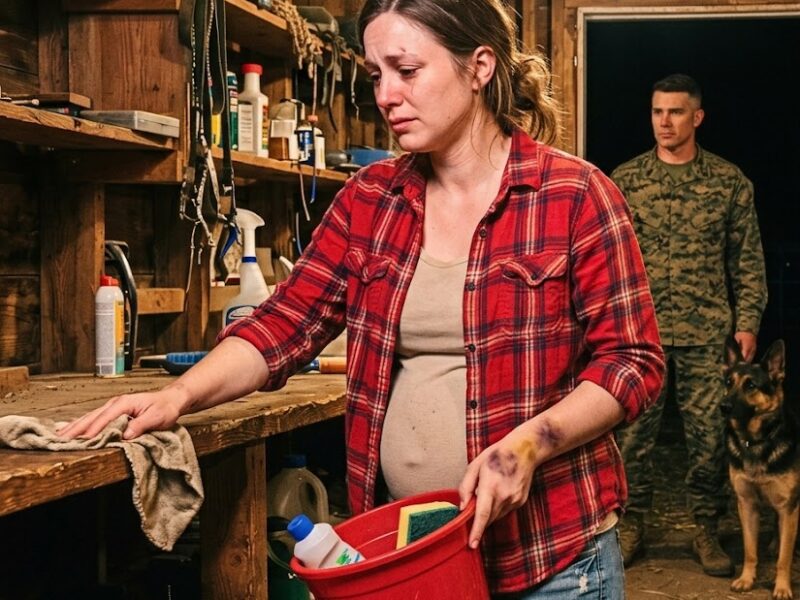
A U.S. Marine noticed bruises on a pregnant woman at his family farm. He didn’t ask. He didn’t push. He just watched. Then the truth came out—and it shattered everything.
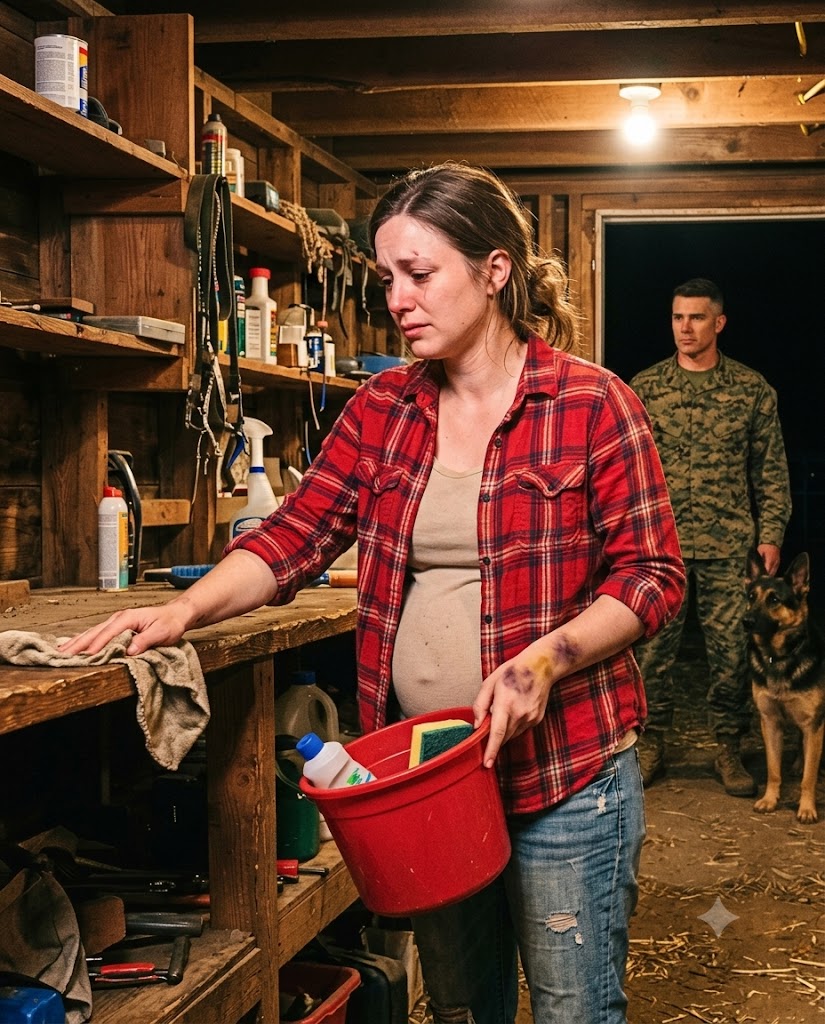
## Part 1
Late that night, his canine suddenly stopped and stared into the barn like something wasn’t right.
When the marine stepped inside, he found a pregnant woman working alone, moving slowly like she was hiding pain—until her sleeve slipped and he saw the bruises.
Not from work. Not normal.
For a second, nothing made sense, until the light hit her face and everything stopped.
He recognized her—someone from his past who had been gone for 15 years.
So he said her name, but she looked straight at him and denied everything.
And that’s when he realized she wasn’t just hiding who she was.
She was hiding the truth about what had happened to her.
—
The wind moved low across the frozen fields, carrying the dry scent of hay and distant pine through the Carter family ranch under a pale, watchful moon.
Staff Sergeant Lucas Hail stepped out of the back door with the quiet, measured discipline that had been carved into him over nearly two decades in the United States Marine Corps.
At 39, Lucas carried himself with a rigid, controlled posture—6 feet tall, broad-shouldered, his body hardened by years of combat deployments and relentless training cycles.
His face was angular, defined by a strong jawline, and a faint scar cutting through his right eyebrow—a remnant from a roadside explosion in Helmand Province.
His hair was kept short in a regulation military cut, dark brown fading into hints of gray at the temples, and his eyes—sharp, observant, and often unreadable—had the distant look of a man who had seen too much and learned to say too little.
Around others, Lucas was reserved, polite, but never fully present.
The war had not taken his body, but it had quietly reshaped the way he trusted the world.
Behind him padded Kota, a 5-year-old German Shepherd with a powerful muscular build and thick amber and black fur that caught the moonlight in subtle highlights.
Kota moved with controlled confidence, his ears upright and constantly adjusting, his eyes alert and intelligent.
Unlike most dogs, Kota rarely barked without reason.
He observed first, judged second.
Trained partially during Lucas’s time working alongside K9 units, Kota had developed an uncanny ability to read human tension—he could sense fear, aggression, even deception, often before Lucas himself consciously recognized it.
To Lucas, Kota was not just a companion, but a second set of instincts he trusted without question.
Lucas pulled his jacket tighter against the cold as he walked toward the livestock barn, boots crunching softly over the frost-hardened ground.
The ranch had been in his family for three generations, sprawling across acres of open land outside Jackson Hole, Wyoming—a place where isolation wasn’t just common, it was chosen.
After months away at a training facility in California, the silence here felt almost unfamiliar.
Too still. Too clean.
He had returned only that morning, expecting routine, predictability—something solid he could stand on again.
But as he approached the barn, something shifted.
Kota slowed first.
The dog’s posture changed almost imperceptibly—his head lowered slightly, ears angling forward, body tightening just enough to signal awareness without alarm.
Lucas stopped mid-step, his instincts snapping into place instantly.
He followed Kota’s line of sight toward the half-opened barn door, where a faint yellow light flickered against the darkness inside.
Someone was in there.
Lucas didn’t rush.
He never rushed.
Instead, he moved forward slowly, his breathing controlled, his eyes scanning every detail—the shadows, the edges, the movement of light against wooden beams.
He reached the door and pushed it open just enough to see inside.
A woman stood near one of the workbenches.
She was alone.
At first glance, she looked out of place—not because she didn’t belong on a ranch, but because everything about her movements suggested strain.
She was tall but slender to the point of fragility, her frame narrow, her shoulders slightly hunched as if she were constantly bracing against something unseen.
Her hair, a dull chestnut brown, was tied loosely at the back, strands falling out of place around her face.
Her skin was pale, almost ashen under the dim light, and her features carried a quiet exhaustion that went deeper than simple fatigue.
Her clothes were practical—worn jeans, a long-sleeve shirt rolled up at the forearms—but they hung on her body as if she had lost weight too quickly.
She was pregnant.
That much was clear.
Her belly curved gently beneath the fabric, not large enough to suggest she was near-term, but far enough along that every movement required care.
And yet she was working slowly, deliberately, wiping down a wooden shelf with a cloth that moved in uneven strokes.
Each motion seemed calculated, controlled, as though she were forcing her body to obey despite its resistance.
Lucas frowned slightly.
This didn’t make sense.
Kota stepped forward before Lucas could say anything, his movements cautious but purposeful.
The dog approached the woman from the side, not directly, keeping a respectful distance as he observed her.
The woman froze for a brief second, her body tensing, her hand tightening around the cloth.
Then slowly, she turned her head toward the dog.
There was fear in her eyes.
Not the sudden kind—no sharp inhale, no startled reaction—but something deeper.
A constant, lingering fear that had settled into her bones long before this moment.
She didn’t step back.
She didn’t speak.
She simply watched Kota as if trying to decide whether he was a threat or something else.
Kota stopped a few feet away from her.
He didn’t growl.
He didn’t bark.
He just stood there—still and alert, his gaze fixed on her in a way that made Lucas’s chest tighten slightly.
Kota wasn’t reacting to danger.
He was reacting to distress.
Lucas stepped inside then, his boots echoing softly against the wooden floor.
“You shouldn’t be working this late,” he said, his voice calm but firm.
The woman flinched.
It was subtle but unmistakable.
She turned toward him quickly, her expression shifting into something guarded, controlled.
“I’m fine,” she replied, her voice quiet, almost too quick. “Just finishing up.”
Lucas studied her for a moment.
There was something off in the way she held herself—not just the tension, but the distance in her eyes, as if she were constantly calculating, measuring every word before it left her mouth.
She turned back to the shelf, raising her arm again.
That’s when he saw it.
Her sleeve slipped down just slightly, exposing the inside of her wrist.
Bruises—dark, uneven, layered over one another in different shades of purple and yellow.
Some older. Some fresh.
Not the kind you get from working on a ranch.
Not accidental.
Lucas didn’t speak immediately.
Years in the Marines had taught him how to read damage—on buildings, on terrain, on people.
And those marks told a story he didn’t need explained.
Before he could say anything, Kota moved closer.
The dog stepped beside the woman now, his body angled slightly between her and Lucas—not in aggression, but in quiet protection.
His head tilted upward just enough to watch her face, his presence steady, grounding.
The woman’s hand trembled.
She noticed the dog.
Then slowly, her shoulders eased—just a fraction.
It was the first sign of relief Lucas had seen in her.
He followed her gaze upward as she turned slightly toward the hanging light.
And then he saw her face clearly.
The scar—a thin, pale line cutting through her left eyebrow, barely noticeable unless you were looking for it.
But Lucas knew that scar.
He had seen it years ago.
A childhood memory surfaced without warning.
Summer heat. Dusty roads. A girl laughing as she tried to climb a broken fence, slipping and cutting her brow open while he stood there, too stunned to help at first.
His breath caught.
“Sarah,” he said quietly.
The name hung in the air.
The woman froze completely this time.
For a moment, she didn’t move, didn’t breathe.
Then she lowered her gaze, her expression hardening, closing off as if a door had just been slammed shut from the inside.
“I think you’ve got the wrong person,” she said.
But her voice wasn’t convincing.
Lucas didn’t step closer, didn’t push.
He just stood there watching her, the pieces in his mind locking into place one by one.
Fifteen years gone without a trace.
And now standing in his family’s barn, covered in bruises, pretending she didn’t know him.
Kota let out a low, almost inaudible huff, shifting his weight slightly, as if sensing the tension rising again.
Lucas exhaled slowly.
Something was very wrong.
And whatever it was, she was still trying to hide it.
—
Morning settled cold and pale over the ranch, frost stretching across the ground, while the long gravel road leading to the front gate lay silent under a sky that felt too empty to trust.
Lucas Hail stood by the kitchen window, a cup of untouched coffee in his hand, his eyes fixed on that distant gate as if it might move if he looked away for even a second.
Despite years of discipline that had trained him to ignore unease, something about the way Sarah had reacted the night before refused to let his mind rest.
Kota lay near the door, his large frame relaxed, but his ears constantly shifting, reading sounds Lucas couldn’t hear yet.
And that alone was enough to confirm that the tension Lucas felt wasn’t imagined.
It was shared.
When Lucas returned to the yard later that morning, he didn’t approach Sarah directly, but he watched carefully the way she carried herself among the others.
And it didn’t take long to notice the pattern that set her apart from everyone else on the ranch.
Sarah Mitchell moved like someone who expected something to go wrong at any moment.
Her tall, slender frame always slightly tense, shoulders drawn in, her pale skin almost translucent under daylight, her chestnut hair loosely tied back in a way that suggested she no longer cared about appearances—but only function.
Every time a door slammed or a tool dropped, her body reacted before her mind could catch up—a small flinch, a tightening of her jaw, a quick glance over her shoulder as if she were measuring distance rather than reacting to sound.
And what stood out most was how often she looked toward the gate.
Not casually, not out of boredom, but with a quiet, calculated fear—like someone tracking an invisible threat.
Lucas had seen that kind of behavior before.
Not in civilians, but in men who had survived ambushes.
People who learned the hard way that danger didn’t announce itself.
It appeared when you stopped expecting it.
Kota noticed it, too.
And over the next few days, the German Shepherd began drifting closer to Sarah whenever she worked—lying a few feet away, always within reach, but never intrusive.
His amber eyes following her movements with a calm, steady focus that seemed to ease something inside her that no words could.
The incident came in the late afternoon when the tension that had been quietly building finally surfaced in a way that couldn’t be ignored.
Sarah was in the storage shed trying to lift a feed bag that was clearly too heavy for her current condition, her movement slow and uneven, when a voice cut through the space with sharp impatience.
“For God’s sake, pick it up. We don’t have all day.”
Darren Pike stood in the doorway, his thick arms crossed over his chest, his broad, rough-built frame blocking the light behind him, his face already flushed with irritation.
The kind of man who measured effort in speed rather than circumstance.
He was in his early 30s with a patchy beard and restless energy that made him quick to react but slow to think.
And though he wasn’t inherently cruel, he lacked the awareness to recognize when someone was already at their limit.
Sarah didn’t argue, didn’t even look at him.
She just bent slightly, trying again, her hands trembling as she forced her body to cooperate.
And that was when Lucas stepped in.
“Drop it.”
The word wasn’t loud, but it carried weight—the kind of command that came from years of being obeyed without question.
Darren turned, clearly ready to push back, until he met Lucas’s gaze and understood immediately that this wasn’t a discussion.
Lucas walked forward slowly, his posture controlled, his voice even.
“She’s done lifting. Find something else that needs doing.”
Darren hesitated for half a second, then gave a short nod and stepped away, muttering under his breath, but not daring to argue further.
And the moment he was gone, Lucas turned to Sarah, noticing how her breathing hadn’t settled, how her hands still shook slightly, even though the pressure was gone.
“You’re not working out here anymore,” Lucas said quietly. “Come on.”
She didn’t argue, but she didn’t relax either.
And that told him everything he needed to know.
—
That night, the ranch fell into silence again.
The kind of quiet that made every small sound feel louder than it should.
And inside the kitchen, the soft yellow light created a space that should have felt safe.
But Sarah still sat as if she were ready to leave at any moment.
Kota lay near her feet—closer than before, his body angled toward her like a shield.
And Lucas remained by the counter, giving her space, waiting without pushing, because he knew forcing the truth would only make her retreat further.
For a long time, neither of them spoke.
Until finally, her voice broke the silence—fragile, but steady enough to carry what she had been holding back.
“He’s still looking for me.”
Lucas didn’t move, didn’t interrupt, his attention fixed entirely on her as she stared down at the untouched cup in her hands.
“He wasn’t always like that,” she continued, her voice low, controlled, as if saying it too loudly might make it real again. “Derek—he knew how to make everything feel safe at first. Like I didn’t have to worry about anything.”
She paused, her fingers tightening slightly.
“But once I got pregnant, it changed. Everything changed.”
Lucas’s jaw tightened, but he said nothing, letting her continue.
“He needed to know where I was all the time. Who I talked to. If I didn’t answer, he would call over and over until I did. And when I tried to leave—”
She stopped, her breath catching.
And for a moment, it seemed like she wouldn’t continue—until Kota shifted closer, pressing lightly against her leg, grounding her just enough.
“He said I wouldn’t make it far,” she whispered. “That he would find me no matter where I went.”
Lucas finally spoke, his voice quiet but firm.
“How did you get out?”
She let out a breath that sounded more like exhaustion than relief.
“I waited until he fell asleep. And I ran. No phone. No bag. Just ran.”
Silence returned, heavier this time, filled with everything she hadn’t said.
And Lucas leaned back slightly, processing the weight of it—the pattern, the certainty behind her fear.
And he knew then.
This wasn’t something that had ended.
It was something that was still moving toward them.
He was about to speak again when Kota’s posture changed instantly.
His head lifting, ears forward, body tightening in a way that erased all doubt.
Not toward Sarah.
Toward the front of the house.
Lucas turned his head at the same moment Sarah did.
Both of them looking in the exact same direction—toward the gate that had been empty all day.
But now, neither of them were so sure anymore.
—
## Part 2
The sky turned a dull steel gray by late afternoon—the kind of heavy silence settling over the ranch that made every distant sound feel closer than it should be.
Lucas Hail didn’t wait until morning this time, because instincts like the one Kota had shown the night before were never wrong.
And in his world, hesitation had always been the difference between control and regret.
By dawn, he was already in his truck, driving the narrow road toward the Teton County Sheriff’s Office.
The engine humming low beneath him while his mind worked through everything Sarah had said—every pause, every hesitation, every detail that didn’t need to be spoken out loud to be understood.
Kota sat in the passenger seat, upright and still, his amber eyes fixed ahead, mirroring the same focused alertness Lucas carried—as if the dog understood that this wasn’t just a visit.
It was the beginning of something that had already crossed too many lines.
The sheriff’s office was a modest building on the edge of town—functional more than imposing, its structure reflecting the kind of place where people relied more on familiarity than fear to maintain order.
Inside, the air smelled faintly of old paper and coffee that had been sitting too long.
And behind one of the desks stood Deputy Marcus Reed—a man Lucas had known for years, though time had changed both of them in ways that weren’t always visible at first glance.
Marcus was in his early 40s, tall and solidly built, with a quiet strength that came less from training and more from endurance.
His skin weathered from years of outdoor patrols, his dark hair cut short but beginning to thin slightly at the front.
He wore a trimmed beard that gave him a more rugged appearance, but his eyes told a different story—steady, thoughtful, and cautious.
The kind of man who didn’t rush to conclusions because he had seen too many situations unravel when people did.
“Didn’t expect to see you back so soon,” Marcus said as Lucas approached, his tone casual but his posture attentive.
Lucas didn’t waste time.
“I need you to run a name.”
Marcus studied him for a second, noticing the tension that Lucas didn’t bother hiding.
“All right,” he said, stepping toward his desk. “Who am I looking for?”
“Derek Vaughn.”
The name hung there for half a second longer than it should have.
And Marcus’s expression shifted almost immediately—not alarmed, but sharper, more focused, as if he had just connected a thread he didn’t expect to hear again.
“Where did you hear that name?” Marcus asked.
Lucas didn’t answer directly. “Just run it.”
Marcus nodded once, then turned to his computer, fingers moving quickly over the keys as he pulled up the database.
And for a few seconds, the only sound in the room was the soft tapping and the faint hum of the system processing information.
Then Marcus leaned back slightly, his jaw tightening just enough to signal that whatever he was seeing wasn’t good.
“You’ve got a situation,” he said.
Lucas didn’t react outwardly, but his posture shifted subtly.
“Multiple reports over the past five years,” Marcus continued, scrolling through the file. “Domestic disturbances. Assault allegations. Restraining orders that never held because the victims either dropped the charges or disappeared before anything could stick.”
He paused, his eyes narrowing slightly.
“Guy knows how to stay just inside the line. Enough to scare people. Not enough to get locked up.”
Lucas crossed his arms slowly. “What about recently?”
Marcus clicked again, pulling up newer entries.
“That’s the part you’re not going to like.”
He turned the screen slightly so Lucas could see.
“Last three months, he’s been moving through different states. Asking questions. Showing up in places connected to one name.”
Lucas didn’t need to ask.
“Sarah Mitchell,” Marcus confirmed quietly.
The room felt smaller all of a sudden.
“He’s not just looking,” Marcus added. “He’s tracking.”
Lucas exhaled slowly, his mind already shifting into response mode.
“Has he been in Wyoming?”
Marcus shook his head once. “No confirmed sightings.”
Then he hesitated just slightly. “But that doesn’t mean he’s not close.”
That was enough.
—
By the time Lucas returned to the ranch, the sun had dipped low enough to cast long shadows across the land.
And the quiet that greeted him no longer felt like peace.
It felt like exposure.
He didn’t tell Sarah everything—not yet, because panic wouldn’t help her.
But he didn’t waste a single hour preparing for what might come.
Cameras were installed at key points around the property—not obvious, but placed with precision, covering the main road, the side fences, and the barn entrances.
The front gate lock was reinforced, the mechanism adjusted so it couldn’t be easily forced without noise.
And Lucas made a point of speaking to the neighboring ranchers—men who lived miles apart but understood the unspoken agreement that if something moved wrong out here, they would notice.
Sarah watched all of this without asking too many questions.
But Lucas could see it in her eyes—the way her fears shifted, no longer scattered, but focused, as if part of her already knew that whatever she had run from was no longer far behind.
And yet, despite everything, something else began to change, too.
The tension in her shoulders didn’t disappear, but it softened slightly—especially when she was near the house, near Kota, near a space that didn’t feel like constant escape.
Lucas started taking her into town for her prenatal checkups—not just because she needed them, but because routine was a form of stability.
And stability was something she hadn’t had in a long time.
The clinic sat near the center of town—a small, well-kept building that served most of the surrounding area.
And inside worked Doctor Emily Carter, a woman in her mid-30s with calm, attentive features and a quiet confidence that came from years of working with patients who didn’t always trust easily.
She had light brown hair tied neatly at the back, clear, focused eyes, and a way of speaking that made people feel heard without being overwhelmed.
She didn’t pry, didn’t push, but she noticed everything—from the way Sarah held her breath during the examination to the subtle tension in her hands when certain questions were asked.
“You’re under a lot of stress,” Dr. Carter said gently during one visit, her voice steady. “That can affect both you and the baby.”
Sarah gave a small nod, not offering more.
Lucas stood near the door, arms crossed, silent but present—his role clear even without words.
Over time, those visits became a pattern.
And with that pattern came something unexpected.
Conversation.
Not forced, not heavy, but small pieces of the past slipping through in quiet moments.
Stories of a town they had both left behind.
Memories that felt distant now, but still carried weight.
Sarah spoke more when Kota was nearby—her hands sometimes resting absent-mindedly on the dog’s back as if grounding herself through his presence.
And Lucas listened—not pushing, not interrupting, because trust wasn’t something you demanded.
It was something you allowed to grow.
For a while, it almost felt like it was working.
Until the call came.
—
It was late afternoon when Lucas’s phone rang.
The number unfamiliar, but the timing enough to pull his focus immediately.
And when he answered, Marcus’s voice came through—no longer casual.
“We’ve got movement.”
Lucas stepped outside, away from the house, his eyes instinctively scanning the horizon.
“Where?”
“Gas station about 40 miles out,” Marcus said. “Guy matching Vaughn’s description. Asked about a woman traveling alone—late 20s, pregnant. Showed a picture.”
Lucas’s grip on the phone tightened slightly.
“That’s not confirmed,” Marcus added quickly. “But it’s close enough to matter.”
Lucas didn’t respond right away.
He didn’t need to.
Because at that moment, he already knew.
Marcus spoke again, quieter this time.
“Lucas, if it’s him, he’s not just passing through.”
Lucas looked toward the front gate—the same place Sarah had been watching for days.
“I know,” he said.
And for the first time since this began, the distance between them and the man hunting her no longer felt uncertain.
It felt measured.
—
The night pressed in heavy and windless—the ranch wrapped in a silence so complete it felt like the world itself was holding its breath.
Lucas Hail was awake before the sound reached him, his body responding before his mind fully caught up—years of instinct pulling him out of sleep the moment something felt wrong.
And when he stepped into the hallway, he found Sarah already there.
One hand braced against the wall, her breathing uneven, her tall, slender frame trembling under the loose fabric of her shirt.
Her face had lost what little color it held, her pale skin now almost ghostlike under the dim light, strands of her chestnut hair sticking to her damp forehead as she tried to steady herself.
But the way her body folded slightly inward told Lucas everything he needed to know without a single word being spoken.
This wasn’t fear this time.
Not entirely.
This was something deeper—something physical, something that couldn’t be pushed away or ignored.
“It’s too early,” she whispered, her voice thin, strained, her eyes wide—not just with pain, but with the realization that she had lost control of the one thing she had been trying to hold together. “It’s not supposed to happen yet.”
Lucas closed the distance between them in two steps, his movements controlled but urgent, his mind already shifting into action.
“We’re not waiting,” he said firmly. “We’re going now.”
Kota was already up, standing at the base of the stairs, his body tense but silent.
His amber eyes locked onto Sarah as if he understood exactly what was happening—his usual calm now sharpened into something more focused, more protective.
As Lucas helped Sarah toward the door, he could feel the way her weight leaned into him more than she intended—her strength already slipping between each breath.
And it triggered something inside him he hadn’t felt in years.
Not fear, not exactly, but the kind of pressure that came when you knew there was no room for mistakes.
The truck engine roared to life against the cold as Lucas guided her into the passenger seat, pulling the door shut before circling around—his movements quick but precise.
And within seconds, they were on the road, tires cutting through the gravel as the ranch disappeared behind them.
The drive to Jackson wasn’t long under normal circumstances.
But nothing about this moment felt normal.
Every mile stretching further than it should, every second carrying weight that pressed harder the longer it passed.
Sarah gripped the edge of the seat, her knuckles pale, her breathing breaking into uneven fragments as another wave of pain hit—her body curling inward despite her effort to stay still.
“Stay with me,” Lucas said, his voice steady, grounded—the same tone he had used to pull men through chaos when everything else was falling apart. “Just breathe.”
But Sarah wasn’t just fighting the pain.
She was fighting something else.
“I didn’t tell you,” she said suddenly, her voice shaking as her gaze shifted toward him—not fully meeting his eyes, but no longer avoiding them either. “I knew. I knew it was you that night.”
Lucas didn’t look away from the road, but something in his expression changed—something tightening beneath the surface.
“I recognized you the moment you said my name,” she continued, her voice breaking slightly as another contraction forced her to pause, her hand pressing against her abdomen before she could continue. “I just—I couldn’t say it. I couldn’t let anything connect back to me. If he found out where I was, if he found out who I was with—”
Her breath hitched again, sharper this time.
“I thought if I pretended, if I stayed invisible, I could keep him away from you.”
Lucas exhaled slowly, his grip on the wheel tightening just enough to reveal the shift in his focus, but his voice remained controlled.
“You don’t get to carry that alone.”
For the first time since the night in the barn, Sarah looked at him fully—her eyes filled not just with fear now, but with something deeper.
Relief. Guilt. And something close to recognition finally allowed to exist without denial.
“I’m sorry,” she whispered.
Lucas shook his head once, firm.
“You’re still here. That’s what matters.”
Behind them, Kota lay stretched across the back seat—unusually still, his body pressed low, but his eyes open, watching, listening, every muscle ready despite the confined space, as if he understood that the danger Sarah had been running from had not disappeared.
It had only shifted its distance.
—
The hospital lights appeared ahead like a distant signal, cutting through the darkness.
And when they finally pulled into the emergency entrance, everything moved quickly after that—the calm, practiced efficiency of people who had seen this before taking over the chaos that had followed them inside.
Nurses stepped forward immediately, guiding Sarah onto a stretcher, their voices calm but direct as they assessed her condition.
And Lucas followed close behind until they reached the point where he could go no further.
“We’ll take care of her,” one of the nurses said, her tone firm but reassuring.
Lucas nodded once, stepping back, though every instinct in him resisted the distance.
—
Hours passed without shape.
Time in a hospital didn’t move the same way it did outside—every minute stretching under the weight of uncertainty.
And Lucas remained seated in the waiting area, his posture still, his eyes fixed on nothing in particular, as his mind replayed everything that had led to this moment.
Kota lay at his feet—calmer now, but still alert, his presence grounding in a way Lucas didn’t fully acknowledge but relied on all the same.
When the doctor finally appeared, Lucas stood before she could speak.
Doctor Emily Carter removed her gloves slowly, her expression softening just enough to signal the outcome before the words came.
“She made it through,” she said. “Both of them did.”
Lucas exhaled—tension releasing in a way he hadn’t allowed himself to feel until that exact moment.
“It was early,” she added. “But he’s stable. Small, but strong.”
Lucas nodded once. “Can I see her?”
—
A few minutes later, he stepped into the room—the air quieter here, softer, the harsh edges of urgency replaced by something fragile and new.
Sarah lay in the bed, exhaustion written across every line of her face, her pale skin still drained but calmer now, her breathing steady as she looked down at the small bundle in her arms.
“He’s here,” she said softly, her voice carrying something Lucas hadn’t heard from her before.
Peace.
Lucas stepped closer, his gaze settling on the child—a small boy wrapped tightly, his features delicate but defined enough to show strength beneath the fragility.
“Noah,” Sarah whispered. “Noah Mitchell.”
Lucas nodded slightly, his expression unreadable but steady.
At that moment, his phone vibrated—the sound cutting through the quiet sharply.
He stepped back, answering without hesitation.
Marcus’s voice came through—lower than before, but this time carrying something different.
Not uncertainty, but confirmation.
“We got him.”
Lucas’s eyes narrowed slightly. “Where?”
“Gas station off Route 89,” Marcus replied. “He caused a scene, started asking questions, got aggressive when no one answered. We picked him up.”
Lucas said nothing for a second.
“There’s more,” Marcus added. “We’ve got enough now to reopen everything. He’s not walking away this time.”
Lucas ended the call slowly, his gaze shifting back toward Sarah—who was watching him now, her expression searching for something she didn’t need explained.
“It’s over,” he said.
And for the first time since she stepped onto that ranch, Sarah’s shoulders lowered completely—the tension leaving her body not in pieces, but all at once.
She didn’t say anything.
She didn’t need to.
Because for the first time in a long time, she wasn’t running anymore.
—
## Part 3
Spring came slowly to the valley, thawing the last lines of frost into dark soil, while the ranch breathed again under a sky that no longer felt heavy.
Months had passed since that night in the hospital, and the rhythm of life had begun to rebuild itself in quieter, steadier patterns—the kind that didn’t demand attention, but proved their strength through consistency.
Sarah Mitchell moved differently now—not because her past had disappeared, but because it no longer controlled every step she took.
Her tall, slender frame still carrying traces of the woman who had once braced against every sound, but now balanced with something steadier, something rooted.
Her chestnut hair had grown slightly longer, often tied back loosely as she worked around the house.
And though her pale complexion still reflected the exhaustion of recent months, there was warmth returning to it—subtle, but real.
She no longer avoided the open spaces of the ranch, no longer measured every distance as an escape route.
And while her eyes still drifted toward the gate from time to time, the fear behind that habit had faded into something quieter—something that no longer dictated her choices.
Inside the house, the smallest change had made the greatest difference.
Noah Mitchell, wrapped in a soft blanket inside a wooden crib Lucas had repaired himself, slept with the uneven but steady breathing of a newborn who had fought early to arrive but refused to be fragile.
He was still smaller than most babies his age, his features delicate but defined, with faint hints of his mother’s shape already forming in the line of his nose and the curve of his brow.
And though he rarely cried, his presence filled the space in a way that nothing else could.
Kota rarely left his side.
The German Shepherd had taken on his role without instruction—positioning himself near the crib whenever Noah slept, his large body stretched across the floor, his amber eyes half-closed but always aware.
At five years old, Kota had matured into a quiet sentinel, his instincts no longer just reactive, but deliberate.
And the bond he had formed with the child wasn’t based on training.
It was something deeper—something built from the same understanding that had first drawn him to Sarah in the barn that night.
Lucas Hail watched it all from a distance more often than he admitted—his presence steady but never intrusive, because he understood that this life Sarah was building had to be hers, not something shaped around him.
At 39, he had returned to his unit weeks earlier, duty pulling him back into the structured world he had always known.
But the ranch had never really left him.
And neither had the people in it.
Every time he returned on leave, the change was visible—not dramatic, but undeniable.
And it settled something in him that no deployment ever could.
The sharp edges in his expression had softened slightly, the constant tension in his posture easing when he stepped back onto the land that had raised him.
And though the weight of his past still lived beneath the surface, it no longer defined every moment the way it once had.
—
The decision for Sarah to stay hadn’t come all at once.
It had grown over weeks—shaped by routine, by safety, by the absence of fear rather than the presence of certainty.
Lucas had helped her enroll in a basic accounting program at the local community college—a small institution that served the surrounding towns, where the pace was slower but the expectations were real.
It was there that she met Linda Alvarez, a woman in her late 40s who taught introductory finance courses with a firm but patient approach.
Her dark hair, streaked with early gray, was always pulled into a tight bun, her posture straight, her voice steady.
Linda had spent years working in corporate accounting before choosing to teach—a decision shaped by a personal loss that had shifted her priorities.
And she carried herself with the kind of quiet authority that didn’t demand attention but earned it naturally.
She noticed Sarah immediately—not for her performance, but for the way she approached every task with careful precision, as if mistakes were not an option but a threat.
And instead of pushing, Linda adjusted—giving her space while setting clear expectations that allowed Sarah to rebuild confidence without pressure.
Sarah adapted slowly, but she adapted well.
Her days began early, structured around Noah’s needs, her movements steady and deliberate as she learned to balance responsibility with recovery.
And by evening, she would leave for class, her steps no longer hesitant as she crossed the threshold from one part of her life into another.
She found part-time work not long after—assisting with bookkeeping for a small supply store in town, a job that required attention to detail but offered the kind of stability she had never been given before.
And with each passing week, the version of herself that had once lived in constant fear grew more distant—replaced by someone who still remembered, but no longer lived inside those memories.
Lucas remained part of that change, though never in a way that overshadowed it.
When he visited, he helped where needed, fixed what was broken, and stepped back when it wasn’t.
His presence consistent, but never overwhelming.
Conversations between them no longer carried the weight of unspoken tension, because that moment—the one where everything had been acknowledged in the truck that night—had already done what it needed to do.
They didn’t revisit it often.
They didn’t need to.
What remained was something quieter, something stronger—built not on obligation, but on history that had survived distance, silence, and everything in between.
—
Years passed the way they always did in places like that—without announcement, marked only by change that became visible when you stopped to look.
Noah grew from a fragile newborn into a steady, curious child—his small frame strengthening with time, his laughter becoming a constant presence in the house.
And Kota, older now but no less vigilant, stayed close—his movement slower, but his instincts unchanged, still positioning himself near the boy as if nothing in the world would pass him unnoticed.
Sarah completed her program, her skill and discipline leading her to a full-time position with a local financial firm—a role that demanded precision and trust, both of which she had earned.
And for the first time in her life, her future wasn’t something she feared.
It was something she planned.
—
One afternoon, years later, Lucas stood near the edge of the ranch, watching as Noah ran across the open field—his small figure moving freely without hesitation, without the weight that had once followed every step his mother took.
And Kota moved beside him—slower now, but still present, still watching.
Sarah stood a short distance away, her posture relaxed, her gaze steady.
And when Lucas looked at her, there was no fear left to recognize.
Only the quiet strength of someone who had chosen to stay when running would have been easier.
“You’re not looking at the gate anymore,” Lucas said, his voice low but certain.
Sarah smiled slightly—the expression simple but complete.
“I don’t need to.”
Lucas nodded once, his eyes returning to the field, to the life that had been built—not in a moment, but over time, piece by piece, until it became something real.
Not because it was easy.
But because it was finally theirs.
—
Sometimes the miracles we pray for don’t arrive as sudden flashes of light, but as quiet moments of protection, second chances, and the right people entering our lives at the exact time we need them.
In this story, it wasn’t just courage that saved Sarah.
It was grace—the kind that only God can place in the path of someone who feels lost, guiding them step by step toward safety, healing, and a future they thought they would never have.
In our daily lives, we may not always recognize it, but God is working in the background—in the strangers who help us, in the strength we find when we feel weakest, and in the doors that open when everything else seems closed.
Sometimes the very thing we think is coincidence is actually protection—a quiet reminder that we are never truly alone, even in our darkest moments.
If this story touched your heart, take a moment to share it with someone who might need hope today.
Leave a comment and tell us where you’re watching from or what part of this story moved you the most.
And don’t forget to subscribe to the channel for more stories that remind us of faith, courage, and the unseen ways God is always watching over us.
May God bless you, protect you, and bring peace into your life today and always.









