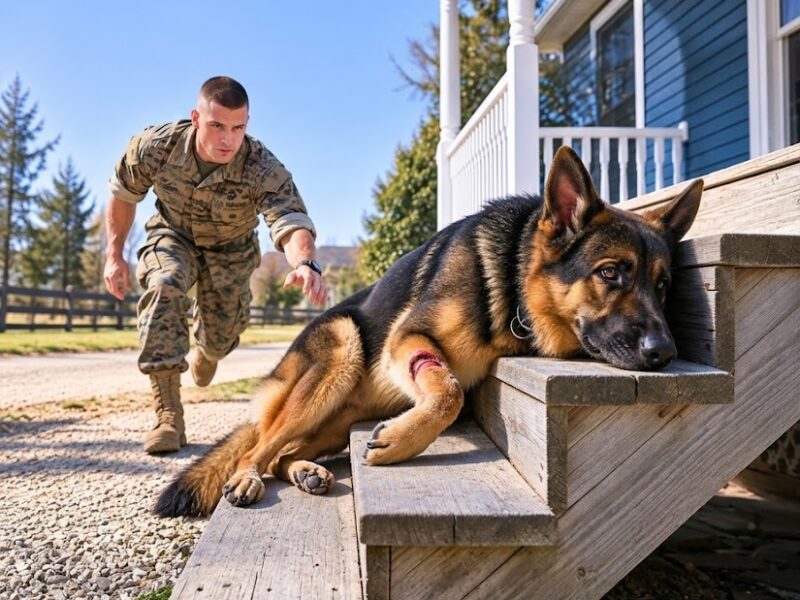
A U.S. Marine found a wounded German Shepherd bleeding in the snow. What the dog led him to next changed everything.
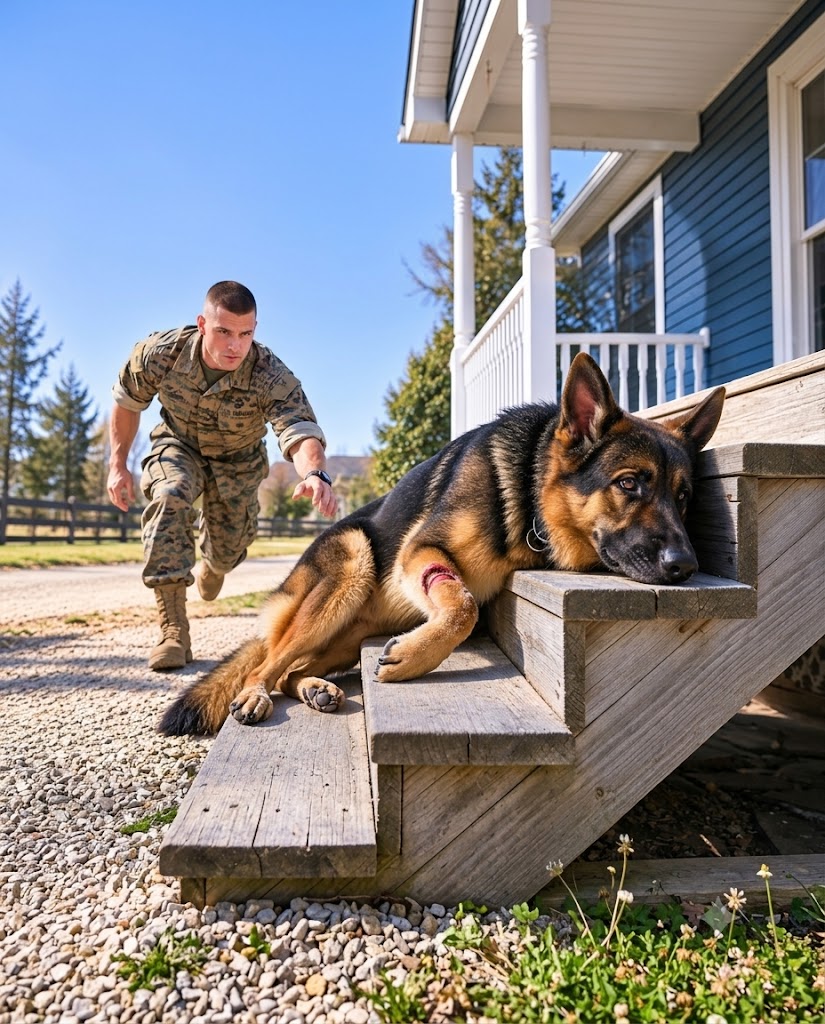
On a warm spring afternoon outside Buford, South Carolina, Staff Sergeant Cole Maddox spotted an aging German Shepherd collapsed on the steps of an abandoned farmhouse.
The dog’s front leg was injured, and Cole expected him to accept help and leave.
Instead, the shepherd refused to move and kept staring toward the half-opened door.
Then, Cole heard a weak voice from inside.
Following the dog’s warning, Cole entered the house and found an elderly caretaker trapped beneath a collapsed floor.
But saving the man and treating the wounded shepherd was only the beginning.
Atlas carried a forgotten military past.
And when a coastal storm later left a volunteer missing in flood water, Cole would learn why this old dog had once been trained to leave no one behind.
The April afternoon outside Buford, South Carolina, was bright enough to make the marsh grass shine pale gold beneath a wide blue sky.
Live oaks leaned over the narrow county road, their branches draped with Spanish moss, while the warm coastal wind moved through open fields and old wooden fences.
Staff Sergeant Cole Maddox was halfway home when he noticed the dog.
Cole was 37, six-foot-one, broad through the shoulders, and built with the compact strength of a man who had spent most of his adult life carrying equipment, running before sunrise, and learning how to keep moving after his body wanted to stop.
His dark brown hair was clipped into a regulation Marine cut, almost shaved at the sides, and his square face usually wore the same focused expression whether he was standing inspection or buying groceries.
People sometimes assumed Cole was unfriendly.
He wasn’t.
He simply preferred listening before speaking.
Fifteen years in the United States Marine Corps had made him disciplined, dependable, and unusually calm when other people became uncertain.
Those same years had also made temporary living feel normal.
Different assignments, different houses, different people promising to stay in touch.
Cole had eventually learned not to unpack too much.
The small rental outside Buford reflected that habit.
His uniforms were organized.
His kitchen was clean.
His furniture was practical.
Almost nothing on the walls suggested anyone planned to grow old there.
That afternoon, Cole was returning from a training period near the installation, still wearing his camouflage utility uniform with the sleeves rolled neatly above his forearms.
His tan boots carried a thin layer of dust from the training grounds, and a black sports watch rested against his left wrist.
He had driven the road many times.
That was why the old farmhouse caught his attention.
It sat behind a weathered split-rail fence about sixty yards from the pavement, painted a faded blue that had probably been much brighter twenty years earlier.
White trim bordered the porch, though several boards had lost their paint.
A gravel driveway curved toward the house beneath two large oak trees.
Something black and tan lay across the front steps.
Cole eased off the accelerator.
At first, he thought a farm dog might simply be sleeping in the afternoon warmth.
Then the animal lifted its head.
Cole pressed the brake.
The pickup stopped beside the driveway.
“All right,” he murmured.
He switched off the engine.
The German Shepherd on the steps was large, even while lying down.
He appeared to be around nine years old, perhaps older, with a broad chest, heavy shoulders, and the deep black and tan markings common to working-line shepherds.
Gray had begun spreading around his muzzle and beneath his eyes, but nothing about his expression seemed dull.
One ear stood perfectly upright, the other tilted slightly outward.
His eyes followed Cole immediately—alert, tired, careful.
Cole stepped out of the truck.
The shepherd did not bark.
Cole stopped beside the front of the pickup and studied him.
The dog’s right front leg rested differently from the left.
There was an obvious injury around the lower portion of the leg, partly covered by dirt and dried staining.
But Cole deliberately avoided moving closer until he understood the dog’s reaction.
A frightened large dog could make bad decisions.
So could a person trying too hard to help one.
Cole opened the passenger door and retrieved a bottle of water.
“Hey, buddy.”
The shepherd’s ears shifted.
Cole walked halfway up the gravel path, then stopped.
The dog raised his head slightly higher.
No growl, no attempt to retreat—but no invitation either.
Cole lowered himself into a crouch.
“Fair enough.”
He placed the bottle beside him and waited.
Two minutes passed.
Then a vehicle moved somewhere on a distant road before disappearing again behind the trees.
The shepherd continued watching Cole.
Cole had grown up around dogs in North Carolina.
His father had owned two hunting Labradors, both energetic enough to turn every open door into a negotiation.
Cole understood that patience usually communicated more than reaching hands.
Eventually, he moved one step forward.
The shepherd remained still.
Another step—still nothing.
When Cole reached the bottom of the porch, he stopped again.
Up close, the dog’s age was clearer.
Silver fur framed his face, and the movements of his rear legs were slightly stiff when he adjusted his position.
Yet the animal still had the powerful frame of a dog that had once been extraordinarily fit.
Cole unscrewed the water bottle and poured some into a shallow plastic container he kept in the truck.
He slid it onto the first step.
The shepherd looked at the container, then at Cole.
“You don’t trust me.”
The shepherd blinked.
“Reasonable.”
Cole backed away.
After nearly a minute, the dog lowered his head and drank.
That was enough progress for Cole.
He waited until the shepherd finished before approaching again.
This time, the dog allowed him to reach the second step.
Cole slowly extended the back of one hand.
The shepherd smelled it.
For several seconds, nothing changed.
Then some of the tension left his shoulders.
“Good.”
Cole carefully examined the injured leg without disturbing it more than necessary.
“You need somebody who knows more about this than I do.”
He glanced toward the farmhouse.
No vehicle stood nearby except an old utility trailer beside the barn.
No person appeared at the windows.
Cole looked at the dog again.
The shepherd wore an old brown leather collar worn soft from years of use.
There was no ordinary name tag attached to it.
Cole reached beneath the collar carefully.
His fingers touched metal.
A narrow rectangular plate hung against the dog’s chest, scratched badly enough that most of the lettering had nearly disappeared.
Cole turned it toward the light.
Only part of the marking remained readable.
MWD.
Cole stared at it.
Military working dog?
Possibly—or the letters could mean something completely unrelated.
Before he could examine it further, the shepherd shifted his head toward the front door.
Cole noticed.
“You live here?”
The dog’s gaze remained fixed on the house.
Cole stood slowly.
His original plan had been simple.
Get the dog into the pickup, call the appropriate local service, and make sure someone checked the property.
He stepped toward the shepherd as though preparing to help him stand.
The reaction was immediate.
The dog planted his left front paw against the porch.
Cole stopped.
“Easy.”
The shepherd did not snap or show aggression.
He simply refused to move.
Cole tried changing his position.
The dog braced again.
Then he looked at the door.
Cole followed his gaze.
The farmhouse entrance stood slightly open, only an inch or two.
Maybe someone had forgotten to close it.
Maybe the dog had pushed against it earlier.
Cole looked back toward the road.
Then he heard something.
He froze.
At first, he thought it had come from beneath the porch.
A dull sound, very faint.
Cole listened.
Nothing.
The shepherd lifted his head.
Then the sound came again from inside.
Cole immediately stood.
“Hello.”
No answer.
He moved toward the doorway.
The shepherd tried to rise.
His front half came up first.
His injured leg barely touched the wood.
“Stay.”
Cole had not expected the word to mean anything.
The dog stopped completely.
Cole looked at him.
That was strange.
“Stay.”
The shepherd remained where he was.
Cole pushed the farmhouse door open.
“Hello, I’m Staff Sergeant Cole Maddox. Is anyone inside?”
This time, a voice answered—weak, but unmistakable.
“Back here.”
Cole entered.
The interior smelled of old wood, dust, and the faint dampness common to houses near the coast.
Furniture had been covered with sheets in the front room, suggesting the farmhouse was used only occasionally.
“Keep talking to me.”
“Back room.”
Cole moved carefully down the short hallway.
The rear portion of the living room opened toward an older storage area.
There he stopped.
Several floorboards had given way near the entrance to a shallow cellar used for pipes and utility access.
Below them sat an elderly man.
He was conscious.
That was the first thing Cole cared about.
“I’m okay,” the man said. “Just can’t get myself out.”
“You stay where you are.”
“I’ve been doing that fairly successfully.”
Cole almost smiled.
The elderly man was Henry Walsh, seventy-two years old, thin but still tall, with white hair combed straight back and a narrow weathered face browned by decades outdoors.
He wore work pants, an old green shirt, and sturdy boots.
Even after spending most of a day trapped in an uncomfortable situation, Henry’s voice retained the dry humor of someone who disliked making his problems other people’s emergencies.
That temperament had been shaped by a lifetime of repairing things himself.
Henry had worked as a carpenter and property caretaker for more than forty years.
Retirement had never fully suited him.
So he continued watching over several old family properties around Buford, including this farmhouse.
Cole took out his phone.
“How long have you been down there?”
“Since yesterday afternoon.”
Cole’s expression changed.
“My phone’s upstairs,” Henry added. “Dropped my flashlight. After that, I figured my options were limited.”
Cole contacted emergency services and gave the location.
While waiting, he remained where Henry could see him.
Then Henry asked a question Cole did not expect.
“Dog still outside?”
Cole looked toward the hallway.
“The German Shepherd?”
Henry nodded.
“Good dog.”
“He’s yours?”
“No.”
Cole frowned.
Henry rested his head briefly against the wall behind him.
“Started showing up about three weeks ago.”
“You know where he came from?”
“Not a clue.”
Henry explained that the shepherd had first appeared near the fence line one morning, watching the property from beneath one of the oak trees.
Henry left food and water.
The dog accepted both, but he never entered the farmhouse.
Every day he returned to roughly the same place.
Sometimes he sat facing the road for an hour or more, watching passing vehicles as though expecting one particular truck to stop.
“I started calling him Soldier,” Henry said. “Didn’t seem like a Biscuit.”
Cole glanced down the hallway.
“What happened yesterday?”
Henry shook his head.
“Old floor finally reminded me it was older than I am.”
He had been checking a plumbing problem when the damaged section gave way.
He wasn’t sure exactly what the shepherd had done afterward, but at some point the dog had appeared inside the rear room.
Henry remembered seeing him trying to get close through the damaged area before disappearing again.
Cole looked toward the hallway once more.
The injured leg, the open front door, the dog on the steps.
Whatever had happened, the shepherd had not simply been resting outside.
He had been waiting.
Emergency personnel arrived soon afterward.
Cole stepped outside to guide them in.
The German Shepherd was still on the porch, but now he was sitting upright.
His entire attention remained fixed on the farmhouse.
As the rescue crew entered, the dog watched every person pass.
Cole stayed beside him.
Several minutes later, Henry was carefully brought out.
The moment the old man appeared, something changed in the shepherd.
His ears lifted.
His body relaxed.
Henry saw him.
“Told you,” he said quietly. “Good dog.”
The shepherd tried to stand.
Cole placed one hand gently against his shoulder.
“Easy.”
Henry was transferred onto a stretcher for evaluation.
As the crew moved him toward the ambulance, the shepherd watched until the doors closed.
He continued staring even after the vehicle started down the driveway.
Cole waited.
Finally, the dog turned his head.
Those brown eyes settled on Cole.
Cole looked at the worn leather collar, then at the scratched metal plate.
MWD.
Three weeks near an unfamiliar farmhouse.
A man trapped inside.
A dog injured but still trying to reach the road.
And somehow, when help finally arrived, he had known exactly where Cole needed to go.
Cole opened the passenger side of his pickup.
This time he did not try to pull the shepherd away.
He simply waited beside the door.
After several seconds, the old German Shepherd pushed himself carefully to his feet.
Cole slipped one arm beneath his chest and another beneath his body, lifting him without putting weight on the injured leg.
The shepherd did not resist.
Cole settled him gently onto the rear seat.
For the first time all afternoon, the dog stopped looking toward the farmhouse.
Instead, he looked directly at Cole.
Cole closed the door.
“All right, Soldier.”
He glanced once more at the mysterious plate hanging beneath the collar.
“Let’s figure out who you are.”
Low Country Veterinary Clinic sat fifteen minutes outside Buford behind a row of live oaks and a low white fence—the kind of place easy to miss unless someone was looking for it.
By the time Cole Maddox pulled into the gravel parking lot, the late afternoon light had softened, and the German Shepherd in the back seat had finally lowered his head against the folded blanket Cole had placed beneath him.
Cole had spent most of the drive checking the rearview mirror.
Each time, the dog had been watching him—not nervously, assessing him.
Cole parked close to the entrance and stepped out.
When he opened the rear door, the shepherd tried to rise on his own.
“Don’t.”
The dog paused.
Cole stared at him.
That was the second time the animal had responded immediately to a simple command.
Cole slipped one arm beneath his chest and supported the rest of his weight carefully.
The shepherd allowed himself to be lifted without resistance.
“You’re making this suspiciously easy.”
The dog’s one slightly crooked ear moved.
Inside, Dr. Rachel Quinn was waiting.
Rachel was thirty-nine, about five-foot-seven, lean and straight-backed, with dark auburn hair pulled into a low ponytail and gray-blue eyes that seemed to notice small changes before anyone else did.
She usually wore navy scrubs beneath a lightweight clinic jacket and moved with the efficient calm of someone who had spent years working around frightened animals and worried people.
Rachel had grown up on a horse property outside Charleston and had learned early that panic rarely improved a difficult situation.
A riding accident involving her younger brother when they were teenagers had strengthened that instinct.
He recovered, but Rachel remembered how quickly fear had spread through the adults around them.
Since then, she had developed a habit of slowing down whenever everyone else wanted to rush.
She looked at Cole first.
“Found dog?”
“Found me. Depending on how you describe it.”
Rachel looked at the German Shepherd.
“That usually means there’s a story.”
“There is.”
The examination took time.
Rachel did not force the dog into unfamiliar positions.
She allowed him to smell her hand, then checked him in sections, pausing whenever his body became tense.
Cole remained near the table.
The shepherd watched Rachel, but every few seconds his eyes returned to Cole.
“He’s older,” Rachel said. “Nine would be my first guess. Maybe a little more.”
“Anything serious?”
“Nothing I’m seeing yet.”
She examined the injured front leg carefully.
The injury looked worse from a distance than it actually was.
The tissue around it was irritated, but there was no sign of a fracture and no obvious damage suggesting the leg would lose normal function.
Rachel believed he had probably caught the leg against damaged wood or metal while trying to move through the broken portion of the farmhouse.
“He needs cleaning, antibiotics as a precaution, rest, and probably several quiet days,” she said. “No heroics.”
Cole looked at the shepherd.
“I’ll pass that along.”
Rachel continued the examination.
The dog’s shoulders were still muscular beneath the coat.
His teeth showed age but had been cared for at some point in his life.
His nails were worn evenly.
Then Rachel moved to the hind legs.
The shepherd stiffened slightly when she flexed one joint.
“There it is.”
“What?”
“Mild arthritis. Not unusual.”
Cole frowned.
“He was moving like that outside the farmhouse.”
“He’ll probably be stiff after rest and cold weather, but he’s in surprisingly good condition for a dog that’s apparently been wandering around for weeks.”
Rachel looked at the collar.
“Anything on this?”
Cole showed her the scratched plate.
She turned it beneath the examination light.
“MWD.”
“You see it, too?”
“I see three letters. I’m not promising what they mean.”
A veterinary assistant passed the open doorway carrying a stack of metal bowls.
Her name was Tessa Reed, twenty-four, short and energetic, with tightly curled brown hair and a habit of moving too quickly whenever the clinic became busy.
She had been working there less than a year and cared about animals enough that Rachel was constantly reminding her that helping faster was not always helping better.
One of the bowls slipped.
It struck the floor in the hallway with a sudden metallic crash.
The German Shepherd moved before Cole did.
He rose despite the injured leg and placed himself between Cole and the doorway.
No barking, no lunging, no panic.
He simply stood there—body square, eyes fixed on the hall.
Rachel stopped.
Cole did, too.
Tessa appeared at the doorway.
“Sorry.”
Rachel raised one hand.
“Give him a second.”
The shepherd remained still.
Once the hallway became quiet again, he slowly relaxed.
Rachel looked at Cole.
“That wasn’t ordinary startle behavior.”
“No.”
“Try something.”
“What?”
“Whatever you’re already thinking about.”
Cole hesitated.
Years around Marine installations meant he had seen military working dogs trained before, though he had never been a handler himself.
He stepped slightly to the side.
The shepherd’s eyes followed him.
Cole raised one hand, palm downward, then moved it in the simple signal he remembered seeing used for a down command.
The dog lowered himself immediately.
Rachel’s expression changed.
Cole tried another hand signal.
The shepherd sat—no hesitation.
Cole looked at the scratched collar plate again.
“All right.”
Rachel nodded slowly.
“Now I’m more interested in those letters.”
A microchip scan gave them their first real answer.
The dog was registered.
The name appeared on the clinic screen in plain capital letters.
Atlas.
Cole read it twice.
“Atlas.”
The shepherd lifted his head.
Rachel looked at him.
“Well,” Cole said it again. “Atlas.”
This time, the dog’s ears moved forward.
That was enough.
“Looks like he remembers it.”
The rest of the record was less useful.
The address belonged to a property that had changed owners years earlier.
The phone number was disconnected.
Several fields had not been updated in nearly five years.
One line near the bottom caught Rachel’s attention.
Working canine transfer record.
Cole leaned closer.
“Can you open that?”
“Not from this registry.”
Rachel made a phone call to Low Country Animal Rescue.
Twenty-five minutes later, Jenna Price arrived.
Jenna was thirty-one, five-foot-four, with a compact build, chestnut hair cut just above her shoulders, and dark brown eyes that seemed permanently tired without ever becoming unfriendly.
She wore jeans, practical boots, and a faded green rescue vest covered with pockets.
Jenna had spent eight years working in animal rescue.
Early in that career, she had learned that enthusiasm alone was not enough.
She had once placed an energetic dog with a family whose schedule clearly did not match what the animal needed.
The adoption failed within weeks.
Since then, Jenna had become careful almost to the point of stubbornness.
She believed the right home mattered more than the fastest one.
She crouched several feet from Atlas.
“That’s a serious-looking dog.”
“He’s less dramatic than the paperwork,” Cole said.
Jenna smiled.
“We’ll see.”
She reviewed the microchip information and photographed the collar plate.
“Working K-9 transfer record is interesting. Military, maybe.”
Cole pointed toward the plate.
“MWD.”
Jenna tilted her head.
“Military working dog would make sense. But I’d rather find the record than guess.”
Atlas was transferred that evening to Low Country Animal Rescue because Cole’s rental agreement did not permit a large dog without prior approval.
Cole told himself that made the decision simple.
He had found the dog.
He had gotten him medical care.
Now professionals could handle the rest.
The next afternoon, Cole returned.
Jenna saw him enter and looked at the clock.
“Checking on him.”
“Exactly.”
Atlas had been placed in a quiet indoor run with a padded bed and enough space to move without putting unnecessary pressure on his healing leg.
When Cole entered the hallway, Atlas lifted his head before Cole reached the kennel.
Jenna noticed.
“So he knows your footsteps.”
“He knows somebody’s footsteps, of course.”
Over the next several days, the pattern repeated.
Cole came after duty.
Atlas heard him first.
Cole insisted he was only checking the wound.
Jenna stopped asking.
Visitors came through the rescue center every afternoon.
Families paused at Atlas’s kennel, admired his size, his face, and the calm way he watched people.
Then the practical questions began.
“How old?”
“Nine, approximately.”
“Medication?”
“Probably joint support long-term.”
“Large dog?”
“Very.”
Most moved on.
Younger dogs received applications quickly.
Atlas received compliments.
That difference bothered Cole more than he expected.
On Friday evening, his older sister called.
Her name was Lauren Maddox, forty-one.
Tall like Cole, but narrower through the shoulders, with the same dark hair and direct expression shared by nearly everyone in their family.
Lauren worked as an elementary school administrator and had spent years balancing schedules, parents, children, and problems that rarely arrived one at a time.
Divorce five years earlier had made her more independent, but also more protective of her son.
“I need a favor.”
Cole leaned against the rescue center wall.
“That sentence has never improved my evening.”
“You love me.”
“Unproven.”
“Mason needs somewhere to be for two hours.”
Cole looked through the kennel window.
“Bring him here.”
Mason Maddox arrived twenty minutes later.
He was eleven, thin, a little short for his age, with straight brown hair that fell across his forehead and light hazel eyes.
He was thoughtful, quiet around unfamiliar adults, and far more observant than people usually expected children to be.
Three years earlier, an excited large dog had knocked him down at a crowded park.
He had not been bitten.
He had not been seriously hurt.
But fear did not always require injury.
Since then, Mason avoided large dogs whenever possible.
The moment he saw Atlas, he stopped.
Cole noticed.
Atlas noticed, too.
The German Shepherd lifted his head.
Mason took one step backward.
Cole said nothing.
Atlas looked at the boy for several seconds.
Then, instead of moving toward the kennel gate, he slowly lowered himself onto the bed.
He rested his head between his paws.
Mason remained where he was.
“He won’t come out?” Mason asked.
“Not unless somebody opens the gate.”
Mason nodded.
That evening, he sat in a chair nearly fifteen feet away while Cole spoke with Jenna.
The next afternoon, Mason asked to return.
He brought a book.
This time, he sat approximately five yards from Atlas’s kennel.
Atlas never approached the gate.
He simply stayed where he was and watched the room.
Mason read for almost forty minutes.
Neither of them crossed the distance.
Cole found that strangely important.
Later that evening, after Lauren collected Mason, Cole stayed behind.
He worked with Atlas in the small exercise yard.
“Heel.”
Atlas moved directly to his left side.
“Stay.”
Atlas froze.
“Down.”
Immediate.
Cole tested two hand signals.
Both worked.
This was no collection of tricks learned casually in someone’s backyard.
Somebody had trained this dog carefully.
Jenna appeared at the yard gate holding her tablet.
“I found another registry.”
Cole stopped.
Atlas sat automatically beside his leg.
Jenna walked closer.
“It’s an archived working dog database. Most of the file is locked behind an old transfer system, but there’s one name attached to the record.”
Cole looked at her.
“Owner?”
“Handler. Maybe.”
She turned the screen toward him.
The name appeared beside Atlas’s identification number.
Gunnery Sergeant Mark Ellison.
Cole looked down at Atlas.
The old shepherd was staring toward the entrance, calm and silent.
For the first time, Cole had more than faded letters beneath a collar.
He had a name—and somewhere, possibly, the first real answer to where Atlas had come from.
Cole Maddox called the number attached to the archived registry just after seven the next morning.
The line rang five times before an older male voice answered.
“Ellison.”
Cole stood beside his pickup outside the barracks administration building, one hand resting on the roof.
“My name is Staff Sergeant Cole Maddox. I’m calling from Buford, South Carolina. I’m trying to locate a former Marine connected to a working dog named Atlas.”
Nothing came through the phone.
Cole checked the screen to make sure the call had not dropped.
“Sir?”
The voice returned quieter this time.
“What did you say the dog’s name was?”
“Atlas.”
Another silence followed.
Not confusion—recognition.
Cole had heard that kind of silence before.
It happened when someone was handed information they had stopped allowing themselves to expect.
“Where is he?” the man asked.
“At Low Country Animal Rescue. He’s safe.”
“How old?”
“About nine. Black and tan.”
“Yes.”
“Small scar near the base of the left ear.”
Cole straightened.
“Yes.”
The man exhaled slowly.
“My name is Mark Ellison. I’ll be there tomorrow.”
Mark lived outside Savannah, Georgia, a little less than two hours away.
He arrived at the rescue center shortly before eleven the following morning in an older silver SUV that looked meticulously maintained despite its age.
Gunnery Sergeant Mark Ellison, retired, was sixty-four, a little under six feet tall, with thick silver hair cut short and a face lined by decades of sun, wind, and responsibility.
His shoulders were still broad beneath a dark green field jacket, though he carried more weight through the middle than he probably had during active service.
He walked with a slight stiffness in his right knee—an old injury made more noticeable after a later surgery.
There was nothing dramatic about Mark’s manner.
He spoke calmly, shook hands firmly, and looked people directly in the eye.
But Cole noticed something immediately.
Mark was nervous.
Not in the obvious way.
His hands did not shake.
His voice remained steady.
He simply kept looking toward the hallway leading to the kennels.
Jenna Price met them near the front desk.
“You want a minute first?”
Mark nodded.
“I think so.”
Mason was there, too.
Lauren had dropped him off for a few hours because the boy had asked to help Jenna fold towels again.
Over the previous week, Mason had moved from sitting fifteen feet away from Atlas to reading in a chair much closer to the kennel.
He still did not touch the dog.
Atlas still did not ask him to.
Mason stood near the supply shelves now, holding a folded blanket against his chest.
Cole glanced toward him.
“You can stay.”
Mason nodded.
Jenna opened the interior door.
Atlas was lying on his padded bed with his back partly toward the hallway.
The bandage around his front leg was smaller now, and Rachel had already said the healing was progressing normally.
Mark stopped in the doorway.
Cole expected him to call the dog.
He did not.
Mark simply stood there.
Atlas lifted his head.
For several seconds, the shepherd stared toward the entrance.
His ears moved forward.
Then his body changed.
Not dramatically—just enough that Cole noticed.
Atlas pushed himself up.
His rear legs were still stiff from age, and he kept most of his weight off the healing front leg, but he stood.
Mark said nothing.
Atlas took one step, then another.
Mason lowered the blanket slightly.
Jenna remained still.
Atlas crossed the kennel slowly until he reached the open gate.
Mark finally crouched as far as his knee allowed.
The shepherd stopped in front of him.
He smelled Mark’s hand first, then the front of his jacket, then his face.
Mark’s expression tightened.
“Hey, partner.”
Atlas pushed his head against Mark’s chest.
Mark wrapped both arms around the old dog.
No barking, no jumping, no theatrical burst of excitement.
Just recognition.
Cole looked toward Mason.
The boy was watching closely.
Mark kept one hand against Atlas’s neck.
“You got old.”
Atlas’s tail moved once against the floor.
Mark laughed softly.
“So did I.”
Cole did not need the registry anymore.
This was the man.
Later, they moved into the small meeting room beside the exercise yard.
Atlas lay near Mark’s boots while Jenna brought water and Cole took the chair opposite him.
Mark placed an old photograph on the table.
Atlas was younger in it—much younger.
His muzzle was black instead of silver, his body lean and powerful beneath a working harness.
Beside him stood Mark in Marine utility uniform, perhaps fifteen years younger, one hand resting lightly near Atlas’s shoulder.
Across the harness was a working identification panel.
Atlas looked directly into the camera—focused, ready.
“That was him at three,” Mark said.
Cole picked up the photograph.
“So the MWD tag was real.”
Mark nodded.
“Marine Corps working dog.”
“What did he do?”
“Tracking and patrol work. Mostly locating people, following scent, perimeter support. Later, when he slowed down a little, we used him more for controlled searches and recovery exercises.”
Mark paused.
“He was never the dog people imagined when they heard the word military.”
Cole understood what he meant.
Not aggressive—capable when necessary, but that wasn’t what made him good.
Mark looked down at Atlas.
“Patience made him good.”
He explained that Atlas had been unusually steady even when he was young.
Other dogs might become excited by movement or noise.
Atlas watched first.
If a person was frightened, he did not rush them.
If someone was injured or unable to move easily, he stayed close.
If Atlas believed somebody was still out there, he hated leaving.
Mark said that was probably his strongest habit.
Cole thought immediately of Henry Walsh trapped below the damaged floor.
Atlas refusing to leave the farmhouse.
The injured leg.
The open door.
The dog waiting until another person finally stopped.
“He did exactly that when I found him.”
Mark looked at Cole.
“Then he remembered who he was.”
Mark noticed the small scar beside Atlas’s left ear and touched it carefully.
“That’s old.”
“You remember it?”
“Training accident. Nothing serious. He was about four.”
Atlas leaned slightly toward Mark’s hand.
For the next half hour, Mark told Cole what had happened after Atlas left active work.
When Atlas retired, Mark had taken him home personally.
For several years, the arrangement worked.
Then Mark’s health changed.
A knee problem that had followed him since his military years became worse.
Surgery helped, but recovery took longer than expected, and complications made ordinary walking difficult for months.
At the same time, Mark was moving from his larger house.
A longtime friend and his family offered to care for Atlas temporarily.
“They knew him,” Mark said. “He trusted them. I thought it would be six months.”
Six months became longer.
The family moved for work.
Then there was another relocation.
Phone numbers changed.
Paperwork did not follow.
The microchip remained attached to old information.
Mark tried to track Atlas through everyone involved, but each lead became weaker.
“I looked for more than a year,” he said. “Called shelters, checked old addresses, asked people I hadn’t spoken to in years.”
“What happened?”
Mark looked down.
“Nothing. That was the worst part. Nothing happened. Eventually, the trail simply ended.”
“You don’t stop caring,” he said. “You stop expecting the phone to ring.”
Cole looked at Atlas.
The old shepherd had fallen asleep with his body partly against Mark’s boot.
For a moment, Cole assumed the story had reached its obvious conclusion.
Mark had found his dog.
Atlas would go home.
Then Mark said, “I can’t take him.”
Cole looked up.
Mark’s jaw tightened slightly.
“I live in senior housing outside Savannah now. Large dogs aren’t allowed.”
“You could move.”
“I thought about it before I drove here.”
Cole waited.
Mark tapped his right knee.
“This isn’t what it used to be. Neither is the rest of me. Atlas needs somebody who can manage the medications, the exercise, the vet visits, the stairs—all of it.”
“He’s your dog.”
“He was.”
The sentence clearly hurt him to say.
Mark looked toward the old photograph.
“I lost him once because I trusted a temporary solution to stay simple. I’m not going to make another decision based on what I want instead of what he needs.”
Cole had no response ready.
Mark glanced toward him.
“He watches you.”
Cole frowned.
“What?”
“Every time you move.”
Cole looked down.
Atlas appeared asleep.
Cole shifted his chair slightly.
One of Atlas’s ears moved.
Mark smiled faintly.
“Exactly.”
That afternoon, Mark took Atlas into the exercise yard.
Cole followed.
Mason stayed near the fence.
Mark showed Cole several of Atlas’s old hand signals—a raised palm, a movement toward the ground, a small directional gesture.
Atlas remembered almost all of them.
He was slower.
That did not seem to matter to Mark.
When Atlas completed a short heel and sat beside Cole, Mark nodded.
“Good.”
Cole looked at him.
“What else should I try?”
“Nothing.”
Cole seemed surprised.
Mark crouched and rubbed Atlas gently behind the ear.
“Let him remember without making him prove anything.”
Cole stored the sentence away.
Mason approached the fence a little closer.
He had been watching Mark and Atlas for almost twenty minutes.
“Mr. Ellison?”
Mark turned.
“Mark is fine.”
Mason hesitated.
“Did Atlas ever hurt people?”
Cole looked at the boy.
Mark did not seem offended.
“No. Never.”
Mark considered how to answer.
“He was trained to protect his handler and follow commands, but most of his working life was about finding people, not frightening them.”
Mason looked at Atlas.
“Even strangers?”
“Especially strangers. Missing people usually are strangers.”
Atlas noticed Mason looking at him.
The dog stayed where he was.
Mark saw that, too.
“He’s giving you space.”
Mason nodded.
“He always does.”
“Then he remembers that part, too.”
Mason remained at the fence several minutes longer.
For the first time, when Atlas looked directly at him, Mason did not step backward.
That evening, Mark prepared to return to Savannah.
He knelt beside Atlas one more time.
“I’ll come back.”
Atlas rested his muzzle briefly against Mark’s arm.
Mark stood.
Before leaving, he handed Cole the old photograph.
“That belongs with him now.”
Cole stared at it.
“I’ll keep it safe.”
“I know.”
After Mark drove away, Cole remained beside the exercise yard while the late afternoon light faded behind the trees.
His phone vibrated.
A weather alert.
Cole opened it.
A tropical system in the Atlantic had strengthened faster than expected.
Forecast models now showed the possibility of heavy rain, strong coastal winds, and flooding across portions of the South Carolina Lowcountry in the coming days.
Cole read the alert twice.
Atlas sat beside him, looking toward the gate where Mark’s SUV had disappeared.
Cole glanced at the old dog.
For the first time, he knew exactly where Atlas had come from.
What he did not yet understand was where Atlas belonged now.
The weather alert remained on Cole Maddox’s phone the next morning, but for the moment, Buford looked nothing like a place preparing for trouble.
The sky was pale blue.
Warm sunlight reached through the live oaks around Low Country Animal Rescue, and Atlas was stretched near the front of his indoor run with his bandaged leg resting comfortably beneath him.
Rachel had reduced his restrictions again.
Short walks were allowed.
Controlled movement was encouraged.
Long adventures were not.
Atlas seemed to understand the first two rules and consider the third negotiable.
Mason Maddox arrived carrying a paperback book and a small paper bag containing the sandwich Lauren had packed for him.
Over the past two weeks, the eleven-year-old had developed a routine at the rescue center.
He no longer stayed directly beside Cole.
He helped Jenna fold clean towels, stacked lightweight food bowls, and carried fresh water to the smaller kennels.
He still avoided dogs that jumped against gates, but he no longer turned around and left the room when they barked.
Atlas remained different.
The old shepherd never crowded Mason.
When the boy entered, Atlas usually raised his head, watched him for a moment, then returned to whatever he had been doing.
That distance had become its own kind of conversation.
Jenna noticed it, too.
“Your assistant is here,” she told Atlas one afternoon.
Mason frowned.
“I thought I was your assistant.”
“You don’t shed enough.”
Mason almost smiled.
He placed a stack of folded towels on the supply shelf, then carried a shallow water bowl toward the quiet run.
Atlas was lying near the gate.
Mason stopped several feet away.
Atlas looked at him.
Mason looked back.
Neither moved.
Then Mason set the bowl down and walked away.
Cole watched from the hallway.
He had learned not to interfere.
Three years earlier, when Mason had been knocked down by the large dog at the park, nearly every adult in the family had tried to fix the fear immediately.
They explained that the dog had only been excited.
They said most large dogs were friendly.
They encouraged Mason to pet dogs he clearly did not want to touch.
None of it helped.
Cole had eventually realized that explaining away fear rarely removed it.
Atlas seemed to understand that without anyone teaching him.
The first real change happened four days later.
Mason was helping Jenna prepare blankets near the exercise yard.
The afternoon had turned cooler, and he wore a light brown work glove on each hand because the storage shed had left dust on nearly everything.
Atlas rested beneath a shade structure twenty feet away.
Mason carried a folded blanket toward the bench.
One glove slipped from his hand.
Atlas raised his head.
Mason noticed.
The shepherd stood.
Mason stopped moving.
His shoulders tightened immediately.
Cole was near the gate.
He could have stepped between them.
He did not.
Atlas walked toward the glove.
Slowly.
His injured leg was almost fully usable now, though he still placed it with a little more care than the others.
He lowered his head, picked up the glove, and turned toward Mason.
Mason went rigid.
Atlas stopped several feet away.
Then he took one more step and placed the glove on the ground—not at Mason’s feet, about a yard in front of him.
Atlas backed away.
Mason stared.
Cole said nothing.
Jenna pretended to reorganize a shelf while watching from the corner of her eye.
Mason waited several seconds, then walked forward and picked up the glove.
Atlas remained where he was.
“That’s mine,” Mason said quietly.
Atlas sat.
Mason looked toward Cole.
“Did he know?”
“Know what?”
“That I wanted it.”
Cole shrugged.
“Maybe he knew it belonged to you.”
Mason looked at Atlas again.
The dog’s tail moved once across the ground.
That evening, Mason sat three feet closer than usual while reading.
Atlas did not move toward him.
Two days later, Mason shortened the distance again.
By the end of the week, he was sitting on the ground beside the kennel gate.
The first touch happened without anyone arranging it.
Atlas was lying in the exercise yard after a short walk.
Mason approached from the side, stopped, then crouched.
Atlas lifted his head.
Mason almost stood again.
Instead, he slowly extended one hand and rested it on the shepherd’s shoulder.
Atlas stayed still.
Mason’s fingers disappeared slightly into the thick black and tan coat.
“That’s it?” Mason asked.
Cole leaned against the fence.
“What were you expecting?”
“I don’t know.”
Atlas lowered his head again.
Mason kept his hand there.
For Cole, the moment was small enough that nobody else would have noticed it from across the property.
For Mason, it was not small at all.
A week earlier, touching a German Shepherd had seemed impossible.
Now he sat beside one.
At the same time, Cole had developed a problem he was making increasingly difficult to deny.
His landlord allowed one pet with approval.
Maximum weight: sixty pounds.
Atlas was well beyond that.
Even if Cole convinced the landlord to make an exception, the narrow yard behind the rental was barely large enough for a dog who needed steady movement.
Then there was Cole’s career.
He could receive transfer orders in the future.
Another base, another state, another rental, another reason not to build anything too permanent.
That logic had protected his life from inconvenience for years.
It had also kept almost everything temporary.
Jenna understood the conflict before Cole admitted it.
One afternoon, he arrived carrying a large reusable shopping bag.
Jenna looked inside.
Joint supplements, a new leash, two durable toys, and the food Rachel had recommended.
Jenna looked at him.
Cole looked at her.
“These are supplies for a dog you’re not adopting.”
“Correct.”
“You bought a leash.”
“The rescue needed one.”
“We have thirty-seven.”
Cole glanced toward the supply room.
“You counted?”
“I run the place.”
Atlas appeared at the gate.
Cole removed the leash from the bag.
Jenna folded her arms.
“Very professional.”
“I’m checking his walking.”
Cole ignored her, but while clipping the leash onto Atlas’s collar, he realized he had stopped thinking of veterinary expenses as somebody else’s responsibility.
That bothered him more than the money.
A few days later, Henry Walsh arrived.
The seventy-two-year-old caretaker had recovered well from the farmhouse accident, though he now used a simple wooden cane during longer walks.
His white hair was trimmed shorter than before, and his narrow face had more color in it.
Henry still disliked people treating him like someone fragile and had apparently argued with three relatives about whether he should continue looking after old properties.
The relatives had lost.
Atlas recognized him immediately.
The shepherd stood as Henry entered the yard.
Henry smiled.
“There’s my troublemaker.”
Atlas walked toward him and stopped.
Henry scratched beneath his chin.
“You look better than the last time I saw you.”
“So do you,” Cole said.
Henry pointed the cane at him.
“Don’t get sentimental.”
He had come with news.
The blue farmhouse would not be demolished.
A contractor had inspected the damaged section, and Henry had decided to repair it properly.
“Been standing eighty-six years,” he said. “One bad floorboard doesn’t get the final vote.”
Mason listened closely.
Henry invited him to help with one harmless part of the restoration—repainting the wooden number plaque near the driveway.
The following Saturday, Mason spent nearly an hour at a workbench brushing fresh white paint onto the raised numbers while Henry supervised from a chair.
Atlas lay nearby beneath the porch.
Cole noticed that the old shepherd still preferred positions where he could see the road.
Every passing vehicle earned a brief glance.
But now, when Cole moved across the yard, Atlas checked his location, too.
Mark Ellison began visiting once a week from Savannah.
He never turned the sessions into formal training.
That was important to him.
Instead, he taught Cole short scent games Atlas could enjoy without stress.
A glove hidden behind a planter.
A cloth tucked beneath one of three empty boxes.
A familiar object placed twenty feet away.
Atlas worked slowly, concentrating on each task.
Mark always ended the game before Atlas became tired.
One afternoon, Cole suggested another search.
Mark shook his head.
“He already won. He found it fast. That’s why we stop now.”
Cole understood.
Let him remember without making him prove anything.
During one of Mark’s visits, another German Shepherd arrived at the rescue center.
His name was Cooper—a two-year-old male with a sleek black saddle, long legs, bright amber-brown eyes, and enough restless energy to inspect every corner of the exercise yard twice before breakfast.
Cooper was friendly, healthy, and young.
Within three days, two families submitted applications.
Within five, Jenna approved one.
Mason watched Cooper leave with his new family.
Then he looked toward Atlas.
“How many people asked about him?”
Jenna hesitated.
“None yet.”
Mason seemed genuinely confused.
“But Atlas is better behaved.”
“Different families want different things.”
“He can find stuff.”
“That isn’t what everybody needs.”
Mason looked dissatisfied.
Jenna sat beside him.
“Young dogs are easy for people to imagine growing up with. Older dogs make people think about medicine, shorter walks, and time.”
Mason looked through the window at Atlas.
“So they think old means bad.”
“No.”
Jenna considered the wording carefully.
“Sometimes people just need help seeing what old can mean.”
That idea became a small project.
Jenna added a section to the rescue center’s information board explaining senior adoption in simple terms—realistic exercise expectations, veterinary planning, calmer routines, and the advantages of dogs whose personalities were already known.
Atlas’s story was mentioned carefully.
Not as a hero story.
Not as advertising.
Simply as an example of an older dog whose value had nothing to do with being young.
A few visitors began asking different questions.
Not whether Atlas could run five miles, but whether he liked quiet homes, whether he was comfortable around children, whether older dogs could adapt.
No application appeared, but people stayed at his kennel longer.
Meanwhile, Cole’s own life shifted in ways he almost missed.
Lauren invited him to dinner on Sunday.
Normally, he would have found an excuse.
He went.
The following week, he went again.
Mason spent twenty minutes explaining how Atlas had returned his glove.
Lauren looked across the table at Cole.
“You know, he talks about that dog constantly.”
Cole took a drink of water.
“He’s making progress.”
“So are you?”
Cole frowned.
“With what?”
Lauren smiled and changed the subject.
Late that week, the atmosphere around Buford changed.
The air became heavier.
Clouds thickened over the coast.
Cole checked the latest weather update while standing outside the rescue center.
The tropical system had changed direction.
Earlier forecasts had suggested much of the worst weather might remain offshore.
The new track showed something different.
Heavy rain was increasingly likely across Buford County.
Low-lying roads could flood.
Drainage areas were expected to fill quickly.
Local agencies were beginning preparations.
Cole lowered the phone.
Atlas was lying inside the doorway watching the parking lot.
Mason sat several feet away with his book, one hand resting casually against the shepherd’s shoulder.
For the first time, neither of them seemed to notice the distance between them.
Beyond the trees, the sky over the Lowcountry had begun to darken.
The rain reached Buford sometime after midnight.
By three in the morning, it had become steady enough to blur the streetlights outside Cole Maddox’s rental house.
By sunrise, several low sections of Buford County were already holding water.
Drainage ditches had filled to their edges, and county crews were closing roads that had been open only hours earlier.
The storm had not arrived with one dramatic moment.
It had simply kept raining until the landscape began to change.
Cole had been awake since before dawn.
His unit had been assigned to support local emergency services with transportation, supply movement, road barriers, and evacuation assistance where military vehicles could operate safely.
Cole spent most of the morning moving between staging points, helping carry bottled water and emergency supplies, checking routes, and reminding younger Marines that flooded pavement was not something to test simply because a vehicle looked capable.
Water could hide damaged road surfaces.
Cole respected what he could not see.
At Low Country Animal Rescue, Jenna Price had started moving dogs before sunrise.
Animals housed nearest the lower section of the property were transferred into the main building, while several others were taken to temporary locations on higher ground.
Mason had arrived with Lauren after schools announced weather closures.
Cole had immediately told him he was not going anywhere near evacuation traffic.
Mason did not argue.
That alone surprised him.
Instead, the eleven-year-old joined Jenna inside the rescue center.
He carried clean bowls, replaced blankets, and sat beside nervous dogs that had become unsettled by the unfamiliar routine.
Three weeks earlier, Mason would have avoided any kennel containing a large dog.
Now he worked beside them.
Atlas remained in the quiet indoor section near the office.
His front leg had healed well enough that the bandage was gone, though Rachel had insisted he still avoid unnecessary strain.
The old shepherd spent most of the morning lying near the doorway, watching people enter and leave.
Henry Walsh called shortly after eight.
The farmhouse property sat on slightly higher ground than the rescue center, and the old barn behind it remained dry.
Henry offered the building as temporary shelter if Jenna needed more space.
By ten, several crates and supplies had already been moved there.
Henry supervised from beneath the covered porch, cane in one hand and a rain jacket zipped to his neck.
“You’re supposed to be resting,” Jenna told him.
“I rested for seventy-two years. Didn’t take.”
She gave up.
Mark Ellison had also driven in before the worst roads became difficult.
His original plan had been to spend the morning helping Cole with another short scent exercise for Atlas.
Instead, he helped secure crates and organize supplies.
No one mentioned training.
By early afternoon, the immediate evacuation work appeared organized.
Then Jenna’s phone rang.
Cole was at a county staging point when she called him ten minutes later.
Her voice was controlled.
That worried him more than panic would have.
“We’ve lost contact with Ben.”
Cole stepped away from the others.
“What happened?”
Ben Torres was forty-four, about five-foot-ten, thick through the shoulders, with close-cropped black hair, a neatly trimmed beard, and the heavy hands of a man who had spent most of his adult life repairing electrical systems.
He worked as an electrician during the week and had volunteered at Low Country Animal Rescue for nearly four years.
Ben rarely spoke more than necessary.
He had begun volunteering after helping Jenna repair a damaged kennel heater one winter.
She had offered to pay him.
He refused.
He returned the next weekend to repair three more things nobody had asked him to fix.
After that, he simply became part of the rescue center.
Dogs liked him because he never rushed them.
People liked him because he fixed problems before anyone finished complaining about them.
That morning, Ben had been driving a rescue van loaded with blankets, bottled water, and portable crates between the shelter and one of the temporary staging locations.
The van stopped transmitting location updates shortly after noon.
Someone found it forty minutes later beside a partially flooded rural road.
The vehicle was empty.
Ben’s phone was still inside.
Cole’s expression tightened.
“Any sign of him?”
“Some tracks,” Jenna said. “Maybe. But the rain is washing everything out.”
Emergency personnel had already begun checking the surrounding area.
The route passed several older drainage lines and utility structures that had once served nearby agricultural properties.
Most were unused now.
Cole finished his assignment at the staging point and received permission to assist with the search.
When he reached the abandoned van, rain still moved steadily across the road.
The water was not deep where the vehicle sat, but enough had collected farther ahead that the route was no longer safely passable.
A rescue team had already marked the accessible areas.
One responder pointed toward a narrow drainage route running away from the road.
“We found partial footprints heading that direction.”
“How far?”
“Maybe fifty yards before we lost them.”
Cole studied the ground.
There was almost nothing left.
Mud, flattened grass, water.
Ben had done the sensible thing by leaving the vehicle before the route became completely isolated.
But somewhere between the road and higher ground, the weather had erased his trail.
Cole returned to the rescue center to collect one of Ben’s jackets for the search team.
The moment he entered, Atlas stood.
Cole stopped.
The old shepherd’s eyes fixed on the jacket.
Mark noticed.
“So did you.”
Cole looked at him.
“He’s nine.”
“I know.”
“His leg just healed.”
“I know that, too.”
Atlas stepped closer.
Cole shook his head.
“No.”
The shepherd stopped.
Mark did not argue.
That was one reason Cole trusted him.
Instead, he said, “If you even consider it—controlled terrain only. Flat ground. Search team beside you. Short duration. The second he slows, you stop.”
Cole looked toward Atlas.
“No steep ground.”
“Agreed.”
“No flooded crossing.”
“Absolutely.”
“And if Rachel says no, this conversation ends.”
Rachel Quinn arrived fifteen minutes later after Jenna called her.
She checked Atlas carefully before saying anything.
“I don’t like unnecessary risk.”
“Neither do I,” Cole replied.
Rachel looked at Mark, then Atlas.
“If he works, it stays short. You stop before he looks tired, not after.”
Cole nodded.
Atlas was transported to the safest search staging area, nowhere near moving water or unstable ground.
Ben’s jacket was sealed inside a clean bag until they arrived.
Cole crouched beside Atlas.
Rain tapped steadily against his own jacket.
He opened the bag and allowed Atlas to smell the fabric.
The change was immediate.
The shepherd’s tail stopped moving.
His head lowered.
His attention narrowed.
Mark had described that expression before.
Working.
Cole clipped the leash securely.
“Find him.”
Atlas moved.
Not quickly.
There was no sudden sprint into the storm.
He lowered his nose, walked several yards, stopped, corrected his direction, and continued.
Cole remained beside him.
The rescue team stayed behind them.
After five minutes, Atlas angled toward the old drainage route.
A responder looked at Cole.
“That matches the partial footprints.”
Cole said nothing.
Atlas kept moving.
The rain made scent work difficult, and the old shepherd paused often, sometimes circling a small section before choosing a direction again.
Cole watched his breathing more than the ground.
After seven minutes, he stopped.
“Rest.”
Atlas looked forward.
Cole held the leash.
“Not optional.”
The shepherd stood quietly while Cole gave him water and several minutes to recover.
Then they continued.
The drainage route curved away from the road and toward a group of abandoned utility buildings, partly hidden behind low trees.
Atlas changed direction again.
Cole followed.
A shallow sheet of water covered part of the route farther ahead, so the team redirected along higher ground.
Atlas adjusted with them.
No one forced him across anything unsafe.
After roughly twenty minutes total, the old shepherd stopped, his head lifted.
A small concrete pump house stood beyond a line of shrubs.
The building had not been used in years.
Atlas pulled slightly toward it.
Cole saw movement near the doorway.
Then a figure raised one hand.
The rescue team moved forward.
Ben Torres was sitting inside the old pump house—wet, exhausted, but alert.
His left ankle had been strained while crossing uneven ground, and when the water began rising behind him, he had decided remaining inside the structure was safer than wandering farther.
“Thought somebody would eventually find me,” he said.
Then he saw Atlas.
Ben stared.
“You brought the old man.”
Cole looked down.
Atlas was sitting beside his leg.
“He brought us.”
Ben laughed once, mostly from relief.
The team helped him back toward the staging vehicles.
Atlas walked several minutes before Cole stopped him.
“That’s enough.”
The shepherd looked ahead.
Cole crouched.
“You already did your part.”
He lifted Atlas into the utility vehicle for the remainder of the return trip.
There was no celebration in the rain.
No one treated Atlas like something impossible.
He had simply used an old skill for a short time under careful supervision.
Someone was missing.
Atlas helped locate him.
Rachel examined him immediately afterward.
She checked his breathing, joints, hydration, and the previously injured leg.
“Tired,” she said.
Cole waited.
“That’s all. That’s all I’m finding. He rests tonight and tomorrow.”
Mark stood near the door, pretending not to be worried.
Rachel looked at him.
“You too.”
“I didn’t do anything.”
“You aged ten years in twenty minutes.”
Mark finally smiled.
When Atlas returned to the rescue center, Mason was waiting.
He did not rush toward him.
Instead, he crouched beside the old dog’s bed and rested one hand carefully against Atlas’s shoulder.
Atlas lowered his head.
The next morning, local news outlets briefly reported that a retired military working dog had assisted in locating a missing rescue volunteer.
Calls began coming into Jenna’s office.
Some people asked about Atlas.
Jenna answered their questions.
Then she did something more important.
She told them about the other older dogs.
A ten-year-old hound mix that had been waiting for six weeks.
An eight-year-old Labrador whose owner could no longer care for him.
A bonded pair of senior mixed breeds that needed to stay together.
“If Atlas made you think about older dogs differently,” Jenna told one caller, “then come meet all of them.”
Cole heard her from the hallway.
Atlas rested near the doorway, eyes half-closed.
Mason sat beside him reading.
Outside, rain continued falling lightly over Buford.
But inside the rescue center, people had begun asking a question almost nobody had asked before.
Which older dog has been waiting the longest?
Three months after the storm, the blue farmhouse outside Buford no longer looked abandoned.
The roof had been repaired.
Fresh white paint covered the trim.
Henry Walsh had replaced the weak section of flooring inside and hired a local carpenter to rebuild the front steps with thick pressure-treated boards that looked almost too new against the weathered siding.
The old split-rail fence had been straightened, and a simple wire enclosure now surrounded part of the rear yard.
Even the wooden address plaque Mason had helped repaint hung cleanly beside the driveway.
Atlas noticed every change.
The old German Shepherd walked through the property slowly the first afternoon Cole brought him back.
His front leg had healed, though age still showed in the careful way he placed his rear feet after resting too long.
The silver around his muzzle had spread slightly, and the scar near his left ear remained visible beneath the thick black and tan coat.
He inspected the porch.
He checked the barn.
Then he stood near the same place where Cole had first found him months earlier.
Cole watched from the yard.
“Remember it?”
Atlas looked toward the road, then back at Cole.
That simple movement carried more weight than Cole wanted to admit.
Cole had changed houses two weeks earlier.
The decision had taken less time than he expected.
Henry owned a small cottage behind the farmhouse property, originally built for a caretaker years before.
It had two bedrooms, an old but functional kitchen, a covered porch, and something Cole’s rental near the base had never offered—a fenced yard.
Henry had mentioned it almost casually.
“You keep complaining about your lease.”
“I don’t complain.”
“You’ve explained the dog weight limit four times.”
“That’s information.”
“That’s complaining with military vocabulary.”
The cottage had been empty for nearly a year.
Cole looked at it that afternoon.
Signed the lease two days later.
For most of his adult life, moving had meant reducing things.
Packing only what mattered, throwing away anything that made relocation difficult.
Choosing furniture because it was easy to carry rather than because he liked it.
This move felt different.
Cole bought a large orthopedic dog bed before he bought a dining table.
Jenna laughed when she found out.
“You understand you can admit this now.”
“Admit what?”
“That you’re adopting him.”
Cole looked toward Atlas.
The old shepherd was asleep beneath the rescue center window.
“I’m considering options.”
Jenna placed a folder on the desk.
The front page read: ATLAS ADOPTION APPLICATION.
“You’ve been considering for three months.”
Cole picked up the pen.
He signed.
There was no dramatic decision after that.
No speech, no sudden realization.
Cole simply filled out the paperwork, listened while Jenna explained information he already knew, scheduled Atlas’s next veterinary appointment with Rachel, and drove home with an old German Shepherd sleeping across the back seat.
He did not adopt Atlas because Atlas had once been a military working dog.
He did not adopt him because he had helped find Ben Torres.
Cole adopted him because for months Atlas had started every day by checking where Cole was.
And somewhere along the way, Cole had begun doing the same.
The cottage changed quickly.
A stainless steel water bowl appeared beside the kitchen door.
Then another bowl for food.
Medication occupied one corner of a cabinet.
A leash hung from a hook beside Cole’s keys.
Atlas’s old photograph with Mark Ellison was placed on a shelf in the living room.
It was the first photograph Cole had ever deliberately displayed in one of his homes.
Mark continued driving from Savannah most weekends.
The first time he visited the cottage, he stood outside the gate and watched Atlas walk across the yard toward him.
Atlas greeted him warmly, then turned his head toward Cole before returning to Mark.
Mark noticed.
“He checks both of us now.”
Cole nodded.
“That bother you?”
Mark scratched Atlas beneath the chin.
“No.”
He looked toward Cole.
“It means he has somewhere to go when I leave.”
That mattered.
Mark had found Atlas again without pretending the years between them could be erased.
He never tried to reclaim the life they once had.
Instead, he became part of the life Atlas had now.
Sometimes Mark brought one of the old training objects from storage—a scent cloth, a worn canvas pouch, an old rubber reward toy Atlas clearly remembered.
They kept the exercises short.
Five minutes.
Sometimes ten.
Atlas still worked with the same concentration.
Then Mark ended the session.
“Enough.”
Cole had learned not to argue.
Mason visited almost every weekend.
The change in the boy was easiest to see when someone who had not visited recently watched him.
Three months earlier, Mason had stood behind Cole whenever Atlas moved in his direction.
Now he opened the gate himself.
He clipped the leash onto Atlas’s collar, and on cool mornings, the eleven-year-old walked beside the old shepherd along the edge of the property while Cole followed several yards behind.
Atlas never pulled.
Mason no longer held the leash with both hands.
One Saturday, Lauren watched from the porch.
“I remember when he wouldn’t stand within ten feet of a dog that size.”
Cole looked toward Mason.
“He figured it out.”
Lauren shook her head.
“No. Atlas let him figure it out.”
Cole considered that.
She was probably right.
Rachel continued monitoring Atlas’s joints.
She remained practical about his age and never allowed anyone to confuse improvement with youth.
“He is doing well,” she told Cole during one checkup. “That means keep doing what you’re doing. It does not mean turn him into a twenty-mile hiking dog.”
Cole looked at Atlas.
“You hear that?”
Atlas watched Rachel’s hand, waiting for the treat he knew was coming.
Rachel smiled.
“He heard the important part.”
Something else had begun changing after the storm.
Calls to Low Country Animal Rescue continued—not only about Atlas.
People asked about older dogs, retired working dogs, dogs that needed quieter homes, dogs that required medication, bonded animals that could not easily be separated.
Jenna began keeping a separate folder because the questions no longer fit into ordinary adoption conversations.
One evening, she spread the paperwork across Henry’s farmhouse kitchen table.
Cole, Mark, Rachel, and Henry sat around it.
Atlas slept near Cole’s chair.
Mason sat at the far end doing homework.
Jenna tapped the stack.
“We keep getting the same questions.”
“What questions?” Cole asked.
“Can retired working dogs adjust to normal homes? Can military families adopt older dogs with irregular schedules? How expensive are senior medications? What happens if two dogs need to stay together?”
Mark looked through several pages.
“Most people aren’t saying no.”
“No,” Jenna replied. “They’re saying they don’t know how.”
Cole looked toward Atlas.
Three months earlier, he had done exactly that.
He had looked at Atlas and seen responsibility—housing, food, vet bills, future transfer orders, problems.
Most of those problems had not disappeared.
They had simply become manageable once he decided the dog mattered enough.
“What if we help with the part they don’t know?” Cole asked.
That sentence became the beginning of Last Watch K9.
The name came from Mark.
Working dogs spend their lives standing watch.
He explained that somebody should stand the last watch for them.
The program remained small.
No expensive building, no professional advertising campaign.
Henry offered the renovated barn several days each month for adoption events and information sessions.
Rachel created simple veterinary planning sheets explaining realistic senior dog care.
Mark advised families considering retired military or police dogs, especially animals that still needed structure after working life ended.
Jenna handled matching and refused to place any dog simply because someone liked its story.
Cole focused on military families and first responders whose schedules made ordinary adoption planning difficult.
Last Watch K9 also began raising a modest fund to help qualified adopters with initial veterinary costs for senior dogs.
Mason became the youngest regular volunteer.
At the first adoption event, he stood beside Atlas near the barn entrance.
Not behind Cole.
Not outside the fence.
Beside Atlas.
When visitors approached too quickly, Mason politely told them to give older dogs time.
When children seemed nervous, he explained that they did not have to touch any dog until they felt ready.
Cole heard him tell one boy, “You can just sit there. Atlas knows how to wait.”
Cole turned away before Mason could notice him smiling.
By early summer, the farmhouse property had become something Henry had never planned.
The barn held adoption events twice a month.
The porch became a meeting place.
Mark’s SUV appeared most Saturdays.
Rachel stopped by when she could.
Jenna always arrived carrying more paperwork than seemed physically necessary.
Ben Torres repaired the barn lights and refused payment, exactly as everyone expected.
And Atlas moved through all of it without needing to be the center.
That suited him.
One warm evening, Cole sat on the new front steps while sunlight stretched across the grass.
Mason sat on one side of Atlas.
Mark sat on the other.
Henry stood near the porch railing, arguing with Jenna about whether the barn needed another shelf.
Rachel had already left.
Inside the farmhouse, Lauren was helping prepare dinner.
Atlas lay across the wooden steps almost exactly where Cole had first seen him, but nothing else was the same.
His leg was healed.
His coat was clean.
His collar now carried a proper identification tag beneath the old scratched military plate.
The farmhouse behind him was no longer empty, and no one was trapped inside waiting for help.
Cole looked at the old shepherd.
That first afternoon, he had believed he had stopped because Atlas needed saving.
That was true.
It simply had not been the whole truth.
Atlas had helped Henry get out of that house.
He had given Mark back a part of his life he had believed was gone forever.
He had taught Mason that fear did not have to disappear all at once.
He had helped Ben return safely.
He had made people notice older dogs they had once walked past.
And somehow, without Cole recognizing when it happened, Atlas had changed the way Cole understood home.
Cole had spent years living as though every place were temporary.
Now there was a dog bed beside his window, a leash beside his keys, family coming for dinner, a landlord who lived fifty yards away and treated privacy as an optional concept, people expecting him next weekend, reasons to return.
Atlas lifted his head.
He looked at Mark, then Mason, then Cole.
Satisfied, he lowered his head onto the warm wooden step and closed his eyes.
Behind him, someone opened the farmhouse door.
Voices drifted out onto the porch.
Atlas did not move.
He did not need to watch the road anymore.
For the first time in a very long while, everyone he was waiting for was already home.
You know what stays with me most about Atlas’s story?
It wasn’t just the faded MWD tag, the broken farmhouse, or the sight of an old German Shepherd lying on those worn wooden steps with nowhere left to go.
It was the moment Cole realized Atlas had never been waiting there for someone to save him.
He had been waiting for someone to understand him.
Henry was still trapped inside, and even exhausted, injured, and alone, Atlas refused to walk away while another life still needed help.
Most people would have seen an old dog and thought his best days were behind him.
But Atlas had already spent a lifetime proving that loyalty does not retire.
He stayed for Henry.
He found Ben when the storm erased the trail.
He gave Mark back a piece of his past.
He gave Mason the courage to stand beside a dog he once feared.
And without ever asking for anything, Atlas slowly taught Cole that home is not the place you happen to sleep.
Home is where someone waits for you to come back.
Maybe that was what God wanted Cole to see that afternoon.
Not just an old shepherd on a porch, but a second chance waiting quietly in front of him.
Because Cole stopped, Henry came home.
Mark found Atlas again.
Mason lost his fear.
Ben returned safely.
Older dogs that people once walked past began finding families.
And a Marine who had spent years treating every house like a temporary stop finally found a reason to stay.
Tonight, I pray God blesses you and your family, protects your home, heals the parts of your heart you rarely speak about, and gives you the wisdom to recognize the quiet souls still waiting for someone to notice them.
If Atlas’s story touched your heart, write amen in the comments.
And if you still believe loyalty, faith, kindness, and second chances can change a life, subscribe and stay with us.
But Atlas would not be the last retired canine to bring a Marine face to face with a promise that had never been forgotten.
Wait until I tell you about the former Marine driving through a midnight thunderstorm who discovered an abandoned police cruiser beside a flooded highway.
Inside was an aging German Shepherd that refused to leave the back seat even when the door was opened.
Everyone thought the dog was simply frightened until the Marine noticed what he had been guarding beneath an old emergency blanket.
That discovery led to a missing handler, a sealed storage locker, and one final duty the dog had been waiting months to finish.
Subscribe now, because the next story begins with one empty patrol car, one loyal canine, and a secret nobody expected to find.









