A U.S. Marine Entered a Quiet Small-Town Diner—Then an Elderly Woman Called Him by a Name No Civilian Should Have Known
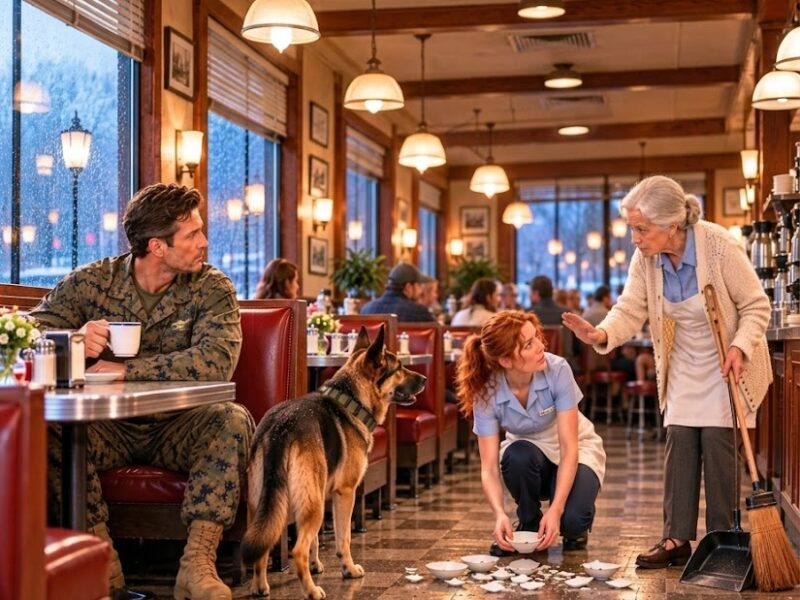
Everett Ror’s coffee cup stopped halfway to his lips the moment he heard the elderly woman behind the counter speak.
Thirty-one years had passed since he’d last heard that voice—or thought he had.
The U.S. Marine sat frozen in the booth, the ceramic mug suspended in midair, steam curling past his face like a ghost he couldn’t quite name.
His German Shepherd, Bishop, sensed the change immediately.
The dog’s ears swiveled forward, his dark eyes tracking from his handler’s rigid posture to the counter beyond.
Maybe it was only coincidence.
Then someone called her name.
“Miriam, can you grab the decaf?”
Everett felt the air leave his lungs.
When she picked up the coffee pot and started walking toward his table, a memory he had carried for more than three decades was about to come rushing back like water through a broken dam.
—
Cold October rain swept across the roads outside Cordelane, Idaho at 5:45 p.m., turning the lake beyond the pines into a sheet of gray and smearing the last daylight across the wet pavement.
Gunnery Sergeant Everett Ror drove with both hands steady on the wheel of his dark pickup, watching the road rather than the scenery.
At forty-two, Everett stood a little over six feet tall, broad through the shoulders without being bulky, with the economical movements of a man who had spent years learning not to waste energy.
His dark brown hair was cut short, with the first threads of gray showing at the temples.
His clean-shaven face was angular around the jaw and cheekbones.
A thin pale scar near his right eyebrow was easy to miss unless the light caught it just right.
His gray-blue eyes tended to make people think he was stern, though Everett was rarely unfriendly.
He simply listened longer than he spoke.
Years in the Marines had strengthened that habit, but part of it had existed since childhood—after one winter night taught him how quickly an ordinary drive could become something a person carried forever.
This trip had nothing to do with that night.
Everett had several days of leave before returning to duty and had chosen a quiet road trip rather than airports, schedules, and crowded places.
He had already booked two nights at a motel near the lake before continuing west.
Cordelane was only a stopping point.
On the passenger side floor behind him rested Bishop, his seven-year-old German Shepherd.
Bishop was a large but proportionate black and tan dog with a deep sable saddle, alert brown eyes, upright ears, and the controlled stillness of a well-trained working animal.
He was neither restless nor overly affectionate with strangers.
Bishop watched first, waited for Everett, and acted only when there was a reason.
Everett appreciated that about him.
The rain thickened enough to blur the road signs.
When Everett saw the warm windows of the Silver Creek Diner ahead, he turned into the gravel lot.
—
Inside, the diner smelled of coffee, grilled onions, and old wood warmed by decades of winters.
Everett took a booth beside the window where Bishop could settle against his left leg without blocking the aisle.
Behind the counter, Warren Pike, the sixty-eight-year-old owner, moved between the register and coffee station.
Warren was a heavy-set man with thinning white hair, a square face, and reading glasses hanging from a cord against his plaid shirt.
He greeted regulars by name, and Everett with the same uncomplicated nod he seemed to give everyone.
Everett ordered black coffee.
For several minutes, that was all the evening was.
Rain traced crooked lines down the glass.
Bishop rested his chin near Everett’s boot.
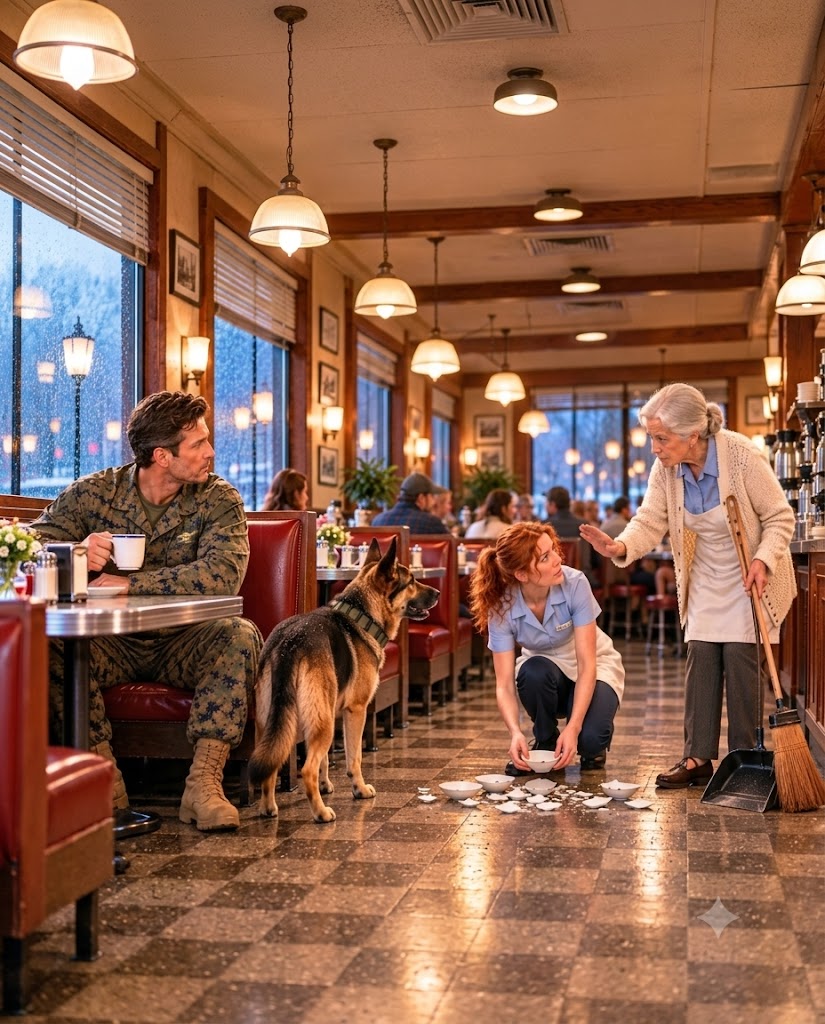
Everett had just wrapped one hand around the hot ceramic mug when a plate shattered behind the counter.
A young waitress froze.
She could not have been older than twenty—a slim, red-haired woman with freckles across her pale cheeks.
Her name tag read Kelsey.
Embarrassed, she immediately crouched and reached toward the broken pieces with her bare hand.
Then a woman spoke from somewhere beyond the counter.
“Easy, sweetheart. Leave the glass. Just breathe.”
Everett stopped.
His fingers remained around the mug, but he no longer felt its warmth.
Something inside him had gone perfectly still.
It was not the sentence.
He could not have sworn those were the same words.
It was the voice—low for a woman, softened by age, deliberate without being slow.
More than anything, it was the way she lowered her tone when someone else was frightened, as though calm could be handed from one person to another.
Everett knew that sound.
Or thought he did.
For an instant, the diner disappeared beneath another sound.
The metallic ticking of a damaged engine cooling in freezing darkness.
He was eleven again.
—
A blue Ford pickup lay crooked below a mountain road somewhere in northern Idaho, far from Cordelane.
Black ice had taken the tires before his father could correct the slide.
Everett remembered the violent sideways movement, glass exploding, then darkness interrupted by the dashboard lights.
His father had been slumped motionless in the front.
Everett had been trapped, blood running warm from somewhere near his hairline while the cold slowly invaded the wreck.
He remembered being terrified that his father was dead.
Then someone had appeared outside the broken window.
Everett could no longer summon her face, but he remembered a coat pushed through shattered glass and placed over him.
And he remembered a voice refusing to let him drift away.
—
Bishop lifted his head.
The German Shepherd looked at Everett first, not toward the counter.
His ears angled forward as he registered the sudden tension in his handler’s body.
Everett slowly released the mug.
An elderly woman emerged from the back carrying a broom and dustpan.
She was seventy-six, perhaps five-foot-three, narrow-framed but upright, wearing dark slacks, sensible shoes, and a cream cardigan beneath a diner apron.
Her skin was fair and lined deeply around the mouth and eyes, and her silver-white hair was gathered into a low bun at the nape of her neck.
She moved carefully rather than frailly.
There was nothing dramatic about her presence.
“Don’t touch that, Kelsey,” she said gently. “I’ve got the broom.”
Everett watched her.
Thirty-one years could erase certainty from a face.
The woman he remembered had been somewhere in her forties.
This woman was in her seventies.
Warren passed behind her.
“Thanks, Miriam.”
The name hit Everett almost as hard as the voice.
Miriam.
He looked down at his coffee.
His father had remembered that name, too.
Maybe Miriam.
That was all they had ever had.
Everett forced himself not to build certainty out of coincidence.
There were thousands of women named Miriam.
Voices changed.
Memory changed even more.
He had spent enough years around frightened people to know that the mind could turn fragments into facts simply because it wanted an answer.
So he waited.
—
Miriam finished sweeping the broken porcelain and reassured Kelsey with a small smile before returning to her work.
She had been helping Warren a few shifts each week, though nothing about her suggested someone desperate for the paycheck.
She greeted customers quietly, refilled cups without interrupting conversations, and seemed most comfortable being useful without becoming the center of attention.
Eventually, she approached Everett with the coffee pot.
Bishop raised his head again.
Miriam noticed the German Shepherd and stopped at a respectful distance.
She did not reach for him or make the clicking noises strangers often used around dogs they did not know.
“More coffee?”
Everett looked up, closer now.
He searched her face and found nothing he trusted enough.
“Yes, ma’am.”
She filled the cup.
Before she could turn away, Everett spoke.
“Did you always live around Cordelane?”
Miriam glanced back, mildly surprised.
“No. Why?”
Everett felt his heartbeat change.
“Did you ever live farther north? Mountain country?”
Something shifted behind her eyes.
“A long time ago.”
Everett swallowed.
“There was a blue Ford pickup.”
The coffee pot stopped moving.
“Black ice. A mountain road. The truck went into a ravine.”
Miriam stared at him.
Everett continued more quietly.
“There was a man unconscious in the front. An eleven-year-old boy trapped inside.”
The color slowly left Miriam’s face.
Bishop remained perfectly still beside Everett.
“You put your coat through the broken window,” Everett said. “You kept asking him questions. Told him to look at you. Told him to keep talking.”
Miriam lowered the coffee pot until it rested on the edge of the table.
For several seconds, neither of them spoke.
Then her eyes moved across Everett’s face as if searching beneath thirty-one years for someone much smaller.
When Miriam finally spoke, her voice was barely above a whisper.
“That boy lived.”
Everett felt the old wreck around him again—the cold, the blood, his father’s motionless body, and that unseen woman refusing to leave.
He gave one slow nod.
“Yes, ma’am.”
Miriam’s hand tightened around the handle of the coffee pot.
Everett held her gaze.
“He did.”
—
By closing time, the rain had softened to a fine mist against the diner windows, leaving the parking lot black and shining beneath the lamps, while the last customers pulled their coats tight and disappeared into the October night.
Miriam finished her shift before she sat down with Everett in the booth farthest from the counter.
There had been no sudden embrace, no tears spilling into a stranger’s shoulder, simply because the past had finally acquired a face.
Thirty-one years stood between them, and Everett understood almost immediately that neither of them possessed the whole memory.
Warren dimmed the front lights and quietly busied himself near the register, giving them the kind of privacy that did not require an announcement.
Bishop settled beneath the outside edge of the booth beside Everett, his body relaxed, but his ears occasionally turning toward the low voices above him.
For a while, Miriam held both hands around a fresh cup of coffee without drinking.
“I wondered about you,” she finally said.
Everett looked at her.
“I wondered about you, too.”
—
He told her his father had survived.
The injuries had been serious enough to require months of treatment and rehabilitation.
The period afterward had been confused by doctors, insurance forms, missed work, and a family trying to rebuild ordinary routines around something that no longer felt ordinary.
His father had tried to identify the woman who had stayed with his son below the road.
Everett remembered phone calls and questions, remembered his father repeating that her first name might have been Miriam.
Nothing useful had come from it.
Less than a year later, the family moved away from the region, and the search gradually became one of those unfinished things life buried beneath more immediate responsibilities.
“My dad hated that,” Everett said. “Not being able to thank you.”
Miriam looked down at her coffee.
“He was alive. You were alive. That was enough.”
Everett almost disagreed, then stopped himself.
For him, the night had been a dividing line.
For Miriam, he realized, it might have been something entirely different.
—
“What happened before you found us?”
Miriam took a slow breath.
She had been driving home through the mountains that night when something made her ease off the accelerator.
At first, she thought she had heard metal shifting somewhere in the trees.
Then came a faint horn from below the road.
Not a sustained blast—just a weak sound that seemed too deliberate to be wind or machinery.
She stopped, walked back along the shoulder, and called into the darkness.
No one answered clearly.
“So I went down.”
Everett pictured the slope from a child’s memory.
Snow crust, loose rock, trees leaning at impossible angles.
“You went down there alone? There wasn’t anyone else.”
Miriam described finding the blue Ford wedged below the road.
Everett’s father was unresponsive.
Everett was conscious but trapped, frightened, bleeding near the hairline and becoming colder by the minute.
Miriam had known enough not to drag him through the broken window.
She could not tell whether his neck or spine had been injured, and moving him carelessly might have made things worse.
“I told you I was going for help.”
Everett frowned slightly.
“I don’t remember you leaving.”
“I’m glad.”
—
The nearest help she knew of was a staffed highway maintenance station almost half a mile away.
Miriam climbed back to the road and ran.
She had not been a runner, and the cold air burned her lungs before she reached the building.
The employee on duty made the emergency call while Miriam explained where the truck had left the road.
Then she went back.
Everett stared at her.
“You could have stayed at the station.”
“Yes.”
“But you didn’t.”
“No.”
—
When Miriam reached the wreck again, she pushed her coat through the broken window and covered as much of the boy as she could.
She asked his name, asked what grade he was in, asked him to count backward.
Whenever his answers became slow, she found another question.
Everett remembered pieces now—not pictures so much as sensations.
Cold vinyl beneath his hand, the smell of gasoline and wet earth, a woman telling him to keep his eyes open.
“You kept asking me stupid questions,” he said.
For the first time that evening, Miriam smiled.
“You kept answering them.”
—
By the time rescuers reached the ravine, Miriam was shaking badly from the cold.
Their attention went immediately to the injured father and son.
Someone checked Miriam briefly, and later a local acquaintance drove her home.
Because the maintenance station employee had placed the emergency call, Miriam’s name was never the obvious thread Everett’s family hoped it would be.
By the time his father was well enough to pursue the question seriously, the trail was already thin.
Everett leaned back.
For thirty-one years, he had imagined the woman outside that window as fearless.
Memory had simplified her into exactly what an eleven-year-old needed her to be.
Calm, certain, unbreakable.
Then Miriam told him about Caleb.
—
Her only biological son had been eighteen—tall and lean, with sandy brown hair that never stayed combed and a crooked smile inherited from his mother.
Caleb had been quick to laugh, impatient with instructions, and forever convinced he could repair anything if someone gave him enough tools.
Eight months before Miriam heard the horn below the mountain road, Caleb had been killed in a workplace accident.
Everett did not speak.
The diner seemed suddenly larger around them.
Miriam traced one finger along the rim of her cup.
“I wasn’t doing very well then.”
Everett studied her face, finally understanding something the boy in the wreck never could have known.
“You just lost your son. Eight months felt like yesterday, and you still went down that ravine for somebody else’s.”
Miriam’s expression tightened—not with anger, but with discomfort at the shape of the question.
“How did you do that?”
She looked toward the dark window.
“I heard somebody’s boy down there.”
Her voice remained quiet.
“I couldn’t leave him alone.”
—
Everett lowered his eyes.
For most of his life, he had carried gratitude toward a woman he had unknowingly turned into a legend.
Now the legend became human.
Miriam had not descended that slope because grief could not reach her.
She had gone while carrying grief so heavy Everett could scarcely imagine it.
—
Years later, Miriam told him, life had changed again.
She married Thomas Holstead, a patient, broad-shouldered man with dark hair—already thinning when they met—and a habit of listening completely before answering.
Thomas had a young daughter from an earlier relationship.
Dana grew into a practical, warm-hearted woman who inherited her father’s patience and eventually built a life in Spokane, Washington.
Miriam never asked Dana to regard her as a replacement for her biological mother.
Somehow, over years of school mornings, illnesses, birthdays, disagreements, and ordinary meals, they became family.
“Anyway, Thomas died four years ago.”
Dana was forty-seven now, married with two children of her own.
Miriam had barely finished saying it when her phone vibrated against the tabletop.
The screen illuminated between them.
Dana.
Miriam looked at the name.
Something subtle changed in her face.
The phone continued vibrating.
Everett said nothing.
After several seconds, Miriam turned it face down.
The vibration stopped.
Bishop shifted quietly beneath the table and settled again.
Everett could have asked why she had ignored the call.
Instead, he reached for his coffee and let the silence remain where Miriam had placed it.
For thirty-one years, he had wondered why he had never found the woman who refused to leave him alone in the dark.
Now, sitting across from her at last, Everett began to wonder why she seemed determined to be alone herself.
—
Morning came clear and cold over Cordelane, the rain gone from the streets and a pale October sun breaking across the lake.
Everett had nowhere urgent to be.
His motel reservation still had another night, and the road west was open.
He went back to Silver Creek Diner anyway.
Everett told himself he wanted breakfast.
The explanation lasted until he parked in almost the same place as the night before and saw Miriam’s sedan near the side entrance.
Bishop waited quietly while Everett clipped on his lead, then stepped down beside him.
Inside, Warren looked up from the grill and gave Everett a knowing glance without commenting on his return.
“Coffee, please.”
Miriam was carrying silverware toward the counter.
She stopped when she saw Everett, and for half a second something close to surprise crossed her face.
“You came back.”
“I paid for two nights.”
“That isn’t what I said.”
Everett almost smiled.
“No, ma’am.”
—
The morning rush gave them little opportunity to talk.
Everett ate eggs and toast while Miriam worked, and he found himself watching—not because he was still searching for the woman from the ravine, but because he wanted to understand the person she had become afterward.
What he discovered first was that Miriam did not need saving.
She owned a small house in an older residential neighborhood and had finished paying the mortgage years earlier.
Her bills were manageable.
She still drove herself, bought her own groceries, kept track of her accounts, and handled the ordinary maintenance of a life without asking anyone to take it over.
There was no hidden illness behind her careful movements and no financial disaster waiting beneath the surface.
She worked at Silver Creek a few shifts each week because Warren had been her friend for years, and because, as she eventually admitted, a house gets too quiet if you let it.
Warren overheard.
“You’re here because my coffee is exceptional.”
Miriam looked at Everett.
“His coffee is terrible.”
Warren pointed a spatula at her.
“And yet you keep drinking it.”
—
The exchange made Everett laugh, but he noticed what followed.
When the breakfast crowd thinned, Miriam wiped the same section of counter twice before sitting on the stool at the far end.
There was nowhere else she needed to be.
That was when Everett began to understand.
Her life was not broken.
It had simply become smaller.
Since Thomas died four years earlier, the boundaries had narrowed so gradually Miriam seemed not to notice them.
Her house, the diner, the grocery store, occasionally the pharmacy or bank, then home again.
She was capable of going farther.
She simply found fewer reasons to do it.
—
Dana gave her reasons.
“She wants me in Spokane every other weekend,” Miriam said later.
They were sitting at the counter during the slow hour after lunch.
Bishop rested near Everett’s stool, leaving the aisle clear.
“Do you go sometimes?”
Everett waited.
Miriam sighed.
“Not often.”
She spoke about Dana’s family carefully, as though affection needed qualifications.
Dana’s husband was good to her.
Their two children had grown up knowing Miriam as family.
Both called her Grandma Miriam—a title Miriam seemed determined to correct whenever she repeated it.
“I’m not actually their grandmother.”
Everett took a drink of coffee.
“Do they know that?”
Miriam gave him a dry look.
“They understand biology.”
“That wasn’t what I asked.”
She did not answer.
—
The younger child, Lucy Whitlock, was twelve—small for her age, with straight chestnut brown hair that fell below her shoulders, hazel eyes, and the serious concentration of a child who hated practicing badly more than she hated practicing at all.
Everett learned those details from the photograph Miriam eventually showed him on her phone.
Lucy stood holding a violin beneath her chin, her narrow face set in exaggerated determination, while one strand of hair had fallen across her cheek.
“She looks terrified,” Everett said.
“She was trying to play a G major scale.”
“Same thing.”
Miriam laughed before she could stop herself.
—
Lucy’s first school violin recital was coming up.
She had apparently informed her mother that one seat needed to be saved specifically for Grandma Miriam.
“Dana keeps calling about it,” Miriam said.
Everett remembered the phone turned face down the previous night.
“When is it?”
Miriam told him.
Then she added quickly, “I’m working.”
From behind the register, Warren looked up.
Everett caught the movement.
So did Miriam.
Warren wisely lowered his eyes again.
Everett said nothing.
—
Twenty minutes later, while Miriam carried dishes into the kitchen, Warren set a receipt beside Everett’s cup.
“She isn’t working that day,” he murmured.
Everett looked toward the kitchen doors.
“I figured.”
He did not confront her.
—
By mid-afternoon, Bishop had begun treating Miriam as part of the diner rather than an unfamiliar person moving through it.
She had earned that familiarity by doing almost nothing.
She never called his name to pull his attention away from Everett.
She never offered him scraps.
She never reached over his head or assumed that because he was calm, he wanted to be touched.
When Everett moved to a booth to answer a message, Bishop settled several feet from Miriam’s usual stool while still keeping Everett in view.
Miriam glanced down.
“He doesn’t seem to need much from anybody.”
Everett looked at Bishop.
One ear turned toward his voice.
“He needs people. He just doesn’t make a lot of noise about it.”
Miriam’s expression changed.
Everett immediately knew she had heard something beyond the dog.
—
For a while, neither spoke.
Then Miriam folded a napkin slowly between her fingers.
“Dana has a husband, two children, a job, a house that always seems to need something repaired.”
She paused.
“She has a life.”
“So do you.”
“For now,” Everett waited.
“I’m seventy-six.”
There was no self-pity in the statement.
“One day I may stop driving. Maybe I’ll need help getting groceries. Maybe stairs become difficult. Maybe there are appointments.”
She looked toward the window.
“And then somebody starts rearranging things. Dana leaves work early. Her husband changes plans. The children miss something because Grandma Miriam needs a ride.”
There was that title again.
This time she had not corrected it.
Everett noticed but let it pass.
“So you’re preparing for that now?”
“I’m trying not to become an obligation later by staying away.”
Miriam’s fingers stopped folding the napkin.
“I’m making sure she understands she doesn’t have to build her life around me.”
—
Everett could have told her what he thought.
He could have pointed out that Dana kept calling, that Lucy was saving a seat, that no one appeared to be asking Miriam to surrender her independence.
He did none of those things.
Instead, he said, “Does Dana know that’s what you’re doing?”
Miriam looked at him.
The question landed more deeply than an argument would have.
—
Outside, afternoon light stretched across the wet parking lot.
Bishop lowered his head onto his paws, comfortable enough to close his eyes while Miriam sat only a few feet away.
Everett remembered a woman running back toward a ravine when she could have remained somewhere warm and safe.
Thirty-one years ago, Miriam had heard a stranger’s child in the darkness and decided he should not be left alone.
Now, Dana kept calling.
Lucy kept saving her a seat.
And Miriam, believing distance was a form of kindness, was slowly removing herself from the lives of people who had never asked her to go.
—
Everett’s final full day in Cordelane began beneath a clear October sky, cold enough to silver the edges of parked cars with frost.
His bag was mostly packed at the motel, the pickup fueled, and by the following morning, the road west would be waiting.
He stopped at Silver Creek Diner one more time.
Miriam was already there, seated at the far end of the counter with a cup of coffee she had barely touched.
She was not working that morning.
No apron, no order pad, no reason to be there except habit.
Warren moved quietly behind the counter while Bishop settled beside Everett’s stool.
Everett had learned enough about Miriam not to make a ceremony out of goodbye.
“You heading out?”
“Tomorrow morning.”
She nodded.
“Road should be better by then.”
—
Her phone vibrated against the counter.
Miriam looked down.
Dana.
Everett saw the name only because the phone lay between them.
Miriam watched it for several seconds, then pressed the side button and silenced the call.
Neither mentioned it.
Warren brought Everett a plate of eggs and toast.
Conversation moved toward ordinary things.
The weather farther west, road construction, whether Warren’s coffee had improved overnight.
“It hasn’t,” Miriam said.
Everett took another drink.
“I’ve had worse.”
Warren looked offended.
“That is the nicest thing anyone has said in here all week.”
—
The phone vibrated again.
Dana.
This time Miriam exhaled before silencing it.
Everett continued eating.
“She wants to know if I’ve changed my mind,” Miriam said.
He set down his fork.
“About Lucy’s recital.”
Miriam nodded.
“She called last night too. Says Lucy keeps asking which seat is mine.”
Everett did not remind Miriam that she was free that day.
He did not ask why she kept refusing something she clearly wanted.
The answer had already been given.
—
For a minute, Miriam stared into her coffee.
Then she surprised him.
“All those years in the Marines. Did you ever think people were better off when they didn’t have to worry about you?”
Everett looked at her.
There was no need to ask what she meant.
“Yes.”
Miriam lifted her eyes.
“When I was younger, I did it a lot.”
He leaned back slightly.
Bishop remained quiet below them.
Everett had spent years leaving for places where schedules changed without warning, and promises about returning on time meant very little.
In his younger years, whenever someone cared enough to worry, he had treated their concern like a problem he was responsible for solving.
If he believed his absence would make someone wait, rearrange plans, lose sleep, or sacrifice something important, he often stepped away first.
“I thought I was making things easier.”
“Were you?”
“At the time, I could make a good argument for it.”
“And now?”
Everett looked through the diner window at the pale morning outside.
“Now, I think sometimes I was protecting people,” he paused. “And sometimes I was just making their decision for them.”
Miriam said nothing.
“I decided what they could handle, what they should worry about, what they should give up. Then I called it protecting them because that sounded better.”
Her fingers tightened slightly around the cup.
Everett did not turn the conversation toward Dana.
He did not say, “That’s what you’re doing.”
Miriam was intelligent enough to hear whatever belonged to her in his answer.
—
Her phone vibrated a third time.
Dana.
Miriam stared at it.
Everett reached for his jacket.
He stood, placed cash beside his plate, and gave Bishop a quiet hand signal.
The German Shepherd rose immediately and moved to his left side.
Miriam looked up.
“You don’t have to leave because of me.”
“I’ve got a few things to take care of before tomorrow.”
He gave Warren a nod, then looked at Miriam.
“It was good finding you.”
Something in her expression softened.
“It was good knowing you lived.”
Everett rested one hand briefly against the edge of the counter.
Then he walked out with Bishop.
He never told her to answer the phone.
—
Through the diner window, Miriam watched the Marine cross the parking lot until he disappeared beyond the edge of the glass.
Her phone stopped vibrating.
She had not answered.
—
That evening, Miriam returned to the small house she had owned for years.
The rooms were clean and orderly, not neglected, but quiet in a way she had once considered peaceful.
She hung her coat in the hall, set her keys in the ceramic dish beside the door, turned on one lamp, then another.
For years, she had defended that quiet as independence.
Tonight, it felt different.
In the kitchen, she filled a glass with water and opened the refrigerator.
A child’s drawing was held to the door by two mismatched magnets.
It had been there for months.
Miriam had seen it hundreds of times without truly looking.
Two figures stood beneath a yellow sun, their bodies made from simple lines.
One had long brown hair.
The other had a crooked gray shape that was apparently meant to be a bun.
Their oversized hands met between them.
Across the bottom in uneven purple letters, Lucy had written, “Grandma Miriam, plus me.”
—
Miriam touched the edge of the paper.
She thought of Dana calling three times.
She thought of Lucy asking which seat belonged to her.
Then, unwillingly, she thought of Everett’s words.
Sometimes I was just making their decision for them.
Miriam had spent four years telling herself she was protecting Dana from obligations that had not yet arrived.
She had imagined future appointments, missed work days, grocery runs, difficult winters—all the small burdens age might eventually place on another person.
But Dana had never asked Miriam to disappear in preparation for them.
Neither had Lucy.
—
Miriam stood alone in the kitchen for a long time.
No Marine waited beside her.
No daughter pleaded through the phone.
No German Shepherd watched from the floor.
There was no one left to persuade her.
The choice finally had nowhere to belong except to Miriam.
—
The following morning, she pulled a small suitcase from the closet and placed it on her bed.
She packed slowly.
Three blouses, two pairs of slacks, a cardigan, comfortable shoes, toiletries, her medications, and reading glasses.
Then she stopped, looking at the suitcase as though it had accused her of something.
Ten days, she decided.
Not forever.
Not surrender.
A visit.
—
Miriam sat on the edge of the bed and picked up her phone.
For several seconds, her thumb hovered over Dana’s name.
Then she called.
The answer came before the second ring.
“Mom.”
Dana’s voice was cautious, almost afraid that speaking too loudly might make Miriam retreat.
Miriam closed her eyes.
“Is that seat still empty?”
Silence.
Then Dana gave a small, breathless laugh.
“Lucy wouldn’t let us give it away.”
Miriam pressed her lips together.
Something inside her loosened.
Not dramatically, not all at once, but enough.
She looked toward the open suitcase.
When she spoke again, she did not correct the title.
She did not explain biology.
She did not remind Dana that blood had never connected her to the twelve-year-old girl waiting in Spokane.
“Tell her Grandma Miriam is coming.”
—
The morning Everett left Cordelane was bright and cold, the lake flashing silver between the pines as he checked out of the motel, loaded his bag into the pickup, and settled Bishop’s gear behind the passenger seat.
He could have taken the highway west from there.
Instead, he drove to Silver Creek Diner.
Everett told himself he only wanted to say goodbye properly.
When he stepped inside, Warren was behind the register, counting change into the drawer.
“Miriam here?”
Warren looked up.
“Not today.”
Everett glanced toward the far end of the counter anyway, at the stool where Miriam usually sat during quiet hours.
“Day off.”
Warren’s mouth shifted into the beginning of a smile.
“Something like that.”
Everett understood he was not getting more.
He shook Warren’s hand, thanked him for the coffee, and walked outside with Bishop.
—
The German Shepherd waited beside Everett while he unlocked the pickup.
Everett had one hand on the door when a dark blue sedan turned into the parking lot.
It slowed near the diner.
Everett recognized Miriam in the passenger seat.
A woman in her late forties was driving.
Dana Whitlock, forty-seven, had shoulder-length dark blonde hair touched with lighter strands near the temples, warm brown eyes, and a composed face that suggested she had spent years solving problems without needing anyone to notice.
She was medium height and sturdily built, dressed in jeans, ankle boots, and a navy wool coat.
Nothing about her expression carried resentment when she looked toward Miriam.
Mostly, she looked relieved.
—
In the back seat sat the girl Everett had previously seen only in a photograph.
Lucy Whitlock was smaller than Everett expected, her straight chestnut brown hair falling below her shoulders and her hazel eyes bright behind the glass.
A violin case lay beside her.
Miriam’s small suitcase was in the trunk.
One suitcase.
Ten days.
She had not sold her house, handed over her keys, or surrendered the life she had spent decades building.
She was going to Spokane for Lucy’s recital and giving herself ten days to discover whether the burden she feared existed anywhere beyond her own imagination.
—
Dana parked.
Lucy was out first.
“Grandma Miriam, can I carry your bag?”
Miriam stepped from the passenger side.
“It weighs nearly as much as you do.”
“I can still carry it.”
“No, half.”
Miriam looked at Everett and shook her head, but she was smiling.
There was no hesitation in Lucy’s use of grandma.
No courtesy forced upon a child by adults.
It was simply the name she had for the woman standing beside her.
—
Dana came around the car and extended a hand to Everett.
“You must be Everett.”
He shook it.
“Miriam told you.”
“Enough.”
Miriam gave Dana a warning look.
Dana smiled.
“Not everything.”
Everett appreciated that.
—
Lucy crouched several feet from Bishop but did not reach for him.
“Is that Bishop?”
“Yes.”
“Can I pet him?”
“Not right now.”
“Okay.”
No disappointment, no argument.
She stood again and returned to Miriam’s side.
Everett looked at Miriam’s suitcase.
“So, you’re going. Ten days.”
“Ten.”
“Don’t make it sound permanent.”
“I wouldn’t dare.”
—
They stood quietly for a moment while Dana and Lucy went inside to say hello to Warren.
Everett realized there was something he had not yet told Miriam.
“When I was eleven, after the accident, my dad used to say that if we ever found you, we’d find some way to repay you.”
Miriam’s expression softened.
“I kept thinking that, too,” Everett continued. “For a long time, I figured if I ever found the woman who stayed with me, I was supposed to do something big enough to balance it.”
Miriam studied him.
“How many years have you worn that uniform?”
Everett told her.
“And in those years, how many people have you helped?”
He gave a slight shrug.
“I don’t know.”
“How many did you never see again?”
Everett was quiet.
Too many names.
Too many faces encountered at the worst moment of someone’s life and never seen after the danger passed.
“I couldn’t count.”
Miriam nodded.
“Then stop trying to bring it back to me.”
—
Everett looked at her.
“I didn’t loan you anything in that ravine,” she said. “You don’t owe me your life because I happened to be there when you needed somebody.”
“Happened to be there?”
“All right. I ran farther than I would have preferred.”
Everett smiled.
Miriam continued more softly.
“If somebody stayed for you and that taught you to stay when somebody else needed it, then it already went somewhere. Let it keep going forward.”
For thirty-one years, Everett had imagined gratitude as a circle he was supposed to close.
Miriam had just told him it was a road.
—
Bishop stood beside him, watching the parking lot.
Miriam looked down at the dog.
Then she looked at Everett.
She did not reach.
Everett gave Bishop a quiet release cue.
Bishop stepped forward on his own, closing the distance without tension.
Miriam lowered one hand and let him investigate first.
The German Shepherd sniffed her fingers, then remained beside her, posture loose.
Only then did Miriam touch him.
Her hand moved once along the fur at his shoulder.
“That took three days,” she said.
“He’s selective.”
“So am I,” Everett laughed.
—
Miriam straightened for a moment.
Neither seemed certain what goodbye was supposed to look like after thirty-one years of wondering.
Then Miriam tilted her head.
“Still keeping your eyes open?”
The parking lot vanished for half a heartbeat.
Everett was eleven again beneath a mountain road, fighting cold and sleep while a woman’s voice kept finding him through the darkness.
This time he smiled.
“Yes, ma’am.”
—
Dana and Lucy returned.
Miriam climbed into the passenger seat.
Everett opened his pickup for Bishop.
Minutes later, the two vehicles left Silver Creek Diner in different directions.
—
Months passed.
Everett was back with his unit when a plain envelope arrived with his name handwritten across the front.
Inside were two photographs.
The first showed Lucy on a school stage, violin tucked beneath her chin.
In the audience, Miriam sat between Dana and a tall, lean man Everett assumed was Dana’s husband.
He appeared to be in his late forties with short brown hair, rectangular glasses, and the relaxed smile of someone comfortable letting other people have the attention.
Miriam was leaning forward in her seat.
The second photograph was less dignified.
Miriam wore an apron in Dana’s kitchen.
Lucy stood beside her holding a spatula.
On the counter sat a pancake burned nearly black.
Both were laughing.
—
Everett turned the photograph over.
Miriam had written, “I went for 10 days. I stayed 12. Nobody complained.”
Below it was another line.
“Turns out they weren’t waiting for me to be useful. They were waiting for me to show up.”
Everett read it twice.
Bishop lay at his feet.
—
Thirty-one years earlier, Miriam Holstead had saved a frightened boy in the simplest way that mattered.
She stayed.
Thirty-one years later, Everett had not saved Miriam.
He had only arrived at the right moment for the woman who once taught him the value of staying to realize there were still places in this world where people were waiting for her to show up.
—
Sometimes a miracle doesn’t arrive with thunder, flashing lights, or an answer we immediately recognize.
Sometimes God simply places one person in another person’s path at exactly the right moment.
Thirty-one years ago, Miriam stayed beside a frightened boy because she could not leave someone’s child alone in the darkness.
Decades later, that boy returned to her life.
Not to repay a debt, but perhaps to remind her of something she had forgotten.
Love is not measured by how useful we can be to others.
Sometimes the people who love us are simply waiting for us to show up.
Maybe there is someone in your life who needs your presence more than your solutions.
Maybe there is a phone call you have been postponing, a chair waiting for you at someone’s table, or a person who would rather carry part of your burden than watch you disappear.
If this story touched your heart, share it with someone who may need that reminder today.
Tell us in the comments where you’re watching from and what this story meant to you.
And if you believe stories of loyalty, kindness, and second chances still matter, please subscribe to The Last Patrol and join us for the next journey.
May God bless you, protect your family, and place the right people in your path when you need them.









