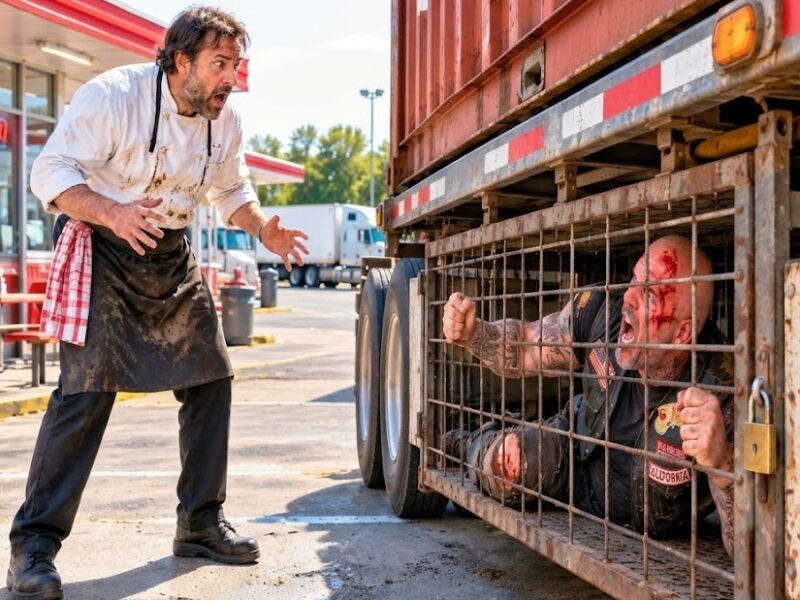
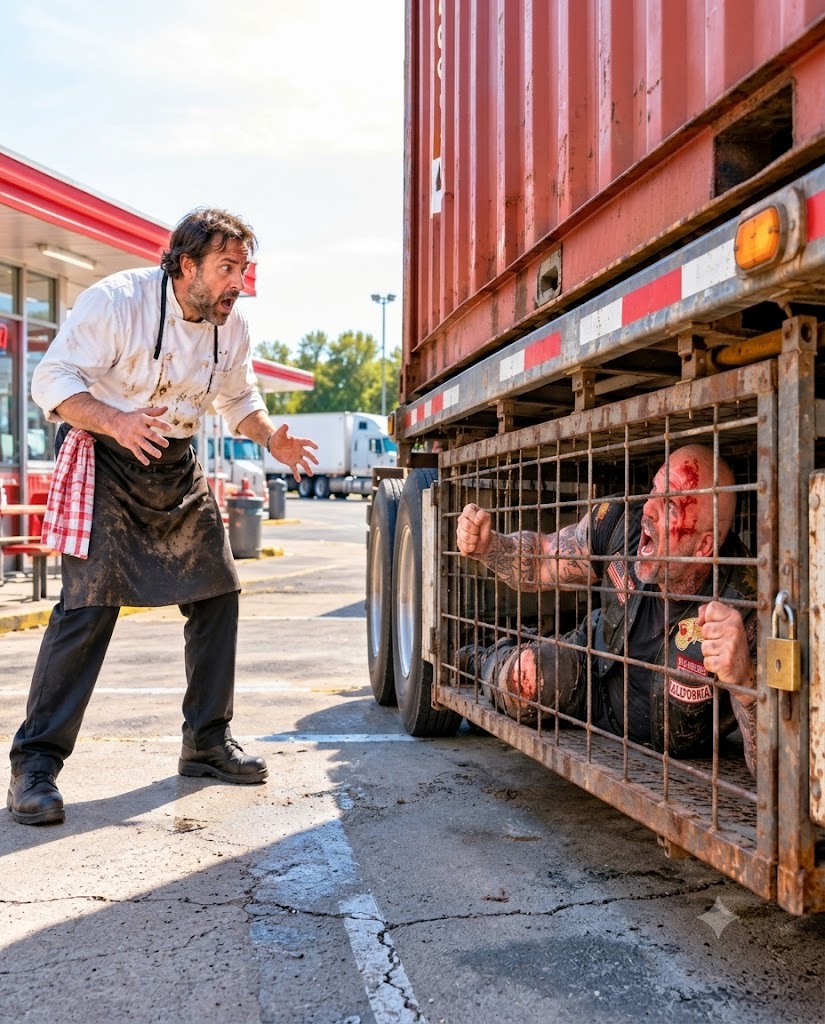
A truck stop cook heard banging from inside a locked freight truck. He opened it—and found a Hells Angel barely alive.
**Part 1**
A fist hammered against steel from the inside. Then again. Harder. The sound rolled across an empty parking lot before dawn, slow and heavy.
A big man in a greasy apron froze beside a trash bin. He set it down.
He listened. The knocking came again, weaker now, from deep inside a freight trailer at the far end of the lot.
He walked toward it. He pressed his ear to the cold metal. A voice answered from inside. Barely a whisper.
“Help me.”
The cook’s name was Earl Dawson, and he had fried eggs at that truck stop for 19 years without ever making trouble. He grabbed a pry bar from his own truck.
He did not know that behind those doors sat a man 300 bikers would burn the world to find. What he found inside would bring hell down by sunrise.
Stay with me on this one.
Now, here’s the thing about Earl Dawson. He was a big man, but he moved small. Six foot three, hands like catcher’s mitts, a chest that filled a doorway.
And in 19 years, nobody at the Chrome Diner had ever seen him raise his voice. He came in at 4:00 in the morning. He fired the grill.
He cooked for the truckers who rolled off Route 66 outside Barstow, and he went home. That was the whole shape of his life. Eggs, bacon, coffee, silence.
He liked it that way. He wasn’t looking for anything more, and nothing more had ever come looking for him.
But a few months back, the quiet at the Chrome Diner started to crack. And the crack had a name. Vernon Pike.
Pike ran freight up and down the interstate. And somewhere along the way, he decided the truck stop belonged to him. He parked his rigs wherever he wanted.
He ran tabs and never paid them. He’d sit in the corner booth with two of his men, loud, taking up all the air in the room.
And if you looked at him too long, he’d stare back until you looked away. Most people looked away. That’s how men like Pike win.
They don’t win because they’re strong. They win because everybody around them decides, one small decision at a time, that it isn’t worth the trouble.
And a man like that doesn’t stop at one win. He needs the next one.
Every month Pike pushed a little further, and every month the diner shrank around him. There was a trucker named Hollis who used to eat there four nights a week, good tipper, knew everybody.
Pike took his booth one night, and when Hollis said something, Pike followed him out to the lot and did something to the man’s rig that cost him a week of work and a tow. Hollis never came back.
Nobody ever proved a thing. That’s how it went. The regulars thinned out. The ones who stayed learned to keep their eyes on their plates.
Earl watched it build. He watched Pike stiff the diner on $300 of food and dare anyone to say a word. He watched a place that used to feel like somebody’s living room turn into a place where folks ate fast and left faster.
And worst of all, he watched him go after Donna.
Donna worked the night shift. Fifty-four years old, widowed, two grandkids she was raising on tips. She was kind to everybody, even the drunks.
She remembered your order and your kids’ names, and she’d slide you an extra biscuit when you looked like you were having a hard week. And Pike treated her like dirt.
He’d snap his fingers at her. Call her sweetheart in a way that wasn’t sweet at all. He’d send plates back for no reason, just to watch her carry them.
One night Earl heard a crash and came out of the kitchen to find Donna on the floor, a tray of broken dishes around her, and Pike standing over her laughing. He’d stuck his boot out, tripped her on purpose, just to watch.
Earl helped her up. He didn’t say anything to Pike. He wanted to. Believe me, he wanted to. His hands closed into fists, and every muscle in him was screaming to reach across that booth.
But Earl had a record from 30 years back. A bad few years when he was young. A temper and a man who ended up in a hospital, and a judge who told Earl the next one would be the last one.
He’d done his time. He’d come out and promised himself he’d never give anyone a reason to put him back in a cage. Nineteen years he’d kept that promise.
So he swallowed it. He always swallowed it. He told himself a cage was worse than a bully. Most days he believed it.
Donna knelt there picking up glass and looked up at him with tired eyes and said, “You don’t have to protect me, Earl.” And Earl said, “I know.”
But he didn’t mean it. He meant it the way you mean a thing you’ve given up on. He went back to his grill and cooked, and the anger sat in his chest like a stone, same as always.
And by morning he’d pushed it back down where it lived.
The night it all started, Pike rolled in around 11. Big man himself, bigger than Earl, with a gut that strained his shirt and a gold watch he liked to flash.
He parked a long freight trailer at the dark end of the lot, backed it into the shadows past the fuel pumps, away from the lights, away from the road. Then he came inside, ate a full meal, and told Donna to put it on his tab. Same as always.
But this time before he left, he did something different. He stopped at the kitchen window and pointed one thick finger at Earl.
“That trailer out back,” Pike said, “nobody touches it. It stays sealed till my driver comes for it tomorrow. You hear me, cook?”
Earl wiped his hands on his apron and nodded. “I mean it,” Pike said. “Anybody goes near it, there’s going to be a problem. A big problem.”
He tapped the counter twice with that gold watch, hard like a gavel. Then he walked out into the dark.
Earl watched him go, and he thought it was strange. In all those months, Pike had never cared about his loads. Trucks came and went out of that lot all day and all night, and Pike never once looked twice.
Why did this one matter? Why seal it, park it in the dark, and threaten a cook over it? A man doesn’t guard furniture like that. A man doesn’t put a gold watch down like a gavel over a load of furniture.
Earl didn’t sleep much that night. He kept thinking about the way Pike said it. There’s going to be a problem. And he kept thinking about that trailer sitting out there in the cold, backed into the dark where nobody would look.
By 4:00 in the morning, he was back in the kitchen, grill hot, coffee on. Donna had gone home. The lot was empty. Just him and the hum of the fridges, and the first gray light sneaking in from the east.
And then he heard it. The knocking.
He told himself it was nothing. A loose strap. Metal settling in the cold. He went back to cracking eggs. But the knocking came again, slower, like whoever it was had almost given up.
And this time, underneath it, so faint he almost missed it, he heard something that turned his blood to ice water. A voice.
So Earl did the thing that changed everything. He stood in that warm kitchen with the eggs going and the easy, safe morning stretched out in front of him. And he thought about Pike.
And he thought about the cage. And then he walked out into that lot in the dark alone to find out.
The trailer doors were chained. A heavy padlock new. And the chain had been wound twice through the handles and cinched down tight. Whoever closed this did not want it opened.
Earl pressed his ear to the steel again. “Please,” the voice said. “Please, I’ve been in here 3 days.” “There’s a dog.” “Help the dog.”
Earl’s hands were shaking. And Earl’s hands never shook. Nineteen years over a hot grill and they were steady as stone. And now they were trembling on a cold chain in the dark.
He thought about Pike’s warning. He thought about his record, the promise, the judge. The cage he swore he’d never see again. Every smart bone in his body told him to walk back inside. Call the sheriff. And let it be somebody else’s trouble.
That was the safe move. But there was a man in there. And a dog. And three days in the dark. And the sheriff was 40 minutes out on a good day. And that voice was getting weaker every time it came.
Earl jammed the pry bar into the hasp where the padlock met the door. He threw his whole weight on it. The metal screamed and held. He reset his grip. Braced his boot against the bumper.
And pulled until the muscles in his back caught fire. The hasp bent. Bent more. And then with a crack like a gunshot, the screws tore loose and the lock dropped into the gravel.
Earl stood there breathing hard, the busted lock at his feet. Last chance to walk away, he thought. Nobody’s a thing. He didn’t take it. He swung the doors open.
The smell hit him first and I won’t dwell on it, but three days is three days. Then his eyes adjusted. The trailer was nearly empty. A few crates, some packing straps, a bucket in the corner.
And at the far end, slumped against the wall with his wrists zip tied to a tie down ring, sat a man. He was a mess. Dried blood down one side of his face. One eye swollen shut. Lips cracked from no water.
He wore a leather vest, filthy now, and across the back of it when he shifted, Earl caught the shape of wings. A patch. A big one.
And beside him in a crate too small for it, a dog lay on its side. A shepherd gray around the muzzle, a long white scar across its shoulder. It lifted its head when the light came in and let out a sound that wasn’t quite a bark. More like a question.
“Water,” the man rasped. “Him first. Please.”
Earl climbed up into the trailer. He cut the dog’s crate open and the shepherd didn’t attack, didn’t run. It just crawled to the man and pressed against his leg. Loyal to the last.
Earl ran back for a jug of water and a stack of ham off the grill. He held the jug to the dog’s mouth and the man’s mouth both, careful, a little at a time, because he knew a starving body can’t take it all at once.
“Easy,” Earl said. “Easy. You’re all right now.” He sawed through the zip ties. The man’s hands fell into his lap, swollen and purple. He tried to flex them and couldn’t.
“What’s your name?” Earl asked. The man looked up with his one good eye. “Cole,” he said. “Cole Rafferty.” He coughed. “The dog’s Diesel. He’s been in here same as me. Three days.” His voice broke on that.
A man who could take a beating and not break, and the dog is what broke him.
Earl got them both inside the diner as the sky turned pink. He sat Cole in the back booth, out of sight of the windows, and kept the coffee coming and the eggs coming. Diesel lay under the table with his head on Earl’s boot.
Little by little, the color came back into Cole’s face. The swollen hands started to move again, a finger at a time. He ate like a man who’d forgotten food was real.
And here’s where it got quiet. Here’s where Earl let himself breathe. Because for a little while, it felt like it was over. The hard part, the scary part, the padlock in the dark and the pry bar. Done.
Cole was safe. The dog was safe. The sun was up and the diner was warm and the coffee smelled like coffee. Earl figured he’d feed the man, get him strong enough to stand, and then they’d call the sheriff together and tell them what Pike had done. Simple.
He even laughed a little, that low easy laugh of his, when Diesel sat up and begged a strip of bacon. Cole almost smiled. He reached down and scratched the dog’s ears with a hand that finally worked.
He took a long slow sip of water and set the glass down gentle. “You got no idea what you just did,” Cole said quietly. “Do you?”
And Earl, wiping down the counter, still thinking it was over, said, “Fed a hungry man. That’s all.”
**Part 2**
That’s when it changed. Headlights swept across the front windows. Low and wide.
A diesel engine downshifting off the highway, growling as it turned into the lot. Cole went still. Every muscle in him went still.
He set the dog behind him with one hand and slid lower in the booth. “That’s him,” Cole said. “That’s Pike. He came back early.”
Earl’s stomach dropped. Through the glass he watched Pike’s truck roll past the pumps toward the dark end of the lot. Toward the trailer. Toward the open doors and the broken lock lying in the gravel.
“Earl,” Cole said, and his voice was different now, hard and fast and low. “Listen to me. This ain’t about a tab anymore. This ain’t about him being a bully.”
“The second he sees that trailer open, he knows I’m out. And a man like Pike, once a thing like this goes wrong, he can’t afford a witness. Not you. Not Donna. Not nobody who saw.”
Cole grabbed Earl’s wrist with that swollen hand, surprisingly strong. “He’s going to come in here with a gun. And he’s going to try to end it clean.”
See, a minute ago this was a good deed. A quiet cook helping a beat-up stranger. The kind of thing you tell your wife about at dinner.
Now it was something else entirely. Now it was survival. Earl had thought the danger was behind those trailer doors. He thought he’d already done the brave part and come out the other side.
He was wrong. The danger wasn’t in the trailer. The danger was just getting out of its truck, and it had a gun, and it had reasons now to make sure nobody at the Chrome Diner ever spoke again.
Out in the lot, the engine cut off. A door slammed. Then a long, terrible silence.
And then from the far end of the lot, a roar of pure rage as Pike found the broken lock.
“Get down,” Cole said. “Get behind the counter.” But Earl didn’t get down.
Earl, who’d spent 19 years looking away, who’d swallowed every insult and picked Donna up off that floor without a word. Earl straightened up to his full height behind the counter and set his jaw.
He slid the pry bar off the shelf where he dropped it and held it low at his side. Nineteen years of swallowing it and the stone in his chest was done being swallowed.
The front door banged open so hard the glass cracked. Pike filled the doorway, red in the face, and in his hand down at his thigh was a revolver.
“Where is he?” Pike said. Not a question. His eyes swept the diner and landed on the back booth, on Cole, on the dog.
Something flickered across his face. For just a second, Vernon Pike looked afraid. Then the fear turned back to fury and he raised the gun.
“You stupid old fool,” he said to Earl. “You just signed your name on something you can’t take back.”
“Put it down,” Earl said. First words he’d said to Pike in months. Pike laughed.
“You know what I had to do to put that dog and that patch-wearing trash in my trailer? You know who I crossed? I got in too deep to walk away now. And you just made it worse.”
He thumbed the hammer back. “Nothing personal, cook. You just saw too much.”
And this is the moment. This is the one. Because Cole Rafferty, who could barely stand an hour ago, rose up out of that booth. Slow.
He turned his back to Pike on purpose so the morning light fell full on the leather vest, on the great winged skull stitched across it, and on the patch underneath that made Pike’s gun hand drop two inches all on its own. A bottom rocker. A title.
Sergeant at Arms.
“You don’t know what you grabbed off that highway, Vernon,” Cole said, turning back around. “You thought I was some lone rider you could make disappear. I’m the Sergeant at Arms of a chapter 300 strong.”
“And when I didn’t check in three days ago, every one of them started looking for me.” He smiled with his busted lip. “You didn’t kidnap a man. You declared war on an army.”
“And the only person in a hundred miles who did one decent thing in this whole mess is standing right there in an apron.”
Pike’s face went gray. Now, I want to stop here for just one second, because if you’ve made it this far, you already know this is the kind of story that doesn’t come along often.
If you’re still with me, do me a favor and hit that subscribe button. It helps more than you know, and I’ve got a lot more stories like this one. All right. Back to the lot.
Because this is where it turns. Pike recovered fast. Men like him always do.
He swung the revolver from Cole to Earl and back again, and his voice came out tight. “Three hundred bikers,” he said. “And how many of them are here right now? None.”
“It’s just you two and a half-dead dog. I can clean this whole thing up in five minutes and be on the road before anybody rolls a bike out of the garage.” He steadied the gun on Earl. “Starting with the hero.”
And that’s when the second thing happened. The thing Pike didn’t count on. Because Cole Rafferty had been in that diner for over an hour. And the very first thing Earl had done, before the eggs, before the water, was hand the man a phone and say, “Call somebody who loves you.”
Cole had made one call. One. To a number he knew by heart. He’d said six words and hung up. “The Chrome Diner, Barstow, come now.”
That was 50 minutes ago.
So, when Pike finished his threat, into the silence came a sound. Faint at first. Way off down the highway. A low rumble, like far thunder.
Except thunder doesn’t hold a steady note and build. It grew. It layered. One engine, then ten, then more than you could count, until the windows of the diner started to buzz in their frames and the coffee shivered in the pot.
Pike turned his head toward the front windows. And out on Route 66, coming up out of the pink dawn haze, was a line of headlights stretched back farther than the eye could follow. Chrome and leather and 300 engines turning as one.
The sound filled the whole desert. It got into your chest. It got into your teeth.
“That’ll be the family,” Cole said softly. “They’re always early.”
What happened next, Pike would spend the rest of his short freedom trying to forget. The bikes poured into the lot like a river breaking a dam.
They came around both sides of the building. They filled every inch of gravel and kept coming, rank on rank, until Pike’s big freight truck looked like a toy somebody dropped in the middle of them.
The engines cut off one by one, and the silence that followed was somehow louder than the noise had been. Boots hit the ground. Leather creaked.
And through the cracked front door walked a man older than the rest, gray-bearded, calm, with eyes that had seen everything and forgiven none of it. The President.
He stopped in the doorway, took one look at Cole’s ruined face, and the whole room understood that the easy part of the morning was over.
“Vernon Pike,” the old man said. He didn’t raise his voice. He didn’t have to. “We’ve been looking for you. Hard.”
Pike still had the gun. He still had it up. And for one wild second, you could see him doing the math. See him thinking that a bullet might still fix it.
His hand trembled. Sweat ran down into his collar.
“Son,” the President said, almost gentle. “There’s 40 of us in this room and 260 in that lot. You can pull that trigger once. Maybe twice. And then you belong to us for a long, long time.”
“Or you can set it down on the counter and tell me who paid you to put my boy in a box. And this stays about Vernon Pike instead of becoming about everybody Vernon Pike ever loved.”
That last line did it. You could watch the fight drain out of him. The gun dropped an inch. Another.
And then Pike, who’d spent months making a widow pick dishes off the floor, who flashed a gold watch and stiffed an honest diner and thought the whole world was his to shove around, set that revolver down on the counter with a shaking hand and started to cry.
Diesel came out from under the booth. The old dog walked across the floor on stiff legs, right up to Pike and stood there looking at him, scarred shoulder and gray muzzle and all. He didn’t growl. He didn’t bite.
He just looked. And somehow that was worse than teeth. Pike couldn’t meet the dog’s eyes. He turned his face to the wall.
**Part 3**
They didn’t tear him apart. I know that’s what you’re waiting for and I’ll be honest with you. There were men in that lot who wanted to. Men with their hands flexing, waiting on one word from the old man.
But the President shook his head. “We’re not what he says we are,” he told them. “Not today.”
Instead, they held Pike right there, quiet and firm, while Cole told the whole thing from the back booth, slow in his cracked voice with Earl’s coffee warming his hands.
It came out in pieces. Pike’s freight business was drowning in debt. He’d taken money from men far worse than himself to move things that weren’t furniture.
And when Cole Rafferty had seen something at a way station he wasn’t supposed to see, Pike’s bosses told him to make the biker disappear. Pike didn’t have the stomach to do it clean.
So, he zip tied a sergeant-at-arms in a freight trailer, threw the man’s dog in a crate beside him, and let three days in the dark do the work he was too much of a coward to do himself.
He’d parked it at the one truck stop he thought he owned. And he’d threatened the one man he figured would never have the nerve to look.
He figured wrong. He figured wrong about a quiet cook in a greasy apron.
By the time the sheriff’s cruisers came up the highway, lights going, the club had already laid it all out. The names Pike gave up. The route. The way station. The men who’d paid him.
And Cole had made sure every word got written down on the back of a diner order pad in Earl’s own blocky handwriting before a single deputy arrived.
Pike went out the door in handcuffs, past 300 men who parted to let him through, and said not one word. Sometimes silence is the loudest thing a man can walk through. Pike learned that at the end, same as Donna had learned it at the start.
And Earl. Earl just stood there behind his counter with the pry bar still in his hand, not quite believing any of it was real.
The lot cleared out slow over the next hour. Most of the chapter rolled on, their work done, the thunder fading back down the highway the way it had come.
But a handful stayed. The President stayed. Cole stayed because Cole wasn’t going anywhere without Diesel, and Diesel wasn’t going anywhere without finishing the bacon.
The old man came and leaned on the counter across from Earl. Up close his eyes weren’t hard at all. They were just tired and kind and old.
“You know what you risked?” he said. “Man seals a trailer and tells you to stay away. You knew there was weight behind it. You knew it could cost you. And you went out there in the dark with a kitchen pry bar anyway.”
Earl looked down at his hands. “There was a man in there,” he said. Like that explained the whole of it. And maybe it did.
“My boy’s got a family of 300,” the old man said. “And every one of them is going to know your name by tonight. Earl Dawson. The cook who opened the door.”
He put out his hand and Earl shook it and the old man held on a beat longer than a handshake. “You ever need anything, anywhere, any hour, you got people now. You understand me? You’re not alone out here anymore.”
Earl didn’t know what to say to that. Nineteen years of looking away, of swallowing it, of being alone with the grill at 4:00 in the morning. He just nodded and his eyes went wet, and he turned around and pretended to check the coffee so nobody would see.
Donna came in at 7:00 for the morning shift and stopped dead in the doorway at the sight of bikers in her diner and a shepherd licking a plate on the floor.
Earl told her the short version. She sat down hard in the back booth, put her hand over her mouth, and looked at Earl like she was seeing him for the first time.
“All this time,” she said, “I told you you didn’t have to protect me.” Earl poured her a coffee and set it down gentle. “I know,” he said. And this time he smiled.
Cole stayed in Barstow a week while his hands healed and the bruises faded and the law got everything it needed. He ate at the Chrome Diner every single day, corner booth, Diesel under the table.
And every day men rolled in off the highway, one or two at a time, riders who’d heard the story, and they’d shake Earl’s hand and leave a tip that didn’t match the bill.
Pike’s old tab, the $300 he’d stiffed the place on, got paid ten times over inside of a month, and nobody ever said a word about it. That’s just how it works with family.
Cole paid for the cracked front door to get fixed. Then he had a sign painter come out, and over the kitchen window, where Pike had once tapped his gold watch like a gavel and made his threats, Cole hung a small brass plaque.
It said, “The door is always open. Riders welcome.” Underneath in smaller letters it said, “Ask for Earl.”
Nobody who didn’t know the story understood it. Everybody who did got quiet for a second when they read it.
On his last morning, Cole stood up from the booth and whistled low, and Diesel came to his side, moving easier now, the stiffness worked out of him. Cole reached into his bag and set something on the counter in front of Earl.
It was a leather patch, small, hand-stitched. Not a member’s patch. He explained that. Earl hadn’t earned the colors, and both of them knew the colors weren’t given away.
But it was a thing the chapter made for the rare outsider who’d stood up when it counted. A friend of the club. There weren’t many living men who had one.
“You don’t have to wear it,” Cole said. “Keep it in a drawer. Keep it under the register. But it means when you’re on the road from here to the coast and back, you say the word Rafferty and the word Barstow, and you will never, ever stand alone.”
He put his hand flat on the counter. “You pulled me out of the dark, Earl. I don’t forget things like that. None of us do.”
Earl turned the little patch over in his big hands. He thought about the knocking on the steel in the gray light before dawn. He thought about how close he’d come to walking back inside and letting it be somebody else’s trouble.
He thought about how a man’s whole life can turn on one small decision made alone in the dark with nobody watching to tell him he’d done right.
He didn’t put the patch in a drawer. He hung it on a nail by the grill, where he’d see it every morning at 4:00 when he fired up the burners.
And some mornings, when the lot was empty and the desert was still, and the first gray light came sneaking in from the east, Earl Dawson would stop for just a second and listen.
Not because he expected to hear knocking again, but because he knew now, all the way down to his bones, that if he ever did, he’d go out there and open the door. Every time. No matter who told him not to.
That’s the whole story. The quietest man at the truck stop. The bully who thought he owned the world. And a door that should have stayed shut. Opened by the one man with nothing to gain and everything to lose.
Pike thought strength was a gold watch and a loud voice and a gun in your hand. He found out at the end that it’s a man in a greasy apron who picks up a pry bar when it would have been so much easier to look away.
Earl never did raise his voice. He never had to. He just opened the door. And sometimes, that’s the loudest thing a good man can do.









