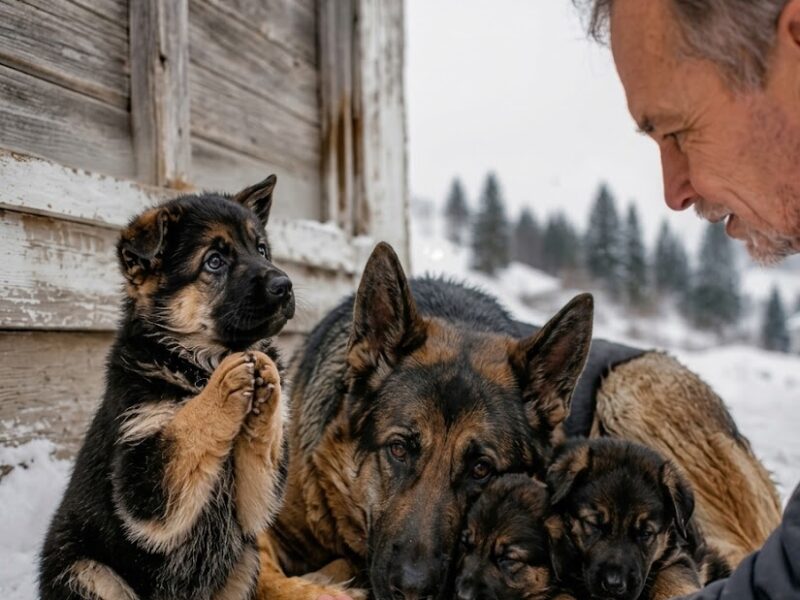
A tiny puppy planted himself in the snow, ready to fight the whole world — but he picked the wrong man to guard against.
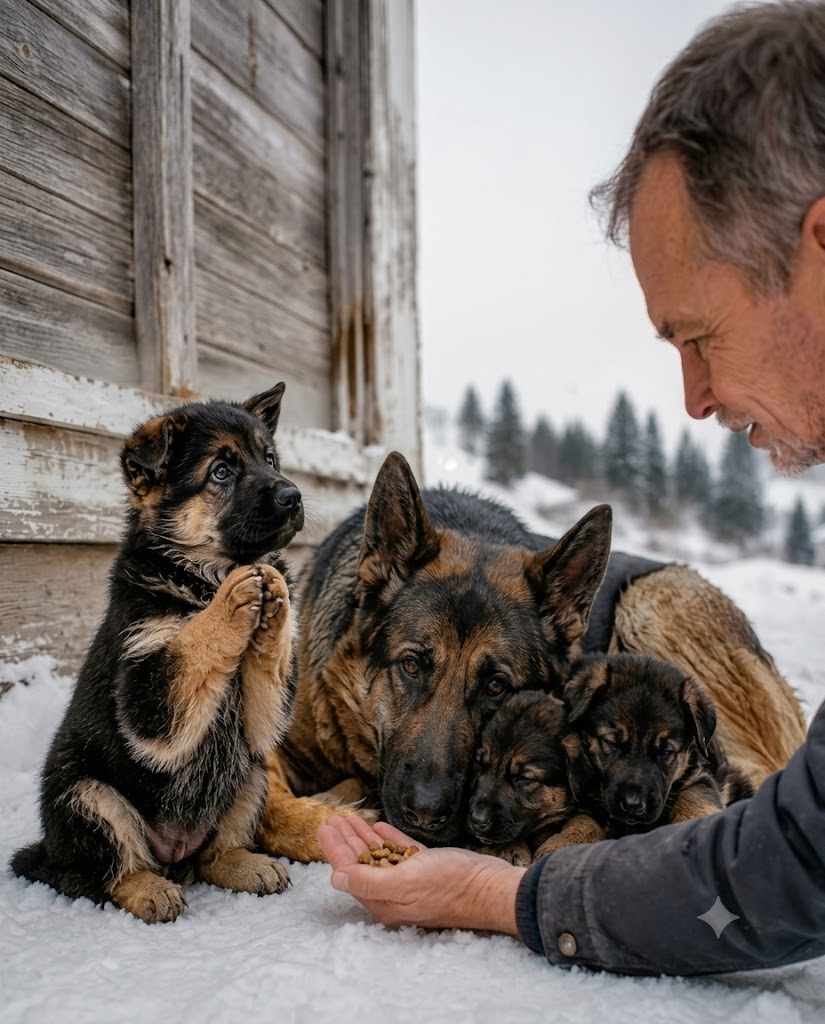
The morning after a heavy February snow, retired police officer Clifford Dayne found something strange behind his quiet home outside Orurafhino, Idaho.
Dog tracks—not one set.
The snow around his old storage shed was covered with them, far too many for a single animal.
But when Clifford reached for the door, a tiny 10-week-old German Shepherd puppy stepped out and blocked his way.
The puppy was trembling from the cold.
Clifford moved left.
The puppy moved left.
He stepped right.
The little dog followed again.
Then Clifford heard a weak cry from inside.
He looked through the narrow opening and froze.
An exhausted German Shepherd mother was curled around two more puppies beneath old blankets.
The little dog outside wasn’t trying to protect himself.
He was protecting them.
Clifford slowly knelt in the snow and held out one bare hand.
“You can trust me, little guy.”
But Clifford had no idea why this frightened family had come to his shed in the middle of the night.
And by nightfall, a stranger would arrive at his door, looking for every one of them.
February had settled hard over the hills outside Orurafhino, Idaho.
Overnight snow had buried the narrow roads, softened the pine-covered slopes, and left the countryside almost completely still beneath a pale winter morning.
Clifford Dayne noticed the tracks just after 7 a.m.
At 62, Clifford had been retired from police work long enough that most mornings no longer required him to be anywhere at a particular hour.
For nearly 30 years, he had lived by radio calls, shift changes, reports, and the quiet discipline of showing up when someone needed him.
Retirement had taken away the schedule, but not the habit of looking carefully at things.
That was why the tracks caught his attention.
They crossed the snow behind his house and circled the old storage shed near the edge of his property.
At first, Clifford assumed a stray dog had found its way in during the storm.
Then he stepped off the back porch and looked closer.
There was one set of larger paw prints.
Around them were several smaller ones.
The little tracks overlapped so often near the shed that Clifford could not tell where one began and another ended.
Some disappeared beneath fresh powder.
Others crossed back and forth near the wall as if whatever had made them had spent part of the night moving around before finally settling.
Clifford stood for a moment with his hands in the pockets of his winter coat.
The shed door had not been fully closed.
A narrow, dark opening showed along one side.
He had been certain he had latched it two days earlier.
Clifford went back inside for a flashlight, pulled on his gloves, and crossed the yard again.
The snow came almost halfway over the soles of his boots.
Nothing moved around the shed.
He reached the door and extended one hand toward it.
Something small stepped out.
Clifford stopped.
A German Shepherd puppy stood in the narrow opening.
It could not have been much more than 10 weeks old.
Its body still had the soft, slightly awkward proportions of a very young puppy, with paws that seemed too large for its legs and ears that had not yet decided exactly how they wanted to stand.
Cold had worked through its fur.
Its back legs trembled visibly.
Still, it did not run.
The puppy planted itself directly between Clifford and the opening.
Clifford shifted one step to his left.
The puppy moved left.
He stopped, then stepped slowly to the right.
The puppy moved again and blocked him.
For the first time that morning, Clifford almost smiled.
There was nothing frightening about the little animal.
It was barely steady enough to hold its position.
Yet it was doing everything it could to make that position matter.
Clifford lowered the flashlight and crouched.
The puppy stiffened.
He did not reach for it.
Years around people had taught Clifford something that worked surprisingly well with frightened animals, too.
Moving slowly often accomplished more than moving confidently.
He removed one glove and lowered himself onto one knee in the snow.
His bare hand remained open, palm down, several feet from the puppy.
“You can trust me, little guy.”
The puppy stared at him.
It did not approach.
Clifford waited.
Snow slid quietly from a pine branch somewhere behind him.
Then a faint sound came from inside the shed.
A weak little cry.
The puppy turned instantly.
It forgot Clifford for two seconds and rushed through the opening.
That was enough.
Clifford leaned sideways and looked through the gap.
His expression changed.
An adult female German Shepherd lay on a pile of old feed sacks and a folded canvas tarp near the far wall.
Two more puppies were pressed against her belly.
One of them was smaller than the others and had somehow worked its way several inches away from the warmth of the mother’s body.
The puppy from the door hurried toward it.
It pushed its nose against the smaller puppy’s shoulder, then nudged again until the sleepy little body shifted closer to the mother.
The puppy touched its nose briefly to one ear.
Then it turned around and came straight back to the doorway, back to Clifford, back to its post.
Clifford looked at the tiny animal standing between him and the others.
“Well,” he murmured.
“You’ve got yourself a job, don’t you?”
The puppy gave no sign that it appreciated the observation.
Clifford decided, at least for the moment, to call him Riley.
He backed away from the shed rather than trying to enter.
A few minutes later, he returned with two dry blankets, a bowl of lukewarm water, and food.
Riley was still at the door.
Clifford placed everything just inside and retreated.
The mother watched him without blinking.
She was tired.
Clifford could see that now.
Her head stayed upright, but the effort seemed to cost her.
Even while lying down, she kept her body positioned along the outside of the three puppies, placing herself between them and the entrance.
Clifford did not challenge that boundary.
He sat several feet away on an overturned wooden crate and waited.
The strongest of the puppies, a small female, was the first to become interested in the food.
She stretched forward, sniffed, then took two uncertain steps toward the bowl.
The smallest puppy followed much more slowly.
Riley remained where he was.
Only when the mother finally lowered her head and began eating did Riley leave the doorway and approach the food himself.
Clifford noticed that, too.
He stayed with them for nearly an hour.
The shed was dry, but it was too cold to leave young puppies there for long.
A small mudroom at the back of Clifford’s house was heated and could be closed off from the rest of the rooms.
The problem was getting the dogs there without frightening them.
So Clifford did not try to carry them.
He opened the interior door that connected the side of the shed area to the enclosed walkway leading toward the mudroom, placed another blanket just inside, then moved well away.
Nothing happened at first.
The mother remained still.
Clifford waited.
Eventually, she raised her head, sniffed the cold air, and stood.
The curious female puppy followed first.
The smallest came next, moving carefully on short legs.
Riley waited until the other two had crossed.
Then he started after them.
At the threshold, he stopped.
Clifford watched the puppy turn around and look back into the shed.
Not quickly.
He stood there for several seconds, staring into the empty corners, the blankets, and the spot where his family had spent the night.
Only then did he cross the doorway.
By late morning, all four dogs were inside Clifford’s mudroom.
The mother slept for most of the afternoon, the smallest puppy curled close against her.
The curious female explored the edges of the room until she eventually fell asleep against a folded towel.
Riley changed places several times, sometimes beside his mother, sometimes beside the smaller puppy, once near the door.
Clifford did not know where they had come from.
He only knew they had traveled through snow deep enough to cover part of their legs, and something had driven them far enough to seek shelter in his shed.
By dusk, another light snow had begun.
Clifford was heating soup in the kitchen when headlights swept across the front windows.
A pickup stopped outside.
He looked toward the mudroom.
Riley raised his head.
A moment later came a knock.
Clifford opened the front door but kept the storm door between himself and the man on the porch.
The visitor was Bryant Lel, 48, a working man with the tired look of someone who had spent too much of the previous night driving country roads.
Snow clung to the shoulders of his jacket.
“Sorry to bother you,” Bryant said.
“Have you seen a German Shepherd female with three puppies? They ran for my uncle’s place last night.”
Behind Clifford, something shifted.
Riley had stood up.
Bryant stepped slightly closer to the door.
The change in the puppy was immediate.
Riley backed toward his mother.
The other two puppies followed.
The adult shepherd rose from the blanket and moved in front of them.
She did not bark.
She did not growl.
She simply stood there, her body between the doorway and her puppies.
Clifford looked from the dogs to Bryant.
He had spent too many years making decisions based on incomplete information to mistake fear for proof.
The dog’s reaction did not tell him Bryant was dangerous, but it told him something had happened.
Something Clifford did not yet understand.
Bryant waited.
Clifford kept his voice neutral.
“I saw some tracks around the property this morning. If I see the dogs, I’ll contact you.”
Bryant nodded, though disappointment crossed his face.
He pulled a small piece of paper from his pocket, wrote down a phone number, and handed it through the opening.
“My uncle’s worried about them. Especially the mother.”
Clifford accepted the paper.
“I’ll keep an eye out.”
Bryant thanked him and returned to the pickup.
The engine started.
Headlights turned across the snow and disappeared down the road.
Clifford closed the door.
For several seconds, Riley remained standing.
Then, as the sound of the truck faded, the puppy relaxed.
He walked first to the smallest puppy and touched his nose to its face, then to the other.
The mother lowered herself back onto the blanket.
Riley stood beside her for a moment.
Finally, he looked across the room at Clifford.
Clifford looked back.
That morning, he had thought four dogs had simply found shelter from a storm.
Now he knew there was more to it.
Somewhere between Bryant Lel’s porch visit, the trembling puppy at the shed door, and the exhausted mother who would not let her babies out of sight, a piece of the story was missing.
And Clifford intended to understand what it was.
Morning came cold and clear outside Orurafhino, with the storm clouds finally breaking apart above the pine-covered hills.
By 8 a.m., Clifford had decided the four dogs needed more than warmth and food.
They needed to be checked, and he needed to know who they belonged to.
Getting them into his vehicle took longer than expected.
Clifford opened the rear passenger door and stepped away.
The mother shepherd followed him as far as the edge of the driveway, then stopped.
Her body became still.
Riley stayed close to her front legs while the other two puppies gathered behind her.
Clifford did not reach for a collar or try to push her forward.
Whatever had happened before the dogs reached his shed, forcing her into another unfamiliar space was unlikely to help.
He returned to the mudroom, picked up the blanket they had slept on, and spread it across the back seat.
The fabric carried the smell of the mother and her puppies, along with the dry warmth of the room where they had spent the night.
Then he waited.
The curious female puppy approached first.
She stretched her neck toward the open door, sniffed the running board, and put one oversized paw against it.
Riley followed but stopped halfway, looking back at his mother.
Several minutes passed before the adult shepherd finally stepped forward.
She sniffed the blanket.
Then she climbed in.
The three puppies immediately followed.
At the veterinary clinic, the examination brought Clifford his first real relief since finding the tracks.
There were no signs that any of the dogs had been deliberately harmed.
The mother was exhausted and mildly dehydrated but otherwise stable.
The puppies had endured the cold surprisingly well.
The smallest one concerned the clinic staff a little more than the others.
He was alert, but slower.
He had lost more body heat during the night and seemed to tire quickly.
Clifford watched him settle against his mother’s leg.
“Joey,” he said quietly.
The name seemed to fit the little dog well enough.
The female puppy was already investigating the edge of a cabinet and trying to nose beneath a chair.
Clifford looked at her.
“And your trouble?”
She stared back at him.
He decided to call her Maisie.
Riley needed no new name.
Somewhere between the shed door and the mudroom, the temporary name had already stopped feeling temporary.
The most important answer came from the mother’s microchip.
Her name was Annie.
Her registered owner was Hugh Barlo, 76, Annie’s longtime owner and the uncle Bryant had mentioned the night before.
Hugh was currently staying at a rehabilitation center after surgery and was expected home within several days.
That changed Clifford’s understanding of Bryant’s visit.
He called the number Bryant had left.
Bryant arrived less than an hour later, and this time, Clifford did not avoid the subject.
“Tell me exactly what happened.”
Bryant looked through the clinic window toward Annie and the puppies before answering.
He had been looking after Hugh’s property while his uncle recovered.
The arrangement had sounded simple at first.
Feed Annie, keep the house checked, make sure everything was ready before Hugh came home.
Then there were three puppies.
Bryant lived more than an hour away and still had his own work to manage.
Driving back and forth every day had become difficult, so he arranged for Annie and the litter to stay temporarily at a local kennel until Hugh returned.
The transfer had gone wrong almost immediately.
A metal crate was being moved down the rear ramp of the kennel vehicle when it slipped.
It struck the ground with a hard metallic crash.
Annie startled.
At almost the same moment, a section of the side gate, already pushed out of alignment by accumulated snow, swung open.
Annie ran through it.
The three puppies followed their mother.
Bryant and the kennel worker chased after them because the county road was not far away.
That made everything worse.
The more people followed, the farther Annie ran.
By the time Bryant realized chasing her was driving her away, the dogs had already reached the tree line.
Snow began falling harder soon afterward, covering the smallest tracks first.
Clifford listened without interrupting.
There was no hidden cruelty in the story.
No one had been trying to hurt the dogs.
A frightened mother had seen an open path and taken it, and three puppies had done the simplest thing young puppies could do.
They had followed her.
That also explained Riley’s reaction the night before.
Bryant’s voice, his truck, perhaps even his smell could have become mixed together with the memory of the crate striking the ground and people running behind them.
Clifford felt some of his suspicion ease.
Not all of it, but enough.
Bryant had brought something with him, an old flannel shirt.
“Hugh,” he explained. “He wears these around the house all winter.”
He placed it on the floor several feet from Annie.
The change in her was immediate but quiet.
Annie stood.
She approached the shirt slowly, lowered her nose, and breathed in several times.
Her tail did not wag wildly.
She did not become excited.
She simply stayed there.
Then she lowered herself onto the floor and rested her head across the folded fabric.
Riley came over and sniffed it too.
Maisie tried to step on one sleeve before Annie shifted enough to make her move around.
Joey remained tucked close against his mother.
Clifford watched Annie close her eyes.
Whatever had frightened her away from Hugh’s property had not erased where she belonged.
One question still bothered him.
“Why my shed?”
Bryant thought for a moment.
Then his expression changed.
“Hugh’s been there before.”
Clifford looked at him.
“Your place,” Bryant said. “A few years back. Didn’t he help you with that shed roof?”
The memory returned slowly.
A summer afternoon.
Loose roofing panels.
An older man who knew far more about repairs than Clifford did and refused to leave until the last section sat properly.
And a German Shepherd lying in the shade near the open door.
Clifford looked through the clinic window at Annie.
He had forgotten her.
Apparently, Annie had not forgotten the place.
It did not mean she had crossed the countryside looking specifically for Clifford Dayne.
There was no need to make the story larger than it was.
During a frightening night in familiar territory, she had reached a place she had known before.
A dry shed, a wall against the wind, somewhere she had once rested without anything bad happening.
That had been enough.
By afternoon, Clifford had Annie and the puppies back home.
He placed Hugh’s flannel shirt near her blanket.
Annie settled beside it with Joey close to her belly.
Maisie immediately found something more interesting near the wall.
Riley moved between them for several minutes before finally lying down.
Clifford went outside for firewood.
When he returned, Riley was sitting just inside the door.
The puppy did not rush toward him.
It simply watched until Clifford stepped inside.
Then Riley turned and walked back toward Annie.
Clifford carried the wood to the stove and glanced across the room.
Annie’s head still rested on Hugh’s shirt.
A few more days, he thought.
Keep them warm, keep them fed.
Then Hugh would be home, and this strange interruption in Clifford’s quiet life could end.
The next morning began quietly inside Clifford’s mudroom.
Outside, the snow along the roofline had started to soften under a weak winter sun, but the cold still held the yard in place.
Inside, Clifford prepared the dogs’ breakfast the same way he had the day before, expecting the familiar little rush of paws as soon as the bowls touched the floor.
Maisie arrived first.
She crossed the room with the same confidence she brought to nearly everything, pushed her nose toward the food, and began eating before Clifford had fully straightened up.
Riley followed a few seconds later.
Annie rose more slowly from the blanket, stretched, then lowered her head to her own bowl.
Joey did not move.
He remained curled near the wall where the blankets had been folded into a warm nest.
Clifford watched him for several seconds.
The smallest puppy had always been slower than the others.
He took longer to wake, longer to eat, and often chose the warmest place in the room while Maisie explored and Riley moved between everyone else.
But this morning felt different.
Riley seemed to notice it, too.
He ate several bites, stopped, and looked toward Joey.
Then he left his bowl.
Riley walked across the blanket and lowered his nose to Joey’s face.
He sniffed along the puppy’s muzzle, then touched one ear lightly with his nose.
Joey opened his eyes.
He did not get up.
Riley stood there another moment before returning to his food.
Clifford did not interfere.
Joey was awake, and there was no obvious sign that he was in pain.
Still, Clifford stayed close instead of leaving the room.
A few minutes passed.
Riley left his bowl again.
This time, Annie lifted her head as he approached Joey.
She watched for a moment, then stood and went to the smaller puppy herself.
Annie licked the top of Joey’s head.
Then she nudged his shoulder.
Joey shifted beneath the blanket.
He placed his front paws under himself and pushed up.
For a moment, Clifford thought that was all it had taken.
Joey managed three small steps.
Then his legs seemed to lose their strength.
He lowered himself onto the floor and stayed there.
Clifford was beside him immediately.
He did not pick Joey up at first.
He placed a hand against the puppy’s side, feeling through the soft fur, then checked the warmth around his ears and paws.
Joey felt cooler than Clifford expected.
Not dangerously cold, but enough to concern him.
Clifford called the veterinary clinic.
He described the previous night in the shed, Joey’s slower recovery, and what had happened that morning.
The clinic advised him to keep the puppy warm, offer small amounts of food rather than a full meal, and watch closely for any further drop in energy.
Clifford added another folded blanket beneath Joey and moved the bedding farther from the draft near the door.
Annie settled beside him.
Riley stayed nearby.
Maisie finished breakfast, looked around as if wondering why no one else seemed interested in continuing the morning normally, then curled against Annie’s back.
Clifford warmed a small portion of soft food and placed it near Joey.
The puppy sniffed once, then turned his head away.
Riley watched.
A moment later, he walked back to his own bowl, picked up a small piece of soft food, and carried it across the room.
He stopped beside Joey.
The piece dropped from his mouth onto the blanket.
Riley sniffed it.
Then he sniffed Joey.
Clifford said nothing.
Joey did not eat.
Riley remained beside him for several seconds before lying down near his front paws.
The room became quiet again.
By late morning, Joey seemed a little more alert.
He lifted his head when Clifford crossed the room and accepted a small amount of water.
Clifford decided to keep watching him instead of rushing immediately back to the clinic.
For a while, that seemed like the right decision.
Near noon, Joey shifted closer to Annie and slept.
Riley followed Maisie around the edge of the mudroom for a few minutes, though he returned to Joey twice before settling.
Clifford kept the stove going and checked the room often.
Early that afternoon, he stepped outside to bring in more firewood.
He had barely reached the stack when he heard scratching from inside.
Fast, repeated.
Clifford turned.
The scratching stopped, then began again.
He dropped the piece of wood in his hands and crossed the short distance back to the door.
Riley was on the other side.
The moment Clifford opened it, the puppy spun away and hurried toward the blankets.
Then he stopped halfway and looked back.
Clifford followed.
Joey had not changed position.
Annie was standing over him now.
Clifford touched the puppy again.
Joey felt colder than he had that morning.
His eyes opened, but only briefly.
That was enough.
Clifford reached for his coat.
He did not wait for things to become worse.
Within minutes, he had Joey wrapped securely in a blanket and the vehicle ready.
Annie followed them to the door and stopped there.
Clifford remembered how hesitant she had been around the vehicle the day before.
He did not force her.
He opened the rear door, placed Joey inside, and waited.
Annie looked toward the bundled puppy.
Then she climbed in beside him.
Riley stood inside the mudroom doorway.
Maisie remained behind him.
Clifford closed the vehicle door.
For the first time since the family had entered his shed, Riley watched one of them leave without being able to follow.
He stayed at the doorway until the vehicle disappeared from view.
The examination at the clinic brought better news than Clifford had feared.
Joey had no serious illness and no hidden injury.
His small body was simply recovering more slowly from the cold exposure and exhaustion of the previous night.
He needed warmth, frequent small meals, fluids, and several quiet days without much strain.
By late afternoon, Clifford drove home with Annie beside Joey in the back.
When the vehicle stopped, movement appeared behind the mudroom door.
Clifford opened the rear door.
Riley came running.
He passed Clifford without slowing, straight to Joey.
Riley pressed his nose to Joey’s muzzle, then moved along one ear and down toward his front paws as Joey climbed carefully out of the vehicle.
Joey stood still through the inspection.
Then he leaned forward and pushed the side of his head into Riley’s neck.
Riley stayed there.
Annie climbed down behind them.
Only then did the group move back inside.
That evening, Clifford prepared another small meal.
Maisie reached the food first as usual.
Annie began eating.
Riley joined her.
Joey remained on the blanket for several seconds.
Then he stood.
His steps were still slow.
Clifford watched him cross the room one careful paw at a time.
When Joey reached the bowl, Riley was already eating from the edge.
Riley looked up, then shifted sideways.
A small space opened beside him.
Joey moved into it and lowered his head.
He began to eat.
Clifford turned away before he could make too much of the moment.
Joey was not suddenly cured.
He was still the slowest of the three puppies.
He tired sooner, ate more carefully, and preferred warm enclosed places whenever he could find them.
But that night, he ate.
That was enough.
Later, Clifford left the mudroom and stepped into the next room to put away the last of the firewood.
A few moments passed.
Then he heard the soft tapping of puppy paws behind him.
Clifford turned.
Riley stood in the doorway.
He did not come farther in.
He simply looked at Clifford for a moment, as if confirming where he had gone.
Then he settled down beside the door.
The next morning was brighter than the day before, though the cold had not lifted.
Sunlight touched the snow outside Clifford’s house, and thin lines of ice still clung beneath the eaves.
Inside, the mudroom had become warmer, noisier, and far less orderly than it had been a few days earlier.
Joey was better.
Not fully recovered, but better.
He still moved more slowly than Riley and Maisie, and he still chose the warmest corner whenever he had the chance, but he had eaten breakfast and stayed on his feet afterward.
That was enough for Clifford to feel comfortable leaving the house for a short while.
He needed to drive into town for medication and a few household items.
Clifford pulled on his coat.
Riley stood up.
Clifford crossed the mudroom toward the back door.
Riley followed.
He was not running or bouncing the way Maisie sometimes did when she became curious.
He simply walked behind Clifford as if that was where he was supposed to be.
Clifford stopped.
Riley stopped, too.
“You’re staying here.”
Clifford turned the puppy around gently and guided him back toward Annie.
Then he returned to the door.
By the time Clifford reached for the handle, Riley was beside him again.
Clifford looked down.
Riley looked up.
For a moment, neither moved.
Clifford walked him back a second time.
Maisie was busy nosing at the edge of a folded blanket.
Joey had already settled close to Annie.
Riley stayed beside them until Clifford took three steps toward the exit.
Then the puppy rose again.
This time Annie changed the pattern.
She stretched across the narrow space near the doorway and settled with her front legs extended.
Riley reached her, paused, and looked toward Clifford from the other side.
Clifford pulled on his gloves.
“I’ll be back.”
He knew Riley could not understand the promise the way a person would, but the words came naturally.
Clifford stepped outside and closed the door behind him.
The drive into Orurafhino took less than half an hour.
The roads had been cleared, though snow still stood high along the shoulders in places.
Clifford picked up his medication, bought coffee, canned soup, bread, and a few other things he had been putting off.
He moved through the store quickly.
There was no reason to stay long.
At the checkout, Clifford began placing his purchases on the counter.
Medication, coffee, bread, soup, a package of batteries.
Then he reached the last item, a small rubber chew toy.
Clifford stared at it.
He did not remember making a decision to buy it.
He remembered walking past the pet section.
He remembered seeing it.
Apparently, at some point between seeing it and reaching the register, it had found its way into his basket.
The cashier scanned it with everything else.
Clifford said nothing.
He paid and carried the bag outside.
A little over an hour after leaving, his vehicle turned back into the driveway.
Clifford expected to see movement at the mudroom window.
There was none.
He carried the grocery bag to the house, unlocked the door, and stepped inside.
Annie was lying with Joey and Maisie near the blankets.
Joey lifted his head.
Maisie stood and stretched.
Riley was not with them.
Clifford looked around the room.
Then he noticed the puppy sitting close to the inside of the door.
Riley had been there quietly enough that Clifford had almost missed him.
The puppy stood when Clifford entered.
He did not jump against Clifford’s legs or make a sound.
He walked forward, lowered his nose to one of Clifford’s boots, and sniffed once.
Then Riley turned away.
He crossed the room and went back to Annie.
Clifford closed the door behind him.
“Yeah,” he said. “I came back.”
Riley settled beside Joey.
That was all.
Still, the room felt different to Clifford for a moment.
He carried the groceries into the kitchen and put everything away.
The rubber toy remained on the counter until late afternoon.
Eventually, he brought it into the mudroom and placed it on the floor.
Maisie found it first.
Of course she did.
She approached, touched it with one paw, jumped backward when it rolled, then immediately chased it across the room.
Riley joined her.
Joey watched from the blanket for nearly a minute before standing and making his slower way toward them.
The toy lasted only a short time before disappearing beneath a chair.
Maisie tried to reach it.
Riley tried from the other side.
Joey sat between them, apparently satisfied to supervise.
Annie watched all three with the patient stillness of a tired mother.
That evening, Clifford brought in three small dog beds he had picked up earlier in the week.
He placed them along the warmer wall of the mudroom, close enough together that the puppies would not be separated, but far enough apart to give each one its own place.
He looked at the arrangement.
It seemed sensible.
Maisie inspected the first bed.
Riley stepped into the second.
Joey sniffed the third.
Clifford nodded to himself.
“There. That makes more sense.”
By the time he went to bed, each puppy had used at least one of them.
The next morning, Clifford entered the mudroom and stopped.
All three dog beds were empty.
He looked left, nothing, then toward the bench.
His old work jacket had slipped onto the floor sometime during the night.
Maisie was stretched across most of it.
Joey was curled tightly beside her.
Riley had managed to lie partly on the jacket, partly on Maisie, and partly across Joey’s back.
The three new beds sat untouched a few feet away.
Clifford stared at them, then at the pile of puppies.
“Wonderful.”
Annie lifted her head.
She looked at Clifford, then lowered it again.
Clifford poured fresh water into the bowls.
Maisie was first to rise.
Riley followed.
Joey took longer, but eventually he stood too.
The morning continued with the small routines Clifford had learned without noticing when they became routines.
Fresh water, food, a towel near the door for wet paws, checking that Joey had eaten enough, moving the rubber toy out from under the chair after Maisie pushed it there again, opening the door briefly so Annie could step outside, closing it before too much cold entered.
None of it was difficult.
That was not the strange part.
The strange part was how natural it had started to feel.
Clifford had spent nearly 30 years waking because a shift required it.
Retirement had given him quiet mornings, no radio, no schedule, and no one waiting for him to arrive.
For a long time, he had believed that was exactly what he wanted.
Now he looked across the mudroom at Annie and the three puppies and realized the house had begun arranging itself around them.
Tomorrow, Hugh would return home.
The family would leave.
Clifford knew that was good news.
Annie belonged with Hugh.
The puppies needed to stay with their mother while the next decisions were made.
Nothing about that should have bothered him.
He stood in the doorway near sunset and looked at the room.
A blanket had been pulled halfway across the floor.
One water bowl had been pushed crooked against the wall.
Tiny wet paw prints marked the tile near the door.
The rubber toy had disappeared again.
Maisie was trying to climb over Riley.
Joey was already asleep.
Annie watched them from the edge of the blanket.
Clifford had spent years becoming comfortable with an orderly, quiet house.
Now it looked less orderly than it had in a long time.
He found that he did not mind.
Tomorrow the dogs would go home, and for the first time since they had arrived, Clifford wondered what the house would sound like after they were gone.
The morning Hugh was due to return home, a light snow began falling again over the hills outside Orurafhino.
It was not a storm, only a steady curtain of fine flakes that softened the driveway and slowly covered the tracks left from the day before.
Clifford had been awake early.
He fed the dogs, refreshed the water bowls, and folded the blankets that had somehow spread across most of the mudroom floor.
Maisie ate quickly.
Joey took longer as usual.
Riley moved between them and Annie, stopping now and then as if the room required one final inspection before anything changed.
By mid-morning, the sound of a pickup came up the road.
Bryant had arrived to take Annie and the puppies back to Hugh.
Clifford opened the door.
Annie stepped outside without hesitation.
The difference from several days earlier was impossible to miss.
There was no fear in her movements now, only alertness.
She paused once near the steps, looked back at the puppies, then continued toward Bryant’s vehicle.
Maisie followed first.
Joey came after her at his slower pace.
Riley stayed close to the doorway.
Bryant opened the rear passenger area and spread a blanket across the seat.
Annie climbed in.
Maisie followed her almost immediately.
Clifford picked up a small bag of food and handed it to Bryant while they loaded the last few things.
Then a gust of wind pushed across the driveway.
The rear door of the pickup, which had not been fully secured, swung shut with a sharp sound.
Joey startled.
He had been a few steps from the vehicle.
Instead of moving toward Annie, he backed away.
Another step, then another.
Bryant was turned toward Clifford, placing the food bag behind the front seat.
Clifford was gathering the folded blanket from the porch.
Neither man saw Joey slip along the edge of the yard.
The small puppy reached the fence line and disappeared behind a row of low brush.
Snow continued falling.
By the time Clifford turned around, Riley was standing beside the vehicle.
Bryant opened the door for him.
Riley did not climb in.
He sniffed along the bottom edge of the door, then moved behind the pickup.
Bryant called him softly.
Riley ignored the invitation.
He returned to the open door and looked inside.
Annie was there.
Maisie was beside her.
Riley backed away again.
Clifford watched him circle toward the yard.
For one brief moment, Clifford thought he understood.
Riley did not want to leave.
The thought came too easily.
For the last several days, the puppy had followed Clifford from room to room.
He had waited near the door when Clifford went into town.
He had checked that Clifford came back.
Now the family was leaving, and Riley was the one being asked to go.
Clifford crouched near him.
“It’s all right, little guy.”
Riley looked at him, but instead of coming closer, he turned away.
He went back to the pickup and sniffed the open doorway again.
Clifford straightened.
Something felt wrong.
He looked inside.
“Annie! Maisie!”
He looked behind Bryant, then toward the porch.
Clifford counted again.
“Where’s Joey?”
Bryant turned immediately.
The answer was obvious.
Joey was not in the vehicle.
He was not beside the porch.
He was not near the mudroom door.
Clifford moved across the yard.
Bryant checked beneath the pickup and around the other side of the house.
No puppy appeared.
The falling snow was already beginning to cover the newest marks in the driveway.
Riley lowered his nose.
He moved toward the porch first, then along the side of the house.
He went several yards in the wrong direction, stopped, and doubled back.
Clifford followed more slowly, watching the ground rather than the puppy.
Near the fence, where the wind had not yet filled every shallow mark, he saw something.
Tiny paw prints.
Only a few were still clear.
They led away from the driveway.
Bryant joined him.
The tracks followed the fence line toward lower ground.
Riley moved ahead, sniffing near the brush.
He stopped twice, once near an old stump, again where the fence turned toward the road.
Then he continued downhill.
Clifford and Bryant followed.
The snow was slightly deeper there, and Joey’s small tracks became harder to separate from the rough surface beneath them.
Riley reached the edge of the old road and paused.
A shallow drainage culvert ran underneath it, little more than a wide metal pipe meant to carry snowmelt away in spring.
Riley moved toward the opening.
He sniffed.
Then Clifford heard it.
A faint sound, not a bark, a small whine from somewhere inside.
“Joey.”
Clifford dropped to one knee.
Snow had slid down around the lower part of the culvert entrance.
It was not completely blocked, but the opening had narrowed enough that the little puppy must have crawled farther inside, looking for shelter from the wind.
Bryant began clearing snow with his gloves.
Clifford joined him.
They opened the entrance wider.
Still, Joey did not appear.
Another whine came from deeper inside.
Riley pushed his nose toward the opening, but Clifford kept one hand in front of his chest.
“Not you, too.”
Riley backed away, then ran several yards along the roadside.
He stopped, sniffed, moved again.
Clifford looked up.
The culvert passed beneath the road.
“There’s another opening.”
Bryant stood and followed.
Riley reached the opposite side first.
He searched along the snow-covered ditch until he found the far end of the pipe.
Then he stopped.
For several seconds, he listened.
Riley barked once.
A small sound answered from inside.
Bryant dropped down and began clearing the snow that had collected around the second opening.
Clifford moved beside him.
They worked until the dark circle of the pipe was visible.
A moment later, something moved inside.
A small black nose appeared.
“Easy, Joey.”
The puppy crawled forward.
His front paws reached the snow.
Then the rest of him followed.
Riley was there before either man could pick Joey up.
He pressed his nose against Joey’s face, moved quickly around one ear, then touched his head against Joey’s neck.
Joey stood for a moment, then leaned into Riley.
Clifford crouched beside them and checked Joey with both hands.
Cold, shaken, but standing.
No obvious injury.
Bryant let out a slow breath.
“I never saw him leave.”
“Neither did I.”
Clifford lifted Joey carefully.
They returned to the driveway.
When Annie saw them coming, she stood inside the pickup.
Bryant opened the door.
Clifford placed Joey down near her.
Annie immediately lowered her nose to him.
She checked Joey first, then Maisie, then Riley when he climbed in.
The four dogs gathered close together on the blanket.
For a few seconds, no one moved.
Joey settled between Maisie and Riley.
Annie lay along one side of the group.
Riley turned once, then lowered himself along Joey’s other side.
Clifford stood beside the open door and looked at them.
A few minutes earlier, he had thought Riley was refusing to leave because of him.
He had been wrong.
Riley had been waiting for someone who was missing.
Bryant closed the door carefully this time.
Snow gathered lightly along the roof of the pickup.
Clifford stepped back.
Joey was safe.
Annie had all three puppies beside her again.
Soon they would be with Hugh.
That should have been the end of Clifford’s part in the story.
But as the pickup prepared to leave, Riley raised his head and looked through the glass toward him.
Clifford held the puppy’s gaze for a moment.
The family was together again.
Yet another question had quietly taken the place of the last one.
When the puppies no longer needed to stay together, where would Riley belong?
Hugh returned home the following afternoon.
Clifford went with Bryant when they brought Annie and the puppies back.
The house had been prepared for them with fresh bedding near the kitchen and enough open floor space for three growing puppies to move around without getting into too much trouble.
Hugh was waiting near the doorway.
He had only recently finished rehabilitation after surgery and still moved carefully.
But the moment the vehicle stopped, his attention went to the dogs.
Bryant opened the rear door.
Annie lifted her head.
Then Hugh spoke.
“Annie.”
That was all it took.
Annie stood immediately.
When Bryant helped open the way for her, she moved straight toward Hugh.
There was no wild jumping and no frantic barking.
She simply reached him, pressed her head into both of his hands, and remained there.
Hugh lowered himself carefully enough to meet her.
Annie leaned closer.
Then she settled at his feet.
Maisie came next, followed by Riley.
Joey took longer getting down, as he usually did, but soon all three puppies were gathered around their mother.
Clifford stayed near the edge of the room.
For several minutes, nobody tried to move the dogs or direct them anywhere.
There was no need.
Annie was home.
The puppies were together.
That was enough for the first day.
No one rushed to separate the litter afterward.
Over the next three weeks, the puppies remained close to Annie while Hugh regained his normal routine.
Clifford visited often enough to see their individual habits becoming clearer.
Joey continued to improve, but he remained the slowest.
When the others crossed a room, Joey was usually several steps behind.
When food arrived, he took longer to finish.
He still preferred warm corners, soft blankets, and places where he could settle without being disturbed.
Maisie had become exactly what Clifford expected.
She investigated everything.
A cardboard box left beside the kitchen table, a dropped glove, an open cabinet, a patch of sunlight moving across the floor.
If something changed in the room, Maisie usually found it first.
Riley was different.
He explored too, but he rarely went far without stopping.
Sometimes he would move ahead with Maisie, then turn and look back toward Joey.
Other times, he would check where Annie was before continuing.
When Clifford arrived, Riley often came to greet him, but after a few moments, he would glance back toward the rest of the family.
The habit remained.
One by one, plans were made for the puppies.
Maisie was the first to leave.
She went to a retired couple in their late 60s who lived nearby and had owned German Shepherds for many years.
They had a quiet home, a fenced yard, and enough experience to understand exactly what they were taking on.
Maisie entered their house the same way she entered almost everything else.
First, she sniffed the doorway, discovered a new room, and disappeared around the corner before anyone had time to worry whether she would adjust.
Joey stayed longer.
Bryant had spent more time with him during Hugh’s recovery, never forcing the little dog to come close.
He would sit nearby and let Joey decide the distance.
Gradually, Joey began choosing the space beside Bryant’s chair.
When the time came, Joey went home with him.
That left Annie and Riley with Hugh, and it left Clifford insisting that none of it concerned him.
“I’m not looking for a dog,” he told Hugh once.
Hugh only nodded.
Clifford went home that evening to a house where a water bowl still sat in the kitchen.
A towel remained beside the back door.
One small dog bed occupied the corner of the mudroom.
The rubber chew toy he had bought without planning to was still under a chair.
Clifford noticed all of those things.
He removed none of them.
A few days later, Hugh brought Annie and Riley to Clifford’s property for a visit.
The snow had thinned during the previous week, though white patches still covered the shaded edges of the yard and the ground around the old shed.
Annie walked comfortably beside Hugh.
Riley ran ahead.
He crossed the yard toward Clifford, circled once near the porch, then ran back toward his mother.
The visit lasted through the afternoon.
When Hugh finally prepared to leave, Annie followed him toward the vehicle.
Riley followed her.
Clifford stood on the porch.
He did not call the puppy.
He did not ask Hugh whether Riley could stay.
He did not make the choice easier by pretending it had already been made.
Annie reached the vehicle.
Riley followed several steps behind her.
Then he stopped.
He looked toward Annie, then toward Clifford.
For a few seconds, he stood in the snow between them.
Suddenly, Riley turned and ran toward the shed.
Clifford watched him disappear through the partly opened doorway.
After a moment, he followed.
Inside, Riley moved slowly through the space where the family had spent that first cold morning.
He sniffed the corner where Joey had often slept.
He crossed the place where Maisie had once pushed blankets out of position.
He paused near the wall where the food bowls had been set down.
The shed was empty now.
No Joey, no Maisie, no Annie curled around three puppies.
Riley walked one last circle.
Then he came back toward the entrance.
Clifford stood outside.
Riley stopped in the doorway.
For an instant, the scene was almost exactly as it had been on the morning they first met.
A tiny German Shepherd between Clifford and the shed.
Clifford remembered taking one step to the left.
Riley had moved left.
He had stepped right.
Riley had moved right.
That morning, the puppy had done everything his small body could manage to keep Clifford outside.
Now Clifford took one slow step forward.
Riley did not block him.
The puppy looked at him, then stepped aside.
Clifford crossed the threshold.
Neither of them needed anything more from the moment.
A short while later, Riley ran outside again.
Annie was still near Hugh’s vehicle.
Riley approached her.
The two touched noses.
Annie sniffed across the top of his head and stood beside him for several seconds.
Then Hugh opened the vehicle door.
Annie climbed inside.
Riley stayed where he was.
He watched the door close.
Then he turned.
He ran across the remaining patch of snow toward Clifford and stopped against his leg.
A moment later, Riley sat directly on top of Clifford’s boot.
Clifford looked down at him.
“Everybody’s accounted for, little guy.”
Riley remained there, and this time when Hugh drove away with Annie, the puppy did not follow.
Months later, another winter morning covered the ground outside Orurafhino with fresh snow.
Riley was larger now, though he still had the restless energy of a young German Shepherd.
He ran ahead of Clifford along the path beside the old shed.
After several yards, Riley stopped.
He turned around.
Clifford was still there.
Riley ran forward again, a little farther this time.
Then he stopped and looked back once more.
Clifford pulled his coat higher around his neck.
“I’m here.”
Riley turned and continued down the path.
Behind them, two sets of tracks stretched together across the snow.
Sometimes family is not defined by where we begin, but by who notices when someone is missing, who waits when someone falls behind, and who turns back to make sure no one is left alone.
Riley was only a small puppy when Clifford found him standing in the snow trying to protect his mother and siblings.
But in the days that followed, Riley showed something simple and powerful.
He always looked back for Joey, for Annie, for the rest of his family, and eventually for Clifford, too.
Maybe that is what this story is really about.
Sometimes being needed again begins with something very small.
A bowl that needs filling, a door that needs opening, or a pair of eyes waiting to see if you are still there.









