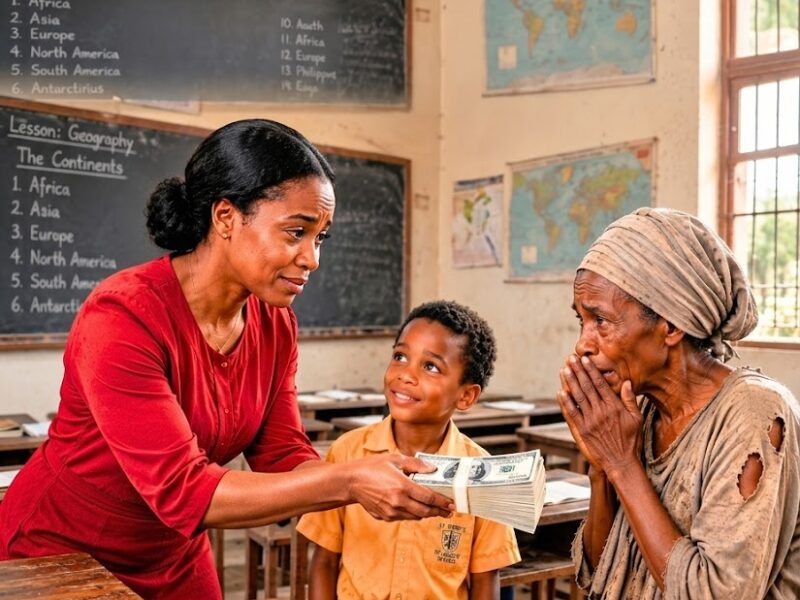
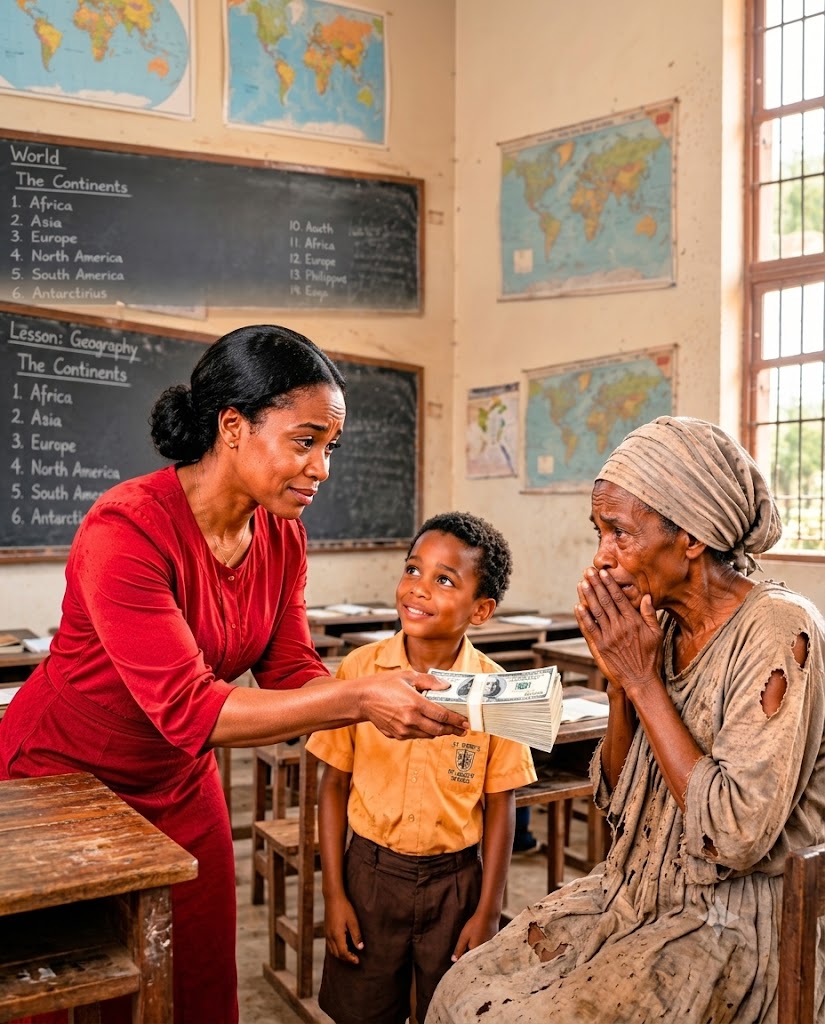
A teacher gave her last salary to a struggling student’s mother. She had no idea the woman she just helped was a billionaire.
The rain hadn’t stopped for three days, and the rent was due in one.
Nneka stood at her classroom window, watching the water streak down the glass like it was trying to wash the whole city away. Her paycheck was still folded in her coat pocket—$2,847.63, direct deposit, already spoken for.
She had exactly $43 left in her checking account, and her landlord had called twice that morning.
But none of that mattered when she saw Ikenna walking to school without a jacket, his sneakers held together with duct tape, his eyes hollow in a way no nine-year-old’s eyes should ever be.
Three days before everything changed, it was just another Tuesday.
The kind of Tuesday where the coffee maker in the teachers’ lounge was broken again, where the photocopier jammed on page twelve of a thirty-page packet, where the principal sent out another email about budget cuts and “doing more with less.”
Nneka had been teaching third grade at Roosevelt Elementary for six years, and she’d learned to measure her days not in hours but in small victories: the moment a struggling reader finally sounded out a difficult word, the shy girl who raised her hand for the first time, the boy who stopped crying at drop-off.
Ikenna had been one of those victories.
When he’d arrived in her classroom two years ago, he’d barely spoken for three months. His mother, Amaka, worked double shifts at a hospital laundry, and Ikenna often came to school with nothing but a granola bar in his backpack—sometimes not even that.
Nneka had started keeping extra snacks in her desk drawer, “just in case.”
She’d never told anyone.
—
“Have you eaten today?”
The question came out before she could stop it, soft and careful, the way you’d approach a wounded bird.
Ikenna looked up from his worksheet, his pencil frozen mid-stroke. “Mama said tomorrow, Mom.”
He called her “Mom” sometimes, a slip of the tongue that neither of them acknowledged. His real mother, Amaka, was a ghost in his stories—always working, always tired, always promising that things would get better.
Nneka crouched beside his desk, her knees popping in a way that reminded her she wasn’t twenty anymore. “Walk with me. I want to check on your mother.”
The boy’s face flickered—fear, hope, something in between.
—
The apartment was on the fourth floor of a building that had seen better decades.
The hallway smelled like bleach and boiled cabbage, and the elevator had a hand-written sign taped to it: OUT OF ORDER. Nneka climbed the stairs with Ikenna’s small hand in hers, her teacher’s bag heavy on her shoulder.
When Amaka opened the door, Nneka’s heart cracked.
The woman was beautiful in the way that exhaustion makes people beautiful—sharp cheekbones, dark eyes that had seen too much, hands that trembled slightly as she gripped the doorframe. She was wearing a nurse’s aide uniform, her name tag still pinned to her chest.
“Ikenna, who is this?”
“I’m his teacher.” Nneka extended her hand. “I just wanted to make sure you both were all right.”
Amaka’s eyes darted to her son, then back to Nneka. Something shifted in her expression—a wall going up, brick by brick.
“We haven’t eaten in two days.” The words came out flat, matter-of-fact, the way you’d report the weather. “I didn’t want him to worry you.”
The apartment behind her was nearly empty. A folding table. Two chairs. A mattress on the floor with a single blanket. No refrigerator. No stove. Just a hot plate and a few cans of beans lined up on the windowsill like soldiers awaiting orders.
—
Nneka reached into her coat pocket.
She pulled out the envelope with her paycheck inside—$2,847.63, every penny she had for the month—and held it out.
“Take this. All of it, please.”
Amaka stared at the envelope like it was a snake. “This is your whole salary.”
“I can’t take this from you. I’ll manage.”
“Ikenna cannot go another night hungry.” Nneka pressed the envelope into her hands. “Get some rest, both of you. I’ll see you tomorrow, Ikenna.”
She turned and walked down the stairs before either of them could argue.
—
The next morning, Nneka’s mother called.
“You look thinner than last week. Are you eating?”
“I’m fine, Mama.”
“You’re not fine. A mother always knows when something is wrong.”
Nneka laughed, but it came out wrong—too bright, too brittle. “Just a busy week at school.”
—
The week got busier.
Ikenna started bringing lunch again—a brown paper bag with a sandwich and an apple, sometimes a juice box. He smiled more. He raised his hand in class. He started calling Nneka “Mom” without catching himself.
But Nneka’s own pantry was getting bare.
She ate ramen for dinner three nights in a row, then rice with soy sauce, then just coffee. Her electricity bill went overdue. Her car made a sound like a dying cat every time she turned the ignition.
And then the eviction notice appeared on her door.
—
“Two weeks. I have two weeks.”
Nneka stared at the paper in her hands, the official lettering, the court date, the words “UNLAWFUL DETAINER” in bold black letters.
She’d known it was coming. She’d just hoped—stupidly, naively—that she could outrun it.
Her mother called again that night.
“An eviction notice? Nneka, what is going on?”
“I gave my salary, Mama. A student’s family was starving.”
Silence. Then a long, slow exhale.
“You have your father’s heart. God help us both.”
Her mother sent $500 the next morning—half her monthly social security check. “It’s not much, but take it. We look after our own.”
Nneka cried in her car for twenty minutes before driving to school.
—
Ikenna noticed.
“You look sad, Mom.”
“I’m fine, buddy.”
“You’re not fine.” He reached into his backpack and pulled out a crumpled piece of paper. “I made this for you. For helping my mama.”
It was a drawing—stick figures, a yellow sun, a house with a red door. Underneath, in wobbly handwriting: “Thank you for being my teacher.”
Nneka taped it to her classroom wall.
—
The eviction date was one week away when Amaka showed up at the school.
She was wearing a different uniform now—not the hospital laundry scrubs, but a tailored navy suit that probably cost more than Nneka’s monthly rent. Her hair was different, too—styled, sleek, expensive.
“Ma’am, is everything all right?”
“Where is Nneka? Now, please.”
The school secretary blinked. “She’s in Room 112, but—”
Amaka was already walking.
—
“Let us continue. Look at the board.”
Nneka was mid-lesson, pointing at a map of Africa, when the door opened.
“Amaka? Is everything all right with Ikenna?”
“He’s fine.” Amaka closed the door behind her. “I’m here about you.”
“I heard what’s happening with your home.”
Nneka’s face went hot. “That’s not something I wanted spread around. I’ll manage it myself.”
“You didn’t let my son go hungry to protect your own pride.” Amaka’s voice was soft, but it carried weight. “Let me return that.”
“I’ve never asked anyone for anything in my life.”
“You’re not asking. I’m insisting.”
—
They went to a coffee shop three blocks from the school.
Amaka ordered two lattes and a plate of pastries, then sat down across from Nneka like she had all the time in the world.
“Tell me everything. The rent, all of it.”
Nneka hesitated. Then the words came spilling out—the $2,847.63, the overdue bills, the eviction notice, the two months behind, the one week left before they put her things on the street.
Amaka listened without interrupting.
When Nneka finished, Amaka pulled out her phone.
“That will not happen. Not to you.”
“You don’t understand. It’s—it’s a lot of—”
“I run one of the largest family foundations in this country.” Amaka met her eyes. “It’s not a lot to me.”
Nneka’s mouth opened. Closed. Opened again.
“You’re—you’re that Amaka Eze.”
—
The landlord answered on the second ring.
“Yes, hello. Consider the debt cleared. And add a year in advance. Thank you.”
Nneka sat frozen, her latte going cold in front of her.
“And this school will be rebuilt.” Amaka was already typing on her phone. “New classrooms, a kitchen, everything these children deserve.”
“All of this from one salary?”
“No.” Amaka looked up, and for the first time, Nneka saw the woman beneath the suit—the tired mother, the grateful friend, the person who had once stood in an empty apartment with nothing but hope and a hot plate. “From one heart that didn’t stop to calculate the cost.”
—
The renovation took three months.
Nneka stood in the parking lot, watching the construction crews tear down the old portables and pour fresh concrete. The school was getting a new library, a computer lab, a cafeteria with actual tables and chairs.
Ikenna ran up to her, his sneakers—brand new, no duct tape—squeaking on the pavement.
“Mom, look! My own desk, and it doesn’t even wobble.”
“That’s great, buddy.”
“The children haven’t stopped smiling since the renovation.” Amaka appeared beside her, carrying a tray of coffees for the workers. “Thank you, Mom.”
“Don’t thank me. Thank the teacher who gave everything before I gave anything.”
—
The school held a ribbon-cutting ceremony in the spring.
There were speeches, applause, a giant pair of scissors that didn’t actually cut anything. The local news came. A photographer took pictures of Amaka and Nneka shaking hands in front of the new building.
But the moment Nneka remembered wasn’t the ceremony.
It was later, when the crowds had gone and the sun was setting, and Amaka found her sitting alone in her new classroom—real desks, real chairs, a smartboard that actually worked.
“It is so good to see you.”
“I visit a lot of schools.” Amaka sat down in a tiny chair, her knees nearly hitting her chin. “This one feels different.”
“That’s because this one has a piece of your heart in every wall.”
—
Nneka’s mother came to visit that summer.
She walked through the new hallways, ran her fingers along the fresh paint, stood in the cafeteria and watched the lunch ladies serve hot meals to kids who’d never had them before.
“Your father would have been so proud of you, my daughter.”
“I only gave what I had, Mama. I never expected—I didn’t expect this.”
“That’s exactly why it came back to you tenfold, my child.”
—
Ikenna graduated third grade with perfect attendance.
He gave a speech at the ceremony—something about dreams and hard work and teachers who believed in you even when you didn’t believe in yourself. His mother cried. Nneka cried. Even the principal, who never cried, wiped his eyes with the back of his hand.
Afterward, Ikenna ran up to Nneka and threw his arms around her waist.
“Mom, pick me up.”
She laughed and lifted him, even though he was getting too big, even though her back protested.
“All right, Ikenna. All right.”
—
Funny how the smallest kindness can rebuild an entire world.
Nneka still taught third grade. She still kept snacks in her desk drawer. She still looked for the quiet kids, the hungry kids, the ones who needed someone to see them.
But now she knew something she hadn’t known before.
The universe had its own way of keeping score.
And sometimes—not always, but sometimes—the people you save come back to save you.
—
“Now class, let’s talk about what it means to give without expecting anything back.”
The children sat up straighter.
“Your education is the key. It is the foundation of everything you will build. You are the future of this country.”
Ikenna raised his hand.
“Yes, Ikenna?”
“Mom, can I tell them what you did?”
Nneka smiled.
“Go ahead.”
And he did.
—
Six months later, the foundation announced a new initiative: a teacher emergency fund, designed to help educators who’d fallen on hard times.
The first recipient was a kindergarten teacher from a small town in Ohio, who’d spent her entire savings on school supplies for her students.
The second was a middle school math teacher from Detroit, who’d been sleeping in her car for three weeks.
The third was a high school English teacher from New Orleans, who’d given her paycheck to a student whose family had lost their home in a fire.
Amaka called Nneka when the news broke.
“Look what you started.”
“I didn’t start anything.” Nneka was sitting on her couch, her rent paid, her fridge full, her heart lighter than it had been in years. “You did.”
“No.” Amaka’s voice was warm. “We did.”
—
Ikenna is in seventh grade now.
He still calls Nneka “Mom” sometimes. He still draws pictures and tapes them to her wall. He still believes—because someone showed him—that kindness is never wasted.
And Nneka?
She still teaches.
She still gives.
She still believes that the smallest gesture can change everything.
Because sometimes, the universe has its own way of
**giving back.**









