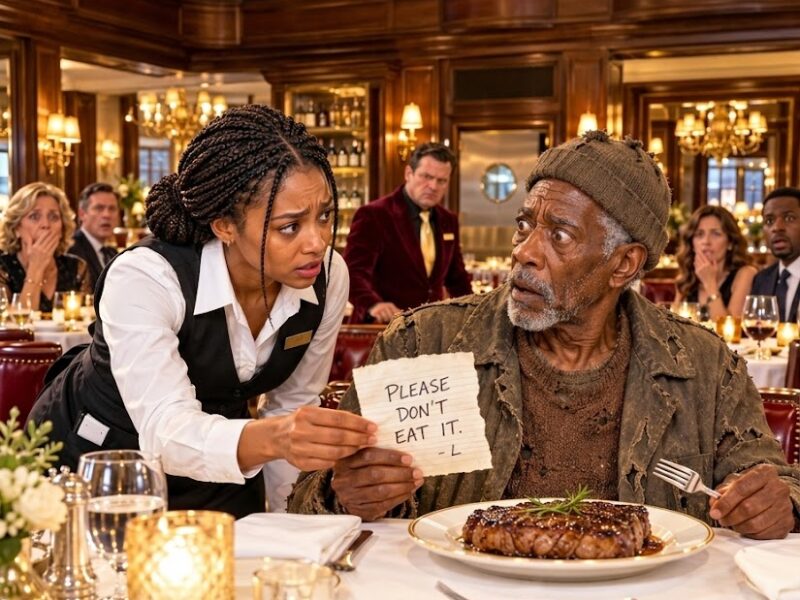
A Struggling Waitress Spent Every Dollar of Her Tips Feeding a Homeless Man—Unaware He Owned the Entire Building
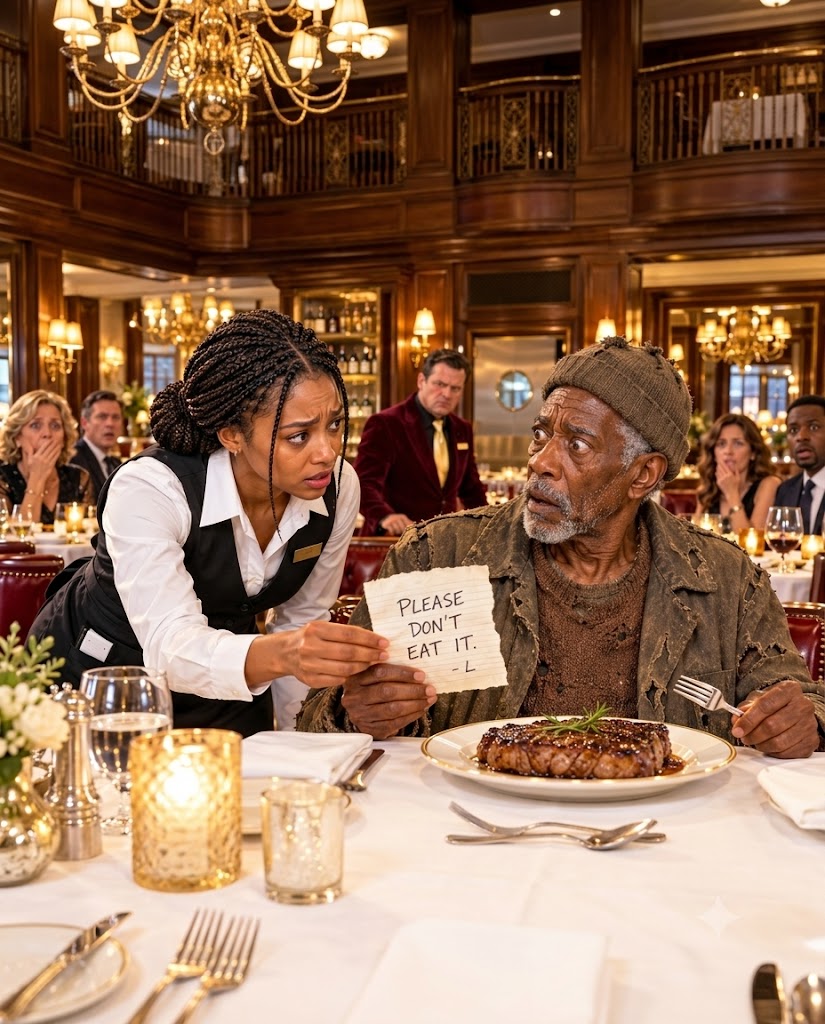
The rain came down in sheets across Fifth Avenue, turning the sidewalk into a slick ribbon of reflected neon and headlights.
Lena Morris stood at the service entrance of The Gilded Oak, her apron still stained with the night’s work, her feet aching from eleven hours of carrying plates that cost more than her monthly rent.
She was halfway through her cigarette—a habit she’d picked up in college and never quite kicked—when she saw him.
An old man in a threadbare coat, hunched against the wind, pressing his face to the glass of the restaurant’s front window like a child looking at a Christmas display.
Most people walked past him without a second glance.
New York did that to you—taught you to look through people instead of at them, to treat the invisible as furniture.
But Lena couldn’t look away.
There was something in the way he stood there, not begging, not asking, just *looking*, as if the warmth inside that restaurant was a language he’d forgotten how to speak.
She stamped out her cigarette and walked around to the front.
“Sir? Are you okay?”
He turned, and she saw his eyes—pale blue, sharp, not the eyes of a man who’d given up.
“I’m not delivering,” he said, his voice surprising her with its clarity. “I’m dining.”
She blinked. “Here?”
“Is there a problem, Tiffany?”
The voice came from behind her—Bradley Finch, the floor manager, his smile as thin as paper.
“He thinks he’s dining,” Bradley said, his tone dripping with condescension.
“The shelter on Fifth gives out free soup, old man.”
The old man didn’t flinch.
He simply looked at Bradley the way you’d look at a fly buzzing around a piece of fruit—annoying, but not worth swatting.
“A table, please,” he said. “And your most expensive steak.”
Bradley laughed, a short, ugly sound.
“Well, money is money. Table 13, by the kitchen door.”
He gestured toward the back of the restaurant, where the servers rushed past with trays and the heat from the kitchen made the air thick and greasy.
“Try not to touch anything.”
The old man nodded, his expression unreadable.
“I’ll do my best.”
—
Lena watched him walk to the table, his back straight despite the weight of his worn coat.
She’d been a waitress at The Gilded Oak for three years, and in that time, she’d learned to read people.
The ones who tipped well were usually the ones who treated her like a human being.
The ones who tipped poorly were usually the ones who treated her like part of the décor.
And then there were the ones like Bradley—the ones who’d sold their souls for a paycheck and wanted everyone else to do the same.
She didn’t know which category the old man fell into, but something told her he wasn’t just another homeless person looking for a free meal.
There was a dignity in the way he held himself, a quiet confidence that didn’t match his ragged clothes.
She grabbed a menu and walked over to his table.
“Good evening, sir. I’m Lena. Can I get you something to drink?”
He looked up at her, and for a moment, she felt like he was seeing straight through her—past the apron, past the tired smile, past the years of customer service that had taught her to hide her real self behind a mask of politeness.
“Water, please,” he said. “And the gilded oak wagyu. Medium rare.”
She nodded, writing it down.
“That’s our best steak. It’s four hundred dollars.”
He didn’t blink.
“I know.”
She hesitated. “Sir, I don’t mean to be rude, but… do you have a way to pay for this?”
He reached into his coat and pulled out a wallet—old, cracked leather, but clearly expensive.
Inside were bills—hundreds, stacked thick.
“I have money,” he said quietly. “What I don’t have is a place where I’m welcome.”
Lena felt a pang of something—guilt, maybe, or shame.
She’d seen people like him before, of course. The city was full of them—the forgotten, the invisible, the ones who’d fallen through the cracks of a system that didn’t care.
But there was something different about this man.
Something that made her want to protect him.
“I’ll put the order in,” she said. “And I’ll make sure it’s perfect.”
—
She walked back to the kitchen, her mind racing.
Bradley was standing by the pass, his arms crossed.
“Table 13?” he said. “You’re actually serving him?”
“He has money,” Lena said. “He wants the wagyu.”
Bradley snorted. “That steak is four hundred dollars. He’s probably got a stolen credit card.”
“He has cash.”
“Even better. We’ll take it, and then we’ll call the cops when he can’t pay his bill.”
Lena stared at him. “You can’t be serious.”
“I’m always serious about money, Morris. You should know that by now.”
She wanted to argue, but she knew it wouldn’t do any good.
Bradley was the kind of man who measured his worth by the size of his bank account—and the size of everyone else’s.
She put the order in and waited.
Twenty minutes later, the steak was ready—a perfect cut of wagyu, seared to medium rare, topped with a truffle butter that cost more per ounce than most people made in a day.
Bradley grabbed the plate before she could.
“I’ll take it out,” he said.
“Bradley—”
“That’s an order, Morris.”
She watched him walk to Table 13, her stomach tight with anxiety.
Something was wrong.
She could feel it.
—
Bradley set the plate down in front of the old man with a flourish that was more theatrical than sincere.
“Your steak, sir. Best thing in the house.”
The old man looked at the plate, then up at Bradley.
“This isn’t what I ordered.”
Bradley’s smile didn’t waver. “It’s the wagyu. Medium rare. Exactly what you asked for.”
“I asked for the gilded oak wagyu. This is a different cut.”
“It’s the same thing.”
“No,” the old man said, his voice calm but firm. “It’s not.”
Lena, who had been watching from the service station, felt her heart sink.
She knew that tone.
It was the tone of a man who’d been lied to before—and who wasn’t going to let it happen again.
She walked over to the table.
“Is there a problem?”
The old man looked at her, and for a moment, she saw something flicker in his eyes—disappointment, maybe, or sadness.
“This steak came off the floor,” he said. “I saw it happen.”
Bradley’s face went red.
“That’s ridiculous. You’re accusing me of—”
“I’m not accusing you of anything,” the old man said. “I’m telling you what I saw.”
Lena turned to Bradley.
“Did you drop it?”
Bradley’s jaw tightened. “Of course not. He’s lying.”
“I’m not lying,” the old man said. “And I’m not paying for a steak that touched the floor.”
Bradley laughed, but there was no humor in it.
“You still pay four hundred dollars. Now leave through the back, please.”
The old man stood up slowly, his movements deliberate.
“Of course,” he said.
He reached into his wallet and pulled out four hundred-dollar bills, placing them on the table.
Then he turned to Lena.
“Thank you for your kindness,” he said. “It means more than you know.”
—
Lena watched him walk toward the back exit, her chest tight.
She’d seen injustice before—had experienced it herself, more times than she could count.
But this was different.
This was a man who’d been humiliated for no reason other than the fact that he didn’t fit in.
And she couldn’t just let it happen.
“Wait, sir.”
He stopped, turning to look at her.
She walked over to the kitchen, grabbed a fresh plate, and loaded it with a new steak—one she’d paid for herself, out of her own tips.
“This one is fresh off the grill,” she said, handing it to him. “I paid for it myself.”
The old man looked at the plate, then at her.
“That was your tips for the whole night.”
Lena shrugged. “Tips come back. Dignity doesn’t.”
For a moment, the old man just stared at her.
Then he smiled—a real smile, the kind that reached his eyes.
“What is your full name?”
“Lena Morris.”
He nodded, as if committing it to memory.
“Thank you, Lena Morris. I won’t forget that name.”
—
Bradley was waiting for her when she returned to the floor.
“Giving food away on my time,” he said, his voice cold. “You’re done here, Morris.”
Lena felt the words hit her like a physical blow.
“Then I’m done.”
She untied her apron and dropped it on the counter.
“Eat it while it’s warm, sir,” she said to the old man, who was still standing by the back door.
He nodded, and she walked out into the rain.
—
The apartment was small—a one-bedroom in Queens that she shared with her mother, a woman who’d worked three jobs to put her through college and who still believed in the American dream, even when it kept letting her down.
“You’re home early,” her mother said, looking up from the sofa.
“I got let go.”
“For what?”
Lena sighed, sitting down next to her.
“For not letting an old man eat a steak off the floor.”
Her mother was quiet for a moment.
Then she reached over and took Lena’s hand.
“Then I’m proud of you. Rent is still due Friday, though.”
Lena laughed—a tired, broken sound.
“I know, Mama.”
“Ward Hospitality tomorrow morning. They’re hiring.”
Lena frowned. “Ward Hospitality? Who was that?”
“The company that bought The Gilded Oak last month. What would they want with you?”
“I have no idea.”
—
The next morning, Lena stood outside the Ward Hospitality building on Madison Avenue, her resume clutched in her hand.
It was a glass tower that stretched up into the clouds, the kind of building that made you feel small just by looking at it.
She’d never been inside before.
She’d never had a reason to.
The lobby was all marble and chrome, with a security desk that looked like it belonged in a bank.
She gave her name and waited.
And waited.
And then a man in a suit appeared.
“Ms. Morris? Mr. Ward will see you now.”
She followed him to the elevator, her heart pounding.
The elevator took her to the top floor—a corner office with windows that looked out over the entire city.
And sitting behind the desk, in a chair that cost more than her apartment, was the old man.
—
He was dressed differently now—in a tailored suit, his hair neatly combed, his face clean-shaven.
But his eyes were the same—pale blue, sharp, knowing.
“Ms. Morris,” he said, standing up. “Thank you for coming.”
Lena stared at him.
“You’re… you’re the owner?”
“Cornelius Ward. Chairman of Ward Hospitality.”
She felt the floor tilt beneath her.
“The old man at the restaurant…”
“That was me. I wanted to see who people are when they think nobody important is watching.”
He walked around the desk and stood in front of her.
“I kept your note.”
He reached into his pocket and pulled out a piece of paper—the same piece of paper she’d written on the night before, the one that said *Come save your sister*.
“I found it on the floor,” she said. “I thought it was—”
“It was a test,” he said. “And you passed.”
He handed her the note.
“Two years ago, my daughter died. She was homeless, living on the streets of Los Angeles. She’d run away from home, and I didn’t know where she was. By the time I found her, it was too late.”
Lena felt her throat tighten.
“I’m so sorry.”
“The note you found was one she wrote to me. I carry it with me always. I dropped it at the restaurant, and you picked it up. You read it. And you tried to help.”
He paused.
“You could have lost your job for that note. And you did.”
“I lost it doing the right thing.”
“Yes,” he said. “And that’s exactly why I’m offering you a job.”
Lena blinked.
“What?”
“The Gilded Oak needs a new general manager. Someone who treats every guest like they matter. Someone who remembers what it feels like to be invisible.”
“I’m a waitress, sir.”
“You were the only one there who protected a guest. That’s not a waitress. That’s a leader.”
He extended his hand.
“What do you say, Ms. Morris?”
—
The applause started in the corner of the restaurant and spread like wildfire.
Lena stood in the middle of The Gilded Oak, her new name tag pinned to her chest, watching as Cornelius Ward took his usual seat at Table 13.
“I should have said no,” she murmured to herself.
“Then say no next time out loud,” Ward said, overhearing her.
“Yes, boss.”
He smiled.
“Fresh plate for every guest. General manager. I start Monday, and the rent is paid.”
Lena laughed—a real laugh, the kind that came from somewhere deep inside.
“That’s my girl,” her mother said later, when Lena called to tell her the news.
“Tell her I want my job back,” Bradley said when he heard—but he was told to apply at the front door like everybody else.
—
Months passed.
The Gilded Oak changed—not in its décor, not in its menu, but in its heart.
Lena made sure of that.
Every guest was treated like they mattered.
Every plate was fresh.
And Table 13 became the best table in the house—the one by the window, where the light was warm and the view was clear.
“Good evening, sir,” Lena said one night, as Cornelius Ward walked through the door. “Table for one?”
“Please.”
She led him to his usual spot and handed him a menu.
“Fresh off the grill, sir. Enjoy.”
He looked up at her, his eyes twinkling.
“She runs this room better than anyone we have,” he said to the waiter beside him.
“Because she remembers what it feels like to be invisible.”
Lena smiled.
“Your usual table is free, Mr. Ward.”
“Thirteen,” he said.
“Thirteen.”
She turned to go, but he stopped her.
“Ms. Morris?”
“Yes?”
“That note you found. The one my daughter wrote.”
“I still have it.”
“Good. Keep it. It’s the best note I ever got.”
Lena nodded.
“Second best.”
Ward raised an eyebrow.
“Second best?”
“The one you wrote me. The job offer.”
He laughed—a warm, genuine sound that filled the room.
“Perfect,” he said.
“Of course it is,” Lena replied. “It never touched the floor.”
—
The rain had stopped by the time Lena left the restaurant that night.
She stood on the sidewalk, looking up at the stars—the few that managed to pierce through the city’s glow.
She thought about the old man who’d walked into her life and changed it forever.
She thought about the note that had started it all.
And she thought about the words she’d written on her own note—the one she’d tucked into her pocket the night she’d lost her job.
*Fresh plate. Fresh start. Every guest. Every plate.*
She smiled.
The code again.
It kept her honest.
And as she walked home, she knew—no matter what happened next, she would never forget what it felt like to be invisible.
Because that was the secret.
That was the key.
And she would carry it with her, always.









