
A Struggling Waitress Gave Away Her Breakfast Money—Then the Hungry Stranger Entered as the Restaurant’s Owner
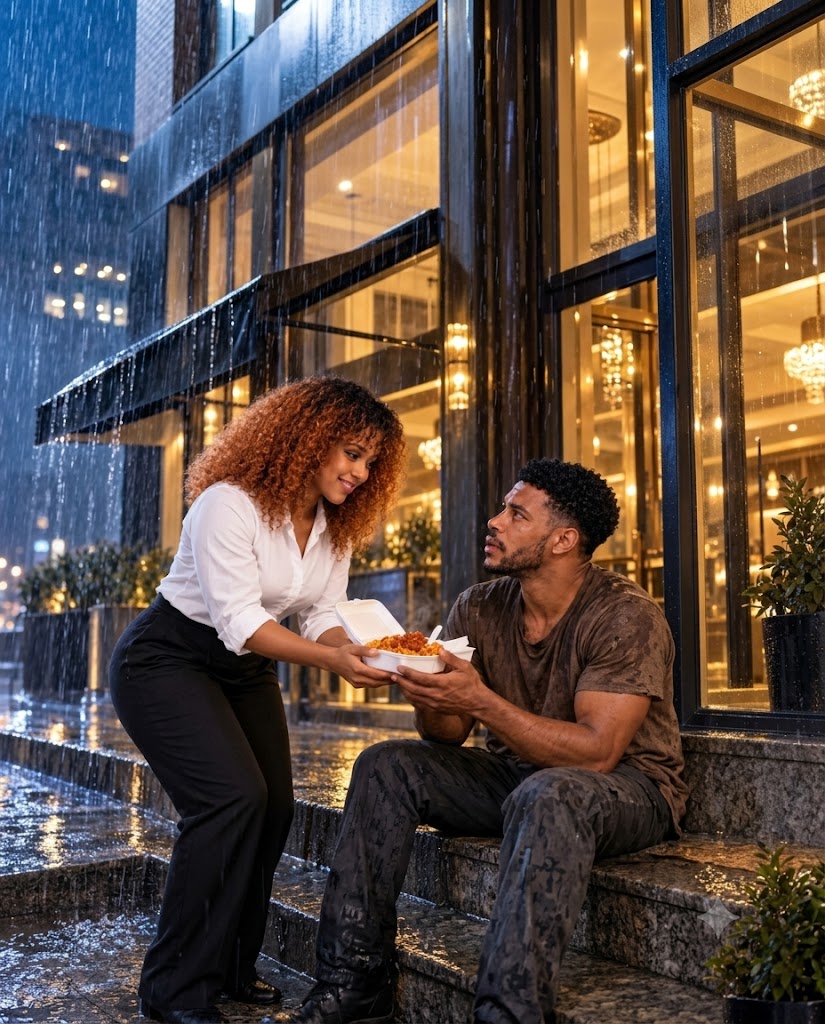
The rain had been falling since before her shift started, a cold November drizzle that turned the sidewalk outside The Golden Spoon into a slick ribbon of reflected neon.
Amara noticed him around six, a man in a worn brown jacket sitting on the bench beside the entrance, hands buried in his pockets, shoulders hunched against the damp.
She watched him through the window as she wiped down tables, as she refilled water glasses, as she smiled at customers who barely looked up from their phones.
He never came inside.
He never asked for anything.
He just sat there, a quiet figure in the periphery, while the dinner rush swelled and faded and the rain kept falling.
By eight o’clock, she had memorized the way he shifted his weight every few minutes, the way he pulled his collar up when the wind gusted, the way his eyes followed people as they passed but never seemed to ask for anything.
Amara had worked at The Golden Spoon for three years, long enough to know the rhythm of the place, the ebb and flow of hungry customers and impatient orders.
She had learned to read faces, to anticipate needs, to move through the dining room like water finding its level.
But she had never seen anyone sit outside for two hours in the rain without once trying to come in.
“Has anyone taken his order?” she asked Marcus, the evening manager, as she passed the host stand with a tray of empty glasses.
Marcus glanced toward the window. “Who?”
“The man outside. On the bench.”
Marcus squinted. “He’s not a customer, Amara. He’s just… sitting.”
“He’s been there since my shift started.”
“Some people just sit.” Marcus shrugged and turned back to his reservation book. “Perhaps he’s waiting for the rain to stop.”
Amara looked outside again. The rain had softened to a mist, barely visible against the streetlights.
“It was hardly raining when I came in,” she said.
Marcus didn’t answer.
She carried the glasses to the kitchen, where the dishwasher was running and the cooks were shouting over the roar of the exhaust fan.
When she came back out, the man was still there.
—
The dinner service ended at nine, and the last customers trickled out around nine-thirty, leaving behind a scatter of crumpled napkins and half-empty coffee cups.
Amara was clearing table four when Daniel, one of the line cooks, came out with a plate of rice and stew.
“Table four?” she asked.
“Cancelled,” Daniel said. “The man left before we brought it out.”
“Don’t throw it away yet.”
Daniel paused, the plate balanced in his hand. “You want it?”
Amara looked toward the window. The man was still there, a dark shape against the glass.
“Sir,” she said, turning to Marcus, who was counting the register. “There’s an unserved meal from a canceled order. May I give it to the man outside?”
Marcus looked up, annoyed. “Which man?”
“Beside the door. He’s been there since my shift started.”
Marcus sighed. “You can give it to him. Just make sure customers can come and go without being disturbed.”
“I’ll keep the entrance clear.”
“You’re going out now?” Marcus gestured toward the window. “Look at that rain.”
Amara was already untying her apron. “If I wait for sunshine, he can have it for breakfast.”
“At least leave your apron here.”
She draped it over the back of a chair and took the plate from Daniel, who was watching her with a mixture of amusement and confusion.
The plate was warm in her hands, the steam rising into the cool air of the restaurant.
She pushed open the front door and stepped outside.
—
“Good evening, sir.”
The man looked up. His eyes were dark, tired, but not unfriendly.
“Am I in the way?” he asked.
“No.” Amara held out the plate. “I brought you something to eat. Rice and stew. It’s still warm.”
He stared at the plate, then at her face. “For me?”
“Yes. A customer cancelled before it was served. It hasn’t been touched. I asked the manager if I could give it to you.”
“And he agreed?”
“I’m standing here, aren’t I?”
The man glanced toward the door, then back at her. “You came outside for this.”
“Fortunately, I’m washable.”
“Why?”
Amara blinked. “Why what?”
“Why did you bring me food?”
She considered the question. “You were sitting here. There was food going to waste. It seemed simple enough.”
“People have been coming and going all evening.”
“Perhaps they didn’t notice.”
The man was quiet for a moment. Then he said, “You shouldn’t have to explain yourself before someone is kind to you.”
Amara felt something shift in her chest, a small, unexpected ache.
“Please eat before it gets cold,” she said. “I’ve already spent half the warmth talking.”
The man looked down at the plate. He picked up the fork she had brought and took a bite.
“It’s good,” he said.
“I’ll tell the kitchen.”
He ate slowly, deliberately, as if savoring each mouthful. Amara stood beside him, the mist settling on her hair, her arms crossed against the chill.
“It has been a long time,” the man said, “since someone considered what I might need without first asking what I could do for them.”
“You don’t need to do anything for me.”
“There must be some way I can repay you.”
“You can finish the food.”
“I am serious.”
“So am I.” Amara shook her head. “You owe me nothing, sir.”
“What’s your name?”
“Amara.”
“Amara.” He repeated it softly, as if testing the sound. “When things improve, you can help somebody else. That will be enough.”
“You sound sure they will improve.”
“I think you should give them a chance.” She paused. “Don’t give up yet.”
From inside, Marcus’s voice called out: “Amara!”
“I’m coming.” She looked at the man one last time. “Find somewhere dry when you’ve eaten. This corner won’t help much if the wind changes.”
“Amara.” His voice stopped her at the door. “I won’t forget you.”
She smiled, just barely, and went back inside.
—
The rain had stopped by the time she finished her closing duties, but the man was gone.
Amara stood at the window for a moment, looking at the empty bench, the darkened street, the shimmer of wet pavement under the streetlights.
“Ready to go?” Marcus asked, jingling his keys.
“Yeah.” She grabbed her bag. “Ready.”
—
The next morning, Amara woke to the smell of her mother’s cooking and the sound of church bells from the cathedral three blocks away.
She lived in a small apartment on the second floor of a building that had seen better decades, with her mother, Rosa, who had raised her alone after her father passed when Amara was twelve.
Rosa was already at the stove, stirring a pot of oatmeal, when Amara shuffled into the kitchen.
“You’re late,” Rosa said without turning around.
“We had a late table.” Amara poured herself a cup of coffee. “Then I stopped to talk outside.”
“Outside?” Rosa finally looked at her. “In that rain?”
“It wasn’t raining anymore.”
Rosa studied her daughter’s face. “Sit down before you tell me anything. You’re standing as if your legs belong to somebody else.”
“If they belonged to somebody else, I would return them.”
“You work too hard.”
“It was just busy today.”
“It is always just busy.”
Amara sat down at the small table by the window. “The man I helped came back to thank me.”
“What man?”
“Yesterday. He was sitting outside the restaurant. I gave him some food.”
Rosa’s eyebrows rose. “Was he all right?”
“He seemed to be. He wanted to give me something.”
“What?”
“I didn’t look. I told him to keep it.”
“Good.” Rosa set a bowl of oatmeal in front of her. “Leave it. Sit. Eat.”
“Mama, you cannot serve people all day and come home to take the jug out of my hand.”
“It will get easier by God’s grace.”
“And with some help from these tired legs.”
“First, let them rest.”
Amara ate her oatmeal in silence, watching the morning light creep across the kitchen floor.
She thought about the man’s eyes, dark and tired but not unfriendly. She thought about the way he had said her name, as if it mattered.
She thought about the plate of rice and stew, and how he had eaten every bite.
—
The lunch shift at The Golden Spoon was always a blur of orders and refills and the constant hum of conversation.
Amara moved through it on autopilot, her feet aching, her smile fixed in place.
At one o’clock, Marcus pulled her aside.
“Table by the long window is yours today,” he said. “Six guests. Important booking.”
“What time?”
“One-thirty. I want it ready before then. Water glasses ready. The kitchen has the reservation note, and I’ve checked the chairs.”
“Good work. You’ll serve them. Keep an eye on what they need. These are guests we want to see again.”
Amara nodded and went to prepare the table.
The guests arrived promptly at one-thirty, a group of well-dressed men and women who spoke in low, important voices and barely glanced at her as she took their orders.
She served them efficiently, refilling glasses, clearing plates, answering questions about the menu with practiced ease.
And then, just as she was bringing the check, she saw him.
The man from the rain.
He was standing at the host stand, wearing the same worn brown jacket, his hands in his pockets.
He looked out of place among the polished wood and white tablecloths, a rough stone in a setting of smooth pearls.
Amara’s heart skipped.
“Welcome to The Golden Spoon,” she heard herself say. “May I have the name on your reservation?”
The man turned. “It’s under Johnson.”
“Good afternoon, Mr. Ez.”
“Good afternoon, Amara.”
She felt her face flush. “Would you like to sit down?”
“If you have a table.”
“Yes, just this way.”
She led him toward a small table near the back, away from the important guests, away from the windows where he might be seen.
But before they could reach it, a voice cut through the dining room.
“Excuse me. Where are you taking him?”
Amara turned. One of the important guests, a man in a gray suit, was watching them with cold eyes.
“To this table, sir.”
“Here?” The man gestured at the space around him. “Is there a problem with the table?”
“The table is fine. It’s the person you’re bringing to it.”
Amara felt her stomach tighten. “He has come to eat, sir.”
“Then let him find somewhere suitable. Look at him.”
“Please lower your voice. There’s no need to embarrass anyone.”
“I am embarrassed. I come here expecting a certain standard. Now you’re bringing in somebody who looks as if he spends his time begging outside.”
Amara’s hands trembled. “He asks for a table. That is all. And you should know when to say no.”
“Tell him to go.”
The man in the brown jacket spoke quietly. “Sir, I haven’t disturbed your meal.”
“I wasn’t speaking to you.”
“We can discuss this calmly,” Amara said, “but please don’t speak to him like that.”
The man in the gray suit turned on her. “You are a waitress. Who gave you the right to lecture me?”
“It is my job to serve our guests. I can’t ask him to leave because you dislike his clothes.”
“What is happening here?”
Marcus appeared, his face pale. “At last, perhaps you can explain what your staff are doing.”
“Amara, step aside for a moment.” Marcus stepped between them. “Tell me what happened.”
“Sir,” the gray-suited man said, “your waitress has decided to turn this place into a shelter. I objected, and now she’s speaking to me as if I am the problem.”
“Was there a disturbance?”
“I’ve just told you.”
“Did this gentleman approach your table?”
“He doesn’t need to approach my table. I can see him from where I’m sitting.”
“He came in and asked for a seat,” Amara said. “I was showing him this one. He hasn’t done anything wrong.”
“And I told her I was uncomfortable. Apparently, that matters less than protecting some stranger.”
“His clothes are worn. That doesn’t mean we should send him away.”
“You hear her? She is still arguing.”
Marcus held up a hand. “Amara has answered my question. Thank you, Amara.”
“I have brought people here,” the gray-suited man said. “Clients. Friends. You know the kind of business I give you.”
“We appreciate your custom, sir.”
“Then act like it. Either you ask this man to leave, or I leave.”
Marcus was quiet for a moment. Then he said, “You are both welcome to eat here.”
“That is not what I asked.”
“I understand what you’re asking. We won’t remove a guest because of his appearance.”
“Then you have made your choice. You’ve lost my business.”
“We appreciate your custom, sir.”
The gray-suited man stormed out, his companions following in a flurry of whispers and backward glances.
Marcus turned to the man in the brown jacket. “I’m sorry you were treated that way. Please take your seat. We’d like to offer your meal with our compliments.”
“Thank you, but that isn’t necessary. I came for an ordinary meal. May I order one?”
“Of course. Please see that he has what he needs.”
Marcus walked away, and Amara was left standing beside the table, her heart pounding.
“I’m sorry about all of that,” she said.
“You didn’t cause it.”
“It still happened here.”
“What would you suggest?”
Amara thought for a moment. “We have rice with chicken, and the stew is good if you don’t mind a little pepper.”
“Then I’ll have the rice with chicken and water, please.”
“Is there anything else you need?”
“I have everything. Thank you.”
“I’ll be right with you, sir.”
She walked toward the kitchen, her legs shaky, her mind racing.
—
The man—Mr. Ez—became a regular after that.
He came in two or three times a week, always alone, always in the same worn brown jacket.
He ordered simple things: rice and stew, chicken and water, sometimes just coffee and a slice of pie.
He never caused trouble. He never complained. He waited patiently when Amara was busy, and when she apologized for the delay, he only smiled and said he wasn’t in a hurry.
The other servers noticed.
“Your friend is back,” Lucia said one evening, nodding toward the corner table where Mr. Ez was reading a newspaper.
“He’s not my friend.”
“He’s something. You always find time for him.”
“I find time for anyone sitting in my section.”
“You know what I mean. You watch for him.”
Amara felt her face warm. “He isn’t my relation.”
“Then why are you so concerned?”
“Have you ever heard him insult anybody here? He waits when I’m busy. He says please. He asks whether I’ve had a difficult day. Those things make serving somebody pleasant.”
“Pleasant doesn’t settle a bill.”
“Did he ask you to settle his?”
Lucia laughed. “Sorry. The look on your face.”
“I know. But every time he comes, we discuss his clothes before anything else. I can see the clothes, too.”
“Fresh glasses, please.”
“Right away.”
—
At home, Rosa was waiting.
“The restaurant must have closed early in your head,” she said. “Your body has only just arrived.”
“Can’t I smile in this house?”
“You can. I am trying to know whether I should join you.”
“Mama, I haven’t mentioned anybody’s name.”
“You didn’t need to.”
Amara sat down at the table. “Yes, he came to eat. And he ate.”
“You have decided to make me work for this conversation.”
“He speaks well. Not because he uses big words. He listens, and he doesn’t seem frightened of anybody.”
“Should he be?”
“No. But people have been unpleasant to him. You would expect him to look as if he wanted to disappear. He doesn’t. There is something about the way he carries himself. Sometimes he looks as though he is the only person in the room who isn’t trying to impress anyone.”
“And that impresses you.”
“It is good that you don’t judge him by what he wears, but you don’t know very much about him yet.”
“I know fine speech is also an appearance, Mama.”
“I am not saying he is a bad man. I haven’t met him. Neither of us knows enough to say what he is. Be kind. Just leave yourself room to learn.”
“I’m not planning anything.”
“Feelings don’t always announce their plans.”
“I will be careful, Mama.”
—
One morning, on her way to work, Amara saw Mr. Ez standing on the corner near the bus stop.
He looked tired, his jacket damp from the mist, his eyes scanning the street as if looking for something.
“Good morning,” she said.
He turned. “Amara.”
“Are you waiting for someone?”
“No. Just… looking for a small job. Anything I can do for now.”
“What sort of work?”
“Whatever will help me manage the basics.”
“Have you eaten?”
“Not this morning.”
“Nothing?”
“No.”
Amara reached into her bag and pulled out a folded bill—a twenty she had been saving for lunch.
“Please get something to eat. There is a woman selling food just along there. You can’t walk around looking for work on an empty stomach.”
“It’s only breakfast.”
“Don’t you need it?”
“I have my transport fare.”
“That isn’t what I asked.”
“I can manage until later.”
“Take it, please.” She pressed the bill into his hand. “I need to go. Eat before you start walking again.”
She turned and walked away before he could argue.
—
At work, Lucia was watching her.
“What?”
“Nothing. You are smiling at a wall.”
“Maybe the wall said good morning.”
“Did it wear a brown shirt?”
Amara laughed despite herself.
“You have fallen for that poor man.”
“He has a name. Mr. Ez.”
“Yes. And you don’t have to like him because I do.”
“Don’t start.”
“I haven’t said anything. Your face has.”
“He is polite. And perhaps I was unfair. I saw the clothes and decided what the trouble would be. He hasn’t caused you any.”
“I know.”
—
The weeks passed.
Mr. Ez continued to come to the restaurant, and Amara continued to serve him, and somewhere along the way, the small table in the corner became his table, and the conversations they shared became something she looked forward to.
He asked about her mother, about her childhood, about the books she liked to read.
She asked about his day, about the weather, about the small things that filled the spaces between words.
He never talked about money. He never talked about work. He never talked about where he went at night or why he wore the same worn jacket every day.
And Amara, despite her mother’s warnings, found herself falling.
—
One afternoon, a man in a dark suit came to the restaurant.
He was tall, well-dressed, with the kind of quiet confidence that suggested he was used to being obeyed.
He asked for a table near the window, and when Amara brought him the menu, he barely glanced at it.
“Good afternoon,” she said. “May I have the name on your reservation?”
“It’s under Eay.”
“Mr. Eay. Good evening. Please keep your voice down.”
Amara blinked. “I’m sorry?”
“Nothing. Is everything all right?”
“Yes. I need a favor. Please don’t mention that you know me to anyone here.”
“Not even—”
“Nobody. I would appreciate it.”
“Of course. Thank you.”
“Your table is ready, sir.”
The man nodded and walked toward the window.
Lucia appeared at Amara’s elbow. “Is that man your relation?”
“Which man?”
“The one you always find time for.”
“I find time for anyone sitting in my section.”
“You know what I mean. You watch for him.”
“He isn’t my relation.”
“Then why are you so concerned?”
“I’m not. I just—” Amara stopped. “He asked me not to mention that I know him.”
“Know him? You’ve never met him before.”
“I know.”
Lucia frowned. “Amara, what’s going on?”
“I don’t know.”
—
That evening, Amara stayed late to help with the closing duties.
She was wiping down the last table when the front door opened and Mr. Ez walked in.
“Good evening,” she said, surprised. “You’re late.”
“I know. I’m sorry.”
“Is everything all right?”
“Yes. No.” He ran a hand through his hair. “Can we talk?”
Amara set down her rag. “What’s wrong?”
“I haven’t been honest with you.”
“What do you mean?”
Mr. Ez took a deep breath. “My name isn’t Ez. It’s Eay. I’m the chairman of the group that owns The Golden Spoon.”
Amara stared at him.
“This restaurant?”
“Yes.”
“You own it?”
“I own the group. This is one of our restaurants.”
“How much money do you have?”
“Why do you ask?”
“Please don’t decide what I should be told.”
He was quiet for a moment. Then he said, “Enough that I have never needed you to buy me a meal. My businesses and investments are worth billions.”
“You’re a billionaire?”
“Yes, Amara.”
“And this morning, you were looking for a small job.”
“I lied. I wasn’t lying when I said I hadn’t eaten. That doesn’t make it better. Food was waiting at home. I let you believe I couldn’t afford it.”
Amara reached into her pocket and pulled out the twenty-dollar bill she had given him.
“This belongs to you. I should never have accepted it.”
“Amara—”
“I kept wondering whether you had eaten while I was working. Every time I carried somebody’s food out, were you laughing at me?”
“No.”
“Did anyone else laugh?”
“No. My friend told me I should have been honest with you. He was right.”
“Was any of it real?”
“I had been going out in those clothes for a few weeks, different places. I wanted to see how people behaved when they thought I had nothing.”
“So you were testing people?”
“Yes. Me, too. When you brought me that food, I hadn’t met you. You chose to come outside. But afterwards, I kept coming back and letting you worry about things I could afford to fix. I wanted to know you cared for me before you knew about the money.”
“You could have asked to know me.”
“I should have.”
“I would have spoken to you.”
“I know that now.”
“No, you knew I would speak to you. I kept doing it.”
“Who knew?”
“My assistant and driver. My friend. People at the office. The guest who came to my table the other evening recognized me. I asked him to keep quiet.”
“The staff here?”
“I never told them. As far as I know, they didn’t recognize me.”
“Is there anything else?”
“No, that’s all. After the first evening, I asked my assistant to make inquiries about you at work. Whether you were dependable, how you treated people. I told him not to approach you or inquire into your private life, but I still asked without telling you.”
“You knew my employer. You could ask people about me. I didn’t even know where you went at night.”
“You’re right. I’m sorry, Amara.”
“I need to go back inside.”
“May I give you my number? You don’t have to use it.”
“Please don’t come looking for me at work.”
“I won’t. And I don’t want this becoming something the manager asks me about.”
“I’ll make that clear. Your work has nothing to do with whether you choose to see me again.”
“I liked you. You should have let me find out who I was liking.”
She walked back into the restaurant and didn’t look back.
—
At home, Rosa was waiting.
“A billionaire,” Amara said, collapsing into a chair. “And I gave him my breakfast.”
“You didn’t know.”
“I feel foolish.”
“You told me to be careful.”
“I didn’t tell you to stop being kind. He is responsible for what he told you.”
“What if I still want to see him?”
“Here, take this.” Rosa handed her a cup of tea. “Then wait until you are ready to see him. You don’t owe him a quick answer.”
“You won’t tell me I’m making a mistake?”
“I will tell you if I think so.”
“You could at least pretend to consider it.”
“I have considered it. Now eat a little. This man has occupied enough of your meals today.”
—
Amara didn’t call him that night.
Or the next night.
Or the night after that.
She went to work, she served her tables, she smiled at customers, and she tried not to think about the man in the brown jacket who had turned out to be someone else entirely.
But she couldn’t stop thinking about him.
She thought about the way he had listened when she talked, really listened, as if her words mattered.
She thought about the way he had stood up for her when the customer had been rude, even though he was the one being insulted.
She thought about the way he had said her name, softly, as if it were something precious.
And she thought about the twenty-dollar bill she had given him, and how he had kept it, and how that small act of kindness had somehow become the most important thing in her life.
—
On the fourth day, she called him.
“I can meet you on Sunday afternoon,” she said. “Somewhere that doesn’t belong to you.”
“Good afternoon.”
“Have you been waiting long?”
“Twenty minutes. I was early.”
“This table?”
“Okay.”
“Yeah, looks good.”
“So, um, do you come here often?”
“Sometimes.”
“I still don’t like what you did.”
“I don’t expect you to.”
“But I came because I’d like to know you properly. If you’re frightened of something, you can tell me. You can’t arrange another test.”
“I won’t.”
“And if I ask a question you don’t want to answer?”
“I’ll say that. I won’t make up an answer.”
“Where did you grow up?”
“I grew up between the city and my grandmother’s house. I learned early that I like building things, and later I learned how expensive some of those lessons could be.”
“Tell me about your mother.”
“She is more formidable than she looks. She would like to meet you.”
“Would she?”
“Eventually. Don’t sound so relieved.”
—
The months passed.
Amara and Eay—she still called him Mr. Ez sometimes, just to tease him—grew closer.
He took her to dinner at restaurants that didn’t belong to his group, to movies, to long walks along the river.
He told her about his childhood, about his grandmother, about the lessons he had learned and the mistakes he had made.
She told him about her father, about the years of struggle, about the dreams she had never quite given up on.
And slowly, carefully, they built something together.
—
One evening, Amara brought Eay home to meet Rosa.
Rosa studied him with sharp eyes, asking questions that were polite but pointed, testing him in ways that only a mother could.
And Eay, to his credit, answered every question honestly, without flinching, without trying to impress.
When he left, Rosa turned to Amara.
“He loves you,” she said.
“How do you know?”
“The way he looks at you. The way he listens when you speak. The way he doesn’t try to be anything other than what he is.”
“Is that enough?”
“It is a start.”
—
The proposal came on a Sunday afternoon, in the small park where they had first met for coffee.
Eay got down on one knee, the way people did in movies, and held out a ring that caught the light.
“Amara,” he said, “I love you. I love having you here. And when you go home, I start thinking about when I’ll see you again. I’d like to make a home with you. Will you marry me?”
Amara looked at him—at the man who had once sat outside her restaurant in the rain, at the man who had lied to her and then told her the truth, at the man who had waited for her to be ready.
“Yes,” she said. “Yes.”
—
The wedding was small, just family and close friends.
Rosa cried. Eay’s assistant, who had been with him for years, smiled and shook his head and said he had known all along.
And Amara, standing at the altar in a simple white dress, looked at the man beside her and thought about the twenty-dollar bill she had given him, and how it had led her here.
—
Years later, when people asked how they had met, Amara would tell the story.
She would tell them about the rain, about the worn brown jacket, about the plate of rice and stew.
She would tell them about the customer who had demanded that Eay be removed, and how she had stood up for him, and how he had stood up for her.
And she would tell them about the twenty-dollar bill, the one she had given him on a cold morning when she thought he was just a man looking for work.
“He kept it,” she would say. “He still has it, framed, in his office.”
“Why?”
“Because it reminds him that kindness doesn’t require wealth. And because it reminds me that the best things in life are often the ones we give away.”
—
On their tenth anniversary, Eay took Amara back to The Golden Spoon.
The restaurant had changed—new paint, new furniture, a new menu—but the corner table was still there, the one where he had sat so many times in his worn brown jacket.
“Do you remember?” he asked.
“I remember.”
“I was so afraid you would never speak to me again.”
“I almost didn’t.”
“But you did.”
“Because you waited. Because you told me the truth. Because you let me decide.”
Eay reached into his pocket and pulled out a small velvet box.
“What’s this?”
“Open it.”
Amara opened the box.
Inside was a twenty-dollar bill, old and worn, framed in gold.
“The first one,” Eay said. “The one you gave me.”
“You kept it.”
“I told you I would.”
“I remember.”
“Every time I look at it, I think about that morning. I think about how you didn’t hesitate. How you gave me your lunch money without knowing anything about me. How you saw me.”
“I saw you.”
“And you loved me anyway.”
“I loved you because of it.”
—
The rain was falling again, a soft November drizzle that turned the sidewalk into a slick ribbon of reflected neon.
Amara stood at the window of The Golden Spoon, looking out at the bench where a man in a worn brown jacket had once sat.
She thought about the years that had passed, the children they had raised, the life they had built together.
She thought about the twenty-dollar bill, framed in gold, sitting on the mantel in their living room.
And she thought about the words she had said to him that first night, standing in the rain, holding a plate of rice and stew.
“You owe me nothing, sir.”
She smiled.
She had been wrong.
He owed her everything.
And he had given it, freely, without hesitation, for the rest of their lives.
—
The rain kept falling.
The world kept turning.
And somewhere, in a small restaurant on a quiet street, a waitress gave a hungry stranger her breakfast money, unaware that he owned the restaurant.
Unaware that he would one day be her husband.
Unaware that kindness, given freely, always finds its way home.
—
**THE END**









