
A stray pup showed up at a retired SEAL’s dock and wouldn’t stop “singing.” Try not to cry at what he did next.
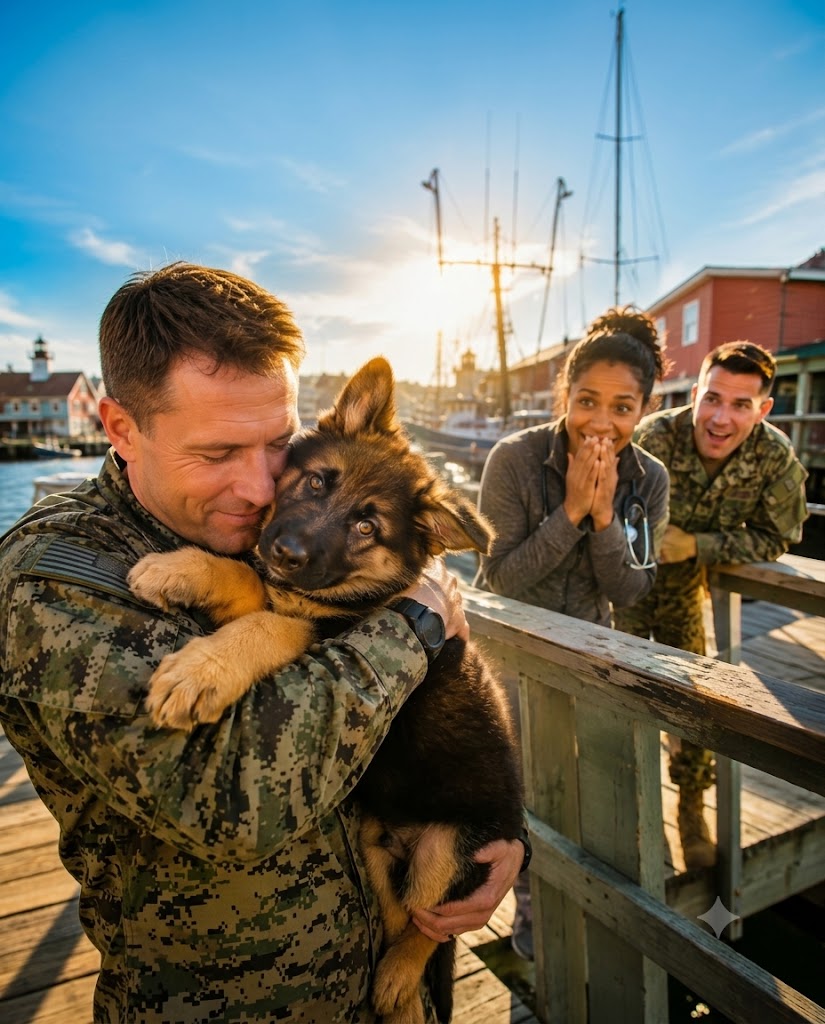
The morning Vernon Hale found the dog, he had not said a full sentence to another living person in 11 days.
That was not unusual anymore.
Since Diane died, words had started to feel like something that belonged to another man’s life—the man who used to sit across the kitchen table from her and talk until the coffee went cold.
Vernon was 52 years old, broad through the shoulders, with the kind of hands that had spent decades doing things that required silence and precision.
Twenty-two years as a Navy SEAL had given him both.
He had operated in deserts, in jungle river systems, in mountain passes where a misplaced breath could end everything.
He had come home from all of it.
He had not expected that the thing that would finally hollow him out would be a Tuesday morning in October when Diane sat down at the kitchen table with her second cup of coffee and did not get up again.
He ran a boat repair shop now on the edge of Caldwell’s Reach, Maine—a town small enough that everyone knew his name and kind enough not to say it too often.
He showed up before light.
He worked until he could no longer see clearly.
He went home to a house that smelled faintly of her rosewater soap and pretended that was enough.
It was a cold November morning, fog sitting low over the harbor, when he heard it under the dock.
He had gone down to check on a client’s lobster boat—a busted tiller housing that had been driving him three visits already—and there it was.
Not quite a bark, not quite a whimper.
Something in between, a trembling cascade of sound that seemed less like an animal in distress and more like a small creature trying to find the right frequency to be understood.
He almost walked past it.
He had been walking past a lot of things lately.
But the sound found a hook in him somewhere beneath the scar tissue, and he crouched at the edge of the dock and looked underneath.
Huddled on a tangle of dock line wrapped around a piling was a puppy.
Yellow-brown, maybe 10 weeks old, soaked through, one ear ragged and dark with old blood where something had gotten to it.
The dog looked up at him with eyes the color of pine sap in October light and made the sound again.
It was not begging.
It was something stranger than that.
It was the sound of a creature that had decided, despite all available evidence, that the world owed it one more chance to speak.
Vernon reached under the dock and lifted the puppy out with both hands.
Cold, maybe 3 pounds of wet fur and insistence.
And even as Vernon tucked it against his jacket, the dog craned its neck and made that sound again—half tone, half trembling, aimed upward at the underside of Vernon’s chin like a small address to the universe.
“You’ve got a lot of opinions,” Vernon said, “for something that fits in a coffee can.”
He drove to Simone Archer’s clinic on Bayview Road before it officially opened, knocked twice, and waited.
Simone was 38, tall and lean, with dark brown skin and the kind of calm that came not from peace but from having been through enough not to panic at new disasters.
She had moved to Caldwell’s Reach four years ago from Portland after losing her younger brother to an overdose.
She carried the quiet, watchful quality of someone who understood that grief did not always announce itself loudly.
She opened the door in her coat, took one look at the puppy, and stepped aside.
“Bring him in.”
She worked without rushing—warmed the dog, cleaned the ear, ran through her checks.
The puppy objected to the thermometer with a round little grumble that made Simone pause.
“Did he just argue with me?”
“He’s been doing that,” Vernon said from the corner where he had been standing with his arms folded, “since I found him.”
Simone pressed two fingers gently against the puppy’s ribs.
“Mixed breed, probably retriever and something bigger. He’s going to need time and food.”
She glanced up.
“You filing a found animal report?”
Vernon looked at the dog, who was looking back at him with the calm certainty of an animal that had already made its decision.
“Not yet,” he said.
Simone said nothing to that, which was one of the things he appreciated about her.
He was carrying the puppy out 20 minutes later, the dog’s bandaged ear poking up from a folded towel, when Simone said from the doorway, “He’ll need a name.”
Vernon stopped on the porch.
The fog had lifted slightly.
The harbor was a pewter line in the distance.
“He sounds like something trying to tune in,” Vernon said, “like static that hasn’t found its signal yet.”
Simone tilted her head.
“Like a chord.”
Vernon glanced down at the puppy, who opened his small mouth and produced a sound that rose at the end like a question.
“Chord,” Vernon said. “Not a question. A decision.”
The dog gave one short, satisfied huff, as if the name had been waiting for him all along.
Chord spent his first week in the shop in a bed Vernon made from a clean, folded drop cloth and an old wool sweater that had been Diane’s.
He should not have used the sweater.
He knew that when he pulled it from the closet shelf and held it for a moment before laying it in the corner.
But Chord crawled onto it the first night, circled twice, pressed his nose into the folds, and made a sound so low and steady it traveled through the floorboards like something warming the whole building from underneath.
Vernon sat on his workbench stool in the dim light and listened.
He had not cried since the funeral.
He did not cry now, but something in the locked room in his chest shifted very slightly—the way a door shifts when the pressure on both sides finally equalizes.
Chord healed fast.
Within days, his ear stood at half-mast while the other lifted straight—a lopsided attention that made him look permanently curious about one side of the world while remaining committed to the other.
He was not an obedient dog.
He had no interest in commands, responded to *sit* with a thoughtful tilt of his head, and usually a gentle sound that seemed to mean *I heard you, and I’ve decided not to.*
But he watched people with a focus that was almost unsettling, as if tracking something invisible that only he could detect.
The first person he found this way was Troy Weston.
Troy was 28, a Coast Guard radio technician stationed at the outpost north of town.
Sandy hair, quick to smile, but quicker to flinch—a habit that had developed after a failed rescue off the point last February, when his team had reached a capsized vessel 40 minutes too late, and Troy had been the one on the radio the whole time, hearing voices that eventually went quiet.
He had been back on duty for three months and told everyone he was fine with the flat insistence of someone who was not sure the word meant what it used to.
He came into the shop one morning to ask about an outboard motor and ended up staying longer than he meant to, drawn by the rhythm of hands that knew what they were doing.
He was mid-sentence about a torque spec when something dropped—a ratchet handle slipping off the shelf, ringing against the concrete floor with a sound like a struck bell.
Troy’s whole body jerked.
His face went somewhere else for half a second.
Chord was already there.
The puppy moved across the shop floor with the unhurried certainty of an old dog who had seen this kind of weather before.
He sat down directly beside Troy’s boot, looked up at him, and made his sound—not playful, not alarmed.
Something low and even, with a warmth to it like a lamp lit in a cold room.
Troy looked down, his jaw unclenched by degrees.
Simone, who had stopped by to check Chord’s ear and was standing near the doorway with a coffee she had not yet touched, watched Troy’s breathing slow.
She did not say anything.
She wrote something in the margin of her clipboard instead.
“That’s not normal,” Troy said quietly.
“Nothing about him is,” Vernon said, not looking up from his work.
That evening, Simone stood in the doorway of the shop while Vernon swept up.
“He isn’t responding to sound as a stimulus,” she said. “He’s responding to the person having the response. That’s different. That’s rare.”
Vernon kept sweeping.
“He’s a dog.”
“Yes,” Simone said. “And some dogs are born understanding one thing very well.”
She looked at Chord, who had fallen asleep on his drop cloth with his chin resting on Diane’s sweater.
“His thing seems to be grief.”
Vernon said nothing.
The broom kept moving.
He did not tell her that when he woke from his own nightmares—the ones that were not about combat, but about a kitchen table and a Tuesday morning and the specific weight of silence after a phone has fallen from a hand—Chord was always already there.
Pressed against his side, warm and certain, making that sound.
Not a lullaby, not a distraction.
Something between the two, a low trembling note that did not deny the darkness but sat with it until the darkness became slightly less total.
Some truths were better carried quietly until they were ready to be handed down.
The day everything changed was the first Sunday of December.
Caldwell’s Reach had a tradition.
Seven bronze bells hung in the harbor chapel, one for every fisherman lost at sea from the town’s recorded history.
Every first Sunday of December at noon, the bell ringer sounded them in slow sequence, and the town gathered on the common to stand in the cold and listen.
It was not a cheerful ritual.
It was not meant to be.
It was the kind of observance that said *we remember, and remembering costs something, and we pay it anyway.*
Vernon had gone because not going felt like a choice he was not ready to make.
He stood near the back of the common with Chord on a leash—both of them slightly outside the gathered crowd, not quite inside it, not quite apart from it.
The first bell sounded.
Chord lifted his head.
The second bell, slower now.
The third.
Chord made a sound Vernon had not heard before—not his usual register.
This was deeper, longer, rising slowly as the bell’s resonance spread and then shaping itself around the decay of the note.
Not imitating it, but answering it.
The sound gathered, layered, became something with its own weight and warmth.
The fourth bell rang.
Chord’s voice threaded beneath it like a second instrument, finding its harmony.
By the fifth bell, the people nearest them had turned.
No one spoke.
The sixth bell.
Chord’s voice changed shape around it—sorrowful now, something in the texture of it like water moving over stone.
An older woman put her hand to her mouth.
A man in a canvas coat looked away.
The seventh bell rang long and slow, and Chord held his note past its echo into the silence afterward, as if offering to fill that silence with something that was not emptiness.
When Chord finally went quiet, no one moved for five full seconds.
A young woman to Vernon’s left had her phone raised.
She had been filming since the fourth bell.
She looked at the screen, then at the dog, then at Vernon.
“Is it all right if I—”
“Yeah,” Vernon said.
She posted it that evening.
By morning, it had 40,000 views.
By the end of the week, the number had six digits and was still climbing, and Vernon’s shop phone had stopped being a thing that was mostly silent.
Letters came first.
Veterans wrote that they had not slept through a night in years and had listened to a recording of Chord’s Seven Bells song on a loop and woken the next morning in daylight for the first time in months.
A military widow from western Virginia wrote that her husband used to hum while he did the dishes, and she had not been able to stand kitchen sounds since he died, and Chord’s voice was the first thing she had heard in eight months that did not feel like an accusation.
People wrote blessings, demands for updates, requests to visit.
Clyde Barden read several of them aloud in the shop, standing near the wood stove with his reading glasses pushed to the tip of his nose.
Clyde was 67, a retired fisherman who now ran the bait shop next door and complained about everything as a form of exercise.
He had broad, thick forearms, a voice like a truck with a bad starter, and the permanent expression of a man who was mildly disappointed in the direction of civilization.
He also, without ever mentioning it, left bags of dog food on Vernon’s back step twice a week labeled as *surplus stock.*
“This one’s from a man in Tucson,” Clyde said, squinting. “Says Chord sounds like the inside of a church that still believes in something.”
Simone looked up from her corner of the workbench.
“That’s beautiful.”
“That’s a liability,” Clyde said. “You get famous, you get people.”
He lowered the letter.
“And people want things.”
He was not wrong.
One letter, different from the others, arrived in a cream-colored envelope with the address written in pencil.
Not a child’s scrawl, but something more careful—the practiced loops of someone who had decided each word before writing it.
The return address said Ruth Ashford, Bangor, Maine.
Vernon read it at the workbench with a cup of coffee he forgot to drink.
*Dear Mr. Hale,*
*My name is Ruth Ashford. I am the grandmother of a boy named Liam, who is 8 years old.*
*Liam’s father was Patrick Ashford, a lobsterman out of Bangor. Patrick went out in the early hours of January 9th this year and did not return. The Coast Guard recovered the boat three days later. They did not recover Patrick.*
*Liam has not been the same since. He eats, he sleeps, he goes to school, but he does not talk much, and when he does, it is very careful—like a person rationing something they are afraid of running out of.*
*Last week Liam saw the video of your dog and the church bells. He watched it four times. When it ended the fourth time, he turned to me and said, “Grandma, he sounds like Dad used to hum when he thought nobody was listening.”*
*That was the longest sentence Liam had said in two months.*
*I know you did not ask for any of this. I know a dog is just a dog. But I thought you should know what your dog’s voice did for my grandson, even from a distance.*
*You do not have to write back.*
*With gratitude,*
*Ruth Ashford*
Vernon set the letter down.
Chord was at his feet.
He nudged Vernon’s boot with his nose and made one quiet sound—low and even, as if he had already read the letter and understood that this was the moment it required.
Vernon picked up his phone and called Simone.
What he did not know yet was that Simone had already been on the phone with Ruth.
What he did not know was that 10 days later, Ruth would drive to Caldwell’s Reach with Liam in the passenger seat—the boy wearing a blue winter jacket and holding a library book he had not opened once the whole trip—and that what happened when they arrived would change the shape of that month and several that followed.
The County Animal Control review had been scheduled for that same week because Vernon had still not filed formal paperwork for Chord.
Officer Faye Brockton was 34, efficient, not unkind, and bound by a system that believed proper placement meant forms and assessments and facility standards that existed for good reasons even when they caught the wrong things in their net.
She had given Vernon a 10-day notice.
The 10 days were up.
The review took place in the back room of the harbormaster’s building.
Faye had set up a table, a chair, and a rubber mat in the center of the room that she described, without any evident irony, as *the evaluation space.*
Faye asked for basic commands.
Chord glanced at Vernon and gave a small conversational sound.
“Sit,” Faye said.
Chord regarded the mat.
He sat halfway, reconsidered, and gave a soft grumble.
Clyde muttered under his breath, “He’s reviewing the request.”
Faye wrote something on her clipboard.
“His responsiveness to standard commands is minimal.”
Simone stepped forward.
“His responsiveness to emotional cues is exceptional. That’s documented.”
She offered the file.
Faye accepted it without expression.
“The standard for placement suitability—”
The door opened.
Ruth Ashford was 64, tall and slightly stooped in the way of people who had spent decades bending toward something—children, garden rows, grief.
She wore a gray wool coat and had silver hair braided over one shoulder.
Her face was weathered and kind and tired in the specific way of people who had been strong for a long time on behalf of someone else.
Beside her stood Liam.
He was small for eight, with his father’s brown hair and a blue jacket zipped to his chin.
His eyes were gray and very serious—the kind of eyes that had seen something they were not supposed to see yet and had not finished processing it.
He held his grandmother’s sleeve with three fingers, not tightly, but steadily—the hold of someone who needed to know the anchor was there without needing to pull on it.
Simone said quietly, “Ruth, Liam, thank you for making the drive.”
Faye looked up from her clipboard with the expression of someone recalibrating a situation.
“This was not on the scheduled agenda.”
“Liam is part of the behavioral documentation,” Simone said, which was technically not a lie.
Faye set her pen down and said nothing, which was a kind of permission.
The room was quiet.
Outside, the harbor wind moved against the building in low, patient pulses.
Faye, trying to continue, reached for her tablet and pulled up a standard anxiety assessment—a recorded track she used for rescue animal evaluations.
Ocean sounds, waves, the low groan of a boat hull working against a dock.
She pressed play.
The sound filled the room, familiar and coastal and cold.
Liam’s face changed.
It happened in a single breath—the color leaving, the eyes going somewhere else, the fingers on Ruth’s sleeve going white.
He was no longer in the harbormaster’s building.
He was somewhere in January at 2:00 in the morning when the phone rang and the voice on the other end spoke carefully and his grandmother sat down on the kitchen floor.
Ruth bent immediately.
“Liam, sweetheart—”
Faye reached for the tablet to stop the audio.
But Chord was already moving.
He did not run.
He did not startle the boy.
He crossed the room in a slow, deliberate line, as if he had been given coordinates and simply followed them, and sat down in front of Liam’s feet.
He looked up at the boy—not with the eager expression of a dog wanting attention, but with something quieter than that.
Something that recognized the specific shape of what it was seeing.
Then he made his sound.
It was lower than it had ever been. Steadier.
It rose slowly from somewhere in his chest like a note that had been waiting at the bottom of a deep place, and it moved through the room not loudly but completely—the way certain kinds of warmth move.
Not blasting. Just arriving. Into corners and along walls and into the space between a frightened boy and a sound he could not outrun.
The recording stopped.
Faye had turned it off, but Chord continued.
Liam’s grip on his grandmother’s sleeve loosened.
Not let go. Loosened.
His other hand dropped slowly until his fingers touched the top of Chord’s head.
Chord made the sound once more, softer now, shaped like an answer.
And Liam said, “He sounds like Dad coming down the stairs at night to check on me.”
Nobody in the room moved.
Troy’s jaw worked once, silently.
Clyde turned his face toward the wall with sudden attention to a window that had nothing particular outside it.
Ruth pressed her free hand to her mouth the way people do when they are trying to hold something in that is too large to hold.
Vernon looked at the boy.
He looked at Chord.
He thought for a moment about a kitchen table and a coffee cup and 18 months of learning to occupy a house that kept expecting someone who was not there.
He understood for the first time what Chord had been doing all along.
Not performing. Not demonstrating. Not being therapeutic in the way the word appeared on Simone’s clipboard.
Just being present. Entirely, stubbornly, specifically present.
The way certain people and certain creatures were born to be present.
The way Diane used to sit beside him on the porch after long deployments, not saying anything, just there—in the exact spot where the silence needed company most.
Faye Brockton closed her folder.
The sound was small and final, and in that room it was enough.
“I’ll reclassify the placement status,” she said.
Her voice was even, professional, and very slightly different from how it had been when she walked in.
“Foster to adopt, pending the standard six-week review, if the owner can demonstrate stable conditions.”
She looked around the room at Clyde and Troy and Simone and Vernon.
“Which appears to be documented.”
Clyde cleared his throat.
“You could say that.”
Chord gave one short, satisfied bark, perfectly timed, and Liam—despite everything, because of everything—laughed.
It was not a loud laugh.
It was the laugh of a person who had forgotten they still had one and found it unexpectedly, the way you find something you stopped looking for.
But it was real.
And in that building, surrounded by harbor fog and the smell of old rope and the particular quiet of people who had just witnessed something they would not fully explain for years, it was more than enough.
Ruth drove back to Bangor with Liam asleep in the passenger seat and the library book still unopened, but with a piece of paper in her coat pocket.
Simone’s number and the Saturday morning schedule of what Simone was beginning to call, in the careful language of someone building something new, a *community support gathering.*
No official name. No paperwork yet.
Just Vernon’s shop, a wood stove, folding chairs, Clyde’s donuts that he delivered every week while claiming he had made too many by accident, and Chord moving between people who had brought their silences with them and found, in that drafty wooden space above the harbor, that silence was easier to carry when it had company.
Troy came every Saturday.
He did not always talk.
Some weeks he sat near the stove with his coffee and watched Chord work the room, and that seemed to be enough for both of them.
A Vietnam-era veteran named Spencer drove 40 minutes from Rockland and said only that his nightmares had changed—not stopped, but changed, from the kind that swallowed you to the kind you could watch from a slight distance.
He attributed this to a recording of Chord’s Seven Bells song that he played each night before sleep.
He did not sound embarrassed saying it.
There were rooms where embarrassment lost its grip.
And Vernon’s shop on Saturday mornings had become one of them.
Six months after the harbor review, Ruth brought Liam back for a visit.
The boy ran through the shop door ahead of his grandmother, which was something he had not done the first time.
And Chord met him at full trot, paws scattering sawdust, tail moving in full circular sweeps.
Liam dropped to his knees in the middle of the floor.
Chord climbed into his lap with the determined inelegance of a dog who had not yet accepted his own size.
And Liam laughed louder this time—the laugh that belonged to a boy, rather than a person managing grief.
When Chord stole Liam’s wool hat and carried it across the room, Liam stood and chased him through the maze of workbenches and rope coils, and Clyde hollered from the corner that some of them were trying to drink their coffee.
Vernon watched from his workbench.
He watched Ruth in the doorway, a little less stooped than before.
He watched Simone writing in her notebook with the focus of someone recording something she wanted to remember exactly.
He watched Troy crouched near the window filming it on his phone, murmuring something about sending it to his sister who had been worried.
The morning light came through the harbor-facing windows in long flat bars, the way winter light in Maine sometimes does when the clouds part without warning.
And everything in the shop caught it.
The sawdust in the air. The rope grain on the wall. Diane’s old coffee mug on the shelf where Vernon had put it the first day and never moved it.
He crossed the shop, lifted the mug, and drank from it.
It was cold.
He didn’t mind.
Outside, Chord made his sound—half bark, half song, entirely particular.
And in the harbor below, the boats shifted on their lines, and the bells in the chapel counted something that had no name in any language Vernon knew, only in the one that lived between a man who had stopped speaking and a dog who had never stopped trying to be heard.
Some things you do not rescue.
Some things rescue you.
And the trick Vernon had finally learned was knowing the difference early enough to let them.









