A Stray Dog Found a Hells Angel Trapped Beneath His Wrecked Harley—What He Did Next Left Everyone in Tears
**Part 1**
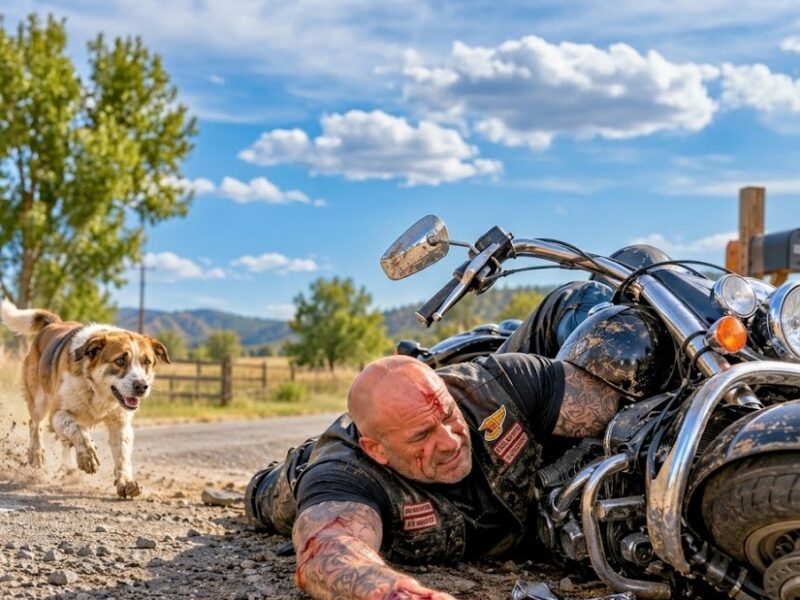
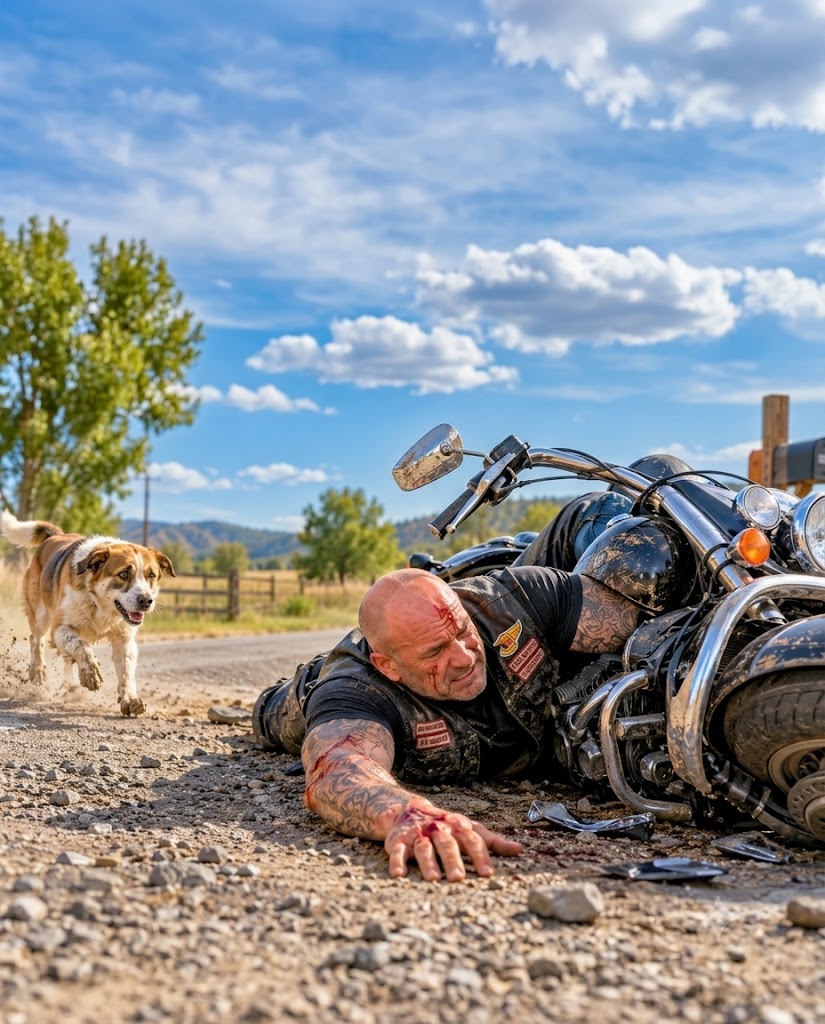
The front wheel caught the gravel and snapped sideways. Six hundred pounds of steel slammed down like a falling piano. A boot jammed under the engine, and a leg folded flat against the ground, pinned and useless. The man pushed. The bike did not move.
He pushed again, harder, and heard something tear inside his knee. He screamed into the empty desert, a raw, animal sound that vanished into the heat shimmer. Nothing answered. No cars. No houses. Just the oven-blast of heat off the asphalt and a sun that burned straight down like a cosmic magnifying glass.
He was forty miles from the nearest town, and he had been down for two hours already. His name was Dutch Marlowe, and he had ridden with the Hells Angels for thirty years. He had never once asked anyone for help.
Now, he would have died out there alone. Except something was watching him from the tree line. What came out of those trees that day changed everything.
Stay with me on this one. Let me tell you about Dutch Marlowe.
Sixty-one years old. Shoulders like a door frame. A gray beard that reached the second button of his vest. And that vest, that worn leather cut with the winged skull on the back, was the only thing he owned that he would have died for.
He had buried two brothers, one wife, and more friends than he could count on both hands. He did not cry at funerals anymore. He had run out of the water for it somewhere back in the nineties.
Dutch rode a 1998 Harley Softail that he had rebuilt with his own hands three times. He knew the sound of that engine the way a father knows his kid crying in the next room. And that morning, rolling out of Barstow on Route 6, the engine had been singing. Clean. Happy.
He was running an errand nobody else wanted. A run up to a brother’s place past the dry lake, carrying a box of tools and a thermos of coffee. Simple. The kind of thing he had done a thousand times.
Here is the thing about the desert, though. It does not care who you are. It does not care about your patch or your reputation or the thirty years you put in.
There was a washout on the shoulder where the last rain had pulled the gravel loose, and nobody had fixed it. Dutch drifted wide to miss a dead coyote in the road. His front tire found that gravel, and the whole world went sideways in half a second.
He did not remember the fall. He remembered waking up with his face against the asphalt and his right leg gone, just gone. Swallowed up under the hot metal of his own machine. The pain came a beat later, the way it does.
He tried to lift the bike. You have to understand, this was a strong man. He had bent rebar for fun. But a Harley on its side with your own leg acting as the anchor is a different kind of problem. Every time he heaved, the foot peg dug deeper into his calf, and the knee that was already torn screamed at him to stop.
So, he stopped. He lay back. He looked at the sky and did the math. The math was bad.
His phone had skidded off somewhere in the fall, and when he finally spotted it, it was a good fifteen feet away in the dirt, screen down, out of reach. No way to call the club. No way to call 911. No way to call anyone.
Route 6 out there was not a busy road. It was the kind of road where you might see one car an hour at a good time of day, and this was not a good time of day. This was high noon in July, and the thermometer back in Barstow had read 109 before he even left.
He had half a bottle of water clipped to the frame. He drank a mouthful and made himself stop. He knew what dehydration did to a man out here. He had seen it. First, you get stupid. Then, you stop sweating. Then, your heart does things it should not do, and then you are just another thing the desert takes back.
Two hours he lay there. He yelled until his throat went raw. He tried the bike nine or ten more times until his hands were torn up and shaking. And somewhere in there, with the sun pressing down on him like a hand, he started to understand that this was how it ended.
Not in a bar fight. Not on a run. Pinned under his own Harley on a road nobody drove, for a mistake any kid could have made.
That was when he heard it. A sound in the brush at the tree line, maybe forty feet off. A dry, careful rustle.
Dutch turned his head, and his heart kicked because out here that sound could mean a coyote, and a coyote will test a man who cannot move. His hand closed around a rock.
But it was not a coyote. Two eyes were watching him from the shade. Low to the ground. Patient.
And then the thing stepped out into the light, and Dutch almost laughed, because of all the things the desert could have sent him, it sent this. A dog.
A skinny, half-starved stray dog. Ribs like a washboard. One ear torn. A coat that had once been some color and was now just dust. The kind of dog nobody wanted and everybody shooed away.
It stood there at the edge of the road looking at the big man trapped on the ground, and it did not come closer. Not yet. And Dutch knew this dog.
Now here is where it turns. Three weeks earlier, Dutch had stopped at the truck stop off the interstate, the one with the cracked sign and the bad coffee. He had been sitting on the curb eating a sandwich when he saw a commotion by the dumpsters.
A big man in a stained apron, the fellow who owned the place, a loud piece of work named Dale Pruitt, was swinging a length of pipe at something. Kicking at it. And the thing he was kicking was this dog.
A skinny stray that had done nothing but come sniffing around the trash hungry. People were watching. A few truckers. A woman with her kid. Nobody did anything because Dale Pruitt was a big mean man who owned the only gas for thirty miles and ran his mouth like a chainsaw.
He had the dog cornered against the fence, and he was laughing, telling the crowd to watch him teach it a lesson. Dutch had put his sandwich down.
He had walked over quiet, the way big men who do not need to prove anything walk. He did not raise his voice. He just stood between Dale and the dog and said, “That is enough.”
Dale looked him up and down, saw a gray-bearded old biker, and made the mistake a lot of men make. He laughed in Dutch’s face. Called him grandpa. Told him to mind his own business before he got hurt.
The crowd went quiet, waiting. Dutch did not hit him. He just looked at Dale Pruitt the way you look at something you have already decided about. And something in that look made the big man’s smile fall right off his face.
Dale backed up. Muttered. Walked away swinging his pipe at the air to save face. And Dutch picked up the rest of his sandwich, crouched down, and held it out to the shaking, bleeding dog.
The dog would not take it from his hand. Too scared. So Dutch set it on the ground and walked away, and when he looked back, the dog was eating.
That was it. That was the whole thing. One sandwich three weeks ago to a dog he never expected to see again. And now here was that same dog, forty miles out in the open desert, standing at the edge of a road where a man was dying.
“Hey.” Dutch croaked. His voice came out like gravel. “Hey. I know you.”
The dog’s torn ear twitched. It took one step closer. Then another. It was still afraid. You could see it fighting the fear with every inch. Its body low, ready to bolt. But it kept coming. One careful step at a time until it was close enough that Dutch could have touched it.
It sniffed at his outstretched hand. And then, slow, like it was deciding something, it lay down in the dirt beside him. Right beside him, pressed against his shoulder in the thin strip of shade his body threw on the ground.
Dutch let out a breath he did not know he had been holding. “Diesel,” he said. For no reason he could explain except that the dog looked like something built to keep running no matter what. “I’m going to call you Diesel. That okay with you?”
The dog did not answer, of course. It just stayed. And for the first time in two hours, Dutch Marlowe was not alone.
He talked to it. He did not know what else to do. He told it about the fall, about the stupid coyote, about the gravel. He told it he was probably not getting out of this one.
And somewhere in the talking, the shade shifted, and the dog got up. Dutch’s heart sank. “Here it goes,” he thought. “Here’s where it runs off like everything does.”
But the dog did not run off. It walked to his bike, to the leather jacket that had come loose and fallen half under the saddlebag when he went down. And it grabbed that jacket in its teeth, and it started to pull.
Dutch did not understand at first. He watched this half-starved stray drag a heavy leather jacket inch by inch across the gravel, out away from the bike, out toward the middle of the empty road. The dog dropped it right there on the center line. A dark heap on the gray asphalt, right where anyone coming would have to see it.
Then it came back, grabbed Dutch’s bandana that had fallen, too, and dragged that out there as well. “What are you doing?” Dutch whispered. But something in his chest had started to pound, because he thought maybe he knew.
Then far off he heard it. A sound under the ringing silence. An engine. A big one. The low diesel growl of a semi truck somewhere back down the road, coming this way.
The dog heard it, too. Its head snapped up. And that skinny, beaten, half-dead stray ran. It ran out into the middle of Route 6, planted itself over that pile of leather, right in the path of eighteen wheels of steel, and it started to bark.
Not little barks. Great, deep, desperate barks. Its whole body heaving with each one. Barking at a forty-ton truck like it could stop it with sound alone.
Dutch tried to scream at it to get out of the road. He was sure he was about to watch this animal get flattened trying to save him. The rig came around the bend, and for one terrible second Dutch saw it bearing down, and the dog did not move, and Dutch closed his eyes.
The air brakes hit like a gunshot. The whole truck shuddered and squealed and came to a stop forty feet past the dog, half off the shoulder in a cloud of dust and burned rubber. For a long moment, nothing moved.
Dutch opened his eyes. The dog was still standing, alive, still barking, and the driver’s door was opening. A trucker climbed down. An older fellow, heavy-set, gray stubble, a trucker’s cap pushed back on his head. He was staring at the dog like he had seen a ghost.
“What in the world?” he started to say, and then the dog stopped barking, grabbed the leather jacket in its teeth again, and ran. Not away. Toward Dutch.
It ran back across the road to where the big man lay pinned, and it stood over him, and it looked back at the trucker as plain as any words. This way. Here. Hurry.
The trucker came. He came at a dead run for a man his age. And when he came around the back of the fallen bike and saw Dutch lying there, gray-faced, lips cracked, pinned under six hundred pounds of Harley, he said, “Oh, sweet lord,” and dropped to his knees.
“How long you been down, brother?” “A few hours,” Dutch rasped. “Maybe more. Lost track.” “Okay. Okay. I got you.”
The trucker, whose name was Earl Haggerty, and who had been driving that same route for twenty-two years, got his shoulder under the frame of the bike. “On three. You pull that leg the second it comes up. You hear me? One. Two. Three.”
Earl heaved. Veins stood out on his neck. The bike came up maybe four inches, and it was enough. And Dutch dragged his ruined leg out from under it and rolled onto his back in the dirt. Free. Free for the first time in hours. Gasping like a man pulled out of deep water.
Earl dropped the bike and fell back beside him. Both of them breathing hard. And the dog pushed its head up under Dutch’s arm and stayed there.
For a few minutes, nobody said anything. The danger was over. Earl got a big jug of water from his cab and made Dutch drink it slow. He got a blanket, propped the bad leg, poured water over Dutch’s burned face and neck.
Dutch lay there in the shade of the truck and felt the panic drain out of him. Felt his heart slow down. Felt, for the first time since the wheel caught that gravel, that he was going to live.
He scratched the dog behind its torn ear. The dog’s tail thumped once against the ground. Earl laughed, a tired, grateful laugh, and said he had a brother-in-law at the fire station in Barstow, and help was already rolling. It was over. The worst was behind them.
Dutch closed his eyes and let himself believe it. And then Earl, wiping his hands on his jeans, leaned over to get a closer look at the dog, and his face changed. All the color went out of it. He went very still and very quiet, and he said one word.
“Rebel.”
The dog’s head came up like it had been struck by lightning. Its whole body went rigid. And it turned and looked at Earl Haggerty with an expression Dutch had never seen on an animal before. Something between hope and heartbreak.
And it let out a sound that was not a bark at all. A high, broken whine. The sound a thing makes when it hears a name it had given up on ever hearing again.
Dutch sat up on his elbows, the grateful calm gone. Every nerve in him suddenly awake. “You know this dog?”
Earl did not answer right away. He reached out with a shaking hand and parted the dust-matted fur at the dog’s throat. And under all that filth, there was a collar. Not a store collar. A thin band of braided black leather. Hand-tooled. The kind a certain kind of man makes himself.
And hanging off it, bent and scratched but unmistakable, was a small brass tag stamped with a winged skull. The same winged skull that was stitched onto the back of Dutch Marlowe’s vest.
“This ain’t a stray,” Earl said, his voice gone rough. “This is Preacher’s dog.”
And just like that, this was not a story about a man who fell off his bike anymore. Dutch felt the ground tilt under him. “Preacher,” he said. “You mean Tommy Vance. Tommy ‘Preacher’ Vance. You knew him. He was my brother.”
Dutch’s voice cracked on it. “He was one of mine. He went down on this road. Right on this road about a year back. Hit and run, they said. They never found who did it. We never found his dog, either. We figured the coyotes got it.”
He looked down at the trembling animal pressed against him. This skinny, scarred, impossible creature. “This is Rebel. Preacher’s Rebel.”
**Part 2**
Now listen. I want you to stay with me here, because this is the part that matters. Earl Haggerty did not look surprised. That was the first thing Dutch noticed.
A man who hears that a dog belonged to a dead biker, and that the biker was killed in a hit-and-run a year ago, that man ought to look surprised. Earl just looked sick. Sick and ashamed, like a man carrying something heavy he had carried too long.
“I need to tell you something,” Earl said, “and you are not going to like it. But that dog, that dog turning up here right now with you, there’s a reason. And I think I know what it is.”
Dutch waited. The desert was dead quiet except for the tick of the cooling truck engine.
“A year ago, I was running this same route,” Earl said. “Nighttime, and I came up over that rise back there, and I saw it. A rig pulled over, lights off, and a man standing in the road looking down at something. I slowed up. And in my headlights, I saw a motorcycle all busted up in the ditch, and a man laying next to it not moving. And the fellow standing over him, when my lights hit him, he jumped in his cab and tore off into the dark. Didn’t check on the rider. Didn’t call nobody. Just ran.”
Earl’s jaw was working. “I stopped. I did what I could, but your brother was already gone, friend. There was nothing nobody could have done by then.”
“You saw the truck,” Dutch said, slow and careful. “You saw the man who ran.”
“I saw the truck. I saw the logo on the door. And I knew the man because everybody on this route knows him. And I have been too much of a coward to say a word for one entire year.”
Earl looked him dead in the eye. “It was Dale Pruitt. The fellow owns the truck stop off the interstate. He runs a rig on the side, hauls for cash, drives it drunk half the time. It was his truck. It was him standing over your brother. And I let it go because he’s a mean son of a gun and I’ve got a family. And I told myself there wasn’t any proof and what good would it do.”
Dutch did not say anything for a long moment. Dale Pruitt. The name landed in him like a stone down a well. The big man with the apron and the pipe. The man he had stood between and a starving dog three weeks ago. The man who had called him grandpa and backed down.
The dog. Dutch said finally, “Where’s the dog been all year?”
Earl shook his head slow. “I can guess. That dog loved your brother. Dogs like that, they don’t leave. I figure it stayed by the wreck till they hauled everything off, and then it just… it started walking. Living wild. Living off scraps. And somewhere in there it wound up back at that truck stop, scrounging the dumpsters, and Dale Pruitt took to beating on it for sport. Not knowing. Or maybe knowing exactly whose dog it was and that being the whole sick point.”
He looked at Dutch. “You fed it three weeks ago. I heard about that. Whole truck stop heard about the old biker who stared Dale Pruitt down over a stray. You showed that dog the first kindness it had seen in a year. And you were wearing that.”
He nodded at the winged skull on Dutch’s chest. “Same patch its own man used to wear. The same smell. Leather and engine and the road. That dog has been looking for its people for a solid year, brother. And three weeks ago, it found them. It found you.”
Dutch looked down at Rebel. The dog was looking back up at him with those steady, patient eyes, and Dutch understood all at once, the whole terrible shape of it. The dog had not come back to the tree line today by chance. It had been following the scent of that patch, of that world, ever since the truck stop.
It had found the one man in forty miles who smelled like home. And it had come. And it had stayed. And when that man was dying, it had thrown its own broken body in front of a semi to save him.
Not because Dutch had fed it. Because Dutch was the closest thing left on this earth to the master it had lost. And now the thing was climbing into his chest and would not let go. The thing he had run out of water for back in the nineties.
And here it came anyway, hot and sudden. And Dutch Marlowe, who did not cry at funerals, put his torn-up hand over his eyes and wept in the dirt beside the road where his brother had died.
The fire truck and the ambulance came twenty minutes later, lights spinning in the heat. A sheriff’s cruiser came with them because that is how it works out there. Everybody rolls on a call. And by then, Dutch had his jaw set again and his mind clear, because a plan had been building in him the whole time, cold and quiet, the way the old plans always built.
He would not let Earl drive off. He made the man stay. And when the sheriff’s deputy came over with his notepad, a young fellow named Reyes, Dutch said he had a witness to a crime, and the witness was standing right there, and he had carried the truth for a year, and he was ready to set it down.
Earl told it all again. The rig, the logo on the door, Dale Pruitt standing over a dying man and running. Deputy Reyes stopped writing halfway through and just listened, because Preacher Vance’s hit-and-run was a cold case that everybody in that department had a bad feeling about. And here it was, walking up out of the desert on a dead man’s dog.
They loaded Dutch into the ambulance. He would not go until they loaded Rebel, too, right there on the gurney beside him, and the medics did not argue because there is a look a man gets that tells you arguing is a waste of everyone’s day. The dog lay against his side, and Dutch kept one hand buried in its fur the whole ride.
And he made a promise to it under his breath, a promise he intended to keep. Here is what the desert does not know. It does not know about brotherhood. It takes a man, and it figures he is gone, and it moves on. But Dutch Marlowe rode with four hundred brothers across that state. And when one of them put out the word from a hospital bed in Barstow, the word traveled.
It took the law eleven days to build the case. Deputy Reyes was good, and he was hungry for it. Earl’s statement gave them the truck. A warrant gave them the rig, and that rig, even a year on, still had the damage. A cracked bracket low on the front frame. A dent nobody had bothered to fix. And when the lab matched the paint transfer to Preacher’s bike that they had kept in the evidence yard all that time, the thing was done.
They had him. Dale Pruitt, who had run a good man down drunk and left him to die, and then spent a year beating that man’s dog for the fun of it, sat in an interview room and watched the whole thing fall on top of him.
But before the law closed its hand, the club got its say. And no, not the way you are thinking. Dutch had made that clear from the hospital bed.
“Nobody touches him,” he had said. “Nobody gives that man what he wants, which is a reason to cry victim. We do this clean. We do this so it sticks.”
So on the day they knew the arrest was coming, two dozen Hells Angels rode out to the truck stop off the interstate. They did not break anything. They did not say a word to Dale Pruitt, who stood in his doorway going pale as the engines filled his lot and shut off all at once into a silence louder than any shouting.
They just parked, two dozen of them in a long row facing his place, and they stood by their bikes with their arms crossed, wearing the winged skull, and they waited. And when Deputy Reyes pulled in with two cruisers behind him and walked Dale Pruitt out in handcuffs in front of every trucker and traveler in that lot, the bikers did not cheer. They just watched him go. Which was worse. Which was exactly as Dutch had wanted it.
Dutch was there, on a crutch, his leg in a brace. He had refused to miss it. And as the cruiser pulled past him, Dale Pruitt turned his head and looked out the window, and recognized the gray-bearded old man he had called Grandpa, and his face came apart, because he understood at last who he had been dealing with the whole time, and how small his own mean little life had always been.
Rebel sat at Dutch’s good side through all of it. Clean now, fed, still skinny, but filling out. A new collar on him, store-bought, but the old one, the braided leather with the brass skull, Dutch had kept that.
Dale Pruitt went away for a long time. Not as long as some of us would have liked, but long enough that he came out an old man into a town that remembered exactly what he was.
Dutch healed slow. The knee never came all the way back, and he walked with a limp after that, and he did not mind it, because every step reminded him of a road and a dog and a thing he had almost left behind out there.
He did not ride as much. When he did, Rebel rode in a sidecar he built himself. The dog’s torn ear flapping in the wind, its face turned into the sun, and Dutch swore the thing was grinning every mile.
People asked him about it after. How a stray dog nobody wanted turned up forty miles out in open desert at the exact moment a man needed saving. Dutch never had a tidy answer. He would scratch Rebel behind that torn ear and think about it.
And what he landed on was this. That dog had lost everything. Its man, its home, its name, every kindness the world was supposed to owe it. A lesser creature would have gone hard and mean, the way Dale Pruitt went hard and mean. But that dog took one sandwich from one stranger who smelled like home, and it decided the world was still worth saving.
It walked those forty miles of burning desert looking for its people. And when it found a man dying in the dirt, it did not think about the hundred reasons to run. It lay down beside him. It dragged his jacket into the road. It threw its body in front of a truck.
Loyalty, Dutch would say, is not something you earn. It is something you are. Preacher knew that. The dog knew it before any of them. And a mean man with a pipe never knew it at all. And that, in the end, is the whole difference between the two kinds of men there are.
Earl Haggerty and Dutch stayed friends until Earl passed three years on, and Dutch rode at the front of that procession with Rebel in the sidecar. Deputy Reyes made sergeant. And every July, on the anniversary, Dutch rode out to that stretch of Route 6, to the washout they finally fixed, and he sat on the shoulder a while with his brother’s dog, and he did not say much.
He did not need to. He had learned, late in life, that the quietest things carry the most weight. A sandwich, a collar, a dog that came back, and a big, broken-down old man who had spent thirty years believing he needed no one, finally understanding that he had been saved by the smallest, hungriest, most forgotten creature on that whole empty road.
And that, brother, is a debt you do not pay back. You just carry it, gladly, all the way home.









