
A Son Begged a Doctor to Save His Sick Mother, but the Hospital Turned Him Away—Until a Black CEO Witnessed the Heartbreaking Scene
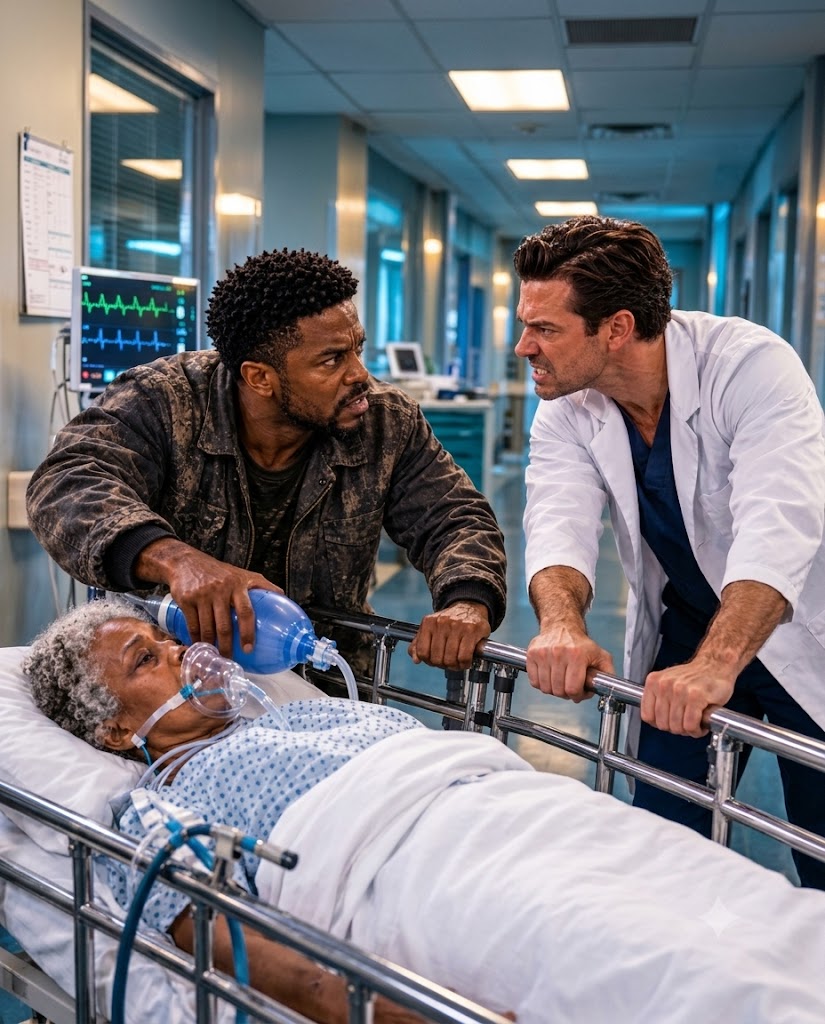
**Part 1**
The ER doors slid open at 2:14 a.m. and a man in a grease-stained jacket pushed a wheelchair through them himself, because no one had met him at the curb.
His mother’s head lolled against the chair back, her lips the color of old newspaper, and he was talking to her in a low, steady voice, the way you’d talk to a nervous animal.
“Stay with me, Mom. We’re inside now. You hear that? We’re inside.”
A triage nurse looked up from her screen. “Sir, you need to register at the front desk before—”
“She’s bradycardic. Forty-six. Pressure’s running low, maybe eighty over fifty.” He kept pushing. “She’s had chest pressure for two hours. I gave her aspirin at the house. She’s seventy-two, hypertensive.”
The nurse blinked. “Are you medical?”
“Community emergency response certified. She made sure of it.” He glanced down at his mother. “She spent thirty years making sure of it.”
That was the first time the room went quiet around him.
The second time came four minutes later, when the registration clerk slid the card back across the counter without inserting it. “We’ve never seen this issuer. Do you have another form of payment?”
“It wasn’t declined. You didn’t even run it.”
“We can’t verify it, sir.”
“Then use the terminal and verify it.”
The clerk’s voice dropped into the flat, patient tone of a person who has said the same sentence ten thousand times. “Mr. Hayes, yelling won’t change policy.”
“I’m not yelling.” His hands were shaking. He flattened them on the counter. “She’s being assessed right now. That’s what matters. That’s what’s supposed to matter.”
But the assessment had a hallway attached to it, and the hallway had a door, and the door had a lock with a name on it.
Julian Sterling, MD, Chief of Emergency Medicine, arrived with his badge swinging and his coffee untouched, and he did not look at the patient first. He looked at the man.
“Dr. Bennett.” His voice was mild. “Why is this stretcher in my restricted unit?”
“She’s unstable. Trauma bay two was full.”
“Room one is on administrative hold.”
“For what?” Derek Hayes asked.
Sterling turned, finally, and gave him the full weight of his attention, the way a man gives attention to a mosquito. “Reserved under an executive care agreement. The Voss family arrives in six minutes.”
“Voss. The donor family.”
“You understand how this hospital operates, then.”
“I’m beginning to.” Derek’s jaw tightened. “You’re telling me my mother can’t have that room because a donor’s family might want it in six minutes.”
“I’m telling you room one stays on hold.”
“Her pressure is seventy-eight. She’s crashing.”
“Then stabilize her here.” Sterling gestured vaguely at the curtained bay, the monitor, the oxygen line. “Dr. Bennett is stabilizing her. Registration proceeds in parallel. That’s the protocol.”
“Protocol.” Derek said the word like it was a foreign coin. “She needs a cardiac team, not a payment screen.”
“Cardiology’s occupied with the donor.”
“Then move one cardiologist.”
“You don’t assign my staff.”
“Then do your job and assign one yourself.”
The silence that followed had teeth. Sterling’s eyes flicked to the security guard at the end of the hall, then back. “Watch your tone.”
“Julian.” The voice came from the doorway—a woman in surgical scrubs, gray at the temples, a chart tucked under her arm. Dr. Arhek. “The board is waiting on the compliance file.”
“Let them wait.”
“This affects every research program in the hospital.”
“So did tonight.”
Derek heard the words but didn’t turn. His mother’s eyes had fluttered closed. Her breathing had gone shallow and irregular, a sound he knew from a hundred volunteer shifts, a sound that meant the body was beginning to negotiate with itself.
“Mom. Mom!”
“Dr. Sterling.” Claire Bennett’s voice cut through. “Pressure’s sixty-eight and falling. We’re losing her.”
“Bring respiratory support. Analysis two.”
“She needs suite one.”
“I said two.”
“No.” Derek stepped between them, hands up, not touching, never touching. “Step away. Open suite one.”
“You don’t give orders here. Nobody enters that suite.”
“Then move the equipment out here.”
“This is not your hospital.”
“Noted.”
Sterling’s hand came up. “Escort him out.”
“His mother is losing respiratory effort,” Claire said.
“I said remove him.”
Derek didn’t move. His hands were still up, palms open, the universal posture of a man who has decided not to be the reason this gets worse. “Do not interfere with her care.”
“You mechanics,” Sterling said, “think because you can fix an engine—”
“Finish that sentence.”
Claire was already moving, sealing the mask, tilting the jaw, counting under her breath. “Good seal. Keep that rhythm.”
“I know,” Derek said, and he did, because his hands were on the bag valve mask beside hers, because his mother had taught him on a kitchen table with a borrowed mannequin when he was fourteen years old.
Sterling stared. “Where did you learn that?”
“From her.” Derek’s voice cracked, just once. “She spent thirty years keeping strangers alive. Tonight she’s the stranger.”
That was the third time the room went quiet, and this time the quiet had a different quality—not surprise, but shame, looking for somewhere to sit.
“Please,” Derek said. “You’re done. Take your hand off my mother’s stretcher.”
“Don’t touch me.”
“I’m protecting her airway.”
“Julian, don’t—”
“We have reached the hook.” Sterling’s voice was flat. “Get her out of my restricted unit.”
“Take your hand off her stretcher,” Derek said, and there was no heat in it now, only the cold precision of a man who had run out of other options.
“Or what?”
“Then use the next sixty seconds carefully. Every choice is being recorded.”
Sterling’s phone buzzed. He looked at it, and something in his face changed—not softened, exactly, but recalibrated, the way a man’s face changes when the elevator he’s in starts moving in a direction he didn’t choose.
“Jerrick?”
“Arthur. I’m outside cardiac suite one. Why are you downstairs?”
“My mother is deteriorating.”
“Evelyn? Put Claire on.”
Claire took the phone without asking. “Severe hypotension. Bradycardia. Deteriorating oxygenation.”
“Open suite one immediately.”
“The donor patient—”
“Room one is for the sickest patient.” The voice on the phone was quiet and absolute. “Open it now.”
Sterling took the phone back. “Sir, this man interfered with security—”
“He didn’t. I saw it.”
“So did I,” said a second voice, closer now, and Derek turned to see a man in a dark coat coming down the hall with two board members behind him. “Who exactly is he?”
“Julian. Step away from Derek Hayes.”
“Mr. Hayes?” Sterling’s voice had gone strange. “You were comfortable with mechanic.”
“Don’t,” Derek said. “You were comfortable with mechanic. Don’t do that now.”
“I’m coming down,” the voice on the phone said. “Derek, I’m coming down.”
“Arthur.” The man in the dark coat stopped three feet away. “Mr. Hayes. I’m sorry we’re meeting like this.”
“Don’t.” Derek’s voice was very quiet. “My bank account isn’t treating my mother. She is.”
“I didn’t know who you were.”
“That’s the problem.” Derek turned back to the stretcher. “My mother shouldn’t have to be somebody’s mother to deserve that room.”
Nobody answered that, because there was no answer that didn’t indict the room.
“Hey.” Claire’s hand was on his shoulder. “Hey. She’s stable enough for intervention. Not safe yet. But stable enough.”
“I’m going in.”
“I will do everything I can.”
“You were a nurse,” Derek said, and it wasn’t a question.
“Thirty years.”
“That doesn’t affect admission status.”
“No.” Claire’s mouth twisted. “It shouldn’t. Neither should my jacket.”
“His wife is dying,” the man in the dark coat said quietly, to no one in particular, “but the ventilator is still breathing.”
The words hung there. Arthur Jerrick—the hospital’s chief administrator, Derek would learn later, a man who had spent twenty years making spreadsheets into policy—looked at the stretcher, and then at Sterling, and then at the floor.
“None of this matters,” Sterling said. “We need cath lab now.”
“I called twice,” Claire said.
“Why wasn’t it activated?”
“Julian.” Jerrick’s voice was tired. “I followed admission protocol.”
“You delayed cardiac activation.”
“Her coverage wasn’t verified.”
“You delayed treatment. For billing.”
The word billing landed like a dropped instrument tray. Jerrick straightened. “Preserve everything. CCTV. Badge logs. Timestamps. Payment terminal records. All of it.”
“This is being blown out of proportion.”
“She nearly died waiting for a room.”
“I made a judgment call.”
“Good. Then the record will show what your judgment was based on.”
Somewhere above them, a cath lab door opened and a team rolled a gurney toward the elevator. Somewhere below them, the Voss family was arriving through a side entrance, three minutes behind schedule, and would be met by a patient liaison with a folder and a smile.
And in the space between those two facts, a woman named Evelyn Hayes lay on a stretcher with a bag valve mask on her face and her son’s hand on her forehead.
—
The cath lab took forty-one minutes. Derek spent all forty-one of them in a plastic chair in a hallway that smelled like antiseptic and burnt coffee, because they wouldn’t let him in, and because he understood why.
Claire sat down beside him at minute twenty-two with two cups of vending machine coffee and didn’t say anything for a long time.
“Twenty-three,” she said finally.
He looked at her.
“Compliance already had an open pattern review. Tonight’s incident triggered the file.” She turned the cup in her hands. “Twenty-three cases. Eleven mentioned Dr. Sterling by name. Seven involved financial screening before escalation.”
“Complaints aren’t findings.”
“No. But they’re a map of where to look.”
Derek took a sip of the coffee and grimaced. “I don’t want to destroy a hospital.”
“I know.”
“I want it to open the door next time.”
“I know.”
“She taught me that.” He stared at the wall. “An emergency has no social class. She used to say it like a joke, because it was obvious. Then she’d say it again like it wasn’t.”
“That’s the whole lesson, isn’t it.”
“It should be.”
At minute thirty-nine, a surgeon came out and said words like restored flow and intervention and you got her here in time, and Derek didn’t hear any of them clearly except the last part, which he would repeat to himself for weeks afterward.
“We almost didn’t.”
“It will never happen again,” the surgeon said, and meant it as comfort, and it wasn’t.
Evelyn woke up eleven hours later in a cardiac suite that was not room one, because room one had been held for the Voss family until 8:40 a.m., and by then she didn’t need it anymore.
“What happened to my boy?” she asked, her voice a dry rustle.
“You kept that?” Derek said, and pulled out the card—black, embossed, absurd—that she had pressed into his hand at the door of her own emergency.
“You taught me something with it.”
“What?”
“That an emergency has no social class.”
She looked at him for a long moment. Then she laughed, which turned into a cough, which turned into a nurse coming in and telling him to let her rest.
“He’s fine, Mrs. Hayes,” the nurse said. “He’s been sitting there for eleven hours.”
“Of course he has,” Evelyn said. “He’s a mechanic. We fix things.”
—
**Part 2**
The board meeting was scheduled for 9:00 a.m. on a Tuesday, and by 8:45 the hallway outside the conference room held more people than the room itself could legally admit.
Derek Hayes stood at the window in a suit he had bought the previous day, because he owned exactly one suit and it was at the cleaner’s, and because his mother had raised him to believe that if you’re going to ask a room full of people to be accountable, you should at least shave.
Arthur Jerrick found him there. “Mr. Hayes. I wanted to say—before we go in—”
“Don’t say it in the hallway.” Derek didn’t turn. “Say it in the room. On the record.”
“Of course.” Jerrick hesitated. “The compliance file is… extensive.”
“How extensive?”
“Twenty-three complaints. Eleven naming Dr. Sterling directly. Seven involving financial screening before clinical escalation.” Jerrick paused. “The review board has opened a formal inquiry.”
“That’s not what I asked.”
“I’m sorry?”
“I asked how extensive it is. You gave me a count. What I want to know is how many of the twenty-three were Black patients, how many were uninsured, and how many died before anyone wrote it down.”
Jerrick was quiet for a moment. “The demographic data is still being compiled.”
“That’s a sentence that means nobody wanted to compile it.”
The conference room had a long table and twelve chairs and a phone at the center that had been unmuted for forty minutes, on the theory that the lawyers wanted to hear everything. Derek sat at the end of the table, not the head—the head was for the board chair, a woman named Dr. Okafor who had flown in from the system’s regional office and looked like she had not slept on the plane.
Dr. Sterling sat across from Derek, and Claire Bennett sat beside him, and neither of them had been allowed to speak to the other since Friday.
“Mr. Hayes.” Dr. Okafor folded her hands. “You’ve brought a request for systemic review. This board has read your statement. We’d like to hear it in your own words.”
Derek set a folder on the table. It was thin—twelve pages, printed that morning at a copy shop, because he didn’t trust the hospital’s printers and wanted to walk in with something he had physically assembled himself.
“Friday night,” he said, “my mother arrived at this ER at 2:14 a.m. with a probable heart attack. She was triaged in four minutes. That was the fastest part of the night.”
He turned a page. “At 2:18, a registration clerk returned my insurance card without running it. At 2:26, I was told room one was on hold for a donor family arriving in six minutes. At 2:34, Dr. Sterling told me room one stays restricted, and that if I didn’t like it, security would escort me out.”
“What is your point, Mr. Hayes?” Sterling asked.
“My point is the twenty-three.” Derek slid a second folder down the table. “I asked this hospital for four things. One: the complaint file. Two: the admission logs for the last eighteen months, sorted by insurance status. Three: the CCTV from the trauma bay hallway. Four: the timesheet for Dr. Sterling’s shift on the night in question.”
“You’re asking the board to investigate itself,” Sterling said.
“I’m asking the board to read its own mail.”
Dr. Okafor held up a hand. “The files have been provided to the board’s independent counsel. Mr. Hayes has requested that the findings be made public at the conclusion of the review. That request is… under consideration.”
“Under consideration,” Derek repeated. “Dr. Okafor, with respect—that’s a word people use when they’re deciding whether to bury something quietly or loudly.”
“Mr. Hayes—”
“Friday night, my mother’s pressure hit sixty-eight. Her oxygen saturation was in the eighties. She was dying in a hallway because a room was being held for a donor’s family, and because a card was in the wrong color, and because a doctor looked at my jacket and decided I wasn’t worth his protocol.” He sat back. “That’s not a mistake. That’s a system working exactly the way it was built. The only thing that changed was who I turned out to be. So no—I don’t want Dr. Sterling’s job. I want the next man in the grease-stained jacket to get the room anyway.”
The room was quiet. The phone at the center of the table, unmuted, gave off a faint hum.
“Dr. Bennett.” Okafor turned. “You heard the same instructions Dr. Sterling gave. Why didn’t you comply?”
Claire’s hands were folded in front of her. “Because my patient was dying. The order was to move her out of a restricted unit. The order did not include a plan for where she would go. Compliance without a plan is not compliance. It’s abdication.”
“You’re aware you’re subject to disciplinary review as well.”
“I am.”
“And you chose to act anyway.”
“I chose to treat the patient in front of me, yes.”
“Would you do it again?”
“Tonight,” Claire said, “and every night.”
Sterling’s lawyer leaned forward, but Sterling shook his head, just slightly, and the lawyer sat back. It was the first thing Derek had seen Sterling do all morning that looked like a choice rather than a reflex.
“Dr. Sterling,” Okafor said. “You’ve read the complaint file. Do you contest its findings?”
“I contest the characterization.” Sterling’s voice was flat. “Every hospital in this system screens for coverage before escalation. It’s policy. It’s how we keep the doors open. I applied the policy. I made a judgment call at the point of care, and I made it under pressure.”
“You made it about the card,” Derek said.
“I made it about the room.”
“You made it about whether my mother was worth the paperwork.”
Sterling looked at him for a long moment. “And if I had known who you were?”
“You’d have opened the room in thirty seconds.”
“Perhaps.”
“Not perhaps. You’d have opened the room and called me sir and offered me a coffee and my mother would have gotten the cardiac team before her pressure hit sixty-eight.” Derek’s voice was very quiet. “That’s the whole thing. That’s the entire problem. You’d have done it for Derek Hayes, the CEO. You didn’t do it for Derek Hayes, the mechanic. Same man. Same mother. Different jacket.”
“The board will retire to consider its findings,” Okafor said.
“No,” Derek said.
“I’m sorry?”
“Don’t retire. Not yet. There’s one more thing.”
He pulled a single sheet from his folder and slid it across the table. It was a photograph, printed on cheap paper, of a young woman in scrubs standing in front of a hospital that no longer existed—Northside Volunteer Clinic, closed in 2019, the sign already faded. She had a stethoscope around her neck and a smile that Derek recognized from a thousand kitchen-table mornings.
“That’s my mother,” he said. “Thirty years. Most of it in a clinic that never turned anybody away. She taught me CPR on a borrowed mannequin. She taught me that an emergency has no social class. Friday night, I used what she taught me on her, in the hallway of a hospital that does.”
He folded the photograph and put it back in his folder. “So no. I don’t want Dr. Sterling fired. I want the board to adopt a single standard of triage that doesn’t depend on who’s asking. I want the financial screening moved after clinical stabilization, not before. I want the complaint file published, in full, with the demographic data your staff hasn’t finished compiling. And I want a plaque in that hallway that says the ER opens because someone needs help, not because someone recognizes their name.”
“Mr. Hayes,” Okafor said slowly, “that’s a lot to ask of a single meeting.”
“Then hold more meetings. You have a phone that’s been on mute for forty minutes. Use it.”
Dr. Okafor looked at the phone. Then she looked at the folder on the table. Then she did something Derek would later describe, to his mother, as the first sensible thing anyone in that building had done all week.
She unmuted the phone, and she said, “Counsel, are you recording?”
“Yes, Dr. Okafor.”
“Then let the record show that the board has received Mr. Hayes’s request, that the demographic data will be compiled by Friday, and that the triage policy will be placed on the agenda for the next full board session.” She paused. “And let the record show that Dr. Sterling’s suspension is extended pending the compliance review, that Dr. Bennett’s suspension is lifted effective immediately, and that this hospital will be publishing a corrected triage standard within thirty days.”
Sterling’s lawyer started talking. Sterling put a hand on his arm, and this time the lawyer stopped.
“Dr. Sterling,” Okafor said. “Do you have anything to add?”
Sterling was quiet for a long moment. When he spoke, he didn’t look at Derek. He looked at the photograph on the table, though Derek had folded it away.
“Friday night,” he said, “I had a patient in front of me, and I made a judgment about her based on a card and a jacket. That judgment was wrong. I’m not going to sit here and pretend the judgment was the system’s fault. The system gave me a menu. I ordered from it.” He looked up. “I’d like to be part of writing a better menu.”
“Then help write it,” Derek said.
The meeting adjourned at 10:52 a.m. Nobody shook hands. Derek walked out past the window where he’d stood that morning, and the light was the same, and the hallway was the same, and nothing had changed except a minute in a recording and a folder on a table and a promise with a Friday deadline.
Claire caught him at the elevator. “You didn’t ask them to fire him.”
“No.”
“He nearly killed your mother.”
“He would have. He didn’t.” Derek pressed the button. “Firing him fixes one Friday. Changing the policy fixes every Friday after.”
“That’s a lot of faith in a hospital board.”
“It’s not faith. It’s a Friday deadline and a published file and a plaque in a hallway. Faith is what you have when you don’t have a deadline.”
Claire laughed—the first real laugh he’d heard from her since the trauma bay. “You sound like her.”
“I know.” The elevator doors opened. “That’s the point.”
—
**Part 3**
Evelyn Hayes was discharged on the eleventh day, with a list of medications, a cardiac rehab schedule, and a stern instruction from her cardiologist to avoid stressful situations for at least six weeks.
“Stressful situations,” she said, buckling her seatbelt in the passenger seat of her son’s truck. “He says that to a woman who raised you.”
“I was a very calm child.”
“You took apart the dishwasher when you were nine.”
“To fix it.”
“To see how it worked.”
“That’s the same thing.”
She laughed, and it was a good sound, and Derek drove her home the long way, past the hardware store where he’d worked in high school, past the diner where she’d taken her coffee black and her pie à la mode, past the corner where the Northside Volunteer Clinic used to be.
“Stop the truck,” she said.
“Mom—”
“Stop the truck, Derek.”
He pulled over. The clinic was a shuttered storefront now, the windows papered over, the sign gone except for the ghost of it, the faint rectangle where the letters had been.
“I worked there for nineteen years,” she said. “Before that, I worked at County General for eleven. Thirty years. Do you know how many people I treated who couldn’t pay?”
“Thousands.”
“I don’t know the number. That’s the point. I never knew the number because I never asked. If someone came in bleeding, I put my hands on them. The bill came later. The bill always comes later.” She looked at the storefront. “Friday night, I was the one bleeding, and the bill came first. That’s what I want you to fix.”
“I’m trying.”
“I know you are.” She turned to him. “The plaque. You asked for a plaque in a hallway.”
“Dr. Okafor emailed me the design. It goes up Friday. Right outside trauma bay two.”
“What does it say?”
Derek pulled out his phone and showed her. She read it twice, the way she read everything, and then she nodded.
“That’s a good plaque,” she said. “It’s not a solution. A plaque is never a solution. But it’s a door that opens a little wider than it used to.”
“It’s a start.”
“It’s a start,” she agreed.
—
**Part 4**
The Friday deadline came and went. The demographic data was published at 4:58 p.m. on the last possible working minute, and it was worse than anyone had expected, which is to say it was exactly as bad as anyone who had been paying attention had expected.
Of the twenty-three complaints, nineteen involved patients of color. Of those, fourteen were uninsured or underinsured. Six patients had experienced clinical escalation delays of more than twenty minutes while coverage was verified. Two of those six had died within thirty days of discharge.
Two.
Derek read the report in his truck in the parking lot of a hardware store, and then he read it again, and then he sat very still for a long time.
The hospital’s press release used the word “regrettable” four times and the word “systemic” zero times. The board’s cover memo used the word “systemic” once, in a sentence about “systemic issues that require ongoing attention,” which is what people write when they mean “please stop asking.”
Derek’s mother read the report on her tablet, in her kitchen, with her glasses on the end of her nose, and when she finished she took her glasses off and set them on the table and said nothing for a full minute.
“Two people,” she said finally. “Two people waited for a room and went home and died.”
“It’s not always the delay. The report says the correlation isn’t—”
“Derek.”
He stopped.
“Don’t do the hospital’s job for them. They have lawyers for that. You have a voice for something else.”
He didn’t call the reporters. He called a meeting instead—a small one, in a church basement, with the two families who had agreed to speak, and a community health worker, and a woman from the state insurance board who had come because she was tired of reading the same report with different dates.
“What do you want us to do?” the community health worker asked.
“I don’t want you to do anything,” Derek said. “I want to ask you what you’ve been asking for, and then I want to write it down and fund it.”
The list took three hours to assemble. It fit on two pages.
A triage standard that puts clinical stabilization before financial screening. A patient advocate in the ER from 6 p.m. to 6 a.m., which is when the lobby fills and the staff gets thin. A quarterly public report with names redacted but numbers intact. A review board that includes two community members with no financial relationship to the hospital, appointed by the city, not the system.
And one more item, at the bottom of the second page, in Derek’s handwriting: an emergency fund, $250,000, drawn from his own accounts, to cover stabilizing care for uninsured patients while their coverage is being resolved. Not charity. A bridge. The bill still comes later. But it comes after the hands are on the patient, not before.
The hospital accepted every item except the review board, which took four more weeks and a public comment session, and when the board finally voted, Dr. Sterling voted yes.
—
**Part 5**
The plaque went up in the hallway outside trauma bay two on a Thursday morning in October, with no ribbon and no press release, because Derek had asked for neither.
It was small. Brass, twelve inches by four. Evelyn Hayes read it standing up, with her hand on her son’s arm, and then she read it again, the way she read everything.
*This door opens because someone needs help, not because someone recognizes their name.*
“Twelve inches,” she said. “That’s all it took.”
“It took twenty-three complaints and two deaths.”
“That’s what it took to get the twelve inches.” She squeezed his arm. “What it takes to keep them is you, showing up, every Friday, asking to see the file.”
“I know.”
“Do you?”
He did. That was the thing about the plaque: it was a door, not a wall. It didn’t stop anything. It just reminded people where the hinges were.
They walked out through the ER lobby, and Derek saw a man in a grease-stained jacket standing at the registration desk with a woman in a wheelchair and a look on his face that Derek recognized in his bones.
He didn’t step in. It wasn’t his hospital, and it wasn’t his job, and the whole point was that the man at the desk shouldn’t need Derek Hayes to walk over and make it work.
But he watched. He watched the clerk take the card, and insert it, and look at the screen, and then look up and say something that made the man’s shoulders drop two inches.
Then he watched a nurse come around the desk with a wheelchair and a smile and roll the woman back through the double doors, past the plaque, past the room where nobody was holding a bed for a donor family, past the place where the hallway used to be a wall.
“What are you looking at?” his mother asked.
“A door,” Derek said. “Opening a little wider than it used to.”
“That’s all a plaque is,” she said. “A door with a story on it.”
They walked out into the October light, and behind them the ER doors slid shut, and somewhere a registration clerk ran a card without looking at the color of it, because that was the job now, and the job was the whole point.
Compassion, Derek thought, isn’t a feeling. It’s a policy with a Friday deadline.
He got in the truck. His mother got in the truck. They drove home the long way, past the hardware store and the diner and the shuttered clinic, and the light was the same as it had been that night in February, and nothing had changed except everything that had.
“Mom,” he said, at the corner where the clinic used to be, “thank you for the mannequin.”
“You’re welcome, sweetheart,” she said. “Now drive. I have cardiac rehab at two, and I’m not missing it for a plaque.”
He drove.
And the doors behind them opened and closed and opened again, because that was the job now, and the job was the whole point.









