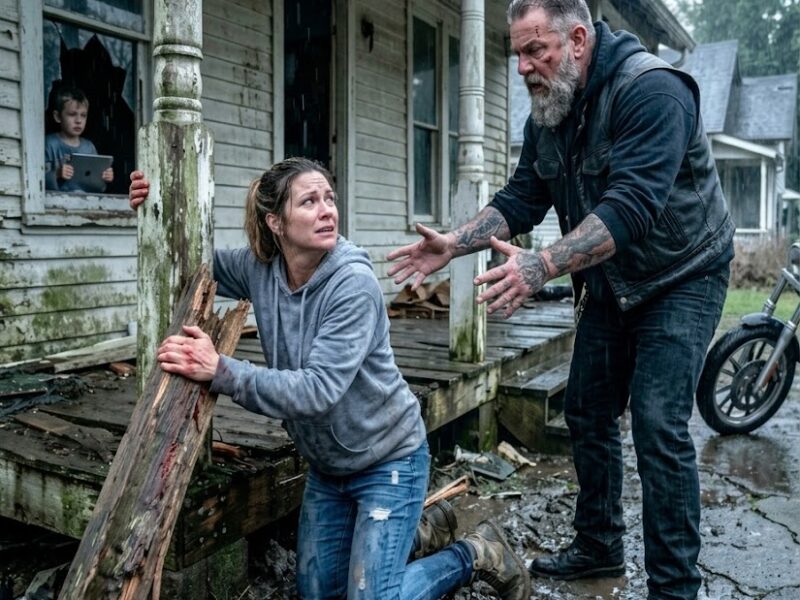
A single mom was struggling to fix her run-down home all alone — until a Hell’s Angel noticed, and sent 50 bikers to rebuild it from the ground up.
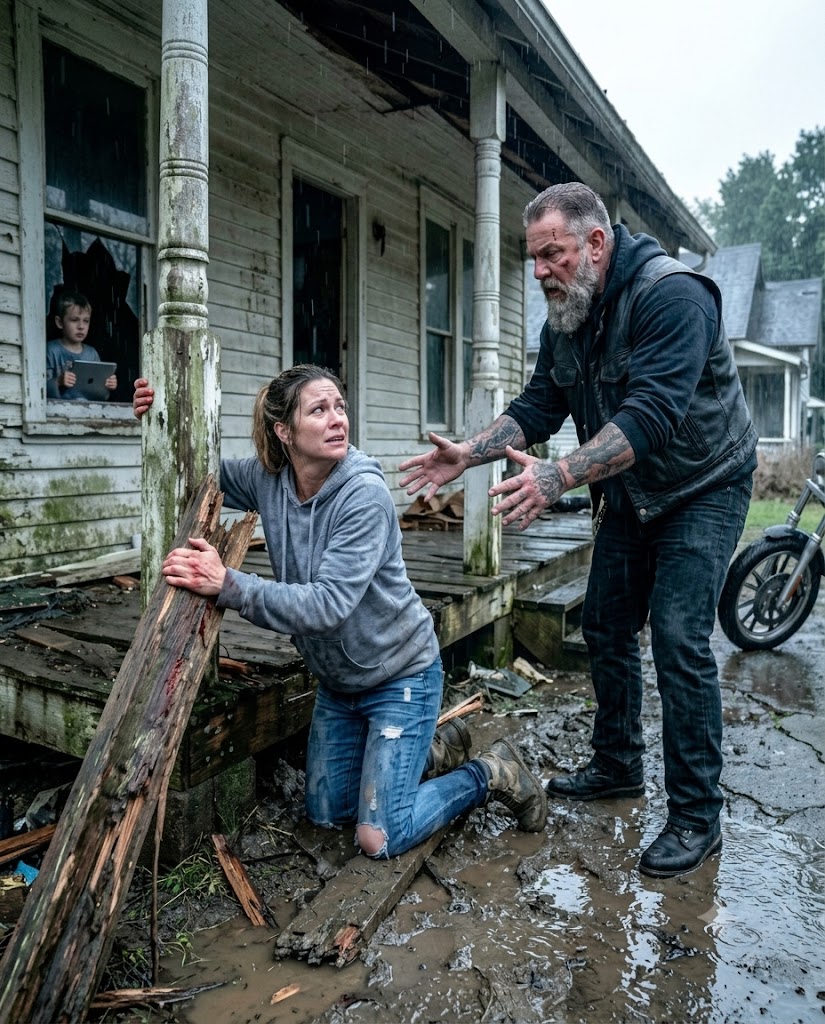
Rainwater tasted like copper and old dust.
Maggie pressed her forehead against the sagging aluminum siding of the porch, letting the chill numb the throbbing behind her eyes. She smelled wet rot. It was the kind of damp, pervasive decay that lived in the very bones of the house she’d bought out of sheer desperation six months ago. This place was supposed to be a sanctuary after the divorce drained her accounts. Instead, it was a trap built of crumbling drywall and black mold.
A rusted framing nail bent sideways under the uneven strike of her hammer. Maggie swore, a sharp guttural sound that was instantly swallowed by the heavy downpour. She dropped the hammer. It landed in the mud with a wet thud, splashing brown grit across her already ruined work boots. Her hands were blistered, the skin around her knuckles cracked and bleeding from wrestling with splintered two-by-fours all morning. She was trying to reinforce a load-bearing porch pillar before the roof collapsed, a job meant for three men with proper tools, not one exhausted woman operating on four hours of sleep and cheap bitter coffee.
Inside the house, visible through a cracked windowpane taped together with duct tape, her seven-year-old son, Leo, sat cross-legged on a mattress on the floor. He was watching cartoons on a tablet with a shattered screen. The faint blue light painted his pale face. Maggie felt the familiar sickening twist of guilt in her gut. It was a heavy physical ache right below her ribs. She resented the house. On her darkest days, she resented the trapped feeling of it all.
She wiped a mixture of sweat and rain from her eyes, leaving a smear of grease across her cheek, and bent to retrieve the hammer. The fiberglass insulation she’d been ripping out earlier had worked its way under her collar, biting into her skin like microscopic glass shards. She hated this. She hated the vulnerability of poverty, the way it stripped away dignity until you were just a tired animal fighting the elements in your own front yard.
That was when the vibration started.
It wasn’t a sound at first, but a low, rhythmic trembling in the cracked concrete of the driveway. Maggie paused, the muddy hammer loose in her grip. The vibration built into a deep, mechanical roar, echoing off the dilapidated houses of the dead-end street. A single motorcycle turned the corner. It wasn’t a sleek sports bike. It was a massive, stripped-down Harley-Davidson, flat black and loud enough to rattle the fillings in her teeth. The rider slowed, the heavy tires crushing wet gravel as he coasted to a stop right at the edge of her property line. He didn’t cut the engine. The V-twin idled with an aggressive, uneven lope.
Maggie stared, her defensive instincts instantly flaring. He was a mountain of a man, wide-shouldered and thick with muscle, sitting astride the trembling machine. Rain sheeted off a battered black leather vest worn over a soaked gray hoodie. On the back of the vest, a massive patch was stitched into the leather, a winged death’s head. Hells Angels. The bottom rocker read Washington. Maggie tightened her grip on the hammer. She wasn’t a fool, and she wasn’t naive. She knew what that patch meant. The neighborhood was rough, filled with forgotten people, but the arrival of a 1% motorcycle club on her curb was an entirely different kind of trouble.
The biker kicked the heavy kickstand down and stepped off. He didn’t take off his helmet immediately. He just stood there, arms crossed over his chest, rain dripping from the visor, watching her. Maggie felt a hot spike of anger cut through her exhaustion. She didn’t need an audience. She didn’t need some outlaw watching her fail to hold up a rotting piece of wood. She turned her back to him, stubbornly grabbing the heavy waterlogged 4×4 beam she’d been trying to wedge under the porch roof.
“Get under there, you piece of shit,” she hissed through her teeth, driving her shoulder into the rough wood. She pushed upward, her boots slipping in the mud. Her muscles screamed in protest. The beam shifted, scraping against the aluminum overhang, but it was too heavy, slick with rain and slime. It slid out of her grip, crashing down heavily against her shin. Maggie cried out, biting her lip so hard she tasted blood, and dropped to one knee. The pain was blinding, a sharp white-hot flash that made her stomach heave. She clutched her leg, fighting back a wave of humiliating tears. She wouldn’t cry. Not out here. Not in front of whoever this was.
Heavy steel-toed boots crunched on the gravel. She smelled him before she looked up. A sharp, distinct mix of unburned gasoline, wet leather, and stale tobacco.
“You’re doing it wrong.” A voice rumbled. It was deep, scraped raw like dragging a cinder block across asphalt.
Maggie jerked her head up. The biker had removed his helmet. He had a thick graying beard, deep-set eyes that looked entirely unimpressed, and a jagged scar cutting through his left eyebrow. He wasn’t looking at her with pity. There was no savior complex in his eyes. He was looking at the collapsed beam like it was a puzzle that annoyed him.
“I didn’t ask for your opinion.” Maggie snapped, her voice trembling as she forced herself to stand, leaning heavily on her good leg.
“Didn’t offer an opinion, stated a fact.” The man replied evenly. His name stitched on a small patch on his chest read Garrett. “Wood’s rotten. You try to force a load-bearing post under that compromised fascia, the whole roof’s coming down on your head. And the kid inside.”
Maggie flinched. He had noticed Leo. “I can handle it. Go away.”
Garrett didn’t move. He looked at the cracked siding, the sinking foundation, the missing shingles on the main roof. It was a brutal, clinical appraisal. He wasn’t judging her. He was sizing up the damage. He reached down, effortlessly hoisting the heavy 4 by 4 beam with one massive tattooed hand, and tossed it to the side of the yard like it was a twig.
“You need a jack and a steel brace,” Garrett said. He turned on his heel, boots sinking into the mud, and walked back to his bike. Maggie watched, bewildered and angry, as he threw a thick leg over the saddle. He fired up the engine, drowning out the rain, and without another look in her direction, kicked it into gear and roared down the street, leaving nothing behind but the smell of exhaust and the cold realization that she was completely out of her depth.
Saturday morning tasted like stale pennies and panic.
Maggie sat at her chipped Formica kitchen table, staring at a stack of past-due bills wrapped in a rubber band. The coffee in her mug had gone cold, forming a bitter, dark skin on the surface. Her shin was heavily bruised, a mottled canvas of purple and yellow creeping up to her knee, throbbing with a dull ache every time she shifted her weight. Two days had passed since the biker, Garrett, had stopped in front of her yard. She had tried to forget the encounter, chalking it up to a bizarre, isolated incident in a neighborhood where strange things happened regularly. She had propped up the porch roof temporarily with a stack of cinder blocks she dragged from the alley, a precarious fix that made her hold her breath every time the wind blew.
She rubbed her temples, listening to the drip, drip, drip of water leaking from the ceiling into a plastic bucket in the hallway. The house was dying around her, and she had exactly $42 in her checking account until next Thursday. Then, the air pressure in the kitchen shifted. It wasn’t a sound, not initially. It was a feeling in her chest. A low, resonant frequency that made the water in her cold coffee vibrate. The cheap ceramic plates in the cupboards began to chatter against each other. Maggie frowned, standing up and limping toward the front window. She pulled back the faded curtain, expecting to see a garbage truck or a low-flying cargo plane.
Instead, the street was filling with metal.
They rolled around the corner in a tight staggered formation, a mechanized cavalry clad in denim and black leather. The noise was apocalyptic. It wasn’t just one motorcycle. It was an ocean of them. The deafening, synchronized thunder of 50 V-twin engines echoed off the narrow street, drowning out the ambient sounds of the city. Maggie’s breath caught in her throat. Her heart hammered against her ribs like a trapped bird. They parked in a long, unbroken line that stretched past her house and down the block, taking over the curbs, the sidewalks, and the edges of her dead grass lawn. The sheer mass of them was terrifying. These were big, hard-looking men. Beards, tattoos winding up their necks, scarred faces, and heavy boots. Every single one of them wore the winged death’s-head patch of the Hells Angels.
Neighbors up and down the street were pulling their blinds shut, locking their deadbolts, hiding. Maggie stumbled backward, instinctively moving toward the hallway where Leo was playing with his battered toy cars. Her mind raced. Had she insulted Garrett? Did she owe someone money without realizing it? You didn’t attract the attention of 50 Hells Angels unless you were in deep, inescapable trouble.
Before she could process a plan, grab Leo, run out the back door, call the police who probably wouldn’t show up anyway. Heavy footsteps crossed her porch. The cinder blocks groaned under the weight. Someone knocked. It wasn’t a polite knock. It was a solid, authoritative pounding that rattled the door frame. Maggie swallowed the dry lump in her throat. She picked up a heavy cast-iron skillet from the stove, a ridiculous, pathetic weapon against an army of outlaws, and walked to the door. Her hand shook as she undid the deadbolt and pulled the door open an inch.
Garrett stood on the porch. He was wearing the same heavy leather cut. Behind him, her front yard was swarming. Men were already unstrapping heavy canvas tool bags from the back of their bikes. Someone was carrying a massive hydraulic jack. Another man, heavily tattooed with a bald head, was tossing thick coils of heavy-duty extension cords across the lawn.
“What do you want?” Maggie asked, her voice cracking. She held the skillet tightly, trying to hide it behind the door.
Garrett looked down at her, then his eyes flicked to the skillet she was attempting to conceal. A muscle feathered in his jaw, the closest thing to amusement she had seen on his rough face. “Put the pan away,” Garrett grunted. “You’re going to break your wrist trying to swing that at me.”
“I asked what you want,” Maggie repeated, refusing to back down even as her knees trembled. “I don’t have any money. I don’t want any trouble.”
“Ain’t here for your money,” Garrett said. Then he turned and gestured to the chaos in her yard. “Brought some hands. We got three roofers, two electricians, and enough carpenters to frame a house by sundown. Dutch brought a flatbed with lumber pulling up the rear.”
Maggie stared at him, her brain short-circuiting. The smell of exhaust fumes and cigarette smoke drifted into the house. “Why?”
“Because that porch is going to crush your kid if it rains again,” Garrett said flatly. He didn’t offer a warm smile. He didn’t act like a hero. He sounded annoyed that the porch was structurally unsound, as if the shoddy carpentry offended him personally.
A massive biker with a braided beard walked up onto the porch holding a crowbar. “Garrett, we tearing this fascia off or jacking the whole sill plate?”
“Jack the plate, Hoss. The rot goes down to the foundation,” Garrett ordered. He looked back at Maggie. “You want to stand in the doorway all day, or you want to show us where the breaker box is?”
Maggie’s defensive walls, built high and thick over years of betrayal and disappointment, didn’t immediately crumble. She didn’t feel a wash of immense gratitude. She felt deeply, profoundly suspicious. Nobody did anything for free. The world didn’t work like that.
“I can’t pay you,” she insisted, her voice tight. “I won’t owe you.”
Garrett leaned in slightly, his dark eyes locking onto hers. The scent of motor oil and old leather was overwhelming. “Look around, lady. You think any of these guys need your 40 bucks? We’re doing this because I said we’re doing it. Now the breaker box, where is it?”
Maggie hesitated for one long agonizing second. The roar of the engines had died down replaced by the heavy metallic clanking of tools, the thud of lumber hitting the dirt, and the gruff shouts of men coordinating a teardown. She looked at Garrett’s face searching for the catch, the hidden cost. She saw nothing but impatient pragmatism. She lowered the skillet.
“It’s in the basement.”
“Show me,” Garrett said stepping past her into the damp mildew scented hallway, his massive frame making her house feel even smaller. The invasion had begun and Maggie realized with a terrifying knot in her stomach that she was entirely powerless to stop it.
Sawdust coated the back of Maggie’s throat like powdered chalk.
She stood at the top of the basement stairs, her hands gripping the door frame so tightly her knuckles ached. Below her, the narrow musty space was filled with a harsh scrape of heavy boots and the sharp tang of ozone. Garrett was down there with a flashlight held between his teeth, his massive shoulders brushing against the cobweb draped floor joists. He was yanking out loops of frayed illegal wire the previous owner had jury-rigged to bypass a blown fuse. Upstairs, her living room had become a war zone.
Poverty is intensely private. It hides behind closed doors masked by drawn curtains and ignored phone calls. Having 50 intimidating heavily tattooed men tear her house apart felt like being stripped naked in the middle of the street. Every piece of rotted wood they ripped from the walls, every patch of black mold they exposed with their crowbars was a billboard broadcasting her failure to provide.
A deafening roar ripped through the house as a reciprocating saw bit into a stubborn 2 by 4. Maggie flinched, the sound vibrating deep in her chest. She backed out of the hallway, nearly tripping over a heavy canvas drop cloth. She needed to do something. The sheer helplessness was suffocating. She couldn’t just watch these men, these violent outlaws with wrap-around sunglasses and scarred knuckles, fix her life while she cowered in the corner.
Maggie hurried into the kitchen, grabbed a cheap plastic broom with bent bristles, and marched back into the living room. A giant of a man wearing a grease-stained bandana was currently taking a sledgehammer to the crumbling plaster surrounding her front window. Chunks of white debris rained down, turning the hardwood floor white. Maggie marched right up to the edge of his swing radius and started sweeping. It was a completely futile gesture. She was pushing a small pile of dust around while chunks of plaster the size of dinner plates crashed down a foot away.
The biker paused, leaning the heavy sledgehammer against his hip. He looked at her, then down at her pathetic pile of dust, and let out a huff of breath that smelled like wintergreen chewing tobacco.
“Ma’am, you’re in the drop zone,” he said. His voice was surprisingly soft, a stark contrast to the aggressive ink creeping up his neck.
“I’m cleaning up.” Maggie snapped, her voice high and defensive. She swept harder, the bristles snapping against the floorboards. “It’s my house. I’m cleaning.”
The biker didn’t argue. He just watched her for a second, recognizing the frantic cornered animal energy radiating off her. He nodded slowly, stepped back, and pulled a walkie-talkie from his belt. “Hey, Hoss. Hold up on the demo in the front room. Homeowner’s doing a sweep.”
Maggie stopped, her chest heaving, the broom handle slick with her own sweat. She felt entirely ridiculous. She looked over her shoulder. Sitting on the kitchen counter, well out of the dust, was Leo. He hadn’t run away. He hadn’t cried. He was sitting cross-legged, holding his tablet, completely mesmerized. A biker with a long gray braid and a patch that read “Nomad” was standing near him, mixing a bucket of quick-set cement. The man wasn’t talking down to Leo. He was working in silence, but every time he scooped the gray powder, he let Leo toss a small pebble into the bucket. Leo’s eyes were wide, tracking the man’s massive calloused hands with quiet awe.
“He likes the kid.” Maggie spun around. Garrett had emerged from the basement, wiping grease off his hands with a dark rag. His boots left dirty tracks on the linoleum, but Maggie didn’t care. The house was already destroyed.
“You shouldn’t let him near the cement. The dust is bad for his lungs.” Maggie said, immediately defaulting to an argument to cover her own anxiety.
Garrett looked at her, truly looked at her, his dark eyes cutting through the bravado. He tossed the dirty rag onto a nearby counter. “Nomad put a mask on him 10 minutes ago. Kid’s fine.”
Maggie squinted through the haze of the room. Garrett was right. A heavy-duty industrial dust mask was strapped to Leo’s small face, making him look like a tiny fighter pilot. The knot of tension in her stomach tightened instead of releasing.
“Why are you letting them do this?” she asked, her voice dropping to a harsh whisper. She stepped closer to Garrett, ignoring the sharp smell of gasoline and sweat radiating from his leather vest. “You come in here, you take over my house, you order me around. What is the angle? Nobody just fixes a foundation out of the goodness of their hearts, especially not guys who wear death’s heads on their backs.”
Garrett didn’t blink. He crossed his thick arms, the leather of his cut creaking under the strain. He looked around the gutted room, observing the framing going up. The fresh yellow pine replacing the black spongy rot.
“You think too much.” Garrett rumbled.
“And you don’t explain anything.” she shot back.
He leaned down slightly, his voice a low, gravelly hum that barely carried over the noise of the power tools. “I don’t owe you an explanation, lady. We ride by. We see a porch that’s a stiff breeze away from crushing a kid. We got guys who swing hammers. We got lumber. It ain’t a conspiracy. It’s just work.”
Maggie stared at the jagged scar slicing through his eyebrow. She wanted to yell at him, to kick him out and reclaim her miserable failing independence. But as she listened to the rhythmic, undeniable sound of nails driving into fresh wood, a sound that meant safety, she realized she couldn’t. She swallowed hard, her throat burning. She tightened her grip on the plastic broom, lowered her head, and went back to sweeping the impossible dust.
Dusk arrived without romance.
The sky didn’t turn bruise purple or gold. It just bled into a flat, industrial gray that matched the cracked pavement outside. Heavy halogen work lights buzzed to life in Maggie’s front yard, casting stark, blinding beams across the torn-up lawn, and the half-finished skeleton of her new porch. The neighborhood remained deathly quiet. Normally, Saturday nights here meant the thud of cheap car stereos, shouting matches spilling out of dive bars down the avenue, and the distant, anxiety-inducing pop of fireworks or gunfire. Tonight, nothing moved. The 50 motorcycles parked on the street acted like a steel barricade. The Hells Angels had effectively annexed the block, and the city had decided to look the other way.
Maggie sat on the back steps of her house, shivering in a thin cardigan. The air had turned damp and cold, carrying the sharp scent of hot asphalt roofing tar. Behind her, the kitchen was unrecognizable. The leaky plumbing had been ripped out, and the walls were stripped to the studs, exposing the intricate hidden arteries of the house. Her legs ached. Her blistered hands throbbed. She had spent the last 4 hours ferrying cold bottles of water from a massive cooler someone had dragged onto the lawn, trying to make herself useful, trying to earn a charity she hadn’t asked for. Most of the men just grunted a quiet, “Thanks, ma’am.” and went back to swinging hammers.
Gravel crunched heavily nearby. Maggie didn’t turn. She knew the heavy, deliberate tread by now. Garrett walked around the corner of the house holding two steaming foam cups. He looked exhausted. Smeared black grease painted his forehead, and his heavy leather vest was dusted with white drywall powder. He stopped at the bottom of the steps holding out one of the cups.
“Black. Like you were drinking yesterday.”
Maggie hesitated, staring at the cup. Her cynical brain screamed at her to refuse it, to maintain the fragile barrier between them, but her fingers were freezing, and the smell of cheap burned coffee was agonizingly tempting. She reached out and took it. Her fingertips brushed against the thick, calloused leather of his knuckles. He felt like coarse grit sandpaper.
“Thanks.” she muttered, pulling the cup to her chest to absorb the heat.
Garrett didn’t walk away. He sat down heavily on the bottom step, leaving a foot of space between them. He stretched his massive legs out, his heavy boots resting in the mud, and took a slow sip from his own cup. The silence between them was thick, punctuated only by the distant hum of a generator and the rhythmic slap of a staple gun from the roof.
“Roof sealed,” Garrett said abruptly, staring straight ahead at her overgrown, weed-choked backyard. “Waterproofing goes on tomorrow. Framers will have the porch load-bearing by noon. You’ll be safe to sleep upstairs tonight.”
Maggie traced the rim of the foam cup with her thumb. The heat was seeping into her frozen joints. “I still have exactly $42 in my bank account. When the city inspector drives by next week and sees unpermitted structural work on my property, he’s going to fine me into oblivion.” It was a harsh, ungrateful thing to say, but she needed to inject reality back into this bizarre fever dream.
Garrett chuckled. It was a dry, scraping sound deep in his chest. “Inspector ain’t going to say shit.”
“You can’t intimidate the city government,” Maggie said, looking down at the top of his head.
Garrett turned his head slowly, looking at her over his shoulder. The harsh backlighting from the halogen lamps cast deep shadows across his face, making him look dangerous, predatory. “Lady, who do you think runs the plumbing and electrical unions in this county? Half the guys working in your living room right now golf with the city inspector. The permits were pulled at 4:00 yesterday afternoon under a shell LLC. It’s clean.”
Maggie felt the wind knocked out of her. She stared at him, her mind struggling to process the sheer scale of the operation. They hadn’t just brought hammers. They had brought bureaucracy.
“Why?” The word tore out of her throat before she could stop it. The protective anger she had been clutching all day finally cracked, leaving raw, jagged confusion in its place. “Don’t give me that about seeing a bad porch. People see bad things all the time. People walk past homeless veterans. People watch kids starve. Nobody stops. You stopped.”
Garrett turned his head back to the yard. He took another sip of his coffee. For a long minute she thought he wasn’t going to answer. The staple gun on the roof fired three times in rapid succession.
“My mother was a waitress at a truck stop out on I-90,” Garrett said, his voice flat, devoid of any self-pity or melodrama. It was simply a recitation of facts. “Raised me and my brother in a single-wide trailer. Floor rotted out in the bathroom. She didn’t have the cash to fix it. Just put a piece of plywood over the hole.” He stopped, crushing the foam cup slightly in his grip. The dark coffee sloshed close to the rim. “One night I was six, brother was eight. We’re sleeping. Hear a crash. Mom fell through the floor. Plywood snapped. She caught her leg on a rusted crossbeam underneath the rig.”
Garrett stared into the dark overgrown grass. “Took 4 hours for the fire department to cut her out. Artery was shredded. She bled out holding my hand while I sat on the linoleum.”
Maggie stopped breathing. The cold air suddenly felt like ice against her skin. She looked at the brutal graying man sitting at her feet, seeing past the leather and the death’s head patch for the very first time.
“A house shouldn’t eat its people.” Garrett finished quietly. He tossed the remaining coffee into the dirt and crushed the cup in his fist. He stood up, towering over her, his face a mask of stone once again. “Get some sleep, Maggie. We start ripping the siding at dawn.”
He walked away, his heavy boots crunching into the darkness. Maggie sat alone on the steps, the foam cup trembling violently in her blistered hands. She looked back at the exposed, splintered bones of her house. The tears she had fought back for 6 months finally spilling hot and fast down her dirty cheeks.
Sunday morning smelled of burnt bacon fat and wet mud.
Maggie stood over her rusted four-burner stove, a pair of cheap metal tongs in her blistered hand, flipping strip after strip of thin, translucent bacon. Grease popped, stinging her bare forearm, but she didn’t flinch. She just wiped the hot oil away with the back of her wrist and kept cooking. She had taken her last $42, driven to the discount grocery store at 6:00 in the morning, and bought four dozen eggs, five packages of the cheapest meat they sold, and six loaves of generic white bread. It was a reckless, stupid decision. She had zero left in her checking account. No money for gas, no safety net. But as she listened to the heavy, synchronized thud of boots climbing onto her roof outside, a fierce, primal stubbornness seized her. She would not be a charity case. She could not pay for the lumber, the permits, or the skilled labor, but she could feed them. It was the only currency she had left.
The kitchen was already sweltering. Steam rolled off a massive dented aluminum pot filled with boiling water where she was scalding tomatoes to peel for a makeshift hash.
“Smells like a diner in here.”
Maggie jumped, dropping the tongs against the edge of the skillet. Garrett was leaning against the doorframe. He wore a fresh black T-shirt that stretched tight across his chest. His heavily tattooed arms crossed. The harsh daylight exposed the gray in his beard and the deep exhausted lines bracketing his mouth. He looked at the towering stack of toast on the counter, then at the massive bowl of scrambled eggs Maggie was frantically whisking.
“I bought breakfast,” Maggie said, her voice defensively sharp. She grabbed a chipped ceramic plate and shoved it toward him. “Eat.”
Garrett uncrossed his arms. He didn’t argue. He walked over, the floorboards groaning under his weight, and took the plate. He piled it high with eggs and bacon, grabbed three slices of toast, and leaned against the counter eating in silence. He didn’t eat politely. He ate like a man who was used to consuming calories quickly before the next job, eyes scanning the kitchen, assessing the water damage around the sink basin.
Within 10 minutes, the house was filled with them. Massive men in cut-off shirts and leather vests crowded into her tiny dilapidated kitchen. They smelled of sweat, stale cigarettes, and fresh sawdust. It was deeply surreal. These were men who looked like they belonged in a police lineup, politely forming a single-file line saying, “Thank you, ma’am.” and “Appreciate it.” in low, rumbling voices as she handed out paper plates.
Hoss, the giant with the braided beard, carefully balanced a tiny paper plate on his massive palm, chewing thoughtfully. “Good bacon, Maggie.” he grunted, using her name for the first time.
“It’s the cheap stuff.” she muttered, feeling a strange, hollow ache in her chest.
“Salt is salt.” Hoss replied, walking back out the front door.
Maggie leaned against the sink, watching them spread out across her front yard, eating their breakfast while sitting on stacks of plywood and the saddles of their motorcycles. They looked like an invading army taking a ration break.
A sharp, demanding knock on the back door shattered the moment. Maggie turned. Through the grimy glass pane, she saw Mrs. Higgins, her next-door neighbor. Higgins was a retired administrative assistant who spent her days peering through her blinds, meticulously pruning her rose bushes, and calling the city about tall grass. She wore a tight floral bathrobe and a deeply disapproving scowl.
Maggie unlocked the door and cracked it open. The cold morning air hit her face, carrying the harsh buzz of a circular saw starting up in the front yard.
“Maggie, what on earth is going on?” Mrs. Higgins demanded, her shrill voice cutting through the mechanical noise. She pointed a trembling, manicured finger toward the street. “There is a gang in your yard, a literal gang. They are parked on my swale, and the noise started at dawn. It is Sunday.”
“They’re fixing the porch, Helen,” Maggie said tiredly, wiping her hands on a dish towel.
“They are criminals,” Mrs. Higgins hissed, her eyes darting nervously toward the corner of the house as if expecting a biker to jump out from the bushes. “I called the police 20 minutes ago. You need to get them off the street before someone gets killed.”
A hot sudden spike of rage flared in Maggie’s chest. It wasn’t the slow simmering frustration she felt about her bank account. It was a violent protective anger. She thought of Garrett sitting on her steps crushing a coffee cup talking about his mother bleeding out on a linoleum floor. She thought of the $40 she just spent to feed men who were tearing her rotting house apart just to put it back together again.
“You called the cops?” Maggie’s voice dropped an octave. It sounded raspy, dangerous.
“Of course I did.”
Maggie pushed the door open all the way stepping out onto the small back porch. She was half a foot shorter than Mrs. Higgins smelling of cheap bacon and sweat. But the older woman instinctively took a step back.
“Listen to me very carefully, Helen,” Maggie said, her teeth clenched so tightly her jaw ached. “My porch was going to collapse. My roof has been leaking for 6 months. I’ve watched you water your driveway every afternoon while I carried buckets of dirty water out of my living room. You never offered to help. You never even said hello.”
Mrs. Higgins gaped, her mouth working uselessly.
“Those men out there,” Maggie continued pointing a blistered finger toward the front yard, “they are the only people in this entire miserable city who gave a damn whether my kid was going to get crushed under a falling roof. So, if the cops show up, you tell them it was a mistake. If you try to stop this, if you say one word to them, I swear to God I will back my car over your prized rose bushes.”
Maggie stepped back inside and slammed the door, the cheap glass rattling in its frame. She stood in the quiet kitchen, her heart hammering against her ribs, her hands shaking violently. She realized, with a terrifying clarity, that she had just drawn a line in the sand. She had chosen her side.
Peeling away the aluminum siding of the west wall revealed a hidden graveyard.
Maggie stood ankle-deep in crushed weeds, holding a crowbar she barely knew how to use, staring at the exposed skeleton of her home. The wood beneath the faded yellow aluminum was black and spongy, riddled with carpenter ant tunnels and powdery white rot. It smelled intensely of damp earth and centuries of slow decay. Her house wasn’t just broken, it was diseased. Seeing it laid bare like this, completely stripped of its superficial covering, made Maggie’s stomach turn. It felt like a brutal metaphor for her own life over the past year. The ugly, rotting foundation hidden beneath a thin, unconvincing layer of normalcy.
“Don’t look at it too long. It’ll just make you depressed.”
Garrett stepped up beside her. He was holding a massive reciprocating saw, the heavy battery pack strapped to his hip. He didn’t look at her. His eyes were scanning the rotted sill plate, doing the complex mental math of load distribution and structural integrity.
“How is it even standing?” Maggie asked, her voice barely a whisper.
“Habit,” Garrett grunted. “And tension. Sometimes things hold together just because they don’t know how to fall apart yet.” He stepped forward, kicking a particularly soft piece of wood with the steel toe of his boot. It crumbled into wet splinters. “We’re going to have to sister these joists, put fresh pressure-treated lumber right alongside the dead wood and bolt them together. Transfer the weight. You don’t take out the bad, you just make the good stronger so it can carry the load.”
Maggie looked at him. The metaphor was heavy, but Garrett wasn’t a poet. He was a mechanic talking about wood. He raised the heavy saw, the blade biting viciously into the rotting timber, raining black dust over his boots. The noise was deafening, a shrieking mechanical wail that vibrated in Maggie’s teeth. She took a step back, coughing into her sleeve, and retreated toward the backyard. She needed a minute to breathe. The constant noise, the dust, the overwhelming presence of 50 men. It was sensory overload.
She rounded the corner near the rusted chain-link fence and stopped. Leo was sitting on an overturned plastic bucket. He wasn’t holding his cracked tablet. He wasn’t isolating himself in the digital world like he usually did when the real world got too loud or too scary. He was holding a piece of coarse sandpaper. Sitting across from him, cross-legged in the dirt despite his heavy leather cut, was Hoss. The massive biker had a piece of fresh pine clamped between his knees. He was showing Leo how to smooth the edges.
“You got to go with the grain, little man.” Hoss rumbled gently. His hands were covered in faded prison ink, the knuckles scarred and thick. But he guided Leo’s small, pale hand with surprising delicacy. “You fight the grain, you get splinters. You follow it, the wood gets smooth. Try it.”
Leo pressed the sandpaper against the wood. He bit his lower lip in intense concentration, dragging his hand in a straight line. “Like that?” Leo asked. It was the first time Maggie had heard him speak to anyone besides her in months.
“Exactly like that.” Hoss said, nodding approvingly. “You’re a natural. When we build the new railing for the porch, you can sand the balusters. Make sure nobody gets a splinter. Important job.”
Leo’s eyes widened, shining with a sudden, fierce pride. “Okay.”
Maggie leaned against the rough bark of the old oak tree in the yard. Her chest tightened painfully. Her ex-husband, a man who wore tailored suits and smelled of expensive cologne, had never once sat in the dirt with Leo. He had found fatherhood inconvenient, messy, and ultimately expendable. He had walked away to a cleaner life, leaving Maggie to drown in the wreckage. Now, her son was learning about hard work and responsibility from a man who had a teardrop tattooed under his right eye and carried a folding knife the size of a machete on his belt. It was completely insane. It broke every rule of proper parenting she had ever read.
And yet, as she watched Hoss patiently explain the difference between a framing nail and a finishing nail, Maggie felt a profound, exhausting wave of relief wash over her. Leo was safe. The bikers weren’t treating him like a fragile piece of glass. They were treating him like a crew member. They were giving him purpose in the middle of the chaos.
“He’s a good kid.”
Maggie didn’t jump this time. She turned her head. Garrett had followed her to the back, wiping sawdust from his beard with a dirty rag. He stood a few feet away watching Hoss and Leo.
“He doesn’t talk much,” Maggie said quietly, crossing her arms against the late afternoon chill.
“Doesn’t need to,” Garrett replied. “Most men talk too much anyway. Try to fill up the quiet because they’re scared of what’s in it. Kid knows how to just be.”
Maggie looked down at her blistered hands. “The police came by earlier. A cruiser drove slowly down the block.”
“I know,” Garrett said. “Dutch handled it. Offered the officers a cup of your coffee. They kept driving.”
“Just like that?”
“Just like that.” Garrett turned to look at her, the harsh angles of his face softening just a fraction in the fading light. “You fought the neighbor.”
It wasn’t a question. Maggie felt a flush of heat rise in her cheeks. “Helen Higgins is a busybody. I told her if she interfered, I’d run over her roses.”
A slow, genuine smirk tugged at the corner of Garrett’s mouth. It changed his entire face, wiping away years of hardened violence, revealing a glimpse of something fiercely loyal underneath. “Good for you, Maggie. About time you stopped letting people walk all over your lawn.”
He turned and walked back toward the roar of the saws, leaving Maggie in the quiet backyard. She watched him go, feeling the cold wind bite through her thin sweater. But for the first time in 6 months, she didn’t feel entirely alone in the storm.
Monday tasted like chalk dust and cheap black tea.
The ocean of 50 motorcycles had receded, leaving behind a core crew of 12 men who moved through Maggie’s house with terrifying, practiced efficiency. The framing was done. The massive, gaping wounds in her living room walls had been filled with thick, pink fiberglass insulation, trapping the heat inside for the first time since she had bought the place. Now came the drywall. Heavy sheets of gypsum board were carried in by pairs of massive, leather-clad men, their boots leaving dusty, white tracks across the scuffed hardwood. The noise had changed from the aggressive shriek of demolition to the rhythmic, rapid-fire thwack of screw guns driving black metal into yellow pine.
Maggie stood in the center of the kitchen, her hands submerged in a sink full of hot, soapy water. She was washing the breakfast plates, her knuckles raw and stinging. The water was actually hot. A man named Dutch, whose neck was entirely covered in a sprawling, intricate spider web tattoo, had spent 6 hours in her cramped basement the day before quietly replacing the corroded heating element in her water heater. He hadn’t asked for permission. He had simply walked upstairs, handed her a rusted, calcified metal rod, and grunted, “Throw that out.”
She scrubbed a plate until her fingers cramped. The sheer weight of what these men were doing was threatening to crush her. It was a suffocating kind of debt, the kind that couldn’t be paid back with cheap bacon and instant coffee.
“You’re taking the enamel off that plate.”
Garrett stepped into the kitchen, ducking slightly to avoid the low door frame. He wasn’t wearing his leather cut today, just a heavy flannel shirt rolled up to his thick elbows. Fine white drywall dust coated his hair and the gray in his beard, making him look older, weathered like a stone monument left out in the wind. Maggie stopped scrubbing, but didn’t drop the plate. She stared down at the soapy water.
“I don’t know how to do this,” she said. Her voice was tight, brittle, right on the edge of breaking.
“Wash dishes?” Garrett asked, stepping closer to the counter. He smelled of joint compound and sweat.
“Accept this,” Maggie corrected sharply, looking up at him. Her eyes were bloodshot from exhaustion and dust. “I have spent my entire adult life fighting for every single inch. My ex-husband fought me for the bank accounts. The lawyers fought me for their fees. The city fought me over the property lines. Every time someone steps onto my lawn, it costs me something. I don’t know how to just stand here and let you rebuild my house.”
Garrett leaned against the counter, crossing his arms. He didn’t offer a platitude. He didn’t tell her it was okay or that she deserved it. He just looked at her with those dark, unreadable eyes.
“You’re waiting for the other shoe to drop,” he observed flatly.
“Yes.”
“You think we’re going to finish this porch, pick up our tools, and then hand you an invoice? Or maybe ask you to run drugs out of your basement.”
Maggie flinched. The bluntness of his words hit her like a physical blow. “I don’t know what to think.”
Garrett reached out, his massive, calloused hand gently taking the wet, soapy plate from her tight grip. He set it down on the drying rack. “We ride under a patch that scares 99% of the world, Maggie. We know what people think. We don’t care. But we got rules. We got a code. You don’t prey on a woman trying to keep a roof over her kids’ head. You just don’t.”
He grabbed a dry towel and wiped the soap from his fingers. “When I was 19, I caught a charge. Aggravated assault. Guy deserved it, but the law didn’t see it that way. I was looking at 5 years hard time. Public defender told me to take a plea. Then a guy I barely knew, a guy who rode with the club, put up his own house against my bail. Paid a real lawyer. Got the charges dropped.”
Garrett tossed the towel onto the counter. He looked out the window, his jaw tightening. “I asked him how I was supposed to pay him back,” Garrett continued, his voice dropping to a low rumble. “He told me, ‘You don’t pay it back, kid. You pay it forward when you have the weight to carry it.'”
“I have the weight now, Maggie. The club has the weight. You don’t owe us a damn thing. You owe the next person who falls through the floorboards.”
Maggie stared at him, the knot in her chest pulling so tight she could barely breathe. It was a completely alien philosophy built on a brutal underground loyalty she couldn’t fully comprehend.
“I can’t just do nothing,” she whispered, a stubborn tear finally breaking free and tracking through the dust on her cheek. She wiped it away furiously with the back of her wrist.
Garrett watched her fight the tears. He didn’t pity her. “Hoss is mudding the seams in the hallway. He’s got hands like catcher’s mitts. He’s terrible at the detail work. You want to do something? Go grab a 6-in taping knife and smooth out his corners. Otherwise, the paint’s going to look like garbage.”
Maggie blinked, taken aback by the sudden shift to pure functional pragmatism. She looked at Garrett, seeing the faint challenging spark in his eyes. He was giving her a way out. An out from the guilt. An out from the helplessness.
“A 6-in knife?” she repeated.
“And keep the blade wet,” Garrett instructed, turning to walk back toward the chaos of the living room. “Hoss mixes the joint compound too dry.”
Maggie stood in the kitchen for a long moment, listening to the heavy boots and the hum of machinery. She dried her raw, blistered hands, took a deep breath of dusty air, and walked out to find a taping knife.
Polyurethane fumes burned the back of Maggie’s nose, a sharp chemical scent that somehow felt entirely like victory.
It was Wednesday evening. The heavy halogen work lights were humming again, casting long stark shadows across the brand new structurally sound front porch. The transformation was violent in its suddenness. The rotting sagging disaster that had threatened to crush her son was gone. In its place stood a fortress of pressure-treated lumber, thick solid 6 by 6 pillars, and an elegant tightly spaced balustrade. The roof overhead was sealed with fresh black architectural shingles, completely impervious to the threatening gray clouds rolling in from the west.
Maggie sat on the top step, the wood still slightly tacky beneath her jeans. She ran her hand over the smoothed edge of a vertical support post. There wasn’t a single splinter. Hoss had spent 3 hours that afternoon meticulously sanding every edge with Leo sitting dutifully beside him, mirroring his movements with a tiny piece of sandpaper.
The street was quiet again. The massive tool bags had been strapped back onto the heavy motorcycles. The mountain of scrap wood and black diseased rot had been hauled away in Dutch’s flatbed. Only three bikes remained parked at the curb. Hoss’s, Nomad’s, and Garrett’s flat black Harley.
The metal front door clicked open behind her. Maggie turned her head as Hoss stepped out, holding a heavy black canvas duffel bag. Nomad followed, a coil of heavy-duty extension cord slung over his shoulder.
“Porch is locked in tight, Maggie.” Hoss rumbled, his voice startlingly gentle for a man of his size. He stopped at the top of the steps and looked down at her. “City inspector signs off tomorrow at noon. Dutch made the call. You just smile and hand him the paperwork on the kitchen counter.”
Maggie stood up, brushing the dust from her jeans. The defensive armor she had worn for months felt heavy and useless now. She looked at Hoss, really looking at the intricate ink curling around his throat and the deep, permanent scars on his forearms.
“Hoss,” she started, her voice catching slightly. She cleared her throat, forcing herself to maintain eye contact. “Thank you. For the porch. And for showing Leo how to use the sandpaper. He hasn’t stopped talking about it all day.”
Hoss shifted his weight, looking genuinely uncomfortable with the gratitude. He rubbed the back of his massive, braided neck. “Kid’s got a good eye for the grain. You buy him a coping saw for his birthday. Keep his hands busy.” He gave a stiff, awkward nod, lumbered down the heavy wooden steps, and slung his duffel over the back of his bike.
Nomad tipped his head silently as he passed, his heavy boots clomping solidly on the new wood. The porch didn’t groan. It didn’t shift a millimeter. It felt anchored to the center of the earth.
Garrett walked out last. He had his heavy black leather cut back on, the winged death’s head stark and intimidating against the fading light. He stopped next to Maggie, zipping a thick canvas pouch.
“Breaker boxes labeled? You got three new designated circuits. Don’t run the microwave and the space heater in the back bedroom at the same time, or you’ll trip it again,” Garrett said, his tone purely business. He didn’t look at the finished porch. He was already moving on to the next problem in his head.
“Garrett,” Maggie said.
He stopped and looked at her. The harsh halogen light caught the jagged scar through his eyebrow.
“I painted the hallway corners,” Maggie said, pointing a thumb back toward the house. “Like you told me.”
“I saw,” Garrett said. “You feather the edges too much. Leaves a ridge.”
Maggie let out a sudden, startled laugh. It was a rusty, unfamiliar sound that scraped her throat, but it felt incredibly good. “You are an absolute bastard, you know that?”
Garrett’s mouth twitched. The ghost of a smirk appeared, softening the hard lines of his face. “I’ve been called worse by better people.”
He turned fully toward her, the leather of his vest creaking. The silence stretched between them, heavy with the weight of the last four days. He had seen the absolute worst of her life. He had seen the poverty, the desperation, the literal rotting foundation of her existence, and he hadn’t flinched.
“You’re going to be all right, Maggie,” Garrett said quietly. It wasn’t a question. It was a command.
“I am,” she replied. And for the first time in a long time, she realized she was telling the absolute truth.
Garrett reached into the deep pocket of his leather cut. He pulled out a small heavy object and held it out to her. Maggie hesitated, then extended her hand. He dropped it into her palm. It was a thick forged steel carpenter’s plumb bob. It was heavy, shaped like an inverted teardrop, scarred and dull with age.
“Gravity,” Garrett said, looking down at the piece of steel in her hand. “Keeps things straight. When you start building the next thing, you drop that line. Tells you if your foundation is true. If it ain’t true, you tear it down and start over.”
He didn’t wait for her to respond. He walked down the steps, his heavy boots sounding out a steady, reliable rhythm. He threw his leg over the massive Harley, kicked the starter, and the V-twin engine roared to life, shattering the quiet evening. Hoss and Nomad fired their bikes up a second later, the combined noise vibrating in Maggie’s chest. Garrett didn’t look back. He kicked the bike into gear and rolled down the street, leading the small formation into the darkening city, leaving the air smelling of raw exhaust, fresh-cut pine, and survival.
Rain returned on a Tuesday.
It wasn’t the creeping, terrifying dampness that used to keep Maggie awake, staring at the water stains spreading across the ceiling like bruised skin. This rain was just weather. It beat against the new architectural shingles with a dull, heavy rhythm, a sound that felt more like a heartbeat than a threat. She stood in the center of her living room, barefoot on the hardwood, listening. No drips. No wind whistling through rotting window frames. Just the solid, undeniable quiet of a house that was finally holding its ground.
Footsteps echoed loudly on the porch, followed by a sharp, authoritative rap on the front door. It was noon. Maggie walked over and unlocked the deadbolt. It slid back with a crisp, metallic snap. No jimmying or lifting the door from its hinges required anymore. On the new, perfectly leveled porch stood a thin, graying man in a damp, beige windbreaker. A plastic badge clipped to his lapel read, “City Code Enforcement.” He held a metal clipboard pressed against his chest like a shield.
“Margaret Lawson?” he asked, his eyes darting suspiciously over her shoulder to the freshly mudded drywall in the entryway. “I’m Inspector Evans. I have a record of permits pulled late last week for major structural repairs. I need to inspect the framing and electrical.”
“Come in,” Maggie said, stepping aside.
Evans wiped his boots on the mat, a stiff-bristled rectangle Maggie had bought at the hardware store for $6. He walked into the living room, his head swiveling constantly. He tapped a sharp knuckle against the drywall. It didn’t yield. He walked to the window, inspecting the reinforced sill. He crouched down, shining a harsh LED penlight into the basement stairwell to examine the sister joists.
“The permits are on the kitchen counter,” Maggie called out, leaning casually against the doorframe. She wasn’t holding her breath. She didn’t feel the familiar sickening panic of being caught. She felt a strange, detached calm.
Evans picked up the thick manila envelope Dutch had left behind. He pulled out the heavy stack of papers, his brow furrowing deeper with every page he turned. “This is an LLC out of Seattle. Union commercial grade.” He looked up, squinting at her through thick lenses. “You hired a commercial firm to fix a residential porch and jack your sill plates? That must have cost you $20,000.”
“I got a good rate,” Maggie lied smoothly. It wasn’t a defensive, high-pitched lie. It was a flat, unyielding statement that invited no further questions.
Evans looked back at the papers, shaking his head. He walked over to the electrical panel in the hallway. He pulled the gray metal door open. Inside, perfectly routed copper wires were secured in neat, rigid rows. Every single circuit was clearly labeled in Garrett’s sharp, aggressive, black handwriting.
“This is flawless,” Evans muttered. He sounded almost disappointed, like a man who had brought a net to catch a fish and found a concrete wall instead. He closed the panel with a loud click. He signed the bottom of the master permit with a cheap blue pen, the ballpoint scratching loudly in the quiet house. “You’re cleared. Pass entirely. Have a nice day, Ms. Lawson.”
He walked out into the rain. Maggie locked the door behind him. She let out a long, slow exhale, feeling the very last knot of institutional dread dissolve in her stomach. The smell of fresh pine and curing joint compound still clung heavily to the air. It would take months for the house to smell like her again, but she didn’t mind. The industrial chemical scent was a daily reminder that she hadn’t drowned.
From the kitchen, a rhythmic scraping sound echoed. Maggie walked in. Leo was sitting at the table. He wasn’t hunched over a glowing tablet screen. He had a small block of scrap wood clamped to the edge of the cheap Formica. In his right hand, he held the yellow-handled coping saw she had bought him on Friday with the remaining cash from her first paycheck of the month. Sawdust dusted his jeans and the floor. He was biting his lower lip, dragging the thin blade backward, finding the groove, then pushing forward. His strokes were uneven and jerky, but he wasn’t quitting.
“Don’t force it,” Maggie said softly, remembering the deep rumbling cadence of Hoss’s voice. “Let the teeth do the work. Follow the grain.”
Leo paused, adjusting his grip. He relaxed his small shoulder and pulled the saw back again. The blade sang a higher, cleaner note. A tiny coil of pale wood shaved off, falling onto his shoe. Leo smiled, a small, genuine expression that actually reached his eyes.
“I’m making a boat,” he announced.
“It’s a good boat,” Maggie said.
She walked over to the sink and poured herself a glass of tap water. She looked out the window. Next door, Mrs. Higgins was standing on her pristine driveway holding an umbrella. For a brief second, their eyes met through the rain-streaked glass. Mrs. Higgins stiffened, her jaw clenching tightly before she abruptly turned her back and marched toward her pristine, untouched rose bushes. Maggie took a sip of the cold water. She didn’t feel the urge to scowl or assert her dominance. She just felt tired. But it was a good kind of tired. It was the bone-deep exhaustion of a job finished, not the panicked fatigue of running on a treadmill over a cliff.
She reached into her front pocket. Her fingers closed around the heavy, cold steel of the plumb bob Garrett had given her. She pulled it out, feeling the dense weight of it resting in her palm. It wasn’t shiny. It was battered, forged for brutal utility, not for show. She thought about the roar of the 50 engines, the sharp smell of gasoline, and the terrifying, violent grace of men who had decided to step between her and the abyss.
They were gone. The street was empty. The neighborhood had gone back to its miserable, grinding routine. But inside these walls, the rot had been systematically cut out. Maggie carried the plumb bob to the back door. She looped the attached piece of rough, frayed twine over a small finishing nail driven into the top of the door frame. She let it drop. The heavy steel teardrop swung back and forth for a few seconds, fighting the momentum before gravity seized it. It settled perfectly still, suspended in the air, pulling the string tight and straight down. A true, undeniable line.
Maggie reached out, steadying the cool metal with one blister-scarred finger, feeling the unyielding pull of the Earth. She was still broke. She was still exhausted. But as she watched the steel hold its center, she finally knew she wasn’t going to fall.
**Part 2**
Three weeks passed like a slow thaw.
The house still smelled faintly of joint compound and fresh pine, a chemical perfume that had become strangely comforting. Maggie had started sleeping through the night again, a luxury she hadn’t realized she’d lost until it returned. No more waking at 2 a.m. to the sound of water dripping into a bucket. No more lying rigid in the dark, calculating how many days until the roof caved in. The silence of a solid house was a kind of wealth she had never known how to measure.
The first paycheck from her new job at the medical billing office had cleared on a Friday. It wasn’t much—$412 after taxes—but it was hers. She had spent $87 on groceries, $60 on gas, and $40 on a used bicycle for Leo she found at a garage sale down the street. The rest went into a savings account she had opened with $25, just to prove to herself that she could.
She still had exactly zero margin for error. But zero was better than negative. Zero meant the floor wasn’t moving.
Leo had started talking more.
Not a lot. Not the endless chatter of some seven-year-olds. But more. He narrated his boat-building progress at dinner. He asked questions about how engines worked. He pointed out different types of wood when they walked past construction sites. The coping saw had become his constant companion, and a small collection of half-finished wooden shapes had accumulated on the kitchen windowsill. A boat. A rough approximation of a dog. Something that might have been a car.
Maggie had started noticing other things too. Small things. The way the morning light hit the new porch railing. The fact that the furnace, which had been wheezing like a dying animal all winter, now ran quiet and steady thanks to the new insulation. The way her shoulders didn’t ache quite so much when she woke up.
She had also started noticing the neighborhood.
The dead-end street she lived on was still rough. Still filled with forgotten people in forgotten houses. But something had shifted in the weeks since the bikers had come. It was subtle, almost imperceptible. The neighbor two doors down, a taciturn old man named Earl who had never once acknowledged her existence, had started waving when she pulled into her driveway. The teenage girl across the street, who had previously only communicated in sullen glares, had knocked on her door one afternoon to ask if Leo wanted to play in her yard.
Maggie had said yes. She had watched them from the porch, two small figures running through the overgrown grass, and felt something crack open in her chest.
Even Mrs. Higgins had changed.
Not in any dramatic, apologetic way. Helen Higgins was still Helen Higgins. She still watered her driveway every afternoon. She still peered through her blinds at the neighborhood. But she had stopped calling the city. And one morning, Maggie had found a small plastic container of homemade cookies on her front porch. No note. No explanation. Just a Tupperware container with a faded label that read “Higgins” in shaky handwriting.
Maggie had eaten one. It was dry and slightly burnt. She had eaten three more anyway.
The plumb bob sat on her kitchen windowsill, next to Leo’s wooden boats. She had tied the twine to a small hook above the window and let it hang, a constant, silent reminder. Gravity. Truth. The unyielding pull of what was real.
She found herself touching it sometimes, when she was thinking. Running her thumb over the scarred, dull steel. It was a strange talisman, a gift from a man she would probably never see again. But it anchored her in a way she couldn’t fully explain.
The letter arrived on a Thursday.
It was a plain white envelope, no return address, postmarked from Seattle. Maggie had assumed it was a bill or a piece of junk mail. She had opened it with a butter knife while Leo ate breakfast, not expecting anything at all.
Inside was a single sheet of paper. Heavy stock, slightly textured. At the top, in bold black lettering, was the same winged death’s head logo she had seen on Garrett’s vest. Hells Angels Motorcycle Club. Washington.
Below the logo, in neat, typed print, was a short message:
*”Ms. Lawson,*
*The club is hosting its annual charity ride for the Children’s Hospital next month. We’re looking for volunteers to help with setup and food service. If you’re interested, call the number below. Bring the kid. Hoss says he owes him a sanding lesson.*
*— G”*
Maggie had stared at the letter for a long time. The coffee in her mug had gone cold. Leo had asked her twice if she was okay. She had nodded, folded the letter carefully, and tucked it into her back pocket.
She didn’t call the number that day. Or the next day. Or the day after that.
But she kept the letter.
She kept it on the kitchen counter, under the plumb bob, where she could see it every morning when she made her coffee. She told herself she was just thinking about it. That she hadn’t decided anything. That she had too much going on, too many bills, too many shifts at work.
That was a lie.
The truth was more complicated. The truth was that she was terrified. The letter was an invitation, a door opening, and Maggie had spent years learning that open doors usually led to empty rooms. She didn’t know how to trust kindness. She didn’t know how to accept help without waiting for the bill. She didn’t know how to believe that people could do good things for no reason at all.
But she also didn’t know how to forget the way Hoss had patiently guided Leo’s small hand across the sandpaper. She didn’t know how to forget the way Garrett had sat on her steps in the dark, talking about his mother bleeding out on a linoleum floor. She didn’t know how to forget the sound of 50 engines roaring down her street, a mechanized cavalry that had come not to destroy but to rebuild.
On a Friday afternoon, three days before the charity ride, Maggie picked up her phone. Her hands were shaking. She dialed the number on the letter before she could talk herself out of it.
A gruff voice answered on the second ring. “Yeah.”
“I’m calling about the volunteer thing,” Maggie said. Her voice was steady. She was surprised. “The charity ride. For the hospital.”
There was a pause. She could hear the sound of tools in the background, the familiar clang of metal on metal. “Maggie?” the voice said. It was Garrett.
“Yeah.”
Another pause. Longer this time. She could almost hear him thinking, weighing his words. When he spoke again, his voice was softer than she had ever heard it. “Good. We need someone to run the coffee station. Hoss burns everything.”
Maggie laughed. It was a real laugh, a full laugh that came from somewhere deep in her chest. “I can do that.”
“Saturday. 8 a.m. Bring the kid. Hoss already bought him a new saw.”
Maggie hung up the phone and stood in her kitchen for a long moment. The plumb bob hung perfectly still on the windowsill, a steel teardrop suspended in the quiet afternoon light. She reached out and touched it, feeling the cold, dense weight of it against her fingertips.
She was still broke. She was still exhausted. She still had exactly $12 in her checking account until next Thursday.
But she had a house that didn’t leak. A son who was learning to build instead of hide. A plumb bob that told her which way was down. And somewhere out there, a group of men with death’s heads on their backs had decided she was worth fighting for.
Maggie picked up the letter and read it one more time. Then she folded it neatly, tucked it into her back pocket, and went to find Leo.
“Hey, buddy,” she said, leaning against the kitchen doorframe. “How would you like to go to a charity ride next weekend?”
Leo looked up from his latest wooden creation. His eyes were bright, curious. “What’s a charity ride?”
“It’s where a bunch of bikers get together to raise money for sick kids. And I think there might be someone there who wants to teach you how to use a coping saw properly.”
Leo’s face split into a grin. It was the kind of grin she hadn’t seen in years, the kind that made her chest ache with something that wasn’t quite pain. “Hoss?”
“Yeah, bud. Hoss.”
Leo nodded, turning back to his project with renewed intensity. “I’ll make him something. A present. To say thank you.”
Maggie watched him for a moment, his small hands working the saw, the blade singing a clean, steady note. She thought about the way the world worked. The way bad things happened to good people. The way poverty stripped away dignity. The way a house could eat its people if no one stepped in.
But she also thought about the way a single motorcycle could turn a corner and change everything. The way 50 engines could sound like salvation. The way a man with a death’s head on his back could sit on your steps in the dark and tell you about his mother.
She thought about the plumb bob. Gravity. Truth. The unyielding pull of what was real.
She was still standing.
And that, she realized, was enough.
The charity ride was chaos.
The kind of chaos that felt like a family reunion, if your family was 300 bikers with leather vests and loud opinions. Maggie and Leo had arrived at the staging ground—a massive empty parking lot on the outskirts of the city—at 7:45 a.m. By 8:15, Maggie had been handed an apron, a giant industrial coffee urn, and a crash course in how to use a commercial espresso machine by a woman named Trish who had a tattoo of a rose on her neck and hands like a fighter.
The air smelled of gasoline, exhaust, and something that might have been chili. Someone had set up a massive grill near the edge of the lot, and Hoss was already manning it, flipping burgers with the same intense focus he had used to teach Leo about sandpaper.
Leo had disappeared within minutes.
Maggie had panicked at first, her eyes scanning the crowd for his small figure. But then she spotted him, sitting on an overturned crate next to Hoss, holding a brand-new coping saw. Hoss was pointing at something in the distance, explaining something with broad gestures. Leo was nodding, his face serious and intent.
Maggie exhaled. She poured coffee. She handed out cups. She listened to stories about rides, about club business, about the kind of lives that existed in the margins of society. She heard about a man who had lost his leg in a crash and still rode with a prosthetic. She heard about a woman who had spent 10 years in prison and now ran a halfway house for women leaving the system. She heard about charity rides that had raised $50,000 for children’s hospitals. She heard about funerals, about brothers lost, about loyalty that ran deeper than blood.
No one asked her why she was there. No one looked at her with pity. No one treated her like a charity case.
They treated her like she belonged.
At noon, Garrett found her.
She was refilling the coffee urn, her hands steady, her mind quiet. She smelled him before she saw him—that familiar mix of gasoline, leather, and stale tobacco. She turned, and there he was, leaning against the table, his arms crossed, his face unreadable.
“You came,” he said.
“You invited me.”
“I didn’t think you would.”
Maggie shrugged, a small smile tugging at the corner of her mouth. “I didn’t think I would either.”
Garrett nodded slowly. He looked out at the crowd, at the chaos, at the small figures of Leo and Hoss in the distance. “Kid looks good. Happy.”
“He is. He’s been building things. Boats. Cars. Something that might be a dog.”
Garrett grunted. “Good. Keep his hands busy. Keep his mind off the bad stuff.”
Maggie looked at him, really looked at him. The gray in his beard. The scar through his eyebrow. The deep lines around his eyes. He looked tired. Older than he had a month ago. She wondered how many other houses he had fixed. How many other porches he had held up with his own hands. How many other single mothers he had saved from drowning.
“You do this a lot?” she asked.
“Do what?”
“Show up. Fix things. Save people.”
Garrett was quiet for a long moment. He uncrossed his arms, reaching into his pocket. He pulled out a pack of cigarettes, tapped one out, and lit it with a battered Zippo. He took a long drag, exhaling smoke into the cold afternoon air.
“I don’t save people, Maggie,” he said finally. “I just fix what’s broken. There’s a difference.”
“Is there?”
Garrett looked at her. His eyes were dark, unreadable. “You saved yourself. I just gave you a hand.”
Maggie felt something shift in her chest. A door opening. A wall coming down. She thought about the plumb bob, hanging on her windowsill, pulling a true line. She thought about the way her house no longer felt like a trap. She thought about the way her son smiled now, the way he talked, the way he had started to build instead of hide.
“You gave me more than a hand,” she said quietly.
Garrett didn’t respond. He just took another drag from his cigarette, his eyes fixed on something in the distance. The smoke curled up into the gray sky, dissolving into nothing.
“I should get back to the coffee,” Maggie said, turning away.
“Maggie.”
She stopped. Turned back.
Garrett reached into his pocket again. He pulled out a small, battered business card. It was plain white, with a phone number scrawled in black ink. No name. No logo. Just a number.
“If you ever need anything,” he said, holding it out. “Anything at all. You call.”
Maggie took the card. Her fingers brushed against his, feeling the rough callouses, the warmth of his skin. She tucked it into her pocket, next to the letter, next to the plumb bob that hung on her windowsill.
“Thank you,” she said.
Garrett nodded. He dropped his cigarette, crushed it under his boot, and walked away. Maggie watched him go, his broad shoulders disappearing into the crowd. The roar of engines filled the air, a mechanized symphony that vibrated in her bones.
She went back to the coffee urn. She poured. She served. She smiled.
And for the first time in a long time, she felt like she was exactly where she was supposed to be.
The ride itself was a blur of noise and motion.
Three hundred motorcycles rolling through the city streets, a thunderous procession that turned heads and stopped traffic. Maggie rode in the back of a pickup truck with the other volunteers, Leo sitting beside her, his face pressed to the window, his eyes wide with wonder. The bikers had arranged themselves in a tight formation, a rolling wall of leather and chrome, and the sound was unlike anything Maggie had ever heard. It was a physical force, a vibration that rattled her teeth and made her heart pound in her chest.
They rode for two hours. Through downtown. Past the hospital. Along the waterfront. The streets were lined with people—families, children, old men in wheelchairs—all waving, all smiling, all cheering. Maggie saw a little girl in a pink hat holding a sign that read “Thank You Riders.” She saw a woman in a hospital gown standing on a balcony, tears streaming down her face. She saw a man in a veterans’ cap saluting, his hand trembling.
And she saw the bikers.
They didn’t wave back. They didn’t smile. They just rode. A wall of silent, steady power. But Maggie understood now. The silence wasn’t coldness. It was respect. It was focus. It was the quiet dignity of people who had chosen to use their strength for something good.
The ride ended at a park on the edge of the city. There was food, music, a raffle. Someone had set up a bouncy castle for the kids. Leo disappeared into it within minutes, his laughter echoing across the grass.
Maggie found a quiet spot near a tree and sat down, her legs aching, her heart full. She watched the chaos around her—the bikers, the families, the volunteers—and felt something she hadn’t felt in years. A sense of belonging. A sense of community. A sense that she was part of something larger than herself.
Garrett found her there, sitting under the tree.
He didn’t say anything. He just sat down next to her, his back against the trunk, his eyes fixed on the crowd. They sat in silence for a long time, watching the children play, listening to the music, feeling the cold breeze on their skin.
“Leo’s having fun,” Garrett said finally.
“He is. He hasn’t stopped smiling all day.”
“Good. He deserves it.”
Maggie looked at him. His face was relaxed, softer than she had ever seen it. The hard lines around his eyes had smoothed out. The tension in his jaw had eased. He looked almost peaceful.
“Can I ask you something?” she said.
“Sure.”
“Why did you stop that day? In front of my house. Why did you pull over?”
Garrett was quiet for a long moment. He reached into his pocket, pulled out his pack of cigarettes, then put it back. He didn’t light one. He just stared at the crowd, his eyes distant.
“I was riding home from a meeting,” he said slowly. “Long day. Bad news. One of our brothers got diagnosed with cancer. Stage 4. We were trying to figure out how to help his family, how to pay for the treatments. I was angry. At the world. At the unfairness of it all. And then I turned the corner, and I saw you.”
He paused. Maggie waited.
“You were fighting,” he continued. “Fighting that beam. Fighting the rain. Fighting everything. And I thought, ‘There’s someone who hasn’t given up.’ You looked exhausted. You looked beaten. But you were still swinging that hammer. Still trying. And I thought, ‘If she can keep fighting, so can I.'”
Maggie felt tears prick at the corners of her eyes. She blinked them back, refusing to let them fall.
“So I pulled over,” Garrett said. “I didn’t know what I was going to do. I just knew I couldn’t drive past.”
He turned to look at her. His eyes were dark, steady, full of something she couldn’t quite name.
“You reminded me why we do this,” he said. “Why we ride. Why we fight. Why we keep going. It’s not about the patch. It’s not about the club. It’s about the people. The ones who need help. The ones who haven’t given up. The ones who are still swinging that hammer.”
Maggie reached out. She didn’t think about it. She just did it. She took his hand, her fingers wrapping around his rough, calloused palm. He didn’t pull away. He just looked at her, his eyes soft, his grip steady.
“Thank you,” she whispered. “For everything.”
Garrett nodded. He didn’t say anything. He didn’t need to. The silence between them was enough.
They sat there for a long time, hand in hand, watching the sun set over the park. The bikers packed up their bikes. The families gathered their children. The volunteers cleaned up the coffee station. And Maggie sat under the tree, her hand in Garrett’s, feeling the weight of the plumb bob in her pocket, the pull of gravity, the truth of the earth.
She was still broke. She was still exhausted. She still had exactly $12 in her checking account until next Thursday.
But she had a house that didn’t leak. A son who was learning to build instead of hide. A community of people who had shown her that kindness didn’t have to come with a price tag.
And she had a plumb bob that told her which way was down.
She was still standing.
And that was enough.
**Part 3**
The months that followed were not easy.
Maggie would never pretend they were. Poverty doesn’t disappear because a group of bikers fixes your porch. It lingers, a chronic condition, a constant low-grade fever that flares up every time the car makes a strange noise or the electric bill spikes in the winter. She still worked long hours at the medical billing office. She still clipped coupons. She still lay awake some nights, staring at the ceiling, doing the math in her head.
But something had changed.
It was subtle at first. A shift in perspective. A softening of the edges. She started to notice the small victories. The way the house stayed warm through the coldest nights. The way Leo laughed more. The way her shoulders didn’t ache quite so much when she woke up in the morning.
She started to notice other things too. The way the neighborhood felt different. The way people nodded at her when she walked to the mailbox. The way Earl, the taciturn old man two doors down, had started leaving his extra tomatoes on her porch. The way Mrs. Higgins had stopped glaring at her through the blinds.
It wasn’t a fairy tale. The neighborhood was still rough. There were still police sirens at night. There were still boarded-up windows and broken streetlights. But there was also something new. A sense of connection. A sense of community. A sense that people were looking out for each other.
Maggie had started volunteering at the community center on Saturdays. It was a small thing—just helping serve lunch to the homeless, just organizing the food pantry, just being present. But it felt important. It felt like paying forward the kindness that had been shown to her.
Leo had thrived.
His collection of wooden creations had grown. Boats, cars, animals, abstract shapes that defied description. He had started selling them at the community center’s monthly craft fair, earning $20, $30, sometimes $50. He had opened a savings account of his own, depositing his earnings with a solemnity that made Maggie’s heart ache.
He had also started talking more. Not just to her, but to everyone. He had made friends at school. He had joined the woodworking club. He had started asking questions about everything—how engines worked, why the sky was blue, what it meant to be brave.
Maggie had started to believe that maybe, just maybe, they were going to be okay.
The plumb bob still hung on her windowsill.
She had never taken it down. It had become a fixture, a constant presence, a silent witness to the slow reconstruction of her life. She touched it sometimes, when she was thinking, feeling the cold, dense weight of it against her fingertips. It reminded her of Garrett. Of that day. Of the moment she had realized she wasn’t alone.
She had called the number on his card twice.
The first time was three months after the charity ride. She had been sitting in her kitchen, staring at a stack of bills, feeling the familiar panic rise in her chest. She had picked up the phone, dialed the number, and listened to it ring. Once. Twice. Three times.
She had hung up before he answered.
She wasn’t ready. She didn’t know what she would say. She didn’t know what she wanted. She just knew she wasn’t alone.
The second time was six months after the charity ride. Leo had won a ribbon at the school science fair for a wooden model of the solar system. He had been so proud, so excited, so full of joy. Maggie had wanted to share it with someone. Someone who would understand.
She had picked up the phone, dialed the number, and listened to it ring.
This time, he answered.
“Garrett.”
“Hey,” she said. Her voice was steady. She was surprised. “It’s Maggie.”
There was a pause. She could hear the sound of tools in the background, the familiar clang of metal on metal. “Maggie. Everything okay?”
“Yeah. Everything’s okay. I just… I wanted to tell you something.”
“Okay.”
“Leo won a ribbon at the science fair. For a wooden model of the solar system. He built it himself. All of it. He used the coping saw you gave him.”
There was another pause. When Garrett spoke again, his voice was softer than she had ever heard it. “That’s good, Maggie. That’s really good.”
“I know. I just… I wanted you to know. I wanted someone to know.”
“I’m glad you called.”
Maggie closed her eyes. She could feel the plumb bob hanging on the windowsill behind her, a steel teardrop suspended in the quiet afternoon light. She could feel the weight of it, the pull of it, the truth of it.
“Thank you,” she said. “For everything.”
“You don’t have to thank me, Maggie. You never did.”
“I know. But I wanted to.”
Garrett was quiet for a long moment. She could hear him breathing, slow and steady, a calm presence on the other end of the line.
“You’re doing good, Maggie,” he said finally. “You’re doing real good.”
Maggie smiled. It was a small smile, a private smile, a smile that was just for her.
“Yeah,” she said. “I am.”
She hung up the phone and stood in her kitchen for a long moment. The house was quiet. The sun was setting. The plumb bob hung perfectly still on the windowsill, a true and undeniable line.
She was still broke. She was still exhausted. She still had exactly $12 in her checking account until next Thursday.
But she had a house that didn’t leak. A son who was learning to build instead of hide. A community of people who had shown her that kindness didn’t have to come with a price tag.
And she had a plumb bob that told her which way was down.
She was still standing.
And that was enough.
The letter arrived on a Tuesday.
It was a plain white envelope, no return address, postmarked from Seattle. Maggie had assumed it was a bill or a piece of junk mail. She had opened it with a butter knife while Leo ate breakfast, not expecting anything at all.
Inside was a single photograph.
It was a picture of a group of bikers, standing in front of a house. Her house. The porch was finished, the roof was new, the windows were clean. The bikers were smiling, their arms around each other, their leather vests bright in the afternoon sun. Garrett was in the center, his arms crossed, his face serious. Hoss was next to him, his braided beard catching the light. Nomad was on the other side, his gray braid visible over his shoulder.
At the bottom of the photograph, in neat, typed print, was a short message:
*”The club is hosting its annual charity ride for the Children’s Hospital next month. We’re looking for volunteers to help with setup and food service. If you’re interested, call the number below. Bring the kid. Hoss says he owes him a sanding lesson.*
*— G”*
Maggie stared at the photograph for a long time. The coffee in her mug had gone cold. Leo had asked her twice if she was okay. She had nodded, folded the photograph carefully, and tucked it into her back pocket.
She didn’t call the number that day. Or the next day. Or the day after that.
But she kept the photograph.
She kept it on the kitchen counter, under the plumb bob, where she could see it every morning when she made her coffee. She told herself she was just thinking about it. That she hadn’t decided anything. That she had too much going on, too many bills, too many shifts at work.
That was a lie.
The truth was more complicated. The truth was that she was terrified. The photograph was an invitation, a door opening, and Maggie had spent years learning that open doors usually led to empty rooms. She didn’t know how to trust kindness. She didn’t know how to accept help without waiting for the bill. She didn’t know how to believe that people could do good things for no reason at all.
But she also didn’t know how to forget the way Hoss had patiently guided Leo’s small hand across the sandpaper. She didn’t know how to forget the way Garrett had sat on her steps in the dark, talking about his mother bleeding out on a linoleum floor. She didn’t know how to forget the sound of 50 engines roaring down her street, a mechanized cavalry that had come not to destroy but to rebuild.
On a Friday afternoon, three days before the charity ride, Maggie picked up her phone. Her hands were shaking. She dialed the number on the photograph before she could talk herself out of it.
A gruff voice answered on the second ring. “Yeah.”
“I’m calling about the volunteer thing,” Maggie said. Her voice was steady. She was surprised. “The charity ride. For the hospital.”
There was a pause. She could hear the sound of tools in the background, the familiar clang of metal on metal. “Maggie?” the voice said. It was Garrett.
“Yeah.”
Another pause. Longer this time. She could almost hear him thinking, weighing his words. When he spoke again, his voice was softer than she had ever heard it. “Good. We need someone to run the coffee station. Hoss burns everything.”
Maggie laughed. It was a real laugh, a full laugh that came from somewhere deep in her chest. “I can do that.”
“Saturday. 8 a.m. Bring the kid. Hoss already bought him a new saw.”
Maggie hung up the phone and stood in her kitchen for a long moment. The plumb bob hung perfectly still on the windowsill, a steel teardrop suspended in the quiet afternoon light. She reached out and touched it, feeling the cold, dense weight of it against her fingertips.
She was still broke. She was still exhausted. She still had exactly $12 in her checking account until next Thursday.
But she had a house that didn’t leak. A son who was learning to build instead of hide. A plumb bob that told her which way was down. And somewhere out there, a group of men with death’s heads on their backs had decided she was worth fighting for.
Maggie picked up the photograph and looked at it one more time. Then she folded it neatly, tucked it into her back pocket, and went to find Leo.
“Hey, buddy,” she said, leaning against the kitchen doorframe. “How would you like to go to a charity ride next weekend?”
Leo looked up from his latest wooden creation. His eyes were bright, curious. “What’s a charity ride?”
“It’s where a bunch of bikers get together to raise money for sick kids. And I think there might be someone there who wants to teach you how to use a coping saw properly.”
Leo’s face split into a grin. It was the kind of grin she hadn’t seen in years, the kind that made her chest ache with something that wasn’t quite pain. “Hoss?”
“Yeah, bud. Hoss.”
Leo nodded, turning back to his project with renewed intensity. “I’ll make him something. A present. To say thank you.”
Maggie watched him for a moment, his small hands working the saw, the blade singing a clean, steady note. She thought about the way the world worked. The way bad things happened to good people. The way poverty stripped away dignity. The way a house could eat its people if no one stepped in.
But she also thought about the way a single motorcycle could turn a corner and change everything. The way 50 engines could sound like salvation. The way a man with a death’s head on his back could sit on your steps in the dark and tell you about his mother.
She thought about the plumb bob. Gravity. Truth. The unyielding pull of what was real.
She was still standing.
And that, she realized, was enough.
The charity ride was chaos.
The kind of chaos that felt like a family reunion, if your family was 300 bikers with leather vests and loud opinions. Maggie and Leo had arrived at the staging ground—a massive empty parking lot on the outskirts of the city—at 7:45 a.m. By 8:15, Maggie had been handed an apron, a giant industrial coffee urn, and a crash course in how to use a commercial espresso machine by a woman named Trish who had a tattoo of a rose on her neck and hands like a fighter.
The air smelled of gasoline, exhaust, and something that might have been chili. Someone had set up a massive grill near the edge of the lot, and Hoss was already manning it, flipping burgers with the same intense focus he had used to teach Leo about sandpaper.
Leo had disappeared within minutes.
Maggie had panicked at first, her eyes scanning the crowd for his small figure. But then she spotted him, sitting on an overturned crate next to Hoss, holding a brand-new coping saw. Hoss was pointing at something in the distance, explaining something with broad gestures. Leo was nodding, his face serious and intent.
Maggie exhaled. She poured coffee. She handed out cups. She listened to stories about rides, about club business, about the kind of lives that existed in the margins of society. She heard about a man who had lost his leg in a crash and still rode with a prosthetic. She heard about a woman who had spent 10 years in prison and now ran a halfway house for women leaving the system. She heard about charity rides that had raised $50,000 for children’s hospitals. She heard about funerals, about brothers lost, about loyalty that ran deeper than blood.
No one asked her why she was there. No one looked at her with pity. No one treated her like a charity case.
They treated her like she belonged.
At noon, Garrett found her.
She was refilling the coffee urn, her hands steady, her mind quiet. She smelled him before she saw him—that familiar mix of gasoline, leather, and stale tobacco. She turned, and there he was, leaning against the table, his arms crossed, his face unreadable.
“You came,” he said.
“You invited me.”
“I didn’t think you would.”
Maggie shrugged, a small smile tugging at the corner of her mouth. “I didn’t think I would either.”
Garrett nodded slowly. He looked out at the crowd, at the chaos, at the small figures of Leo and Hoss in the distance. “Kid looks good. Happy.”
“He is. He’s been building things. Boats. Cars. Something that might be a dog.”
Garrett grunted. “Good. Keep his hands busy. Keep his mind off the bad stuff.”
Maggie looked at him, really looked at him. The gray in his beard. The scar through his eyebrow. The deep lines around his eyes. He looked tired. Older than he had a month ago. She wondered how many other houses he had fixed. How many other porches he had held up with his own hands. How many other single mothers he had saved from drowning.
“You do this a lot?” she asked.
“Do what?”
“Show up. Fix things. Save people.”
Garrett was quiet for a long moment. He uncrossed his arms, reaching into his pocket. He pulled out a pack of cigarettes, tapped one out, and lit it with a battered Zippo. He took a long drag, exhaling smoke into the cold afternoon air.
“I don’t save people, Maggie,” he said finally. “I just fix what’s broken. There’s a difference.”
“Is there?”
Garrett looked at her. His eyes were dark, unreadable. “You saved yourself. I just gave you a hand.”
Maggie felt something shift in her chest. A door opening. A wall coming down. She thought about the plumb bob, hanging on her windowsill, pulling a true line. She thought about the way her house no longer felt like a trap. She thought about the way her son smiled now, the way he talked, the way he had started to build instead of hide.
“You gave me more than a hand,” she said quietly.
Garrett didn’t respond. He just took another drag from his cigarette, his eyes fixed on something in the distance. The smoke curled up into the gray sky, dissolving into nothing.
“I should get back to the coffee,” Maggie said, turning away.
“Maggie.”
She stopped. Turned back.
Garrett reached into his pocket again. He pulled out a small, battered business card. It was plain white, with a phone number scrawled in black ink. No name. No logo. Just a number.
“If you ever need anything,” he said, holding it out. “Anything at all. You call.”
Maggie took the card. Her fingers brushed against his, feeling the rough callouses, the warmth of his skin. She tucked it into her pocket, next to the photograph, next to the plumb bob that hung on her windowsill.
“Thank you,” she said.
Garrett nodded. He dropped his cigarette, crushed it under his boot, and walked away. Maggie watched him go, his broad shoulders disappearing into the crowd. The roar of engines filled the air, a mechanized symphony that vibrated in her bones.
She went back to the coffee urn. She poured. She served. She smiled.
And for the first time in a long time, she felt like she was exactly where she was supposed to be.
The ride itself was a blur of noise and motion.
Three hundred motorcycles rolling through the city streets, a thunderous procession that turned heads and stopped traffic. Maggie rode in the back of a pickup truck with the other volunteers, Leo sitting beside her, his face pressed to the window, his eyes wide with wonder. The bikers had arranged themselves in a tight formation, a rolling wall of leather and chrome, and the sound was unlike anything Maggie had ever heard. It was a physical force, a vibration that rattled her teeth and made her heart pound in her chest.
They rode for two hours. Through downtown. Past the hospital. Along the waterfront. The streets were lined with people—families, children, old men in wheelchairs—all waving, all smiling, all cheering. Maggie saw a little girl in a pink hat holding a sign that read “Thank You Riders.” She saw a woman in a hospital gown standing on a balcony, tears streaming down her face. She saw a man in a veterans’ cap saluting, his hand trembling.
And she saw the bikers.
They didn’t wave back. They didn’t smile. They just rode. A wall of silent, steady power. But Maggie understood now. The silence wasn’t coldness. It was respect. It was focus. It was the quiet dignity of people who had chosen to use their strength for something good.
The ride ended at a park on the edge of the city. There was food, music, a raffle. Someone had set up a bouncy castle for the kids. Leo disappeared into it within minutes, his laughter echoing across the grass.
Maggie found a quiet spot near a tree and sat down, her legs aching, her heart full. She watched the chaos around her—the bikers, the families, the volunteers—and felt something she hadn’t felt in years. A sense of belonging. A sense of community. A sense that she was part of something larger than herself.
Garrett found her there, sitting under the tree.
He didn’t say anything. He just sat down next to her, his back against the trunk, his eyes fixed on the crowd. They sat in silence for a long time, watching the children play, listening to the music, feeling the cold breeze on their skin.
“Leo’s having fun,” Garrett said finally.
“He is. He hasn’t stopped smiling all day.”
“Good. He deserves it.”
Maggie looked at him. His face was relaxed, softer than she had ever seen it. The hard lines around his eyes had smoothed out. The tension in his jaw had eased. He looked almost peaceful.
“Can I ask you something?” she said.
“Sure.”
“Why did you stop that day? In front of my house. Why did you pull over?”
Garrett was quiet for a long moment. He reached into his pocket, pulled out his pack of cigarettes, then put it back. He didn’t light one. He just stared at the crowd, his eyes distant.
“I was riding home from a meeting,” he said slowly. “Long day. Bad news. One of our brothers got diagnosed with cancer. Stage 4. We were trying to figure out how to help his family, how to pay for the treatments. I was angry. At the world. At the unfairness of it all. And then I turned the corner, and I saw you.”
He paused. Maggie waited.
“You were fighting,” he continued. “Fighting that beam. Fighting the rain. Fighting everything. And I thought, ‘There’s someone who hasn’t given up.’ You looked exhausted. You looked beaten. But you were still swinging that hammer. Still trying. And I thought, ‘If she can keep fighting, so can I.'”
Maggie felt tears prick at the corners of her eyes. She blinked them back, refusing to let them fall.
“So I pulled over,” Garrett said. “I didn’t know what I was going to do. I just knew I couldn’t drive past.”
He turned to look at her. His eyes were dark, steady, full of something she couldn’t quite name.
“You reminded me why we do this,” he said. “Why we ride. Why we fight. Why we keep going. It’s not about the patch. It’s not about the club. It’s about the people. The ones who need help. The ones who haven’t given up. The ones who are still swinging that hammer.”
Maggie reached out. She didn’t think about it. She just did it. She took his hand, her fingers wrapping around his rough, calloused palm. He didn’t pull away. He just looked at her, his eyes soft, his grip steady.
“Thank you,” she whispered. “For everything.”
Garrett nodded. He didn’t say anything. He didn’t need to. The silence between them was enough.
They sat there for a long time, hand in hand, watching the sun set over the park. The bikers packed up their bikes. The families gathered their children. The volunteers cleaned up the coffee station. And Maggie sat under the tree, her hand in Garrett’s, feeling the weight of the plumb bob in her pocket, the pull of gravity, the truth of the earth.
She was still broke. She was still exhausted. She still had exactly $12 in her checking account until next Thursday.
But she had a house that didn’t leak. A son who was learning to build instead of hide. A community of people who had shown her that kindness didn’t have to come with a price tag.
And she had a plumb bob that told her which way was down.
She was still standing.
And that was enough.









