
A Single Mom Was Fired for Stealing—Then Her 6-Year-Old Handed the Billionaire a Drawing That Exposed Everything
## Part 1
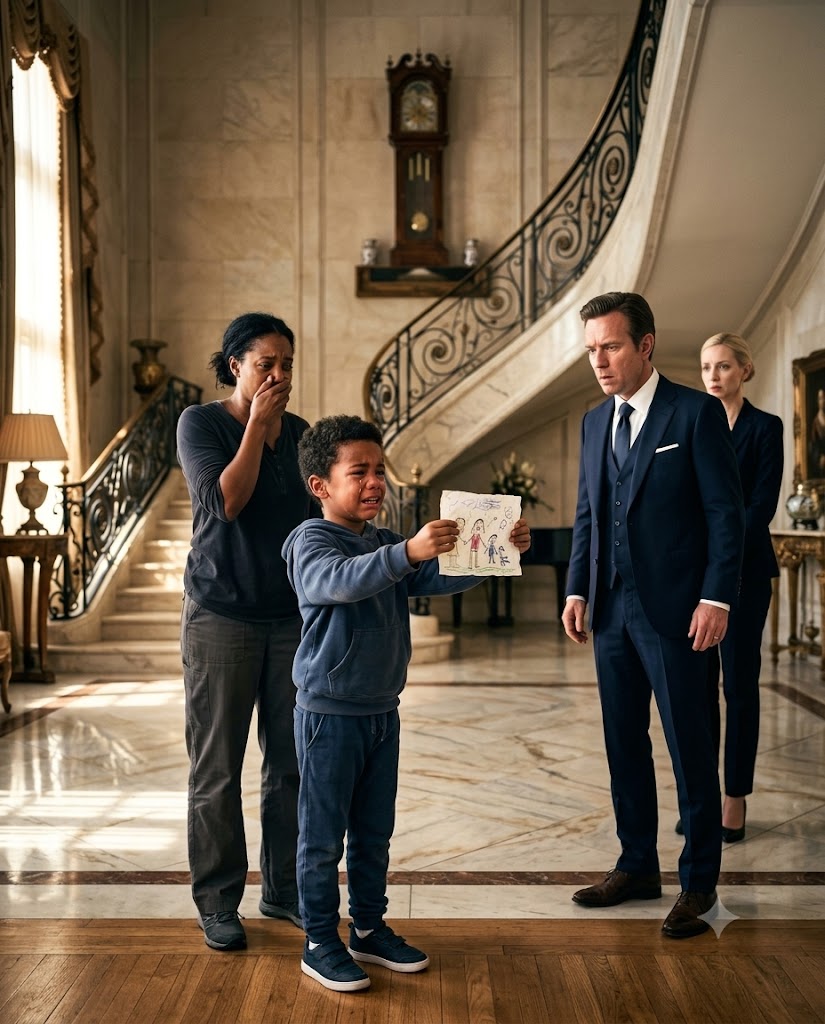
The marble hallway of the Hail Estate went so silent you could hear the old radiators ticking behind the walls. A six-year-old boy stood in the center of a mansion worth more than most small towns, his little fist shaking, a crumpled piece of paper held up over his head like it was the last true thing left in the world. And Preston Hail, the richest man in Connecticut, a man who had stared down bankers and senators and boardrooms without blinking, could not find a single word to say to a child because the boy was right. The drawing in his hand was about to bring down everyone in that house.
Denise Carter had exactly forty dollars in her purse and a six-year-old son buckled into the backseat of a car that took three tries to start in the cold November air. Three hours earlier, she had been walked out of the largest estate in Greenwich, escorted past rooms she had cleaned, hallways she had crossed ten thousand times, and people she had poured coffee for every single morning for four years. They called her a thief in front of every one of them. She did not shout. She did not cry. She did not beg a single one of them to look at her and remember who she really was. She simply bent down, picked her son’s stuffed gray elephant off the mudroom floor where it had fallen, took his small hand in hers, and walked out the side door for the last time.
What Denise did not know, what she would not know for almost another full day, was that her son had spent that whole terrible morning working on something. Something small. Something folded three times over and pressed flat inside the pocket of his little denim jacket. And in less than twenty-four hours, that folded piece of paper would do what no grown adult in that mansion had the courage to do. It would tell the truth.
—
The Hail Estate sat at the end of a quarter-mile drive lined with oak trees older than the country itself, behind iron gates that opened only for cars most people would never see up close in their entire lives. Preston Hail had built a software empire out of a rented one-bedroom apartment in Raleigh, North Carolina. By the time he turned forty-four, his face had been on the cover of every business magazine that mattered, right beside words like visionary and self-made. He had more money than three generations of his family could ever spend. And he was almost never home.
He was in London closing a merger. He was in Tokyo courting investors. He spent more nights in hotel suites and private terminals than he ever did under his own roof. The great house in Greenwich ran without him. Smoothly. Quietly. Expensively. Like a machine whose owner had long since stopped checking whether all the parts were still honest. That was where Denise came in.
Denise Carter had worked for the Hail household for four years. She had come to them the way a lot of good people come to hard work because life had knocked her down, and standing back up was the only option she had ever allowed herself. Her husband Marcus had been an army sergeant. Steady. Gentle. Quick to laugh. The kind of man who fixed the neighbor’s fence without being asked. He had served two tours overseas and come home safe both times. And then, in the most ordinary week of an ordinary year, a drunk driver had taken him on a rain-slicked highway just eleven miles from their front door.
Denise had been pregnant with Isaiah when it happened. Her husband never got to hold his son. She was twenty-eight then. She was thirty-four now. And in the six years between, she had done what widows and single mothers have always done all across this country. With no cameras watching and no medals handed out, she got up every morning, she worked, and she carried her whole world on her back so that her boy would never once feel the weight of it.
She started at the Hail Estate as a part-time driver, running errands, airport pickups, grocery runs. But Denise had a way about her. She was never late. She never cut a corner. She remembered that Mr. Hail liked the heat set to sixty-eight in the car and that the head groundskeeper’s wife had a birthday in March. Within two years, she had been promoted to the family’s primary personal driver. Trusted with the schedules, the keys, and the quiet, careful movement of a very rich, very private family. Not because anyone handed it to her. Because she earned it. One honest day at a time.
Isaiah was six now. A quiet, watchful boy with his father’s easy smile and his mother’s serious eyes. He had practically grown up in the corners of that great house on the days when the sitter fell through and there was simply nowhere else for him to go. He would sit on a bench in the garage while his mother detailed the cars, drawing in a spiral notebook that went everywhere with him. Cars. Dogs. Buildings. People. Isaiah drew the world the way he saw it. Carefully. And always more true than a photograph.
“Mama,” he asked her once, looking up at the six garage doors and the gleaming cars behind them. “Why does Mr. Hail have so many cars if he can only drive one at a time?”
Denise had laughed. A real laugh. The kind that had gotten harder to come by.
“Baby,” she said. “Some folks collect cars the way other folks collect worries. Doesn’t mean they ever get to enjoy a single one.”
Preston Hail barely knew his own driver’s son by name. But there had been a handful of mornings, rare ones, when a flight got canceled or a deal fell through and the great man found himself unexpectedly home. He would wander into the garage with a cup of coffee and find a small boy on a bench drawing. Once, just once, Preston had stopped. He had looked over the boy’s shoulder at a surprisingly good sketch of the very car he was standing next to. Right down to the license plate.
“That’s real good, buddy,” Preston had said, genuinely surprised. “You drew the whole thing from memory.”
Isaiah had nodded, solemn as a judge. And Preston, a man who almost never did anything without a reason, had reached into his jacket, pulled out one of his personal cards, and written a number on the back. His direct cell. A number even the men on his own board did not have.
“Tell you what,” he had said, crouching down to the boy’s level. “You ever draw something so good, you just have to show somebody, you have your mama call this number. Deal?”
He had tucked the card into the front pocket of Isaiah’s little denim jacket, ruffled his hair, and been halfway to the airport before the coffee went cold. Isaiah, who was only just learning to read, kept that card in his jacket pocket for three months. He couldn’t read the name, but he had traced the numbers on the back with his finger so many times he could have dialed them in his sleep. Denise never even knew it was there.
—
Everything changed on a gray Tuesday in November. Vivian Lockhart, the estate’s household manager, called an emergency meeting in the staff corridor at seven-fifteen in the morning. Vivian was the one who ran the day-to-day of that enormous house. The schedules. The payroll. The hiring and firing. She reported directly to Mr. Hail’s chief of staff. She was efficient. She was precise. And she had a voice that went flat and clipped whenever she was about to say something that would hurt somebody who couldn’t fight back.
“An item is missing from Mr. Hail’s private study,” Vivian said, her tone brisk and cold. “A watch. An heirloom. His late father’s. It was kept in the wall safe behind the bookcase.”
Denise’s stomach tightened before Vivian said another word. She didn’t know why. She just knew. The way you sometimes know that a door is about to close on you.
“The safe was accessed at nine-forty last night,” Vivian went on. “The household access log shows only three people entered that code yesterday. Myself. Robert Ellis, the estate accountant.” She paused. Her eyes moved across the small crowd of gathered staff and did not — would not — quite land on Denise’s face. “And Denise Carter.”
The corridor went so quiet you could hear the old radiators ticking. Six other staff members stood frozen, staring at the floor, the walls, their own shoes. Anywhere but at Denise.
“I didn’t go near that safe,” Denise said. Her voice was steady, even though her hands had started to tremble at her sides. “I was at the pediatrician’s office with my son until almost seven last night. Isaiah had an ear infection. You can call them. They’ll have it on record. The time I checked in. The time I left. Please. Just call them.”
“We’ll be reviewing everything,” Vivian said in the flat voice of a person who has already made up her mind. “In the meantime, per household policy, you’re suspended without pay. Effective immediately. Pending a full investigation.”
“Suspended?” The word hit Denise like cold water. “Vivian, I have worked in this house for four years. I have never so much as taken a pen. My whole life is in the backseat of that car right now. My son is—”
“This isn’t personal, Denise.”
And for just a fraction of a second, Vivian’s eyes finally met hers. And something flickered there. Something that looked, for the briefest moment, almost like guilt. Then it was gone. Sealed over like water closing above a stone.
“It’s protocol.”
By nine o’clock that morning, Denise was standing in the mudroom with a single cardboard box holding four years of her life. A spare cardigan. A travel mug with a chipped rim that nobody else had ever wanted. A small framed photo of Marcus in his uniform — the one she kept taped inside her locker so she’d have him with her through every shift. And Isaiah’s spare drawing pad, the one she kept at work for the days he came along.
Isaiah stood beside her, confused, holding his stuffed gray elephant against his chest, wearing the same little denim jacket he wore every day the sitter couldn’t take him.
“Mama?” he asked quietly. “Are we going home early?”
Denise knelt down. She forced a smile onto a face that felt like it might crack straight down the middle.
“Yes, baby,” she said. “We’re going home early today.”
She didn’t tell him she’d just lost her job. She didn’t tell him that an accusation of theft, even one that was never proven, would follow her name onto every background check for the rest of her working life. She didn’t tell him that they had four hundred dollars in the bank and rent was due in eight days. She just took his small hand in hers and walked out the same side door she’d walked through every morning for four years. And this time, nobody said goodbye.
—
That night, in a cramped apartment on the second floor of an old converted house, with a mother trying not to cry through a thin wall and a six-year-old who could hear every sound of it, something quiet began that would put the entire Hail household on notice.
The apartment Denise and Isaiah shared was a one-bedroom above a shuttered dry cleaner in a working-class stretch of Stamford. Fifteen minutes from the Hail Estate by car and a whole other world in every way that mattered. The pipes knocked. The stairwell always smelled faintly of somebody else’s cooking. But it was theirs. And until that Tuesday morning, it had been enough.
Denise sat at the small kitchen table long after Isaiah had gone to bed. The calculator open on her phone, running the same numbers over and over, as if they might rearrange themselves into something survivable. Rent. The car payment. The overdue balance on Isaiah’s dental work. Four years of spotless service, and all of it erased by two words that would sit on her record like a stain. Theft investigation.
She thought about Marcus. She thought about how he used to sit right across from her at a table just like this one, back when they had nothing, and take her hands and say, “We’re going to be all right, D. We always find a way. We just got to keep our heads up.”
She put her face in her hands and for the first time since she’d walked out that side door, Denise Carter let herself cry.
Down the short hallway, Isaiah was not asleep. He lay in his small bed and listened to the sound of his mother crying through the thin wall. And something in his six-year-old mind decided, with the total certainty that only children have, that this was a problem. And problems were meant to be solved. He thought about the nice man with the fast cars. The one who had looked at his drawing and said it was real good. The one who had given him a card and said, “You ever draw something so good, you just have to show somebody. You have your mama call this number.”
Isaiah didn’t fully understand what had happened that day. But he understood that his mama was crying. And he understood something else, too. Something he had been carrying around in his chest all day like a stone, not knowing what to do with it.
Because Isaiah had seen something on Monday in the garage. He had been sitting on his bench with his notebook while his mama wiped down the black car. And he had watched somebody do something that didn’t make sense to him. And because Isaiah drew the world the way he saw it — carefully and always more true than a photograph — he had already put it down on paper. The way he put everything down on paper. He just hadn’t understood until tonight that it mattered.
He climbed out of bed. He dug through the pile of clothes on his little chair until he found the denim jacket and slid the slightly bent card out of the front pocket where it had lived, forgotten, for three months. He couldn’t read the name on the front, but he knew the numbers on the back the way he knew his own name. Then he crossed the hall to the kitchen drawer where his mama kept her old cracked phone — the backup one she never threw away — and with the careful, deliberate concentration of a child on the most important mission of his life, he pressed the numbers one at a time.
It rang twice.
“This is Preston Hail.” The voice was sharp, distracted, clearly braced for a business call at nine-forty at night.
There was a pause. Then a small voice.
“Hi. It’s Isaiah.”
Preston Hail, standing at the window of a hotel suite in Denver with a glass of water he hadn’t touched and four unread emails from his attorney glowing on his laptop, went completely still.
“Isaiah,” he said slowly. “The boy who draws the cars.”
“Yeah.”
A pause. The sound of small bare feet shifting on a cold kitchen floor.
“My mama’s crying.”
A breath.
“She got fired today. Miss Vivian said Mama stole a watch. But my mama didn’t take it. I know she didn’t because she was with me at the doctor and then we got applesauce and then we went home and she never even went in your study. She doesn’t go in there. She says it’s not her place.”
Preston Hail lowered himself onto the edge of the hotel bed.
“Isaiah.” His voice had gone quiet in a way it hadn’t in years. “Your mama is Denise. Denise Carter.”
“Yeah. She drives your cars.”
A small, trembling breath.
“She’s real sad, mister. Can you tell Miss Vivian she’s wrong? You said if I had something to show somebody, I could call.”
His voice dropped to almost nothing.
“I’ve got something to show you.”
For a long moment, Preston Hail — a man who had negotiated deals worth more than the annual budgets of small nations without so much as a change in his breathing — could not find one single word to say to a six-year-old on the other end of a cracked phone.
“Isaiah,” he said finally. “Buddy. Can you put your mama on the phone for me?”
—
Preston Hail had built an entire empire on a single principle. Check everything. Verify every number. Trust no claim you hadn’t confirmed with your own two eyes. He had made billions being the man in the room who asked the one question nobody else thought to ask. And he was about to realize that he had never once applied that principle to his own home.
Denise nearly dropped the phone when Isaiah appeared in the kitchen doorway, holding it out to her, his small face set with the serious determination of a child trying to fix the whole world by himself.
“Mama. It’s the car man.”
“The what?”
“The nice man from the cars. He wants to talk to you.”
Confused and bone tired, expecting a wrong number or a scam, Denise took the phone.
“Hello?”
“Denise. This is Preston Hail.”
The kitchen seemed to tilt sideways.
“Mr. Hail, I— I am so sorry. I don’t know how my son got your number. I swear to you, I never—”
“Denise. Stop.” His voice wasn’t angry. If anything, it was gentler than she had ever heard it. “I need you to tell me exactly what happened today. From the very beginning. And I need the truth. Not the version you think I want to hear. The real one.”
So she told him. She told him about the meeting in the corridor at seven-fifteen. The accusation. The four years of her life packed into a cardboard box in eleven minutes. The long walk out the side door with her son’s hand in hers. She told him about the pediatrician’s office, about the after-visit summary still sitting in her purse stamped with a checkout time of 6:51 p.m. — nearly three hours before that safe had supposedly been opened. She told him, her voice finally cracking, that in four years she had never once taken so much as a paperclip from that house. That her husband had died believing the most important thing a person could leave their child was a good name. And that in a single morning, someone had tried to take that from her son.
Preston Hail listened without interrupting once. And something cold and hard settled into his chest. Not aimed at Denise. But at himself. He had let Vivian Lockhart run his entire household for years with almost no oversight because she was efficient. Because she never troubled him with the small things. Because he was always somewhere else. Always on a plane. Always in a meeting. Always chasing the next deal. Always trusting a machine he had never once bothered to check.
“Denise,” he said. “I want you to keep that after-visit summary somewhere safe. Don’t throw anything away. And don’t discuss this with anyone else. Not tonight.” He paused. “Isaiah said he has something to show me. Do you know what he means?”
Denise looked at her son, who was standing in the doorway, clutching a folded piece of paper against his chest with both hands. The way he held things that were precious.
“No,” she said slowly. “But I think I’m about to find out.”
“Can you come to my office downtown tomorrow at nine? I’ll send a car. Bring the boy. Bring whatever it is he wants me to see.”
“Mr. Hail, I— I don’t want trouble. I just want to understand what happened to me.”
“So do I,” Preston said. “And I promise you, I intend to find out.”
He hung up. And then he made the second call of the night.
—
Gareth Doyle had spent twenty years as a federal fraud investigator before Preston Hail hired him to quietly handle the sensitive matters that came with great wealth. He was careful, thorough, and completely without illusions about what people would do when money was involved.
“Gareth, I need the full security footage from the Greenwich estate. Every camera. Going back seventy-two hours. And I need the access log for the study safe. But not through the household system. I want it pulled directly from the manufacturer. The one that can’t be edited from inside my house.”
“That’s a strange request at ten at night,” Gareth said. “Can I ask what this is about?”
“A woman who drove for my family for four years was fired in eleven minutes over an accusation that nobody bothered to verify,” Preston said. “I want to know who actually opened that safe. And I want to know it from a record that no one in that house could have touched.”
“Give me till morning,” Gareth said.
He called back at 2:15 a.m. His voice was careful. The particular kind of careful people use when they already know the news isn’t going to be welcome.
“Preston. The manufacturer’s log doesn’t match the household record that Vivian submitted to your chief of staff. The safe was accessed at 9:40 p.m. That part’s true. But the household system logged that entry under a generic maintenance code that had been reset earlier that same week.”
“And the manufacturer’s log?”
“The manufacturer’s log is tied to biometrics. It doesn’t record a code. It records a fingerprint.”
Preston closed his eyes. “Whose fingerprint?”
There was a pause.
“Vivian Lockhart’s.”
The line was quiet for a long moment.
“There’s more,” Gareth said. “When something like this comes up, I run a standard financial review on anyone with safe access. It’s routine. Vivian’s been making minimum payments on close to seventy thousand dollars in debt for the better part of a year. The trouble seems to have started around the time she took on the cost of her mother’s long-term care. The payments have been slipping badly.”
The picture was assembling itself now with a clarity that made Preston’s stomach turn. Vivian Lockhart had not investigated a theft. Vivian Lockhart had committed one and then built the fastest, most convenient story in the world to cover herself. She had pointed at the two other people who happened to have safe access that week, knowing full well that Robert Ellis, the accountant, had been out of state at a conference with a hundred witnesses. Which left exactly one name standing alone in that corridor. Denise. The single mother. The widow. The woman with no husband to make phone calls on her behalf. No family lawyer. No board seat. No leverage of any kind. The one person in that entire house who could be blamed the most easily and defended the least.
“She didn’t just steal from me,” Preston said very quietly. “She chose the person she thought no one would fight for. And she nearly got away with it because I was too busy to look.”
“What do you want to do?” Gareth asked.
Preston Hail stood up and reached for his coat.
“I’m going home,” he said — for the first time in six weeks. “And I want you to bring everything.”
—
Denise arrived at Preston Hail’s downtown office at nine o’clock sharp the next morning. Isaiah’s hand tucked in hers because there had been nowhere else to leave him. And honestly, because after last night she wasn’t ready to let him out of her sight. She half expected the security desk to turn her away. The fired driver. The accused thief walking into the headquarters like she belonged there. Instead, an assistant was already waiting and led them straight up to a glass-walled conference room where Preston Hail stood, still in the same rumpled shirt from his overnight flight home.
“Mrs. Carter,” he said. “Thank you for coming.”
Then he crouched down. A billionaire in a thousand-dollar shirt, lowering himself to the eye level of a six-year-old boy.
“And thank you, Isaiah. That phone call you made last night might just be the most important call anybody has made in this whole company all year.”
Isaiah studied him with those serious eyes for a long moment.
“Did you fix my mama’s problem yet?”
“I’m working on it, buddy,” Preston said. “I promise you I am working on it. But I think you might be able to help me finish the job.” He nodded toward the folded paper in the boy’s hand. “Is that what you wanted to show me?”
Isaiah looked up at his mother. Denise, who still had no idea what her son had been carrying, gave him a small, encouraging nod. Slowly, carefully, Isaiah unfolded the paper on the glass conference table and smoothed it flat with both small hands.
It was a drawing. A child’s drawing. But an unusually careful one. It showed the inside of the estate garage, drawn from the low angle of a boy sitting on a bench. There were the six cars lined up in a row, each one recognizable. There was a figure at the far end. A person standing at the little wall-mounted key cabinet where the spare keys and access fobs were kept. The figure was a woman. She was drawn with short dark hair pulled up in a bun, a dark blazer, and something clutched under one arm. A small rectangular shape that Isaiah had colored in gray with a little band around it.
Above the figure, in the shaky backwards-and-forwards letters of a child just learning to write, Isaiah had labeled her the only way he knew how. Miss Vivian.
And in the corner, because Isaiah put everything he saw down on paper the way another child might write the date, the way his mother had taught him to read the numbers on the microwave, he had copied down the time from the digital clock on the garage wall. 9:41. Monday night. The night before the theft was ever reported. The night before Vivian Lockhart stood in a corridor and accused an innocent woman.
The conference room was completely silent. Denise stared at the drawing, her hand pressed over her mouth.
“Isaiah,” she whispered. “Baby. When did you draw this?”
“Monday,” Isaiah said simply. “When you were cleaning the black car. Miss Vivian took a thing out of the cabinet and put it under her arm and looked around like this.”
He mimed a furtive over-the-shoulder glance.
“And then she went in the little door. It looked funny. So I drew it.”
He looked up at her, suddenly worried he’d done something wrong.
“Was I not supposed to?”
Denise pulled her son into her arms and held him so tightly that he squeaked.
Preston Hail stood looking at that drawing for a long, long time. A watch taken from the study safe. But first, a key or an access fob taken from the garage cabinet the night before. A woman who had access to every part of that house, planning a theft one day and staging the story to cover it the next. And a witness she had never once thought to worry about. Because who on earth would ever think to ask the six-year-old boy on the garage bench what he had seen?
“Mrs. Carter,” Preston said quietly. “Your son didn’t just draw a picture. He drew the one thing my entire security team couldn’t get me. A witness who was in the room. And he did it a full day before anyone even knew there was a crime.”
He looked at the boy, and for a moment the sharp, distracted expression the world knew so well was completely gone from his face.
“You keep drawing what you see, buddy,” Preston said. “Don’t you ever let anybody talk you out of it.”
—
At eleven o’clock that same morning, Preston Hail walked through the front doors of his own Greenwich estate for the first time in six weeks. Not for a party. Not for a meeting. Not for a photograph. He walked in with Gareth Doyle at his side, a folder of manufacturer logs and financial records under his arm, and he called an all-staff meeting in the very same corridor where Denise had been fired the day before.
Vivian Lockhart arrived expecting to brief her employer on the quarterly household budget. Instead, she found Preston Hail standing with his arms crossed and an expression on his face she had never once seen in all her years of service. The expression of a man who has finally, belatedly, decided to look.
“Vivian,” he said, his voice even. “Walk me through what happened with my father’s watch.”
She recited the story she had told the staff. The safe. The three access codes. The process of elimination that ended so tidily at a single name.
“That’s interesting,” Preston said when she’d finished. “Because the manufacturer’s independent log — the one that isn’t kept anywhere inside this house, the one that no one here can edit — shows that the safe was opened by a fingerprint. Not a code. A fingerprint.” He tilted his head slightly. “Would you care to guess whose?”
The color left Vivian Lockhart’s face like a tide going out.
“Preston,” she started. “I can explain—”
“I have a great deal more than that log,” Preston said, and his voice stayed low and level, which somehow made it far worse than if he’d shouted. “I have the garage footage. I have the reset maintenance code you used to hide the entry in the household system. I have the financial review. And I have a witness. An eyewitness who watched you take the fob from the garage cabinet at 9:41 on Monday night. And who was honest enough and brave enough to put it down on paper.”
He set Isaiah’s drawing on the sideboard. Face up. Where everyone could see it. Miss Vivian. 9:41.
Vivian Lockhart stared at the child’s drawing of herself, and something in her simply came apart.
“I have my mother,” she said, her voice breaking. “The care home costs more every month than I clear. I’ve been drowning for a year, Preston. A year. I made one terrible decision and then I panicked and I—”
“You accused an innocent woman of theft to save yourself.” Preston did not raise his voice. “You watched her walk out of this house in front of her son, carrying a box and a reputation that you knew — that you knew — was a lie. She is a widow, Vivian. Her husband served this country and died before he ever got to hold that little boy. And when it came time to choose who would take the fall for what you did, you looked around this house and you chose the one person you decided nobody would ever stand up for.”
Vivian had no answer. There wasn’t one.
“That’s not panic,” Preston said. “Panic is a moment. This took planning. This took a Monday and a Tuesday and a story rehearsed in advance. This was calculation.”
Then he turned slowly to the rest of the staff gathered in that corridor. The same faces that had stood there in silence the day before, watching an innocent woman be walked out the side door.
“I also want to understand,” he said, “why six people stood in this hallway yesterday and watched Denise Carter get fired and not one of you picked up a phone to call me. Not one of you said, ‘Wait.’ Not one of you asked the simplest question in the world. Did anybody check her story?”
Nobody spoke. Shoes shifted. Eyes dropped to the floor.
Finally, a young housekeeper named Priya, barely into her twenties, broke the silence. Her voice was trembling.
“Miss Vivian told us that anyone who questioned the investigation would be treated as obstructing it,” she said. “She said we’d lose our jobs. We were scared, Mr. Hail. Most of us have families. I— I’m sorry. We should have said something. Denise was always good to us. We should have said something.”
Preston Hail looked slowly around the corridor at the fear that had apparently governed his own house for years. While he was somewhere far away, closing deals, building an empire, trusting a machine he had never once bothered to inspect.
“Vivian, you’re terminated. Effective immediately,” he said. “Gareth will be walking you out, and I’ll be turning the financial records over to the appropriate people to handle what comes next.” He drew a breath. “As for the rest of you — I understand fear. I do. A person shouldn’t have to risk feeding their family to tell the truth in the place where they work. That’s not on you. That’s on me. For building a house where fear was allowed to run things while I was gone.”
He paused.
“But that ends today. This house is going to be run differently from this morning forward. And the first thing that’s going to change is that anyone in this household will be able to come to me directly, without fear, when something isn’t right.”
—
By that afternoon, two more names had been added to the list. The estate accountant, Robert Ellis, who had quietly helped Vivian reroute household expenses to paper over the missing funds. And one supervisor who had known about the reset maintenance code and said nothing when asked directly. But not the ones who had only stayed silent out of fear. Those Preston kept. Because he understood, finally, that he had helped build the very fear that silenced them.
Justice of a kind had been served. But Preston Hail already knew that firing three people would never be enough to undo what one small boy had set right with a drawing and a phone call.
That evening, Preston Hail did not go back to his office. Instead, he drove — actually drove himself, without a driver, for the first time in longer than he could remember — to a one-bedroom apartment above a shuttered dry cleaner in Stamford, where Denise and Isaiah were eating scrambled eggs at their small kitchen table because it was the only thing Denise had the energy to make. He knocked on the door himself.
“Mr. Hail?” Denise opened the door and stared, stunned. “Is everything—”
“Everything’s fine,” he said. “Better than fine, actually. May I come in for a minute?”
He sat down at their small kitchen table. A table that could have fit inside one closet of his Greenwich estate. And he told Denise everything. The manufacturer’s log. The fingerprint. The garage footage. The reset code. Vivian’s termination and the two others. He told her that the checkout time on her son’s after-visit summary had matched the records perfectly, confirming exactly what she had said from the very first moment. That she had been nowhere near that house when the safe was opened.
“I owe you more than an apology, Denise,” he said. “I owe you four years of the trust I should have given you from the start. And I’m ashamed that it took a six-year-old boy with a box of crayons to make me finally pay attention to my own house.”
Isaiah, sitting cross-legged on a kitchen chair with a smear of egg on his chin, looked immensely, quietly proud of himself.
“I fixed it,” he announced to no one in particular.
Preston laughed. A real laugh. Tired and genuine. The kind he hadn’t let himself have in a long time.
“You did, buddy,” he said. “You surely did.”
Then he turned back to Denise.
“I’d like to offer you your position back,” he said. “But I want to do more than that. Because your old position isn’t good enough for what you are. I’m restructuring how the entire household is run. And I need someone in charge of it that I actually trust. Not just managing schedules, but overseeing the whole staff. With the authority to come straight to me when something’s wrong. No more layers of people between me and the truth.”
Denise stared at him.
“It comes with a significant raise,” Preston went on. “Full benefits. And there’s a two-bedroom cottage on the property if you want it. So that Isaiah has a real home and a real yard. And you never have to scramble for a sitter again. He’d catch the same school bus as the groundskeeper’s kids.” He paused. “I know it doesn’t undo what happened to you yesterday. Nothing can. But I’d like the chance to spend the next four years earning the trust I should have given you in the first one.”
Denise’s eyes filled with tears for the second time in two days. But these were not the tears of a woman afraid of losing everything.
“Mr. Hail,” she said. “I don’t know what to say.”
“Say you’ll think about it,” Preston said gently. “And please. Call me Preston.”
Denise took the position. Not because a rich man offered it. But because she had spent her whole life learning to tell the difference between a handout and an open door. And this, she decided, was an open door. She would walk through it the way she walked through every door. On her own two feet. And only as far as her own work would carry her.
—
Over the months that followed, the Hail estate changed in ways that went far beyond the names on the payroll. Preston Hail started coming home. Not out of guilt, though there was plenty of that at first. But because standing in that corridor, looking at his own frightened staff and a six-year-old’s drawing, he had realized something that no deal, no merger, no magazine cover had ever managed to teach him. That he had built an entire empire while barely knowing the names of the people who kept his own house standing.
He began taking his breakfast at home twice a week. He learned that the groundskeeper had a daughter starting nursing school. He learned that Priya, the young housekeeper who had found the courage to speak up in that corridor, was studying for her citizenship exam at night — and he quietly made sure she had the time off to sit for it. He learned that Denise Carter made the best sweet potato pie he had ever tasted in his life. And that the quiet dignity she had carried through four years of being nearly invisible to the people she served was worth more than the approval of any board he had ever sat on.
And he got to know Isaiah. The serious, watchful boy who drew the world more true than a photograph. Preston bought him a real set of drawing pencils. The good kind. The kind that came in a wooden case. And more than once, when a deal fell through and the great man found himself unexpectedly home, he’d wander out to find the boy at a table with his notebook. And he’d pull up a chair and just sit and watch and ask what he was drawing.
Vivian Lockhart, for her part, faced the legal consequences of what she had done. But Preston, after long consideration, chose not to pursue the harshest penalty available to him. It did not excuse her. It did not undo one minute of what she had put Denise through. But he had learned something in that corridor about how people come undone. How a good person, worn down by a debt and a sick mother and a year of quiet desperation nobody ever thought to ask about, can talk herself one small step at a time into something she would never have believed herself capable of.
People rarely become the worst version of themselves overnight, Preston thought. They erode slowly. Under a weight nobody around them ever bothers to notice. Until it’s too late. He couldn’t fix what Vivian had done. But he could make sure that the next person drowning in his household never had to steal to stay afloat. And so he started something new. A hardship fund. Quiet and confidential. That any employee could go to before things ever got that far. He named no one. He asked no questions. He just made sure the door was there.
—
A year later, Denise Carter stood in the very same corridor where she had once been fired in eleven minutes. She was the head of household operations now. That morning, she was training two new staff members. And the first thing she taught them — before schedules or protocols or anything else — was a single rule.
“In this house,” she told them, “if something ever looks wrong, you say so. Out loud. To me. Or straight to Mr. Hail himself. Nobody in this household will ever lose their job for telling the truth. You have my word on that. And you have his.”
She had earned the right to make that promise the hardest way there is.
Isaiah was seven now. He still didn’t fully understand what he had done that cold night, dialing numbers on a cracked phone in a dark kitchen while his mama cried in the next room. To him, it had always been simple. His mama was hurting. A nice man had once told him that if he ever had something important to show, he could call. So he called.
But to Denise — and in time, to Preston — it had become something much larger than that. It had become a reminder that the truth doesn’t always travel from the top of a house down to the bottom. Sometimes it rises up from the very bottom. From the smallest, most overlooked person in the room. From someone the world had already decided wasn’t worth asking. From a child on a garage bench with a notebook, watching more carefully than any of the grown-ups ever imagined.
Preston Hail learned that trust without verification isn’t kindness at all. It’s neglect wearing kindness’s clothes. And it can cost an innocent person everything, while the man responsible is too busy, too far away, too sure of his own machine to even notice.
Denise Carter learned something she thought she had already known. But hadn’t. Not really. Not all the way down. She learned that telling the truth plainly and without shaking — even when every single face in the room has already decided against you — is never wasted. Because somewhere, someday, in a way you cannot possibly predict, the truth finds a hand to carry it forward.
Hers, it turned out, was very small. It had egg on its chin and crayons in its pocket. And somewhere in a great house that had once run on silence and fear, a little boy had taught a billionaire the simplest lesson there is. The one that all the money in the world had never managed to teach him. When someone you love is hurting, you don’t wait for a grown-up to come and fix it. Sometimes you pick up the phone yourself. Sometimes you draw what you saw. Sometimes the bravest thing a person can do is just tell the truth out loud to whoever will finally listen.
Marcus Carter never got to hold his son. But that year, when Denise finally moved their little life into the cottage on the property, she hung his photograph — the one in his uniform, the one that had traveled in the bottom of a cardboard box out that side door — right in the front hall where the morning light hit it first. And under her breath, only for herself, she said the thing she had wanted to say to him for six long years.
“We found a way, Marcus. We always do. And your boy—” She smiled. “You should see your boy. He kept his head up. He kept it up for both of us.”









