A Single Mom Sold Her Son’s Beloved Piano to a Millionaire—What He Found Inside Changed All Three Lives
The rain tapped against the window like it was asking to come inside, and ten-year-old Marcus Brooks stood in the middle of their small living room, staring at the empty corner where Grandma Ruth’s old upright piano had always stood. His voice was soft, but to his mother, Elena, it sounded like thunder. “Mom, did you sell grandma’s piano because of me?” The question shattered her before she could answer.
For two years, she had hidden the truth. She had worked until her hands cracked, smiled when her body wanted to collapse, and told Marcus everything was fine again and again, because mothers sometimes lie when the truth is too heavy for a child to carry. But now his eyes were trembling, and Elena saw the one thing she had tried hardest to protect him from: guilt.
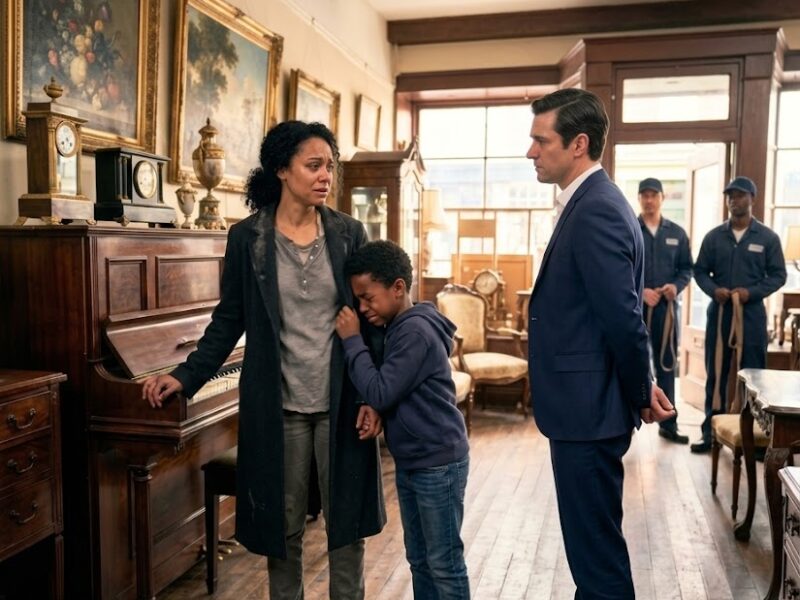
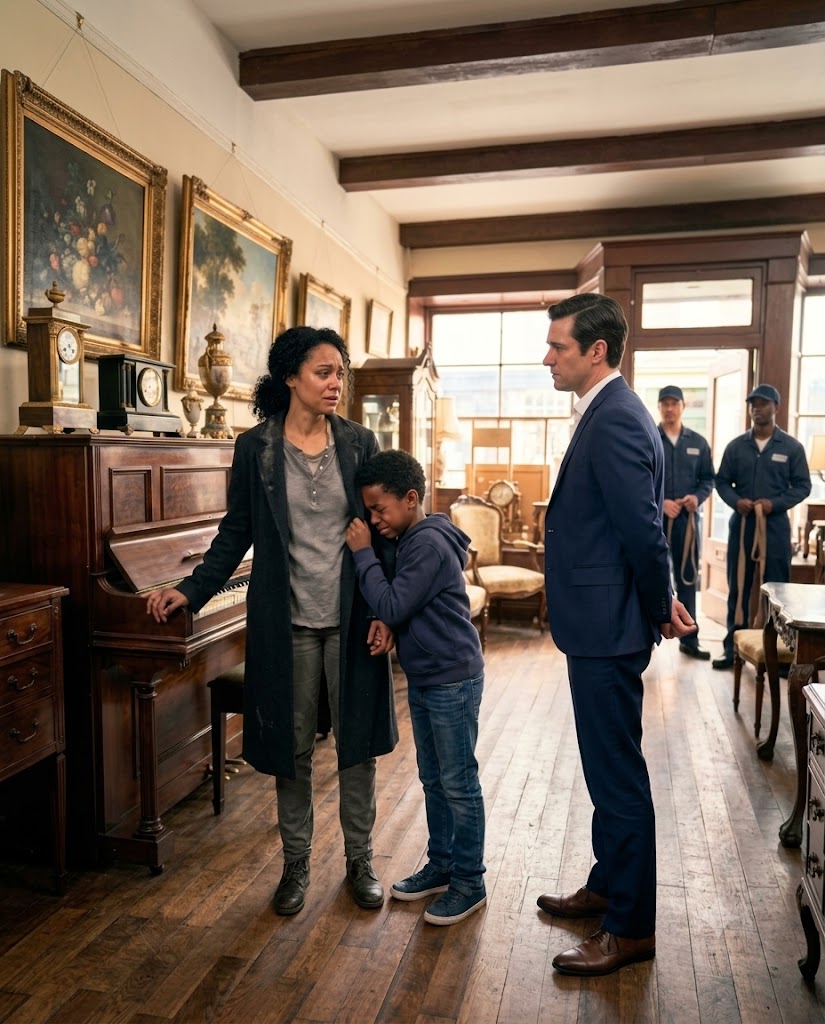
Before she could speak, her mind pulled her back to the day it all began. Two years earlier, when Marcus was only eight, Elena stood inside Whitcomb Antiques on a rainy Thursday afternoon holding a pen with shaking fingers. On the glass counter before her lay a simple contract.
The paper called it a “vintage upright piano.” Not Grandma Ruth’s piano. Not the piano that had filled their tiny apartment with lullabies when money was short and hope was even shorter. Not the piano Elena had fallen asleep beside as a little girl while her grandmother played hymns in the dark. Not the piano that still carried a faint scratch on one wooden leg from the day Elena dragged a chair too close because she wanted to sit beside Grandma Ruth. To the antique shop, it was furniture. To Elena, it was family.
Across the counter, Mr. Whitcomb lowered his voice. “Mrs. Brooks, you don’t have to do this today.” For one second, Elena almost believed him. She wanted to run to the back of the shop, wrap her arms around the old mahogany piano, and take it home. But then she remembered Marcus sitting on his bed three nights earlier holding the flyer from Westbridge Community Music Academy. “It’s okay, Mom,” he had whispered. “I don’t need lessons.”
That was the sentence that broke her, because he did need lessons. Marcus did not just play piano. He listened to it. He could hear a melody once and find it again by instinct. His small hands moved over the keys as if the music had been waiting inside him long before anyone taught him its name. His teacher had said, “Your son has a gift. Please don’t let money be the reason it disappears.”
But money was everywhere. In unpaid bills, in patched shoes, in late rent notices, in Elena’s double shifts at the medical laundry facility and the office building she cleaned after midnight.
She had tried everything. Scholarships, phone calls, extra hours, selling her wedding ring from a marriage that had already abandoned her in every way that mattered.
Still, the academy required a deposit. And Elena had only one thing left valuable enough to save her son’s dream: Grandma Ruth’s piano. Her tears fell onto the contract. Then she signed. The ink dried quickly. Her heart did not.
Mr. Whitcomb took the paper gently. “I’ll make sure it goes to someone who values it,” he said. Elena nodded. But value was not love. No buyer would know the third key above middle C stuck in winter. No buyer would know Grandma Ruth tapped the side twice before playing, as if waking an old friend.
No buyer would know the lullaby that began with three soft notes, then dipped low, then rose again like a soul refusing to stay broken. As a child, Elena once asked what made the song so special. Grandma Ruth had smiled and said, “Listen to the space between the notes, baby. That’s where the heart lives.” Elena had not understood then. She understood now. The heart lived in silence, in sacrifice, in the empty places love leaves behind.
“Would you like a moment with it?” Mr. Whitcomb asked. Elena nodded. She walked to the back of the shop where the piano stood beneath a warm lamp. Its mahogany body was old, scarred, and beautiful. She placed one hand on the wood. “I’m sorry, Grandma,” she whispered. “I tried.” Then she opened the fallboard and pressed the first three notes of the lullaby.
The sound rose softly into the dusty shop, imperfect, tender, alive. Elena bent over the keys and cried. But what she did not know was that Mr. Whitcomb had stepped quietly away, not because he was impatient, but because he had seen this kind of grief before. In his shop, people sold more than objects.
They sold wedding rings after marriages ended. They sold china cabinets after mothers passed. They sold watches from fathers whose hands would never wind them again. But this piano was different, even to him. He had watched Elena enter the shop twice before that Thursday. The first time she had only asked what the piano might be worth.
The second time she had stood beside it in the back room for nearly twenty minutes without saying a word. She had traced the carved edge, pressed one key, then closed the fallboard as if closing the door on a room inside herself. Mr. Whitcomb had seen poverty. He had also seen pride. Elena carried both with dignity.
When she returned to the counter, he cleared his throat and said, “I can hold it for a week before listing it.” Elena looked at him. “A week?” “Yes, in case you change your mind.” Hope flared in her so suddenly it almost hurt, but just as quickly she remembered the academy deadline. The deposit was due Monday. The first month’s tuition was due with it. Marcus had already been accepted into the beginner performance track, and if she missed the deadline, his place would be given to another child. “I won’t,” she said softly. Mr. Whitcomb seemed to understand. Still, he wrote something on a small card and slid it across the counter. “My number,” he said. “If something changes.” Elena took it because refusing would have required more strength than she had left.
Outside, rain streaked the shop window. She saw her reflection there. Thirty-four years old, though exhaustion made her look older, brown eyes red from crying, hair pulled into a tired bun, jacket damp at the sleeves, hands rough from detergent and cold water. For a moment, she barely recognized herself. She remembered being a little girl in Grandma Ruth’s kitchen, sitting on a yellow stool, swinging her feet while the old woman made cornbread in a cast iron skillet. Ruth Brooks had not been wealthy. She had cleaned classrooms for thirty-one years and saved quarters in coffee cans labeled rent, food, church, and Elena’s future. But every Sunday evening, no matter how tired she was, Ruth sat at the piano. She played hymns first, then blues, then songs she claimed she had invented, but which Elena suspected had been born long before either of them. “Music is proof,” Grandma Ruth used to say. “Proof of what?” Elena would ask. “That pain didn’t get the final word.”
Elena stepped away from the shop window before the memory could break her completely. That evening, she came home to the apartment where the piano still waited for the movers. Marcus sat at the kitchen table doing homework, his curly hair falling over his forehead. “Mom?” he asked. “Were you crying?” “No,” Elena said quickly. “Allergies. It’s raining. Rain can have allergies, too.” Marcus gave her a doubtful look, but he did not push. Elena knelt in front of him and took his hands. “I have good news,” she said. “You got accepted into Westbridge Community Music Academy.” For one second, Marcus only stared. Then his whole face lit up. “Really? But the deposit?” “I handled it.” His smile faded slightly. His eyes moved toward the piano in the living room. “Mom, you start Monday,” Elena said too quickly. “Please, baby, let me be happy about this.” Marcus looked at her for a long moment. Then joy slowly returned to his face. “I’m going to work so hard,” he whispered. Elena pulled him into her arms before he could see her tears. “You already make me proud.”
That night, Marcus fell asleep faster than usual. Elena did not. She sat on the edge of the couch in the dark, staring at the piano. The apartment was small enough that the living room, kitchen, and hallway shared the same breath. Every object had learned to serve more than one purpose. The kitchen table was where Marcus did homework, where Elena folded laundry, where bills were sorted into piles she could pay and piles she had to pray over. But the piano had never been practical. It took up too much room. It made the floor creak when moved. It needed tuning she could rarely afford. Still, it had made the apartment feel less like survival and more like home. Elena rose quietly and crossed the room. She lifted the fallboard and sat on the bench. The bench groaned softly beneath her. She was not a pianist. Grandma Ruth had tried to teach her, but Elena had been impatient as a child. She wanted to run outside. She wanted to dance, not practice scales. Only later did she understand that every lesson she had resisted was really her grandmother trying to leave her something no landlord could evict, no boss could underpay, no hardship could fully steal. Elena placed her fingers on the keys. She played the first three notes. Then she stopped because the fourth note would make her remember too much.
Behind her in the hallway, Marcus stood silently. He had gotten up for water and seen his mother sitting there. He did not say anything. At eight years old, he already knew there were moments when grown-ups needed privacy from their own children. So he turned around, went back to bed, and pretended he had not heard his mother crying over the piano that would soon be gone. The next morning, the movers came after Marcus had left for school. Elena could not let him watch. Two men wrapped the piano in thick blankets and lifted it carefully. The old wooden feet scraped softly against the floor, leaving four pale marks where it had stood for years. Elena stared at those marks as if they were wounds. The piano passed the kitchen table, the wall where Marcus’s height had been marked in pencil, the family photographs. Then it brushed lightly against Elena’s sleeve as the movers carried it through the door. No one noticed. Elena did. It felt like goodbye.
Outside, rain began again. The movers secured the piano inside the truck. When the doors closed, the latch clicked like a final sentence. Elena got into her old sedan and followed the truck through the wet city streets. Buses hissed at corners. People hurried under umbrellas. Red lights changed to green. The world continued as if Elena Brooks had not just lost the last sacred thing her grandmother had left behind. At a stoplight, the truck paused ahead of her. Its brake lights glowed red through the rain. Elena gripped the steering wheel and imagined Grandma Ruth sitting beside her in the passenger seat, wearing her blue house dress, hands folded peacefully in her lap. “I’m sorry, Grandma,” Elena whispered. Her voice broke. “I don’t have another choice.” The light changed. The truck moved. Elena followed. She did not know then that the piano was not leaving her life forever. She did not know its music would one day reach a grieving little girl in a house full of silence. All she knew was that love had asked for a sacrifice, and Elena Brooks had paid with the most precious thing she had left.
Marcus started at Westbridge Community Music Academy the next Monday. To him, it felt like a miracle. To Elena, it felt like a wound she had to smile through. He stood outside the old brick building, his backpack hanging from one shoulder, staring at the brass letters above the entrance as if they belonged to another world. “Do you think they’ll let me play today?” he asked. Elena forced a gentle smile. “I think that’s why we’re here.” “What if I mess up?” “Then you’ll mess up in a room full of people who understand music. That’s the safest place to mess up.” Marcus smiled. A woman with silver hair and kind eyes opened the door. “You must be Marcus Brooks,” she said warmly. “I’m Mrs. Langley. We’ve been waiting for you.” Those words nearly broke Elena. We’ve been waiting for you. For so long the world had treated Marcus like a child who should be quiet, patient, and grateful for less. But here, someone was waiting for him as if his gift mattered.
Marcus looked back at his mother. “You’re staying, right?” “Of course.” And she did. She sat outside the practice room while Marcus sat at a glossy black piano that was not theirs. Newer, cleaner, perfect in a way Grandma Ruth’s old piano had never been. Marcus placed his small hands above the keys. At first, he played only a few soft notes. Then his shoulders relaxed. His head tilted slightly, the way it always did when he heard something no one else could hear. Elena covered her mouth. The music coming through the door was not perfect, but it was alive, and every note told her two things at once. She had made the right choice, and the choice had cost her everything.
Mrs. Langley stepped into the hallway after the lesson, holding Marcus’s first assignment book against her chest. “Elena,” she said gently. “May I speak honestly?” Elena stiffened. Honesty from institutions had rarely been kind to her. It usually came dressed as policy, deadline, or balance due. “Yes,” she said. “Marcus has an unusual ear.” Elena looked through the small window in the door. Marcus was still sitting at the piano, reluctant to leave. “I know he likes music,” she said carefully. “No,” Mrs. Langley replied. “It is more than liking. Some children learn notes as symbols. Marcus hears them as relationships. He understands emotional movement before he understands theory. That is rare.” Elena did not know what to say. Rare sounded expensive. Rare sounded like another door she might not afford to keep open. Mrs. Langley seemed to read her fear. “We will do what we can here,” she said. “But he needs practice time. Real practice time. Consistent access to a piano.” Elena’s stomach tightened. At home, there was now only an empty corner. “I’ll figure something out,” she said. She had no idea how.
That became Elena’s new life, figuring things out. She found a church three bus stops away that allowed Marcus to practice on Tuesdays if no choir rehearsal was scheduled. She learned that the library had a digital keyboard in its youth arts room, but only for forty-minute reservations. She asked the manager of the office building she cleaned whether the dusty keyboard in the lobby could be used after hours. He said yes, then changed his mind a week later after another employee complained. So Marcus practiced wherever music would let him. On paper, on tables, on his knees, on windows fogged with winter breath. Elena began carrying a small notebook in her purse. On the inside cover she wrote: Marcus practice times. Monday academy. Tuesday church basement, 5:30 to 6:15. Wednesday library, 3:40 to 4:40. Friday Mrs. Langley’s extra room, if available. Saturday, sometimes the recreation center. Sometimes that word became the enemy. Sometimes there was a piano. Sometimes there was not. Sometimes Elena had gas money. Sometimes she counted coins in the car while Marcus pretended not to notice. Sometimes her feet hurt so badly after work that she wanted to cancel practice, but then she would look at Marcus’s fingers moving silently over his lap and say, “Get your coat.”
One evening after a church practice, an elderly woman named Mrs. Alvarez stopped them at the door. “You’re Ruth Brooks’s granddaughter, aren’t you?” Elena turned, surprised. “Yes, ma’am.” Mrs. Alvarez smiled with a sadness that belonged to another decade. “I knew Ruth from the old neighborhood. She played at my husband’s memorial service. Wouldn’t take a dime. Said grief shouldn’t have an invoice.” Elena laughed softly despite the ache in her chest. “That sounds like her.” Mrs. Alvarez looked toward Marcus. “He plays like her.” Marcus blinked. “I barely remember her.” “That doesn’t matter,” Mrs. Alvarez said. “Some people leave their rhythm in the blood.” On the drive home, Marcus was quiet. Finally, he asked, “Do you think that’s true? That Grandma Ruth left music in us?” Elena kept her eyes on the road. “I think love leaves more behind than we understand.” Marcus looked out at the wet streetlights. “Then maybe the piano still has some of her, too.” Elena’s hands tightened on the steering wheel. Maybe. She wanted to tell him then. She almost did. But he was staring out the window with such trust that her courage failed her. She told herself she would explain when he was older. When the rent was caught up, when the academy bills stopped frightening her, when the sacrifice looked less like a wound and more like a bridge. But truth does not disappear simply because we postpone it. It waits.
Weeks passed. Marcus changed in beautiful little ways. He woke early to practice finger movements on the kitchen table. He checked music books out from the library. He tapped rhythms on cereal boxes, window sills, and his own knees. On lesson days, he carried his sheet music like treasure. Elena changed, too. Her hands grew rougher. Her back ached constantly. The shadows beneath her eyes deepened. She worked longer shifts at the medical laundry facility, then cleaned offices downtown after midnight. Some nights she slept in pieces. Twenty minutes in the car, three hours before work, ten minutes at the kitchen table with an unpaid bill beneath her hand. Marcus noticed. “Mom, are you sick?” “I’m fine.” “You look tired.” “I’m just busy.” “You always say that.” Elena would kiss his forehead and smile, because mothers had a language made of beautiful lies. I’m fine. I already ate. Don’t worry about me. But the apartment told the truth. The empty corner in the living room remained empty. At first, Elena tried to fill it. She put a floor lamp there. Then a plant. Then a small bookshelf from a thrift store. Nothing worked. That corner had known music. It would not accept decoration. Sometimes after Marcus went to bed, Elena stood there in the dark and placed her hand against the wall where the piano’s shadow used to fall. She could almost hear Grandma Ruth’s lullaby. Three notes, a low turn, then a rise. But memory was cruel. It never played the whole song. It only gave her enough to miss what was gone.
One night, three months after Marcus began lessons, Elena came home after midnight and saw a light under his bedroom door. She opened it softly. Marcus was sitting on his bed with sheet music on his lap, moving his fingers silently over the blanket. “Baby,” she whispered. “Why are you awake?” “I couldn’t sleep.” “You have school tomorrow.” “I know.” She sat beside him. He looked down at the paper. “Miss Langley says I’m getting better.” “You are.” “I wish we still had Grandma Ruth’s piano.” The sentence entered Elena quietly and hurt everywhere. She looked down at her tired hands. “Me, too.” Marcus traced one note on the page. “Do you think she’d be mad that it’s gone?” Elena’s throat tightened. “No,” she said softly. “Grandma Ruth loved people more than things.” Marcus thought about that. Then he whispered, “One day I’m going to play as beautifully as she did.” Elena smiled, but her eyes filled. Marcus saw it. “Mom?” She stood quickly. “I’m just tired, baby. Go to sleep.” Then she went to the bathroom, turned on the faucet, and cried with one hand pressed over her mouth. She cried quietly because the walls were thin. She cried because Marcus missed the piano. She cried because he did not know why it was gone. And worst of all, she cried because every step forward in his dream felt like another step away from the woman who had first taught her what love sounded like.
Months became seasons. Marcus’s music grew stronger. At his first winter recital, he wore a white shirt Elena had found on clearance and a navy tie borrowed from a neighbor. He kept touching the tie as if it belonged to someone else. “You look handsome,” Elena said. “I look like I’m going to court.” For the first time that week, Elena laughed. When Marcus’s name was called, he walked to the piano with careful steps. Elena sat in the third row, holding up her phone to record. He began with a simple piece. Then something changed. He slowed the tempo, let one note breathe before touching the next. Then he added three gentle notes that were not on the page. Elena stopped breathing. She knew those notes. Grandma Ruth’s lullaby. Marcus had never truly been taught it. He had only heard Elena hum little pieces while washing dishes or folding laundry, but somehow his heart had remembered. When the final note faded, the room applauded. Marcus looked surprised. Then he looked for Elena. She stood clapping with both hands, tears running openly down her face. Afterward, he ran to her. “Was it okay?” She pulled him close. “It was beautiful.” “Did I mess up?” “Only enough to prove you’re human.” He laughed into her coat.
But across the recital hall, Mrs. Langley stood near the doorway with her hand over her heart. She had taught hundreds of children. Some were technically brilliant. Some practiced with discipline beyond their years. Some had parents who could buy Steinways and summer programs and private master classes without blinking. But Marcus Brooks had something she could not teach. He knew how to leave silence inside a song. Not because he understood musical interpretation yet, but because he understood absence. When the hall emptied, Mrs. Langley approached Elena. “That ending,” she said softly. “Where did he learn it?” Elena wiped her cheeks. “My grandmother.” “Did she teach him?” “No. She passed when he was little.” Mrs. Langley looked toward Marcus, who was helping another child pick up fallen sheet music. “Then he inherited more than memory.” Elena did not answer. Her throat was too full.
That night, long after Marcus fell asleep, Elena watched the recital video alone in the dark. She played it once, then again, then again. At the part where he added the three notes, she paused and pressed the phone against her chest. “Grandma,” she whispered, “he remembers you.” After that, the video became her secret strength. She watched it during lunch breaks beside buzzing vending machines. She watched it in her car before cleaning offices at midnight. She watched it in grocery store parking lots after putting back food she could not afford. Whenever exhaustion nearly swallowed her, she watched Marcus walk to the piano. She listened to those three notes, and somehow she stood up again.
By the second year, Marcus was no longer just a talented child. He was becoming a musician. Mrs. Langley recorded short clips of his lessons and, with Elena’s permission, posted them on the academy’s page. One video showed Marcus playing a gentle piece built around Grandma Ruth’s melody. He called it “The Space Between the Notes.” When Elena heard the title, she had to leave the room. The video spread quietly at first. A few parents shared it. Then strangers began to comment. One woman wrote that it reminded her of her mother. A retired teacher said Marcus played with a sorrow too deep for his age. Marcus was thrilled. Elena was proud and afraid, because the more the world saw his gift, the harder it became to hide the price of it.
One evening, Elena sat alone in the living room while Marcus slept. The empty corner was lit by the blue glow of her phone. She played the video again, but this time she stared at the piano he was using at the academy. Glossy, black, beautiful, not theirs. A sob rose in her throat. “I’m sorry,” she whispered into the dark. She no longer knew whether she was speaking to Grandma Ruth, to Marcus, or to the woman she used to be before life taught her to sell sacred things. Then, on an ordinary Thursday afternoon, Elena’s phone rang while she was folding hospital gowns at work. The number was unfamiliar. She almost ignored it, but something made her answer. “Hello?” A careful male voice spoke. “Miss Brooks? Yes, this is Arthur Whitcomb from Whitcomb Antiques.” Elena’s hands went still. The laundry machines roared around her, but suddenly all she could hear was her own breathing. Mr. Whitcomb continued gently. “I’m sorry to call you at work, but there is someone who purchased your grandmother’s piano, and they have asked to meet you.” Elena leaned against the folding table. “Why?” There was a pause. Then Mr. Whitcomb said, “Because they believe the piano may have changed their daughter’s life.”
Elena closed her eyes. For two years, she had believed the piano was gone because love demanded a sacrifice. She did not yet understand that sometimes love travels after we release it. Sometimes it enters rooms we will never see. Sometimes the very thing we mourn becomes the answer to someone else’s prayer. For a long moment, Elena Brooks could not speak. The phone stayed pressed against her ear while the laundry machines roared behind her. Steam rose from the dryers. Someone pushed a cart of hospital sheets past her, but Elena heard only one sentence. They believe the piano may have changed their daughter’s life. Her grandmother’s piano. The one she had sold with shaking hands. The one she had mourned in silence for two years. “I don’t understand,” Elena whispered. “I know,” Mr. Whitcomb said gently. “But the family asked to meet you. Only if you’re comfortable.” “Who are they?” “The buyer is Mr. Julian Ashford.” The name meant little to Elena at first. Then a woman nearby looked up sharply. “Julian Ashford?” she mouthed. Elena turned away. “The businessman?” “Yes,” Mr. Whitcomb said. “But this is not about business. His daughter wants to meet you too, if she can.” If she can. Something in that phrase made Elena’s fear soften into concern. “What happened to her?” “That is their story to tell,” he said. “But when they came into my shop, they were not looking for furniture.” “How did they find me?” Elena asked, her voice careful now. “They found your name in the shop’s ownership record,” Mr. Whitcomb said. “I would never have shared your contact without asking first. That’s why I’m calling.” Elena looked down at the hospital gown in her hands. It was small, pediatric size, the kind that always made her pause because children should not have to wear fabric that smelled of fear and antiseptic. “Can I think about it?” she asked. “Of course.” But after the call ended, Elena already knew she would go. Not because Julian Ashford was rich, not because the name carried weight, but because somewhere a child had touched Grandma Ruth’s piano and found something Elena thought had died inside its wood when it left her apartment.
The next afternoon, Elena arrived at Whitcomb Antiques with trembling hands. The same green awning hung above the door. The same lamp glowed in the window. But the place felt different now, as if the past had been waiting there for her. Mr. Whitcomb greeted her quietly. “They’re in the back room,” he said. “I told them we would take this slowly.” “Is the piano here?” Elena asked. “No, it’s at their home. But they brought something they wanted you to see.” He led her through the shop and opened the private room door. Inside, a tall man stood at once. Julian Ashford looked like the photos Elena had seen online, but more tired. His suit was expensive, his posture controlled, yet his eyes carried the exhaustion of a father who had spent too many nights trying to reach a child lost inside grief. Beside him sat a little girl in a cream sweater. Clara. She was nearly ten, with auburn hair, pale skin, and a blue ribbon tied around one wrist. Her hands were folded tightly in her lap. She did not look at Elena at first. She looked at the floor.
“Miss Brooks,” Julian said. “Thank you for coming.” Elena sat across from them, her purse clutched in both hands. Julian took a slow breath. “My wife, Caroline, died three years ago,” he said. “Clara was six. After that, she stopped speaking for long stretches. Some days one word. Some days nothing.” Elena looked at the child. Clara’s small hands tightened. “Caroline played piano every evening,” Julian continued. “Mostly for Clara. After she died, Clara refused to enter the music room.” His voice lowered. “Her therapist suggested we try music again. I thought buying a piano might help. We visited several dealers, but Clara walked away from every instrument.” For the first time, Clara spoke. “They sounded empty.” Her voice was barely a whisper. Julian’s face softened. “Then we came here,” he said. “Clara found your grandmother’s piano in the back of the shop. She touched the wood first. Then she sat down and played one note.” He paused. “Then she cried for the first time in months.” Elena pressed a hand to her mouth.
Julian slid a photograph across the table. Elena picked it up. There was Grandma Ruth’s piano in a bright music room with tall windows. Sunlight rested on the old mahogany wood. On top of it sat a framed photograph of Caroline Ashford. Beside the piano stood Clara, one small hand touching its side. Elena’s eyes blurred. The piano looked different there. Not lost. Alive. Clara finally raised her eyes. “It didn’t feel like the other pianos,” she whispered. Elena swallowed. “What did it feel like?” Clara’s eyes filled with tears. “It felt like somebody had loved it.” Elena could not stop her own tears then. For two years, she had believed she had betrayed Grandma Ruth by selling the piano. But here was a child saying the love had stayed inside it. Not vanished, not wasted. Stayed.
Julian placed a tablet on the table. “Then Clara saw a video online.” Elena knew before he pressed play. Marcus appeared on the screen sitting at the academy piano. The title beneath the video read: Brooks — The Space Between the Notes. The music began. Clara leaned forward. When Marcus played the three gentle notes from Grandma Ruth’s lullaby, Clara whispered them under her breath. Elena stared at her. “You know those notes?” Clara nodded. “I played something like them before I saw the video.” Elena went still. Julian explained softly. “The first little melody Clara played on your grandmother’s piano began with something close to those same three notes. She said the piano helped her find them.” Elena knew there could be a simple explanation. A half-remembered sound. A coincidence. A wounded child reaching for comfort. And yet some part of her believed there were certain kinds of love that stayed behind after hands were gone. Maybe music did not belong only to the living. Maybe some songs waited inside old wood until the right wounded heart was ready to hear them.
Julian turned the tablet off. “When Clara saw Marcus playing, she spoke more that evening than she had in months. She asked who he was. Then she asked if the boy in the video could teach her.” Elena looked at Clara. “Marcus?” Clara nodded quickly. “I don’t want a fancy teacher,” she whispered. “I want him. He plays like he knows what missing someone feels like.” Elena’s tears fell freely. She thought of Marcus practicing silently on his blanket because they no longer had a piano. She thought of every extra shift, every hidden receipt, every night she cried with the faucet running. She had believed her sacrifice opened one door only for Marcus, but it had opened another door too. In a house full of silence, a grieving little girl had heard her son’s music and felt less alone.
Clara slid a folded paper across the table. “For Marcus,” she whispered. Elena opened it. Dear Marcus, your song made my house feel less quiet. My mom used to play piano before she went to heaven. I stopped liking music because it hurt too much. But when you played, it hurt in a different way. Like maybe hurting can also mean remembering. I want to learn from you. From, Clara. Elena pressed the letter to her chest. For a moment, no one spoke. Then Elena whispered, “He doesn’t know.” Julian frowned gently. “About what? The piano?” Elena said, “Marcus doesn’t know I sold it to pay for his lessons.” Clara looked down at her lap, guilt gathering in her small face. To a child who had already lost too much, even receiving something beautiful could feel like taking it from someone else. “Will he hate me?” she asked. Elena reached across the table and gently covered Clara’s hands. “No, sweetheart. You didn’t take it from us.” Clara’s tears spilled over. Elena squeezed her hands. “I thought I had lost it forever,” she whispered. “But maybe it found someone who needed it, too.” For the first time in two years, the guilt inside Elena loosened. Not completely. But enough for breath.
Julian placed a sealed envelope on the table. “I would like to help with Marcus’s music education,” he said. Elena straightened. “No.” Julian nodded slowly. “I understand.” “I didn’t come here for money,” Elena said. “I sold the piano because I had no choice. I won’t sell my son, too.” Julian’s expression did not harden. If anything, it softened with respect. “I’m not trying to buy access to him,” he said. “Clara asked to meet him. If the answer is no, we will respect that. The offer has no condition.” Elena breathed unevenly. Then Clara whispered, “Can I meet Marcus? Just once?” The question was so small it stripped the room of pride, wealth, and fear. Only one child asking for another. Elena looked at Clara’s pale face, the blue ribbon around her wrist, the grief still sitting quietly in her eyes. Then she thought of Marcus, tender-hearted Marcus, who played like he understood the language of missing someone. “I’ll talk to him,” Elena said. Clara’s face changed just a little, but it was light.
On her way out, Elena turned back. “My grandmother used to say, ‘The heart lives in the space between the notes.’” Clara’s eyes widened. “That’s why Marcus named the song that,” Elena said. Clara looked down at her hands, then softly she played three notes in the air with her fingers. No sound came, but Elena heard them all the way home. That evening, Marcus was sitting at the kitchen table when Elena opened the apartment door. “You’re late,” he said. “I know.” “Everything okay?” For two years, Elena had answered with the same lie. I’m fine. But tonight the words would not come. She looked toward the empty corner of the living room. It did not feel empty in the same way anymore. It felt like it was waiting. Then she turned back to her son. “Marcus,” she said softly. “There’s something I need to tell you about Grandma Ruth’s piano.” His face changed. And in that silence, Elena understood that the hardest part of love was not always letting go. Sometimes it was finally telling the truth.
Marcus stared at his mother as if the room had suddenly gone silent. “What about Grandma Ruth’s piano?” he whispered. Elena sat across from him, hands trembling. “I sold it,” she said. “I sold it to pay for your music lessons.” Marcus froze. “Because of me?” “No, baby. I sold it because I believed in you.” His eyes filled with tears. “But it was mine, too.” The sentence cut deeper than anger. Elena nodded. “You’re right. And I’m sorry.” For a while, neither of them spoke. Rain tapped softly against the window. The empty corner of the living room seemed to listen with them. Marcus wanted to be grateful. He wanted to be kind. But for one painful moment, he was only a boy, grieving the loss of something he had not been allowed to say goodbye to.
Then Elena placed Clara’s letter on the table. “A girl named Clara has the piano now. She said she lost her mother. Her mother used to play piano for her. After she died, Clara stopped speaking much. But when she touched Grandma Ruth’s piano, she cried for the first time in months.” Marcus looked up slowly. Elena continued. “Then she saw your video. She heard your song and asked if you could teach her.” Marcus unfolded the letter and read it. When he reached the line, “Your song made my house feel less quiet,” his face softened. “She thinks I know what missing someone feels like,” he whispered. Elena nodded. “Do you?” Marcus looked toward the empty corner. “I miss Grandma Ruth, even though I barely remember her. That still counts.” He wiped his face with his sleeve. “I’m still sad,” he said. “I know.” “And I wish you had told me.” “I wish I had, too.” He looked down at Clara’s letter again. Then he whispered, “But I’m not mad at her.”
That night, Marcus did not practice. He sat beside the empty corner with his knees pulled to his chest. Elena did not tell him to move. She made him hot chocolate in the chipped blue mug he had used since he was six and placed it beside him without a word. After a while, Marcus asked, “Did you cry when they took it?” Elena sat on the floor beside him. “Yes.” “Did you watch them?” “Yes.” “Why didn’t you let me say goodbye?” Elena closed her eyes. “Because I thought I was protecting you.” “From what?” “From feeling responsible.” Marcus stared at the pale marks still faintly visible on the floorboards. “But I feel responsible now.” “I know,” Elena whispered. “That is why secrets are dangerous. They try to protect us from pain, but sometimes they only save the pain for later.” Marcus leaned his head against her shoulder. “I wish we could buy it back.” “So do I. But Clara needs it.” Elena nodded. “I think she does.” Marcus was quiet for a long time. Then he said, “Grandma Ruth would probably say the piano is doing its job.” Elena looked at him. “What job?” “Making somebody less lonely.” Elena pressed her lips together to hold back tears. “Yes,” she whispered. “She probably would.”
Two days later, Elena drove Marcus to the Ashford house. It was large and quiet, with tall windows and old trees around it. Julian Ashford opened the door himself. No staff, no performance, just a tired father trying to help his daughter heal. Clara stood near the music room doorway, wearing a pale blue dress and a ribbon around her wrist. Marcus raised one hand awkwardly. “Hi.” Clara whispered, “Hi.” It was only one word, but Julian’s eyes filled with tears. Then Clara led them into the music room. There, beside the tall window, stood Grandma Ruth’s piano. Elena stopped breathing. The same old mahogany wood, the same worn edges, the same scratch on the left leg. On top of it sat two photographs. One of Caroline, Clara’s mother. One of Grandma Ruth. Marcus walked toward the piano and touched the scratch. “That was Mom,” he said quietly. Elena laughed through tears. “I was seven.” Marcus looked at Clara. “I’m sad it left our house,” he said. “But I’m not mad you have it.” Clara’s eyes filled. Marcus sat on the bench and left space beside him. “Do you want to play?” Clara shook her head. “I’ll ruin it.” Marcus smiled gently. “You can’t ruin a song by telling the truth.”
Slowly, Clara sat beside him. Marcus began with the three notes from Grandma Ruth’s lullaby. Soft, tender, familiar. Then he stopped. “Your turn.” Clara pressed the first key with one trembling finger. Then the second. Then the third. The notes were uneven, but they were alive. Marcus gently wove them into his melody. The duet was imperfect, full of pauses and shy glances, but it was beautiful because it was honest. Elena cried silently. The piano had not been lost. It had carried Grandma Ruth’s love into another wounded home. When the final note faded, Clara looked at Elena. “Do you think Grandma Ruth is mad?” Elena looked at the photograph on the piano. “No,” she whispered. “I think she’s listening.”
After that first meeting, something tender began. Not friendship all at once. Children do not always heal in dramatic speeches. Sometimes they heal by sitting beside each other without needing to explain the ache. Sometimes they heal by sharing the same bench, pressing the wrong keys, and discovering that the world does not end when sadness makes a sound. Marcus visited the Ashford house every Saturday afternoon. At first, Elena stayed in the room. Then she sat in the hall. Then eventually, she waited in the kitchen with Julian while the children played. It was there she learned that wealth did not save a person from helplessness. Julian could buy the best doctors, the best therapists, the best schools, the best instruments, but he could not buy back Caroline. He could not force Clara’s grief to loosen its grip. He could not command his daughter’s voice to return by signing a check.
One Saturday, while Clara and Marcus practiced, Julian stood at the kitchen window, watching the trees bend in the wind. “I used to believe every problem had a solution,” he said. Elena looked at him. “And now?” “Now I know some wounds do not want solutions. They want witnesses.” Elena was quiet. “That sounds like something my grandmother would say.” Julian smiled faintly. “She sounds like someone I wish I’d known.” Elena looked toward the music room. “She would have liked Clara.” “Why?” “Because Clara listens.” Julian’s eyes lowered. “She listens more than she speaks. Sometimes that means a child has learned the world is too loud.” The words surprised Elena as soon as she said them. Julian turned to her with an expression that held gratitude and pain together. “I think that’s true.” In the music room, Clara missed a note and apologized. Marcus said, “Don’t apologize. The piano has heard worse.” For the first time since Elena had known her, Clara laughed. Not much. Just a small sound. But Julian gripped the edge of the counter as if the floor had shifted beneath him. Elena saw his eyes fill. “She laughed,” he whispered. “Yes,” Elena said. Julian bowed his head. For all his money, all his influence, all his public composure, he was only a father standing in a kitchen, trembling because his daughter had laughed in the next room. Elena looked away to give him dignity. Grandma Ruth had taught her that, too. Some pain should not be stared at. It should be protected while it passes through.
Over the next months, Marcus and Clara built a language that belonged only to them. When Clara could not say how she felt, Marcus asked her to play one note. High meant scared. Low meant sad. Two notes meant tired. Three meant remembering. Sometimes Clara played a cluster of keys with both hands. Marcus would nod seriously and say, “That means today was a lot.” Clara would nod back. Their friendship became a small bridge between two homes that had once seemed impossible to connect. One home had too little money but too much love to measure. The other had too much space but too much silence. Between them stood Grandma Ruth’s piano, and the music kept walking back and forth.
At Westbridge Community Music Academy, Marcus’s progress became impossible to ignore. Mrs. Langley encouraged Elena to let him audition for the Spring Showcase, a citywide youth performance held every year in a historic theater downtown. Elena hesitated. “How much does it cost?” Mrs. Langley’s expression softened. “I already spoke to the director. The fee will be waived.” Elena’s first instinct was pride, then suspicion. “Why?” “Because Marcus earned it.” That word mattered. Earned. Not pitied. Not sponsored. Earned. Elena nodded slowly. “I’ll ask him.” Marcus wanted to audition but was terrified. “What if everyone there is better?” “Then you’ll hear beautiful music,” Elena said. “What if I’m not ready?” “No one ever feels ready for the doors that change them.” He frowned. “That sounds like Grandma Ruth.” “Good. Then listen.”
Marcus auditioned with “The Space Between the Notes.” Clara came to watch. She sat beside Elena in the back of the small hall, hands folded in her lap, blue ribbon around her wrist. Julian sat on the other side of her. Marcus walked onto the stage, bowed awkwardly, and sat at the piano. At first, his hands trembled. Then he looked into the audience and saw Elena, then Clara, then Mrs. Langley. He breathed and played. The song had grown since the recital. It still began with Grandma Ruth’s three notes, but now it carried something new. It held the apartment’s empty corner. It held Clara’s quiet house. It held Elena’s sacrifice. It held Julian’s helpless love. It held a mother, a grandmother, a grieving daughter, and a boy, learning that pain could become music without becoming bitterness. When he finished, no one spoke for one full second. Then the room applauded. Clara stood first. She clapped so hard her ribbon came loose and fell to the floor. Marcus saw her and smiled.
That evening, Elena received the email. Marcus had been selected for the showcase. He read it three times. Then he sat down very slowly. “Mom,” he whispered. “I got in.” Elena laughed and cried at the same time. “You got in?” “I need to practice.” “Yes.” “A lot.” “Yes.” He looked toward the empty corner. For once, he did not look angry at it. He looked thoughtful. “Can we ask Clara if I can practice sometimes on Grandma Ruth’s piano?” Elena hesitated. “You don’t have to call it that if it hurts.” Marcus shook his head. “It is Grandma Ruth’s piano. It’s just also Clara’s now.” Elena pulled him into her arms. There are moments in a mother’s life when she realizes her child has grown in a way she did not teach directly, but somehow prayed into existence. That was one of those moments.
The showcase arrived on a cool April evening. The theater was old and golden, with velvet seats and a ceiling painted like a twilight sky. Elena had never sat anywhere so beautiful. She kept smoothing the front of her dress, a simple black one borrowed from Mrs. Alvarez, while Marcus stood backstage in a white shirt and dark trousers. Julian and Clara arrived quietly. Clara carried a small folded paper in both hands. “For Marcus,” she told Elena. Backstage, Marcus opened it. It was a drawing. A piano with two children sitting at it. Above them, in careful handwriting, Clara had written, “Play so the quiet people can hear you.” Marcus stared at it for a long time. Then he folded it and placed it in his pocket. When his name was called, Elena felt her entire body go still. Marcus walked onto the stage. The theater lights made him look smaller than he was. Just a boy. A boy whose mother had sold the last sacred object she owned. A boy who had practiced on tables, church pianos, library keyboards, and blankets. A boy who had turned grief into melody without knowing he was doing it.
He sat down. For a moment, his hands hovered above the keys. Then he began. The first three notes rose into the theater. Soft, tender, brave. Elena closed her eyes. She saw Grandma Ruth’s hands. She saw the movers carrying the piano away. She saw Marcus reading Clara’s letter. She saw Clara pressing one trembling key. She saw Julian crying silently in his kitchen. She saw every unpaid bill, every midnight shift, every hidden tear. And somehow none of it felt wasted. Marcus played as if he were not trying to impress anyone. He played as if he were trying to bring everyone home. When the final note faded, the silence that followed was not empty. It was full. Then the applause came. Not polite applause. Not the careful applause adults give children. It rose like weather. Elena stood without realizing it. Clara stood beside her. Julian stood too. Marcus bowed, but his eyes searched only for his mother. When he found her, she placed one hand over her heart. He smiled, and for the first time, Elena felt something inside her forgive herself. Not completely. Forgiveness, like music, often begins with one note. But it had begun.
Later, Julian spoke gently. “I want to start a music fund for children who have the gift but not the money. Not charity. A door. And I’d like your help shaping it.” Elena did not answer immediately. She had known the humiliation of needing help, and she refused to let any child’s dream become someone else’s performance of generosity. She looked at Marcus, then at Clara, then at the piano. “If we do this,” Elena said softly, “it has to protect their dignity. No child should feel like a story someone rich gets to tell at dinner. No parent should have to stand in a room and prove their pain is worthy of help.” Julian nodded. “Then that is exactly how we will build it.” “What will you call it?” Julian asked. Elena smiled through tears. “The Ruth Brooks Music Fund.”
The first meeting for the fund was held not in Julian’s corporate office but in a small community center on the south side of the city. Elena insisted. “If this fund is for families like mine,” she said, “then it needs to begin where those families can walk through the door without feeling like they entered the wrong building.” Julian agreed. He arrived without cameras, without press, without a speechwriter. Elena arrived with a folder full of handwritten notes. Mrs. Langley came too, carrying lists of students who had talent but limited access. Mrs. Alvarez brought coffee in large silver containers from the church basement. Mr. Whitcomb showed up unexpectedly with a check folded inside an envelope. “It isn’t much,” he said. Elena looked at him. “It is enough to mean something.” That first meeting was not glamorous. The folding chair squeaked. The microphone did not work. Someone’s toddler cried through half of Julian’s opening remarks. But by the end of the night, six children had been approved for lessons. Three old pianos had been pledged for repair, and one retired tuner had volunteered his services twice a month. Elena watched it happen with quiet wonder. For years, poverty had taught her that every door opened only after a fight. Now, because Grandma Ruth’s piano had traveled through grief and found Clara, doors were opening for children Elena had never met. That was the part that undid her. Not that her sacrifice had been returned to her, but that it had multiplied.
Months later, the fund helped its first children begin music lessons. It paid fees, repaired old instruments, and made sure no parent had to sell something sacred just to give a child a chance. Marcus and Clara played together often. Clara still had quiet days. Marcus still missed the piano at home. Elena still felt the ache, but now the ache had music inside it. One Saturday morning, a donated upright piano arrived at Elena’s apartment. It was not Grandma Ruth’s piano. Its wood was lighter. Its voice was different. But when it was placed in the old empty corner, the apartment seemed to breathe again. Marcus sat down and played the three notes. Then he looked at Elena. “Do you want to try?” “I never learned much,” she said. “I know. Be honest.” He guided her fingers to the keys. “Start with three notes. Let them breathe.” Elena pressed the first key, then the second, then the third. The sound was uneven, imperfect, beautiful. That night, Elena placed Grandma Ruth’s photograph on top of the new piano. She understood now. Love was never trapped inside wood or keys. It lived in what people did with it. In a mother’s sacrifice, in a child’s forgiveness, in a grieving girl’s first note after silence, in every door opened for another child.
A year after the fund began, Westbridge Community Music Academy held a special evening concert for the children it had helped. No one called it a charity event. Elena had forbidden that word. It was called “The Open Door Concert.” On the program beneath the title was one sentence from Grandma Ruth. “Listen to the space between the notes. That’s where the heart lives.” Elena sat in the front row. Marcus, now eleven, sat beside Clara backstage. Clara spoke more often now, though never just to fill silence. She had learned that her voice did not need to be loud to be real. Julian sat two seats away from Elena, holding the printed program with both hands. “You know,” he said quietly, “I thought I was buying a piano.” Elena smiled. “You bought a bridge.” He looked toward the stage. “No,” he said. “Your grandmother built it. We just found it.”
The concert began. One by one, children walked onto the stage. A boy with glasses played a folk song on a repaired violin. A shy girl performed a simple piano piece with such concentration that her tongue peeked out between her teeth. A pair of brothers played a duet on a keyboard the fund had delivered to their apartment after their mother wrote that they practiced on a cardboard drawing of keys. Elena cried through almost all of it. Not loudly, not dramatically. Just quietly, with a tissue folded in her hand. Because every child on that stage was proof that dignity could be protected and dreams could be shared without shame. At the end, Marcus and Clara walked out together. They sat at the piano. For a moment, Elena remembered the first times they had sat together at Grandma Ruth’s instrument. Both wounded in different ways. Both afraid to press the wrong note. Now Marcus looked steady. Clara looked calm. They began with three notes, the old lullaby. Then the melody widened. Other children joined from the side of the stage. A violin. A cello. A flute. A second piano. The song became larger than one family, larger than one sacrifice, larger than one empty corner. Elena felt something warm move through the room. Not magic. Something better. Mercy.
When the concert ended, Marcus came down from the stage and placed his arms around his mother. “Did Grandma Ruth hear it?” he whispered. Elena looked at the children, the parents, Clara, Julian, Mrs. Langley, Mr. Whitcomb, and every face shining with tears and hope. “Yes,” she whispered. “I think she heard every note.” Later that night, after everyone had gone home, Elena returned to the apartment with Marcus. The donated piano stood in the corner beneath Grandma Ruth’s photograph. Rain tapped softly against the window, just as it had on the night Marcus asked the question that shattered her. But now the room felt different. Marcus sat at the piano and played the three notes one last time before bed. Then he turned to Elena. “Mom.” “Yes, baby.” “I’m still sad sometimes that you sold it.” Elena nodded. “Me, too.” “But I think I understand now.” She sat beside him. “What do you understand?” “That sometimes love leaves your house because it has somewhere else to go.” Elena closed her eyes. There are sentences children say that adults spend their whole lives trying to deserve. She kissed his forehead. “Yes,” she whispered. “Sometimes it does.” Marcus leaned against her. “And sometimes it comes back different.” Elena looked at the lighter wood of the new piano. Its voice was not Grandma Ruth’s. It had its own sound, its own history, its own scars waiting to be loved into meaning. “Yes,” she said. “Sometimes it comes back different.” Marcus placed his small hand over hers. “But it still comes back.” Elena smiled through tears. “Yes.” Then together, mother and son pressed the first three notes. Not perfectly. Not in rhythm. Not like Grandma Ruth. Not like Marcus. Not like Clara. But like themselves. And in that small apartment where an empty corner had once held grief, music rose again. Not loud. Not perfect. But enough. Enough to know that nothing given from the heart is ever truly lost.









