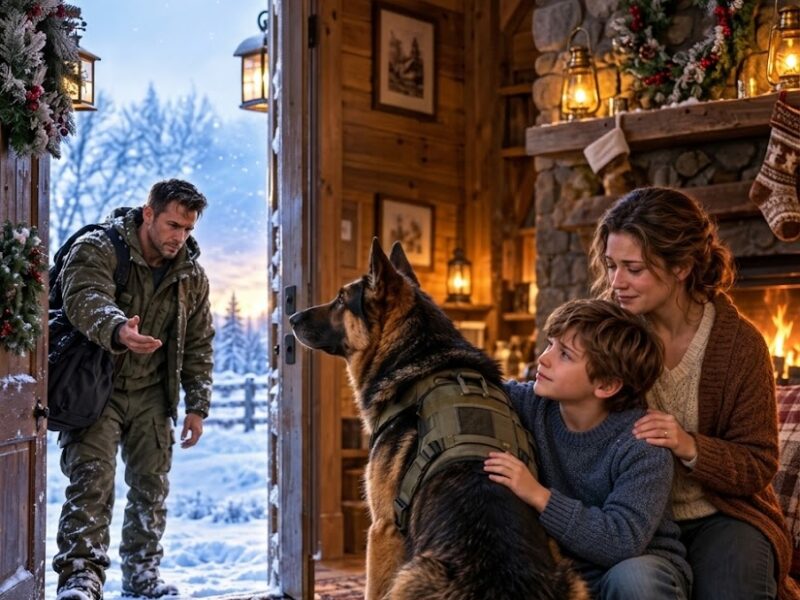
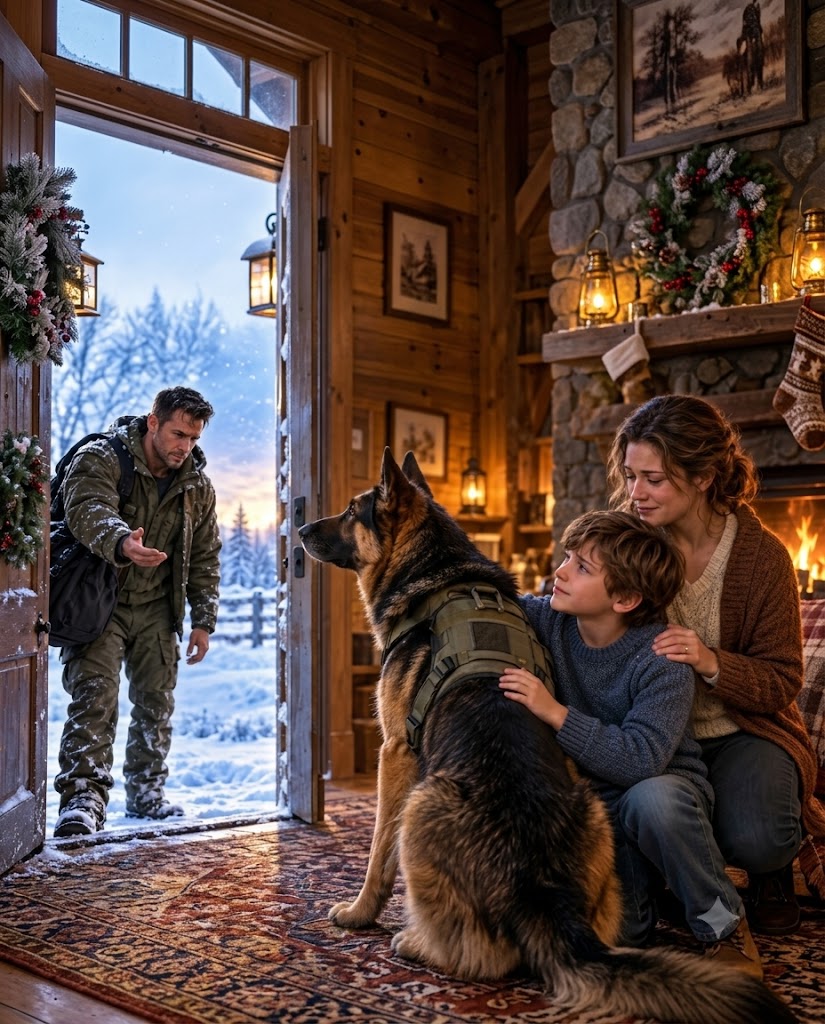
A single mom opened her door to a freezing stranger — she had no idea he was a Navy SEAL, or that his K9 would refuse to leave her son by morning.
## Part 1
At 6:14 in the morning, the Navy SEAL gave his canine a hand signal that had never failed.
Axel looked straight at him and refused to move.
Cole Barrett stood beside Sarah Nolan’s front door, wearing borrowed boots and a coat that was still damp from the storm.
His face was pale from the cold, but his right hand was steady as he repeated the silent command.
Heel.
The large German Shepherd did not come.
Instead, Axel pressed his body closer to 10-year-old Owen, who had fallen asleep on the rug beside the wood stove.
The dog’s chin rested across the boy’s ankles.
One scarred ear turned toward Cole, but his eyes stayed on the child.
Cole tried the voice command.
“Axel. With me.”
The dog had followed that voice through gunfire, smoke, and collapsing walls.
Now he lowered his head over a boy he had known for less than four hours.
Sarah stepped between Cole and the door.
“What is wrong with him?”
“Nothing is ever wrong with Axel,” Cole said. “That’s what worries me.”
Owen woke when he felt the dog’s weight shift.
He could not hear Cole’s voice or the wind beating against the windows, but he saw the tension in both adults.
He sat up and began moving his hands.
Sarah translated, “He says Axel thinks you’re leaving him. We’re leaving.”
Owen watched Cole’s lip, then signed again.
He says, “The road is still closed.”
Cole glanced through the window.
Snow had swallowed his footprints, the fence, and half the porch step.
“The road has never stopped us before.”
Axel rose for one second.
Cole thought the dog had finally obeyed.
Then Axel crossed to the wall behind Owen’s chair, pressed his nose against the baseboard, and drew a slow breath.
He returned to the boy and stood so close that Owen’s shoulder touched his chest.
Cole’s expression changed.
“How long has he been doing that?”
“Since before dawn,” Sarah said.
Axel looked at the wall again.
Whatever had made a retired military K-9 ignore the only handler he had ever trusted, it had begun during a night that should have ended with a cup of coffee and a grateful goodbye.
It had begun four hours earlier, when something scratched three times at Sarah Nolan’s back door.
The first scratch woke her.
The second made her reach for the flashlight beneath her bed.
The third was followed by the heavy thud of a human body against the porch rail.
Sarah looked at the clock.
2:17.
No one came to the Nolan house at that hour.
No one sensible came at all during a blizzard.
The house stood nine miles outside Pine Hollow, Idaho, at the end of a county road that vanished whenever the wind came down from the Bitterroot Range.
She pulled on a robe, took the fireplace poker, and moved through the dark hall.
Owen’s bedroom door was open.
Her son stood barefoot beside it, watching the back entrance.
She signed to him with one hand.
Stay here.
He frowned but obeyed.
Sarah turned on the porch light.
A German Shepherd stood outside with ice crusted across his dark coat.
He wore an olive working harness, though no leash was attached.
His front paws rested on the top step.
Behind him, a man in green field clothing had one arm around the porch post and the other pressed against his chest.
The man tried to speak.
No sound reached her through the door.
The dog looked back at him, then struck the wood once with his paw.
He was not asking to come inside.
He was asking her to see the man.
Sarah opened the inner door but kept the storm door latched.
“Who are you?”
The man lifted his face.
Snow clung to his beard and eyelashes.
“Cole Barrett,” he managed. “Truck went off Miller Ridge. No signal. Dog found your light.”
“Are you armed?”
“Pistol in the truck. Nothing on me.”
The direct answer mattered.
Sarah studied the dog.
He did not growl or bare his teeth.
He stood between Cole and the door, alert but controlled.
A stitched label on his harness read AXEL.
Cole’s knees folded.
The shepherd turned fast enough to catch his shoulder with his own body.
The man did not fall, but he could no longer stand alone.
Sarah unlatched the storm door.
“Bring him in,” she said, though she was not sure whether she meant the dog or whether she had simply forgotten how strange the command sounded.
Axel understood.
He moved beside Cole and gave him something to lean against.
Sarah took the man’s other arm.
Together, they crossed the kitchen and lowered him onto the couch near the stove.
His clothes were soaked.
His hands had gone from red to a frightening waxy white.
Sarah had taken a winter first aid course after moving this far from town.
She knew not to place frozen hands against direct heat and not to force a dangerously cold person into a hot bath.
She added wood to the stove, brought dry towels, and wrapped Cole in layers while the room warmed him slowly.
Axel watched every movement.
When Sarah reached toward Cole’s collar, the dog stepped closer.
“I’m checking his breathing,” she said.
Axel’s eyes remained fixed on her fingers.
Owen entered carrying his own quilt.
Sarah turned sharply and signed, “I told you to stay.”
He answered, “You need help.”
It was difficult to argue with a child who had inherited her exact expression.
Owen stopped several feet from Axel.
He did not reach toward the dog.
He lowered the quilt to the floor and waited.
Axel’s ears shifted first toward the boy’s moving hands, then toward his face.
Owen signed slowly to his mother.
“Does he understand hands?”
Sarah looked at Cole, but his eyes were closed.
“Maybe,” she said aloud, knowing Owen could read her lips.
Working dogs use signals.
Owen pointed to the quilt, then to Cole, asking permission without approaching.
Axel sniffed the wool.
After a moment, he moved aside.
Owen carried the quilt forward and placed it across Cole’s legs.
The dog watched him the entire time.
“Thank you,” Cole whispered without opening his eyes.
Owen did not hear him, but Axel did, or at least Sarah thought he did.
The dog’s ear moved, yet he did not look toward Cole.
He was still watching Owen’s hands.
Sarah found Cole’s identification in the inside pocket of his wet jacket.
The photograph matched the card.
It identified him as a chief petty officer in the United States Navy.
A small metal trident hung from a chain at his neck.
“A Navy SEAL,” she murmured.
Cole opened one eye.
“Recently retired. Still learning the past tense.”
“Do retired SEALs usually drive mountain roads in weather that closes them?”
“Only the foolish ones.”
“Good. At least the cold hasn’t damaged your judgment.”
“It was already like that.”
The corner of his mouth moved.
Sarah tried the landline.
Her cell phone showed no service.
The battery radio reported two downed power lines and a plow stranded below Miller Ridge.
No rescue vehicle would reach them before morning.
“You’re staying until the road opens up,” she said.
Cole shook his head.
“My truck has supplies.”
“Your truck is in a ditch.”
“Axel’s food is there.”
Owen disappeared into the pantry and returned with a bowl of cooked chicken left from supper.
Axel looked at Cole before touching it.
Cole gave a small downward motion with two fingers.
Eat.
The dog obeyed immediately.
Owen’s eyes widened.
He copied the motion.
Axel stopped eating and looked at him.
Cole noticed.
“Don’t give him commands you don’t understand.”
Owen read his lips.
Then he pointed to Cole and signed a question.
Sarah translated.
“He wants to know what the signal means.”
“It means he’s free to eat.”
Owen tried a different signal, moving his open hands from his mouth toward Axel.
“That means food in American Sign Language,” Sarah explained.
Axel tilted his head for the first time.
The hard line of Cole’s face softened.
“Close enough,” he said.
Sarah made coffee while Cole’s color slowly returned.
Owen sat on the floor near the stove, far enough from Axel to leave the dog a choice.
He brought a notepad and wrote in careful block letters.
“Is he a police dog?”
Cole read it.
“Military working dog. He found explosives, tracked people, and warned us before trouble got close.”
Owen wrote another question.
“Is he yours?”
Cole looked at Axel before answering.
“We belong to each other.”
The boy considered that, then wrote again.
“Does he get scared?”
“Yes.”
Sarah expected Cole to soften the truth for a child.
He did not.
“Courage doesn’t mean he never gets scared,” he continued. “It means fear doesn’t make every decision for him.”
Owen nodded as if he understood that better than most adults did.
He removed the pillow from the armchair and placed it halfway between himself and Axel.
Then he turned his attention to a picture book, giving the dog permission to ignore him.
Axel sniffed the pillow.
After a minute, he lay down with one paw across its edge.
That was the first choice.
Axel was not simply choosing a lonely child over his handler.
Before that morning ended, everyone in the house would learn that the dog had been trying to warn them about something hidden only a few feet from Owen’s bedroom.
The second warning came just before Cole’s body began to shake again.
His eyes opened, but for several seconds he did not seem to know where he was.
He caught Sarah’s wrist when she reached for another blanket.
Axel rose instantly.
Owen saw the dog’s body tighten.
He did not hear the growl building in Axel’s chest, but he felt the vibration through the floorboards.
The boy lifted both hands where the dog could see them.
Easy.
It was not one of Cole’s formal commands.
It was an ordinary sign Sarah used when Owen became frustrated.
Axel looked at him.
Owen repeated it more slowly.
“Easy. Safe.”
The dog’s shoulders lowered.
Sarah freed her wrist and placed the blanket over Cole.
When she looked back, Axel had moved to Owen’s side.
“How did you do that?” she asked.
Owen pointed to his eyes.
“He is listening.”
Sarah felt something tighten behind her ribs.
Most people met Owen and immediately thought of everything he could not hear.
The dog had looked at him for less than two hours and discovered the language he did have.
Cole slept again.
Owen remained on the rug.
He read by the stove light, signing pieces of the story.
Whenever Axel watched his hands, the dog could not understand the words, but he seemed to understand the calm rhythm of them.
Near dawn, Owen fell asleep with his hand resting on the pillow between them.
Axel moved closer and placed his body across the boy’s feet.
When Cole woke, the storm had faded enough to reveal the porch rail beneath the snow.
He stood carefully, borrowed a pair of Sarah’s late father’s boots, and reached for his damp coat.
Then he gave Axel the command to leave.
The dog refused.
Cole repeated the hand signal.
Heel.
Axel rose, walked to the baseboard behind Owen’s chair, sniffed it, and returned to the boy.
“How long has he been doing that?” Cole asked.
Sarah watched his face.
“What do you think it means?”
“I don’t know yet.”
Owen stood and signed directly to Cole, though Cole understood only the question in his expression.
“He wants to know why Axel uses hands,” Sarah said.
Cole crouched beside the dog because his hearing was damaged.
Owen stopped moving.
Cole touched two fingers lightly behind Axel’s left ear.
“A blast injured both of us. He still hears low sounds and some voices, but not reliably. Hand signals became the safest way to work with him.”
Owen looked at Axel with a new expression.
Not pity.
Recognition.
“Me too,” he signed.
Sarah translated, but Cole had already understood.
Axel watched the boy’s hands.
Owen touched his own chest, then pointed to the dog.
Same.
The shepherd stepped forward and pressed his forehead against Owen’s shoulder.
Cole looked away.
Sarah saw the reaction.
“Has he ever done that before?”
“Not since the hospital.”
“With who?”
Cole stood too quickly.
The room tilted and he gripped the back of a chair until it steadied.
“A teammate,” he said. “The man who trained him before Axel was assigned to me.”
“What happened to him?”
“He didn’t come home. His name was Mason Ruiz. He raised Axel from an impatient young dog into a partner who could work through darkness without a spoken command.”
On their final mission together, Axel stopped at the entrance to a narrow stairwell and stared at Mason’s hand.
The dog had detected danger beyond the wall.
Mason trusted him immediately.
He pulled Cole and two others back before the first blast.
The second explosion came from behind them.
Mason used his body to shield Axel and never regained consciousness.
Cole woke in a military hospital with damage to his shoulder and a ringing in his ears that lasted for months.
Axel woke in the veterinary wing, unable to hear the trainer who kept calling his name.
He searched every room for Mason.
“When they brought him to me,” Cole said, “he stood at the door for three days. I was the one person left who smelled like the life he had lost.”
Sarah understood then why Cole spoke of belonging to the dog instead of owning him.
“Did Mason ask you to take care of Axel?”
“No. He trusted us to know. That felt heavier than a promise.”
Cole had spent the months since retirement moving between temporary rooms, unable to decide what came after duty.
His father’s cabin was not home.
It was simply the only place where no one would watch him fail to become the man he had been before.
Then Axel had found a house where a boy spoke with his hands, and for one night the dog stopped searching the doors.
Owen could not hear the change in Cole’s voice, but he saw it in the man’s jaw.
He did not ask another question.
Instead, he signed something to Axel.
Cole looked at Sarah.
“What was that?”
“He said, ‘You can miss someone and still stay.'”
Cole stared at the boy.
“He’s 10 going on 80. That’s inconvenient.”
“You have no idea.”
For the first time since the knock at the door, Sarah and Cole smiled at the same moment.
The smile faded when Axel returned to the wall.
He traced the baseboard with his nose, stopped beneath an electrical outlet, and sat.
His eyes moved from the outlet to Cole.
Cole’s posture sharpened.
“Turn off that circuit.”
Sarah followed his gaze.
“The power’s already out. Is there a generator in the shed?”
“It stopped around midnight.”
“Then leave it stopped until we inspect this wall.”
Sarah knelt and touched the outlet.
It felt cold.
“I don’t smell anything.”
“His nose works before ours does.”
Axel remained seated.
Sarah went to the basement panel and switched off the bedroom and hall circuits.
When she returned, Axel was still guarding Owen.
Cole looked through the snow-covered window.
“The house will lose heat if the stove fan stays off.”
“The stove is enough for this room for a few hours.”
“Not if the temperature drops tonight.”
Sarah folded her arms.
“You’re barely able to stand.”
“I can inspect a wire.”
“You said you were a SEAL, not an electrician.”
“My father was an electrician. I spent 18 years trying not to become him. Some lessons survived.”
Owen signed from the floor.
Sarah almost laughed.
“What did he say?” Cole asked.
“He says, ‘Maybe fathers teach us even when we’re not listening.'”
Cole looked toward the boy.
“Definitely inconvenient.”
The storm weakened after 8.
The radio reported that a county plow had begun clearing the lower road but would not reach the Nolan property before afternoon.
Cole inspected the outlet with a circuit tester.
No scorch mark showed on the face plate.
Nothing felt warm.
The smell Axel detected might have come through the wall from the pantry, or it might have been caught in his coat from the wreck.
Still, the dog would not leave Owen.
Sarah served eggs and toast.
Cole ate like a man embarrassed by hunger.
Owen sat across from him and taught him three signs.
Thank you.
Dog.
Home.
Cole learned the first two quickly.
His hands hesitated on the third.
“Again,” he said.
Owen repeated the sign for home.
Cole copied it.
Axel rested his head beneath the table between them.
“His father learned that one first,” Sarah said.
Owen’s expression closed.
Cole noticed.
“Where is his father?”
Sarah waited until Owen looked away.
“He left when Owen was five. The hearing loss came after meningitis. Evan said he couldn’t live in a house where every conversation felt like work.”
Cole’s face hardened.
“Conversation is what people are. Work isn’t a reason to leave them.”
“I know that. Owen knows it too. Knowing hasn’t stopped him from believing silence drives people away.”
Across the table, Owen was stroking the edge of the pillow Axel had claimed.
“Does Evan visit?” Cole asked.
“Birthday cards sometimes. No return address.”
Cole stared at his plate.
“What?”
“Nothing. I shouldn’t say it in front of a child.”
Sarah almost smiled.
“You’re learning.”
Cole looked at Owen and Axel.
“Maybe later.”
While Sarah checked the radio, Cole showed Owen the difference between Axel’s signals for stand down, follow, and search.
Owen repeated each one precisely.
Axel obeyed him only after glancing at Cole for permission.
That mattered to Cole.
The dog was not confused.
He knew exactly who his handler was.
Yet every time the lesson paused, Axel returned to Owen.
Owen taught Cole signs in exchange.
Friend.
Help.
Safe.
Cole’s large hands moved awkwardly, but he never pretended to understand when he did not.
Owen corrected him without embarrassment.
No adult had ever allowed the boy to be the expert so quickly.
Sarah watched from the kitchen.
She had spent five years protecting her son from pity.
Cole gave him something different.
Responsibility.
It frightened her more than pity did because responsibility could become trust, and trust could leave a deeper wound.
At 10:30, the wind shifted north and the house temperature fell four degrees in less than an hour.
Sarah checked the wood stove.
The fire was strong, but the old farmhouse leaked heat through every window frame.
If the plow failed to arrive, they would need the generator for the well pump and circulation fan.
“I have to start it,” she said.
Cole looked at the outlet.
“Not until we isolate the damaged circuits.”
“I turned off the bedroom and hall breakers. The fault may be on the pantry circuit.”
“Then we inspect it.”
“We?”
“This is my house.”
Cole did not argue.
They removed the pantry shelves and checked the exposed outlet boxes.
Everything looked dry.
No wire was blackened.
Axel watched from the doorway beside Owen.
Cole found a faint odor near the floor, but it disappeared when the draft changed.
“Could be an old mouse nest against the cable,” he said. “Keep the bedroom circuit off. We start the generator, then watch the wall.”
Sarah pulled on her coat.
Owen reached for his.
She signed.
Stay inside.
He protested.
She pointed to the window.
The shed stood only 30 yards away.
“Stay with Axel. If the wall changes, come outside.”
Owen nodded.
Cole gave Axel the hand signal to guard.
The dog looked at him, then at Owen, and lay across the pantry doorway.
This time he obeyed.
Sarah and Cole crossed the yard.
Snow reached their knees in places.
The generator sat inside a narrow shed beside the wellhouse.
Sarah cleared ice from the exhaust vent while Cole checked the fuel line.
“You do this alone often?” he asked.
“Everything is ‘often’ when you do it alone.”
“That wasn’t an answer.”
“It was the one I have.”
He recognized his own words from earlier and let the subject rest.
Inside the house, Owen sat on the floor with a book open across his legs.
Axel did not relax.
The dog lifted his nose.
He looked toward the pantry wall, then toward the back door.
Owen followed his gaze.
Nothing had changed.
Outside, Cole primed the generator.
Sarah pulled the starter.
The engine coughed once.
Inside, the kitchen lights flickered.
Axel rose.
Sarah pulled again.
The generator caught, sending power through the few circuits she had left active.
Behind the pantry wall, a cable chewed thin by mice heated beneath its cracked insulation.
Owen saw Axel’s ears go forward.
He smelled nothing yet.
Axel pressed his nose against the baseboard and jerked back.
Then he seized the sleeve of Owen’s coat from the chair and dropped it in the boy’s lap.
Owen looked toward the window.
Sarah and Cole were still at the shed.
Axel struck the floor once with his paw.
Come.
It was the same way he had knocked at the back door hours earlier.
Owen pulled on his coat.
The first thin ribbon of gray smoke slipped from beneath the pantry shelf.
The boy did not hear the dry crackle inside the wall.
Axel did, and this time the dog did not wait for permission.
He caught Owen gently by the coat sleeve and pulled him toward the back door.
Owen resisted for only a second.
Then he saw the smoke curling above the pantry shelf.
He opened the door, stepped onto the covered porch, and turned to count.
One dog.
One boy.
No mother.
Owen pointed toward the generator shed and made the signal Cole had taught him for searching.
Then he added his own signal.
Help.
Axel looked once at the boy as if making sure he would remain outside.
Then he ran into the snow toward the shed.
Sarah was holding the fuel line while Cole listened to the engine.
Axel struck the door with both front paws.
Cole turned.
The dog was alone.
“Where’s Owen?”
Axel spun toward the house and ran three steps, then looked back.
Sarah did not need a translation.
She dropped the fuel line and raced after him.
Cole shut down the generator, grabbed the extinguisher from the shed wall, and followed as fast as his stiff legs allowed.
Owen stood on the porch, exactly where Axel had left him.
His face was white, but he was not frozen with fear.
He pointed into the house and signed.
Fire.
Sarah pulled him against her.
Cole reached the kitchen doorway.
Gray smoke rolled along the ceiling, but the flames were still contained behind the pantry wall.
“Main breaker!” he shouted.
Sarah pointed toward the basement.
“Already off when the generator stopped.”
Cole stayed low, discharged the extinguisher through the opening behind the shelf, and backed out.
Sarah brought the second extinguisher from beneath the sink.
Together, they cooled the wall until the smoke thinned and the orange glow disappeared.
Axel remained outside with Owen.
He could have followed Cole into the smoke.
His training would have taken him there without hesitation.
Instead, he held the position he had chosen before dawn, beside the boy.
When the kitchen was safe, Sarah stepped onto the porch and dropped to her knees in front of her son.
She checked his hands, his face, and the front of his coat.
Owen signed, “I’m fine.”
She pulled him into another embrace anyway.
He let her.
Cole came out coughing from the extinguisher dust.
Axel moved toward him, touched his nose to Cole’s hand, then returned to Owen.
Cole stared at the dog.
“He wasn’t refusing my command,” he said.
Sarah looked back at the scorched pantry wall.
“He was refusing to leave the danger. More than that, he chose the person who couldn’t hear it.”
Owen watched their lips.
Sarah signed the words for him.
The boy shook his head and answered.
“What did he say?” Cole asked.
Sarah’s voice broke.
“He says Axel warned him with his eyes. He only had to believe him.”
Cole crouched in front of Owen.
“You did more than believe him. You got yourself outside and sent him for us. That’s what a partner does.”
Owen looked toward the blackened doorway.
He signed.
I was scared.
Cole answered with one of the signs Owen had taught him.
Same.
The movement was awkward, but the meaning was clear.
“Being afraid didn’t erase what you did next,” Cole said. “Remember that.”
Owen read his lips and nodded.
Axel placed one paw on the porch between them.
Owen signed another question.
“Did he stay because I can’t hear?”
Cole waited for Sarah to translate, then shook his head.
“He stayed because he saw something you needed to know. He trusted you to notice him, and you did.”
Owen looked unconvinced.
Cole touched the dog’s harness.
“Axel doesn’t measure people by what’s missing. Neither should you.”
Sarah lowered her eyes.
She had never told Owen he was less capable, but fear had sometimes delivered the message for her.
She checked every door twice, watched him cross empty roads, and refused sleepovers because another home might not have the alarms he needed.
Owen touched her sleeve and signed, “You keep me safe.”
Then he added, “But I kept me safe, too.”
Sarah pulled him closer.
“Yes,” she whispered, signing the word against his back, where he could feel the motion. “You did.”
Cole watched mother and son hold each other while Axel remained between them and the damaged house.
In the teams, trust had never meant believing danger would not come.
It meant knowing the person beside you would act when it did.
That morning, Owen had acted.
Sarah sat back in the snow.
The strength she had worn all morning broke at last.
Her hands began to shake.
“If you had taken him when you tried to leave—” She could not finish.
Cole looked toward the wall Axel had repeatedly checked.
“I almost made him obey.”
“But you didn’t.”
“Because he’s earned the right to be questioned before he’s overruled.”
Sarah wiped her face with one sleeve.
“Most people don’t give children that right.”
“Most people should learn from dogs.”
The fire had burned through one wall stud and ruined the pantry wiring, but it had not reached the attic.
When the Pine Hollow volunteer chief arrived with the plow three hours later, he said, “Another five minutes might have taken the kitchen and trapped smoke in the bedroom hallway. That dog smelled the insulation before it flashed.”
He said, “You’re lucky.”
Sarah looked at Axel beside Owen.
She answered, “We’ll listen to him.”
The medic examined Cole and found no serious injury beyond cold exposure, bruising, and exhaustion.
A deputy recovered his truck from the ridge.
The front axle was broken, one window gone, and the engine compartment packed with snow.
It would be in the repair shop for weeks.
The deputy offered Cole and Axel a ride into town.
Cole borrowed a dry coat and gathered the few things recovered from the truck.
Axel watched from the porch beside Owen.
“We have to go,” Cole said.
He gave the hand signal.
This time, Axel obeyed.
He crossed the yard and stood at Cole’s left side, but he kept looking back at Owen, who remained very still beneath the porch light.
Owen did not ask them to stay.
He had learned too young that asking did not stop a door from closing.
He simply signed to Axel.
Safe journey.
Cole understood only the final word.
Sarah translated the rest.
Axel whined so softly that Cole felt it more than heard it.
The deputy opened the rear door.
Cole did not load the duffel.
He looked at Sarah.
“Your pantry wall is open. Half the circuits are dead, and the temperature will fall again tonight.”
“The county will find an electrician.”
The volunteer chief shook his head.
“Every electrician in the valley is working on storm lines. Three days at least,” he said.
Cole set his duffel back on the snow.
“My father taught me enough to make the damaged line safe and restore the well pump, if you’ll let me.”
Sarah studied him.
“You don’t owe us for opening the door.”
“I know. And Axel doesn’t owe Owen for trusting him.”
“I know that too.”
“Then why stay?”
Cole looked at the boy and dog on the porch.
“Because for the first time in a long while, leaving feels more frightening than staying.”
Sarah said nothing for several seconds.
Then she took his duffel and carried it back into the house.
“The spare room is small,” she said. “And the window whistles.”
“I’ve slept beside helicopter engines.”
“Owen wakes early. So does Axel.”
“I make terrible coffee.”
“That may be the real emergency.”
Owen saw Sarah smile and smiled too.
Cole stayed three days to repair the wall.
On the fourth day, he installed a smoke alarm with flashing lights in Owen’s bedroom.
On the fifth, he added a vibrating alarm beneath the boy’s mattress and tested it twice.
“The county didn’t ask you to do that,” Sarah said.
“The county didn’t know what the house needed.”
Owen stood in the doorway, watching Cole fit the final wire.
He signed.
Thank you.
Cole answered correctly this time.
You’re welcome.
Axel sat between them like an instructor approving the lesson.
The truck repair took two weeks.
Cole used the time to replace the pantry shelves, seal two leaking windows, and split enough firewood to last through March.
Sarah objected until he showed her a notebook where he had carefully listed the room, meals, and materials he believed he owed.
She crossed out every number.
“This isn’t a hotel bill,” she said.
“Then what is it?”
“A house. People do things because they live in one together.”
Cole looked at the word she had written beneath his figures.
Home.
He knew the sign now.
Every afternoon, Owen and Axel trained in the yard.
Cole taught the boy to give clear, consistent signals.
Owen taught Cole enough sign language to carry a real conversation without Sarah translating.
Axel changed first.
The dog stopped pacing whenever Cole slept.
He no longer checked each window through the night.
Sometimes he chose Owen’s rug.
Sometimes he chose the space outside Cole’s door.
Most often he slept in the hall where he could see all three rooms.
Owen changed more slowly.
At school, he had always kept his hands close to his body around hearing children.
He disliked the pause while someone waited for an interpreter and the exaggerated sympathy that followed.
With Axel, movement was authority.
The boy’s hands could send a powerful working dog across a field, bring him to heel, or ask him to search for a hidden glove.
For the first time since losing his hearing, Owen did not feel that everyone else possessed the important language.
Sarah saw the change when he volunteered to demonstrate Axel’s signals at the Pine Hollow Winter Fair.
Cole stood at the edge of the school gym while Owen guided the dog through a simple search exercise.
Children who once avoided speaking with him crowded close afterward, asking questions through the interpreter.
Owen answered everyone.
When the applause came, he could not hear it.
Axel could hear only part of it, but both saw the raised hands and smiling faces.
Cole looked down when Sarah slipped her hand into his.
Neither of them moved away.
By March, his father’s empty cabin had been repaired, and Cole’s truck was ready.
There was no practical reason to remain at the Nolan house.
He packed before breakfast.
Axel watched from the hall but did not block the door.
The dog had done enough choosing for everyone.
Sarah found the duffel beside Cole’s boots.
“The cabin is open. Heat is on. Roof is sound.”
“That’s good.”
Neither of them believed her voice.
“Sarah, I don’t want Owen to build his life around a man who may not know how to stay.”
“Then learn.”
Cole looked at her.
“You think it’s that simple?”
“I think it’s that difficult.”
Owen entered carrying the pillow Axel had claimed on the first night.
He placed it on top of the duffel.
Cole signed, “What is this?”
Owen answered, “It belongs to Axel.”
Then the boy added another sentence.
“You don’t have to stay because he wants you to.”
Cole nodded slowly.
“I know.”
Owen continued, “You should only stay if you want us to.”
Sarah turned away, but not before Cole saw her eyes.
“Your son has a cruel habit of making retreat impossible,” he said.
“He gets that from me.”
Cole crouched so he and Owen were level.
He signed carefully, making each word clear.
I was going to the cabin because empty places cannot lose anyone.
Owen watched.
Cole continued, “But empty places cannot become a family either.”
The boy’s hands remained still.
Cole looked at Sarah.
“I can’t promise I’ll never wake from a bad night. I can’t promise Axel will stop checking exits. I can’t promise I’ll understand every sign the first time.”
“Good,” Sarah said. “I don’t trust perfect promises.”
“I can promise to keep learning, if there’s room for that.”
Sarah looked around the small kitchen at the repaired wall, the flashing alarm above the hall, and the extra pair of boots that had stood beside hers all winter.
“There’s room,” she said.
Cole did not kiss her.
Not then.
He reached for her hand, and she let him hold it.
Owen removed the pillow from the duffel and returned it to the hall.
Axel followed, circled once, and lay down across it.
Cole unpacked that spring.
He accepted a job training search and rescue dogs for three mountain counties.
The work kept him near Pine Hollow and gave Axel occasional demonstrations without asking the retired K-9 to return to danger.
Sarah expanded the small bookkeeping business she ran from home.
Cole drove Owen to school when snow turned the road slick.
Owen taught Cole a new sign every morning and tested him at supper.
The sign Cole practiced most was staying.
Not the military command.
The human one.
On the anniversary of the storm, snow began falling before dawn.
Sarah woke to an empty hall and found all three of them on the covered porch.
Owen wore Cole’s old navy jacket over his pajamas.
Axel sat between them, gray beginning to show around his muzzle.
Cole signed a question to the boy.
Ready?
Owen nodded.
Cole gave Axel the same signal he had given one year earlier.
Heel.
The dog rose and stepped to Cole’s side.
Then he looked at Owen.
Owen signed one word.
Home.
Axel moved between them so that one shoulder touched the Navy SEAL and the other touched the boy.
Sarah stood in the doorway holding three mugs and smiling through tears.
People in Pine Hollow later said a single mother had saved a freezing Navy SEAL during the worst storm of the year.
Others said a retired K-9 had saved a deaf boy from a fire hidden inside the wall.
Both stories were true.
Neither was complete.
Sarah opened a door because a stranger was cold.
Owen offered a pillow because a tired dog needed somewhere safe to rest.
Cole listened when loyalty asked him to question a command.
Axel stayed beside a child the world too often expected to follow rather than lead.
No single act made them a family.
A family formed in the choices that followed.
A repaired wall.
A hand held at a school gym.
A flashing alarm above a bedroom door.
One more place set at breakfast.
One more person willing to learn the language of the house.
Axel had been trained to find danger before anyone else knew it was there.
That winter, he found something else first.
He found a home none of them knew they were searching for.
If this story touched your heart, tell us in the comments what you believe made Axel stay beside Owen first.
The warning hidden in the wall, or the boy who understood his silent world?
Subscribe to Seal K9 Stories for more stories of courage, loyalty, and the quiet moments that turn strangers into family.









