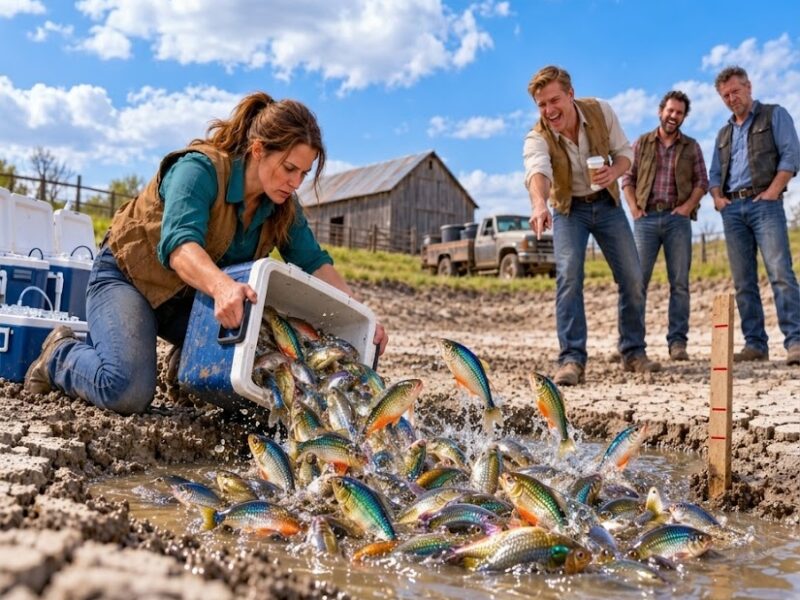
A single mom filled an empty pond with minnows. She had no idea the worst drought in 60 years was coming—or that her little pond would become the most contested water in the county.
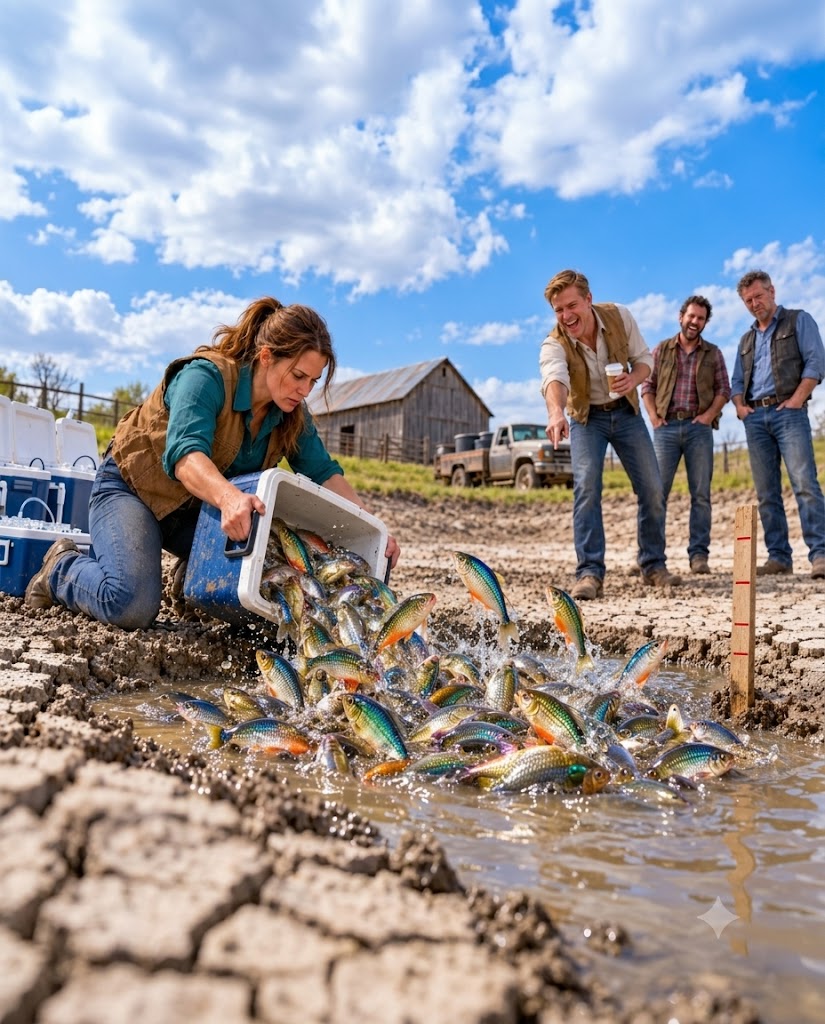
In April, Mara Whitlock stood on the cracked white floor of a nearly empty pond and poured thousands of minnows into a puddle so small a grown man could step across it.
The ranchers on the bank laughed out loud.
Grant Barington asked whether she was raising fish or simply burying the last of her money in the mud.
Mara said nothing.
She drove a wooden stake into the soft ground at the water line, marked the level with a red pen, and walked back to the house.
Four months later, the worst drought in sixty years swept across Dry Creek, and nobody was laughing at her pond.
If you love stories where the most doubted person sees what everyone else missed, subscribe and stay to the end.
Mara Whitlock arrived in Dry Creek, Kansas on a cold morning in late February, driving a fifteen-year-old pickup with a cracked side mirror and her nine-year-old daughter, Josie, asleep against the passenger window.
The divorce had taken two years and most of what she had built before it.
When the lawyer finally stopped calling, Mara did the only arithmetic that still mattered to her.
Sixty-eight thousand dollars could buy a cramped rental in a city she had grown to dislike, or it could buy seventy acres at the dead end of an unpaved road in a county where land had been losing value for a decade.
She chose the land.
The realtor, a tired man named Dennis Crow, drove her out to see it with the air of someone apologizing in advance.
The property sat at the eastern edge of town where the gravel gave out and the section road became two ruts in the grass.
Behind the barn, the ground dropped into a wide shallow basin that had once held water, almost two acres of it, and now held nothing but cracked gray clay and a crust of dead algae curled up like paint peeling off a wall.
Dennis kicked at the edge of it and said what he had clearly rehearsed on the drive.
The last owner had given up on the pond years ago because the ground out here held water about as well as a screen door.
Dennis waited.
When she stood up, she asked him only one question, which was whether any of the original survey paperwork had stayed with the property.
She bought the farm eleven days later for fifty-four thousand dollars, which was eight thousand less than the asking price because no one else had made an offer in nineteen months.
She did not tell anyone in town what she had done before she came here, and nobody asked.
What she had done was work eleven years as a field technician for a land and water survey outfit, hauling probes and sample jars across four states, logging soil, moisture, and aquifer behavior for clients who paid by the hour and never learned her name.
The talking started at the farm supply store on County Road 4, which was where everything in Dry Creek started.
Mara went in for fence staples and came out with PVC pipe, a secondhand transfer pump, native grass seed, and a soil moisture meter she tested twice at the counter before paying.
Grant Barington was leaning against the end cap with a coffee in his hand, thirty-one years old, wearing boots that had never been in a feedlot.
He watched the pile grow, then asked loud enough for the two men by the register whether she was planting or performing science.
He said that these days anybody with a decent internet connection could decide they were a farmer and that the ground out east had a way of correcting that opinion by about the second August.
His father came by the farm eight days after that, and his father was a different kind of problem entirely.
Silas Barington was fifty-six, silver at the temples, and he arrived in a clean truck with the Barington Cattle and Land brand on the door, burned into roughly four thousand acres between the highway and the county line.
He complimented the porch repair.
He asked about Josie by name, which meant he had already asked somebody else about Josie.
Then he stood at the edge of the empty basin with his hands in his pockets and made his offer in the easy voice of a man who had never been told no in a way that stuck.
He wanted the twenty-five acres along her southern boundary, the stretch that ran down toward the old county drainage.
He offered nine hundred dollars an acre and framed it as a favor, explaining that the south piece was hard pan, useless to someone starting out, and that it happened to square off a corner of his own grazing rotation.
Mara asked him to wait a moment, walked to the barn, came back with a moisture meter, and pushed the probe into the ground at the top of the slope while he watched.
She looked at the number, wrote it on the back of her hand, and said, “No, thank you.”
Silas smiled with his mouth and said the offer would be there when she changed her mind.
That was the first time Silas Barington truly looked at her.
It was the beginning of everything that came after.
Two weeks later, Mara was clearing the north end of the barn loft, hauling out sixty years of someone else’s abandoned decisions, when she pulled a flat tin case out from under a stack of rotted seed sacks.
Inside was a survey plat from the summer of 1964, folded in quarters, the paper gone the color of weak tea.
A mouse had taken a semicircular bite out of the lower right corner and carried off whatever had been printed there.
The elevation contours were still legible, and so was a thin blue line, hand-inked rather than printed, that entered the property from the southwest, bent once, and ran straight toward the center of the basin before stopping at its edge.
There was no note beside it, no arrow, no symbol she recognized from any modern standard.
Mara carried the plat into the house, flattened it under glass on the kitchen table, and did not mention it to a single person in Dry Creek.
What Mara did over the following six weeks convinced the whole county that she had no idea what she was doing.
In fairness, from the road, it looked that way.
She did not deepen the pond.
She did not order a water truck, which two of her nearest neighbors did that same spring at four hundred dollars a load.
She did not drill a new well, even though the outfit out of Hollis had a two-week backlog.
Instead, she spent her days on things that produced nothing anyone could point at and sell.
She cleared the old drainage swales on the west half of the property by hand and with a borrowed loader, one length at a time.
She seeded the whole slope above the basin in native grass, big bluestem and switchgrass and cidosma, which cost her less than two thousand dollars and would not look like anything for at least one full season.
She cut six wooden stakes out of a fence post, drove them into the basin floor in a line from the rim to the lowest point, and marked each one in red paint at one-inch intervals.
Every morning at seven, before Josie’s bus came up the section road, she walked the line and wrote six numbers in a spiral notebook.
Then a storm came through on a Tuesday night and dropped an inch and a quarter in ninety minutes.
In the morning, there was water in the bottom of the basin.
Not a pond, nothing like a pond, just a brown puddle, maybe forty feet long and six inches at the deepest point.
The kind of thing that evaporates into a damp ring by Friday and is a memory by Sunday.
Then she drove ninety miles to a bait and stock operation outside Wilmore and bought fathead minnows by weight, as many as the tanks could give her, a little over four thousand fish for two hundred and twenty dollars.
She drove them back in aerated coolers, carried them down the bank one at a time, and poured them into six inches of muddy water in a basin that had been dry for most of two decades.
Grant Barington happened to be coming up the section road with a load of mineral tubs, and he stopped.
He stood on the rim with his thumbs in his belt and watched a woman empty a cooler of live minnows into a puddle.
He laughed so hard he had to set his coffee on the hood.
He asked whether she was stocking fish or burying money, a line he would repeat so often over the next four months that he stopped remembering it had ever been funny.
Mara capped the last cooler, drove the red-marked stake at the waterline, wrote the level in her notebook, and walked up the bank past him without saying one word.
By six that evening, the story was at the Ridgeline Cafe on Main.
The new woman out east is raising fish in a mud hole.
That was the sentence, and it did what sentences like that do in a town of eleven hundred people.
Grant gave the place a name because naming a thing is how you make a joke permanent.
Within a week, everyone in Dry Creek used Whitlock Marina without thinking.
Somebody got a piece of weathered barn board, burned the words into it with a woodburning kit, and wired it to her gate post one night when she was asleep.
Josie found it on her way to the bus and asked her mother if they should take it down.
Mara said, “No, leave it. That way, people will know where to find us.”
She went to town that same afternoon for pipe fittings.
When the counter clerk called her fish lady by accident and turned red, Mara just told him the size she needed and paid.
She did not defend herself once, which disappointed everybody.
A woman who writes down six numbers twice a day and keeps her face still is simply a mystery nobody has the patience for.
The only person in Dry Creek who looked at her operation and felt something other than amusement was Wade Hollister, sixty-three years old, who had pulled and set pumps and wells in that county since he was nineteen and had been hired to look at the ancient transfer pump in her barn.
Then he walked the property on his own time and stood at the rim of the basin with his hat off, studying the shape of the land above it the way other men study a horse’s legs.
He noticed that the swales she had cleared did not run toward the basin the way a person would dig them to fill a pond.
They ran across the slope, slowing water down rather than carrying it in, which is what a person does when they want water to go into the ground instead of across it.
He asked her straight out whether she had put the minnows in to raise them.
She said no, one word, and she went back to the hose and weighed Hollister drove home that evening, thinking about it the whole way.
That night, Mara took a flashlight down the bank at a quarter to eleven.
She crouched at the edge of the water and put the beam into it, and the surface broke into a thousand small flickers as the minnows scattered and regrouped, alive three weeks after the men on the rim had given them a weekend.
She moved the light to the nearest stake and read the paint line against the water.
The level stood just under half an inch higher than her entry from the previous morning.
It had not rained in Dry Creek for three days.
The humidity had been under twenty percent, and the daytime high had touched eighty-six.
June arrived and the rain simply stopped.
It stopped the way a conversation stops when somebody walks into the room, abrupt and total.
At first, nobody worried because two dry weeks in June is a Tuesday in Kansas.
Two weeks became three.
Three became five, then six, and the National Weather Service office in Dodge City started using language in its outlooks that the older men in town recognized from their fathers.
The pastures went from green to yellow in nine days, and from yellow to the dull brown of a paper sack by the second week of July.
The farms that had laughed in April began doing math at the kitchen table in June.
Grant Barington’s show pond, dug four years earlier and stocked with largemouth bass, dropped eleven feet and left a ring of dead cattails in cracked mud.
The shallow wells went first, the forty and fifty foot ones on the older places, losing pressure in the afternoon and then losing it by noon and then not coming back.
Hay that had been eighty dollars a ton in March was quoted at two hundred and thirty by the middle of July.
Silas Barington was not worried, and he had earned the right not to be.
The Barington reservoir, dug in two stages during the late 1960s, held more surface water than everything else in the county combined.
For thirty years, the Baringtons had sold water out of it to their neighbors in dry stretches at a fair price with a handshake.
That generosity was the foundation of everything else they owned.
Because a family that has saved you once owns a piece of your opinion forever.
So when Silas began buying land that summer, the town told itself a comfortable story about it.
He bought the Lindstrom place in the first week of July at four hundred an acre under what it would have brought in a wet year.
He came to see Mara a second time on the eleventh of July in the evening, when the thermometer on her barn still read ninety-nine.
He offered to buy the entire seventy at twelve hundred an acre, more than double what she had paid for the whole farm.
He said that a single woman with a child, no herd, no well worth the name, and no irrigation was running a race she had already lost, and that there was no shame in taking a win when it was offered.
Mara said no.
Silas put his hat back on, looked down at the basin where a brown oval of water sat surrounded by forty feet of baked clay, and told her in the same pleasant tone he used in church that when her pond turned to dust, the next offer would be considerably smaller.
Here is what was strange, and what the men at the cafe started mentioning to each other in late July without quite knowing why it bothered them.
The pond at the Whitlock place was shrinking, but it was not dying.
By the end of July, it had pulled back to perhaps a third of its April footprint, a dark oval maybe sixty feet across, and then it more or less stopped, holding a shape it had no business holding through six weeks without rain in hundred-degree July.
The minnows were still there.
Mara was not watching it with hope, which is what people assumed.
She was measuring it.
She took the water temperature at four fixed points every morning and again every evening and wrote the numbers down with the air temperature beside them.
She noted wind direction because wind drives evaporation harder than heat does.
She noted where in the basin the fish were holding, which was a column she had been filling since the second week of April.
By the last week of July, the drought stopped being a season and became a crisis with rules.
The Barington operation announced it would be limiting outside water sales in order to protect its own herd, which was reasonable, legal, and devastating.
Grant drove the county with the window down, telling anyone who would listen that the people who had prepared would come through fine, and that this was just the land sorting out who was serious.
Meanwhile, Mara was building.
She bought two used fifteen-hundred-gallon poly tanks at a dairy sale and set them on a timber pad above the house.
She rebuilt a quarter mile of ancient buried line, pulled the transfer pump out of the barn, and set it in a plywood box at the pond’s edge, and began moving small volumes of water, never more than a few hundred gallons at a time, out to the new grass on the upper slope on a schedule she timed with a kitchen clock.
Josie helped her glue fittings on the porch and asked why they were watering grass nobody could eat.
Mara told her that the grass was not the crop, the ground underneath it was.
The rumor started in the second week of August, and it started fast because a town under pressure will always prefer a villain to a mystery.
Somebody driving by saw the pump box, the new tanks, and green grass on the Whitlock slope.
The sentence that came out of it was that the woman out east had a well nobody knew about and was pulling groundwater while the rest of them rationed.
Within four days, Silas Barington stood up at the town council meeting, expressed concern in the calmest possible voice for the local aquifer during a declared emergency, and asked that the county water office look into unpermitted withdrawals at the Whitlock property.
The vote to request an inspection was unanimous, and Mara, who did not attend meetings, learned about it from a letter in her mailbox.
The inspection was set for the twenty-first of August at nine in the morning.
By eight forty, there were seven trucks parked along the fence line, which told Mara everything about how the day was expected to go.
Dale Brunner came out from the county water office with a clipboard and a younger man carrying a locator wand.
Grant was there leaning on his tailgate with three other landowners wearing the particular relaxed posture of a man who has arrived early for a public execution.
Silas did not come, which was its own kind of statement.
Mara had everything laid out on the tailgate of her own truck before he asked: the deed and the log for the single house well, a fifty-two-year-old hand-dug shallow that served the kitchen and the shower and had never been connected to anything else.
Her notebooks, all four of them.
There was no new well.
The locator wand found no unregistered casing anywhere on the seventy acres, and Brunner’s man walked a grid for two hours in the sun to be certain of it.
There was no hidden line running to a neighbor’s system, no tap into the rural district main, no meter anywhere, no connection to the municipal supply, and no diversion from any creek, because the creek that gave Dry Creek its name had been a dry sand channel since the first week of June.
The pump in the plywood box drew from one place and one place only, which was the pond, through a four-inch intake sitting in open water that every man standing on that rim could see.
Then Brunner stood there with the clipboard against his leg and asked the question that none of them had prepared for, which was where the water was coming from.
The pond had lost most of its surface area since spring, but the level at the stakes had fallen less than eleven inches in a summer that had evaporated more than four feet off open water across that part of Kansas.
He asked whether anybody had hauled water in, and six men who had been watching that fence line all summer out of pure entertainment had to admit that nobody had ever seen a truck.
Grant said the obvious thing, which was that she had capped a well somewhere and the wand had missed it, and Brunner told him in front of everyone that the wand does not miss steel casing at four feet and that he was welcome to come walk the grid himself tomorrow.
Grant did not take him up on it.
The inspection closed with no violation, no citation, and a two-page report that would sit in the county file for years, and the trucks drove off down the section road in a long train of dust that hung over the ditch for twenty minutes.
Mara put her notebooks back in the house and went to fix a leaking fitting on the upper tank because the grass she had planted needed water on a schedule and nothing that had happened that morning changed the schedule.
Three days later, Silas Barington came back.
He did not mention the inspection.
He stood in her kitchen because it was a hundred and three outside, declined a glass of water with a small smile, and offered her one hundred and ninety thousand dollars for the farm, which was more than three times what she had paid for it in February.
He said she could be out by October with enough to buy a house in town and put something away for Josie.
For the first time in six months, Mara asked Silas Barington a question instead of answering one.
She asked why a man with four thousand acres and the largest reservoir in three counties wanted a worthless farm this badly in the middle of a drought at triple price.
Silas held her eyes for about four seconds, and then he said it had been a pleasure, and he left without answering.
That evening, Wade Hollister’s truck came up the section road, and he was carrying a cardboard file box that had been in his mother’s basement since his father died.
His father had been a ditch contractor here from the end of the war until 1971, which meant every drainage project in that part of Kansas had gone through his hands, and the man had never thrown away a piece of paper in his life.
There were bid sheets, hand-drawn profiles, two water rights filings, and near the bottom, folded into eighths and soft as cloth, a United States Geological Survey quadrangle sheet from 1958 with hand annotations in his father’s square printing all over it.
Mara brought out the 1964 plat and laid the two sheets side by side, lined up on the section corner and the old bench elevation.
The thin hand-inked blue line on her plat ran exactly where a feature on the older map ran, and the older map had a label that her plat did not.
Printed in small block letters across the basin behind her barn, in a hand that had been dead for thirty years, were three words.
Old Spring Basin.
A natural spring-fed basin, mapped and named six years before somebody drew a blue line toward it and then stopped explaining what it meant.
Wade said he had grown up two miles from here and had never once heard anybody call it that.
Mara said that was the part that worried her, because a spring does not quit.
A spring can weaken.
A seep can go seasonal.
But a spring that fed a two-acre basin strongly enough to earn a name on a federal map does not vanish inside one generation and leave sixty years of people believing the ground out here just does not hold water.
Something had happened to it.
The two of them sat at that table until almost one in the morning with a magnifying glass and a flashlight.
The question they could not answer was the only question that mattered, which was what had been done, and by whom, and whether any record of it still existed.
The answer was in the courthouse basement in Hollis, in nineteen boxes of county drainage district minutes that had not been pulled by anyone since a graduate student in the early 2000s.
It took Mara and Wade four trips across eleven days.
What they found was not hidden exactly.
It was simply boring, which is a far better place to hide something.
Between 1966 and 1969, the Barington operation had petitioned the drainage district four separate times for improvements along the West Fork, and every petition had been approved because in those years the Baringtons were the drainage district in every way except the name on the letterhead.
One filled an old meander and a connected lateral ditch that the 1958 map showed running northeast directly toward the Old Spring Basin, and the minutes described it in one sentence as abandonment of a non-productive channel.
Another built an intake structure and a berm that redirected the entire shallow seasonal flow of that drainage southwest into what was then the new Barington reservoir.
Laid out in sequence, the four projects told a story so simple it was almost disappointing.
The water that had recharged the shallow formation under her farm for an unknown number of centuries had been intercepted upstream and routed somewhere more profitable.
Within about eight years, the spring basin behind her barn had gone from a named landmark to the place where the ground does not hold water.
But a spring is not a faucet, and this is where Mara’s eleven years in the field became the only thing in the room that mattered.
Cutting off the surface recharge had starved the basin and dropped the local water table below the pond floor, which is why it went dry and stayed dry.
It had not emptied the formation itself.
Deep under that basin, the ground still carried water because the basin sat at a structural low point where an underlying layer pinched out and the formation came close to the surface.
Which is precisely why there had been a spring there in the first place.
In a year when regional pressure shifted, when heat drove transpiration down and the big neighboring withdrawals changed the gradient, water could still find its old exit.
But it was still a door, and nobody for sixty years had thought to check whether it was locked.
This is the part of the story that the whole county had been laughing at since April, told correctly.
Fathead minnows live about one year, tolerate filthy water, and survive temperatures that kill nearly everything else.
But they cannot survive what a closed, stagnant, rain-fed puddle does in a hundred-degree Kansas August.
In that case, the water heats top to bottom.
The oxygen crashes, and within six weeks, a stocked population is a crust of dead fish on a mudbank.
That is what should have happened at Whitlock Marina by the middle of June.
The men on the rim had expected it so confidently that they stopped driving past to check.
Mara had not bought four thousand fish to raise them or sell them or eat them.
She had bought them because a professional hydrogeologic survey of a seventy-acre property with test borings, a pump test, and lab analysis would have cost between nine and fourteen thousand dollars.
In February, she had fifty-four hundred dollars left after closing.
Minnows cost two hundred and twenty dollars.
And they do something no instrument does for that price.
They are a living sensor distributed across the entire basin floor.
They respond to differences in temperature and oxygen too small for a cheap probe to resolve reliably.
They do it continuously, every hour, for free, while the owner is fixing a fence.
If there was no groundwater contribution, they would die and the question would be answered.
If there was, they would not die randomly.
They would concentrate.
They concentrated.
By the second week of May, Mara’s notebook column showed the school holding day after day over a patch of the basin floor roughly thirty feet across, about forty feet east of the lowest point.
They were not there because it was deepest, because it was not.
She waded out with the probe in June and found what she already knew she would find.
The water over that patch ran four and a half degrees cooler than water fifty feet away in the same pond at the same hour.
It is what happens where water of a stable deep temperature enters from below continuously in small volume and gets mixed and swallowed by a pond that is losing twice as much to the sky.
That was the month Mara knew.
It was the second week of June.
The drought was four weeks old, and she had the location of a working spring seep on a property that every person in Dry Creek, including the man who sold it to her, had written off as dead ground.
She could have kept pumping quietly, let the town run out, and sold water at whatever the market would bear by September, which would have been an extraordinary amount of money.
She went the other direction entirely, and that choice is the reason the Baringtons eventually lost something they could not buy back.
## Part 2
By the third week of August, the drought reached a point where the arithmetic stopped working for everyone.
The Barington Reservoir had been designed to be refilled by seasonal flow out of the West Fork, and the West Fork had produced nothing since the second week of May.
For one hundred and six days, the largest body of water in three counties had been a bank account with withdrawals and no deposits.
The intake tower stood in the open air at the north end like a chimney in a burned house, and the shoreline had retreated far enough that cattle were walking out onto cracked flats to reach it and getting stuck.
Silas cut outside sales to four hundred gallons per operation per week on the eighteenth, and on the twenty-second he suspended them entirely with a letter that used the phrase operational necessity.
That letter changed Dry Creek faster than anything the drought had done on its own.
The Haskin family sold ninety head in one morning at a loss that ended four generations of cattle on that ground.
The men who had spent the spring saying Whitlock Marina out loud now drove past that fence line slowly in the heat, looking at an oval of standing water with minnows breaking the surface at dusk, and found that the words stopped forming in their mouths.
They simply stopped telling the joke, which is the same thing.
Grant Barington came up her driveway on the twenty-sixth of August at eight in the morning, alone, and he did not get out leaning on anything.
He had a hundred and forty pairs on a lease pasture with a tank that was pulling air by noon every day, and his father’s suspension letter applied to him the same as everyone else.
He asked if she would sell him water.
He offered four times the going rate.
He did not call her fish lady, and he did not look at the sign on the gate post.
Mara could have made him stand there a long time.
Instead, she asked him how many head and over what distance, got a pencil, and told him the truth, which was that what she had was not a solution, and anyone who treated it like one would kill it.
The seep produced something on the order of two thousand gallons a day, and that number would fall if she drew the pond down hard.
She would commit nine thousand gallons a week total to be divided among operations that were actually at the wall, with the Haskins first.
She would charge the rate Barington had charged in June, not a cent more.
There was a condition, which she had written out two weeks earlier and had been waiting for someone to come ask for.
Anyone who took water agreed to put labor and equipment into reopening the old lateral along the West Fork and rebuilding the catchment above her basin, so that whenever rain finally came, the recharge path that had been filled in 1967 would carry water back toward the formation instead of to the reservoir.
Not a lawsuit and not a claim against anybody.
Grant read the single page twice, and he understood with perfect clarity what it meant, which was that the water in Dry Creek was about to stop having one owner.
Silas understood it faster.
He came to her door on the thirtieth of August without an appointment and without any pleasantness left.
For the first time, he raised his voice, which Mara noted the way she noted everything.
He told her that the water under her property was part of a system his family had developed and paid taxes on for three generations, and that his attorneys would file for an injunction within the week and tie her farm up in court until she had nothing left to defend it with.
He was not entirely bluffing.
In a water rights fight in that state, the person with the longer history and the bigger legal budget usually wins, and he had both.
Mara let him finish.
Then she went to the kitchen table, came back, and laid three things in front of him without a word.
The 1958 quadrangle with Old Spring Basin printed across her property in federal ink six years before his father’s first petition.
The certified copies of all four drainage district approvals from 1966 through 1969, with the line about abandonment of a non-productive channel marked in pencil.
If he filed, all of it became public record and the subject of testimony.
The family that had spent sixty years being the reason Dry Creek survived its dry years would spend a trial explaining what they had quietly done to someone else’s water in 1967.
Silas Barington looked at those three pages for a long moment, and he did not say anything at all.
That silence was the loudest thing that had happened in that county all summer.
The last discovery belonged to Wade, and it reframed everything one final time.
Working through his father’s profiles, he mapped the elevation of the underlying confining layer across eleven sections.
What emerged was that the old spring basin was not a small isolated pocket of water sitting under one woman’s farm.
It was a discharge point, the place where a much larger formation reached its structural low and surfaced naturally, the way a slow leak finds the lowest seam in a roof.
It sat beside a lined, straightened, engineered channel that had been designed to capture surface flow and had been doing so brilliantly for fifty-eight years.
In the process, decades of heavy pumping and redirected drainage had steadily reduced the natural recharge of the whole area and left that enormous reservoir almost entirely dependent on rain that fell in a season.
Whitlock Farm did not have the most water in Dry Creek.
It had never had the most water.
Whitlock Farm simply happened to sit at the one place in the county where water could still come back up out of the ground on its own.
The Baringtons had spent three generations building a magnificent system that could not do that at all.
The community meeting was held in the Dry Creek School Gymnasium on the ninth of September, called by the council to discuss emergency water coordination, and roughly two hundred and forty people came, which was nearly everyone who was not milking or hauling.
Silas Barington spoke first, and he spoke well.
He talked about sixty years of his family making water available to neighbors at cost.
He said that it was difficult to watch an outside party arrive with no history in the community, discover a temporary advantage during a natural disaster, and attach conditions to it, and that he worried about where that logic led.
He did not need to, and when he sat down, there were people in that gymnasium who nodded.
Mara Whitlock walked to the front with a cardboard box.
She did not argue with anything Silas had said, which denied the room the fight it had come for.
She set out the 1958 quadrangle and read the three printed words aloud.
She set out the 1964 plat with the hand-inked line and the mouse-chewed corner.
She set out the four drainage district approvals, the dates, and the single sentence about the abandoned channel.
She set out her water temperature logs, four locations twice daily, from the second of April through the eighth of September, and the stake measurements beside them.
She passed the open notebooks down the front row so that men who had farmed for fifty years could see the handwriting change color where she had run out of blue ink in the middle of June.
Then she put one more thing on the table, which was a photograph.
It had been taken on the fourteenth of April with a cheap camera on a timer, and it showed a dry gray basin, a six-inch puddle, a wooden stake with a red mark at the waterline, and the date burned into the corner by the camera itself.
Four months before the drought was declared, before any person in that gymnasium had a reason to care what the water level was on a worthless farm east of town, every measurement she had just handed them began on a day when there was nothing in Dry Creek worth measuring.
Which meant that whatever else anyone wanted to say about her, no one in that room could stand up and say she had assembled a story after the fact to fit a disaster.
Grant Barington was standing against the wall by the trophy case, and the arithmetic ran across his face in front of two hundred people.
The woman he had named in a feed store parking lot had understood the ground under this county from her first spring on it.
His family, with four thousand acres and a reservoir and eleven employees, had not noticed that their entire system had quietly become a rain gauge.
Old Hollis Dempsey, seventy-one years old, who had laughed the loudest at the cafe in April and had told the mud hole joke to his own grandchildren, turned around in his folding chair and said, loud enough for the back rows, that it appeared that Mud Hole knew more about water than any of them did.
There was just a long noise of two hundred people shifting in metal chairs at the same time.
Nothing collapsed that night.
Silas Barington did not go broke, and anyone hoping for that ending was in the wrong county.
What they lost was smaller than their fortune and far more valuable than any piece of it, which was the unspoken authority to decide who in Dry Creek got to survive a dry year.
After the ninth of September, water in that town was something the town worked out together, with records, maps, and a rotation on a piece of paper taped inside the council room door, and no family’s goodwill stood between a man and his herd ever again.
The work started that same week, and it was unglamorous in the way that real repair always is.
They reopened sixteen hundred feet of the lateral that had been filled in 1967, rebuilt two shallow catchments above the basin, keyed in a low berm so runoff soaked in instead of running to the ditch, and seeded the disturbed ground in the same native mix Mara had planted in April.
Grant Barington ran a tractor for four days of it.
Silas neither helped nor objected.
In October, the Barington operation quietly contributed eleven hundred feet of culvert to the project without a press release, which was as close to an apology as that family had ever come to anything.
The rain returned on the second of October, and it did not come as a storm.
It came as a gray morning drizzle that started before sunrise and kept on for nineteen hours, the kind of rain that does not run off, and by evening there were small rings spreading across the surface of Whitlock Pond where the drops landed.
Mara stood at the rim in a jacket and watched them, and Wade stood beside her.
After a while, he asked the question he had been carrying since April.
He asked, “Why minnows?”
She told him about the fourteen thousand dollars she did not have and the two hundred and twenty she did, about oxygen and temperature and the simple fact that a living thing will find the one good spot in a bad pond and stay there.
Then she told him the other half, the part she had never told anyone.
Not Josie, not the county, not the two hundred and forty people in the gymnasium.
When she had first flattened that 1964 plat under the glass on her kitchen table in March, she had spent most of a night going over it with a magnifying glass, and in the white margin along the bottom edge, in pencil, half rubbed away, was a line of handwriting left by whoever had walked this ground with a chain and a rod sixty years ago.
It was not a measurement, not a coordinate, not an X over anything.
Four words written the way a man writes something down because it struck him and he had nowhere else to put it.
Minnows remained through August.
Every owner of that property since 1964 had presumably seen that plat at some point and read right past it because it looks like nothing.
It is a sentence about fish.
But Mara Whitlock had spent eleven years logging water behavior for people who paid her to notice exactly that kind of thing.
She understood what the surveyor had actually recorded without knowing it.
A rain-filled basin in that climate does not keep minnows alive through August.
If small fish had lived in that basin through the dry end of a Kansas summer in 1964, then that basin was not holding rain.
It was being fed from below, and the man with the chain had written down the proof in the margin and then gone home.
So in April, Mara had not been gambling.
She had been running the only experiment the note allowed her to run, which was to put the same indicator back into the same basin and find out whether what had been true in 1964 was still true.
The worst drought in six decades, the thing that destroyed herds and emptied wells and broke four generations of families across that county, had done one other thing entirely by accident.
It had removed every drop of rainfall from the equation for one hundred and thirty consecutive days and turned the whole basin into a perfectly controlled test of a single penciled observation that had been sitting unread in a barn loft for sixty years.
On a cool morning in the first week of October, Mara stepped out onto the porch with coffee while Josie waited at the end of the drive for the bus.
The pastures beyond the fence still carried long brown scars from the drought and would carry them into the following summer.
But in the low ground behind the barn, in a ring maybe thirty feet wide around the water, there was new grass coming up, a green so fresh it looked out of place in that landscape.
There was no moment anywhere in that autumn when anybody in Dry Creek stood up and told Mara Whitlock that she had been right, and she never once asked for it.
There was only Mara on the porch, Wade’s truck coming up the road with a load of pipe, and a sound at the east end of the basin so faint you had to stop walking to hear it, which was water finding its way back to the surface of the ground where it had been going for a very long time before anyone in that county was born.
Grant Barington drove past a little after eight, slowed, and stopped.
The weathered barn board was no longer wired to the gate post where someone had hung it in April.
Mara had taken it down, cleaned it, and set it on two posts at the edge of the water facing the road.
Whitlock Marina.
Grant looked at it for about four seconds, and then he lifted two fingers off the steering wheel and drove on.
Mara smiled, and it was not the smile of a woman who had beaten anybody.
Silas Barington was still rich.
She smiled because of something smaller and more private, which was that for five months, every person in Dry Creek looked at that pond and seen fish.
They had seen a joke, a mud hole, a woman wasting the last of her money.
Not one of them had ever once asked the only question that was worth asking, which was not whether the fish were alive.
It was where exactly those fish had chosen to swim, and why they would not leave that one cool patch of water sixty feet from the deepest part of the pond.
Sometimes what makes a person a joke is not that they are wrong.
It is that they are looking at something nobody else has the patience to look at long enough to understand.
Mara Whitlock did not beat a drought with money or land or leverage or a louder voice at a meeting.
She beat it by measuring the same six things twice a day while people laughed from the road, by trusting a four-word note a stranger left in a margin sixty years before she was born, and by refusing to let anyone else’s certainty replace what she could prove.
If you like stories about ordinary people who get written off and end up changing how an entire community sees them, subscribe and stay with us for the next one.
And whatever it is that you are quietly working on right now while somebody tells you it will never hold water, keep writing down your numbers.
The dry season is exactly when the truth finally shows.









