A Single Father Gave a Homeless Woman Shelter—Then Her True Identity Left the Entire World Stunned
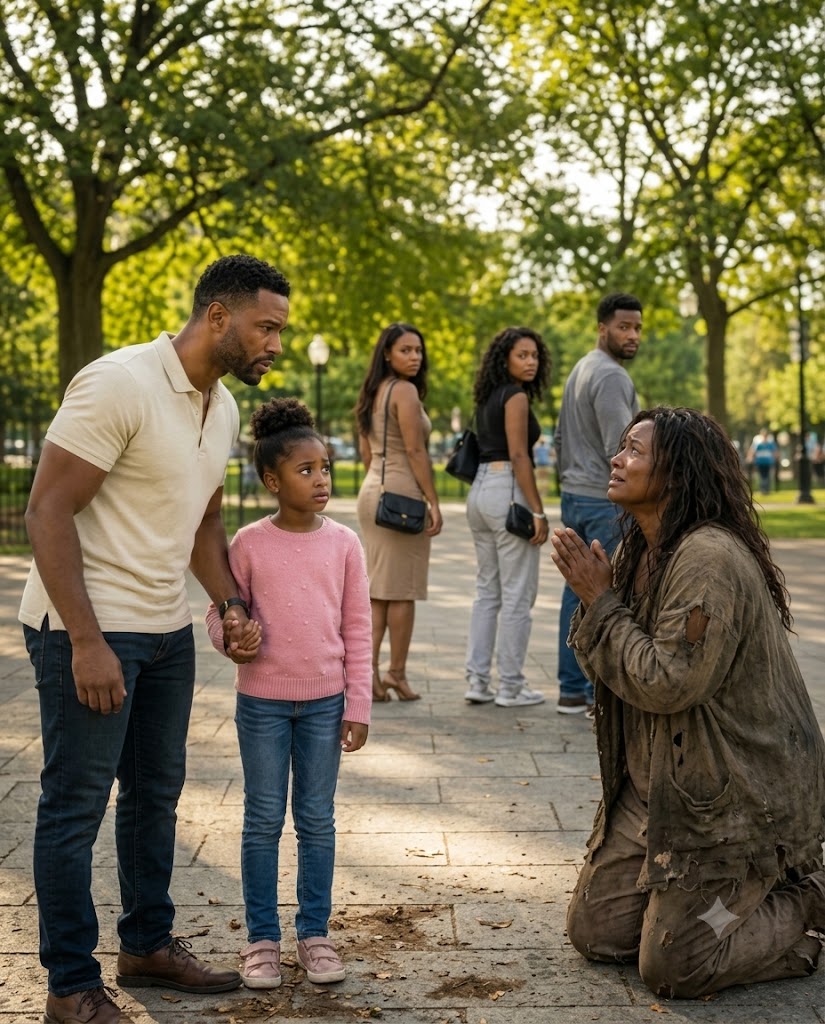
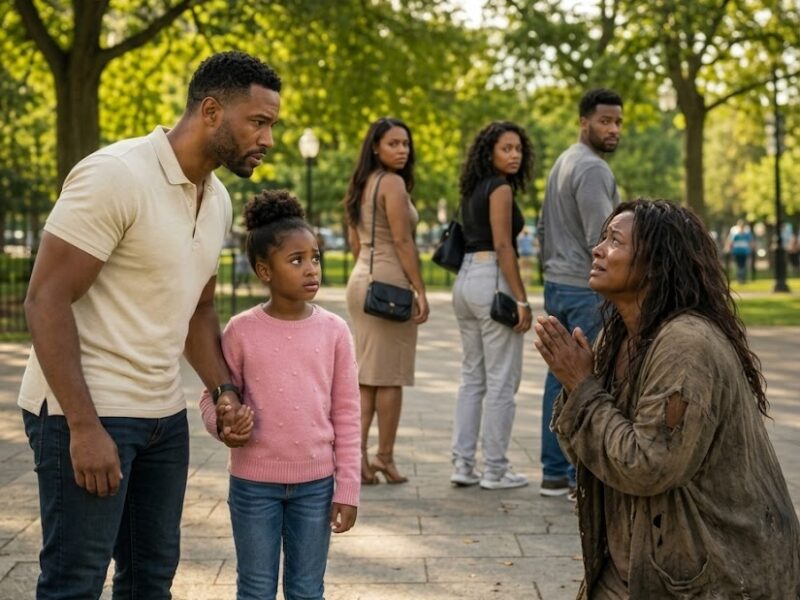
The rain had been falling for three hours when Owen Powell first saw her kneeling in the wet gravel of Ridgeline Park.
She wasn’t asking for money. That was the first thing he noticed, the detail that made him slow his steps while other people walked faster. Her voice barely carried over the noise of the park—joggers splashing past, a distant ice cream cart bell, kids screaming on the swings despite the gray sky.
“Five minutes,” she said to a man in running shoes who had already adjusted his earbuds and kept moving. “Just five minutes to tell you why she looks exactly like my little girl.”
The man didn’t stop. Neither did the woman pushing a stroller who steered wide around her like she was something spilled on the pavement that hadn’t been cleaned up yet.
Owen had his daughter Ava’s hand curled tight in his own and a bag of oranges in the other. He almost kept walking. There were good reasons—a six-year-old at his side, a rule he’d made for himself a long time ago about not getting tangled in strangers’ lives.
But Ava had already stopped. She had a habit of doing that, freezing midstep whenever something in the world didn’t sit right with her.
“Daddy,” she tugged. “That lady’s crying.”
—
Lauren didn’t lift her head when Owen approached. She was bracing for another round of mockery—he could see it in the set of her shoulders, the way her hands curled tighter around the strap of a worn backpack.
“I’m not going to ask you for money,” she said quickly, like she needed to get the words out before he could walk away. “I just haven’t eaten today. Or yesterday, really.”
Owen glanced at the bag in his hand, then at his daughter, whose expression made refusing feel impossible. He didn’t say anything. He just walked to the small food cart near the entrance and came back with a wrapped chicken sandwich, a bag of pretzels, and a bottle of water.
Lauren stared at the food like it might vanish if she blinked.
“Thank you.” Her voice cracked clean in half on the second word. She hugged the sandwich to her chest before she even opened it.
Owen nodded, already turning to leave when she spoke again, quieter now, like she already knew the answer.
“I don’t have anywhere to go tonight. If there’s a stairwell, a porch, anything with a roof, I’ll be gone before the sun’s up. I promise.”
Something in Owen’s chest pulled tight. He looked down at Ava’s small hand in his, and the words came out before he could dress them up into something kinder.
“I can’t. I have a daughter. I don’t know you.”
Lauren nodded fast, like she’d already rehearsed hearing that exact sentence.
“Of course. You’ve already done more than you had to.”
She managed something close to a smile, and it was somehow worse than if she’d cried.
—
That night, after Ava had fallen asleep with her lamp still on, Owen stood at the kitchen window and watched clouds swallow the last of the streetlight.
The first drops hit the glass a few minutes later. Within an hour, it was a full storm, wind bending the trees along his street sideways.
He kept thinking about her hands. The way they’d shaken, even wrapped around a sandwich, like her body hadn’t caught up yet to the idea that someone had actually said yes.
He grabbed his keys off the counter before he’d fully decided to, telling himself he was only checking that she’d found somewhere dry.
He did not tell himself the truth—that instinct was pulling him back into the rain toward a stranger he’d turned away hours earlier.
What Owen didn’t know, standing in his driveway, soaked through, was that the woman he was driving back to find had a name the whole country would have recognized instantly if she hadn’t been buried under it eleven months ago.
Someone had made very sure Lauren Mills would never be found.
They just never counted on a park bench, a little girl who noticed everything, and a father who couldn’t let it go.
—
The park was unrecognizable in the storm. Empty benches slick with rain. The fountain spray drowned under thunder rolling low across the sky. Street lamps throwing broken halos onto the wet asphalt.
Owen drove the perimeter twice, scanning every bench, every awning before he finally saw her—huddled beneath the old pedestrian bridge, knees pulled to her chest, soaked clean through to the bone, shivering hard enough that he could see it from the car.
He parked, killed the engine, and sat there a moment longer than he meant to, watching the rain hammer the windshield, half convinced he was about to do something foolish.
Then he got out into it anyway.
Lauren flinched when his shadow fell over her, then recognized him and went very still, like she didn’t quite trust what she was seeing.
“You shouldn’t have come back,” she said, teeth chattering around the words.
“Neither should you have been left out here.”
Owen crouched down, holding out a hand. “One night. That’s all I’m offering. Tomorrow, we figure something else out.”
She looked at his hand for a long moment—long enough that he almost withdrew it—before she finally took it.
—
Ava was asleep when they got to the house, and Lauren moved through the front hallway like she was trying to take up as little space as possible. Careful not to drip on the rug. Careful not to touch anything she hadn’t been offered.
She apologized twice before Owen had his coat off.
“It’s one night,” he said again, mostly to remind himself. “There’s a bathroom down the hall, towels in the closet. Help yourself to whatever’s in the kitchen.”
Lauren’s eyes caught on a photograph above the fireplace. A woman with a warm, easy smile, her arm looped through Owen’s. Both of them younger, sunlit, unaware of what was coming.
Lauren didn’t ask. She just looked at it a second too long, in the way of someone who understood grief without needing it explained to her.
“She was beautiful,” Lauren said quietly.
Owen didn’t answer. He turned off the hallway light instead and disappeared into his room.
—
It was near midnight when Lauren, still awake on the couch wrapped in one of his blankets, noticed the security camera mounted on the pole across the street.
Angled at a strange, deliberate pitch.
She sat up sharply, every muscle suddenly alert.
“Don’t stand in front of that window,” she said before she’d even thought about how strange it would sound.
Owen paused halfway through the kitchen, a glass of water in his hand. “What?”
“The camera across the street. It’s not pointed at the sidewalk. It’s angled toward your porch.”
She caught herself, cleared her throat, tried to sound casual. “I just—I notice things.”
Owen studied her for a moment too long. “Most people don’t notice things like that.”
Lauren looked away first, pulling the blanket tighter as if it could hide the mistake.
—
It kept happening after that, in small pieces. He almost talked himself out of noticing.
She glanced at his watch the next morning and said without thinking that it was a limited production model worth more than most people’s cars.
She answered a wrong number call on his landline in fast, fluent French before catching herself and hanging up flustered.
She checked the deadbolt twice before she’d even agreed to stay a second night.
When his television flickered past a business news segment, her eyes locked onto the corporate logo for three full seconds before she forced herself to look away, jaw tight.
None of it added up to anything Owen could name outright. All of it added up to a feeling he couldn’t shake—a low hum of wrongness underneath everything she said.
—
Ava wandered out around midnight, rubbing her eyes, unbothered by the stranger on her couch in the way only children can be.
“Are you the lady from the park?”
“I am.”
“Why do you look sad all the time?”
Lauren considered the question with more weight than a six-year-old’s question usually earned, turning it over like it deserved a real answer.
“Because sometimes people lose things they can’t replace.”
Ava nodded slowly, like this made perfect terrible sense to her, and climbed up next to Lauren without asking permission, tucking herself against her side.
Owen watched from the doorway and felt something in his chest twist. The same ache he carried whenever anything reminded him of what his daughter had already lost once—and how easily she still offered her trust to strangers who hadn’t earned it yet.
He fell asleep telling himself it was one night.
—
He woke to an empty living room, gray morning light through the curtains, and a silence that felt wrong before he’d even fully opened his eyes.
The particular quiet of a house that had one more person in it than usual the night before—and now didn’t.
For a moment he lay there, half convinced he’d dreamed the whole strange evening. Then he heard nothing where there should have been the small sounds of a guest waking. No water running. No floorboard creaking under an unfamiliar weight.
The dream feeling collapsed into something closer to dread.
Lauren was gone before dawn.
The blanket he’d given her was folded into a careful, precise square on the couch cushion. Too careful. Like the folding itself was an apology she didn’t know how else to leave behind.
Her backpack, though, was still there—tucked half beneath the coffee table, like she’d forgotten it in her hurry.
Or like she hadn’t.
—
Owen picked it up, meaning only to check for a name inside, some clue to who to call if she didn’t come back.
His fingers found a seam in the lining that didn’t sit flush with the rest of the fabric. Stitched differently. Deliberately. Like it had been opened and resealed more than once.
He pulled at it before he could stop himself.
Something slid free and landed face up on the carpet.
A photograph.
The woman in the photograph wore a tailored charcoal suit, her hair pulled back, her chin lifted with the confidence of someone who had never once doubted that a room belonged to her. Behind her rose a glass and steel tower catching the afternoon sun, a company crest engraved into the polished stone at its base.
Mills International.
Owen turned the photo over, searching for a date, a name, anything. Nothing on the back.
He turned it right side up again and stared at the woman’s face until there was no way left to pretend it wasn’t the same face that had slept twenty feet from his daughter’s room six hours earlier.
—
He opened his laptop with hands that weren’t quite steady, typing the company name first. Then, after a breath, he forced himself to type her name.
The search results loaded in less than a second, and there she was. Dozens of images. Magazine covers. Conference panels. A Forbes headline calling her one of the most influential self-made executives under forty. A photo of her cutting a ribbon outside a hospital wing that bore her family’s name.
And then beneath all of it, buried under a year of silence, the headline that mattered.
**Billionaire Lauren Mills Presumed Dead After Private Aircraft Disaster.**
Eleven months old.
Owen sat back, the chair creaking under him. He read it twice, then a third time, chasing the details that didn’t sit right.
No public identification of remains—only a statement citing conditions of the wreckage. A closed casket memorial held within a week, faster than seemed reasonable for a death this prominent. Company leadership reorganized almost immediately, with her younger brother, Marcus Mills, stepping smoothly into place as interim chairman. Her fortune quietly folded into a family-controlled trust before the mourning period had even ended.
He thought of the three strangers in the park. Their laughter. The way they hadn’t looked surprised so much as delighted.
*No way that’s actually her.*
They hadn’t been shocked to see a homeless woman kneeling in the gravel. They’d been shocked to see a dead one breathing.
—
He scrolled further back through older coverage, the celebratory pieces written when Mills International went public. The profile that called her “the most careful person in any room she enters.”
There was a photo from a shareholder gala. Lauren in emerald green, laughing at something off camera. A hand resting on her brother’s shoulder like she trusted him completely.
Owen stared at that photo the longest. Whatever had happened to her, it had happened to someone who once believed without question that the person beside her wanted her to succeed.
He read the obituary next, the one the company itself had released. Three paragraphs of careful language about legacy and vision. Not one line about how she’d actually died. No mention of an investigation. No mention of anything beyond grief.
It read less like a tribute and more like a door being quietly closed.
Owen sat back and rubbed a hand over his face, trying to make the pieces sit still long enough to look at them properly. A woman worth more than he’d earned in ten lifetimes had slept on his couch, eaten cereal at his kitchen table, and told his daughter something true about grief without once mentioning who she used to be.
None of it fit together the way it should have. All of it kept circling back to the same unanswerable question.
*What kind of person survives being erased and chooses to stay erased?*
—
The front door opened behind him, and Owen turned to find Lauren standing in the doorway—rained damp again despite the morning sun outside—staring at the photograph in his hand like it was a weapon already pointed at her chest.
Neither of them spoke for a long moment. The silence stretched until it felt like its own kind of accusation.
“Who are you?” Owen finally asked.
“You should have left that backpack alone.”
“Who are you?” he said again, louder this time, the words scraping out of him.
Lauren closed the door behind her, slow and deliberate, like she needed the click of the latch to steady herself before she could answer.
“I’m exactly who that article says I am. And I’m asking you—not for money, not for shelter—just to forget you ever saw this.”
“I have a daughter.” Owen’s voice shook. Anger and fear tangled together. “I let you sleep twenty feet from her room. I need to know if you’re dangerous. No more half answers.”
“I’m not dangerous.” Lauren’s eyes were wet, but her voice stayed level, almost eerily calm. “I’m hunted. There’s a difference. And it matters more than you could possibly know yet.”
“Then explain it to me,” Owen said. “Explain it so I understand, because right now all I have is a photograph and a headline that says you’re supposed to be in the ground.”
—
Lauren pressed her palms flat against her thighs, steadying herself.
“I will. I promise you I will. Just not standing in your living room with the blinds open and a car outside that I don’t recognize yet.”
“Are people looking for you?”
A long silence stretched between them, heavy enough that Owen thought she might not answer at all.
Then, quietly, almost like a confession dragged out of her: “Yes.”
Owen opened his mouth to say something else—he didn’t know what yet, some mix of demand and warning—when movement outside the front window caught his eye.
A black SUV moving slower than the street speed limit allowed. Easing past the house at a crawl, like it was reading the numbers off the mailbox one digit at a time.
Lauren’s face drained of color before Owen even fully turned to look.
“They found me,” she whispered.
And for the first time since he’d met her, Owen heard real terror in her voice. Not the tired, resigned fear of a woman used to being ignored—but the sharp fear of someone who knew exactly what came next.
—
Owen’s hand was already reaching for his phone when Lauren crossed the room in two quick strides and closed her fingers gently over his wrist.
“Don’t call the police,” she said, breathless. “Please. I don’t know yet who’s safe to trust. And a badge doesn’t automatically mean safe. Not for me. Not with what I’m carrying.”
“That’s not good enough.” Owen pulled his wrist back, though he didn’t lift the phone.
“I know.” Her voice cracked on the words, the composure she’d held onto all morning finally slipping. “I know it isn’t enough. Give me one more day. Just one. Then I’ll tell you everything I know. And if you still want me gone after that, I’ll go, and I won’t argue, and I won’t come back.”
Owen didn’t answer right away. He watched the SUV disappear around the far corner of the street and didn’t let himself relax until it was fully gone, counting the seconds in his head like it might come back if he stopped.
—
Over the next hour, in careful, incomplete pieces that came slower each time—like each one cost her something real to hand over—Lauren let him see fragments of a life that didn’t match the exhausted woman who’d knelt in the wet gravel, begging for bread.
She’d had drivers once, she said. Security details who rotated in shifts. A private floor of an office building with her name etched into frosted glass doors.
She didn’t explain why all of it was gone—only that the people who’d taken it from her were still out there. Still watching. Still patient. Still waiting for her to make exactly one mistake.
“Why not just go back?” Owen asked, still not fully able to picture the woman she was describing standing in his kitchen. “If it’s yours, fight for it in the open.”
“Because the people who took my life,” Lauren said, meeting his eyes directly for the first time all morning, “are the same people waiting for me to walk straight back into it.”
—
Later that afternoon, Owen caught her slipping half of her lunch into a paper bag, along with two protein bars quietly pulled from his pantry without asking.
“For an older man who sleeps near the transit station,” she explained, clearly embarrassed at being caught. “I used to bring him something when I could. Back when I had almost nothing myself. Habit, I guess.”
She met Owen’s eyes, something almost defiant in the way she said it.
“Having nothing doesn’t mean you have nothing to give.”
Owen didn’t have a response ready for that. He was starting to understand—slowly, and against his better judgment—that everything he thought he knew about this woman kept turning out to be smaller than the truth underneath it.
He thought about the strangers in the park again. The way they’d laughed at her, called her ruined, mistaken her for someone whose worth had run out along with her money.
None of them had known what he was starting to learn. That whatever Lauren had lost, generosity hadn’t been part of it. If anything, poverty had only sharpened it, stripped it down to something that no longer needed an audience to be real.
Something that asked nothing of anyone watching.
—
Everything changed an hour later, all at once, the way disasters always seemed to.
Ava came home from a friend’s birthday party flushed and wheezing, her lips swelling before Owen had even gotten her fully out of her booster seat.
He froze. The particular useless panic of a parent whose mind goes white with fear at exactly the moment it needs to work fastest. Hands fumbling uselessly at the buckle.
Lauren didn’t freeze.
She was across the room before Owen had finished shouting her name, checking Ava’s airway with steady hands, tilting her head just so, calling out clear, calm instructions.
“Call 911. Tell them anaphylaxis. Tell them we need epinephrine now. Tell them her airway’s compromised.”
With the exact practice steadiness of someone who had done this before—or trained relentlessly for the possibility that she might have to.
—
At the hospital hours later, once the swelling had finally eased and Ava was sleeping soundly under a thin blanket, still faintly wheezing but breathing on her own now, a doctor pulled Owen aside to tell him gently that Lauren’s quick response had very likely saved his daughter’s life.
“How did you know exactly what to do?” Owen asked her afterward, in the sterile quiet of the waiting room, the adrenaline finally draining out of both of them.
Lauren stared at her hands for a long moment, turning them over like she was looking for something written on her palms.
“I’ve had to learn how to keep people alive,” she said finally. “It wasn’t a skill I ever wanted to need.”
The statement settled over Owen like a stone dropped into still water. He didn’t ask what she meant. He was afraid of the answer—and afraid, too, of how much he was already starting to trust a woman he still barely knew anything true about.
Ava fell asleep across two plastic chairs, her small hands still curled in the sleeve of Lauren’s borrowed jacket.
Watching her, something in Lauren’s carefully held composure finally slipped.
“She reminds me of a child I imagined having once,” she said, so quietly Owen almost missed it entirely. “Before everything happened. Before all of this.”
—
Owen eventually dozed off in the chair beside them, exhaustion outrunning fear at last. He didn’t see Lauren ease her phone from her pocket and step quietly into the hallway.
He didn’t hear her whisper, “I’m ready to stop running,” into the receiver, her voice barely audible over the hum of the vending machines.
Or the voice that answered—low and familiar and utterly without warmth.
“Then come home, Lauren.”
The voice belonged to her brother.
—
Lauren told him the truth two days later, sitting across the kitchen table with the porch light off and the blinds drawn tight, like even the walls of Owen’s house might be listening.
“My name is Lauren Mills,” she said, folding her hands in front of her like she needed somewhere to put them. “I owned sixty-one percent of Mills International. And according to every legal document filed eleven months ago, I am dead.”
Owen didn’t say anything at first. He’d already half known—had spent two sleepless nights preparing for this exact sentence—and hearing it out loud still didn’t make it any easier to hold.
She told him the rest in pieces that came slower, like each one cost her something real to surrender.
Months before the crash, she’d found irregularities buried inside quarterly filings. Transfers routed through a chain of shell accounts. Numbers that refused to reconcile no matter how many times she ran them.
She traced the pattern for weeks in secret before the name at the center of it became undeniable. Impossible to explain away any longer.
Marcus. Her own brother.
She’d sat with that knowledge alone for four days before she told anyone, hoping she was wrong, running the numbers a dozen different ways, looking for an innocent explanation that never came.
Marcus had always been the charming one—the one investors liked in a room, the one who could make a bad quarter sound like a strategy. She’d built the company. He’d always been better at explaining it to people who didn’t understand what they were buying.
She was two days from bringing it to the full board when her private plane went down over open water, during what was supposed to be a routine flight to a shareholder summit.
She remembered the cabin losing pressure. The sudden, violent drop. And very little after that—until she woke alone in a small regional hospital three hundred miles off the flight’s intended course, with no ID on her and a nurse who told her gently, almost apologetically, that the news was already reporting Lauren Mills had died in the crash.
“I could have walked back in that very week,” she said. “Corrected the record before it hardened into fact. Instead, I disappeared.”
Her hands were flat on the table now, steady, like the telling itself had burned through the last of her fear.
“I needed evidence Marcus couldn’t bury a second time. And I needed to find out, once and for all, if there was a single person left in my life who valued me for something other than what I could hand them.”
—
Owen’s jaw tightened. Old anger surfacing fast.
“You brought that danger into my house. Around my daughter. Lauren—she’s six years old.”
“I know.” Lauren didn’t flinch from it. Didn’t look away. “And if you tell me to leave right now, tonight, I will. I won’t ask you to forgive me for putting her at risk, because I’m not sure I’d forgive myself either.”
The anger in Owen’s chest didn’t fully leave. But underneath it, something else was building steadily—something that made the idea of her leaving harder to picture than the idea of her staying.
He thought of his wife briefly, the way he still did at strange, unguarded moments. How she’d always said the measure of a person wasn’t how they treated you when things were easy, but what they admitted to you when they didn’t have to.
Lauren hadn’t needed to tell him any of this. She could have vanished the way she’d vanished from everyone else’s life and left him with nothing but questions.
Instead, she was sitting at his kitchen table, handing him the truth like it might cost her everything to do it.
Maybe it would.
—
“There’s one more thing,” Lauren said, and something in her voice shifted, grew smaller.
“Months before any of this happened, I visited a community center anonymously, doing due diligence for a grant proposal. I saw a man help an elderly stranger carry groceries up three flights of stairs because the elevator was broken. And he didn’t know anyone important was watching. And he didn’t ask for a single thing in return.”
She looked at him directly, unguarded, for the first time.
“When I had nowhere left to go, I came back to this exact neighborhood on purpose. I wasn’t testing whether people were kind in general. I already knew most weren’t. Not really. Not when it cost them anything.”
She paused.
“I wanted to know if you still were.”
—
Owen sat with that for a long time. The accusation and the confession and the strange, unearned tenderness of it all tangled together in his chest until he couldn’t separate one thread from the next.
He was still sitting with it, still turning it over, when he glanced toward the window and saw two unfamiliar cars parked across the street that hadn’t been there an hour earlier.
Engines idling. Headlights off.
Lauren followed his gaze, and her whole body went rigid beside him.
“They aren’t here for me anymore,” she said quietly, her voice gone flat and strange.
Owen looked at her, not understanding, his stomach already dropping before his mind caught up.
She looked toward Ava’s darkened bedroom window down the hall.
“They’re here because now they know exactly where I stayed.”
—
Owen felt the floor tilt slightly under him, the way it had in the hospital waiting room. The same white-edged panic.
He crossed to the window and eased the curtain shut one careful inch at a time, as if speed itself might draw attention.
“Then we don’t wait for them to decide what happens next,” he said, surprising himself with how steady it came out. “Tell me what you need.”
Lauren looked at him for a long moment, like she was recalculating something about him entirely.
“I need you to trust me for one more day,” she said. “That’s all I’m asking tonight.”
—
Everything about Owen’s routine changed within a single day.
He started varying his route to Ava’s school, taking the long way one morning and cutting through side streets the next. He walked her all the way to the classroom door instead of dropping her at the curb like he used to.
He found himself scanning parked cars on quiet residential blocks, cataloging makes and models and license plates the way he’d never once thought to before Lauren walked into his life.
Lauren watched him rebuild his entire routine around her danger, and it broke something loose in her that she’d been holding together by sheer will.
She started keeping a mental log of every small sacrifice. The overtime shift he turned down because it meant Ava would be alone at pickup. The friend he stopped answering because too many questions about “the woman staying with you” had started circulating around the neighborhood.
None of it was said aloud between them. She simply noticed—the way she noticed everything—and each item added weight to a decision she’d been circling for days without quite landing on it.
—
“I should go,” she said one evening, standing by the door with her backpack already over one shoulder. “Tonight. Before this gets any worse than it already is.”
“No.”
Owen’s answer came faster than he expected it to, surprising even himself.
“Owen—”
“You came into my house because you had nowhere else to go,” he said, crossing the room to stand in front of her. “I’m not throwing you out the moment your past finally catches up to you. That’s not who I am. Not to you. Not to anyone. And especially not now.”
Lauren set the backpack down slowly, like she wasn’t fully convinced her legs would carry her back out the door anyway.
“You don’t know what you’re agreeing to,” she said. “You don’t know what Marcus is capable of when he thinks he’s losing.”
“Then tell me,” Owen said. “Stop protecting me from the truth and let me decide for myself what I’m willing to risk.”
Lauren studied him for a long moment, like she was weighing whether he meant it or whether it was the kind of thing people said before they understood what they were asking for.
Whatever she saw in his face seemed to settle something in her. Because she pulled out a chair and sat down across from him, ready finally to stop managing how much of the truth he was allowed to carry—and to let him decide for himself what he could bear to know.
—
A man approached Owen outside his workplace two days later.
Mid-thirties. Expensive coat. A voice pitched low and pleasant in a way that made the threat underneath it sharper than any shout could have been.
“You don’t know what kind of woman you’re protecting,” the man said, falling into step beside him.
“I know enough,” Owen answered, and walked past him without breaking stride.
Though his hands didn’t stop shaking until he was safely back in his car with the doors locked.
He didn’t tell Lauren about the man at first. He sat with it through dinner, through Ava’s bath, through the quiet ritual of tucking her in—weighing how much fear was fair to hand someone who was already carrying more of it than any one person should.
In the end, he told her anyway. Because keeping it from her felt like its own kind of lie, and lies were the one thing he’d promised himself he wouldn’t build this into.
Lauren listened without interrupting, her expression unreadable until he finished.
“That means Marcus knows you’re not just someone I stayed with,” she said quietly. “He knows you’re someone I choose to protect. That makes you a target, Owen. Not a bystander anymore.”
—
That night, Lauren finally showed him everything she’d been carrying.
Encrypted files backed up quietly across three separate accounts. Financial records copied in fragments over months. A handful of recordings, pieces of correspondence she’d gathered in the frantic weeks before the crash.
Enough to raise serious questions. Not enough yet to end this for good.
“There’s one archive I can’t access remotely,” she admitted, closing the laptop. “It’s inside Mills International’s secure internal servers, behind credentials that were wiped the week I was declared dead. I’d have to go back in person to pull it. And the moment I badge into that building, Marcus will know within minutes.”
“Then we go back in person,” Owen said, before he’d fully thought it through.
Lauren studied him like she was searching for the catch in it. Some hidden condition.
“If you come with me, there’s no version of your life that goes back to normal after this. You understand that?”
“Not fully back.” Owen thought of the quiet, careful, guarded life he’d built since his wife died. A life constructed entirely around keeping Ava safe from a world he no longer fully trusted to be gentle with either of them.
He thought of how small and airless that life had started to feel in the eight days since a woman knelt in the wet gravel of a park and asked for nothing more than bread.
“There wasn’t much of a life worth protecting,” he said quietly, “before you two showed up and complicated all of it.”
He didn’t get to finish the thought.
—
Headlights swept hard across the living room window, cutting the dark in half.
A black SUV pulled directly into his driveway, blocking the only exit. Doors opened in near-perfect unison. Men stepped out, unhurried, certain of themselves in a way that made Owen’s stomach turn cold and heavy.
One of them looked directly at Lauren through the front window and smiled, like he’d been waiting for this exact moment for eleven long months.
“Mrs. Mills,” he said, his voice carrying easily through the glass. “We’ve been looking absolutely everywhere for you.”
“Get Ava upstairs,” Lauren said, low and fast, already moving toward the hallway. “Now, Owen. Go.”
Owen didn’t argue. He scooped his daughter up, half asleep and confused, and carried her up the back stairwell while voices rose sharply in the driveway below.
Marcus’s men demanding entry. Demanding Lauren. Demanding answers Owen had absolutely no intention of giving them.
When he came back down, taking the stairs two at a time, Lauren was already at the front door, her hand on the knob.
“Don’t,” he said.
“They’re not leaving until they see me,” she said, not turning around. “Better on my terms than theirs.”
She stepped outside before he could stop her.
—
Owen followed close behind, every muscle in his body coiled tight, ready for a violence that never quite arrived.
Because Lauren didn’t run. And she didn’t cower. And she didn’t wait for them to make the first move.
She reached up and pulled back the hood she’d worn every single day since the park—and let them see her face. Fully. Deliberately. For the first time in eleven months.
“You spent eleven months,” she said, her voice carrying clean and steady across the driveway, “looking for a dead woman.”
Nobody moved. Nobody breathed.
“You finally found her.”
For one long, suspended second, the whole driveway seemed to hold still. One of the men actually took a half step backward, as if her voice alone carried more authority than the gun-shaped bulge under his jacket.
It was, Owen would think later, the first time he understood that whatever Lauren had once been, she had never once been small.
Then the man in front barked a sharp order, and the moment shattered into motion all at once.
—
Owen pulling Lauren back through the side gate.
Lauren cutting through the neighbor’s yard with a precision that told Owen this was not, in fact, the first time she’d needed to disappear on short notice.
She knew instinctively which streets had cameras and which didn’t. She knew exactly how to use a stranger’s open garage as cover for ninety critical seconds while the pursuit cars searched the wrong block entirely.
Watching her move through the dark with total, practiced calm, Owen finally understood all the way down.
This had never been a homeless woman stumbling blindly through survival.
This was someone who had spent eleven months deliberately training herself to vanish on command.
—
By midnight, from a borrowed motel room two towns over, curtains drawn, lights off, Lauren was on the phone with a federal financial crimes investigator she’d trusted with a single encrypted file months earlier.
Enough, finally, tonight, to open a formal inquiry that Marcus couldn’t quietly smother.
Marcus, somewhere across the city, in an office that still bore his name on the door, was working just as fast to erase whatever remained of the evidence Lauren hadn’t already secured for herself.
Owen sat on the edge of the motel bed watching her work, struck by how completely she’d shifted. The trembling hands from the park were gone, replaced by the same calm precision she’d shown the night Ava couldn’t breathe.
It occurred to him that fear and competence could live in the same body, taking turns depending on what the moment demanded of her.
He thought about the woman kneeling in the gravel, refusing money, asking only for bread—and tried to reconcile her with the woman now typing case numbers into an encrypted messaging app like she’d done it a hundred times before.
Maybe she had.
Maybe survival simply meant learning to be whoever the moment required. And the real Lauren was somewhere underneath both versions, waiting for a life quiet enough to let her stop performing either one.
—
Outside, the storm that had chased them across two neighborhoods finally broke. Rain hammering the motel’s thin window in the same rhythm as the night he’d first found her under the bridge.
Neither of them mentioned it. But Owen noticed. And something about the symmetry of it settled him more than it should have.
“You don’t have to stay for this part,” Lauren said without looking up from the screen. “This is the part that gets dangerous in a different way. Paperwork instead of driveways. But just as capable of ruining a life.”
“I already told you,” Owen said. “There wasn’t much of a life to protect before you two showed up in it.”
“There’s one file left,” Lauren said, opening her laptop with hands that hadn’t fully stopped shaking since the driveway. “The one that ties everything together. The sabotage report on the aircraft. The falsified death certificate. The full money trail. It’s the only surviving copy left anywhere.”
Owen leaned over her shoulder as the file finally, slowly loaded on the motel’s weak connection.
Lauren’s face changed the instant she read the first line. All the color draining out of it at once.
“What?” Owen asked, alarm sharpening his voice. “What is it? What does it say?”
She didn’t answer right away. Her eyes moved down the page, then snapped back up to the top, like she needed to read it twice before she could let herself believe it.
Marcus hadn’t acted alone. Not even close.
Someone inside the very federal agency meant to investigate her disappearance had quietly helped bury it from the very beginning. Someone with enough reach to keep an eleven-month-old case from ever properly opening.
Owen watched her set the laptop down with unnatural care, as though it might shatter if she moved too fast.
“That changes everything,” she said, half to herself. “It’s not just my company anymore. It’s not just Marcus. Whoever this is, they have real power. And they’ve had eleven months to make sure nobody ever asked the right question.”
She looked up at Owen, and for the first time since the park, he saw something other than fear in her face.
He saw resolve settling into place behind it.
—
Two days later, Lauren Mills walked into the headquarters of Mills International wearing no disguise at all.
No ragged coat. No worn backpack slung over one shoulder.
A sharply tailored suit instead. Her hair pulled back exactly the way it had been in the photograph Owen found hidden inside her bag. Her expression carefully unreadable as she crossed the marble lobby—past the security guard who dropped his coffee cup the instant he recognized her face.
She didn’t stop for anyone. Didn’t slow her pace once until she reached the boardroom on the fortieth floor, where Marcus sat comfortably at the head of the table that used to be hers.
Owen followed a few steps behind. Close enough to be useful. Far enough to let the moment belong entirely to her.
He’d offered to wait outside. Lauren had shaken her head.
“You’ve earned the right to see this part,” she told him in the elevator, watching the floor numbers climb. “You believed me before I had a single piece of proof to show you. That matters more to me than anything waiting behind these doors.”
The elevator had opened onto a floor that still somehow felt like hers. The same charcoal carpet. The same view of the skyline she used to watch from her old office at the end of the hall. The same hush of people too important to raise their voices in the workplace.
Nothing about it had changed in eleven months—except the name on the door at the end of it.
And the man now sitting comfortably behind it, believing it was his to keep.
—
The room went dead silent the moment the door opened.
Somewhere down the table, a coffee cup was set down too hard, china clicking against the wood. Nobody stood. Nobody spoke.
Eleven months of careful, comfortable silence about the exact circumstances of her death cracked open all at once—and every face at that table seemed to be doing the same fast arithmetic.
How much had they known? How much had they simply chosen not to ask?
Marcus’s face drained of every trace of color.
“You’re supposed to be dead.”
“You held my funeral,” Lauren said, closing the door behind her with a soft, final click, “without ever once having my body.”
She walked the length of the table to the head seat—his for eleven months, but hers before that, and hers again within the next thirty seconds—and set a slim drive down directly in front of him.
“Bank transfers rerouted through four shell accounts you were certain I’d never trace. Maintenance logs proving the aircraft’s hydraulic system was deliberately tampered with six hours before takeoff. A recorded call between you and a contact inside the federal investigator’s office, agreeing to keep the entire inquiry quietly closed.”
She let the silence stretch out, taut and unbearable.
“Would you like me to continue? Or has the room heard quite enough already?”
—
Marcus tried to laugh it off. Tried to accuse her of fabricating every last piece of it.
Until the doors opened again behind Lauren—and federal agents walked calmly into the room.
And the accomplice inside the investigation, exposed by the sound of his own recorded voice, was escorted out in handcuffs before Marcus had even finished his sentence.
By the end of the hour, Marcus Mills was removed from the building in restraints. And the board—stunned, visibly shamed, scrambling to distance themselves from a man they’d defended for eleven months—reinstated Lauren as controlling owner and CEO on a unanimous vote taken with something close to open relief.
Several of them unable to meet her eyes, even as they raised their hands to confirm it.
—
Owen watched all of it unfold from the back of the room.
And understood, finally and completely, that the woman who had once knelt in the mud asking strangers for bread had never once needed him to rescue her from anything.
She’d needed someone to believe her before she’d had a single shred of proof to offer.
He thought about the version of that morning where he kept walking past the fountain, groceries in hand, and never once looked back. It would have been easier. It would have been safer.
It also would have meant a woman went on believing, for the rest of whatever life she had left, that the world truly had no room left in it for her.
He was glad, watching her now, that he hadn’t been that version of himself.
Beside him, one of the older board members leaned over and asked quietly whether he’d known who she really was that first morning in the park.
Owen shook his head.
“I knew she was hungry,” he said. “Everything after that just kept turning out to be true.”
The man studied him a moment longer, then nodded slowly—like the answer had told him something worth remembering.
—
That evening, standing in front of the same board that had erased her existence a year earlier, Lauren announced the creation of the Lauren Mills Foundation for Children and Families.
A fund built for kids who’d lost a parent too soon. And for families sitting one bad month away from the streets.
She didn’t frame it as charity, not once. She framed it simply and plainly as paying forward a sandwich she never should have had to beg for in the first place.
Owen assumed, watching her walk off that stage to a wave of applause she barely seemed to register, that her story—and their small, strange part in it—was finally, completely finished.
That evening, Lauren showed up at his front door anyway.
No cameras behind her this time. Carrying a single sealed envelope.
“This isn’t for you,” she said gently—and crouched down to Ava’s height instead, holding the envelope out to her with both hands.
—
Inside the envelope was an education trust in Ava’s name. Tuition, books, and an entire future paid forward in full—with Lauren’s signature at the bottom of every single page.
Owen’s first instinct was to refuse it outright.
“I didn’t help you so you’d end up owing us something. That’s not what this was.”
“I know,” Lauren said, setting the envelope gently on the counter. “That’s exactly why I want you to have it, Owen. This isn’t payment. You never once asked what I could do for you. Not the whole time I stayed here. That’s rarer than you think—when you’ve spent your entire life surrounded by people who only ever wanted to know what you could give them.”
She told him then what he hadn’t fully understood until that exact moment.
That it was Ava’s question in the park. The one about her own mother. The one that had cracked something open in Owen he’d thought stayed sealed for good.
That had reached Lauren, too—sitting soaked and hopeless under that bridge, certain the world had nothing left to offer her.
“Your daughter saw me,” Lauren said softly, “before she even knew my name. Before there was a single thing to gain by seeing me at all.”
—
Owen looked over at Ava, who had wandered off to draw at the kitchen table, entirely unaware that she was the reason two lives had been so completely off their original course.
“She’s always been like that,” he said. “Sees things before I do. Sometimes I think she understands people better at six than I do at forty-two.”
“Don’t underestimate what that’s worth,” Lauren said. “The whole company. Every asset. Every account. None of it ever once looked at me the way she did in that park. Like I was simply a person having a hard day—and not a headline.”
Owen thought of the version of himself that had almost kept walking that morning, groceries swinging at his side, and felt something close to gratitude that his daughter’s instincts had been faster than his own hesitation.
It struck him, not for the first time, that he’d spent years trying to teach Ava how to be careful with strangers.
And somewhere along the way, she’d taught him something truer. That carefulness and kindness weren’t opposites—and a person could hold both at once without breaking either.
He wondered, standing there, how many other moments like that one he’d almost walked past without noticing.
—
In the weeks that followed, Owen found himself carefully examining the walls he’d built since his wife died. Walls meant to protect Ava from a world that could take everything from a person in one single, ordinary afternoon.
He was slowly starting to understand that protecting someone didn’t always have to mean keeping every door locked tight.
Sometimes it meant learning, patiently, who was actually safe enough to let all the way inside.
Lauren rebuilt, too—though not back into the exact woman she’d been before the crash took everything from her.
She opened shelters instead of expanding office towers. She funded emergency housing programs instead of another glass headquarters. She showed up in person, again and again, without cameras trailing her, without a title attached to her name—and sat with people the world had long since stopped bothering to look at.
Because she remembered, with total clarity, exactly what that felt like from the other side of it. Kneeling in the gravel with nothing but a promise no one believed.
But she still kept coming back to Owen’s small house on the quiet street. Not as a billionaire arriving to bestow some grand gift on a grateful family.
Just as Lauren.
—
Months later, she returned to the park on her own.
The same bench. The same fountain. The same stretch of gravel where she’d once knelt with absolutely nothing left to lose.
This time, she came without security trailing her. Without a driver waiting patiently at the curb. Dressed as simply as the very day Owen first found her—minus all of the fear that had once lived in her shoulders.
Owen and Ava found her there in the soft, late afternoon light.
Ava ran ahead of her father and pressed a small yellow flower into Lauren’s open palm before climbing up onto the bench, wedging herself comfortably between them both.
“I used to think having everything,” Lauren said, turning the flower slowly between her fingers, “meant never needing anyone else at all.”
“And now?” Owen asked, watching her carefully.
She looked at Ava first. Then at him.
“Now I know that needing people isn’t weakness. It’s the only thing that ever actually saved me in the end. When nothing else could.”
—
She had once owned skyscrapers. Private jets. A fortune large enough to buy nearly anything a person could ever name.
None of it had ever once made her feel truly seen.
A single father with a bag of groceries had given her something every dollar she’d ever earned couldn’t come close to touching.
He had looked at a homeless woman kneeling in the gravel and seen—simply, and without hesitation—a human being worth stopping for.
And sometimes the greatest rescue isn’t pulling someone out of poverty at all.
It’s reminding them, gently and completely, that they were always worth saving in the first place.
—
If this story hit you somewhere real—if you found yourself rooting for Owen before you even knew who Lauren truly was—don’t scroll past it.
Share it with someone who still believes a little kindness can outrun any amount of money.
And if you want more stories like this one, follow along.
Because this isn’t the last stranger with a secret who’s about to walk straight into someone’s ordinary life.









