A sick boy drew 400 bikers on his hospital wall. Then someone posted a photo—and every single one of them showed up.
Clare’s hand was still on the phone when the boy asked in a voice thin as paper whether anyone had called.
Ten years old, fever burning, four hundred little riders watching from the wall behind him, and she lied.
“No, sweetheart. Nobody called.”
She had just told a stranger to stay away, and now the boy turned his face to the pillow and whispered that maybe they were just far away.
Two days later, the hospital windows began to tremble.
Something enormous was rolling down Riverbend Drive. She could hear it before she could see it. And when the first headlight swung around the bend, Clare realized what she had done.
At 5:40 on a Tuesday morning in October, the fourth floor of Riverbend Children’s Hospital was as quiet as it ever got. The vending machine hummed at the end of the hall. A monitor chirped somewhere behind a closed door, steady and unbothered. Outside the tall windows, Columbus lay under a low gray sky, and the first cold rain of the season ticked against the glass like fingernails.
Clare Hamilton had worked the pediatric oncology wing for nine years, and she knew its sounds the way a sailor knows weather. At thirty-four, she had learned to carry her worry in her shoulders and keep it out of her voice. She pushed her cart down the corridor, checked the whiteboard beside room 412, and paused with her hand on the door. She always paused at this one.
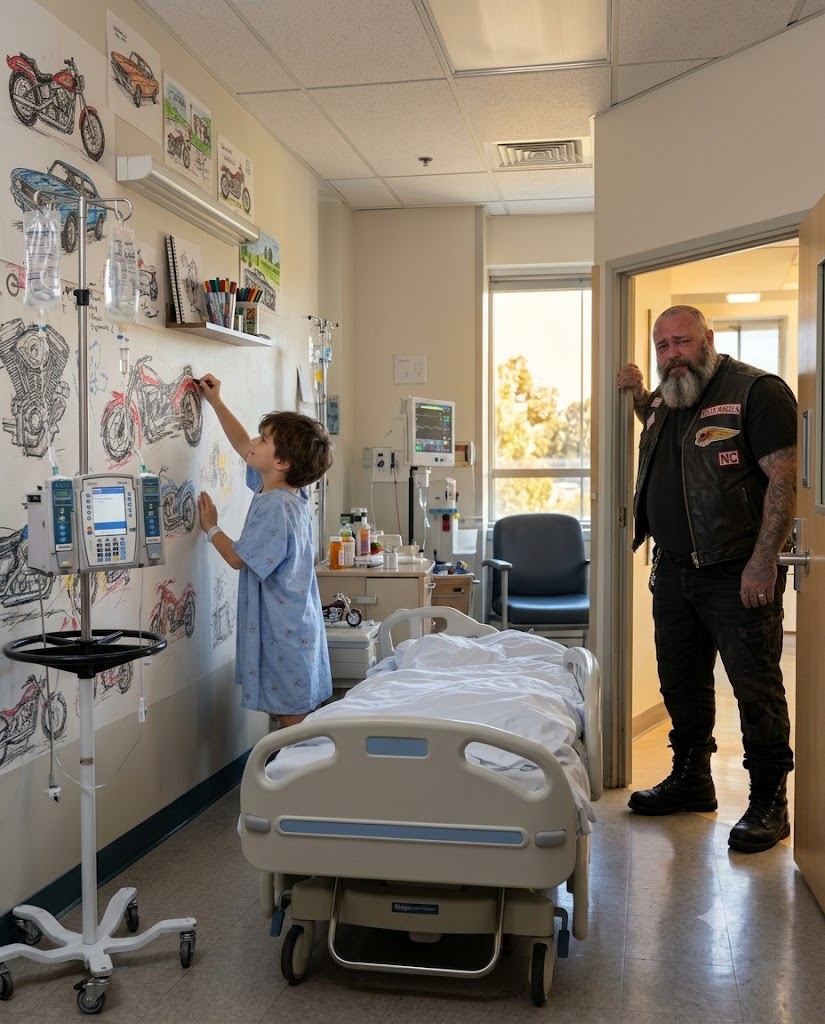
Inside, the room was lit only by a clip-on lamp and the blue glow of the infusion pump. Laura Mitchell slept sitting up in the vinyl recliner, her coat over her knees, her phone still in her hand. And in the bed, propped against three pillows with a marker in his fist, sat ten-year-old Henry Mitchell, who was supposed to be asleep, too.
“You’re up early, Mr. Mitchell,” Clare whispered.
“I’m up on schedule,” Henry whispered back. “I have numbers to finish.”
He pointed at the wall.
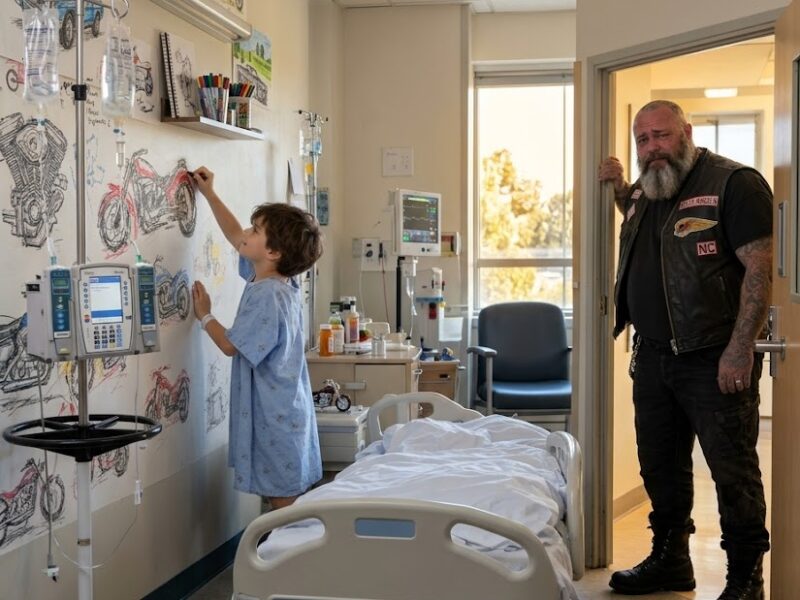
It was not an ordinary wall anymore. In July, when Henry came back to Riverbend after his relapse, the Child Life team had taped long sheets of white butcher paper across the wall opposite his bed, floor to ceiling, and told him he could draw anything he wanted. Most kids drew rainbows, dogs, superheroes. Henry had drawn a road.
It started low in the left corner, a gray ribbon that curved and climbed across the whole room. And along that road, one after another, he had drawn motorcycles. Each one was small, no bigger than Clare’s hand. Each rider wore a tiny helmet or a bandana, a beard or a ponytail, a vest with a patch stitched on the back. No two were alike. One had a sidecar with a spotted dog riding in it. One wore sunglasses and a cowboy hat. One was clearly a grandmother, white hair streaming behind her, a little cane strapped to the frame. Above every rider, in careful block letters, Henry had written a number.
Every day since July, no matter how sick he felt, he had added at least one more. And the nurses had stopped walking past that wall without looking.
“Three ninety-seven,” Clare read, tapping the newest one near the window. “Who’s this?”
“Marcus the Magnificent. He’s a plumber on weekdays.” Henry uncapped the marker with his teeth like a pirate. “He has a deep voice, but he’s really nice to cats.”
“And you’ve drawn four hundred of these.”
“Three ninety-seven. Two more days. Maybe one if my stomach behaves.”
He said it the way other kids said two more days until Christmas. Clare checked his wristband, his temperature, the line in his chest, the numbers on the pump. Everything was ordinary, which on this floor was its own kind of good news. Somewhere beneath the antiseptic smell, she could still catch the scent of marker ink.
Henry’s cheeks were thin, and his head was bare under a faded red cap, but his eyes were bright in a way the chemotherapy had never managed to dim. He had been sick on and off for two years. He had been in this room for ninety-six days. Somehow the wall had become the most alive thing in the building, and it made her uneasy.
It was not the dogs or the cowboy hats. It was the leather.
Every rider on that wall wore it, and every one sat astride a loud machine, and in Clare’s experience, men like that did not belong anywhere near sick children. She had never said so to anyone on the floor. It was not a thing a children’s nurse was supposed to feel, but it sat in her chest like a stone she had been carrying for eleven years, and she knew exactly where she had picked it up.
Down on Riverbend Drive, an engine growled to life. It was a deep rolling sound, the kind that rattled window panes. It swelled past beneath the fourth-floor windows and faded toward the interstate. Clare’s shoulders went tight. She did not notice until Henry spoke.
“You don’t like them,” he said.
“I don’t know them, sweetheart.”
“That’s what my mom said, too.” He studied her with the unnerving calm of a kid who has spent too many nights thinking. “Before.”
“Before what?”
Henry glanced at his sleeping mother. Then he slid his hand beneath the pillow and drew out a sheet of notebook paper folded into a small square with a scrap of black leather stitched crookedly to one corner. The leather was cracked and worn soft, and it held a faded stitched road and a few white letters.
“I wrote them a letter,” he said. “When I get to four hundred, I’m going to ask you to mail it.”
“Mail it where? Henry, do you know their address?”
“No.”
“Then how will they get it?”
He smiled, and it was the smile of someone who knew a secret too big to explain at 5:45 in the morning. He tucked the letter back under the pillow and pressed it flat with his palm.
“They’ll find it,” he said. “And when they come, you’re going to be scared, but don’t be. They’re the best people I ever met.”
Clare opened her mouth to answer, then closed it. A cold gust of rain rattled the glass, and out on the far highway, faint and distant, another engine rolled by. She stood very still in the half-dark, listening to it fade, and for the first time in a long while, she wondered what exactly she was so afraid of.
Two years earlier, on the first Saturday of May, rain had fallen on Interstate 71 as if someone were emptying buckets from the sky. Laura Mitchell remembered every detail of that afternoon because it was the worst and strangest day of her life. They had spent six hours at the hospital for Henry’s first round of chemotherapy. He was eight years old, tired, and sick to his stomach in the back seat with a plastic bowl in his lap. Laura was gripping the wheel with both hands, trying not to cry where he could see.
Then the rear tire blew out with a bang like a gunshot, and the old sedan lurched onto the shoulder and shuddered to a stop. She sat there in the rain with her forehead on the steering wheel. She had no spare she knew how to reach, no husband to call since he had left when Henry was four, and no money for a tow truck until Friday. Cars blew past, throwing sheets of spray, and nobody slowed down.
Then came the sound.
It started far away, low and rumbling, and it grew until the whole car vibrated with it. Laura looked up into the mirror and saw headlights, a long double line of them sliding onto the shoulder behind her. Eleven motorcycles. Eleven riders in black leather and dripping rain gear, boots hitting the wet pavement.
Laura locked the doors. She remembered that part with shame. She locked the doors and pulled Henry’s blanket over his bald, tender head and prayed they would keep riding.
They did not keep riding.
A huge man with a gray beard and a face like a weathered barn walked to her window and crouched down so he would not tower over her. He raised both hands, palms open.
“Ma’am,” he said, loud enough to be heard through the glass. “My name’s Ray. Looks like you got a flat. Mind if we handle it?”
Eleven minutes. That was how long it took them. Two men worked the jack, one wrestled the spare out of the trunk from under a pile of Henry’s school things, and a woman with a silver braid held a jacket over the wheel well to keep the rain off the tools. Nobody asked Laura for money. Nobody asked her why her eyes were red.
When the big man saw the hospital wristband on Henry’s thin arm, he looked at it for a long moment and his face changed. He did not ask about that, either. He just rummaged in his saddlebag and came back with a small leather patch, black and worn, with a stitched road and three words in white thread: Buckeye Road Riders.
“Spare,” he told Henry through the cracked window. “Every road crew needs a badge.”
“What’s your name?” Henry asked.
“Folks call me Tank.”
“Why?”
“Because I’m hard to stop.”
And then the big man smiled, tapped the roof of the car twice, and walked back into the rain. Within a minute, the whole line was gone, thunder fading down the interstate, and Laura sat in the quiet, shaking her hands over her mouth. She never learned a single last name.
That was the story Henry had told his mother ten thousand times in the long months afterward, whenever the fear came back. It was the story he was telling now in the gray light of Wednesday afternoon, while his thin hand drew rider number three ninety-nine.
“Tank said I’m part of the crew,” Henry said. “So I’m building the crew.”
Clare stood at the foot of the bed with a chart in her hands, and she did not know what to say. Laura had told her the whole story an hour earlier in the hallway, with tears standing in her eyes. Clare had listened and nodded, and felt something inside her shift, then settle again into the same cold place.
“Maybe,” she had said carefully, “he could draw something else for a while. Flowers, animals, something a little, I don’t know, gentler.”
“Gentler than the only thing that makes him eat?” Laura had answered not unkindly. “Clare, he’s had three bites of food all week. Then he draws a biker, and he asks for crackers. I’ll take a hundred more bikers.”
Clare had dropped it. She told herself it was none of her business, but on her break, she sat in the empty family lounge and could not finish her coffee.
On Thursday at 3:12 in the afternoon, Henry finished. He set the marker down very slowly, the way a runner sets down a baton. The four hundredth rider was the biggest of all. He had a gray beard that reached his chest, a vest covered in patches, and a motorcycle as long as Henry’s forearm. Perched in front of him on the gas tank sat a tiny bald boy in a red cap, one fist raised, grinning from ear to ear. Above them both, in letters bigger than any others, Henry had written 400.
Gloria Banks, the charge nurse, stood in the doorway and clapped slowly. Gloria had worked on the floor for twenty-six years and had a laugh you could hear from the elevator.
“Well, Mr. Mitchell, that is the finest wall in the building. Can I get a picture?”
Henry looked up at Clare. “With the whole thing, for the letter.”
Laura wiped her face and held out her phone. “Clare, would you?”
Clare hesitated for only a second. She took the phone, framed the shot, and stepped back until she had all of it. The long gray road, the four hundred tiny riders, and the small boy in the red cap grinning in the middle of it. She snapped three pictures. She noticed her hand was not quite steady.
That night, in the recliner, Laura typed for a long time. Then she posted the best of the photos in a big online group for Ohio motorcyclists, a place she had found while searching for a name she did not have. Her caption was short.
“Two years ago, riders from the Buckeye Road Riders stopped for my son and me in the rain on I-71. My son has been in the hospital since July. He drew 400 bikers on his wall so he would never forget you. If anyone knows Tank, please tell him Henry is still riding.”
She fell asleep with the phone on her chest. By midnight, the post had been shared two thousand times. By dawn, thirty-one thousand. And on Friday morning, a printout of that photograph was lying on the desk of Philip Pratt, the vice president of operations at Riverbend Children’s Hospital, with a yellow sticky note slapped across the top.
Where did this come from and who authorized it?
“I’m not an unreasonable man, Ms. Hamilton,” said Philip Pratt, and the way he said it made Clare certain that he was. It was 8:15 on Friday morning, and she sat in a leather chair in his glass-walled office still in her scrubs. Pratt was a tidy, gray-suited man with a carefully calm voice, the kind who measured every sentence for liability. On his desk lay the photograph and a stack of printed comments.
“There are more than forty thousand shares of that image,” he said. “Riders all over the state say they intend to come here. Some say hundreds. A few are driving in from Kentucky and Indiana.”
“I didn’t post it,” Clare said. “The mother did.”
“I understand, but you took the photograph and you work the floor, so I’m asking for your judgment.” He folded his hands. “These children have no immune systems. We cannot have hundreds of strangers tracking in germs and noise or a parking lot full of motorcycles blocking an ambulance bay. And frankly, I have seen what happens when large groups of that type gather. I will not turn a children’s hospital into a rally.”
Clare felt the stone in her chest turn over. She wanted to say that Laura had only been hoping to say thank you. Instead, she heard herself say, “That sounds reasonable.”
“Good.” Pratt nodded once. “Please ask the mother kindly to take the post down. And if anyone calls about it, the answer is no. Visitors, no exceptions.”
“Yes, sir.”
She walked out of the office feeling relieved and a little sick, and she could not have said why.
At 12:20 that afternoon, Henry’s temperature climbed to 103.4. Clare felt the whole floor tilt. On a child with no defenses, a fever was never just a fever. She called Dr. Samuel Whitaker, the oncologist, and within minutes the room was full of people moving fast and speaking low. Blood cultures, antibiotics, fluids, a sign on the door. Laura stood against the wall with both hands pressed to her mouth. Henry lay small and flushed in the bed, the marker rolling off the sheet onto the floor.
“He’s going to be all right,” Dr. Whitaker told Laura an hour later. “We caught it early and we know how to treat it, but he’ll be in isolation for a few days. No visitors except you.”
At 4:40, Clare was at the nurses’ station charting with a hand that would not quite stop shaking when the main line rang. She picked up on the second ring.
“Fourth floor oncology, this is Clare.”
“Ma’am.” The voice was low, deep, and gravelly, a voice with a lot of road in it. “I’m sorry to bother you. I’m trying to reach the family of a boy named Henry Mitchell. I saw a picture online. Name’s Raymond Dawson. Most folks call me Tank.”
Clare’s grip tightened on the phone. She could hear wind behind him and an engine idling.
“I’m sorry, sir. I can’t give out patient information.”
“I understand that. I don’t need any. I just wanted to say that picture stopped me cold. That boy drew every one of us and we never even gave him our names.” His voice thickened and steadied. “We’d like to come say hello, ma’am. A few of us. Maybe more than a few.”
Here it is, Clare thought. She looked down the hall at the closed door of room 412. She thought of Pratt’s hands folded on the desk. She thought of the long night eleven years ago and her mouth moved before her heart could catch it.
“Mr. Dawson, please don’t come.” Silence on the line. “This is a children’s hospital,” she heard herself say. “We can’t have a crowd. It isn’t safe. I’m sorry.”
The wind hissed in the receiver for three long seconds. When Tank spoke again, his voice had gone gentle and very quiet.
“Yes, ma’am. I understand. We’ll respect that.” A breath. “You tell that boy the road is open if he wants it.”
The line clicked. Clare set the phone down very carefully, as if it might break.
At 7:00 that evening, Henry opened his eyes. Laura was dozing in the chair. The room was dim and smelled of antiseptic.
“Clare?” His voice was thin as paper. “Did anyone call? About the picture.”
She stood by the bed with her hand on the rail. It would have been so easy to tell the truth. It would have been just as easy to say nothing at all.
“No, sweetheart,” she said. “Nobody called.”
Henry looked at the wall for a long moment, at the four hundred little riders in the dusk, then he turned his face to the pillow.
“That’s okay,” he said so softly that she almost didn’t hear it. “Maybe they’re just far away.”
Clare walked straight into the supply closet, closed the door, and stood among the shelves with her palms flat against her eyes. That was where Gloria found her ten minutes later.
“Sit,” Gloria said and pushed a stool at her with one foot. “Talk.”
So Clare talked. Eleven years ago, she had been a twenty-three-year-old nurse in her third month in the emergency room and a pack of riders had burst through the doors one night carrying a friend whose motorcycle had gone under a truck. One of them, a big man, had slammed his fist into a locker so hard that the metal dented and shouted at everyone in the room. He had grabbed her arm hard and she had never fully stopped being frightened.
“I never forgot his face,” Clare whispered. “I never forgot the sound it made, that fist hitting metal.”
Gloria listened with her arms folded and her head tilted. When Clare finished, she was quiet for a while.
“Honey,” she said at last. “What happened to his friend?”
“He died.”
“So that man was watching his best friend die and he was afraid and he did the only thing his body knew how to do with it.” Gloria’s voice was low and firm. “You’ve been judging a whole country of people by the worst night of one. And tonight you looked a sick child in the eye and lied to him to protect that judgment.”
Clare’s shoulders shook. She said nothing.
“I’m not telling you this to hurt you,” Gloria said. “I’m telling you because you’re the best nurse on this floor and you’re better than this.”
When Gloria left, Clare sat in the dark for a long time. Then she slipped into room 412 while Laura and Henry slept and stood in front of the wall. Four hundred strangers drawn by a boy who had decided to judge none of them.
At the nurses’ station she found the number in the call log and her thumb hovered, and then she pressed it. It rang once.
“Dawson,” said the gravelly voice.
“Mr. Dawson, it’s Clare Hamilton from the hospital.” She closed her eyes. “I made a mistake today. I’m so sorry. I was wrong.”
A pause. Then the low voice came back warm as a hand on her shoulder. “Ma’am, I hoped you’d call. Is it too late to ask for what you offered? Just to say hello.”
“We’d have come anyway if we’d had a way to do it right,” Tank said. “We just weren’t going to barge in.” She could hear him smile. “Now, how many of us can you handle?”
Clare looked at the wall through the glass of room 412 and a small shaky laugh escaped her. “Mr. Dawson,” she said, “I think I better ask how many you can’t stop.”
Dr. Whitaker was not a man who said yes quickly. He listened to Clare’s plan on Saturday morning with his glasses pushed up on his forehead and his coffee going cold. Which entrances? How many? How long? How would anyone with a cold be kept away from the unit? Clare answered every one. She had stayed up half the night with a legal pad.
The plan was simple. Five riders chosen by Tank would sign a health screening, scrub their hands for two minutes, and wear masks and gowns. They would stay fifteen minutes at the bedside and only if Henry’s fever stayed down. Everyone else would stay in the parking lot, engines off, no closer than the pavement beneath his window.
“And Mr. Pratt?” the doctor asked.
“He hasn’t said yes,” Clare admitted. “He said no to the first idea. I haven’t told him this one.”
Dr. Whitaker smiled for the first time that week. “Then I’d better tell him. Let me deal with him. You go sleep.”
She did not sleep.
On Sunday at 7:20 in the morning, Henry’s fever had been gone for thirty-one hours and the doctor said today is as good a day as any. By 8:00, Clare was standing in the cold at the main entrance with Frank Odum, the senior security officer, a broad quiet man. They both heard it at the same time. It began as a feeling in the soles of her feet, then a vibration in the glass doors behind her, then a low rolling sound from the south like a storm still miles out over the river, and Frank lifted his head and stared down Riverbend Drive.
“Miss Hamilton,” he said slowly, “you’d better look at this.”
They came around the bend two by two, headlights burning in the gray morning, a long glittering column of chrome and black leather that stretched back as far as she could see. They rode slowly in perfect formation and turned into the lot row after row, filling the front lot, then the side lot, then the overflow lot beyond the garage. There were old riders and young riders, women with gray braids, men in denim vests, a sidecar with a spotted dog riding in it. On every windshield, every tank, every helmet, someone had taped a number.
The engines went off in a long ripple, one after another, and the silence afterward was so enormous that Clare could hear her own heart.
The doors burst open behind her. Philip Pratt strode out in his gray overcoat with his phone already at his ear, his face the color of ash.
“Frank, I told you no more than fifty. I’m calling the police.”
“Sir,” Frank said, “they’re parking in rows. They don’t look rowdy to me.”
“Mr. Pratt.” Clare stepped in front of him. “Please, give me two minutes.”
At the head of the column, a motorcycle as long as a canoe rolled to a stop, and its rider swung down. He was enormous and gray-bearded, with a face like a weathered barn, and he held his helmet against his chest as he crossed the lot. He stopped ten feet away and nodded.
“Ma’am, sir.” He looked at Pratt. “Raymond Dawson. I understand there’s concern about the size of the party. We’ll keep the engines off and the lot clean. No one goes inside except the five your doctor approves.”
“You have no idea what you’ve done to this hospital,” Pratt said, and his voice cracked in the middle. “There are four hundred motorcycles in my parking lot.”
“Yes, sir. Four hundred exactly.” Tank pulled a folded printout of Henry’s wall from his vest, creased and soft from handling. “Boy drew four hundred of us. We figured we owed him four hundred back. Every rider took a number off that picture and taped it up. Some drove six hours.”
Pratt looked at the paper. He looked out over the lot at four hundred helmets resting on four hundred seats and not one rider moving a muscle. A police cruiser rolled up beside the curb with its lights off and an officer stepped out and surveyed the scene with raised eyebrows.
“Mr. Pratt,” Clare said quietly. “They asked for nothing. They were willing to stay away. They only asked to be seen.”
Slowly, Pratt lowered the phone.
“Fifteen minutes,” he said hoarsely. “Five riders, masks, the rest stay in the lot.” He turned to the officer. “Thank you, officer. We won’t need you.”
Tank held out his hand and after a moment, Philip Pratt shook it.
Ten minutes later, five masked and gowned riders followed Clare down the fourth-floor corridor. Tank walked in front, enormous in the cramped hallway. Behind him came a silver-braided woman named Patty Sullivan who had been on the roadside that rainy day two years ago, and a tall man with a deep voice who walked as if he were afraid to wake anyone.
“Is that him?” the tall man whispered. “The cat one?”
Clare pushed open the door of room 412. Henry was awake, propped against his pillows with his red cap crooked on his head. Laura sat beside him, one hand over her mouth. The big man stopped in the doorway and simply stood there filling it, his eyes moving across the road and the four hundred little riders. Then he knelt so that his gray head came level with the bed.
“Hey, partner,” he said in a voice that trembled on the last word. “Heard you were looking for a road crew.”
“You came,” Henry whispered.
“Four hundred of us,” Tank said. “Every last one. I had to see the wall. I almost didn’t believe it was real.”
The tall man with the deep voice stepped forward and raised one hand. “Henry, I’m Marcus,” he said. “Number three ninety-seven. I’m a plumber on weekdays, and I have to tell you, I really am nice to cats.”
Henry let out a sound that was half laugh and half sob, and the whole room broke at once. Laura was crying, Patty Sullivan was crying behind her mask, and Tank was looking at Clare.
“Ma’am,” he said quietly over Henry’s head, “I know this floor. My granddaughter was a patient up here five years ago. Abby, ten years old. Dr. Whitaker was her doctor.”
Clare’s breath caught.
“She’s fifteen now. Plays volleyball.” His voice dipped. “I sat in the parking lot forty-one days right under that window. Never came inside. Her mama said I’d scare the nurses, and I figured she was right. So I’d sit on my bike with bad coffee and look up at the fourth floor and wait.”
Clare thought of a man in a black vest in the parking lot, a gray beard and a paper cup, there every afternoon, whom she had glanced down at from the window and quickly turned away from. She had never once wondered what he was waiting for.
“I’m so sorry,” she whispered.
“Don’t be.” He smiled at her above the mask. “You called back.”
Frank Odum wheeled Henry’s bed to the window. Below in the gray morning, four hundred riders had gathered in a single great curve of chrome beneath the fourth-floor glass. Helmets off, faces turned upward. Every one of them raised a hand.
Tank lifted his own hand to the window. In the parking lot, four hundred fists rose like a field of wheat. Then he nodded once and four hundred engines roared to life together. The sound hit the building like a wave. The glass trembled. Henry felt it in his bones, in his chest, and he pressed both palms flat against the window as if he could touch it. Behind them, in the doorway, Philip Pratt stood with his hand pressed over his mouth.
“Four hundred,” Henry whispered over the thunder. “I counted.”
“Counted twice,” Frank Odum said softly and wiped his face with the back of his sleeve.
The fever never came back. It was not magic, and nobody pretended otherwise. The antibiotics did their work as Dr. Whitaker had promised. Henry’s counts crept upward day by day, and by the following Friday, the isolation sign came off the door of room 412. But Clare noticed something none of the charts could measure. Henry ate. He drew. He asked for pancakes on a Tuesday and finished three bites without help. The treatment ahead was long, and Dr. Whitaker was honest about that. There would be more rounds, more needles, more days when Henry felt like a sack of wet sand. But long was a very different word from hopeless.
Philip Pratt came to find Clare on Wednesday afternoon, three days after the ride. She was restocking gloves when she heard his tidy footsteps and braced herself for a reprimand.
“Ms. Hamilton.” He stood with his hands behind his back, looking more tired than she had ever seen him. “I owe you an apology. I told you to turn away people who came here to be kind. I was afraid of what I thought they would be. I never stopped to ask what they were.”
Clare opened her mouth, then closed it. “Mr. Pratt, I said yes to you. I agreed with you. I’m no better.”
“No. But you changed your mind. I would like to have the courage to do the same.” He took a breath. “I’ve spoken with the board. Child Life is creating a program called the Wall Project. Any patient who wants a wall gets one, and no one on this staff will tell a child what he may draw on it. And Henry’s wall will be framed when he goes home and hung in the main lobby.”
Clare’s eyes stung. “He’ll love that.”
“I hope so.” Pratt hesitated. “Mr. Dawson left me his number. I intend to call him this weekend and ask how a hospital says thank you to four hundred people.”
That autumn turned to winter, and winter was long. But the Sundays were different now. Every second Sunday, in rotating groups of five, riders from the Buckeye Road Riders signed in at the front desk, scrubbed their hands for two full minutes, and walked up to the fourth floor with paper masks over their beards. They never stayed more than fifteen minutes. Sometimes they brought a stuffed dog in a tiny leather vest. Sometimes they brought nothing but themselves and sat beside the bed and told Henry about the roads they loved. The Ohio River at dawn, the twisting hills of the southeast, a stretch of highway in Montana where the sky was so big it made you feel small and safe at the same time.
Henry listened to every story with the gravity of a king receiving ambassadors. Then he drew them one by one on a fresh roll of paper until a second road began to grow beside the first.
In December, Clare went on her first toy run. She stood in the cold of the hospital parking lot in a borrowed jacket and a helmet two sizes too big while Patty Sullivan, sixty-one years old and unbothered by anything on Earth, patted the seat of her motorcycle and said, “Hop on, honey. I’ve never lost a passenger yet.”
The first mile, Clare kept her eyes squeezed shut and her arms locked around Patty’s waist. The second mile, she opened one eye. By the fifth, she was laughing helplessly, the wind pulling tears from the corners of her eyes. Ahead of her and behind her, hundreds of bikes rolled down the interstate in the bright bitter air, loaded with wrapped toys for children’s wards across Columbus. Cars slowed on the shoulders to watch.
At mile marker 41 on Interstate 71, the column slowed and a hush rolled down the line. It was just a stretch of shoulder like any other, gravel and guardrail and brown winter grass. But Clare felt Patty’s shoulders go still and she understood. The riders passed at a crawl and everyone lifted a gloved hand toward the spot where a small gray car had once sat in the rain. She lifted her own and her throat closed up.
On the way back, she could see Riverbend Children’s Hospital in the distance, its tall windows catching the light. Fourth floor, third window from the left. She had walked past that glass a thousand times and never once seen it from this side of the road.
Henry’s scans came back in March. Dr. Whitaker sat in the family room with Laura and Clare, glasses in his hand, careful with every word. He did not say cured. He said responding. He said the best numbers since last summer. He said that the road was still long and that they would watch it closely and that Henry could continue treatment from home with regular visits. Laura put both hands over her face. Clare held her shoulder and they stayed that way for a long time.
On a bright morning in April, Henry went home. He sat in a wheelchair at the front entrance in his red cap, a little taller than in October, a little rounder in the cheeks. In his lap, he held a framed photograph of the wall. Nurses lined the lobby. Gloria Banks hugged him so hard that his cap tipped sideways. Dr. Whitaker shook his hand like a colleague’s. Out in the circle drive, a gray sedan with a new tire sat idling. Behind it, stretching down Riverbend Drive as far as Clare could see, waited a river of chrome. Tank was at the front, grinning like a boy.
“Ready, partner?” he called. “Road crew’s got your back.”
They escorted that gray sedan all the way down Interstate 71, four hundred motorcycles in a long glittering line with their headlights burning in the spring sun. At mile marker 41, the whole column slowed and Henry rolled down his window and held his hand up and four hundred hands came up in answer.
Clare did not go with them. She stood at the third window from the left on the fourth floor, where the glass was still smudged with a child’s fingerprints, and watched the thunder fade over the horizon until she could not hear it anymore.
“Clare?” Gloria had come up behind her. “You okay?”
“Yes.” She wiped her eyes and found to her surprise that she was smiling. “I think I finally am.”
For eleven years she had carried a stone in her chest and called it wisdom. She had taught herself to look at a leather vest and see a threat. And all that time in a parking lot not a hundred yards from her window, a man had been waiting with a cup of bad coffee, hoping someone would let him inside to hold a child’s hand.
At the nurses’ station, a note was waiting in her mailbox, written in careful block letters on notebook paper folded into a small square with a crooked stitch of leather in one corner. It was the letter Henry had written in July and he had finally let go of it.
“Dear bikers,” it began. “You stopped when nobody else did. I don’t know all your names so I drew you so I would remember you were real. If you ever need a kid to believe in you, I live in room 412.”
And underneath, in smaller letters, in a hand that had grown steadier over the long hard winter: “P.S. Clare, thank you for being brave. You can ride with them now.”
She read it twice. Then she folded it carefully, slipped it into her pocket, and picked up the next chart. Outside, far down the interstate, an engine rolled across the spring morning, deep and steady. For the first time in eleven years, she turned her head and smiled at the sound.









