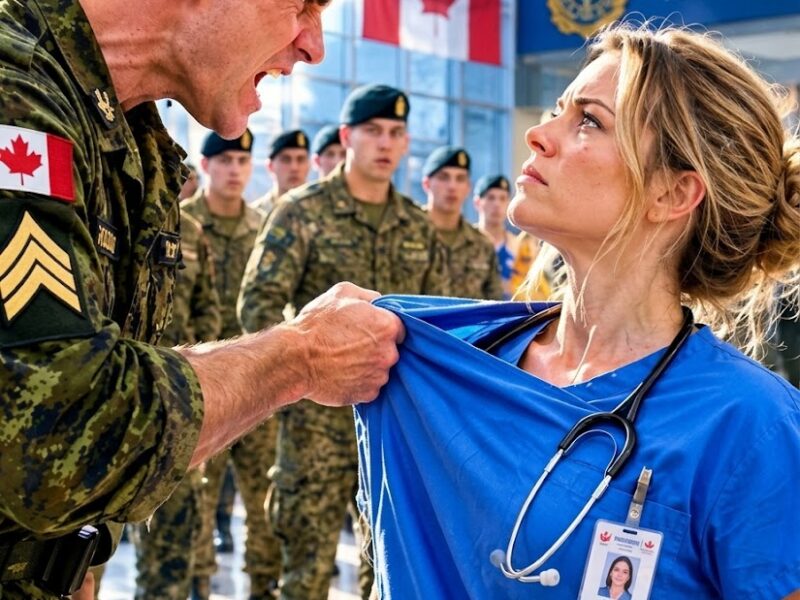
A Sergeant Humiliated the Nurse at CFB Borden — Then His General Saw Her and Saluted
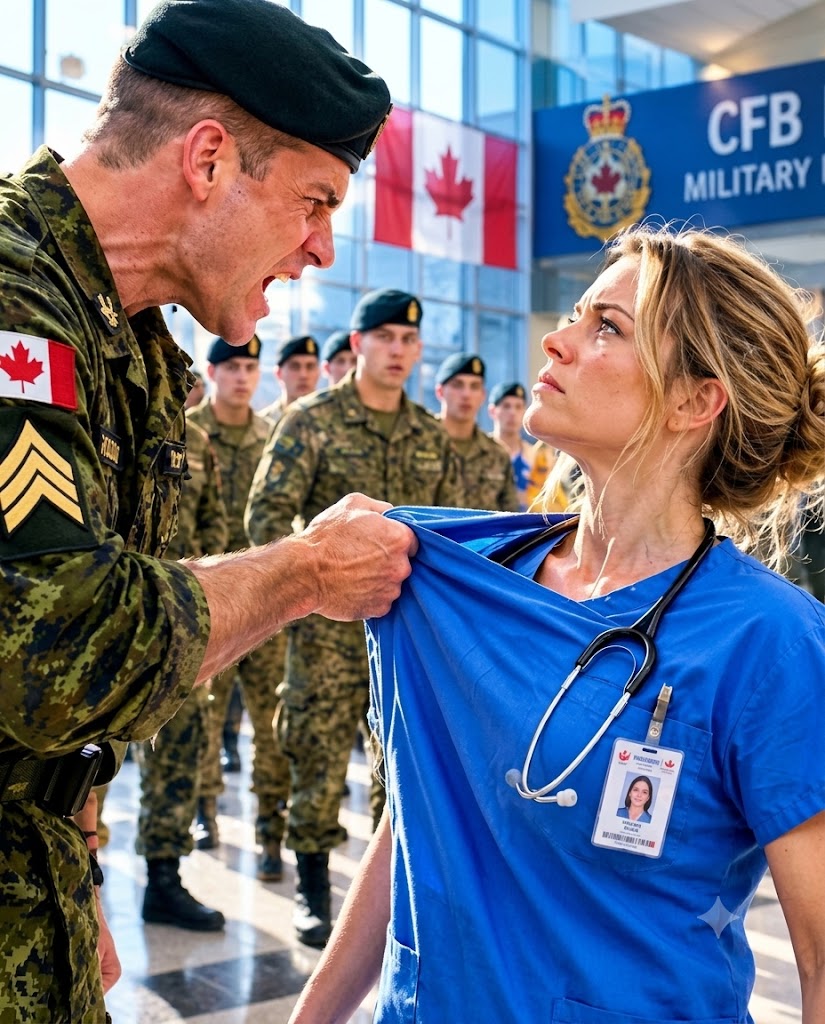
The lobby of the Canadian Forces Health Services Training Center at CFB Borden smelled the way all military buildings smell in late October.
Floor wax, recycled heat, and the faint underscent of institutional coffee that had been burning on a burner somewhere since before anyone currently on shift had arrived for work.
Paige Darvo stood near the intake desk with a patient folder tucked under one arm and a pen she had borrowed three days ago and forgotten to return balanced between her fingers, trying to look like exactly what she appeared to be.
A nurse running behind on a Wednesday morning.
Her scrubs were that particular shade of bright blue that washed out most complexions, but somehow suited her in the way that practical things tend to suit people who stopped caring about appearances a long time ago.
The sleeves had been rolled back twice at the cuff because the smallest size available in the hospital supply room still fit her like a borrowed shirt.
Auburn hair pulled into a low bun with two escaping pieces already losing the argument against gravity.
A narrow scar ran along her left jaw, pale and unremarkable, the kind of mark that read differently depending on who was looking.
Most people did not look.
Paige was thirty-seven years old. She had been a registered nurse at this facility for four years.
Before that, she had been other things, but she had long since made peace with the fact that those things were not something she owed anyone an explanation for.
Staff Sergeant Kyle Blaine came through the main doors at 0815 with the kind of body language that telegraphed trouble before he had covered a single meter of floor.
His combat uniform was immaculate, his beret straight, and the expression on his face was the particular one worn by men who have decided someone was going to have a difficult morning and had simply not yet settled on who.
Behind him, a section of infantry soldiers filed in for scheduled medical processing. Eight of them, young, travel-worn, carrying the particular exhaustion of a three-day field exercise that had clearly not gone the way it was briefed.
Blaine stopped in the middle of the lobby and turned his head until his gaze landed on Paige.
She had seen that turn before. She had learned to recognize it the way you learn to read weather. Something useful for people who spend time outside.
“You,” he said loudly enough to carry. “You the one who bumped Private Tessier’s pre-deployment medical off the schedule.”
Paige looked up from her folder. “I don’t schedule pre-deployment medicals, Staff Sergeant. That goes through the MO’s office.”
“Don’t tell me what goes where.”
He crossed the lobby in six strides, and Paige had just enough time to close the folder and straighten slightly before his hand came up and closed around the front collar of her scrub top, pulling the fabric taut and hauling her half a step forward.
The folder hit the floor. So did the pen.
“You people sit behind these desks and push paper and then stand there looking confused when the system breaks down. You want to know what a broken system costs? My section just came back from three days in the mud because we couldn’t get a soldier cleared in time because someone like you decided paperwork was optional.”
The lobby had gone quiet.
The eight soldiers behind him had stopped moving. A corporal near the pharmacy window stood with a prescription receipt in her hand and did not complete the motion of taking it. Somewhere past the intake desk, a landline was ringing with nobody answering it.
Paige felt the collar tight against her throat.
She felt with complete clarity the precise angle at which she could shift her weight to break the grip and redirect his momentum into the intake desk behind him. She knew the mechanics of it the way you know how to breathe without needing to think.
She had been trained by people who had no patience for hesitation in places where hesitation was the last mistake you made.
She did not move.
She let her chin drop slightly. Let her shoulders curve inward. Let the silence hold her the way she had once let darkness hold her on a hillside in Kandahar Province while she waited for an extraction that was six hours away.
And one of the men beside her was bleeding through every field dressing she had left.
“I understand you’re frustrated,” she said quietly. “But I genuinely cannot help you with the scheduling problem.”
“You don’t understand anything.” Blaine’s grip tightened. “You are not fit to be in this building with people who actually serve.”
A soldier near the back of the section. Private Tessier, Paige would later learn, shifted his weight and looked at his boots, the particular posture of someone who wants to intervene but has been in the military long enough to know the cost of crossing a staff sergeant in a corridor.
Nobody moved. Nobody ever did. Not at first.
That was the part of the world Paige understood most clearly.
The doors at the far end of the lobby opened.
The change in the room was immediate and involuntary. The kind of atmospheric shift that moves through trained people like a current through water before conscious thought has time to catch up.
Paige felt it before she heard the footsteps. Measured, unhurried, the cadence of someone who had never once needed to hurry because the room always rearranged itself around them before they arrived.
Brigadier General Raal Kadu was sixty-one years old, compact, with silver hair cut close and a bearing that had been built across four decades of service into something that no longer needed a uniform to project authority.
Though the uniform helped.
His chest carried a ribbon row that required knowing what you were looking at to read properly, and most people in this lobby did not know what they were looking at.
Paige did.
“Staff Sergeant.”
Blaine’s voice was not raised. It did not need to be. The entire lobby heard it anyway.
Blaine released Paige’s collar so quickly she felt the air return to her chest in a single rush. He squared his shoulders and turned.
“Sir, I was just—”
“I saw what you were doing.”
Kadu crossed the remaining distance with the same unhurried pace.
For a long moment, his eyes moved over Paige’s face. Not her badge, not her scrubs, not the rank she no longer held.
He looked at the scar along her jaw. He looked at the way her weight was still distributed on the balls of her feet. The unthinking ready stance of someone whose body had never fully forgotten what her file did not mention.
He looked at her eyes, steady gray-green, giving nothing.
And something in his expression shifted into a recognition so particular and so specific that it had nothing to do with remembering a face and everything to do with remembering a version of someone they had both hoped on some level never needed to be remembered.
“Sergeant,” he said, so low it barely reached past the two of them, and landed in Paige’s chest like a stone dropped into still water.
She had not heard that name in four years.
She had, with considerable effort and considerable discipline, arranged her life so that she would never need to hear it again. New province. New facility. New paperwork trail. A name that belonged to someone she had folded away as carefully as you fold a dress uniform you are never going to put on again.
“Sir,” she said, voice carefully neutral. “I think you may be—”
Kadu raised his right hand.
The salute was slow, deliberate, textbook correct. The kind extended to officers of significant rank, to people who had earned something the gesture was intended to acknowledge publicly.
Extended to a nurse in oversized blue scrubs, standing in a pool of scattered papers, in a lobby full of soldiers who had stopped breathing long enough to watch.
The room did not simply go quiet. It went still in the particular way of people realizing simultaneously that they had badly misjudged the situation they were standing inside.
Blaine’s mouth opened slightly. The expression that had been sitting on his face for the past three minutes, that particular mix of anger and certainty, drained out of it and left something closer to dread in its place.
“I have saluted exactly three people in my career who were not in my direct chain of command,” Kadu said, his hand still raised. “You are one of them. What you did in the Panjwayi District does not stop being what it was because you changed your address and your job title.”
Before Paige could respond, before anyone in the lobby could process what they had just witnessed, the ceiling speakers came alive with a clean, controlled double tone of a facility-wide emergency alert.
“Trauma team to ambulance bay. Multiple casualties from training range. ETA ninety seconds. This is not a drill.”
The lobby reorganized itself instantly, the way military environments do when the thing everyone has been training for stops being theoretical.
Paige was already moving before the alert finished.
The folder on the floor. Blaine’s wounded pride. Kadu’s raised hand. All of it falling away behind her as her body snapped into a different mode entirely, scrubbed sleeves flapping loose at the wrist.
She cleared the lobby doors and broke into a flat run toward the ambulance bay without looking back.
Kadu lowered his hand and watched her go.
Blaine stood very still with the look of a man who had made an error whose full dimensions were still arriving.
—
Two litters came through the ambulance bay doors within thirty seconds of each other.
The first carried a young master corporal with a badly lacerated forearm from a vehicle rollover on the range road. Serious, manageable, survivable with proper wound care.
The second carried a private named Boyven, nineteen years old, who had been too close to an accidental pyrotechnic discharge during a training evolution, and who was now the more urgent problem by a significant margin.
Paige reached Boyven’s litter before the attending physician did, and what she saw in the next four seconds arranged itself in her mind with the automatic clarity of something she had seen before, in considerably worse conditions than this.
One side of his chest was rising wrong. Not matching the other. The veins along his neck stood out too prominently. His lips had that particular shade of inadequate oxygen, not yet blue but moving toward it with a purposefulness that left no room for comfort.
And his blood pressure, visible on the portable monitor the med tech had running, had dropped ten points in the time it had taken to wheel him from the bay doors to the trauma station.
The words arrived in Paige’s mind before she was consciously aware of forming them.
Tension pneumothorax. Right side.
It is one of the most immediately dangerous things that can happen inside a human chest.
When trauma creates a puncture, in this case the concussive force of a pyrotechnic discharge, air can escape from the damaged lung into the space surrounding it and find no way back out. Each breath the patient draws traps a little more of that air in the wrong place.
The trapped volume behaves like an expanding balloon inside the rib cage, pressing the lung progressively flatter, then crowding the heart and the great vessels beside it until the pressure becomes enough to interfere with the heart’s ability to fill and beat properly.
Left alone, it does not plateau. It progresses within minutes. A healthy young person can go from distress to cardiac arrest without any other injury to account for the decline.
The intervention is a needle decompression. A thin hollow needle inserted into a specific space between the ribs on the affected side, high on the chest wall, to allow the trapped air to escape and relieve the crushing pressure before it can stop the heart.
In the hands of someone trained to do it, the fix is straightforward.
Waiting is not an option.
“I need a fourteen-gauge needle, ten centimeters, now,” Paige said, already pulling gloves from the wall dispenser beside the station. “Right-sided tension, tracheal deviation just starting. Absent breath sounds on the right. JVD. He has maybe three minutes on the current trajectory.”
Dr. Norman Bolu arrived at the bay in time to hear the end of that sentence.
He was the senior physician on the trauma roster, a man Paige had worked alongside for two years, and respected approximately as much as his professional conduct had earned, which was moderately and conditionally.
He took one look at the situation and arrived at the wrong conclusion by the shortest possible route.
“Stand down, Nurse Darvo. Physician assessment first.”
“Doctor, he’s crashing.”
“I am aware of what a deteriorating patient looks like. Thank you.”
Bolu moved to the monitor, scrolled back through the vitals, and frowned at them in a way that suggested he was considerably closer to agreeing with her diagnosis than he was willing to say aloud.
“We follow protocol. That means physician-ordered intervention, not nursing staff making unilateral—”
“He has two minutes,” Paige said, not loudly, not aggressively, in the same tone she would use to read a weather report. “You can order the intervention right now and I’ll execute it in the next thirty seconds, or I can keep explaining to you why I’m right while he uses up the time we have left. Your choice, Doctor. But make it fast.”
Bolu looked at the monitor again. Looked at Boyven’s lips, which had shaded another degree toward the wrong color. The vein in his neck was more visible than it had been twenty seconds ago.
“Do it,” Bolu said.
Paige did not reach for the needle the way a person reaches for something unfamiliar. She reached for it the way a person reaches for a tool they have used many times in places considerably less well equipped than this ambulance bay.
The landmark, second intercostal space, mid-clavicular line, right side, came to her hands rather than to her eyes.
She swabbed, positioned, and inserted with a control so deliberate it looked almost unhurried.
The hiss was audible. Trapped air finally finding a way out.
Boyven’s chest settled just slightly, just enough. His oxygen saturation ticked upward on the monitor. The color of his lips began, slowly and imperfectly, to change.
“Pressure stabilizing,” said the med tech at the monitor, his voice carrying the specific disbelief of someone watching something they were told was high-risk look almost routine.
Bolu said nothing. He stared at the needle still in place, the flutter valve fashioned from a glove finger taped neatly over it. He stared at the monitor.
Then he looked at Paige with the expression of a man revising something he had believed about a colleague for two full years.
—
The man who came through the far bay doors four minutes later moved the way Paige had learned to recognize as immediately significant.
Efficient. Cataloging the room in the first two seconds, already calculating exits and personnel counts before his boots had completed their crossing of the threshold.
He was broad-shouldered, somewhere in his forties, wearing civilian clothes that fit over the bearing of someone who had spent a very long time not wearing civilian clothes. Two others behind him carried the same particular stillness in the eyes.
“Where’s my man?” he said, low and controlled.
“Boyven’s stable,” Paige said without looking up. She was still monitoring the flutter valve. “Tension pneumo from the pyrotechnic blast, decompressed six minutes ago. He needs imaging and a chest tube, but he’s breathing on his own and his pressure is holding.”
The man, she would later learn his name was Warrant Officer Tam Ford, call sign Raptor, JTF2 out of Petawawa, went very still in the particular way of someone who has just updated their assessment of a situation significantly and is processing the implications.
His gaze moved from the flutter valve to the needle placement to the angle and depth of the puncture. Then to the way Paige’s hands had gone still when she had nothing more to actively do. The quality of someone who had stopped moving because they were finished, not because they were unsure.
“That’s not standard nursing technique,” Ford said carefully.
“Lucky guess,” Paige said.
“I don’t guess.” He stepped closer. “And neither do the people who taught that flutter valve rig. I’ve only ever seen it set up that exact way in one training program. One.”
Paige tugged her sleeve back down over her wrist. She had forgotten about the small unit tattoo there, the one her watch band usually covered, that had become briefly visible during the procedure when her sleeve rode up.
An old mark. She had stopped seeing it.
“Your teammate needs imaging,” she said. “Dr. Bolu can walk you through the next steps.”
Ford studied her for another moment, then turned to follow the litter toward the imaging corridor.
At the bay doors, he paused.
“Kadu saluted you in the lobby,” he said. Not a question. “My men were in the parking lot. They saw it through the glass.”
He looked at her one more time. The look of someone standing at the edge of an answer they are fairly sure they already have.
“Whoever you were before those scrubs, Nurse Darvo, you didn’t walk very far.”
—
Brigadier General Kadu found Paige in the staff break room an hour later.
She was sitting with a cup of tea. She was not drinking. Her hands finally allowing themselves the tremor they had suppressed through the procedure and everything after.
He did not announce himself. He simply sat.
For a while, neither of them spoke. The silence was not uncomfortable. It was the silence of two people who had at different moments shared the same kind of dark and had no need to explain it to each other.
“The salute wasn’t appropriate,” he said finally. “In a lobby. In front of all of that. That was my choice and my bad judgment, and it wasn’t mine to make.”
“I know why you did it,” Paige said.
“I know you do.” He set his hands flat on the table. “Lieutenant Colonel Iris Tras has already received an incident report from Dr. Bolu regarding the ambulance bay intervention. She is recommending a formal review. Possibly suspension.”
Paige wrapped both hands around the cup. The warmth helped the trembling.
“Of course she is.”
“I’m going to recommend otherwise. Your service record, once I finish the necessary clearance paperwork, will speak considerably more clearly than his incident report.”
He paused.
“But there’s something else. The security directorate flagged a discrepancy in controlled substance inventory three days ago. It’s connected to a civilian maintenance contractor who’s had facility access for sixteen months.”
He leaned forward slightly.
“This morning, someone submitted an information request through the hospital’s administrative office asking specifically about your full employment history. Asking who you were before you arrived here.”
The trembling in Paige’s hand stopped entirely.
“Someone inside the facility.”
“The request was routed by a name attached to the maintenance contract. A man named Pete Malin. He has badge access to restricted supply rooms. He’s been in them at irregular hours for over a year.”
Kadu’s jaw tightened.
“I don’t like coincidences. I haven’t liked them since Kandahar.”
Paige set the cup down. The quiet she had built for herself. The four years of double shifts and unremarkable paperwork and a small apartment in Barrie with two plants she had kept alive through three winters.
All of it settled around her like a question she already knew the answer to.
“Show me the access logs,” she said.
Kadu almost smiled, the expression of a man who had hoped, not entirely without reason, to hear exactly those words.
—
She spent the afternoon the way she had once spent afternoons before missions. Reviewing schematics, identifying vulnerabilities in the facility layout, running through contingencies until the path of least resistance through each possible scenario was as familiar as the route from her apartment to the base gate.
Ford produced the maintenance corridor floor plans from somewhere inside a jacket pocket, which suggested he had anticipated needing them before she had asked, which told her something useful about him.
By evening, they had identified three things.
Where Malin’s access history suggested he was moving product. Which supply room served as the likely staging point. And the specific secondary stairwell door whose badge reader had a known firmware gap that had been on the facility’s repair list for four months without being fixed.
A man running a sixteen-month operation through a military hospital did not do it alone.
And a man who suspected his cover was collapsing did not wait patiently for it to finish collapsing. He made a decision quickly. Either he ran or he destroyed the evidence before he ran.
Paige preferred to give him neither option.
—
The confrontation in the pharmaceutical storage corridor happened at 0620 the following morning, before the first shift change had fully populated the building with the foot traffic that would have made it impossible to do quietly.
Paige had been in position for forty minutes before Malin arrived.
In that time, she had reviewed the schematics twice, established a radio link with Ford and his two colleagues staged at the corridor’s far access point, and settled into the supply alcove behind a medication cart with the patient, unhurried posture of someone who had spent a great deal of her life waiting in worse places than this for more dangerous things.
Malin came in through the east service door at 0621, tool bag in hand, badge scan clean.
He was followed forty seconds later by a second man who was not a hospital employee. The way he moved through the unfamiliar space made that apparent inside of three steps. He carried a duffel bag with the careful, close-body posture of someone transporting something he very much did not want dropped.
Paige let them reach the supply room door. Let Malin badge in. Let the second man clear the threshold.
Then she stepped out from behind the cart with her clipboard and her most unremarkable voice.
“Sorry to interrupt. I need to verify the controlled substance cabinet serial numbers for the audit log. Shouldn’t take a moment.”
Malin turned, and she watched the recognition arrive in his face. The specific dread of a man realizing that the obstacle he had been trying to identify for twenty-four hours was standing three meters in front of him, wearing scrubs, looking entirely unhurried.
His hand moved toward his jacket.
Paige was faster, and she had not been uncertain about that before she stepped out from behind the cart.
The wrist redirect took half a second. The controlled takedown that followed took another two.
The second man lunged, which she had anticipated, and his own forward momentum did most of the work.
Ford and his colleagues cleared the doorway eight seconds later to find both men on the floor and Paige crouched calmly between them, checking the duffel bag with gloved hands.
“Product from at least three separate controlled batches,” she said, pulling the zipper carefully closed. “And something in the side pocket that the security directorate is going to want their ordnance people to look at before anyone else touches it.”
Ford looked at her, then at the two men on the floor, then back at her.
“You were in position before we were,” he said.
“I got here early,” Paige said. “I always get here early.”
—
The review board convened four days later in a conference room on the third floor with a view of the parade square and the Ontario sky going flat and gray above the treeline the way it does in November, like someone has pulled a curtain across it.
Lieutenant Colonel Isabel Tras, director of health services for the facility, chaired the meeting with the careful precision of someone who had spent the preceding ninety-six hours being considerably surprised about things she had believed were straightforward.
Beside her sat representatives from the base commanding officer’s office, the security directorate, and, at Kadu’s specific insistence, a declassified summary of the service record belonging to Paige Anjelique Darvo, former Master Corporal, Independent Duty Medical Technician, Canadian Forces Afghanistan and domestic postings, 2008 to 2018.
Decorated. Commended in classified terms. Honorably released on her own request after a final deployment that the summary described with the clinical language of official documentation, and that Paige had never described to anyone at all.
Dr. Bolu’s incident report sat on the table as well, in a considerably thinner folder.
Paige sat in the chair that faced the board and did not lower her eyes.
Tras read from the incident report. Asked Paige to respond. Listened.
Then she read from the trauma record. Boyven’s vitals, the timeline, the outcome.
She was quiet for a moment after that.
“The patient is alive,” she said finally. Not a question.
“Yes,” Paige said.
“The intervention was performed within the treatment window. The outcome was optimal.”
Tras glanced at Bolu, who had been studying the table with considerable intensity since the meeting began.
“Doctor, I have reviewed your incident report thoroughly. I have also reviewed your verbal authorization of the procedure captured in the ambulance bay audio log. The record shows you did sanction the decompression before it was performed.”
Bolu’s jaw worked. “I was responding under pressure.”
“The pressure being that the patient was dying,” Tras said, not unkindly but without room for further argument. “You made the right call. The incident report is inconsistent with that call. I would like you to reflect on why, and I would like to discuss it with you separately after this meeting.”
She turned back to Paige.
“The suspension recommendation is withdrawn. The incident report is struck from your personnel file.”
Paige said nothing. Hearing it said clearly still required a moment to settle.
Tras continued: “On the matter of the supply chain breach, Malin and his accomplice have been remanded pending criminal charges. Two additional individuals connected to the diversion scheme have been identified across other CFB facilities. Preliminary estimates suggest sixteen months of systematic theft of controlled substances that our standing audit protocols were not structured to catch.”
A pause.
“Our standing audit protocols are being revised, effective immediately.”
Kadu, seated near the window with his arms crossed, allowed himself a small expression that was not quite a smile.
“Nurse Darvo,” Tras said, “this facility would like to offer you a formal lead position in the development of a trauma response protocol for medical technicians working in austere and high-tempo environments. The position comes with a title change and the accompanying pay grade. It also comes with the understanding that your background, while now partially declassified for administrative purposes within this facility, will be handled with the discretion you have clearly spent considerable effort maintaining.”
She held Paige’s gaze.
“We are not trying to turn you into a story. We are trying to use what you actually know.”
Paige looked down at her hands for a moment.
The hands that had over the years done things that did not appear in any nursing textbook. That had held pressure on wounds in the dark. That had decompressed a chest in an ambulance bay while a physician argued about protocol. That had very recently put two men considerably larger than her onto a corridor floor without leaving any injury more serious than wounded dignity.
“I’ll take the position,” she said, “on one condition.”
Tras raised an eyebrow.
“I keep my scrubs. I’m not putting on another uniform.”
For the first time since the meeting had begun, something in Tras’s composed expression eased into something warmer.
“Done,” she said.
—
Serena Chow was waiting in the hallway outside the conference room when Paige emerged.
She had a takeout cup in each hand from the Tim Hortons on the base perimeter road, the one they both regarded with the resigned affection of people who had accepted it was the best available option and made peace with it.
She held one out.
“Well,” Serena said.
“Still employed,” Paige said, taking the cup.
“Still employed, and according to the rumor running through this building at approximately the speed of sound since Monday morning, also responsible for stopping a major theft operation, physically neutralizing two men larger than you with what multiple witnesses are describing as terrifying efficiency, and receiving a salute from a brigadier general in front of the entire intake lobby.”
Serena looked at her steadily.
“I have been your friend for three years, Paige. You know I love you. But you have been severely sandbagging.”
Despite everything, Paige laughed. A real one, the kind that surprised her on the way out.
“I wasn’t sandbagging,” she said. “I was retired.”
“And now?”
Paige looked down the corridor toward the ward, where somewhere behind a set of double doors, a nineteen-year-old private was breathing steadily on his own in the ICU, probably already complaining about the food.
“Now I teach,” she said. “The same things I know to the people who need them. Without a call sign. Without a uniform. And without anyone deciding what that means about who I am.”
She took a drink of the coffee, which was exactly as mediocre as it always was and exactly as welcome.
“And I still do the double shifts and the paperwork.”
Serena linked an arm through hers as they started back toward the ward.
“The ghost nurse does paperwork,” she said. “Very on brand.”
“Don’t call me that.”
“The entire ward is already calling you that. You can’t stop it now.”
Paige thought about objecting. She thought about the lobby, and Blaine’s grip on her collar, and the silence that had held that room like a fist for the seven seconds before Kadu walked through the door.
She thought about how she had stood there and let the world draw its conclusions the way she always had, because the conclusions the world drew about a quiet woman in oversized blue scrubs had always kept her safer than the truth.
And then she thought about Boyven’s lips turning back from that wrong shade of gray.
“Fine,” she said. “But only on the ward.”
—
Ford was waiting near the ward entrance with his jacket on, clearly heading off base.
He caught Paige’s eye as she approached and gave her a nod. The kind exchanged between people who do not need to say the thing they both already know.
“Sergeant,” he said quietly as she passed.
She paused, looked at him.
“That name,” she said, “belongs to someone who did her job and went home.”
“It belongs to someone who never stopped doing her job,” Ford said simply. “She just changed the uniform.”
Paige considered that for a moment.
The ward hummed around her with its quiet, purposeful noise. Monitors. Soft voices. The deliberate footsteps of people who had chosen, for their own reasons, to spend their days keeping others breathing.
She pushed through the ward doors without answering.
But she did not bother hiding the scrubs.
And for the first time in four years, she walked through the building exactly as tall as she actually was.
—
That’s Paige’s story, and I’m glad I got to tell it.
If it stayed with you, hit like and subscribe to Steady Badges Stories. It genuinely helps this channel keep going.
Drop a comment below about the moment that landed hardest for you. And if you’re listening from somewhere across Canada, let me know where.
Every story on this channel is about people who quietly carry more than the world gives them credit for.
Paige is one of them.
She won’t be the last.









