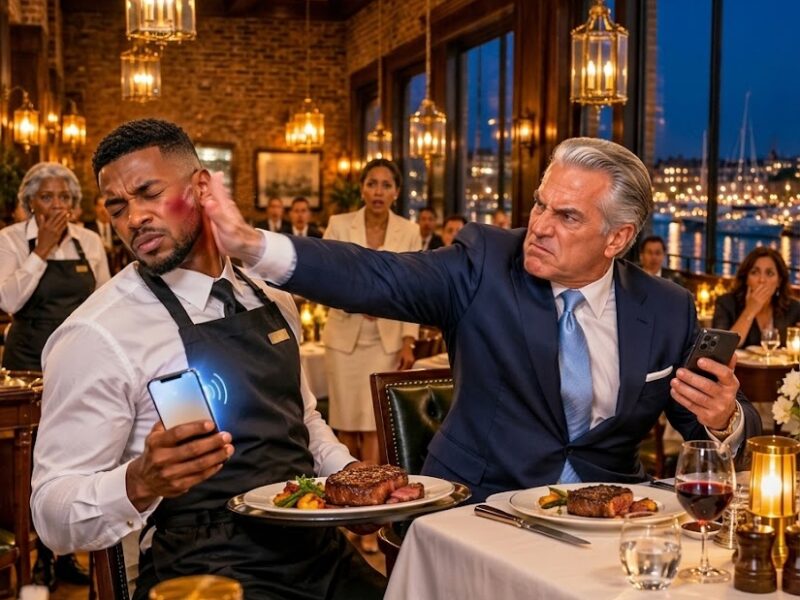
A rich man slapped a Black waiter over a cold steak. Then the waiter dialed the owner—and his own phone rang.
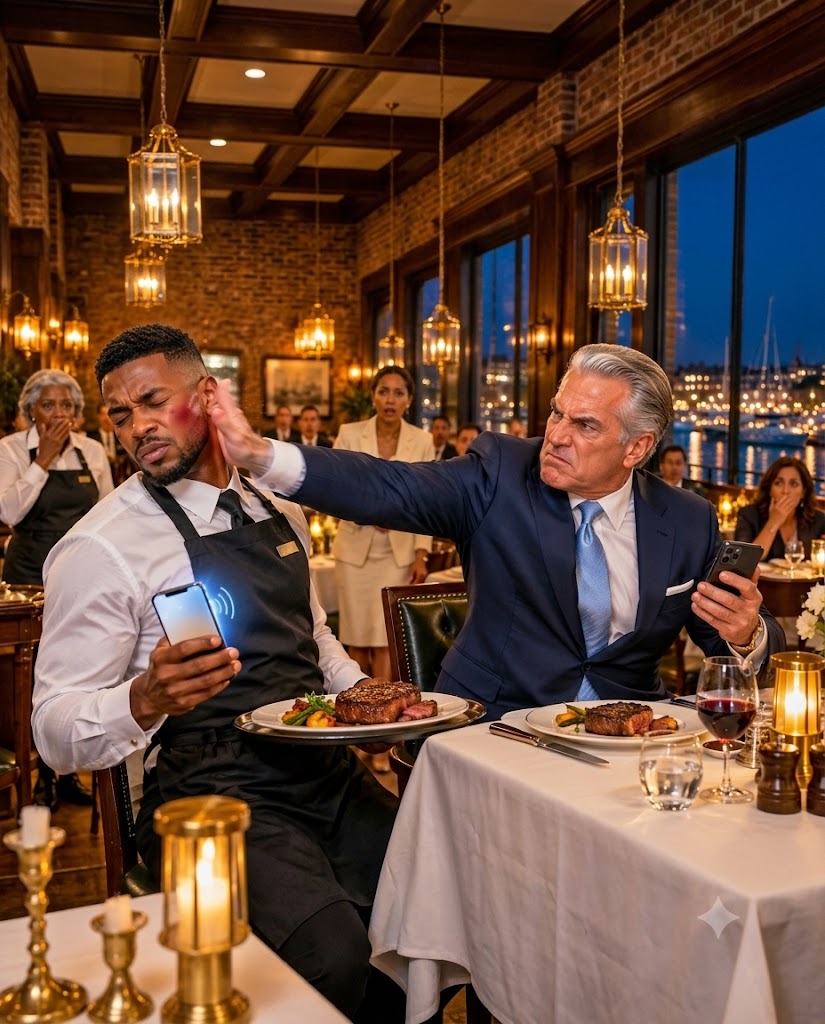
The ribeye came off the grill screaming, charred black outside and cold blue at the center, exactly how Preston Hail demanded it.
But the plate sat under the heat lamp for eleven minutes while the trainee fumbled with a tray of champagne flutes for table seven, and by the time it reached booth nine, the butter had congealed into a pale yellow pool.
Preston Hail didn’t look at the steak.
He looked at the boy holding it, a kid barely out of high school with a name tag that read TRAINEE in bold black letters, and something in his chest tightened with the particular pleasure of a man who had been waiting all day for someone to break.
“You’re telling me what’s in my mouth?” Preston said, his voice low and even, the kind of voice that had closed a hundred deals and buried a dozen competitors.
The trainee’s hands trembled. “No, sir. I’ll take it back again. That’s three. Three steaks. Charred outside, red inside, hot. A child could carry that.”
“It looks fine, Preston,” said the woman across from him, Evelyn Booker, her wine glass halfway to her lips.
“Trust me,” Preston said, “I know a cold steak.”
He set his fork down with the precision of a man who had never in his life been rushed, never been wrong, never been made to wait.
“Preston,” Evelyn tried again.
He ignored her.
“Look at your tag. Trainee. You carry plates. That’s the whole job. And you can’t do it.”
The trainee’s face went red, then white, then something in between that looked like surrender.
“Sorry,” he whispered.
Preston turned to Evelyn with a smile that didn’t reach his eyes. “You can’t get good people in this town anymore. Your boss signs this building over to me Monday. You know who I fire first?”
He didn’t wait for an answer.
“One call and you’re gone.”
The trainee stood there, frozen, the cold steak still on the tray, and for a moment the entire dining room seemed to hold its breath.
Then the kid turned and walked back toward the kitchen, and Preston Hail picked up his phone.
—
Denise had been managing the front of house at The Peninsula Grill for sixteen years, and in those sixteen years she had learned to read a room the way a sailor reads the sky.
She saw the trainee’s shoulders shake as he pushed through the swinging doors.
She saw the way Evelyn Booker was staring at her half-empty glass like it held the answer to a question she hadn’t asked yet.
And she saw Preston Hail, phone pressed to his ear, already dialing, already moving on to the next thing, because men like Preston Hail never lingered on anything that didn’t serve them.
“Evening, Mr. Hail,” Denise said, approaching the booth with a fresh glass of cabernet. “Tonight we’ve got she crab soup, shrimp and grits with tasso gravy, and a blackened grouper.”
Preston didn’t look up from his phone.
“Didn’t catch it.”
“She crab soup. Shrimp—”
“From the top. Slower. You’ve had what? Thirty years to learn it.”
Denise’s jaw tightened, but her smile didn’t waver. “Twenty-four. She crab soup. Shrimp and grits. Blackened grouper.”
“Grouper,” Preston repeated, as if correcting a child. “And pour the cab. Where’s my bread?”
“Coming out now.”
“It was coming out ten minutes ago. You walk like you’re paid by the hour.”
“I am, sir.”
“Then pour faster, Grandpa.”
Denise’s hand shook as she filled his glass, just slightly, just enough for a drop of red to splash onto the white tablecloth.
Preston’s eyes flicked to the stain, then up to her face, and something cold and satisfied settled into his expression.
“Denise,” he called, loud enough for the neighboring tables to hear, “can we get somebody out here who can hold a bottle?”
Evelyn Booker set her napkin on the table. “I’m so sorry, Mr. Hail. I’ll bring a fresh glass.”
“I’ve got it,” Denise said, her voice steady.
“She’s got it,” Preston echoed, mocking. “She’s had it for years. That’s the problem.”
He leaned back in the booth, surveying the dining room like a general surveying conquered territory.
“See this room? By summer, it’s a hotel lobby. Check-in desk right where you’re standing.”
Denise met his gaze. “Will that be all, sir?”
“Go before summer, Grandpa. Walk out on your own. Beats getting walked out.”
He laughed, a short, sharp sound, and turned back to Evelyn as if Denise had already ceased to exist.
“Lora,” he called across the room, “he wants dessert.”
Denise walked back to the kitchen with her spine straight and her hands trembling, and when she pushed through the doors she found the trainee sitting on an overturned milk crate, his face in his hands.
“You okay?” she asked.
He shook his head.
“Did he say something to you? Something besides the steak?”
The trainee looked up, and his eyes were red, and his name tag was crooked, and he was seventeen years old and had been working at The Peninsula Grill for exactly four hours.
“He said I was worthless,” the boy whispered. “He said I’d never be anything. He said—”
He stopped, his voice catching.
“He said his office would call my boss and I’d be fired before I even finished my shift.”
Denise crouched down next to him, her knees creaking in a way that reminded her she wasn’t young anymore, hadn’t been young for a long time.
“He doesn’t have that power,” she said. “Not here. Not yet.”
“Yet?”
She didn’t answer.
—
The call came at six o’clock the next morning.
Denise was in the back office, going over the schedule, when her phone buzzed with a number she didn’t recognize.
She answered on the second ring.
“It’s Loretta,” said the voice on the other end, and Denise’s heart sank.
Loretta had been waiting tables at The Peninsula Grill for twenty-four years.
She had trained Denise when Denise was just a hostess with big dreams and bad shoes.
She had held Denise’s hand through two divorces and one bankruptcy and the death of Denise’s mother.
And now her voice sounded thin and far away, like she was calling from the bottom of a well.
“Loretta. What’s wrong?”
“I’m done.”
“Done?”
“Done. I called to tell you so you wouldn’t worry. But I’m done, Denise. I can’t do it anymore.”
Denise’s hand tightened around the phone. “What happened? Did something happen last night?”
Silence.
“Loretta.”
“Preston Hail had booth nine.”
“I know. I saw.”
“He put his elbow in my wine glass. Spilled cab all over my apron. Then he yelled for you like I’d done it on purpose. Like I’d—”
She stopped, and Denise heard a sound she hadn’t heard from Loretta in twenty-four years.
A sob.
“What did he say to you?” Denise asked, her voice hard. “At the check. I saw him lean in. What did he say?”
“He said—”
Another sob, longer this time.
“He said I should be grateful. He said women my age should be grateful for any job at all. He said he knew my husband left me and my daughter doesn’t call and I should be grateful I have anything.”
Denise closed her eyes.
“And then he put a dollar on the table. One dollar. And he said, ‘That’s what you’re worth.'”
—
Denise found Marcus in the walk-in cooler, sitting on a box of lettuce, staring at the wall.
He had quit in June, and nobody had ever found out why.
Now, standing in the cold, watching his breath fog in the air, Denise thought she understood.
“Booth nine?” she asked.
Marcus nodded without looking at her.
“What did he say?”
Marcus was quiet for a long time.
“He asked me where I was from,” he finally said. “And when I told him, he laughed. Said he’d never hire someone from my neighborhood. Said he could smell it on me. Said—”
His voice broke.
“Said I should go back where I came from.”
Denise sat down next to him on the box of lettuce.
“He said that to Kayla too,” Marcus added. “Before she quit. In August. He told her she’d be prettier if she smiled more. Told her she should be flattered he noticed.”
“And then what?”
“She threw her apron at him. Walked out.”
Denise remembered that night.
She remembered Kayla crying in the parking lot.
She remembered Kayla saying she was fine, it was nothing, don’t worry about it.
She remembered believing her.
“How many of these?” Denise asked.
Marcus looked at her.
“How many people has he driven out?”
He shook his head.
“That’s ten,” he said. “Ten in the last three years. I’ve been keeping count.”
—
The office called every Monday.
Denise had gotten used to it by now, the precise voice on the other end of the line, asking for Mr. Reed’s cell number, always asking, never getting.
“I tell them Mr. Reed’s in Charlotte,” she told Marcus. “They don’t believe me, but they can’t prove otherwise.”
“Has Hail ever seen him?”
Denise shook her head.
“You come in before we open. He comes in after. He thinks Reed is a mailbox with a nameplate.”
“When’s he back?”
“Lunch tomorrow. Dinner Friday. Booth nine both times.”
Marcus stood up, brushing lettuce leaves from his jeans.
“Give his office my number,” he said.
“Your cell?”
“He’s asked for months. Give it to him.”
“And when he calls?”
Marcus smiled, and it wasn’t a nice smile.
“I’m going to see Loretta.”
—
The house was small and white and had a porch that creaked when you walked on it.
Loretta had lived there for thirty years, had raised her daughter there, had buried her husband there, had spent so many evenings on that porch watching the sun go down that she had memorized the way the light hit the oak tree in the front yard.
Denise parked her car and sat for a moment, looking at the house, remembering all the times she had come here for advice, for comfort, for a cup of coffee and a piece of pie.
Then she walked up to the door and knocked.
Loretta opened it wearing a housecoat and slippers.
“You drove all the way down here with a pie on the seat,” she said.
“Peach. Mama made it. She said don’t bring it back.”
“Then don’t sit.”
Denise followed her into the kitchen, where two cups of coffee were already waiting on the table.
“Look at you,” Loretta said. “First night you worked for me, you dropped two dozen oysters on table six.”
“One dozen.”
“Two on the floor. You cried in the walk-in.”
“I did not cry.”
“I held that door shut so nobody would see you.”
Denise sat down and wrapped her hands around the coffee mug.
“What happened Tuesday?” she asked.
Loretta didn’t answer.
“Nothing you need fixing.”
“Denise says he put wine on you.”
“Wine comes out.”
“Then what doesn’t?”
Loretta looked away, out the window, at the oak tree.
“That man eats at your place twice a week. Big checks. You throw that away over an old waitress.”
“Over a lot less.”
Loretta smiled, but it was a tired smile, a smile that had seen too much and expected nothing.
“Some folks pay a dollar just to tell you what you’re worth,” she said. “That’s all you getting.”
“Come back Thursday,” Denise pressed. “Your section’s sitting there.”
“My feet quit years ago. I’m just catching up to them.”
She stood up, walked to the counter, and cut two slices of pie.
“Go on home. Tell your mama thank you and ask about her knee.”
“She’ll say it’s fine.”
“Then she’s lying. Tell her I said so.”
Denise took the pie, and for a moment neither of them spoke.
Then Loretta said, “She send the pie back.”
“She kept the pie.”
“Not you though.”
“She says ask about your knee.”
“My knee’s fine.”
She snorted.
“She said you’d say that.”
Another snort.
“Tomorrow I’m working her section.”
“Working at how?”
“Apron. Tray. Booth nine.”
Loretta stared at her.
“You’ve got six restaurants and you’re going to go carry plates.”
“Loretta won’t tell me what he did. The staff whisper his name. He wants my answer by Friday. I can’t give it to him if I don’t know what he did.”
“So tell him no and throw him out.”
“Then I never find out.”
“And if he knows your face—”
“He’s never seen it. Men like that don’t look at the tray. They look at the plate. He’ll look right through me.”
“He put his hands on her. His elbow. Wine on her apron.”
“Then he’ll put them on you. Don’t you let him.”
“Mama,” Denise said.
“Don’t mama me. Where’s your white shirt?”
“In the car.”
“Go get it. You are not walking into Loretta’s section in a wrinkled shirt. She’d skin us both.”
—
The next morning, Denise stood in the kitchen of The Peninsula Grill wearing a white button-down shirt and a black apron, her hair pulled back, her name tag blank.
Theo, the head chef, looked at her like she had lost her mind.
“New trainee starts today,” Denise announced. “On the floor, he is trainee. Nothing else. Not his name. Not sir. Anybody slips, I’ll hear about it.”
The kitchen staff exchanged glances.
“Yo, trainee,” one of them called. “Fork goes on which side?”
“Left.”
“Knife?”
“Right. Blade in.”
“Look at that. Boss remembers.”
Theo shook his head.
“I’m in the kitchen in here. He’s boss.”
“When’s the last time you carried a tray, boss?”
“Twenty-three years.”
Laughter.
“Lord help booth nine.”
—
Booth nine was the best table in the house.
It sat by the window, overlooking the harbor, where the water caught the light and the boats bobbed in the marina and the whole city of Charleston stretched out like a postcard.
Denise had served that table a hundred times, a thousand times, and she had never once sat in it.
Today, she would.
She approached with a tray balanced on her palm, the way Loretta had taught her twenty-four years ago, palm flat under the middle, not the edge.
“I’m sorry, ma’am,” she said, setting down a glass of champagne. “I’ll pour you a fresh one.”
The woman at the table looked up, and her face was kind, and her eyes were old.
“Easy, sugar. Take your time.”
“It’s my first day.”
The woman smiled.
“It’s our fiftieth. We walked past that window on our wedding night. Couldn’t afford the bread basket.”
“Had a hot dog on the pier,” the man said.
“Two hot dogs. He was showing off.”
The woman laughed, and the sound was like wind chimes, like something from a different world.
“We waited fifty years for this table. We can wait on a glass of champagne.”
She handed Denise her phone.
“Would you mind? She never lets me in the pictures.”
“Because you blink.”
“One more, sir. You blinked.”
More laughter.
“What do they call you, sugar?”
“Today, trainee.”
“Well, trainees, you did just fine.”
Denise handed back the phone, and for a moment she felt something she hadn’t felt in years.
Hope.
“Happy anniversary,” she said.
“You hang on to this job, son. You’ve got a feel for it.”
—
The afternoon shift came and went.
Denise served three more tables, poured a dozen more glasses of wine, carried a dozen more plates, and by the time the lunch crowd thinned, her feet were aching and her back was screaming and she understood, finally, why Loretta had quit.
Not because of Preston Hail.
Because of everything else.
Because of the hundred small indignities, the thousand tiny cuts, the endless parade of customers who looked through you like you were furniture.
Because of the way your body broke down before your spirit did.
Because of the way the world expected you to be grateful for the privilege of being treated like nothing.
“Good afternoon, sir,” she said, approaching booth nine for the third time that day.
“Where’s Grandpa?”
“She’s not working today, sir. Not today. Not ever, I bet. Finally retired.”
“Trainee.” Preston Hail shook his head. “They’re down to trainees. That’s beautiful. How long have you been here?”
“Since this morning, sir.”
“And they put you on my table. That tells you everything about Reed. Man’s never once walked through that door.”
“Water, sir.”
She reached for his glass, and he held up a hand.
“Hold on. Stay right there.”
He pulled out his phone and dialed a number, and Denise stood frozen, her heart pounding, as she listened to a voice she knew very well.
“The wireless customer you are calling is not available. At the tone, please record your message.”
“Reed Preston Hail, third message. Your office finally coughed up this number, so I’m assuming you can work a phone.”
Denise’s hand tightened on the water pitcher.
“You’ve lost three servers this year. You’re about to lose more. I can count. So can your bank.”
He paused, smiling at something Denise couldn’t see.
“Nine million. That’s generous and you know it. It’s gone at midnight tomorrow. I’m having dinner at your place tomorrow night. Booth nine. If you want to talk like a grown man, come find me.”
He hung up and looked at Denise.
“What are you staring at?”
“Water. Ribeye. Black and blue.”
“That’s not on the lunch menu, sir. I’ll ask the kitchen.”
“Don’t ask. Tell. Charred black outside, cold blue center. Tell your cook if it comes out gray, it comes right back.”
“Yes, sir. Anything to drink?”
“Sweet tea.”
“That’s syrup. Unsweet lemon.”
She walked back to the kitchen and leaned against the counter, her hands shaking.
“Gordon,” she said.
Theo looked up from the grill.
“Yeah.”
“Listen. The old woman walked Tuesday. Twenty-some years. Last of the old guard. Now it’s kids and trainees. One more bad month and Reed folds. He’s sitting up in Charlotte watching the numbers drop. He’ll call before midnight tomorrow. They always do.”
She paused, her voice hard.
“Tomorrow night I’m bringing Evelyn Booker in here. Booth nine. I want her looking at the front door of my hotel while she eats. And if he doesn’t call, we wait. Another quitter, another month. Places like this bleed slow.”
She looked at the paper in her hand.
“Forty. Her funds in for forty if she likes the view.”
She laughed, a cold, sharp laugh.
“Draw up the paper. Monday. I own the building.”
She picked up the plate and handed it to Denise.
“Pick that up. Fresh one.”
—
Denise took the plate.
She walked it to the kitchen, where Theo was already firing another ribeye, and she stood there for a moment, watching the flames lick at the meat.
“All right,” she said.
“What?”
“See, you learned faster than grandma did. She needed a minute just to bend.”
Theo looked at her.
“Tomorrow night, 7:30, party of two. And you, clean shirt.”
Denise nodded.
“Yes, sir.”
She walked back out to the dining room, where Preston Hail was finishing his sweet tea and scrolling through his phone.
“He tipped you a dollar to quit,” she said.
Preston looked up.
“What?”
“Loretta said he pays a dollar to tell you what you’re worth. Give me two minutes. I’ll walk him out by his little anchor pin.”
Theo appeared in the doorway.
“Say the word. I’ll tell his office we’re booked forever.”
“Not yet.”
“He dropped a napkin at your feet in your own dining room.”
“He wants an answer by midnight tomorrow. He’s going to get one to his face.”
“And Loretta—”
“He wrote me one word. I want to know what he wrote her.”
“Then you’re carrying his plates again tomorrow.”
“Then I carry him.”
She picked up the menu and walked toward the kitchen.
“Black and blue. I’ll make that man the best steak of his life. He’ll still send it back.”
—
The next evening, the restaurant was full.
Every table was taken, every chair was filled, and the air was thick with the smell of butter and garlic and the low hum of conversation.
Denise stood by the kitchen door, watching the front entrance, waiting.
At 7:30 exactly, Preston Hail walked in with Evelyn Booker on his arm.
He was wearing a suit that cost more than Denise’s car, and he was talking loudly about the hotel he was going to build, the fortune he was going to make, the people he was going to fire.
“Best seat in Charleston,” he said, sliding into booth nine. “Look at that water.”
“It’s a lovely room,” Evelyn said.
“Picture it in glass. Lobby right here. Bar where that kitchen is. Rooftop on top of all this brick.”
“And the restaurant?”
“Monday. It’s mine. The owner’s been stalling for months. He’ll sign.”
“You said that in March.”
“In March, I didn’t have you at the table. I’m naming the rooftop bar after your fund.”
“Please don’t.”
Denise approached the table with two menus.
“Good evening. Can I start you with something to drink?”
“Ribeye, black and blue, and a bottle of the Opus. And bring it hot this time. Yesterday’s took a nap on the way out.”
“I’ll order for myself, Preston.”
“Of course. Forgive me.”
“The grouper, please.”
“And a glass of the Sancerre.”
“Yes, ma’am.”
Denise started to turn away, then stopped.
“I’m sorry. What’s your name?”
Preston laughed.
“It’s—it says right there. Trainee.”
“Yes.”
“Don’t learn their names, Evelyn. They don’t stay long enough to need them.”
—
The grouper came out first, perfectly seared, and Evelyn Booker took a bite and closed her eyes.
“This is incredible.”
“The grouper in the Sancerre. I’ll be right back.”
Denise walked toward the kitchen, and as she passed the window, she saw something that made her stop.
A man was standing on the sidewalk outside, looking in.
He was tall, with gray hair and a gray beard and a suit that had seen better days, and he was staring at booth nine with an expression that Denise couldn’t quite read.
Then he turned and walked away.
She shook her head and kept moving.
“Valet out there. Revolving door right there. You’ll see it.”
She set the ribeye down in front of Preston Hail.
“I said black and blue.”
“That’s black and blue, sir.”
“Is it? Then why am I sending it back? That’s not what I ordered. Twenty-two minutes. I could have driven to Charlotte.”
“I’ll have another out.”
She picked up the plate and walked back to the kitchen.
“Sir,” Evelyn called after her, “is the kitchen busy tonight?”
“No, ma’am.”
“I didn’t think so.”
—
Theo was waiting for her in the kitchen, a fresh ribeye already on the grill.
“That was the best steak I cooked all year,” he said.
“I know.”
“One more. Say the word and I walk this one out to him myself.”
“Just cook it, Theo.”
The door swung open, and Denise looked up.
A woman was standing there, short and round and wearing a housecoat.
“Loretta,” Denise said.
“Where is he?”
“Hey. Hey—”
But Loretta was already pushing past her, already walking toward the dining room, already heading for booth nine.
“Gloria called me,” she said over her shoulder. “Said that boy’s been fetching steaks for Preston Hail. Two days running. He hasn’t carried a tray since high school.”
“It shows. Third steak just went out.”
“Third.”
Loretta stopped and turned around.
“I’m going out there to get him.”
“Watch.”
—
Preston Hail was laughing when Loretta reached the table.
He was telling Evelyn about the hotel, about the money, about the way the world worked, and he didn’t notice the old woman standing beside him until she cleared her throat.
“Preston.”
He looked up, and his face went pale.
“Look at your tag,” Loretta said, her voice cold. “Trainee. You carry plates. That’s the whole job. And you can’t do it.”
Preston’s mouth opened, but no sound came out.
“Sorry. You can’t get good people in this town anymore. Your boss signs this building over to me Monday. You know who I fire first?”
She reached into her pocket and pulled out a dollar bill.
“One call and you’re gone.”
She set the dollar on the table.
“Then call.”
—
The phone rang.
It was a small sound, barely audible over the hum of the restaurant, but somehow everyone heard it.
Preston Hail reached into his pocket, his hand trembling, and pulled out his phone.
“Hello?”
The voice on the other end was calm, steady, the voice of a man who had been waiting for this moment for a very long time.
“This is Darius Reed.”
Preston’s face went through a series of expressions that Denise would remember for the rest of her life.
Confusion.
Disbelief.
Fear.
“Reed, is this a bit? Who put you up to—”
“You wanted to talk like a grown man. Mr. Hail, I’m right here.”
“Mr. Hail,” Evelyn said, “he owns this place.”
“Since when?”
“Since May.”
Preston looked up, and for the first time, he really looked at the person standing beside his table.
The person wearing the white shirt and the black apron and the name tag that said TRAINEE.
The person whose face he had never bothered to notice.
“Mr. Hail,” Denise said.
“Mr. Reed.”
Preston’s voice was shaking now, all the confidence gone, all the power stripped away.
“Okay, we got off on the wrong foot. You slapped me.”
“I didn’t know. How would I know? You’ve got a tag on that says trainee.”
“You didn’t know?”
“Look, you got my offer. Nine million. Evelyn’s right here. Let’s sit down and talk real numbers.”
“You left me three messages because you never called back. I heard all three. The answer is no.”
“Ten. I’ll go ten tonight right here.”
“No.”
“Eleven. You won’t see eleven anywhere on this harbor.”
“It’s no, Mr. Hail.”
Preston’s face was red now, his hands clenched into fists on the table.
“All right. I’m sorry. I was out of line. I apologize, Mr. Reed.”
“I’m not the one you owe.”
Preston blinked.
“Then who do I—ma’am.”
Loretta stepped forward.
“Evening, Mr. Hail. You left something on my table Tuesday.”
She reached into her pocket and pulled out a crumpled napkin.
“This is what you wouldn’t tell me.”
She smoothed it out on the table, and Denise could see the single word written on it in black ink.
*Worthless.*
“You’d have done something foolish,” Loretta said, “like put on an apron.”
Preston Hail stared at the napkin, and for a moment he looked like a man who had finally understood something he should have understood a long time ago.
“Ma’am, that was a joke. A bad one. I apologize. Truly, I—”
“I heard you.”
She folded the napkin and put it back in her pocket.
“Booth nine is closed to you, Mr. Hail, tonight and every night after.”
“You’re throwing away nine million over a waitress.”
Her name is Loretta. Before her, Kayla. Before her, Marcus. People quit. That’s not on me.
Places like this bleed slow. That’s how you put it to Gordon. I never—Thursday booth nine. I was pouring your water.
Evelyn Booker stood up.
“Preston, let’s get out of here. I know a place on King Street.”
“An hour ago, you told me you’d own this building Monday.”
Evelyn looked at him, and her eyes were cold.
“Deal’s off.”
“There are ten other lots on this harbor.”
“You just slapped the man who owns this one, and you tipped him a dollar.”
“That was a joke.”
“You said that about hers, too.”
Preston’s mouth opened and closed like a fish gasping for air.
“I didn’t know who he was.”
“I know. I watched how you talked to him before either of us knew.”
Evelyn picked up her purse.
“My fund is out, Preston. All forty.”
“What do we do?”
“You’ll regret it when that hotel’s full.”
“Then I’ll regret it. Over one bad night—”
“Over three steaks and three servers.”
Evelyn turned and walked toward the door.
“Evelyn, good night.”
She didn’t look back.
—
Preston Hail sat alone in booth nine, surrounded by the wreckage of his evening, his deal, his dignity.
Denise stood beside him, the cold ribeye still on the tray, and she felt something she hadn’t felt in years.
Not triumph.
Not satisfaction.
Just a quiet, steady certainty that justice, when it came, came in strange forms.
“Watch your step, Mr. Hail,” she said.
Preston looked up at her, and for a moment he seemed like a different man.
Older.
Smaller.
Defeated.
“Mr. Reed, I haven’t eaten. I’d still like dinner if you’re still serving.”
Denise smiled.
“I’ll bring you a fresh grouper, ma’am, on the house.”
“I’ll pay for it and I’ll tip.”
“Don’t look at me. I don’t work here.”
Evelyn, who had paused at the door, turned back.
“Who washed my apron?”
“Don’t look at me.”
“Gloria came by Saturday, took it home, brought it back ironed.”
“Of course she did.”
—
The restaurant emptied slowly, the last customers lingering over coffee and dessert, the staff beginning the long process of closing down.
Denise found Loretta in the kitchen, sitting on an overturned milk crate, her feet up on a box of lettuce.
“You did good,” Loretta said.
“I learned from the best.”
“Damn right you did.”
They sat in silence for a moment, listening to the sounds of the kitchen winding down.
“Lunch books full,” Denise said. “Three tables asked for your section.”
“Since when does anybody ask for a section?”
“Since Friday night.”
Loretta smiled.
“Hail development called at nine.”
“What’d you tell him?”
“Mr. Reed’s in Charlotte.”
Loretta laughed, a real laugh, the kind that came from somewhere deep in her chest.
“Look at that. Trainee retired.”
She stood up, stretching her back, and picked up a tray from the counter.
“I’ll take it out.”
“Lord, same as the oyster night. Palm flat under the middle, not the edge. Matter of fact, give me that. That’s my table.”
Denise handed her the tray.
“How are the feet caught up?”
“They’re fine.”
“How’s that knee?”
“It’s fine.”
“Liar.”
Loretta snorted.
“He ever learn to hold that tray?”
“No. I took it from him.”
—
Outside, the sun was setting over the harbor, painting the water in shades of gold and pink and orange.
Denise stood by the window, watching the boats bob in the marina, and she thought about all the things that had led to this moment.
Twenty-four years of serving tables.
Twenty-four years of being invisible.
Twenty-four years of watching men like Preston Hail walk through the door and treat her like she was nothing.
And now, finally, she had done something about it.
Not for herself.
For Loretta.
For Marcus.
For Kayla.
For every server who had ever been told they were worthless by someone who didn’t even know their name.
She reached into her pocket and pulled out the napkin, the one with the single word written on it.
*Worthless.*
She looked at it for a long moment, then walked to the trash can and dropped it in.
Some words didn’t deserve to be remembered.
Some words deserved to be forgotten.
And some words, the ones that mattered, were never written down at all.
They were carried in the heart, in the hands, in the way you held a tray.
Palm flat under the middle, not the edge.
—
The next morning, Denise walked into The Peninsula Grill and found a note on her desk.
It was written in careful, precise handwriting, the kind that came from years of practice.
*Denise,*
*I heard what happened. I heard what you did. And I want you to know that I see you. I’ve always seen you.*
*You’re not a trainee. You’re not a number. You’re not a name tag.*
*You’re the reason this place is still standing.*
*Take the day off. You’ve earned it.*
*—D.R.*
She read it twice, then folded it carefully and put it in her pocket.
Then she walked to the kitchen, tied on her apron, and picked up a tray.
There was work to do.
There were tables to serve.
There were people to remind, one plate at a time, that everyone deserved to be seen.
—
The lunch rush came and went, a blur of orders and plates and glasses and smiles.
Denise moved through the dining room like water, like air, like something that had always been there and always would be.
She served the crab cakes to table four.
She poured the chardonnay for table seven.
She carried the black and blue ribeye to booth nine, where a young couple was celebrating their anniversary, and she set it down with a smile.
“Enjoy,” she said.
And then she walked back to the kitchen, where Theo was already firing the next order, and she stood for a moment, watching the flames.
“You okay?” Theo asked.
“I’m okay.”
“You sure?”
She thought about Loretta, sitting on her porch, watching the sun go down.
She thought about Marcus, finally free of the weight he had been carrying for years.
She thought about Kayla, somewhere out there, smiling again.
And she thought about Preston Hail, sitting alone in his office, staring at a phone that would never ring.
“I’m sure.”
—
The afternoon passed in a haze of sunlight and steam and the low hum of conversation.
Denise served twelve more tables, poured twenty more glasses of wine, carried thirty more plates.
And when the last customer left, and the last dish was washed, and the last light was turned off, she stood in the empty dining room and looked out at the harbor.
The water was calm.
The boats were still.
The city was quiet.
And somewhere out there, in the darkness, a new day was waiting.
She picked up the tray from booth nine, the tray she had carried for two days, the tray that had changed everything.
Palm flat under the middle, not the edge.
That’s how you carry a tray.
That’s how you carry a life.
That’s how you carry the weight of a world that doesn’t always see you, doesn’t always value you, doesn’t always know your name.
You carry it with grace.
You carry it with dignity.
You carry it with the quiet, unshakeable knowledge that you are worth more than a dollar bill, more than a napkin, more than a single word written in black ink.
You are worth everything.
And nobody, not even a man like Preston Hail, can take that away from you.
—
The phone rang at midnight.
Denise was at home, in her kitchen, eating a piece of peach pie that her mother had sent over.
She picked up on the second ring.
“Hello?”
“It’s Loretta.”
“Loretta. What’s wrong?”
“Nothing’s wrong. I just wanted to tell you something.”
“What?”
Loretta was quiet for a moment.
“I got a call today. From a woman named Evelyn Booker.”
“Evelyn Booker?”
“She said she was at the restaurant the other night. She said she saw what happened. She said she was impressed.”
“Impressed?”
“She wants to invest. In the restaurant. She wants to help us buy the building before Hail can get his hands on it.”
Denise’s heart skipped a beat.
“She wants to invest?”
“She’s putting up forty million. Says she’s tired of men like Preston Hail thinking they can own everything.”
Denise sat down at the kitchen table, her hands shaking.
“Loretta, this is—”
“I know.”
“This is everything.”
“I know.”
They sat in silence for a moment, listening to the sound of each other breathing.
Then Loretta said, “You did good, kid.”
“I learned from the best.”
“Damn right you did.”
—
The next morning, Denise walked into The Peninsula Grill and found a crowd waiting for her.
Theo was there, and Marcus, and Kayla, and Gloria, and a dozen other servers and cooks and dishwashers, all of them standing in the dining room, all of them smiling.
“What’s going on?” Denise asked.
Loretta stepped forward, a tray in her hands.
It was the same tray Denise had carried for two days, the same tray she had learned to balance on her palm, the same tray that had changed everything.
“This is for you,” Loretta said.
Denise took the tray, and on it was a name tag.
Not TRAINEE.
Not a number.
Not a label.
Her name.
*Denise.*
“You’re not a trainee anymore,” Loretta said. “You’re not a server. You’re not a manager. You’re not a boss.”
She paused.
“You’re family.”
Denise looked at the name tag, and then at the faces around her, and then at the window, where the sun was rising over the harbor, painting the water in shades of gold.
And she smiled.
“Palm flat under the middle,” she said.
“Not the edge,” Loretta finished.
And they all laughed, and the sound filled the room, and it was the best sound Denise had ever heard.
—
The restaurant opened at eleven.
The lunch crowd came in at twelve.
The plates went out at one.
And Denise, wearing her name tag, carrying her tray, stood in the middle of the dining room and knew, for the first time in twenty-four years, that she was exactly where she was supposed to be.
Booth nine was empty.
But it wouldn’t be for long.
—
The bell above the door jingled.
Denise looked up, and her heart stopped.
Preston Hail was standing in the doorway, his suit rumpled, his hair disheveled, his eyes red.
He looked like a man who hadn’t slept in days.
“I need to talk to Reed,” he said.
Denise set down her tray.
“Mr. Reed is in Charlotte.”
“I know he’s not. I know he’s here. I know he’s been here the whole time.”
“Mr. Reed is in Charlotte.”
Preston’s face twisted.
“You think this is funny? You think this is a game?”
“I think you should leave, Mr. Hail.”
“I’m not leaving until I talk to him.”
Denise picked up her tray.
“Then you’ll be waiting a long time.”
She turned and walked toward the kitchen, and behind her she heard Preston Hail’s voice, loud and desperate and broken.
“I’ll pay. I’ll pay whatever you want. I’ll double the offer. I’ll triple it.”
Denise stopped.
She turned around.
“You want to know what you can do, Mr. Hail?”
He looked at her, and for the first time, he really looked at her.
“You can apologize,” she said. “Not to me. Not to Mr. Reed. To Loretta. To Marcus. To Kayla. To every person you’ve ever treated like they were nothing.”
She paused.
“And then you can leave. And you can never come back.”
Preston Hail stood in the doorway of The Peninsula Grill, and for a moment he looked like a man who had finally understood something he should have understood a long time ago.
Then he nodded.
“I’ll do it.”
“No, you won’t. But it’s nice to hear you say it.”
She turned and walked into the kitchen, and the door swung shut behind her.
—
The lunch rush came and went.
The afternoon passed.
The evening arrived.
And Preston Hail didn’t come back.
He didn’t call.
He didn’t write.
He just disappeared, like a storm that had blown itself out, leaving behind nothing but calm water and clear skies.
Denise served twelve tables that night, poured twenty glasses of wine, carried thirty plates.
And when the last customer left, and the last dish was washed, and the last light was turned off, she stood in the empty dining room and looked at booth nine.
It was empty.
But it wouldn’t be for long.
—
The next morning, Denise found another note on her desk.
This one was from Evelyn Booker.
*Denise,*
*I meant what I said. Forty million. The building. The restaurant. All of it.*
*But I don’t want to own it. I want to invest in it. I want to help you make it something better.*
*Something that treats people like people.*
*Something that remembers names.*
*What do you say?*
*—Evelyn*
Denise read the note twice, then folded it carefully and put it in her pocket.
Then she walked to the kitchen, tied on her apron, and picked up a tray.
There was work to do.
There were tables to serve.
There were people to remind, one plate at a time, that everyone deserved to be seen.
—
The lunch rush came and went.
The afternoon passed.
The evening arrived.
And Denise, standing in the middle of the dining room, wearing her name tag, carrying her tray, knew that this was just the beginning.
The beginning of something new.
The beginning of something better.
The beginning of a world where nobody was worthless.
Where everybody had a name.
Where everybody mattered.
She smiled, and picked up a plate, and walked toward booth nine.
Palm flat under the middle.
Not the edge.
—
**THE END**









