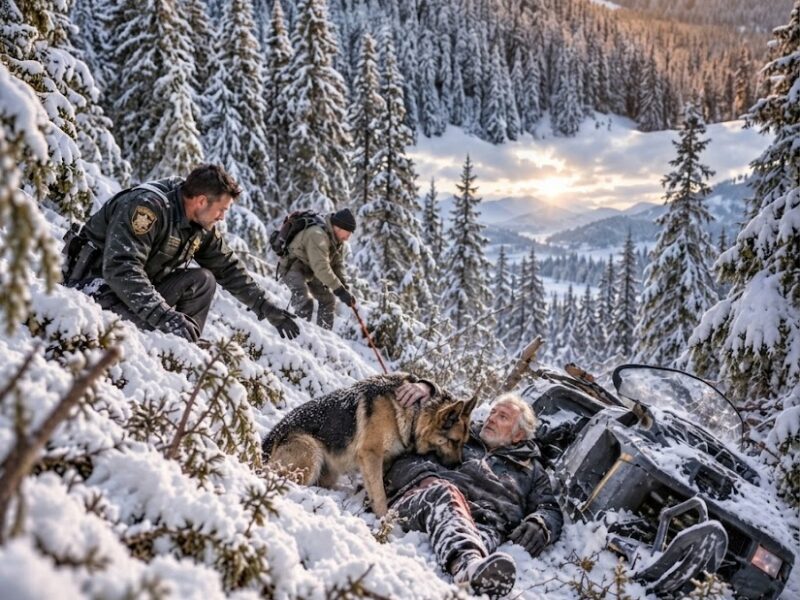
A Retired K9 Led Police Deep Into the Mountains—Then They Saw Who Was Freezing Beside the Snowmobile
By 7:30 that evening, the snow had erased most of the road outside Philipsburg, Montana.
Deputy Sheriff Nolan Pierce kept both hands loose on the steering wheel of the county Explorer and leaned slightly forward, peering through the sweep of the wipers.
The highway had become a narrow gray corridor between walls of darkness.
Snow came hard across the headlights, almost horizontal now, appearing for an instant as bright white streaks before vanishing behind him.
The radio on his shoulder crackled every few minutes with reports of stalled vehicles, drifting snow, and roads that might need to be closed before midnight.
Nolan had been with the Granite County Sheriff’s Office for 12 years.
At 38, he had already spent enough winters on Montana roads to know that storms rarely became dangerous all at once.
They gave warnings first.
A little less visibility, a little more wind, a patch of black ice where pavement had been clear 10 minutes earlier.
Then somewhere between one mile marker and the next, inconvenience became trouble.
He reduced his speed again.
His Navy patrol shirt was hidden beneath a charcoal winter parka, the metal edge of his badge occasionally catching the dashboard glow whenever he shifted.
A radio microphone rested near his left shoulder.
His dark brown hair was cropped short beneath a knit cap, and the light stubble along his jaw made him look more tired than he felt.
A narrow scar above his right eyebrow stood out when he squinted into the storm.
He checked the analog field watch on his wrist.
7:37.
The county had already advised unnecessary traffic to stay off the mountain roads.
In another hour, Nolan expected the highway department to begin closing some of the higher passes.
He rounded a blind curve at barely 25 mph.
Something stood in the center of the road.
Nolan hit the brake.
The Explorer slid half a car length before the tires caught.
A German Shepherd stood directly in the headlights.
For one second, Nolan thought the animal had frozen from fear.
Then he saw its posture.
The dog was large, black and tan, though much of its coat had turned white beneath clinging snow.
Its muzzle was silver with age.
Both ears stood upright, except for a small V-shaped notch along the outer edge of the left one.
The animal was thin enough through the waist to suggest age rather than hunger.
And even in the storm, it stood with a strange steadiness.
It did not scramble away from the vehicle.
It did not bark.
It simply stared at Nolan through the windshield.
“Of course,” Nolan muttered.
He switched on the rear emergency lights, pulled the Explorer as far onto the shoulder as the snow allowed, and reached for his gloves.
The moment he opened the driver’s door, wind pushed cold air beneath his parka.
The shepherd backed away several yards.
Easy.
Nolan stepped onto the road.
The dog watched him.
Up close, it looked even older.
Gray had spread around the lower jaw and beneath the eyes, but there was strength left in the shoulders.
Its eyes were dark amber and unusually steady.
Nolan crouched slightly without moving closer.
“You lost?”
The dog turned and trotted toward the edge of the road.
Nolan waited.
It reached the snowbank, stopped, and looked back.
Then it continued another 20 yards toward a break in the trees.
Stopped again.
Looked back again.
Nolan straightened.
He had seen frightened dogs, injured dogs, farm dogs that wandered onto roads during storms, and pets that bolted from vehicles after accidents.
This was different.
The shepherd was not asking him to approach.
It was checking whether he followed.
Nolan walked a few steps toward it.
The dog immediately moved again.
That’s enough.
At the sound of his voice, it stopped.
Nolan closed the distance carefully and saw the collar.
Old brown leather, wide and worn smooth near the buckle.
A rectangular metal tag hung beneath the dog’s throat, dulled by years of scratches.
Nolan brushed snow from it with his glove.
The engraving was still readable.
K9 Atlas.
Pioneer County Search and Rescue.
Nolan stared at the tag a second longer than he meant to.
Atlas.
One of the dog’s ears shifted at the name, so it recognized it.
Nolan looked toward the trees.
Where’s your handler?
Atlas turned toward the slope below the highway.
That was when Nolan noticed something else.
The dog’s tracks did not begin at the road.
They came up from below it.
Before Nolan could examine them further, his radio came alive.
Unit 12, dispatch.
He lifted the shoulder mic.
12.
Tessa Monroe’s voice came through under a layer of static.
We’ve got a delayed motorist report.
Female, 67, Marian Bell, driving a dark blue Subaru Outback toward Philipsburg.
Family says she should have arrived over two hours ago.
Nolan’s attention shifted immediately.
Last known cell ping was weak.
Somewhere along your corridor, maybe 8 to 12 miles north of town.
We’re trying to narrow it.
Nolan looked at Atlas.
The shepherd had moved back toward the drop-off.
Any crash reports?
Nothing confirmed.
Nolan stepped toward the guardrail and swept his flashlight across the snow.
At first, he saw nothing.
Then the beam caught a shallow deformation in the metal, not enough to tear the rail away, enough to show that something heavy had struck it.
He moved closer.
Snow had already begun filling a gap beneath the lowest rail.
Behind it, barely visible, were two parallel depressions descending the slope.
Tire tracks.
Nolan’s expression changed.
Dispatch, I may have something.
Atlas was already moving downhill.
For the first time that night, Nolan did not tell the dog to stop.
He retrieved a rescue rope, flashlight, thermal blanket, and medical bag from the Explorer, clipped his portable radio more securely to his parka, then climbed through the rail.
The slope was steeper than it had looked from the road.
Within 10 minutes, the highway lights had disappeared behind the snow.
Atlas stayed ahead of him, never more than 30 or 40 yards.
Every time Nolan slowed to pick his footing through deeper drifts, the dog stopped and waited.
Not impatiently.
Not nervously.
It simply watched until Nolan moved again.
That unsettled him more than frantic barking would have.
Dogs could learn patterns.
Working dogs could learn hundreds of them.
But this one behaved as if the pattern mattered.
Twenty minutes down the slope, Nolan stopped beside a pine and listened.
Wind, branches, his own breathing, nothing else.
Atlas stood ahead, almost swallowed by blowing snow.
Atlas.
The dog turned.
Nolan pointed back toward the road.
You sure about this?
It was a ridiculous question.
Atlas took three steps toward him, then turned and continued downhill.
Nolan followed.
Another 15 minutes passed before the dog suddenly disappeared behind a line of young lodgepole pines.
Nolan heard one short bark.
He pushed through the trees.
A dark shape emerged beneath the snow.
Metal, a roof rack, then the rear window of a Subaru.
The SUV had left the road, slid down the hillside, and come to rest nose-first against a cluster of smaller trees.
Snow had piled against one side nearly halfway up the doors.
Nolan moved quickly now.
Sheriff’s office.
He reached the driver’s window and shined his light inside.
A woman moved slowly.
She raised one hand.
Nolan felt his shoulders loosen by a fraction.
Ma’am, can you hear me?
Yes.
Her voice was weak but clear.
I’m Deputy Pierce.
Don’t try to move yet.
The driver’s door was pinned by snow and the angle of the car.
Nolan worked around to the rear passenger side where the door could open several inches.
The woman inside was small-framed with short silver-blonde hair and a pale face drawn tight from cold and exhaustion.
She wore a camel winter coat.
One sleeve pulled awkwardly against her side.
My shoulder, she said before Nolan could ask.
I think I hit it when the car went down.
Any head pain?
Neck pain?
No.
Name?
Marian Bell.
That confirmed it.
Nolan radioed their position and requested rescue assistance.
You’ve got people coming, he told her.
You did the right thing staying in the vehicle.
Marian gave him a tired look.
I didn’t have much choice.
Sometimes that helps.
It earned the faintest trace of a smile.
Only then did Nolan notice Atlas.
The dog had not approached Marian.
Instead, it stood several feet behind the SUV with its nose buried in the snow.
Nolan watched it pull something free.
A faded green canvas bag.
One strap had torn.
The bag must have been thrown from the rear cargo area when the SUV went off the road.
Atlas sniffed it intensely, then froze.
Not frightened.
Not excited.
Simply still.
Marian saw where Nolan was looking.
Oh, no.
What?
That bag.
Yours?
My brother’s.
Nolan picked it up and brought it closer.
Atlas followed, but stopped a few feet away.
Marian touched the canvas with her good hand.
There’s an old blanket in there.
Gideon kept it in the mudroom.
Gideon?
My brother, Gideon Bell.
Her expression shifted.
He died three days ago.
For a moment, the storm seemed louder around the car.
Nolan looked from Marian to Atlas.
You know this dog?
She studied the shepherd carefully.
Atlas stood with snow gathering along its silver muzzle.
No, Marian said, then she frowned.
At least I’ve never seen him.
Nolan waited.
My brother had a German Shepherd, she continued.
For years.
I heard him in the background when we talked on the phone.
Gideon mentioned him sometimes.
What was his name?
Marian looked again at the dog.
Atlas.
Nolan said nothing.
The dog lowered its nose toward the green bag once more.
Now the sequence made sense, at least part of it.
Atlas had not found Marian because he knew her.
He had found something that smelled like the man who had apparently cared for him.
The old blanket.
The canvas.
Perhaps Gideon himself, lingering in a thousand ordinary scents human beings could no longer detect.
Nolan crouched near Atlas.
The dog glanced at him, then back toward Marian.
For the first time since Nolan had found him on the highway, Atlas seemed uncertain.
Not lost.
Waiting.
Rescue lights eventually appeared through the trees above them.
Two volunteers descended with a litter and additional equipment.
Marian was stabilized, wrapped against the cold, and carefully moved uphill.
Before they took her away, she reached toward Atlas.
The dog did not come closer.
Marian let her hand fall.
Gideon cared about that dog, she said quietly.
Nolan looked at her.
How much?
I don’t know.
There was no defensiveness in her answer, only regret.
My brother and I talked.
We weren’t close in the way people pretend families always are.
He lived out here.
I lived in Idaho.
Some things he told me.
Some things he didn’t.
She glanced at Atlas one last time.
But that dog mattered to him.
Then the rescuers carried her toward the highway.
By the time Nolan climbed back to the Explorer, nearly two hours had passed since he first saw Atlas standing in the road.
Snow had begun filling the tire tracks leading to Marian’s SUV.
Nolan opened the rear door of the patrol vehicle.
Come on.
Atlas did not move.
Nolan waited.
The shepherd stood near the shoulder facing north, not toward the slope, not toward the place where Marian had been found, toward the dark mountains beyond the highway.
Snow settled along his back.
Atlas.
One ear turned.
The dog remained where it was.
Nolan followed his gaze.
There was nothing visible beyond the storm.
No lights.
No houses.
Only the black outline of mountain country disappearing into weather.
A working dog could remember a road, a scent, a command.
Nolan knew that much.
What he did not know was why a 10-year-old retired K9 cared for by one man for years would leave a warm house three days after that man died and walk into a Montana blizzard.
Atlas finally turned toward him, but before climbing into the Explorer, the old dog looked north once more.
And Nolan had the uneasy sense that finding Marian Bell had been important.
Just not important enough to explain why Atlas had come out into the storm.
By the time Nolan brought Atlas back into town, the storm had closed the county shelter for the night.
The dog rode in the rear of the Explorer without pacing, barking, or trying to climb forward.
He simply sat behind the metal partition, shoulders squared despite his age, watching the blur of snow through the side window.
Nolan checked the mirror several times.
Atlas never looked back at him.
That suited Nolan fine.
He had no problem with dogs.
He had worked enough calls involving loose livestock, injured pets, abandoned animals, and search teams to know the difference between liking an animal and understanding one.
He did not understand this one.
The safest option was to have Atlas checked before deciding where he could stay overnight.
That brought Nolan to Finch Veterinary Clinic, a low brick building near the edge of Philipsburg whose parking lot had almost disappeared beneath windblown snow.
Doctor Laurel Finch met them at the side entrance.
She was 46 with brown hair pulled into a low knot and a few silver strands visible at her temples.
A pair of thin reading glasses rested on top of her head, apparently forgotten there.
She wore slate blue scrubs beneath a charcoal fleece and moved with the unhurried efficiency of someone who had learned that frightened animals noticed urgency faster than people did.
You always bring me the easy cases after hours, she said.
Nolan opened the rear door.
Atlas remained seated.
I found him in the middle of the highway.
That explains almost nothing.
He led me to a wrecked vehicle.
Laurel looked at him, then at Atlas.
That explains slightly more.
She did not reach for the dog.
Instead, she stood sideways several feet from the door and let Atlas decide whether to step down.
After a moment, he did.
His landing was careful.
The rear leg stiffened for half a second before settling under him.
Laurel noticed.
Old hips maybe, or just 10 years of being a German Shepherd.
Inside the clinic, Atlas allowed a basic examination with guarded patience.
He did not resist when Laurel checked his ears or ran her hands along his ribs.
He watched her continuously, but there was no growling, no attempt to pull away.
The V-shaped notch on his left ear was old and cleanly healed.
His coat was weathered from the storm but not neglected.
Laurel lifted one paw.
Nails were trimmed recently.
How recently?
Few weeks, maybe less.
She checked his teeth next.
Somewhere normal for age.
No heavy tartar buildup.
Somebody’s been taking care of him.
Nolan leaned against the counter.
So he hasn’t been wandering around the mountains for six years.
Laurel gave him a brief look.
If he had, we’d be having a very different conversation.
She ran the microchip scanner slowly along Atlas’s shoulders.
A tone sounded.
There we go.
Nolan straightened.
Laurel read the number twice before writing it down.
I can run the registry, but if this was a law enforcement animal, you may get more from your side.
Nolan called the number in to dispatch.
Tessa Monroe answered on the second ring.
Please tell me you did not adopt the dog.
No.
Good, because I already have enough paperwork tonight.
Tessa was 34 and had been handling dispatch for Granite County long enough to recognize Nolan’s silences.
She had auburn hair she usually tied low at the base of her neck and a habit of speaking faster when the radio traffic got worse.
Nolan could picture her at the communications desk now, headset over one ear, one hand on the keyboard, and a waterproof notebook open beside her console.
I’m sending you a chip number, Nolan said.
Go.
He read it to her.
Laurel continued the examination while Tessa searched.
Atlas weighed less than a young working shepherd of the same frame would have, but not enough to suggest starvation.
His heart sounded steady.
His paws showed ordinary winter wear rather than the cracking and rawness Nolan would have expected from prolonged exposure.
The conclusion became harder to avoid.
Atlas had not been surviving.
He had been living somewhere.
A minute later, Tessa came back on the line.
I’ve got an old registration.
Nolan pushed away from the counter.
What kind?
Government-issued chip.
Pioneer County Search and Rescue.
That matched the tag.
Handler.
Hang on.
Keys clicked faintly through the phone.
Then Tessa stopped typing.
Sergeant Caleb Voss.
Something in her tone changed.
Nolan caught it.
What?
I know that name.
Laurel looked over.
Tessa continued more slowly.
Voss went missing during a winter search operation six years ago.
There was a pretty big regional response.
Nolan glanced at Atlas.
The dog had settled beside the examination table, but his eyes remained open.
And the dog?
I’m seeing an incident notation.
Another pause.
Then Tessa read it aloud.
Atlas.
K9 search dog.
Missing during operation.
Nolan said nothing.
Those four words changed the room more than a dramatic report would have.
Not deceased.
Not recovered.
Not retired.
Just missing.
Laurel crouched beside Atlas and rested two fingers lightly against the fur near his shoulder.
Well, she said quietly.
You’ve had an interesting week.
Nolan looked at her.
Six years.
Laurel shook her head.
No, look at him.
She gestured toward Atlas.
Whatever happened six years ago, somebody took care of him afterward.
Dogs don’t maintain themselves like this.
That distinction mattered.
It turned the situation away from impossible survival and toward something much more ordinary.
Someone had found Atlas.
Someone had kept him.
The mystery was not how the dog lived.
It was why his history had stopped following him.
Nolan asked Tessa to find a current contact for anyone associated with the old SAR unit.
It took almost an hour.
By then, Atlas had accepted a bowl of water and half a portion of food, but refused the clinic kennel.
Each time Laurel tried guiding him toward it, he stopped at the threshold and planted his feet.
She did not force him.
He’s not panicking, she said.
He just doesn’t want to go in.
So if you’ve got a quiet office and nobody’s stupid enough to bother him, that may be less stressful tonight.
Nolan looked down at the dog.
Atlas looked back.
Congratulations, Nolan said.
You’re spending the night at the sheriff’s office.
Atlas showed no visible gratitude.
An hour later, Nolan sat in the report room with a cup of stale coffee while Tessa transferred a call.
The voice on the other end belonged to Owen Barrett.
Pierce?
Yes, sir.
Don’t call me sir.
I’ve been retired four years.
Owen Barrett was 64, a former search and rescue lieutenant who now lived outside Anaconda.
His voice was rough and economical without the sentimental tone Nolan had half expected from someone being told that a long-missing K9 had suddenly reappeared.
You said you found Atlas tonight.
Send me a picture.
Nolan did.
The reply came less than 30 seconds later.
That’s him.
No hesitation.
You’re certain?
I knew that dog before his muzzle turned white.
Owen asked where Atlas had been found.
Nolan explained the highway, Marian’s SUV, the old tag, Gideon Bell’s name.
There was silence on the line.
Then Owen said, Gideon.
You know him?
Not well, but I know the name.
Nolan sat straighter.
Owen explained.
Two weeks after Caleb Voss disappeared, Gideon Bell had found Atlas near Flint Creek Ridge, several miles from the primary search zone.
The dog was exhausted, dehydrated, and still wearing his working collar.
Gideon had done exactly what he was supposed to do.
He called the sheriff’s office.
Atlas was returned to the agency.
There was no secret custody arrangement and no hidden dog.
What happened after that? Nolan asked.
We tried to evaluate him for reassignment.
At first.
Owen’s voice lowered slightly.
He wouldn’t settle.
Atlas had been an experienced search dog, but after Caleb vanished, his behavior changed.
He ate poorly when moved away from the mountain area.
He repeatedly worked doors, fences, vehicle gates, anything that suggested a route outward.
Twice he slipped handlers and tried heading north toward Flint Creek.
That was our best guess.
Nolan looked through the glass wall of the report room.
Atlas lay outside near Tessa’s desk, not asleep, but no longer standing.
So you retired him eventually.
Owen explained that the agency veterinarian and training staff concluded Atlas was unsuitable for reassignment.
He was physically healthy, but his working focus had narrowed around something they could not reproduce or redirect.
Gideon had stayed in contact.
He offered to take Atlas as a retirement placement.
The transfer was documented, approved, and completed legally.
Gideon didn’t steal your dog, Owen said.
I didn’t think he did.
You were wondering.
Nolan almost smiled.
Maybe.
Owen continued.
Gideon gave him a good home, quiet place, enough land.
Knew how to leave a dog alone when it needed leaving alone.
Did you ever see Atlas after that?
Couple times the first year and he was better.
Owen paused.
Not finished, but better.
Nolan disliked the word.
Finished with what?
I don’t know.
That answer stayed with him.
Not because it sounded mysterious, because Owen did not try to make it mysterious.
He simply did not know.
After the call, Nolan returned to the front desk.
Tessa had found additional records confirming the legal retirement transfer.
Nothing about Atlas’s history had been concealed.
The old case had simply aged out of active attention as personnel changed and systems were updated.
Marian Bell called from the clinic in town shortly after midnight.
Her shoulder was badly bruised, but not broken.
Nolan asked about Gideon’s house.
A neighbor named Ruth had been feeding Atlas since Gideon’s death.
The back gate had blown partly open during the storm.
Atlas had disappeared sometime that afternoon.
And the bag in my car, Marian said, I took it from Gideon’s mudroom before leaving.
The green canvas one.
Yes.
The blanket inside belonged to him for years.
That filled in another piece.
Atlas could have followed Gideon’s scent from the property, encountered Marian’s route, and eventually found the SUV.
It was not magic.
It did not need to be.
The dog’s nose was simply better than any explanation humans could invent.
The next morning, Nolan brought the recovered canvas bag into the sheriff’s office.
Atlas stood as soon as he saw it.
Nolan removed the old blanket and placed it on the floor.
Atlas approached.
He sniffed once, then again, longer.
His ears lowered slightly.
For a few seconds, something in his posture softened.
Nolan expected him to lie beside it.
Instead, Atlas stepped away.
He walked to the northern window at the end of the room.
Beyond the glass, the storm had weakened enough to reveal the distant mountains under a pale morning sky.
Atlas stood there looking out.
Tessa came beside Nolan.
So the blanket explains why he found Marian, probably, but not why he left Gideon’s place.
Nolan watched the old dog.
No.
Atlas did not scratch at the window.
He did not whine.
He did not pace.
He simply stood facing the mountains.
And for the first time, Nolan understood that the problem was not that Atlas had disappeared six years ago.
The problem was that some part of him had apparently never stopped going back.
The storm broke sometime before dawn.
By late morning, the sky over Philipsburg had cleared enough to reveal the mountains again, their ridge lines sharp and white beneath a thin wash of winter sun.
Snowbanks stood shoulder-high along some of the county roads, and the trees still carried heavy layers of powder that dropped in soft sheets whenever the wind moved through them.
Nolan drove slowly toward Gideon Bell’s property with Atlas in the rear of the Explorer.
Tessa sat in the passenger seat with a tablet balanced against one knee, reviewing the documents Marian had signed to authorize access to her brother’s records.
She had exchanged her dispatch headset for a dark winter jacket and a wool cap, and without the glow of multiple monitors around her, she seemed quieter, more observant.
Marian followed behind them in a borrowed SUV.
Her injured shoulder was supported by a simple sling beneath her coat, and Nolan had argued twice that she should remain in town.
She ignored him both times.
It’s my brother’s house, she had said.
You’re not sorting through six years of his life without me.
There was no useful response to that.
Gideon’s home stood several miles outside town on a narrow road that climbed gradually into forested country.
It was smaller than Nolan expected.
A single-story log house sat back from the road behind a split-rail fence with a detached workshop on one side and a weather station mounted on a pole near the woodshed.
Snow covered the roof almost to the lower edge of the chimney.
The back gate hung crooked where the wind had forced it open.
Nolan parked.
Before he could open the rear door, Atlas was already standing.
The old shepherd stepped down carefully, paused once in the driveway, and then walked toward the house.
He did not sniff every tree.
He did not search the yard.
He simply went home.
Atlas climbed the porch steps and waited in front of the door until Marian unlocked it.
The moment the door opened, he passed inside.
Nolan followed several seconds later.
The house was cold, but not abandoned.
A neighbor had kept the furnace running low.
Firewood was stacked neatly beside the stove.
A ceramic water bowl sat near the kitchen wall, empty but clean.
A leash hung from a wooden peg beside the mudroom door.
Atlas crossed the living room and went straight to a large rectangular dog bed beside the wood stove.
He turned once, then lay down.
Something about the ordinary nature of it affected Nolan more than he expected.
No drama, no frantic searching, no dog waiting beside a dead man’s chair.
Just an animal returning to the place where it had slept for years.
Nolan looked around.
There were scratches on the floor near the water bowl.
Tan and black hairs caught beneath the edge of a rug.
A faded tennis ball sat under a small table, flattened on one side from use.
Gideon Bell had not kept Atlas as a relic from some strange incident in the mountains.
He had lived with him.
That distinction mattered.
Marian stood in the center of the room looking at things that probably felt both familiar and foreign.
My brother hated buying new furniture, she said.
Tessa glanced at a couch that looked at least 20 years old.
I believe that.
Marian smiled faintly.
He said if something still held your weight, replacing it was vanity.
That sounds inconvenient.
He was inconvenient.
The smile disappeared almost immediately.
Nolan pretended not to notice.
They began with the office.
Gideon had used a small room at the back of the house overlooking the tree line.
Maps covered one wall.
Some were modern forest service maps.
Others were older topographic sheets folded and refolded until the creases had turned soft.
The desk held radio manuals, notebooks, weather logs, receipts, and envelopes secured with rubber bands.
Tessa worked through the documents systematically.
Nolan expected to find something labeled for Atlas.
There was nothing like that.
Gideon did not organize his life for strangers.
Most of his notebooks appeared to be practical records.
Temperatures, snow depth, generator maintenance, fuel purchases, repeater checks, road conditions.
At first, Atlas barely appeared.
Then Marian found a notebook from six years earlier.
She sat in Gideon’s chair and turned pages slowly.
Here.
Nolan moved beside her.
The entry was dated less than a month after Atlas had been transferred into Gideon’s care.
Dog gone again at 4:30.
Found tracks north.
Returned 11:30, soaked and exhausted.
Ate everything afterward.
Two days later, same route.
A week after that, followed him this time.
He isn’t wandering.
Nolan read the line again.
What does he mean?
Marian kept turning pages.
They found out gradually.
Gideon had started marking Atlas’s trips on an old topographic map.
Thin pencil lines left the property, crossed two drainage areas, and headed toward Flint Creek Ridge.
Each line differed slightly.
All of them ended in the same general place.
Tessa studied the map.
That’s deliberate.
Nolan folded his arms.
Or habitual.
Those aren’t mutually exclusive.
He gave her a look.
Tessa returned to the map.
Gideon’s later entries became more detailed.
Thought he was looking for Voss.
Then, three weeks later, not convinced anymore.
Another entry.
He passes the old search sector without slowing.
And finally, always the same station.
Marian looked up.
What station?
Nolan pointed toward a notation on the map.
A small square near the upper section of Flint Creek Ridge.
Tessa enlarged the area on her tablet.
Old emergency radio relay site.
Still active? Marian asked.
No.
Nolan looked through Gideon’s papers.
A maintenance note explained that the station had been downgraded years earlier when newer repeaters were installed farther south.
The building remained.
The system did not.
Marian turned another page.
This time the handwriting had changed slightly, less technical, more personal.
She read the line silently first, then handed the notebook to Nolan.
I kept thinking he was searching for Caleb.
I don’t think that’s it anymore.
Below it, he doesn’t search when he gets there.
Nolan frowned.
Another sentence had been added later.
He waits.
The room became quiet.
Outside, snow slipped from the roof and landed with a heavy thump.
Atlas did not lift his head.
Nolan disliked the direction his mind wanted to go.
Humans were too eager to build meaning around animal behavior.
A dog returned to an old location, so people said loyalty.
A dog waited at a door, so people said hope.
Sometimes a dog simply repeated what years of conditioning had taught it to repeat.
He said as much.
Marian looked at him.
You think Gideon was imagining it?
I think he loved the dog.
That wasn’t my question.
Nolan glanced at the notebook.
I think people see patterns more clearly when they want them to mean something.
Tessa closed the tablet cover.
And sometimes patterns are just patterns.
Before Nolan could respond, a vehicle pulled into the driveway.
Owen Barrett arrived carrying a dented steel thermos under one arm.
In daylight, he looked exactly like his voice had suggested.
Compact, broad through the middle, silver hair cut close, a neatly trimmed gray mustache, and pale blue eyes that seemed permanently narrowed from years of looking across bright snow.
He greeted Marian first, then Atlas.
The reaction was subtle.
Atlas stood.
Owen stopped several feet away.
For the first time since Nolan had met him, the old dog’s tail moved.
Only once.
Owen’s face changed.
Not dramatically.
He simply looked older for a moment.
Well, he said quietly.
You made it.
Atlas approached and pressed his nose briefly against Owen’s hand.
That was all.
Owen did not kneel or embrace him.
He scratched once beneath the dog’s jaw and let him walk away.
The restraint made the reunion feel more real than any display of emotion could have.
They gathered around Gideon’s maps.
Owen recognized Flint Creek station immediately.
We used it all the time back then.
For what? Nolan asked.
Relay point.
Staging in bad weather.
Sometimes the terrain blocked direct radio traffic with command, so teams checked through Flint Creek.
He tapped the map.
Caleb used to finish a lot of searches there with Atlas usually.
Owen described the routine without romanticizing it.
After a search, Caleb would bring Atlas inside, remove the working harness, check the paws, offer water, and give the release cue that ended the dog’s working session.
All done, Owen said.
Marian glanced toward Atlas.
That was the command?
Not exactly a command.
More like permission to stop working.
Nolan looked at Owen.
And Atlas understood that?
Every working dog has signals tied to routine.
Doesn’t mean he understood the philosophy of retirement.
That answer Nolan respected.
Owen continued.
If Gideon says Atlas kept returning there, I’d assume the place had become attached to the final stages of his work with Caleb.
Could that last six years?
Memory can.
Not the same thing as grief.
No.
Owen’s eyes shifted toward Atlas.
But dogs don’t need to experience something the way we do for it to shape them.
Marian returned to Gideon’s notebook.
Near the middle of another page, she found the entry they had been circling around without realizing it.
He is not looking for a man.
Below that, Gideon had written, He keeps returning to the place where the job stopped.
Nolan read it twice.
He still thought the language was too human, too neat.
But now he understood what Gideon had probably meant.
Atlas did not roam the entire mountain.
He did not revisit the place Caleb had last been seen.
He did not search random trails.
He went to a former relay station associated with the end of working sessions.
That was behavior, not mythology.
Owen studied the old routes.
There was confusion the night Caleb disappeared.
What kind?
Radio traffic, weather, search teams relocating.
You know what Caleb’s last assignment to Atlas was?
Owen shook his head.
Not exactly.
He explained that the final transmission from Caleb had been incomplete.
They knew he had made contact with the missing hikers and directed them toward safer terrain.
After that, communications deteriorated.
No one could say with certainty what happened in the final minutes.
Maybe Caleb had sent Atlas toward the station.
Maybe Atlas became separated in the storm.
Maybe the dog had reached the building and found nobody there.
Would he keep trying to repeat the route? Tessa asked.
Owen considered it.
If the sequence never resolved the way he knew it was supposed to, maybe.
Nolan looked toward Atlas.
The shepherd was lying beside Gideon’s bed now, asleep.
Not waiting.
Not guarding.
Just resting.
The contrast bothered him.
At Flint Creek, according to Gideon, Atlas waited.
Here, he slept.
Marian continued searching until late afternoon.
The final notebook was in the bottom drawer of Gideon’s desk.
Its last entries were recent.
Gideon’s handwriting had become shakier.
Nothing suggested he expected to die.
Most of the pages concerned ordinary things.
Snow tires, a leaking valve, a reminder to call Marian.
Then came one final note about Atlas.
Marian read it first.
She did not speak.
She simply handed the notebook to Nolan.
The entry said, He’s older now.
Some winters he only goes halfway before turning back.
Then I stopped trying to bring him all the way home.
Usually he decides on his own.
And beneath that, if there comes a day when he goes back up there and doesn’t turn around, someone should probably finish the walk with him.
Nolan stared at the sentence.
There was nothing supernatural about it.
Gideon had spent six years watching the same dog repeat the same route.
He knew Atlas was aging.
He knew eventually the animal might go farther than it could safely return.
The note was practical.
Almost.
Tessa read over Nolan’s shoulder.
That sounds like Gideon.
Marian nodded.
He never gave advice unless he could disguise it as maintenance.
Owen smiled into his thermos.
Nolan closed the notebook.
He did not believe Gideon had left them a message from beyond the grave.
He did not believe Atlas was waiting for permission from a dead handler.
He believed an old working dog had carried a pattern for six years.
And the one man who understood that pattern best was gone.
That was enough.
He looked toward the window.
Flint Creek Ridge stood somewhere beyond the trees.
For the first time, Nolan stopped asking whether Atlas’s behavior had a hidden meaning.
There was a simpler question.
What happened if no one went with him the next time he tried?
Gideon Bell had left behind no command, no mystery, only an unfinished responsibility.
And Nolan understood those better than he understood ghosts.
Nolan did not reopen Caleb Voss’s case.
He made that distinction clear to everyone involved, including himself.
There was no new evidence of a crime.
No witness had suddenly come forward.
No reason existed to send deputies back across six-year-old ground simply because an old German Shepherd kept returning to one abandoned relay station.
What Nolan wanted was narrower.
He wanted to know what Atlas had been doing during the final minutes of Caleb’s last search.
That question led Tessa into record systems older than the software currently used by the sheriff’s office.
For two days, she contacted county archives, regional emergency communications, retired SAR personnel, and a state office that still maintained copies of winter incident logs on storage media nobody under 30 seemed to recognize.
Owen Barrett contributed what he had kept personally.
Not souvenirs.
Operational material.
Folded topographic maps with search grids drawn in grease pencil, weather notes, a photocopy of the route plan Caleb had filed before heading onto Flint Creek Ridge.
Nolan spread everything across a conference table.
Atlas lay near the wall.
The dog showed no interest in documents describing the most important night of his working life.
That, Nolan thought, was probably healthier than what the humans were doing.
We’re missing the radio architecture, Tessa said.
She stood over an old communications diagram, auburn hair tied back, one finger following a set of faded frequency numbers.
This shows Flint Creek as a relay point, but it doesn’t tell me what was recording what.
Owen leaned back in his chair.
Because the system was held together by two repeaters, three batteries, and Warren Keane swearing at all of them.
Tessa looked up.
Who’s Warren Keane?
The reason half those radios worked in winter.
That was how Warren entered the story.
He arrived the following afternoon carrying a yellow and black radio toolkit that looked older than Nolan.
At 63, Warren Keane had the narrow, weathered build of a man who had spent decades climbing towers, opening frozen equipment cabinets, and working in places most people only saw through windshields.
His gray-white hair curled slightly over the back of his collar.
A short salt-and-pepper beard framed a face lined by sun and cold, and rectangular prescription glasses sat low on his nose.
He wore a rust-brown insulated work jacket over a plaid shirt.
Before sitting down, he placed his toolkit carefully beside the table.
Barrett tells me somebody dug up the Flint Creek mess.
Not the whole mess, Nolan said.
Warren looked at him.
Good.
There isn’t enough coffee in Montana for the whole mess.
He examined the communications diagram.
His expression changed immediately.
Not emotionally.
Professionally.
He began pointing out components Tessa had been unable to identify.
Flint Creek station had not been a simple radio tower.
During bad weather, it served as an intermediate relay between teams working behind the ridge and command units positioned lower in the valley.
Some transmissions went directly through.
Others were captured locally before being rebroadcast when conditions improved.
Captured how? Tessa asked.
Warren adjusted his glasses.
Analog logging unit.
Crude thing.
Recorded traffic when the repeater keyed.
Those recordings still exist?
Most were overwritten.
Most?
Warren looked at Owen.
You kept that storage box?
Owen frowned.
The equipment dump from the decommission.
That one.
I gave it to county archives.
Warren turned toward Tessa.
There may be an old tape cartridge in there.
That sent them back into storage.
The cartridge arrived the next morning.
It was small, scratched, and labeled by hand.
FC17 Jan Winter Ops.
Warren handled it as though it were more fragile than it looked.
The first problem was finding something that could play it.
The second was getting it to play at the correct speed.
The third was the noise.
Static filled the conference room for nearly 20 minutes while Warren adjusted an old interface connected to a digital recorder.
Fragments of voices emerged and vanished.
Coordinates, wind reports, a request for additional snowshoes, a team reporting poor visibility.
Then Owen sat forward.
Back that up.
Warren did.
A man’s voice returned through the static.
Caleb.
Even distorted by age and interference, Owen recognized him instantly.
The room changed.
Atlas did not move.
Nolan watched Owen instead.
The retired lieutenant had not spoken much about Caleb beyond operational facts.
Now his hand tightened slightly around the dented steel thermos he always carried.
Warren replayed the section.
Caleb’s voice came through unevenly.
Contact made.
Two subjects mobile.
Static swallowed several words.
Then directing south.
Emergency shelter.
Tessa began checking the timeline against the paper logs.
That’s consistent with the rescue report.
Owen nodded.
He got them off the upper exposure.
Another transmission followed several minutes later.
This one was worse.
Wind overwhelmed almost everything.
Then three fragments became audible.
Atlas.
A burst of static.
Back to station.
Another break.
Then relay.
Silence.
The tape continued recording background hiss.
No second transmission followed.
Nolan looked at Warren.
That’s it?
That’s what survived.
What came after relay?
I don’t know.
Can you clean it further?
I can make noise louder.
Doesn’t mean I can manufacture words that aren’t there.
Nolan disliked the answer because it was correct.
Tessa had already moved to the incident logs.
There should be acknowledgement from command.
She searched line after line.
Nothing.
A few minutes later, she checked a separate operations sheet.
Still nothing.
The message never made it through.
Owen leaned over her shoulder.
You sure?
No acknowledgement.
No rebroadcast notation.
No command entry referencing Atlas returning to station.
Warren sat back.
That repeater was failing all night.
So Caleb sent Atlas back with information, Nolan said.
Owen answered carefully.
Maybe.
You heard him.
I heard three pieces of a sentence.
Nolan looked at him.
Atlas back to station.
Relay.
That tells us direction, not purpose.
The distinction irritated Nolan more than it should have.
He returned to the route documents.
The two stranded hikers had ultimately been found alive at the southern emergency shelter just after daylight.
According to the logs, a second search team reached them by following Caleb’s filed contingency route.
Not because of his final radio transmission.
Not because Atlas successfully carried a message to command.
Caleb had already done enough to save them.
Whatever he tried to send afterward concerned something else.
A changing route.
His own location.
A damaged radio.
Weather.
Atlas.
There were too many possibilities, and none could be proven.
That should have been the end of it.
Instead, Nolan felt the opposite.
For six years, everyone had known where Caleb’s story stopped.
Now they had found one more incomplete sentence.
It made the absence feel larger.
He spent the afternoon rebuilding the timeline.
At 4:12 p.m., Caleb made contact with the hikers.
At 4:31, he directed them toward the shelter.
At 4:47, another team reported visibility below 50 yards.
At approximately 5:03 came the broken transmission involving Atlas and the station.
After that, nothing confirmed from Caleb.
Nolan circled the time.
Owen watched him.
You’re doing it.
Nolan did not look up.
Doing what?
Turning uncertainty into work because work feels better.
Tessa quietly stopped typing.
Warren closed his toolkit.
Nolan put down the pen.
You think I should ignore this?
No.
Owen’s tone remained calm.
I think you should know what question you’re actually trying to answer.
What happened to Caleb?
That’s not the question you started with.
Nolan looked at him.
You wanted to know why Atlas keeps going back to Flint Creek.
And this may explain it partly.
Owen leaned forward.
But if you start treating the dog like a map to a dead man, you’ll end up asking him to solve something he never understood the way we do.
The words landed harder than Nolan expected.
He pushed back from the table.
For a moment, the conference room disappeared.
He was 26 again, standing beside a command trailer under freezing rain.
His first winter as a deputy.
A missing backcountry surveyor.
Three days of grids, helicopters, volunteers, dogs, drainage searches.
Nothing.
No mistake large enough to blame.
No overlooked footprint discovered later.
The man simply vanished into mountain country.
The family had asked Nolan one question repeatedly.
Where is he?
Nolan had never had an answer.
Years later, he could still remember the helplessness of saying, We don’t know.
That case had taught him something he rarely admitted.
He was comfortable with danger.
He was less comfortable with absence.
Danger gave you something to do.
Absence left a blank space and asked you to live beside it.
First case I ever worked on the mountain, Nolan said.
We never found the man.
No one interrupted.
I kept copies of the search maps for three years.
Tessa looked at him.
Why?
I thought eventually I’d notice something everyone missed.
Did you?
No.
Owen nodded once.
Not sympathy.
Recognition.
Nolan glanced toward Atlas.
The old dog had rolled onto one hip and fallen asleep.
He had no idea that four adults were debating what six years of his behavior meant.
Maybe that was the lesson Nolan had been refusing.
Atlas did not need Caleb’s case solved.
The humans did.
And those were not the same thing.
By late afternoon, Nolan had changed his question.
He no longer wanted to search the ridge for Caleb.
There was no evidentiary basis for it and no operational justification.
Instead, he wanted to take Atlas to Flint Creek Station under controlled conditions.
Owen studied him.
For what?
To see the route.
That sounds dangerously close to curiosity.
It is curiosity.
Nolan did not deny it.
But Gideon wrote that Atlas keeps going there.
He’s 10 years old.
Gideon’s gone.
If the dog tries that road alone again, somebody eventually finds him frozen halfway up.
Tessa nodded slightly.
Nolan continued.
So we go with him once.
We document the station condition.
We make sure the route is safe enough to understand what Gideon was dealing with.
And Caleb?
Nolan looked at the marked maps.
We don’t search for Caleb.
Owen waited.
Nolan finished.
We let that remain what it is.
For the first time that day, Owen seemed satisfied.
Warren cleared his throat.
If you’re heading to Flint Creek, I need to get up there anyway.
Nolan turned.
Why?
Forest Service is pulling the old repeater hardware later this winter.
I promised I’d inventory one of the battery enclosures and verify the serial numbers before they haul it out.
When?
Probably this week.
You’re not going alone.
Warren smiled faintly.
I’ve been working those ridges since before you could drive.
That wasn’t permission.
I don’t work for you.
No, but if you get stranded, I’m still the one who gets called.
That made Warren pause.
Nolan pointed toward him.
Wait for the group.
Warren glanced at Owen, perhaps hoping for support.
Owen drank from his thermos.
Don’t look at me.
I’m retired.
Warren sighed.
All right.
You’ll wait.
Yes.
Say it like you mean it.
I will wait for the group, Deputy.
Nolan accepted that.
Outside, daylight was fading behind the mountains.
Atlas woke when Nolan stood and crossed toward the conference room door.
For a few seconds, the old dog watched him.
Then Nolan picked up the Flint Creek map.
Atlas rose.
It was probably nothing more than movement triggering movement.
Nolan refused to turn it into anything else.
Still, when he folded the map and slipped it under his arm, he found himself thinking about Caleb’s broken transmission.
Not as a clue.
Not anymore.
As the last surviving piece of a job that had never reached a clean ending.
And this time, Nolan had no intention of forcing one.
Three days later, the weather finally gave them a window.
Not good weather.
In January, nobody on Flint Creek Ridge expected good weather, but the wind had dropped below 30 miles an hour.
Visibility had opened across the upper slopes, and the forecast showed several stable hours before another front moved in from the west.
That was enough.
Nolan met the others shortly after sunrise at a Forest Service access point north of Philipsburg.
The snowcat waited beside the maintenance shed, engine already running, its wide tracks half buried in churned snow.
Miles Harlon, 42, stood beside it, checking fuel cans and emergency gear.
He was a Forest Service ranger with a lean build, weather-darkened face, and the practical movements of someone who had spent more time outdoors than behind a desk.
His dark beard was trimmed close, almost hidden beneath the high collar of his winter jacket, and he spoke in short sentences that usually contained only information somebody needed.
You’re Pierce?
Nolan nodded.
Miles Harlon.
They shook hands.
Miles looked toward Atlas.
So that’s the reason we’re climbing a dead repeater road.
One of them.
That answer worries me.
Owen climbed out of his truck carrying his dented thermos.
It should.
Tessa arrived last, bundled in a dark insulated jacket with a waterproof notebook secured beneath one arm.
They loaded rescue equipment, extra blankets, a medical kit, radios, traction gear, and enough emergency supplies to stay out overnight if the weather shifted unexpectedly.
Nolan had no intention of improvising on the mountain.
Atlas wore a simple black working harness Owen had borrowed from a retired SAR handler.
There was no police patch, no bright lettering, nothing suggesting the dog was officially back on duty.
He was not.
That distinction mattered to Nolan.
They were not sending Atlas to search for Caleb.
They were following a route the dog had repeated for years.
Nothing more.
At least that was the plan.
The snowcat climbed slowly through lodgepole pine and open cuts where the wind had sculpted drifts into hard white ridges.
Below them, the valley gradually disappeared behind layers of timber.
Atlas rode quietly near Owen’s boots.
For most of the trip, he looked every bit his age.
He shifted slowly when the vehicle turned.
Once he stretched a rear leg and settled again.
Then Miles stopped the snowcat near the upper access point.
The change in Atlas was immediate.
The dog stood before Nolan had opened the rear door.
When his paws touched the snow, his posture sharpened, his head lowered slightly.
His ears came forward.
The stiffness Nolan had noticed during the drive seemed to recede behind focus.
Atlas did not run.
He simply started walking.
Owen watched him go.
I remember that.
Nolan clipped a long lead to the harness, but let it remain loose.
From Caleb.
From work.
There was an important difference.
They followed Atlas north across the ridge.
The route was not marked as a trail anymore.
Snow and several seasons of fallen timber had erased most evidence of regular use, but Atlas chose his path with almost no hesitation.
He moved between trees rather than across open slopes.
He avoided a wind-loaded section near a shallow drainage.
Twice he paused at places where the old service route split and chose the narrower branch.
Miles checked his GPS.
He’s staying close to the historical access line.
Owen nodded.
Caleb liked this route.
Less exposure when the weather turned.
Nolan looked at Atlas.
The dog was not sniffing continuously as he would during an active search.
He was traveling.
Remembering terrain.
Perhaps repeating an old sequence.
Tessa walked behind Nolan.
Still think this is just habit?
Yes.
That was quick.
Habit can be impressive.
That wasn’t an answer.
It was the only one you’re getting.
She smiled and kept walking.
Forty minutes later, the trees thinned.
The station appeared almost without warning.
It was a squat rectangular building anchored into the ridge, half metal and half concrete with a short mast rising beside it.
Snow had collected against the north wall almost to the windows.
Nothing about it looked important.
That was Nolan’s first impression.
He had expected the place to carry some visible weight after six years of stories.
Instead, Flint Creek Station looked like what it had always been.
Infrastructure.
A place built so voices could cross difficult terrain.
Atlas stopped 20 yards away.
For several seconds, he did not move.
Owen came alongside Nolan.
This is where Gideon said he waited, according to the notebooks.
Atlas finally continued.
The station door required several minutes to clear.
Snow had frozen against the lower frame, and Miles used a shovel before the hinges would move.
When the door opened, cold, stale air came out.
The inside smelled of dust, rust, old insulation, and wood that had been wet too many times.
Tessa swept a flashlight across the room.
An empty equipment rack stood along one wall.
Old cable channels ran across the ceiling.
A workbench sat beneath a narrow window.
There were no dramatic artifacts waiting for them.
No forgotten coat.
No handwritten message from Caleb.
No clue hidden beneath the floor.
Nolan felt relieved.
Atlas stepped inside.
His nails clicked softly against the concrete.
The dog crossed the room.
He passed the equipment rack, past the window, then stopped in the far right corner beside two steel hooks fixed to the wall.
Owen’s expression tightened.
That’s where the harnesses went.
Nolan looked at him.
You sure?
We used to hang working gear there so it would dry.
Atlas stood facing the hooks.
Nothing happened.
One minute passed, then another.
Tessa stayed near the doorway.
Miles quietly began inspecting the structural condition of the room, perhaps deliberately giving the others space.
Nolan watched Atlas.
The dog did not whine.
He did not paw at the wall.
He did not search for someone who was not there.
He simply remained standing.
Owen took one slow step forward.
His voice was quiet.
All done, Atlas.
The shepherd’s right ear shifted.
Owen repeated it.
All done.
Atlas turned his head.
For a moment, his amber eyes rested on the retired lieutenant.
His ears lowered slightly.
Then he looked back at the empty hooks.
That was all.
No sudden relaxation.
No emotional collapse.
No miraculous recognition that six years had passed.
Nolan realized he had been expecting something despite spending days telling himself not to.
Perhaps everyone wanted a visible ending, a sign they could recognize, something that would justify the trip.
Instead, Atlas remained exactly what he had been when they entered.
An old dog standing inside a familiar building.
Owen let out a slow breath.
I guess Gideon was right.
About what? Tessa asked.
He never said the dog needed the words.
Owen looked toward the hooks.
He said somebody might need to finish the walk.
That landed differently.
Nolan crossed the room.
He did not call Atlas.
He did not touch the harness.
He simply lowered himself against the wall several feet away, boots planted on the concrete.
Atlas looked at him.
Nolan leaned his forearms across his knees.
We came.
That was all he said.
Not Caleb is gone.
Not your job is finished.
Not you can let go.
Those were human sentences.
Atlas had no obligation to understand them.
The minutes passed without anyone speaking.
Wind pressed faintly against the metal siding.
Tessa eventually sat on an overturned equipment case.
Owen opened his thermos.
Miles continued taking notes near the door.
The room became ordinary.
That, Nolan realized, might have been the point.
Atlas had always come here with work attached to the place.
Commands, radio traffic, movement.
Caleb.
Gideon had followed him here, but perhaps Gideon had still been following Atlas’s urgency.
Today, nobody asked him for anything.
After nearly 15 minutes, Atlas shifted.
One front paw slid forward, then the other.
He lowered his chest to the floor.
Finally, he rolled slightly onto one hip.
Owen stopped with the thermos halfway to his mouth.
Nolan noticed.
What?
Owen took a second before answering.
I never saw him do that here.
Lie down.
Not after Caleb.
Tessa glanced toward Atlas.
The dog had rested his chin against the concrete.
His eyes remained open, but the tension in his shoulders had changed.
The moment was so small, Nolan almost distrusted it.
There was no proof that it meant anything.
Maybe Atlas was tired.
Maybe the climb had caught up with his age.
Maybe the floor simply felt good beneath his chest.
Nolan decided not to choose.
Not everything needed interpretation.
Some moments were allowed to remain small.
They stayed another 20 minutes.
Miles inspected the abandoned repeater racks and confirmed the structure was stable enough for a later equipment removal.
Tessa photographed the old station layout for their documentation.
Owen walked once around the room, touching nothing.
Atlas remained on the floor.
When Nolan finally stood, the dog lifted his head.
Time to go.
Atlas rose slowly.
This time, Nolan noticed the stiffness returned to the rear legs.
The old dog stretched, shook once, and walked toward the door.
He did not return to the hooks.
Outside, the light had flattened.
Clouds were beginning to gather over the western ridges, but the weather window still held.
Miles checked his radio.
Base, Harlon.
Flint Creek team preparing to descend.
Static answered.
Then a dispatcher’s voice came through.
Miles stopped.
Say again.
The others looked at him.
He listened.
Nolan knew from his expression that this was not about weather.
Miles lowered the radio.
We’ve got a problem.
What kind?
Warren Keane.
Nolan immediately felt irritation before concern.
What about him?
His daughter called County Dispatch.
He hasn’t checked in.
Tessa frowned.
He was supposed to wait.
I know.
Miles continued.
His truck was spotted at the Lower East Access Road this morning.
Nolan stared at him.
He came up here.
Looks like it.
For several seconds, nobody spoke.
Warren had agreed clearly.
He would wait for the group.
Nolan looked east across the ridge.
There were several service branches on that side, some leading to old battery housings separated from the main station.
Did his daughter say why he changed plans?
Miles relayed the follow-up information.
A temperature drop had been forecast for the following night.
Warren apparently became concerned that one of the old battery enclosures would freeze solid before he could verify the serial numbers needed for Forest Service inventory.
He had left a message saying he would be in and out before lunch.
Typical enough to be believable.
Experienced enough to be dangerous.
Nolan rubbed a gloved hand across his jaw.
How long since anyone heard from him?
About five hours.
Tessa checked the time.
Snowmobile?
Miles nodded.
Truck was at the access point.
Trailer empty.
Owen muttered something under his breath.
Nolan looked at Atlas.
The dog had been standing near the snowcat.
Now his head came up.
At first, Nolan thought Atlas was reacting to their voices.
Then the wind shifted.
From somewhere east of the station came a faint mechanical sound.
Not an engine running steadily.
A metallic knock, then silence.
Atlas turned toward it.
His entire posture tightened again.
The change was different from the one earlier.
At the station, he had been remembering a route.
Now he was listening.
Working.
The sound came once more, carried strangely across the cold air.
Miles tilted his head.
Could be something loose on the old access line.
Atlas moved several yards east.
Nolan watched his nose lift into the wind, then drop.
The shepherd did not look back at the station.
He looked toward the tree line.
Nolan clipped the long lead back onto his harness.
Atlas.
The old dog glanced at him.
For four chapters of Nolan’s life with this animal, he had resisted turning every movement into a message.
He was not going to start now.
This was simpler.
There was a missing man somewhere on the ridge.
There was a dog trained for search work standing in front of him.
Nolan looked at Owen.
You think he can still work?
Owen watched Atlas for a moment.
I think he remembers how.
Nolan nodded.
No symbolism.
No unfinished promise.
No ghost from six years ago.
Just an old K9, a cold mountain, and someone who had failed to come home when he said he would.
Atlas stepped east.
This time, Nolan followed him for a reason that belonged entirely to the present.
Atlas took the eastern route without hesitation.
Not quickly.
That was the first thing Nolan noticed.
The old German Shepherd moved with the same focus he had shown on the climb to Flint Creek Station, but age controlled the pace now.
Snow reached halfway up his legs in places, and every few minutes Nolan shortened the lead and slowed the group rather than let Atlas push beyond what his body could sustain.
Miles Harlon walked ahead whenever the route narrowed, checking the slope and probing suspicious drifts with a collapsible pole.
Owen stayed behind Tessa, radio in hand, maintaining contact with base whenever the ridge allowed it.
Nobody spoke unless necessary.
This was no longer a journey into Atlas’s past.
Somewhere ahead, Warren Keane had failed to return from a trip he had promised not to make alone.
That made the mountain feel different.
More immediate.
Less symbolic.
Miles stopped after several hundred yards and raised one hand.
Here.
A shallow groove crossed the snow beneath a line of fir trees.
At first, Nolan saw only windblown powder.
Then Miles brushed the surface aside with one glove.
A snowmobile track appeared underneath, fresh enough that the edges had not fully collapsed.
It came through after the last storm, Miles said.
Nolan looked east.
Single machine.
Looks that way.
Tessa checked the coordinates against the old access map.
That line goes toward the battery enclosure Warren mentioned.
Then we stay on it.
Atlas lowered his nose near the track.
For several seconds, he moved slowly, sampling the air and ground rather than charging forward.
Nolan watched him closely.
This was the first time he had seen Atlas doing anything that resembled actual search work.
There was no cinematic intensity to it.
No constant barking.
No miraculous certainty.
The dog simply gathered information and moved.
Sometimes he followed the snowmobile trail.
Sometimes he drifted several yards away from it.
Once he stopped entirely and lifted his muzzle into the wind, then he continued.
Nolan found that reassuring.
Real competence rarely looked dramatic.
Another quarter mile passed.
The terrain dipped into a shallow drainage where the trees grew closer together.
Miles pointed ahead.
Something blue.
They moved faster.
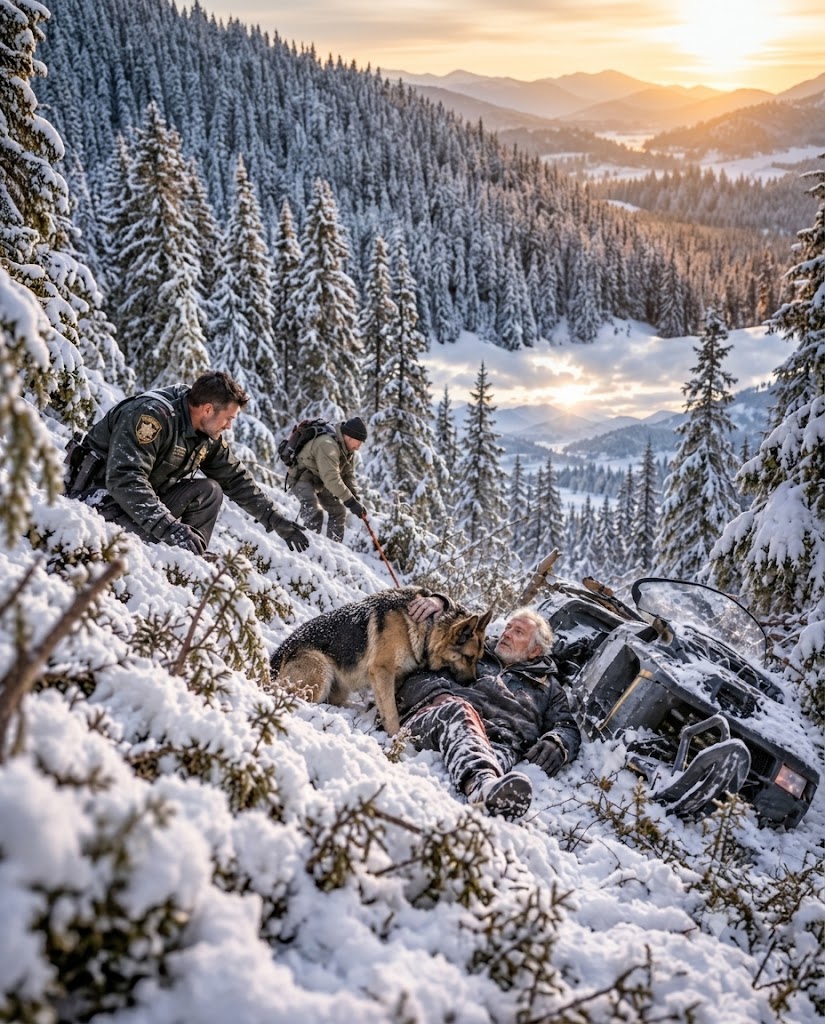
A snowmobile lay on its side near the bottom of the depression.
One ski had caught beneath a fallen lodgepole trunk.
The rear section rested at an awkward angle in the snow.
Beside it, partly protected by the machine and the tree, sat Warren Keane.
He lifted one arm when he saw them.
Well, he called weakly.
This is embarrassing.
Nolan felt relief arrive first.
Irritation followed immediately.
Don’t move.
I’ve been doing an excellent job of that.
They reached him within moments.
Warren’s knit cap was crooked, his glasses fogged at the edges, and much of the color had gone from his face.
His rust-brown work jacket was crusted with snow along one sleeve.
There was no visible blood.
His left leg was pinned beneath part of the machine, but he could move his foot slightly.
Nolan crouched.
Head injury?
No.
Neck?
No.
Hip?
Cold.
That wasn’t one of the options.
Warren managed a thin smile.
My ankle’s sore.
Leg’s mostly trapped.
Not crushed.
Miles began inspecting the snowmobile before anyone touched it.
How long?
Warren checked his watch and seemed surprised by what he saw.
Couple hours.
Closer to four, Nolan said.
Warren looked away.
That answer told Nolan enough.
What happened?
Came down the drainage too wide.
Hit hidden ice under the powder.
Machine slid sideways.
And why exactly did you come up here after telling me you’d wait?
Warren’s expression became almost sheepish.
The temperature forecast changed.
Nolan stared at him.
You nearly froze because of a battery inventory.
When you say it like that, it sounds unreasonable.
It is unreasonable.
Noted.
Nolan wanted to continue.
There would be time later.
Right now, Warren’s hands were trembling, and not from embarrassment.
Miles looked at Nolan.
We stabilize first, then lift just enough to pull him clear.
Nolan nodded.
Tessa opened the medical pack and unfolded a thermal blanket around Warren’s shoulders while Owen moved uphill several yards to get a stronger radio signal.
Base, Flint Creek team.
Subject located.
Conscious.
Trapped.
Lower extremity.
Cold exposure.
Requesting rescue support at transmitted coordinates.
Static answered, then acknowledgment.
Nolan uncoiled the tow strap.
Atlas stood several feet away.
The dog had stopped working the moment they found Warren.
That caught Nolan’s attention.
He no longer scanned the snow.
No longer tested the wind.
He watched the humans.
Waiting.
Owen returned.
Rescue team is moving.
Twenty-five to 30 minutes if the lower trail holds.
Good.
Miles anchored one line around a tree above the machine to prevent further sliding.
Nolan attached a second strap to the snowmobile frame.
They did not need to lift it completely, only control the weight long enough to create enough clearance for Warren to move his leg.
Don’t pull until I tell you, Miles said.
I remember how instructions work, Warren replied.
Nolan gave him a look.
That claim has been challenged today.
Tessa laughed once despite herself.
The sound broke some of the tension.
They worked slowly.
Miles packed snow beneath one side of the machine.
Nolan tightened the strap.
Owen stood ready near Warren’s shoulders.
Atlas remained near Nolan.
The old shepherd’s posture was alert, but still.
At one point, Nolan looked down and realized Atlas was watching his hands.
Not the machine.
Not Warren.
His hands.
It reminded Nolan of something Owen had said about working dogs.
They learned sequences.
People like to imagine loyalty as a feeling.
Often it looked more like attention.
A handler reached for equipment.
A dog noticed.
A voice changed.
A dog prepared.
Atlas had spent years learning the smallest signals of people doing difficult work.
And even now, long after retirement, part of him was waiting to be told where he belonged.
The first attempt to shift the snowmobile gained barely an inch.
Miles stopped them.
Reset.
Warren’s breathing had grown shallow.
Tessa crouched closer.
You still with me?
I’m insulted you’d ask.
Good.
Stay insulted.
She tucked the thermal blanket more tightly around his chest.
Atlas turned his head.
For the first time since they arrived, he looked uphill, back toward Flint Creek Station.
The building itself was hidden behind the trees and ridge, but the direction was unmistakable.
Nolan noticed.
He said nothing.
Atlas remained facing that way for several seconds.
Perhaps he heard something.
Perhaps the station was simply behind them.
Perhaps nothing at all was happening except an old dog pausing during a stressful scene.
Nolan had learned enough not to invent explanations.
Miles repositioned the strap.
Ready again.
Nolan took his place.
Then, almost without thinking, he looked toward Atlas.
All done.
The words came quietly.
Not as a command to leave.
Not as an attempt to cure anything.
Just the release cue Owen had taught him.
Atlas’s ears shifted, but he did not move.
Nolan returned his attention to the strap.
On three.
They pulled.
The machine rose several inches.
Hold.
Miles dropped to one knee and checked the clearance.
Warren, move your foot toward me.
Warren tried.
His boot shifted, then stopped again.
The older man exhaled sharply.
His hands were trembling much harder now.
Tessa looked at Nolan.
He’s getting colder.
Warren attempted another joke and did not finish it.
That changed the room the mountain had become around them.
The problem was no longer the snowmobile.
It was time.
Atlas saw it too, though Nolan could not have said exactly what the dog perceived.
Maybe Warren’s shaking.
Maybe the change in voices.
Maybe the scent of stress.
The shepherd turned away from the direction of Flint Creek.
He walked toward Warren.
No one called him.
He stopped beside the older man and sniffed the sleeve of his coat.
Warren looked down.
Well, hello.
Atlas stepped closer, then lowered himself into the snow against Warren’s right side.
His shoulder pressed along the man’s ribs.
Warren stared at him.
The old dog adjusted once, pushing more of his body against Warren’s coat.
Tessa shifted the thermal blanket over both of them.
That helps, she said.
Warren placed one shaking hand on Atlas’s shoulder.
The shepherd remained still.
Nolan watched them for only a moment before returning to the strap.
He did not need to decide what it meant.
Atlas had been trained for years to stay close to people under stress.
Body warmth was body warmth.
Presence was presence.
That was enough.
The rescue team arrived 18 minutes later.
Two responders came down the drainage carrying additional stabilization equipment and a portable sled.
With more hands, the operation became simpler.
The snowmobile was secured from two points.
Miles controlled the frame.
Nolan and one responder lifted.
The second guided Warren’s leg free.
Once released, Warren could move the limb but could not safely bear weight.
They wrapped him in another insulated blanket and transferred him onto the rescue sled.
Atlas stood when Warren was moved.
Warren caught the edge of Nolan’s sleeve.
Deputy?
What?
I know.
Nolan waited.
I should have waited.
Yes.
I’m assuming this isn’t the part where you tell me not to be hard on myself.
No.
Warren almost smiled.
Good.
They began the trip back.
Atlas walked beside the sled for the first hundred yards before Nolan finally made him ride in the snowcat.
The dog was tired now.
The working focus that had carried him across the ridge had burned away, revealing his age again.
Once inside, he circled carefully and lay near Owen’s boots.
Warren was transferred to the rescue vehicle at the lower access point for evaluation.
His injuries appeared minor.
Cold exposure remained the larger concern, but he was talking normally by the time they handed him off.
The snowcat continued toward the staging area.
For a while, nobody said much.
Tessa rested her head against the window.
Miles drove.
Owen held his thermos between both hands without drinking.
Nolan sat opposite Atlas.
When they rounded a wide section of the ridge, Flint Creek Station appeared in the distance.
Small, gray, almost insignificant beneath the mountain.
Atlas lifted his head.
Nolan noticed immediately.
So did Owen.
The old shepherd looked through the window toward the station.
Five seconds, maybe 10.
Nolan found himself waiting for Atlas to stand, for him to move toward the door, for some old pattern to begin again.
Atlas did none of those things.
He watched the station until the snowcat turned.
Then he lowered his head between his front paws.
His eyes closed.
Owen looked out the opposite window.
Nolan did not ask what he was thinking.
There was nothing useful to add.
No one said mission complete.
No one said Caleb’s name.
No one claimed Atlas had finally understood something.
Perhaps he had simply been exhausted.
Perhaps today had given his mind a different sequence to remember.
A missing man.
A search.
A person found alive.
A return home.
For once, the pattern had an ending.
Nolan leaned back against the seat.
Atlas slept while Flint Creek Ridge disappeared behind them.
And for the first time since Nolan had met him, the old K9 was leaving the mountain without looking for a reason to go back.
By the end of February, the story had traveled farther than Nolan wanted it to.
Not nationally.
Not even across Montana in any meaningful way.
But among county deputies, volunteer rescue teams, Forest Service crews, veterinarians, and the scattered network of people who had worked winter searches long enough to remember names, Atlas had become familiar again.
Someone had posted a photograph of the old German Shepherd sitting beside Warren’s rescue sled.
Another person had shared a short note about a retired K9 helping locate a missing radio technician on Flint Creek Ridge.
The story was accurate enough.
That was what bothered Nolan.
Accurate stories could still become the wrong story.
Within days, people had started using words like miracle, hero, and six-year mission.
Nolan declined two interview requests and told the sheriff’s office public information coordinator to keep the statement plain.
Retired search and rescue K9 assisted responders.
Missing individual located alive.
No heroic mythology required.
Tessa accused him of being allergic to headlines.
He told her headlines were often allergic to nuance.
Atlas, meanwhile, seemed entirely unaffected by his renewed reputation.
He stayed temporarily with Owen Barrett after Warren’s rescue, mostly because the arrangement had worked well during the transition and because Atlas already knew him.
The more immediate question was whether temporary should become permanent.
That answer became clearer when Rebecca Voss arrived in Granite County.
She was 59, tall and narrow-shouldered with steel-gray hair cut just below her ears and the same pale blue eyes Owen remembered in Caleb.
She carried herself with the restrained politeness of someone who had spent many years answering questions about a missing brother she could not answer.
Nolan met her at Owen’s house.
Rebecca did not walk through the door calling Atlas’s name.
She stood in the entryway first and watched him.
Atlas was lying near the wood stove.
He lifted his head when she entered.
His ears moved forward.
Rebecca’s breath caught, but she did not approach immediately.
Owen remained near the kitchen counter, giving her space.
Nolan stayed by the window.
After a few seconds, Rebecca crouched.
Hi, Atlas.
The dog stood.
He crossed the room slowly, not with the urgency he had shown at Flint Creek, not like recognition had struck him across six years.
He simply approached a woman who smelled unfamiliar and perhaps not entirely unfamiliar.
Rebecca held out one hand.
Atlas sniffed her fingers, then her sleeve.
He stayed there for several seconds.
Rebecca smiled through an expression that had almost become grief and then changed its mind.
You’re old, she whispered.
Atlas sneezed.
Owen looked away, hiding a smile.
Rebecca reached into the canvas bag she had brought and removed a photograph.
It was slightly faded, its corners softened from handling.
Caleb Voss sat on the wooden steps outside Flint Creek Station.
Younger than Nolan had imagined him, he wore a winter SAR jacket open at the collar and had one arm resting loosely across his raised knee.
Atlas sat beside him, younger too, dark muzzle, clear eyes, both ears perfect.
The dog in the photograph looked powerful enough to move all day through snow without slowing.
The Atlas standing in Owen’s living room had silver along his jaw and stiffness in his hips, but the shape of the head was the same.
The amber eyes were the same.
Rebecca held the photograph lower.
Atlas sniffed at once, then walked back to the rug beside the stove.
Rebecca watched him go.
Nolan wondered whether she would be disappointed.
Instead, she said, Good.
He looked at her.
She folded the photograph back into the envelope.
If he’d spent six years waiting for us, I think that would break my heart.
There was no answer Nolan could improve by speaking.
They sat at Owen’s kitchen table.
Marian joined them by phone from Boise.
Her shoulder had healed enough that the sling was gone, but she had returned home after finishing the immediate estate work.
Her job involved frequent travel between Idaho and Oregon, and she was realistic about what that meant.
I could take Atlas, she said, but I shouldn’t.
Rebecca nodded even though Marian could not see her.
He needs stability and somebody who understands what he is.
Owen raised an eyebrow.
What he was.
Marian corrected herself.
What he is.
That distinction mattered.
Atlas was not a working K9 awaiting reassignment.
He was an elderly retired dog whose routines had been shaped by years of work.
Rebecca could not take him either.
She lived outside Spokane in a second-floor apartment and worked long days caring for her husband, whose mobility had declined.
Nobody tried to turn the conversation into a contest of love.
That made the decision easier.
Owen had acreage, a fenced yard, a quiet house, years of experience with search dogs.
Most importantly, Atlas already slept there.
I can keep him, Owen finally said.
Rebecca looked at him.
You sure?
No.
She blinked.
Owen took a drink of coffee.
I’m 64.
I have bad knees.
He has bad hips.
And between us, we get up four times a night.
Nolan smiled.
Owen continued.
But yes.
The decision did not feel like adoption.
It felt like continuation.
That afternoon, Rebecca opened the small box she had brought from Caleb’s family.
Inside was a duplicate of Caleb’s old badge, several unit photographs, and one patch from the SAR team.
Owen placed Atlas’s weathered K9 tag on the table.
For a moment, everyone looked at it.
The scratches across the metal seemed deeper indoors.
Rebecca touched the edge with one finger.
He wore this with Caleb for years, Owen said, and with Gideon.
Yes.
She considered that.
Then it belongs to both parts of his life.
Nobody suggested burying it.
Nobody carried it back to Flint Creek.
Nobody turned removing it into a ceremony Atlas was expected to understand.
Rebecca simply placed it in the box beside Caleb’s photograph and badge.
Owen attached a new brass identification tag to Atlas’s brown leather collar.
Atlas Owen Barrett, followed by a phone number.
Atlas shook his head when the tag touched the buckle.
The new metal jingled once, then he walked to the water bowl.
Rebecca laughed softly.
That’s about as much symbolism as he’s willing to tolerate.
It was the first time Nolan had heard her laugh.
Several weeks passed.
Late winter softened.
The snow remained deep in the shaded country, but afternoons grew longer, and water began dripping from the eaves of Owen’s house whenever the sun reached the roof.
Nolan stopped by one evening after shift.
He was still wearing his Navy uniform beneath an open field jacket, badge catching the kitchen light when Owen handed him coffee.
Atlas lay in front of the stove.
The dog had gained a little weight since Flint Creek.
Not much, enough that the ribs no longer showed when he stretched.
You’re spoiling him, Nolan said.
Owen sat down.
I prefer aggressive retirement planning.
Atlas opened one eye.
See, he agrees.
Nolan took the chair opposite the stove.
For several minutes, they said nothing.
That had become easier between them.
A truck passed on the county road.
Its tires hummed against wet pavement before fading into the distance.
Atlas’s eyes opened.
Nolan noticed.
So did Owen.
A month earlier, the dog would have lifted his head fully, perhaps stood, perhaps gone to the window.
This time, one ear moved toward the sound, then relaxed.
Atlas closed his eyes again.
Owen looked into his coffee.
He’s doing that more.
What?
Sleeping.
Nolan glanced at the dog.
That usually happens at his age.
You know what I mean.
Owen explained that Atlas had begun sleeping three or four hours without getting up to check the yard.
He no longer positioned himself directly at the front door every night.
Sometimes he chose the rug by the stove, sometimes the kitchen.
Once Owen had found him asleep in a patch of afternoon sun with his back completely turned to the driveway.
He still watches things, Owen said.
He’s a shepherd.
He still listens when I grab a jacket.
He spent most of his life going somewhere when somebody grabbed one.
But he doesn’t always follow now.
That was the difference.
Not forgetting.
Not becoming a different dog.
Choosing, or simply learning, that every movement in the house did not require a response.
Nolan leaned back.
His field watch ticked quietly beneath his sleeve.
For years, he had believed closure meant information, a location, a timeline, an answer that could be written into the final box of a report.
Caleb’s story still had none of those things.
Nolan did not know where Caleb had spent his last night.
He did not know whether he had been injured, disoriented, or simply trapped by weather.
He did not know the final words missing after relay.
He did not know whether Atlas had reached Flint Creek Station that night.
He might never know.
That realization would once have felt like failure.
Now it felt like a boundary.
There were facts they did have.
Caleb had found the stranded hikers.
He had directed them toward safety.
They had survived.
Atlas had survived too.
Gideon had given him food, shelter, routine, patience, and six years in which he did not have to prove his usefulness to anyone.
Then Warren had needed help.
Atlas had helped find him.
Not because history demanded it.
Because somebody was there.
That was enough of a story.
Nolan looked toward Owen.
Do you ever wonder what Caleb was trying to relay?
Of course.
You ever want to go back and keep looking?
Owen took his time.
Wanting and needing aren’t the same thing.
Nolan nodded.
Outside, wind moved gently through the pines.
Atlas shifted in his sleep.
His new tag tapped once against the floor.
Nolan lowered his hand toward him.
The dog’s eyes opened.
Nolan scratched lightly through the silver fur along the side of his neck.
Atlas leaned into the pressure for a second, then settled again.
No grand recognition passed between them.
Nolan preferred it that way.
He had spent enough years believing endings had to announce themselves.
Sometimes they did not.
Sometimes a missing man remained missing.
Sometimes a broken transmission stayed broken.
Sometimes a dog carried an old routine until one day the routine no longer had enough weight to make him stand.
Nolan looked at Atlas asleep beside the stove.
He thought of Caleb, then Gideon, then Warren.
Three men connected to the same animal in completely different ways.
One had trained him.
One had given him a home.
One had needed him when he was old.
Maybe promises work that way too.
They did not always belong to one moment forever.
Sometimes they changed shape as life continued around them.
The truck sounds were gone now.
The room was quiet.
Atlas slept.
Not as a K9 waiting for the next radio call.
Not as a symbol of Caleb Voss.
Not as a mystery Nolan needed to solve.
Just Atlas, an old German Shepherd in a warm house.
And for once, Nolan did not need anything more than that.
There were promises that survived time, but keeping one did not always mean standing in the same place forever.
Sometimes it meant carrying what mattered forward until the day you could finally stop carrying the rest.
Some promises are not kept by holding on forever.
Sometimes they are kept by carrying love, duty, and memory as far as we can and then allowing ourselves to rest.
Atlas never gave anyone every answer about Caleb’s final day.
But perhaps that was not the gift he was meant to give.
He reminded Nolan that peace does not always come when every mystery is solved.
Sometimes grace arrives more quietly when we finally accept that we did what we could, loved as faithfully as we knew how, and trusted the rest to God.
There may be something in your own life that never received the ending you wanted.
If so, I hope this story reminds you that an unanswered question does not erase the good that came before it.
If Atlas’s story stayed with you, share what it meant to you in the comments and subscribe if you’d like to join us for more stories about loyalty, courage, and the bonds that carry us through difficult seasons.
May God give you peace for what you cannot change, gratitude for what you were able to give, and rest when it is finally time to lay an old burden down.









