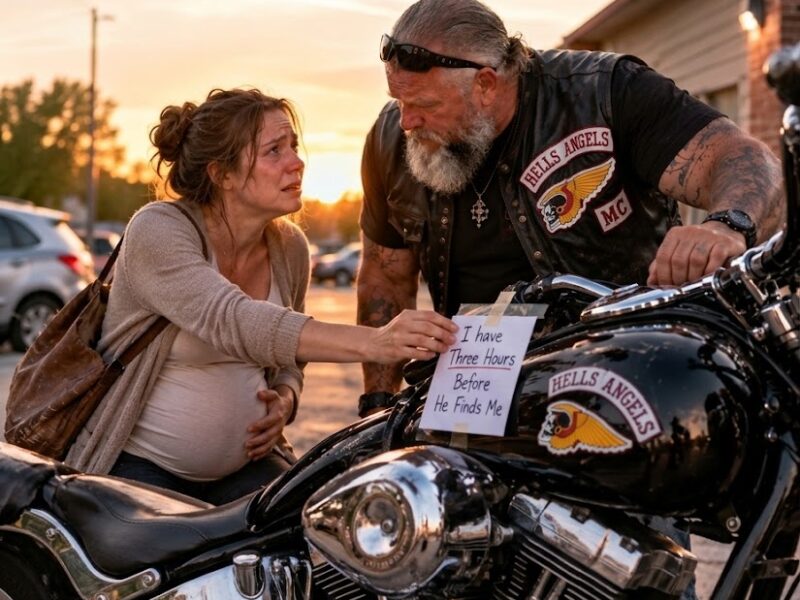
A pregnant woman taped a note to a parked motorcycle. It said four words that made the biker’s blood run cold: “I have three hours.”
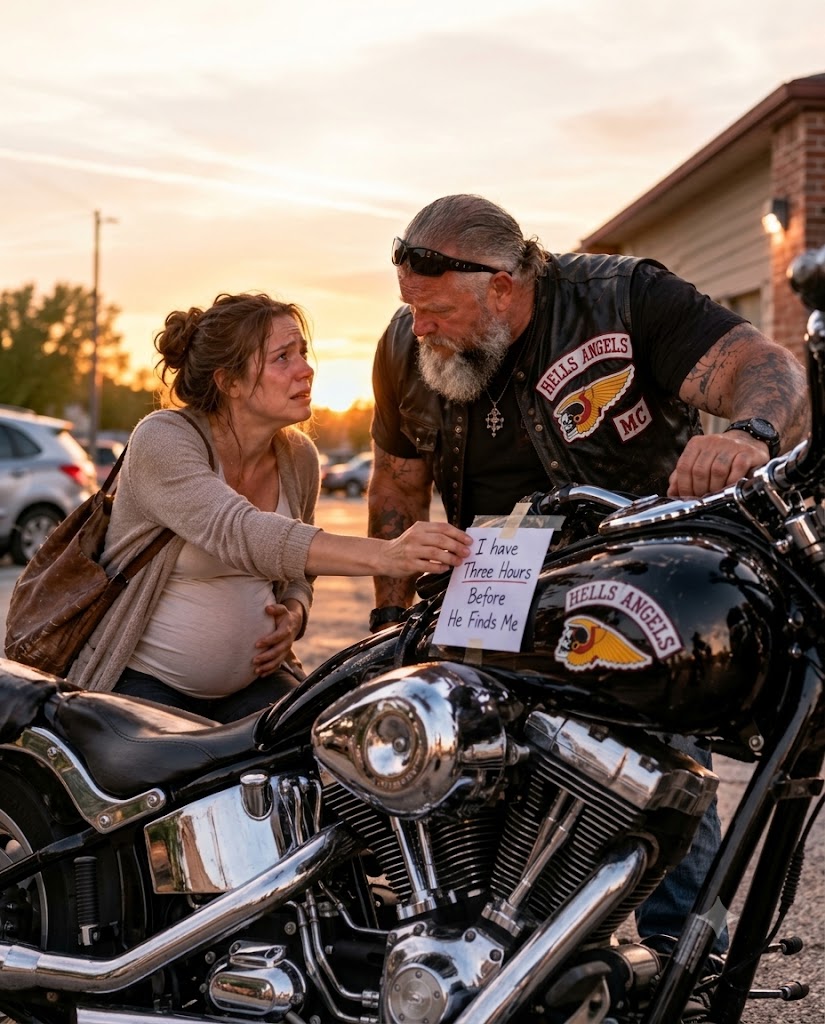
The note was still in Daniel Mercer’s hand when he understood what it meant. Three hours—that was all she had, and the clock was already running.
Across the street, a pregnant woman in a gray coat stood in a bus shelter, one hand pressed against her belly, the other gripping a backpack like the last solid thing in the world.
A silver car rolled past, and her whole body went rigid. She didn’t look at the car. She looked at him.
If he walked away, no one would ever know.
He had walked away once before, and he still heard the volume knob turning.
Somewhere in Columbus, Ohio, a man was watching the clock too, smiling.
The wind coming off the Olentangy River had teeth that Thursday, and Daniel Mercer had his earbuds in, the way he almost always did. It was how he preferred to move through the world—close enough to the city to deliver its bicycle parts, far enough from it that nothing in it could ask him for anything.
He was thirty-four years old and had worked at Gentry Cycle Works for nine years. Walt Gentry, the sixty-seven-year-old owner, sent him out three days a week on the shop’s cargo bike carrying derailleurs, brake cables, and wheel sets to customers across Columbus.
It was honest work. It kept his hands calloused and his days predictable, and it asked nothing of him except that he show up on time.
At ten minutes after one, he leaned the bike against a lamppost outside Clover Street Coffee on North High Street in the Short North, a paper sack of rear hubs strapped into the front box. The sky was the color of dishwater. Orange leaves skittered along the curb.
He locked the frame, went inside for a black coffee and a few minutes of heat, and stood by the window scrolling through nothing.
When he came out eight minutes later, there was a square of yellow paper taped to his left handlebar, snapping in the wind.
His first thought was a parking complaint, which was absurd because nobody ticketed bicycles. His second was an advertisement for a gym. He peeled it off and almost crumpled it before he saw the handwriting.
It was small and pressed hard into the paper, the letters leaning forward like the writer had been walking into a gale. He read it standing on the sidewalk with the coffee going cold in his other hand.
*To whoever owns this bike, I’m sorry to put this on you. I saw the name on your box, Gentry Cycle Works. We fix what’s broken. I don’t know you, and I know how this sounds. I’m eight months pregnant and I have three hours before he finds me. Please don’t post this anywhere and please don’t call the police yet. If you can’t help, throw this away and forget you saw it. If you can, I’m in the bus shelter across the street, gray coat. —C.*
Daniel read it twice. Then he did what he had trained himself to do for years. He looked around for someone else to handle it.
A man in a puffy vest was walking a beagle. Two college kids argued about a playlist. Nobody was looking at him. Nobody was going to take this off his hands.
The paper felt heavier than it should have, the way a wrench does when you already know the bolt is going to be stuck.
He knew exactly why his chest had tightened. Two winters ago, in the apartment he used to rent on the East Side, the couple next door had fought most Saturday nights. He had heard a man’s voice, low and even, and a woman’s voice that got smaller every week.
Each time, Daniel had turned up the television. It was none of his business, he told himself. People couldn’t be rescued by someone who didn’t know the whole story.
Then one Saturday, the voices stopped, and a week later, there was a rental sign in the window. He never learned whether she had gotten out or whether something worse had happened. He only knew that he’d had a volume knob, and he had used it.
Daniel looked up and across High Street. The bus shelter on the far corner had one panel of cracked glass covered by a faded transit ad. Inside it stood a woman in a long gray coat, a navy backpack at her feet, one hand spread across the curve of her belly.
She wasn’t waving. She wasn’t doing anything. She was just watching him, the way you watch a door you aren’t sure will open.
He waited for a break in traffic and crossed. He had no idea what he was going to say. His boots sounded loud on the pavement.
Up close, she looked younger than he expected—maybe thirty, with dark blonde hair pulled into a ponytail, green eyes rimmed red, and skin so pale that the faint yellow shadow along her jaw stood out like a smudge of old paint.
“You read it,” she said. It wasn’t a question. Her voice was steady in the way a glass of water is steady when you’re carrying it too carefully.
“I read it.” He held up the yellow paper, feeling stupid. “I’m Daniel.”
“Caroline.” She glanced at his bike across the street, then at the traffic, then back at him. “Please tell me you’re not going to ask if I’m okay.”
“I wasn’t going to.” The truth was, he hadn’t gotten that far. “I was going to ask what you need.”
Something in her face loosened just slightly, like a knot being tested. Her mouth opened to answer, then her eyes went past his shoulder to a silver sedan crawling down High Street, and all the color drained out of her face.
“Get down,” Caroline whispered.
Before Daniel understood what she meant, she had hooked two fingers into his sleeve and pulled him into the shelter’s narrow shadow. The silver sedan slid past with a dented rear fender and a campus parking sticker. The driver was a kid in a hooded sweatshirt thumbing his phone at the red light, looking at nothing.
Caroline let out a breath so long it trembled. “Not him,” she said. “It’s never him when I’m watching for it. It’s him when I’m not.”
Daniel checked his phone. 1:31. “How long have you been out here?”
“Since 12:40. I took the bus down from Clintonville.” She said it like a report. “I have a backpack, one hundred and ten dollars I skimmed out of grocery money over four months, and a phone I left on the kitchen counter on purpose. He tracks it. As long as it sits there, he thinks I’m in the house. He’s at work until 3:30 on Thursdays and home by 4:00.”
Her hand tightened on the strap. “But sometimes he leaves early without telling me, just to check. That’s the three hours.”
Daniel nodded slowly. It was strange standing in a bus shelter with a pregnant stranger doing arithmetic about a man he had never met.
“Why not the police?” he asked, keeping his voice low. “I’m not saying no. I just want to understand.”
“I called them in March,” Caroline said. “Two officers came. Garrett answered the door in his work shirt and offered them coffee. He told them I’d been emotional since the pregnancy, that he was worried sick, that he’d do anything to help. He was so reasonable. I didn’t have a mark on me that day, and he knew it.”
She touched the faint shadow along her jaw lightly, as if it belonged to someone else. “After they left, he wasn’t angry. That was the worst part. He was calm. He made me tea.”
She exhaled. “I’m not saying they’re all like that. I’m saying I need to be somewhere he can’t talk his way in before someone who knows what they’re looking at has seen me. An advocate, a shelter, somebody who does this every day. There was a card on the back of the bathroom door at my doctor’s office. I memorized the number. I just can’t call from home because he reads the phone bill.”
“Then we call from here,” Daniel said, and pulled out his phone.
“Wait.” Her eyes went to the screen. “What if he can see it’s my phone?”
“He doesn’t know I exist,” he said. He tried to smile. It felt rusty.
The woman who answered the hotline gave her name as Joanne Reeves, and she had the kind of voice that made things seem slightly smaller than they were. She asked Caroline three quick questions—whether she was safe at this moment, whether she was hurt, whether she had a public place to wait.
Caroline answered each in a whisper with her eyes on the street. Joanne said a bed could be arranged at a confidential shelter, but intake had to happen in person, and her driver couldn’t reach them until 4:00.
“Don’t wait outside,” Joanne said. “Don’t go to anyone’s home. Find a place with walls, staff, and plenty of other people. Somewhere he’d have to make a scene to get through.”
Daniel looked at the gray street and realized there was only one place he trusted enough. “Foster’s,” he said. “It’s four blocks. Can you walk?”
Caroline studied him for a long moment, as if memorizing what a person looked like when he said yes. Then she picked up her backpack. “I can walk.”
They moved slowly, Daniel wheeling the cargo bike on the street side of her like a shield. At the corner, he steered it into the alley behind Foster’s Table and pulled a tarp out of the front box, draping it over the logo—Gentry Cycle Works. If Caroline had read it, someone else could too.
Foster’s Table was a narrow diner wedged between a bakery and a tattoo studio, with red vinyl booths, a pie case, and a smell of coffee and fried onions that Daniel associated with every good Tuesday of his adult life.
Marlene Foster stood behind the counter—fifty-eight years old, reading glasses on a beaded chain, forearms like a baker’s. She looked at Daniel’s face, then at the woman beside him, then at the belly, then at the shadow on the jaw, and she didn’t ask a single question.
Daniel handed her the yellow note. Marlene read it once, folded it in half, and slid it into her apron pocket like a receipt. “Back office,” she said. “Corey, lock the back door. Hollis, watch the counter.”
“I don’t want to bring this to your door,” Caroline began.
“You didn’t bring it, honey. I opened it.” Marlene steered her down the narrow hall past the kitchen. “Sit. You’re eating something. Nobody gets through that door without going through me.”
The office was a closet with a desk, a space heater, and a corkboard papered with decades of staff photographs. Caroline lowered herself into the chair, and for the first time since the shelter, her shoulders dropped. Her hands began to shake now that there was finally somewhere for the shaking to go.
Within five minutes, Marlene had a plate of scrambled eggs and toast on the desk and a woman in blue scrubs in the doorway. Tessa Boone, forty-one, an emergency room nurse who ate lunch at booth four every Thursday, took one look at Caroline and set her bag on the floor.
“I’m just going to take your blood pressure,” she said gently. “That’s all. You tell me when to stop.”
At 2:52, Daniel’s phone buzzed. Walt.
He stepped into the hallway. “Kid,” Walt said, and there was something stiff under his voice, like a bolt rusted in place. “Fella just left the shop. Gray Audi, good suit. Polite as a deacon. Said his name was Whitlock. Had a photo of a pregnant gal on his phone. Said she was unwell and missing and he was scared out of his mind.”
A pause. “He knew about the cargo bike, Daniel. Said a barista on High Street saw a woman talk to one of my riders.”
Daniel’s stomach dropped. He had forgotten the barista. “What did you tell him?”
“That I’d ask around. He thanked me twice, shook my hand. Best manners I’ve seen in ten years, and my skin crawled the whole time.”
Daniel turned. Caroline stood in the office doorway, one hand on the frame, the other beneath her belly. She had heard enough.
“It’s not even three,” she said.
“He’s not going to wait until four,” Daniel answered.
“One fifty-two over ninety-eight,” Tessa said, unwrapping the cuff. “That’s higher than I like. You’re dehydrated, and your belly’s been tightening, hasn’t it?”
Caroline nodded. She was sitting again because Marlene had physically pressed her back into the chair.
“Probably Braxton Hicks—practice contractions, and stress will do that—but I want you drinking water and keeping your feet up.” Tessa hesitated. Her eyes rested on the sleeve of Caroline’s sweater, where the fabric had ridden up past the wrist. “Caroline, may I look at your arm? You can say no.”
For a moment, no one breathed. Then Caroline pushed the sleeve up. Above the elbow were four faint oval marks, yellow-green, a little older than the shadow on her jaw, arranged like the print of a hand.
“I’d like to photograph that with the date and time on it,” Tessa said quietly. “Not because you have to do anything with it—because if you ever want a record, it exists, and it’s yours.”
Caroline looked at the marks for a long time. “Okay,” she said.
Tessa took the photographs with her own phone and handed it over so Caroline could see them. Her jaw was set the way Daniel had seen men set theirs when they were holding back something much larger.
Caroline stood up. It took her two tries. “I have to go.”
“You have to sit,” Marlene said.
“He found Walt’s shop in under two hours. He’ll find this place by 3:30. I’m bringing him to your door, to your employees, to a boy who just wanted a job.” Her voice cracked. “I made a mistake coming here. I’ll walk back to the bus. I’ll tell him I got confused. He’ll forgive me. He always does.”
“Caroline.” Daniel hadn’t known he was going to speak until he heard himself. “Can I tell you something?”
She waited.
“Two years ago, I lived next to a couple. I could hear him through the wall most Saturday nights. Every time, I turned up the TV.” He rubbed his thumb over the callus on his palm. “One day, the voices stopped, and I never found out what happened. I’ve been wearing headphones ever since. So when I say this, I’m not being brave. I’m being selfish. I’d rather be loud this time. You’re not bringing anything to anyone. You gave us a chance to turn the volume down.”
Nobody said anything. Marlene took off her reading glasses and cleaned them on her apron, which Daniel understood was how she cried.
“Sit,” Marlene said again, more softly. “My place, my rules, and the rule is you eat.”
Caroline sat.
From the front of the diner came the clear, bright jingle of the door. Marlene was already moving. “Corey,” she called down the hall, her voice perfectly pleasant. “Wipe the pictures on the counter, please.”
Daniel eased the office door nearly closed and put his eye to the gap. Through the pass-through window beside the kitchen, he could see the whole dining room.
The man at the counter was about forty, tall, in a navy suit with a silver-blue tie, a touch of gray at his temples, a wedding ring. He had the open, tired face of a man who coached Little League on weekends. And when he spoke, the diner seemed to lean toward him.
“Ma’am, I’m sorry to bother you at your busiest.” Garrett Whitlock held out his phone. “My wife’s name is Caroline. She’s eight months pregnant and she’s been struggling. She stopped taking her medication two weeks ago, and this morning she just left. No car, no phone.” His voice thickened. “I’m out of my mind. If you’ve seen her, I only want her safe.”
On the screen was a wedding photograph. Caroline looked radiant in it, and Daniel’s stomach turned because he understood that this too was part of the trap. The photograph was real.
“Oh, that poor man,” murmured a woman in booth two.
A grandfatherly voice spoke up from the counter. “Gray coat, you said? Blonde ponytail?”
Hollis Abbott, seventy-four, a retired city bus driver who had eaten the same slice of pie at Foster’s for twenty years, scratched his chin. “I think I saw a girl like that walk by around 1:30.”
Garrett’s head turned, slow and precise, like a compass finding north.
“Hollis,” Marlene said brightly, topping off his coffee. “You saw a pregnant girl walk by the bakery. Half of Columbus is pregnant this year. Honey, he’s scared. Let the man ask his questions.”
A few people chuckled. Hollis blinked at her, then at the coffee, then very slowly back at Marlene’s face. “Right,” he said. “Bakery.”
“Couldn’t tell you what color her coat was.”
Garrett smiled. It didn’t move. “Mind if I use your restroom?”
“Out of order,” Marlene said. “Water main. Plumber’s coming.”
He nodded as though that were reasonable. He set a business card on the counter, squaring its edges with one finger. “My cell’s on the back, day or night. She may be confused. Please, if she comes in, don’t frighten her.”
Then he thanked everyone in the room one by one and walked out.
In the office, Caroline hadn’t moved. Tessa was holding her hand.
“He’s doing the voice,” Caroline whispered. “That’s the one he uses when he’s already won.”
Daniel’s phone buzzed. Joanne Reeves—a crash on I-71, the driver stuck, now 4:30 at the earliest. He relayed it with his eyes on the window. Across the street, a gray Audi was parked at the curb with its engine running, and the driver wasn’t leaving.
Then, as Daniel watched, the door opened and Garrett stepped out onto the sidewalk and turned not toward the car, but toward the alley.
Daniel was out the back door before he finished thinking it. The alley was narrow and damp, lined with dumpsters and a tangle of milk crates. At the far end, Garrett Whitlock stood over the cargo bike with one gloved hand lifting a corner of the tarp. The yellow letters on the box caught the light. *Gentry Cycle Works.*
“There you are.” Garrett said it without turning. His voice was almost fond. “I had a feeling about the bike.” He let the tarp fall. “You’re the one she talked to. Daniel, is it? The barista described you very well.”
“This is private property,” Daniel said. His heart was hammering, but his voice came out level, which surprised him.
“I’m sure it is.” Garrett smiled. Up close, the smile was somehow worse—warm, patient, exact. “Look, I understand what this looks like. A frightened woman, a man with a story. You think you’re doing a kind thing, but my wife is sick and she’s carrying my child and you’ve taken her somewhere without her doctors. If something happens to that baby, that’s on you. Think about that.”
He walked toward the back door as if he’d been invited. Daniel stepped into his path, and Garrett’s eyes flicked down to the width of his shoulders and back up, calculating. Then he turned on his heel and went around the building toward the front.
Daniel ran.
When he burst through the kitchen, Garrett was already inside the dining room, walking straight toward the hallway. Marlene stood in front of it with a pie knife in one hand, and her voice had changed completely. “Staff only, sir. Turn around.”
“Ma’am, please.” He kept walking.
“I’m going to ask you one more time.”
“And I’m going to tell you one more time—no.”
Hollis Abbott was on his feet. So were two men in reflective work vests from booth six and a young mother with a toddler on her hip. Nobody spoke. They simply stood the way people do when they’ve decided something without discussing it.
Garrett looked at them, one face after another. For the first time, he seemed to calculate and not like the numbers. Then he stepped sideways, put a hand on Marlene’s shoulder, and moved her aside as if she weighed nothing.
Daniel was in the hallway before the door of the office opened. Caroline stood in the doorway with Tessa beside her—upright, shaking, one hand gripping the frame.
“There you are, sweetheart,” Garrett said in the soft voice. “You gave me such a scare.”
“I’m not going home, Garrett.”
The room went quiet. Even the kitchen fans seemed to hold their breath.
“You’re not well.” He reached for her. “Come on, we’ll talk in the car.”
“I said no.”
His hand closed around her upper arm, precisely over the four faint marks, and Caroline cried out.
“Let go of her,” Tessa said.
“Hands off,” Daniel said, and caught Garrett’s wrist.
Garrett didn’t let go. He leaned toward Caroline’s ear and spoke so softly that only the people in the hallway could hear it. And in that silence, they could hear every word.
“You think a bike boy and a waitress can keep you? You’ll be home by dinner, and you know what happens when I have to come find you.”
Nobody moved. Then, from the kitchen doorway behind them, came a small, careful sound. The digital chirp of a phone ending a recording.
Seventeen-year-old Corey Dalton stood with his phone held high in a white-knuckled hand, his face the color of paper.
“I got that,” Corey said. His voice cracked on the second word. “I got all of it.”
Garrett’s face did something Daniel would remember for a long time. It wasn’t rage. It was the smooth surface of a lake shifting slightly as something large turned underneath. Then the smile slid back into place, and he released Caroline’s arm.
“She’s confused,” he said to the hallway. “You all see that she’s confused.”
“I see what I see,” said Hollis Abbott.
Outside, a single short chirp of a siren. Marlene had made her call at 3:12—a quiet one with her back to the dining room—and the dispatcher had said it would be a few minutes. It had taken twenty.
The door jingled, and two uniformed officers came in with the cool, watchful quiet of people who had walked into a lot of rooms like this one. The older of the two, a broad-shouldered man with a gray mustache, had Nolan Pierce on his name tag.
“Officers, thank goodness.” Garrett turned, hands open, the Little League coach again. “My wife is unwell. She’s eight months pregnant and off her medication. I’m terrified for her.”
“Sir, I’m going to ask you to step over here.” Officer Pierce’s eyes went from Garrett to Caroline and stayed there. “Ma’am.”
Caroline looked at the room. At Marlene with the pie knife still in her hand, at Hollis and the work vest men and the mother with her toddler, at Tessa’s steady face and Corey’s trembling phone, at Daniel, who had wrapped his arms around nothing, just standing close.
In March, nobody had been standing in the room.
“Please,” Caroline said. “I’m asking you to listen this time.” Her voice shook, but it carried. “My name is Caroline Hayes. I’m not ill. I’m afraid of my husband. He grabbed my arm just now, and there are marks on it that were there before today, and a nurse photographed them an hour ago.”
“I’m Tessa Boone, RN,” Tessa said. “I documented them with her consent. Four distinct bruises, different stages of healing.”
“He shoved me out of the way,” Marlene said.
“I heard what he told her,” Hollis said. “And I’ll say it in any courtroom in Ohio.”
“I recorded it,” Corey whispered. “It’s on my phone. Do you want it?”
Officer Pierce listened to the recording with his head bowed. When it ended, he looked at Garrett for a long moment, and the room watched the kindness leave his face like a tide going out.
“Mr. Whitlock,” he said, “I’m going to need you to turn around.”
“This is absurd. I’m an insurance director. You can’t possibly—”
“Turn around, please.”
The handcuffs made a small, ordinary sound.
As Garrett passed Daniel in the hallway, he spoke without any music in his voice at all. “You have no idea what you’ve done.”
“I have a pretty good idea,” Daniel said.
Caroline didn’t collapse until the police cruiser pulled away. Then her knees simply gave out, and Daniel and Tessa caught her at the same moment and lowered her into the nearest booth.
“I’m okay,” she kept saying. “I’m okay. I’m okay.”
“You’re okay,” Tessa agreed. “And you’re going to the hospital anyway.”
At 4:40, Joanne Reeves’s driver finally pulled up behind Foster’s Table—a quiet woman named Pam in a minivan—and Tessa rode with them to the emergency department where she worked. The contractions stopped within the hour. A monitor traced a heartbeat, fast and furious and entirely healthy, and the obstetrician on call declared the baby stubborn and well.
Daniel hadn’t planned to follow, but when he stepped out of the diner at 5:00, Walt Gentry was sitting at the curb in his old pickup with the engine running.
“Figured you’d want a ride,” Walt said. “Figured you’d say you didn’t.”
They sat in the emergency room waiting area for four hours. Marlene came, still in her apron, with a paper sack of pie. Hollis came because he said he’d driven a bus for thirty-one years and wasn’t about to leave anyone at a stop. Corey came, wearing his school hoodie and holding his phone as though it might go off. Nobody said much.
The earbuds in Daniel’s pocket stayed in his pocket.
A little after nine, Joanne Reeves came through the double doors. She was a small woman with silver braids, exactly as tall as her voice.
“She’s asking for you,” she told the room. And then, looking around at the strangers on the molded chairs, she smiled for the first time. “All of you, apparently.”
Caroline was propped up in a hospital bed in a blue gown with an IV in her wrist and color in her face. She looked at the little crowd in the doorway and her eyes filled.
“You stayed,” she said.
“We did,” said Marlene.
“I put a piece of paper on a bike,” Caroline said. “It was the most frightened I’ve ever been in my life. I thought maybe one person might help.”
“You got a few more than one,” Walt said gruffly.
Joanne’s shelter took her in that night, an address that would never appear in this story. Over the following days, a steady line of people did unglamorous things. An advocate named Joanne sat with Caroline for six hours and explained every option in plain words. A prosecutor reviewed Corey’s recording, Tessa’s photographs, and four witness statements. Garrett Whitlock was charged and released on bond with strict conditions.
And the following week, in a courtroom at the Franklin County Courthouse, a judge granted Caroline a civil protection order. Caroline sat beside Joanne in a borrowed blazer. She didn’t look at Garrett once. She looked at the judge, and her voice did not shake.
Her mother, Ruth Hayes, drove down from Toledo the same afternoon—white-knuckled, red-eyed, and furious at everything, including herself. For two years, Garrett had made calls impossible and visits awkward, always with a smile.
“I should have come anyway,” Ruth said into her daughter’s hair. “I should have broken down the door.”
Caroline held her and said, “You’re here now.”
Six weeks later, at 4:12 on a snowy December morning, Willa Ruth Hayes was born at seven pounds, one ounce, with a fierce cry and a fist of dark blonde hair. Tessa, who was not even on shift, had come in anyway and stood in the corner of the delivery room wiping her eyes.
Daniel didn’t go to the hospital that day. He wasn’t sure he had the right. But on a Thursday in January, Caroline asked him to meet her at Foster’s Table.
He found her in booth four with a car seat on the bench beside her, Marlene hovering with a coffee pot, Walt eating pie like he’d never been refused it, Hollis telling a story, Corey refilling water glasses with ostentatious professionalism.
“This is Willa,” Caroline said, and held out the bundle.
Daniel had not held a baby since he was nineteen. He took her as if she were made of glass and bicycle spokes, and Willa, deeply unimpressed, yawned.
“She hates headphones,” Caroline said gravely. “I looked it up.”
Daniel laughed, a real one, the kind that surprised him. “I stopped wearing them,” he said. “Mostly.”
Something had changed in him over those weeks, and not in a way he could have explained. Walt had turned the back room of Gentry Cycle Works into a weekly clinic where women from Joanne’s shelter could learn to fix donated bikes, wheels being a kind of freedom you could carry. Daniel ran it on Thursdays. He taught people how to true a wheel and how to patch a tube.
And every Thursday, somebody would look up from the stand with a grease-streaked grin and say, “I did that.” It was the closest thing to church he’d ever felt, and he hadn’t said so to anyone.
When he walked out of Foster’s that afternoon, the cargo bike was waiting at the lamppost where he had left it. Taped to the left handlebar was a square of yellow paper snapping in the wind.
His heart stuttered just once. Then he recognized the handwriting—small and pressed hard, leaning forward—and he read it standing on the sidewalk in the thin winter light.
*To the person who owns this bike, three hours was all I thought I had. It turned out I had all of you. Thank you for reading the note. —C.*
He didn’t crumple it. He folded it carefully and tucked it into his wallet beside the first one that Marlene had given back to him, and he stood for a moment on High Street listening to the whole loud, ordinary city around him.
It wasn’t rescuing, he had learned. Nobody had saved anyone. A woman had been brave enough to ask, and a handful of strangers had been willing to turn down the volume and hear her.
That was all it took. It had always been all it took.
He unlocked the bike, pushed off from the curb, and rode on with his ears wide open.









